Showing posts with label Salvador Dalí. Show all posts

Monday, 14 July 2014

Modern art in its pomp, I do like

Les Quatre Races, Ozenfant
Another day, another gallery. Okay, that’s a slight exaggeration, since we took a day off on the Thursday, heading for the Jardin des Plantes to amble among flower beds and the menagerie (I saw a baby vulture!), enjoy a decent lunch and, frankly, get absolutely toasted in the glorious sunshine.

But with rain promised for the Friday, we had planned for the Pompidou, which was a mere 10 minutes away on foot from the garret.

There was no need to fret about queues: a relatively short one disappeared quickly within minutes of the centre opening its doors at 11am, while we sat opposite supping coffees at a café.

Europe, de la Serna
On our previous visit, we’d seen an exhibition on architect Richard Rodgers, who had co-designed the Pompidou itself, and had also taken in some of the most modern exhibits.

Now to be quite frank, I have little memory of what we saw of the latter – other than a Jackson Pollock – because my feet were in the process of murdering me.

So this time, I was determined to see the key collection covering the 70 years of the 20th century.

Thus we headed to the top of the building to find ourselves at the start of a walk into artistic modernity.

It begins with two works by artists previously unknown to me.

First, straight ahead as you enter, is Les Quatre Races, a vast piece by Amédée Ozenfant from 1928, which uses highly simplified human forms and interesting, architectural textures to create an optimistic view of a post-WWI future.

Girl With a Black Cat, Matisse
The architectural aspect is not surprising when you read that Ozenfant was, with Le Corbusier, a co-founder of the Purist movement.

However, we then find Ismaël de la Serna’s Europe – painted in around 1935, as Spain was on the cusp of the civil war – and this is something altogether less hopeful: a view of a continent being handed, once again, to death.

It’s a disturbing canvas, brilliantly executed.

Beyond that, one of the next things to see was a Matisse canvas – Girl With a Black Cat (1910), which was posed by his daughter, Marguerite, and had been in a private collection until last year.

And through a door next to it was an entire room – albeit a small one – full of nothing but works by Matisse, including Portrait of Auguste Pellerin II (1916-17) and Portrait de Greta Prozor (1916).

Femme nue couché, Picasso
Beyond that was a larger room, hung on one long wall with a couple of dozen paintings, like the rooms of early 20th-century Parisian collectors such as the Steins.

High up were a couple of works by artists who were very clearly trying to emulate Matisse and, in effect, reproduce the likes of Luxe, Calme et Volupté and others.

The colours merely managed to look garish – providing an excellent illustration of just how good Matisse really was.

We avoided the one tour party that was breezing through and then enjoyed another Matisse.

Still Life With Arums & Mirror, de Lempicka
Luxe I, which was painted in 1907, provided an opportunity to appreciate what I’d learned when reading Hilary Spurling’s excellent Matisse biography.

In this case, the hills in the background are those marking the south of Collioure, while it was painted in the hills above the village, beyond the railway line, because the rather religious inhabitants would not have been impressed by nude models.

Moving through initial rooms, the art gradually abstracted, while The Other Half got vaguely excited by a replica of the Tatlin Tower.

And since the museum was so generally quiet, it was with great pleasure that we able to sit down and contemplate Picasso’s Femme nue couchée (1936) without interruption for some time.

Perhaps I’m wrong or simply linking the blue of the Blue Period rather too greatly with Picasso’s entire oeuvre, but the green background seemed to lend the work a very different tone to many of those I’ve seen.

The Journalist Sylvia von Harden, Dix
Since you cannot go wrong with a spot of Art Deco, I also enjoyed seeing works by Tamara de Lempicka, and while the portrait style might be familiar, It was nice to see Still Life with Arums and Mirror (1938), which showed the style in a less-familiar way.


We also found Otto Dix’s iconic and absolutely wonderful Portrait of the Journalist Sylvia von Harden from 1926, which seems to so utterly represent the Weimar period that it’s no surprise that it was recreated fleetingly in the opening titles of the 1972 film of Cabaret.

Henry Valensi’s Symphonie verte from 1935 and Symphonie vitale from 1952 are both non-figurative canvases that I took to instantly, simply because he makes the colours work so well.

These were works that further increase the question in my own mind of just what constitutes ‘art’, and I see no reason why decorative works are not, in some minds, considered as highly as figurative.

Symphonie Verte, Valensi
We found a Max Beckmann – an artist we’d first really encountered at a Tate Modern exhibition some years ago – and Édouard Pignon, whose paintings wed discovered at the Museum of Modern Art in Collioure, just last summer.

If there was a disappointment, it was that we didn't see any of the Centre’s works by Léopold Survage – but you can't have everything.

In another gallery, we came across an industrial scene by Bernard Boutet de Monvel (1881-1949), a French fashion illustrator and society portraitist.

View of Pont-Aven, de Monvel
His View of Pont-Aven (1928) is hardly an obvious fit with that sort of portfolio, but it is a striking image that made me think of Metropolis. It has an interesting perspective and use of angles that creates movement in an apparently deserted – dehumanised – industrial landscape.

In the same room were two canvases by Alexandre Hogue (1898-1994), an American painter whose work focused particularly on landscapes during the Dust Bowl, with an ecological message at its core.

Drought Survivors from 1936 has a naive style that completely belies its theme, with signs of man-made life dead or rusting as the man-made ecological disaster rolls in.

Petrol in the Dunes (1944) may not have the same immediately haunting impact, but it’s still a striking and impressive work with the same underlying ethos.

Drought Survivors, Hogue
The entire floor has been recast in recent years under a heading of ‘multiple modernities’, which seeks to explore modern art from across the world and also by there: there is, for instance, a room dedicated to anti-fascist art.


Tarsila do Amaral – usually known simply as Tarsila – is considered one of the most important figures in Brazilian art.

Her A cuca (1924) is another deceptively naïve work, but stays in the mind – and is certainly shown off particularly well in a snakeskin frame that was made especially for it at the time.

A cuca, Tarsila
The way in which the works have been organised does create surprises.

It was more than a tad unexpected to round one corner and find yet another Matisse – this time, Decorative Figure on an Ornamental Background (1925-26), which presented an opportunity to look at how the artist incorporated his love of decorative fabrics into his own works.


Brought up in a weaving area of northern France, Matisse later collected and carried around with him snippets of fabric that he had spotted and liked.

The final corridor, which takes you back to where you started, brings with it several pleasures – not least, Picasso’s Woman in a Turkish Turban (1955) and Giorgio di Chirico’s Il Ritornante (1918), which has all the typical strangeness of that painter’s metaphysical works.

Il Ritornante, de Chirico
Unfortunately, the light from the windows makes it difficult to really see one of Dalí’s myriad masturbation paintings. Perhaps that was a deliberate little joke on the subject matter?

And to finish, a pair of Chagall’s, one of which, Double Portrait with a Glass of Wine (1918) showed him ‘riding’ on the shoulders of his wife as way of showing how she made him feel.

We were delighted to be able to ‘get’ it without looking at the labels, on the basis of what we’d discovered at last year’s Liverpool Tate exhibition.

The Pompidou serves up a wonderful walk through the first 70 years of the 20th century – and three hours had been whiled away so easily and pleasantly.

And it also leaves the visitor with plenty to think about.

Portrait With a Glass of Wine, Chagall
To talk of ‘modern art’ is, really, such a dreadfully clumsy way of indiscriminately lumping together myriad different styles and approaches to myriad different subjects and questions.

That might not be what the Pompidou was attempting specifically to address with its exhibition title of ‘multiple modernities, but it is certainly one way of looking at such a wide range of artistic endeavour over almost three quarters of a century.

Picking just a handful of pictures of the works we saw to illustrate this post is evidence of the breath of ‘modern art – and that doesnt even bring us slap bang up to date.

By the time we were ready to conclude our visit, we’d not seen anywhere near all the exhibits, but I had reached a point of recognising a Rothko but feeling no great need to go and examine it in detail. 

But while a stand-alone trip is hardly problematic, a visit to the Pompidou is a perfect way to continue an exploration of the modern that began with some of the art thats on display in the Musée dOrsay, given that Manet is seen as the painter who began modern art.


Tuesday, 31 December 2013

From the metaphysical to a shiny metal box


The Melancholy of Departure
The weekend’s visit to the Tate Modern for the Paul Klee exhibition also included a wander around the rest of the gallery.

We’d planned well: arriving for around 10.30am after a pleasant walk over the Millennium Bridge on a bright, fresh winter morning.

The plan was to see the Klee first and then have lunch.

It’s worth noting that the gallery’s café is far from the most expensive eatery around and we enjoyed fish and chips – and very good battered fish it was too – with dandelion and burdock, leaving me feeling really rather Famous Fiveish.

And we were lucky enough to sit by a window that gave us a wonderful view beyond bare but lithe silver birches, over the river and to the dome of St Paul’s in the brittle December sunlight.

It’s a vast gallery and you’re never going to seriously see it all in
Spanish Landscape with Mountains
one go, but I’d done my homework and picked two of the permanent collections to look at.

Once fed and refreshed, first up was the Poetry and Dream section, because it promised Picasso, Dalí and de Chirico.

Only recently had I put the latter’s name to paintings we were shown during A’ level art: I remembered the perspective of his metaphysical pictures and this was the first chance to actually see any.

Metamorphosis of Narcissus
The Uncertainty of the Poet (1913), at the entrance to this part of the collection, was crowded. It was easier to view The Melancholy of Departure (1916) later in the displays, although being hung high up doesn’t give you much chance to really look at the brushwork, for instance.

Fortunately, Dalí’s Metamorphosis of Narcissus (1937) was better positioned.

I’d not seen any Dalí in ‘the flesh’ before: this is one of his iconic images and is technically stunning – painted before he got so full of himself that he ceased to be bothered with anything beyond promotion of himself as his main work.

Head of a Woman (Fernande)
Autumnal Cannibalism (1936) and Mountain Lake (1938), although less well known and less vibrantly colourful, are also fascinating canvases.

There was no shortage of Picasso here: including Weeping Woman from 1937 and The Three Dancers from 1925, for which Will Gompertz provides an excellent description in What Are You Looking At?

One of the smaller rooms had three Picasso nudes of varying styles, plus a small sculpture by Matisse – fascinating contrasts.

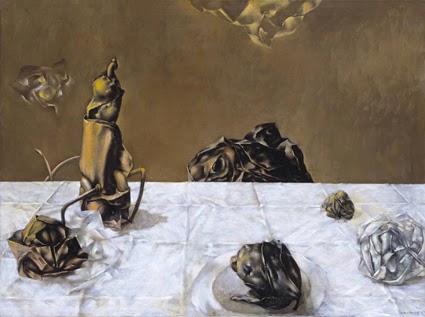
There was plenty that was entirely new to me, though: Dorothea Tanning’s work is fascinating – Some Roses and Their Phantoms (1952) is just one example that caught the eye of both of us.

Paul Nash’s Landscape from a Dream (1936-38) was an interesting companion to Landscape of the Moon’s Last Phase that I’d seen at Liverpool’s Walker Gallery last month.

Self-Portrait
And then there was Max Ernst. I knew the name, but Celebes (1921) and Forest and Dove (1927) are wonderful examples of the fantastical – the latter again reminding the viewer of the place of the forest in German culture.

We’d been lucky with the Klee exhibition not being very busy, but these galleries were rammed.

Other paintings of particular interest included Christian Schad’s Self-Portrait from 1927, which has an Otto Dix-like woman in the background, while the face and expression reminded me very much of those by Albert Aereboe that I’d seen in the Museum Behnhaus Drägerhaus in Lübeck in April.

Dora Carrington’s Spanish Landscape with Mountains (c1924) is another painting you can get lost in, and which seems to float somewhere between the real and the imagined.

And in a similar vein, I was also taken with The Invisibles (1951) by Yves Tanguy – a painting that hovers between the abstract and some sort of alternate, sci-fi reality that you feel yourself nearly but not quite ‘seeing’.

Portrait of Greta Moll
There were works by Duchamps, some Giacometti, some Man Ray, some Miró and some Joseph Beuys too – and again, the Gompertz book helped when looking at some of these, even if they were not always things that excited me the most.

But it was with real delight that we walked into one room to see Portrait of Greta Moll (1908) by Matisse – so that’s why it’s not on display in the National Gallery; its on loan at the South Bank!

With some energy left, we pottered up to Structure and Clarity on the fourth floor, which was nowhere near as heavily populated – possibly because this was where things got rather less figurative and much more ‘modern’
in the way that some people mean when theyre not being very complimentary.

I wanted to see the Cubist works – not least, those by Georges Braque, simply because I’d not seen any by him in the ‘flesh’. They dont bowl me over, even though I understand what the Cubists were trying to do, but it was good to actually see some.

Composition C (NoIII) with Red, Yellow and Blue
At this point there was also more works by Picasso, illustrating yet again his incredible range of styles.

The sculpture, Head of a Woman (Fernande), 1909, particularly caught the eye.

The gallery also offers the chance to see some Piet Mondrian, including Composition C (No III) with Red, Yellow and Blue (1935), and Kandinsky’s Swinging (1925).

Like the Klee earlier in the day, the Mondrain had layers to it, as the artist himself had mounted and framed his work, often giving it a sort of added depth in the choice of mounting.

Gompertz argues that however simple you might consider Mondrain’s iconic geometric paintings, they have a great democracy about them – they appear on all sorts of everyday objects, from bags to phone covers. Its art for everyone and for every day, as promoted by Bauhaus and back to William Morris.

Pierced Hemisphere II
In the same area of the gallery was to be seen Dan Flavin’s ‘Monument’ for V Tatlin’ – which was one a series of four neon installations with the same name, and which date from 1966-69.

We were getting seriously into the realms of the minimal, which is where I’d point out that
Gerhard Richter’s comment on Grey (1974), that the subject of his painting “is the epitome of non-statement” ... “it does not trigger off feelings or associations, it is actually neither visible nor invisible ... Like no other colour it is suitable for illustrating ‘nothing’,” did take me well beyond Gompertz levels of understanding and into the terrain of ‘what pretentious twaddle’.

On the other hand – and thanks in part to Gompertz who discusses it in his book – I actually liked Donald Judd’s untitled open metal box from 1972 – although the line around it that marks the perimeter over which you’re not supposed to step does not take into account short arses like me.

Study for Homage to the Square
The texture and the colour of it, however, are warming and pleasant, and actually seem contrary to conventional, cold minimalism of many other works.

The gallery also displays Henry Moore’s rather sensual Composition from 1932 – The Other Half gets excited over Moore because he were a Castleford lad too – and a number of works by Wakefield’s own Barbara Hepworth, including Pierced Hemisphere II (1937-38).

And going for the really abstract and the minimal, I liked the colours of Joseph Albers’s Study for Homage to the Square (1964) and the sheer simplicity of Ellsworth Kelly’s Black Square with Blue (1970).

Untitled
In fact, the more that I look and explore, the more I realise that I’m fascinated by colour in a way that is very recent – or at least the conscious interest is.

Gompertz’s book has made a huge difference to helping my somewhat more opened mind actually understand what I’m looking at – I’ve recommended it before and will happily do so again.

The visit also offered a great opportunity to – in effect – put into practice what I’d read, and try to approach very modern works from a different perspective.

Some Roses and their Phantoms
Such a visit also adds to an understanding that, contrary to what might be a popular belief, there have been plenty of quality female artists around and rather more British ones (of both sexes) than one might realise.

The former was something that struck me when visiting the Walker Gallery. It had also cropped up during the Royal Academy’s Manet exhibition in the spring, which introduced me to Berthe Morisot – and I later saw work by her in the National Gallery.

Waiting for a bus later, as dusk reclaimed London, we both looked forward to a nice cup of tea – but the effort felt like it had been well worth the effort.


Monday, 19 August 2013

History and a load more art


Royal Chateau, Collioure
In a change of mood that could almost be seen as a case of morning after the night before, Saturday morning brought a spell of sustained and heavy rain to follow the fireworks and festivities.

Having taken the opportunity for a lie in, as the rain petered out, we decided then to amble around to Boramar for … well, pretty much anything that took our fancy.

By the time we sat down at one of the cafés overlooking the village’s central beach, the weather had not simply improved – it had turned into a glorious day.

A refreshing Coke later, we took the opportunity to make our way up to the chateau.

Vauban's work at Villefranche-de-Conflent
Part palace, part fort, the latter was begun in the first years of the 13th century by the Knights Templar and integrated into the royal castle in 1345.

Added to and changed over the following centuries, after the French finally annexed Roussillon in 1659, Vauban – his age’s number one artist when it came to military engineering – took it in hand.

Marshall of France to Louis XIV, he added substantially to its structure as well as upgrading Fort Saint-Elme, which watches over Collioure and Port Vendre from a nearby hill, while Fort Miradou, which stands at the back of the village’s Mouré quarter, also bears his hallmarks.

As I’ve said before, this part of the world is peppered with fortifications – a sign of its importance over centuries of tiffs between France and Spain as they fought to gain control of Catalan country.

You can pick out Vauban’s work quite easily: the chateau had thick walls added that also make it into a star fort – a form that made it harder for canon fire to do serious damage, while also allowing defenders to lay down overlapping fields of fire.

View across Port d'Avall
And then there are the classic Vauban sentry boxes, which I swear I’d recognise anywhere, having seen them not only in Collioure, but at Villefranche-de-Conflent too.

There, Vauban not only fortified the tiny town itself, but also built Fort Libéria on the hill above it to defend this crucial area in the Pyrénées, with the rivers Têt and Cady nearby and the plain not far away.

Anyway, back to Collioure.

We’ve been around the chateau before – and even attended a concert there – but it’s well worth a ramble around in it’s own right, plus there is usually an exhibition being staged. Or in this case, two exhibitions. So all that for €4 – you simply cannot go wrong.

One was made up of photographs of Dalí, who was born not far away, over the border, at Figueres.

Sculpture, Félix Valdelièvre
Now I don’t mind a spot of Surrealism, and some of his earlier work (The Persistence of Memory, Dream Caused by the Flight of a Bee Around a Pomegranate a Second Before Awakening etc) I actively like, while it also makes me wonder how much of an influence he was on the likes of Chris Foss and other sci-fi and fantasy artists.

This exhibition provides no revelations, but it does remind you – should it be needed – that Dalí’s main work was himself, and that his was an ego that could make Picasso seem like Uriah Heap.

And this without mentioning that Dalí’s politics were, to put it mildly, highly dubious, given his admiration for Franco.

‘Stark staring bonkers,” we kept muttering. But very, very clever too.

There was one actual Dalí work there – a piece that, frankly, looked like a Rorschach test, with title and signature daubed in the corner.

We all, to a greater or lesser degree do what Dalí did: we make decisions about how to present ourselves to the world. If we choose, for instance, to follow fashion, we are making one statement. But if we choose not to follow fashion, then it’s every bit as much a statement; a deliberate attempt to convey something; to say something to the world about who we are.

Dalí took that and commoditised it – more than any other artist, his own face is iconic.

If the ability to paint the wildest imaginings influenced some artists, how much did the artist as a work of art influence others, such as Tracey Emin, who has subsequently commoditised herself and others in her own career?

Sculpture, Félix Valdelièvre
After musing over the photos, we made our way further up through the chateau, past the bakery – a tiny little room with a double ‘oven’ that is, in effect, outside the main part of the building – and to the highest points of the chateau.

From there can be enjoyed magnificent vistas. And if you want a single reason for our continuing love affair with Collioure (and there are many) look at the sea at Port d’Avall.

Photographed on an iPhone and with no adjustments to the colour, that really is what it’s like.

Having wandered around Vauban’s walls, we made our way down to the chapel, to see the other exhibition.

This was a very different affair.

Félix Valdelièvre is a sculptor from the south of France, whose first exhibition was in 1999.

The works on show here were from his Volumes selection. And the more you look at them, the more intriguing they become.

Not only are the shapes themselves interesting – and many of them appear to defy gravity – but the manner in which he achieves and uses different textures is too.

Anchovies, Au Casot style
They seem to be primarily created from pieces of stone that are then sliced and polished or roughed up, to provide some of the contrasts, with contrasting stones and metals used sparingly to offer further contrasts.

In art speak, his website explains that he “puts the asymmetry in symmetry, the elevation in the straights, while recognising a taste for contradiction”.

Well, I found myself ‘seeing’ insect cocoons, torpedoes, sci-fi creations and strange armour. As I said, very interesting.

These were firmly non-figurative, but Valdelièvre’s work also includes more figurative pieces.

You can find out more here.

Suffice it to say that art can be found in many things. And later, when were headed to my beloved Au Casot for our first evening meal out of the holiday – and our first return visit to this restaurant – there was art on a plate too.

Squid, delightfully presented – superbly cooked
After enjoying an exquisite starter of two varieties of anchovy, with hard-boiled egg, roasted red peppers and black olives (pretty much a Collioure salad), it was on to baby squid with a persillade dressing.

Now go on – tell me that doesn’t look like art? It tasted like it too, because the chef at Au Casot keeps food simple, but knows how to top-quality, regional ingredients to absolute perfection.

Oh – and the coffee ice cream and apricot sorbet (my own special combo) that I had to finish was the highest quality too.

There’s no end to the art that’s available to enjoy here in Collioure.