Monday, 30 May 2011

More lemons – and a bit of football

It was a blustery Sunday in London, somehow combining a cool wind with a sort of heavy and oppressive atmosphere.

It is also becoming a Sunday habit to pop back up Broadway Market for a few bits and pieces – not least from the London Farmers’ Market that sets up shop at London Fields Primary School.

It’s small, but there are some stalls that make it worth a visit – not least that of Bury Lane Farm, where I’ve been able to pick up asparagus that was only harvested the night before. And yesterday they also had what I was desperately looking for – fresh oregano.

These Sunday jaunts have also revealed that Percy Ingle the baker is open on a Sunday – although for some reason or other, it never has wholemeal loaves after Saturday.

Pottering back, I pick up my habitual can of V (fizz with caffeine etc – but no artificial sweeteners!) and, unless it’s raining, wander into the park behind our flats to sit on a bench, sip my drink and smoke a fag.

Which allows the opportunity to vicariously partake of a very English Sunday ritual: football in the park.

They’re a pretty organised bunch who play behind us each weekend – no jumpers for goalposts here, but ones that are extracted from bags and erected for a match, together with a marked-out pitch.

The skill level is better than you’d perhaps expect and it’s all good humoured.

Yesterday, unsurprisingly, as they set up and warmed up, the talk was of Saturday night’s match.

It’s an old saying that football is the working man’s ballet, but perhaps there has never been quite an exhibition of why as came at Wembley, from Barcelona in the Champions’ League Final.

I hadn’t really been planning to watch, but turned on just 10 minutes into the game. Thank goodness I did, because what followed was sublime: Messi and co are simply on a different planet.

Some months after the 1998 World Cup, the winners, France, came to play a friendly against England at Wembley. These were the days when I was a sports hackette and I readily grabbed the opportunity.

On a chilly February night, the French fielded a side with just two changes from the team that had won in Paris the previous summer.

It was, if memory serves, 0-0 at the break and concluded 2-0 – both goals scored by Nicolas Anelka, who hadn’t played in the final. What stands out in my mind, though, was not the score but the quality of football on display.

And I suspect that, like many others there, long before the final whistle, I had ceased to care that England were losing (the score flattered them), but had become absorbed by the quality of what I was seeing.

The Other Half – not notoriously a big football fan – joined me to watch part of Saturday’s match and marvel at what Barça were doing.

As a Manchester City fan, with the Citizens having qualified for this competition next season, it was a salutary reminder of the step up in class that any progress will require. Big gulp time. But that’s what moving forward means. And it’s a hang of a lot better than relegation.

But for the moment, let’s put that aside and concentrate again on the weekend’s food.

That oregano was wanted for a reason. With The Other Half traveling to Yorkshire and back for Rugby League yesterday, I had a choice: do I make myself something for dinner this evening and then either make him the same or something else later; do I wait until late so that we can eat together or do I find some other way around this.

The solution – entirely in keeping with my current culinary directions – involved lemons. And oregano.

In other words, a kleftiko.

So let me explain, according to a recipe from Rick Stein in his Mediterranean book.

Take a shoulder of lamb and have the butcher chop it into three pieces.

Pop these in a large casserole, with some peeled potatoes, a head of garlic (papery skin removed and then chopped in half on the horizontal), the juice of two lemons, a few bay leaves and generous amounts of dried and fresh oregano.

Pour around 200ml of water in.

Cover with foil and then pop in an oven that’s preheated to 190˚C.

Leave for three hours.

Well, that’s how I did it the first time, a year or so ago.

But it needs to be cooked longer if you really want the meat falling off the bone. That’s barely enough.

Looking online at recipes, it’s interesting the variety of times, from a staggeringly short 1 hour, 20 minutes on the Waitrose site, to around four on a UKTVfood.com recipe from the programme Galley Slaves.

This intrigues me. Mine ended up having around five hours – and another hour tonight to fully reheat the remainder. But I wonder if recipe writers are scared to give a dish that long for some reason?

Perhaps we’re so out of the habit of long, slow cooking, and so used to microwaves speeding everything up, that we’re shocked by really long times and think them impractical or even too costly in terms of the fuel bills?

Which is a shame, because this kleftiko has been considerably better than my first effort. And the big, simple but gutsy flavours are a real pleasure – be generous with the herbs!

The Other Half, who in the days before we met visited Greek restaurants with friends a few times, says that he’s sure that something like chickpeas were also included in the dish, but no recipe I’ve seen thus far has anything other than the ingredients above (well, apart from one that adds cinnamon).

For tonight, though, I did new potatoes and peas on the side, instead of adding more of the former to the main dish.

So, if you’re making kleftiko, try to give it a really long, slow cook. The rewards are obvious when you tuck in.

Saturday, 28 May 2011

A culinary pilgrimage to Soho

More culinary exploration and adventures beckoned on Friday, with another day to myself on the cards.

It was all a question of whether to head to Borough Market – or to try something completely new and make my way to Soho for a foodie outing.

After much musing on the subject – lasting until I actually had to decide which bus stop to go to – Soho came out as the winner.

This was a chance to descend a little deeper into Italian food. First, there was time to have a coffee at Bar Italia on Frith Street. An expensive coffee, to be sure, at £3, but it was the best latte I've tasted by a country mile.

Having been past the legendary cafe many times, but never having been in, the time was right to break that duck.

It really is like stepping into a different world. A long, narrow room, football news on two television screens, mirrors, a wonderful jumble of decorations and bar stools at the narrow table around two walls. And then the counter, with chilled cabinets crammed full of cakes and paninis, and a vast coffee maker on top.

It was more than just liquid refreshment; it was an experience.

And then on down Old Compton Street to Brewer Street.

A couple of weeks ago, I was browsing a new book about Tuscany – recipes combined with writing about the area's produce – when I came across an article about a regional delicacy, Lardo di Colonnata. It's fat from the back of a pig, cured in salt and herbs in baths made of the Carrara marble that is mined nearby – the marble that sculptors from Michelangelo to Henry Moore have chiseled away at.

Have you ever heard of lard being quite so classy?

But in 1996, lardo was nearly sunk, when EU inspectors took one look at the way it was made, threw up their collective hands in horror, proclaimed it unsafe for human consumption and impounded tons of it. To think of all the people it must have killed down the centuries: it's a wonder nobody had noticed ...

Fortunately, the Italian slow food movement stepped in to fight this stupidity, and thus we still have lardo today, made in the traditional – the proper – way.

Days after first reading about lardo, I came across more in Jennifer McLagan's Fat: An Appreciation of a Misunderstood Ingredient with Recipes, and it made me determined to try to find some.

You can cook with it, but it's mostly eaten thinly sliced on warm bread or toast, which melts it.

An online search soon gave me the name of several Italian delis in central London, but one stood out: Lina Stores. And so that was where I headed.

It's a step back into the past: a delightful shop with a soft green livery (which looked almost impossibly retro when the bag was seen later against a red and white gingham tablecloth). Inside isn't exactly big, but it's a floor-to-ceiling heaven for foodies.

I dipped to smell the dried porcini in a whicker basket and found a heady aroma, which prompted me to pile some gently into a bag.

And then there was the deli counter itself, with it's tantalising selection of cooked meats and cheeses. And there, right at the front, was a piece of Lardo di Colonnata. On hearing that I'd never had it but come in search of exactly that, one of the staff offered me a piece to taste.

Wafer thin, creamily white and wrapping itself around a finger, I tasted. Utter bliss. Fabulously sensual and satisfying.

I left the shop with a piece, together with some pancetta, some pork sausages, a chunk of Pecorino and a jar of bottarga – grated sun-dried roe of the red mullet, which can be used as a garnish on pasta, and something else that I'd be hankering to try.

A little of the precious lardo was used to cook the sausages in the evening, serving them with cannellini beans that I'd cooked together with a small tin of plum tomatoes, and some gnocchi from a packet that had been in the cupboard for some time, waiting to be tried.

Not a difficult meal by any stretch of the imagination, but a tasty one. The sausages were excellent and the vegetables and gnocchi worked well too.

But it's going to be a long time before I forget that amazing first taste of Lardo di Colonnata.

Friday, 27 May 2011

Cutting out the additives

It was something of a shock to discover, not so long ago, that table salt often contains aluminum hydroxide, which is added to make the salt pour better. Yet this is something that has been suggested as a potential cause of Alzheimer’s.

The source for this discovery (which I suspect a load of you out there already know) was Raymond Blanc.

There’s always a tub or bag of table salt in the cupboard: I’ve tended to use it for cooking vegetables and pasta, and for when I salt cod.

No more. After reading that information, I lost any remote sense of appetite for such a product. I was already using Maldon sea salt for the table (ironic, eh?) and there was a tub of course sea salt in the cupboard too, so it was hardly as though I was suddenly sans salt.

I haven’t touched the table salt since that time and, last night, the remaining salt itself was poured down the drain and the tub tossed into the recycling crate.

It makes me feel that I’m rather dopey not to have known already. Or rather, I knew that such salts had additives in to stop the salt caking, but it hadn’t really crossed my mind to find out just what they were or to consider that they might be linked to such a serious health condition.

It’s not the only thing I’ve stopped using – or am attempting to do so.

I’d heard years ago – although have scant memory for the detail – that artificial sweeteners have all sorts of questions hanging over them too. Some time ago, I stopped using any in tea or coffee, concluding that it was better to use straightforward granulated sugar.

At the same time, I started drinking more Earl Grey, which I need nothing added to, and camomile, which is also just fine neat. In recent weeks, I’ve stopped taking any sugar in drinks.

The biggest difficulty is Diet Coke or Pepsi. It’s not that I’m addicted, but there are times when I really do want a can of fizz and I’m used to picking up a diet variety.

A quick Google search for ‘health issues aspartame’ reveals a lot of links. There have been claims, over a number of years, that artificial sweeteners can even contribute to weight gain.

Research has suggested that it’s safe, but various governments (at local and national level) have considered banning it, while some supermarket chains have stopped using it in their own-brand foods.

Now, I’m no expert, so I don’t know the rights or wrongs of the claims and counter-claims.

But it does make one think: ‘why risk it?’ Or even if there’s no risk, why bother adding something so completely artificial to one’s food?

I don’t want to get obsessive, but the more I read and the more I think about such things, it seems sensible to maintain as much control over what you consume as possible. And I even have some anecdotal experience to back this up.

Some years ago, a colleague and I did an experiment. The pub over the road from where we worked served Carling on tap. That was what we drank after we'd got the paper away, in the face of the best efforts of a computer network that crashed regularly and with no warning.

But a discussion one evening revealed that both of us suffered headaches or, in my case, odd dreams after even a pint.

We resolved to spend a month drinking the bitter – even though it was from a keg. In all that time, the symptoms that we'd noticed ceased.

I haven't drunk Carling since and, in the years since then, I learned about the Reinheitsgebot, the German purity law of 1516, which said that the only things that a brewer could put into beer were barley, hops, malt and water. What a fantastic (and amazingly obvious) idea – and it's still around, which is why you can drink Becks and never get a really bad head.

Not that the Germans – who know a thing or two about beer – are unique on this score: Czech Budvar is the same: strong and with a serious taste, it still doesn't leave me with any unpleasant dreams or thumping heads.

And after all, it’s hardly as if un-processed food and drink with no additives are boring or bland!

Wednesday, 25 May 2011

Lessons in taste

One of the most rewarding things about investing time in thinking and reading about food is that the learning process does bear fruit.

Alongside actual cooking, it really helps to change a recipe book-cook into one who can cook with passion, as Nigel Slater might put it.

Last night was a case in point.

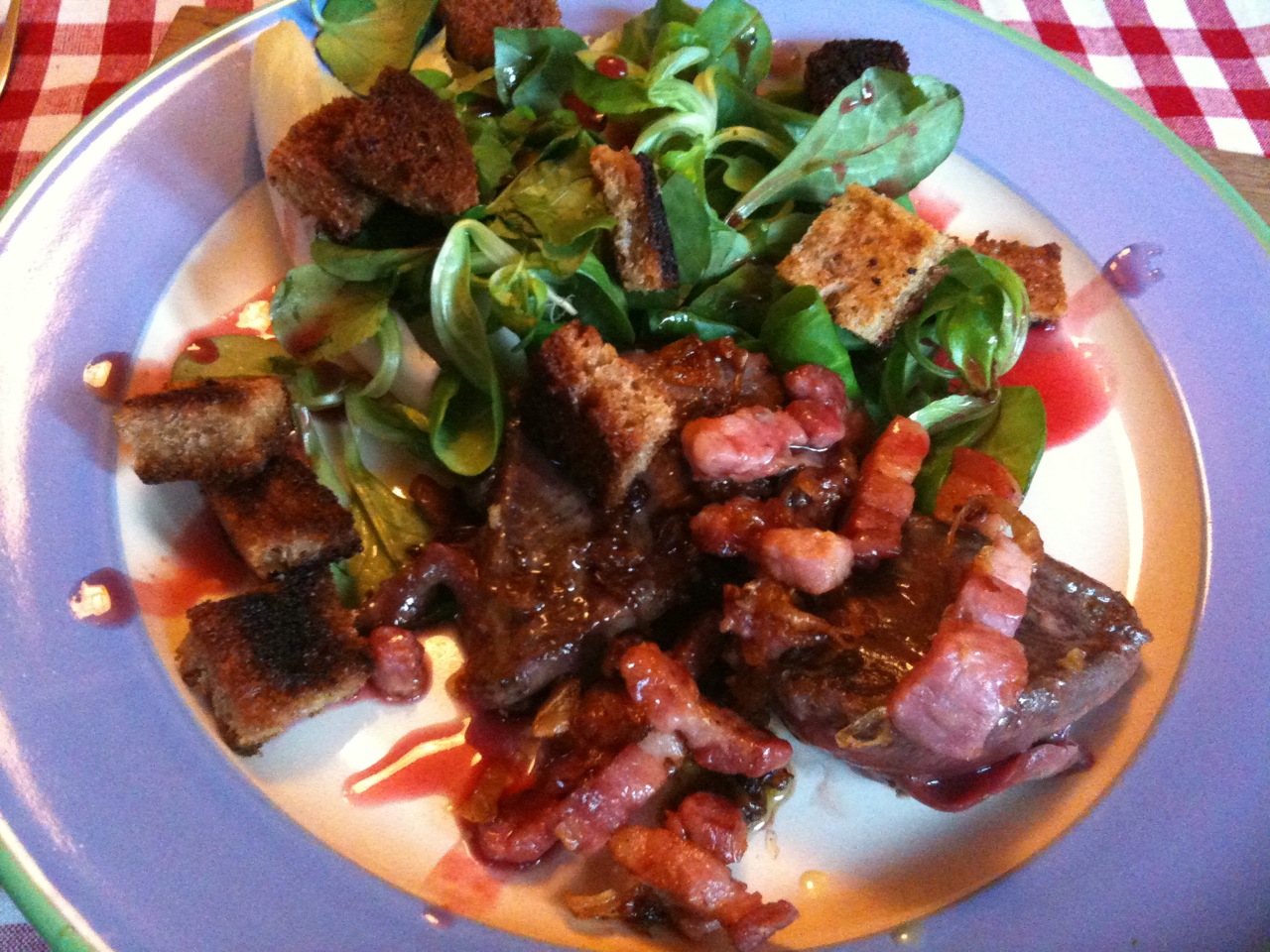
Having bought pigeon breasts at the weekend with a view to serving a mid-week warm salad, I’d very lightly browsed the web for some specific ideas.

Nothing shot out of the blue, demanding to be made.

But ideas can be taken and used once you start to understand what they’re on about.

So later, it was no difficulty to rustle up something that was tasty, quick and not difficult.

So for two, take a large shallot, chop finely and soften in some rapeseed oil. Add some lardons and leave them to start caramelising before moving around.

Make sure your pigeon breasts are nice and dry.

Share out some leaves on serving plates: I used endive, watercress and lamb’s lettuce.

Heat oil or lard and fry a slice of bread that you’ve diced into croutons.

Cook the pigeon breasts quickly in a hot pan. They need to be pink inside.

Decant your shallot and lardon mixture onto the plates. Then add the pigeon breasts and drizzle raspberry vinegar over.

Top with the croutons and serve with crusty bread. Voila!

The shallots and two meats here are sweet, so the raspberry vinegar is tart enough to cut through that and strong enough not to be overwhelmed by the pigeon.

The leaves add a bitter contrast and the croutons add texture.

We all use words to understand what we’re experiencing, and we have to do that by comparing things to something we already know. So when you’re trying to use words to describe a wine you’re tasting, for instance, you can end up with ‘like fresh-mown grass’ and ‘like petrol’ and things that can seem crazy.

I tried a big red wine from South Africa last year after it was suggested by a member of staff in the wine section of a shop. He pointed out that everyone tastes differently – and since everyone’s taste experiences will differ at least a bit, then their ways of describing tastes and smells will be subjective too.

But I admit to being chuffed to pieces when he almost applauded as I said that the first thing that struck me about the wine in my glass was burnt toast. Subjective possibly, but it felt like the ‘right’ answer.

When I ate ostrich for the first time, it was different from anything I’d tasted before. So how to describe that? I eventually came up with saying that it was like a gamey beef. But how would you understand that if you didn’t know what ‘gamey’ meant?

Raymond Blanc’s A Taste of My Life made me start trying to think more about flavours and, as I hope I’ve shown above, it really can help when it comes to putting together even a simple, midweek supper.

Tuesday, 24 May 2011

Lemon and lard: a match made in heaven?

Monday’s TOIL (time off in lieu) brought with it the opportunity for a spot of culinary endeavour.

And it started with a pleasantly lazy breakfast: fried bread and eggs – cooked experimentally for me – in lard.

Was ever there such a dirty word?

Back in February, Oliver Thring discussed that much maligned substance in his weekly Guardian column.

It was just at a time when I was starting to pick up some information surrounding the demonisation of animal fats in our diet and piece two and two together, and one of the things that hit me was just what very negative ideas I had about some fats.

Okay, not goose fat or duck fat perhaps, but that's because of the glow of Frenchness they have. But lard is so very northern; so very lumpen and unsophisticated, isn't it?

Look at the advert here and imagine that sort of an advertising campaign now.

We've been hoodwinked, you and I, into seeing lard – and other fats, including butter – as bad.

However, although I’ve barely used it since I read that article in February, there was some in the fridge.

Jennifer McLagen’s Fat: An Appreciation of a Misunderstood Ingredient with Recipes is a book that’s well worth thumbing through. Not just for the recipes – although the salted butter caramel tart that I’ve made thus far is utterly scrummy – but perhaps particularly for what else is included on the pages.

Part history, part science, McLagen looks at the forgotten health benefits of animal fats. Personally, I had no idea, for instance, just how many nutrients such fats included, having been convinced that saturated fats as a whole contained essentially ‘empty’ calories.

She even goes on to explain the molecular differences between different fats.

Now all this might seem a bit pointless for most of us, but it makes for valuable education when you’ve grown up pretty much alongside that process of demonisation.

Setting aside the health issue and diet myths though, McLagen also makes clear the role that fats play in taste – and also the suitability of certain fats for cooking.

Lard, as it happens, is very good to cook with because it’s so stable.

My fried bread was beautifully crisp, while the eggs were lusciously smooth, cooked beautifully and tasting wonderful. A breakfast that left me very happily sated.

But I’d also been wondering what else to do on the kitchen front and, given the egg whites remaining from Saturday’s culinary exploits (lemon gelato) had decided that this would be the perfect time to make my first attempt at meringue. And in keeping with the taste theme of recent days, I was contemplating a lemon meringue pie.

An internal debate then followed over which recipe to use: go for the simplicity of Delia or the greater complexity of Michel Roux?

I decided that it would be pastry from Roux’s book – but with lard substituted for some of the butter, as per Delia.

The filling and topping would be straight from Roux, which would mean making an Italian meringue – in other words, creating a syrup (including liquid gelatin) and adding this, at a specific temperature, to the whipped egg whites. But okay – I’m not a kitchen scaredy cat any more. I can do complicated things – and I have a jam thermometer.

The pastry veered close to disaster and was a nightmare to roll, as it was so sticky. That, I suspect, was partly because I’d let the fats get too warm before mixing. Fortunately, I had enough to make a second effort to roll and line the tin – and it just about worked.

Then, being a dipstick – and slightly frazzled by this juncture – I forgot to turn the temperature of the oven down from what was required to blind bake the pastry to what was required to cook the filled tart.

I realised about 40 minutes into a 1 hour 20 minute cook, when a glance in the oven showed something that had a rather unexpectedly brown hue on top. Since it was already set to the touch, I whacked the oven off completely and left it in to cool with the oven for a further 20 minutes or so, before bringing it out and, after another spell, removing it from the flan dish.

To compound matters, I then managed to stick a finger into the filling. Still, at least that proved that it was cooked – and still edible.

So meringue will have to wait for another day – it didn’t seem worth the effort after all that. I sprinkled caster sugar on top and simply caramelised that with my blow torch.

Remarkably for something that you think must be inherently fragile, it survived and proved edible. The filling is light as a feather and very fresh. The pastry was crisp and tasty.

There are questions about much modern lard, in that most of it is hydrogenated. But then again, McLagen makes the case – and gives the instructions – for rendering your own. It's not difficult, and it does mean a greater level of control over what you are cooking with and eating. I am seriously tempted to try.

But in the meantime, who knew that lemons and lard could make such a marriage – even given the hitches at the wedding?

Monday, 23 May 2011

Tesco meets street art

A judicial review of the decision to open a new Tesco Express in part of Bristol, which caused rioting in April, is to to be held in June.

Meanwhile, campaigners have called for further clarification on the classification of supermarkets for planning purposes, and the government has decided that the situation is so serious that it's asked TV's retail 'guru' Mary Portas to revive the British high street (only seven months after HM's loyal opposition said it would be looking at policy on the issue – itself only a year after I overheard the now leader of HM's loyal opposition being told about the impact of supermarkets on small businesses).

For a start, Ms Portas will hopefully tell government to stop the situation where supermarkets can build massive carparks, for which they charge nothing, while many town centres have been pedestrianised (not of itself a bad thing), with parking difficult and/or costly, meaning that drivers are effectively punished for shopping in town centres, but not at vast out-of-town supermarkets.

It would also be nice to see some sort of controls on landlords who simply decide that, because Clone Town can bring more money, they drive up rents to deliberately drive out independent businesses and replace them with franchises. Scales of economy (in this case, the capacity of big chains to pay much more than small businesses for rent) should not be the used at the expense of choice and variety.

I felt that it was worth updating readers of this blog, since they may remember my comments about the story here – but also because it offered a sublime opportunity to post Bristolian Banksy's artistic comment on the riots.

Let's face it – every little helps, eh?

And in the meantime, there are a few interesting thoughts here.

Sunday, 22 May 2011

Let's hear it for the lemons

Has anyone else been watching Two Greedy Italians on BBC2 over the last few weeks?

Old friends Antonio Carluccio and Gennaro Contaldo went back to Italy to visit four areas and talk about the food. Okay, they don’t just talk about it – they cook and eat it.

But the trip is not one where gastronomy is a stand-alone motivation: they meet old friends and family, they share stories of their lives before leaving for the UK.

This is not about food in isolation, but about food as a part of life, of love, of family, of friendship. And what it achieves, starting with the title itself, is a sense of vibrancy and earthiness and sensual pleasure that is an absolute joy to behold. There is poignancy in places, but ultimately, this is a celebration.

And the food is simple and gutsy and full of bold flavours.

There was a scene in the second episode when the pair sat there eating lemons they’d plucked from a tree – peel and all.

Now that could leave a northern European quite shocked.

In the last few weeks, I’ve been drifting toward buying more organic fruit and veg than previously. I noticed with organic Jersey Royals that that the flavour was better.

And then there were the lemons I bought last weekend. A softer yellow, knobblier by far than any you’d find in a supermarket and obviously unwaxed. The aroma when you cut into them absolutely sang.

During the week, we squeezed some on pan-fried tuna and some on grilled lamb chops. Lovely stuff.

And when I opened a bottle of Sicilian-style lemonade (made in France) that I’d picked up as an impulse buy, it was a million miles away from most of what I’ve ever tasted that has been called lemonade.

I have a jar of preserved lemons in to try a couple of Morrocan-style salads from Rick Stein’s Mediterranean – that’ll be different. It might not be eating peel in the same way that Carluccio and Contaldo did in the series, but since I’ve never done it before, it’ll still be a whole new culinary experience.

Natives of Asia, lemons made their European debut near southern Italy, no later than the 1st century AD, during the time of ancient Rome, before being introduced to Persia and Egypt.

The first mentions of lemons in literature are in a 10th century Arabic treatise on farming, and trees were used as an ornamental plant in early Islamic gardens.

But it wasn’t until the middle of the 15th century that the first major cultivation of lemons in Europe began in Genoa.

In recent years, lemons have become something that I always have in the house. But I'm only just discovering that not all lemons are equal.

In a fit of lemony enthusiasm yesterday, I bought a load of the organic ones mentioned above.

First, the juice and zest of three went into a first attempt at gelato, the Italian ice cream that uses an egg custard as its base. It's not perfect: letting concentration slip for mere seconds, I barely saved the custard from boiling, and I need to work on the freezing process; it's a tad too icy. But the taste ...

The other thing I did, while The Other Half was biting his nails over a last-kick Challenge Cup victory for the Castleford Tigers at Wakefield, was to have another go at pasta.

Ravioli again, but this time with proper pasta flour – it's much finer. I used 125g of flour to one egg – and a few drops of chilled water. It was much more elastic – which is how you see it on TV – and seemed a little easier to roll.

The stuffing this time was a mixture of ricotta cheese, pine nuts, Parmesan, a little crème fraĂ¯che and lemon zest.

The pasta was thinner this time and I used an off cut to check when it was cooked, throwing that in the pan of boiling water with the ravioli themselves.

The sauce was simple – just some sage leaves fried in good butter and a squeeze of lemon to finish. That was not bad at all. Practice will improve my pasta skills, but it was good to try again so soon, while I still have ideas in my mind about what I did previously.

And if lemon had become an important ingredient for me in the last few years, it might just have moved into a higher pantheon of foods with the experimentation of the last week.