Showing posts with label pleasure. Show all posts

Sunday, 22 May 2011

Let's hear it for the lemons

Has anyone else been watching Two Greedy Italians on BBC2 over the last few weeks?

Old friends Antonio Carluccio and Gennaro Contaldo went back to Italy to visit four areas and talk about the food. Okay, they don’t just talk about it – they cook and eat it.

But the trip is not one where gastronomy is a stand-alone motivation: they meet old friends and family, they share stories of their lives before leaving for the UK.

This is not about food in isolation, but about food as a part of life, of love, of family, of friendship. And what it achieves, starting with the title itself, is a sense of vibrancy and earthiness and sensual pleasure that is an absolute joy to behold. There is poignancy in places, but ultimately, this is a celebration.

And the food is simple and gutsy and full of bold flavours.

There was a scene in the second episode when the pair sat there eating lemons they’d plucked from a tree – peel and all.

Now that could leave a northern European quite shocked.

In the last few weeks, I’ve been drifting toward buying more organic fruit and veg than previously. I noticed with organic Jersey Royals that that the flavour was better.

And then there were the lemons I bought last weekend. A softer yellow, knobblier by far than any you’d find in a supermarket and obviously unwaxed. The aroma when you cut into them absolutely sang.

During the week, we squeezed some on pan-fried tuna and some on grilled lamb chops. Lovely stuff.

And when I opened a bottle of Sicilian-style lemonade (made in France) that I’d picked up as an impulse buy, it was a million miles away from most of what I’ve ever tasted that has been called lemonade.

I have a jar of preserved lemons in to try a couple of Morrocan-style salads from Rick Stein’s Mediterranean – that’ll be different. It might not be eating peel in the same way that Carluccio and Contaldo did in the series, but since I’ve never done it before, it’ll still be a whole new culinary experience.

Natives of Asia, lemons made their European debut near southern Italy, no later than the 1st century AD, during the time of ancient Rome, before being introduced to Persia and Egypt.

The first mentions of lemons in literature are in a 10th century Arabic treatise on farming, and trees were used as an ornamental plant in early Islamic gardens.

But it wasn’t until the middle of the 15th century that the first major cultivation of lemons in Europe began in Genoa.

In recent years, lemons have become something that I always have in the house. But I'm only just discovering that not all lemons are equal.

In a fit of lemony enthusiasm yesterday, I bought a load of the organic ones mentioned above.

First, the juice and zest of three went into a first attempt at gelato, the Italian ice cream that uses an egg custard as its base. It's not perfect: letting concentration slip for mere seconds, I barely saved the custard from boiling, and I need to work on the freezing process; it's a tad too icy. But the taste ...

The other thing I did, while The Other Half was biting his nails over a last-kick Challenge Cup victory for the Castleford Tigers at Wakefield, was to have another go at pasta.

Ravioli again, but this time with proper pasta flour – it's much finer. I used 125g of flour to one egg – and a few drops of chilled water. It was much more elastic – which is how you see it on TV – and seemed a little easier to roll.

The stuffing this time was a mixture of ricotta cheese, pine nuts, Parmesan, a little crème fraïche and lemon zest.

The pasta was thinner this time and I used an off cut to check when it was cooked, throwing that in the pan of boiling water with the ravioli themselves.

The sauce was simple – just some sage leaves fried in good butter and a squeeze of lemon to finish. That was not bad at all. Practice will improve my pasta skills, but it was good to try again so soon, while I still have ideas in my mind about what I did previously.

And if lemon had become an important ingredient for me in the last few years, it might just have moved into a higher pantheon of foods with the experimentation of the last week.

Thursday, 5 May 2011

The economics of pleasure

The glorious weather has brought with it a surge of reading activity on my part: while keeping half an eye on the cats as they enjoy the garden, I’ve been ripping through books.

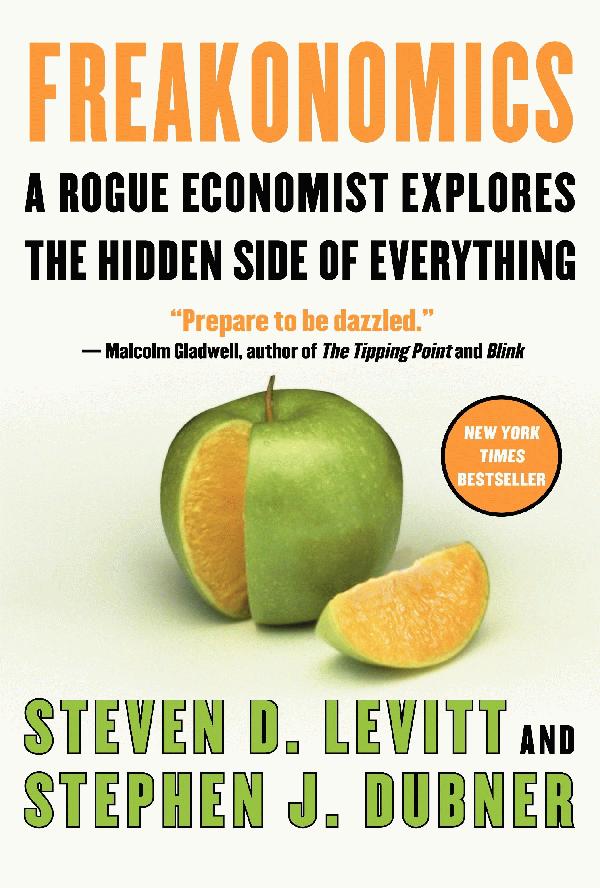
One of the most recent tomes to enjoy this treatment was Freakonomics by Steven D Levitt and Stephen J Dubner.

It's economics Jim, but not as we know it.

There is no overarching theme, but some of the questions that are tackled by Levitt (he’s the economist, while Dubner is a journalist) are intriguing to say the least.

For instance, he debunks the idea that the dramatic fall in crime in the US in recent years was primarily down to innovative policing or changes in sentencing (although he does note that increased numbers of police would have been beneficial).

Instead, he reveals a factor that had not come into many discussions before: that of the impact of the legalisation of abortion meaning that just as a generation of youngsters from that era would have been coming into their criminal prime, they were not there.

Such an analysis is fraught with difficulties, since abortion remains such an emotive subject. But Levitt seems to have been thorough in his work.

For instance, prior to Roe v Wade, the case that saw abortion legalised throughout the US, it had been legal in three states for a short period of time. In these states, the same fall in crime is noticeable earlier than in the rest of country but at the same rate that the rest of the country would subsequently see.

Levitt has been accused of many things for this research, from being a racist to being a eugenicist. However, as elsewhere, he merely looks for what is behind the available data – he makes no moral pronouncements. And quite frankly, while the results of his work may not seem palatable to some, it’s knee-jerkery to dismiss them with such accusations.

He’s interesting too on education and parenting. But this is also where one starts to get the feeling that he’s perhaps over stretching himself – or rather, over stretching what economics can show.

On the one hand he uses incredibly detailed data from Chicago to argue that many parental choices and actions have no impact on children, as much of what they will become is already genetically imprinted in them.

Yet elsewhere, he argues that peers have more influence on children than their parents and later, when discussing this in terms of adopted children, he admits that the approach of adoptive parents can change and improve the life outcomes for an adopted child, even if it cannot, for instance, change their basic intelligence.

In other words, his data shows many things, but even he knows that it would be too crude a conclusion to take his findings in isolation.

And in the ‘bonus material’ at the end of the edition that I was reading (newspaper articles) we see again the limitations – even the danger – of trying to view the world in economic terms alone.

In one brief essay, Levitt looks at leisure activities and he asks the question of why someone would pay more to knit their own scarf than to buy one. Included in his estimate of the cost is that of the person’s own labour. But doing that clearly dodges the question of the pleasure and satisfaction that the knitter gains from that creative activity – and indeed, from producing an end result that they can then wear.

"Cooking for fun” (as a survey of US activities put it) confuses him too.

Again taking the labour into account, he reaches the conclusion that it would be far cheaper to simply buy a takeaway or ready meal from the shop.

Now to be fair, there are hints in the piece that Levitt himself knows that life doesn’t work this simply, but he does seem to be trapped into asking questions where he expects – and wants – clear-cut economic answers.

In this brief essay he seems to suggest that everything is reducible to thinking in terms of finance and incentives.

Now in most households, someone has to buy and prepare food.

It might be the act of buying that ready meal, taking it home and then popping it in the microwave before divvying up onto plates, but it still has to be done.

That, of course, can easily be classed as a ‘chore’.

But what if you take greater time because you want to have control over your food and do not believe that highly processed fodder is actually any good for you?

How does that change the economic situation? It’s still a ‘chore’, but how do you assess the motivation and calculate the cost of that? Indeed, how so you economically calculate the impact of a better diet?

The article suggests that, in terms of economic incentives alone, fast food and ready-made meals are the sensible option.

But to take it a stage further, what happens when you do the latter – not just for the reasons briefly listed above, but also because you actually enjoy it; you find it, say, as therapy after a tough day at work?

Does it cease to become a chore and become leisure?

It’s that peculiar dividing line between leisure and non-leisure: as if something, if it is enjoyable, has less of an economic value.

It’s as though we have become suckered into seeing everything in terms of economic productivity – that economic productivity is the most important factor in all our lives, or should be.

Perhaps, in terms of the US and UK, this is the case – not least because there still exists a rather puritanical idea that work is the most important thing in one's life – even above family and certainly above pleasure.

In Stewart Lee Allen’s In the Devil’s Garden, a history of taboo foods, he comments that food culture in the US is now so denuded of pleasure that people scoff their tasteless fodder to get back to work that much quicker. In other words, go back to being productive.

It’s perhaps no coincidence that, in general, people in the UK and US scorn the idea of the French two-hour lunch. It’s culturally viewed as something negative.

But hold on a moment.

A couple of days ago, the Daily Mail published an article boasting that one of Margaret Thatcher's best legacies was that people in the UK work seven hours longer, per week, than we did before she came to power in 1979. And that is at the same time as workers in most of the rest of Europe have seen their own working week shrink.

That's a great boast. Yet it gets 'better'. In fact, in that time, productivity in the UKL has actually fallen.

And if we specifically compare the UK and France, then the French work noticeably fewer hours than we do – but their productivity is higher. Strangely, the Mail didn't actually mention that, but then who would want to boast that people work longer, to less effect?

But given this sort of attitide, it's little wonder that the likes of Levitt struggle with how to deal with “cooking for fun” in economic terms.

It would be interesting to see them actually try to come up with an economic value for the French 'lifestyle' given that basic data, which comes from a pretty reputable source in the OECD.

Levitt has plenty to say that is of interest – it's easy to see why his expertise is in economics and crime – but he might not have intended to show, as effectively as he has, the limitations of economic analysis and the negative impact of a certain type of economic philosophy on UK and US lifestyles.

Friday, 10 December 2010

The new puritanism

How would you define a ‘vice’ – in a food sense, that is?

After the pantomimic howls of indignation over foie gras by some Guardian readers the other week, I’m delighted to report that it’s not just sandal-munching, museli-reading lefties who get in a lather about such things.

Over at the Telegraph, a report into the slow food movement in Italy provoked the following: “is there anything more absurd than being a ‘foodie’? it is remarkable how humans can turn a necessity into a vice.”

And this comment had then, apparently, been ‘recommended’ by four other people.

As an aside, apparently we have former New York magazine restaurant critic Gael Greene to thank for the term ‘foodie’.

But back to the subject at hand: what makes anyone get their sackcloth knickers into such a knot over food? Or more to the point, over the pleasure that other people take in food?

And when did the enjoyment of food become “a vice”? Or to put it another way, at what stage does enjoyment in food turn from something acceptable into something unacceptable? Where is the gastronomic rubicon? And who gets to decide?

Now I obviously don’t know for certain, but somehow I just cannot imagine this happening in France or Italy or Spain – unless possibly in direct connection to certain interpretations of religious behaviour.

Yet judging by what I’ve seen in recent weeks over here, there is no religious aspect to the disapproval that a number of people appear to have for other people’s enjoyment.

Is this one side of the increasing secularism in society, whereby people are filling the void of conventional religious belief with some sort of other religiosity?

More than one contributor to these discussions threw out the logic before posting. There are people around, for instance, who think (in a somewhat loose sense) that if someone loves food, then that is their entire life and their entire life can be judged accordingly.

The condemnation by a surprisingly large number of people of the idea of taking (excess) pleasure in food seems to have its roots in the puritanical aspects of our past.

Be unhappy with other people eating animals; be unhappy with farm production methods; be unhappy about all sorts of things, by all means. Explain your reasons; put your arguments; campaign.

But why be unhappy about people taking pleasure in something?

Mind, I’ve found myself also considering my own responses to a couple of issues too.

A couple of weeks ago, I bemoaned the reported demise of some of our culinary heritage.

But times change – if they didn’t, we’d all still be swinging from the trees and, even if shoved into a room by the thousand, wouldn’t be able to come up with Hamlet.

But here’s the balancing act: times change, but does that mean baby out with bathwater is always positive?

Some of the dishes I touched on in that post are good enough to make it into Larousse. Yet we don’t value them widely on this side of the Channel. What does that say about what we do value of our own heritage and culture?

And what happens if we simply let our heritage and culture die away in a rush to try different things? Why is heritage and culture important? In part, because of our sense of roots, of belonging, perhaps? These things are part of us – they don’t exist apart from us.

It isn’t a question of believing that nobody should try anything new, whether a whole cuisine or an ingredient. But it’s about not throwing everything out in the rush to try something new, like a spoiled child who wants a new toy every week.

I also found myself wondering if I myself wasn’t a little susceptible to the ‘how dare you enjoy yourself doing this’ mantra, when a colleague announced that he was going to The Fat Duck for a slice of the Heston Blumenthal experience.

I’d touched on the madness of the £200 Christmas pudding here, but I must say that Jay Rayner hits a number of nails on their respective heads in this piece in the Guardian (which comes complete with puritan comment warning).

So, what is my problem with Britain’s top chef? Is it jealousy? Question with a question: of what? Is it a puritanical belief that, assuming they’ve got the dosh, people shouldn’t spend it on whatever they like? No. Apart from anything else, that would be massively hypocritical of me.

Trying to put it clearly, my problem with Mr Blumenthal is not actually Mr Blumenthal, but the way in which the pseudo-worship of what he does seems to be another fad.

To try to explain more clearly: take El Bulli, the Ferran Adrià-run restaurant home of molecular gastronomy near Barcelona. This home of gastronomic experimentation sits alongside a wonderful local cuisine; a cuisine that is valued and vital and fabulously alive.

Here, The Fat Duck doesn’t do that because it can’t do that, because no such situation exists in terms of an indigenous cuisine. So it just seems to me to be one of many distractions from something that has much to offer, but is being neglected, partly because of faddiness and partly because of a lack of interest in the pleasures of food generally.

No, that’s not quite the puritanism I mentioned above, but more the culture of not enjoying food enough to resist the pressures to eat mass-produced fuel in front of the telly, instead of taking time to sit down to a meal with family and/or friends.

Is it too big a leap to suggest that, if as that brief sketch implies, we are becoming more and more alienated even within our own homes, our apparent willingness to dump our culinary heritage is actually linked?

I’ve had online conversations with people who have suggested that there are no objective standards for judging food; that one foodstuff is no better than any other.

That leaves you with a belief that there is no qualitative difference between, say, a Pot Noodle and a chateaubriand steak.

Or as one of those online puritans that I mentioned at the top of this piece suggested, there is no difference between animal and fish produce and vegetarian alternatives: the textured vegetable protein burger and the real burger are no different.

Is it also, therefore, too big a stretch to suggest that, in a time when big business and finance (including the major supermarket chains) hold such sway in the country, such a puritanical rejection of pleasure in food, whether deliberate or not, is useful?

I don’t know the answers and I’m am not about to start positing any glib ideas. But it increasingly seems to me that denying gastronomic pleasure is a stance with more widespread ramifications than we might imagine.

Tuesday, 21 April 2009

A feast for the eyes and the mind


Babette's Feast (1987 Denmark)

In 19th century Denmark, a refugee arrives from the violence in France.

Babette has been sent to the bleak, windswept Jutland coast by a friend, to ask two elderly sisters if she can stay with them, offering to keep house and cook for them in return.

They accept, and instruct her in the cooking that they’re used to and that they also prepare for the poor of their small community. It’s joyless food – mere fuel. The sisters are pious Christians, upholding the legacy of their late father, a pastor, who had founded their strict sect.

In their youth, both Martina and Filippa had turned down suitors or the chance to embark on a singing career, preferring instead to stay with their father.

Then, as their anniversary of his birth approaches, Babette’s ticket comes up in the lottery – her one remaining link with France. And she asks the sisters if she can prepare them and their little congregation a meal for the event.

Director Gabriel Axel’s 1987 award-winning film, from Karen Blixen’s book, is an unmitigated delight, somehow remaining as light as soufflé, even given the subject matter.

Here we have, yet again, a look at the conflict between sensuality and religion. The fear of Babette’s guests as they realise the treat that they are being given is funny – but utterly tragic and wasteful too. They vow, before the meal, to ignore what they will eat; to not contemplate. Only the old soldier, the unsuccessful suitor of Martina decades before and now returning to visit, appreciates the magnificent fare.

How can one be so afraid of pleasure? Why is sensuality so threatening? Why is life itself so threatening? For those who believe, how can locking away of oneself from vast areas of the creation that they believe is God’s be anything less than an insult to that god? Is their god really so cruel as to demand that they ignore his own creation, that he put in place merely to tempt and torment them? Or is Satan a creator too – in his case, of all sensual pleasure and the means to gain those pleasures?

The austere Jutland coast, which matches so well the Puritanism of the sisters and their fellow congregants, is beautifully photographed.

And Stéphane Audran is wonderful as Babette – a delightfully subtle and warm performance.

In some ways, Babette’s Feast is an incredibly simple story. But told like this, it is an exquisite paean to the pleasures of food, and of life itself.

Tuesday, 14 April 2009

As pleasing and complex as a really good truffle


Chocolat by Joanne Harris

The wind has changed direction, and it blows Vianne Rocher and her six-year-old daughter Anouk into the insular French village of Lansquenet-sous-Tannes, just in time for the start of Lent.

But when Vianne opens a chocolaterie, bringing sensual treats to the townspeople, she finds herself in conflict with the curate, Reynaud.

And as he struggles with his 40 days of penance and denial, Vianne’s influence over his flock grows.

A very enjoyable novel – and a deceptively light one – that takes the classic ideas of the pure and the profane and gives them a few tweaks.

Joanne Harris writes with real zest of the joys of good food (not just chocolate) and company. In many ways, it’s a gospel of pleasure and of living; a hymn to the senses. And it is extraordinarily evocative.

You do need to suspend your disbelief over certain issues – the timeframe of the story doesn’t bear too great an analysis, but it does suit the subject and can be forgiven for that reason.

Reynaud’s form of his religion is obsessively about denial and control – and he fully intends to foist these on his parishoners (and those who are not amongst their number). His is a censorious and patronising concern for their wellbeing, nourished by his own agonising guilt; he looks down on them and has set himself up as being responsible for them, seeking his own redemption in them. And in attempting this, he loses sight of their humanity.

But there are reasons for Reynaud’s attitudes – just as there are for Vianne’s approach to life. And Harris’s strength as a writer is that she never opts for the most simplistic approach.

Chocolat is not simply concerned with the battle between pleasure and denial, but also with mortality and the question of how you live life – including how you die.

It’s about love and laughter, friendship and joy. About loss and longing, pain and fear, and the need to stop running. There is a belief in magic here – the magic of life and living.

Harris has created a really delightful – and remarkably provocative book. My religious mother disliked it quite intensely, although she won’t talk about it other than to state that simple fact.

And finally, there is Armande, based on Harris’s own grandmother. No spoilers here – but perhaps the real question that the book leaves you with is whether you could, or would, follow Armande’s lead. It is a challenge for anyone who has been brought up to view conformity as the only possible option. Live, says this book: live!

Sunday, 5 April 2009

It might as well be spring

It wasn’t even 10am, but while there was still a spring morning nip in the air, it was glorious; a clear, blue canopy above and the symphony of birdsong all around.

Sitting outside with a good coffee (single estate from somewhere or other, via the local French deli), I tried to see everything, smell everything, hear everything. Tried to process it all in the mind, putting words to everything so that I might hope to hold on to it.

A church bell tolled from the Anglican convent just across the small park that sits behind; not a peel of bells, but a steady, monotonous call to worship – the sort of sound, in fact, that makes the advertised act seem so much less of a joyful one than sitting outside and drinking in the beauty of the morning.

Life is an ephemeral thing, and yet people go and sit inside gloomy churches rather then relish the glory of the world that they claim their god created. How perverse, when everything around you – particularly at this time of year – screams of creation and life. The sap is rising, blossom, flowers and leaves are bursting their bonds and flooding the world with colour and scent.

I might not, any longer, be able to fathom the churchgoing (although perhaps I never could, but merely went along with it unthinkingly), but I did manage to discipline myself into a brief spot of spring cleaning, washing down windows and sills in the kitchen, and clearing out a cupboard where there was an infestation of tiny bugs that seem to thrive on flour.

They’re flour weevils apparently, and seem to have been breeding in a bag of their favourite snack that was hidden from my vertically challenged view at the back of the top shelf. I only found it with the aid of the ladder.

As part of my efforts to keep them at bay – or better yet, get rid of them altogether – I’ve got an order of storage cans and tubs arriving on Tuesday. The flours can all go in stainless steel canisters, while the plastic tubs will be useful for storing – and organising – a whole range of things, including bags of nuts and dried mushrooms. Old 200g instant coffee jars do very nicely for storing assorted sugars.

It’s one of the things about enjoying cooking – no matter your initial antipathy to cleaning up, you start to get more and more committed to it. I do more washing up these days than I’ve ever done in my life, but it doesn’t feel more onerous. Now I simply understand it as a necessary part of the process, and I want my utensils as clean as possible.

And then armed with the satisfaction of such cleanliness and organisation, I went to sit outside, sporting a sleeveless t-shirt and squinting at the pages of a book as the warmth started to seep through to my bones.

By the time the clouds drifted into view, I didn’t even feel too great a resentment and, with thoughts of lunch drifting from my stomach to my brain, donned a baggy old cotton sweater against the cool and headed for the kitchen.

In River Café Two Easy, Rose Gray and Ruth Rogers present a series of soups, explaining that Italian soup is usually very rustic and chunky – not pureed within an inch of its life. Knowing I still had an odd courgette around the place, I thought I’d try and courgette and pea soup.

Talk about easy. Chop garlic and soften in olive oil, before adding chopped courgette. After a few minutes, tip in some peas (frozen ones are fine) and then a little stock. Let it simmer until the peas are cooked, then pop into a blender and pulse briefly – it needs to retain plenty of texture, not become smooth. Reheat with some basil leaves in it. Serve with grated parmesan.

I made some minor adjustments, adding a few fine because I had some left over and because it ensured that lunch would supply me with three portions of my fruit and veg.

The cupboard was bare when it came to basil, but I used the cheese as directed – and added a garnish of toasted pine kernels.

And the result? Lovely.

The big question in my mind now, though, is Easter. What am I going to cook? I’d scarcely given it a minute’s thought until yesterday, when it suddenly dawned on me that it was almost upon us.

I do want to try to make my own hot cross buns for the first time, but I’m struggling at present to think what else to cook.

Chocolate has to be involved somewhere.

It’s too early for the first lamb of the year (that’s actually best in August anyway). But possibly I’ll consider a leg of lamb anyway. If I can get decent quality, then I might do it with garlic and rosemary – or even dried lavender.

I gave up thinking about it after a while. I’ve done a basic order of core ingredients online, but I’ll give other things a few days to ferment, as it were.

So I’m left with this evening’s meal. Okay. We return to the River Café book. I got a dressed crab from Broadway Market yesterday. I’ll cook it gently with chili flakes and lime juice (and possibly some fennel), and serve with pasta.

Simple – and great flavours.

It’s been a good day thus far. The Other Half’s team won (it’s a cup weekend, so this is knock-out Rugby League) and Les Catalans won too (we both have a very large soft spot for the French side). And whilst my football team lost yesterday, my RL team won today, against the other strongest team in the country. So I'm reasonably happy. And Granddad would be proud.

Just occasionally, I wish that the whole idea of heaven and eternal life were true – not because I dream of eternal purgatory for nasty people, but because I wish that, somewhere, my grandfather was still around – even if only in the ether. But then again, what always brings me back down to Earth is the realisation that if that were the case, and if it were as the churches proclaim it to be, there would be no place for my grandfather. Or me. We'd be destined to meet in the nether regions of eternity.

And I look out at the dusk, and I see such life as spring takes control. And on this Palm Sunday, would I really like to be with Christ in Paradise?

I’ll leave you to consider the answer to that.

Tuesday, 31 March 2009

Dressing down the sartorial naysayers


The Thoughtful Dresser by Linda Grant (published by Virago)

Novelist Linda Grant doesn’t claim to be a stylist or even a fashion buff. What she enjoys, she explains, are good clothes. And shoes. And handbags.

So what she has set out to do in her new book is to explore why clothes are important – and why making an effort to think about how we dress is not wasted time.

This accessible – and in places very, very funny – book is not what you’d call a work of scholarly rigour, but Grant still manages to get across a number of messages with enjoyable ease.

She illustrates, with just a cursory look at the distant past, how humans have always cared about how they look – about how they present themselves, from the earliest adornments and tattoos. Which, as she points out, makes a nonsense of the view that fashion is only a product of capitalism and consumerism, and that shallow women are just manipulated into contemplating matters sartorial.

She also illustrates the inherent misogyny in the view that thinking or talking about clothes is an indicator of vapidity. Men base so many of their responses to women on how women look, and criticise them if they don’t look ‘good’, but also criticise the time they spend achieving that look.

As Grant points out, we have to wear clothes: a man begging on the street might have plenty of people pass by and ignore him. But if he’s naked, the police will turn up pretty quickly and take him away. Clothes, in our society, are not an option. It might sound howlingly obvious, but if that’s the case, why do some people consider it to be an indicator of a weak mind – or a capitalist plot – when people enjoy thinking about clothes, shopping and dressing?

Why, for instance, is shopping derided more than, say, watching football or playing dangerous sports or playing shoot-em-ups on a computer – or any other predominantly male form of pleasure?

Grant rails against clothing being limited to the strictly utilitarian, and peppers the book with anecdotes about her own mother – the daughter of immigrants – who understood the way clothing could be used to help fit in. And there is a series of interviews with Canadian style doyen Catherine Hill, an Auschwitz survivor whose teenage life was possibly saved by a moment of old-fashioned, female vanity.

The point that, in the 19th century, department stores were a new and liberating place for women, where they could go unchaperoned, is made too (see Zola's The Ladies' Paradise). And how new designs (by designers, thus stressing the importance of designers) for shoes and dresses also helped in the process of liberating women (from corsets etc).

We read how Coco Chanel created the timeless little black dress as long ago as 1926, and how, in the aftermath of WWII, women swooned for Christian Dior’s beautiful New Look.

Grant is quite clear that fashion – in terms of the catwalks etc – is not ‘real’ clothing, but a form of art, and every bit as valid as a painting or a piece of music. However, she also believes that our innate desire to look aesthetically good – to be attractive – is “irrational”.

But that begs the question of whether art in general is irrational – indeed, whether it’s irrational to consider aesthetics in anything that could be strictly utilitarian (architecture, for instance). And unless you think it is, then it’s difficult to conclude that clothing should adhere to a different ethos.

Grant ends with the story of a single red, high-heeled, patent shoe that she spotted on the top of a display of shoes at Auschwitz, where they’d been stolen from owners who were mostly destined for the gas chamber.

She dares us to denigrate the unknown victim of the Holocaust who had worn or carried with her on that final journey, shoes that she loved.

And she leaves us with a challenge – to live and to make the most of it. Including in the enjoyment of what we wear.

This feels a little like Richard Dawkins’s The God Delusion: as he was eventually provoked by fundamentalists into writing, so Grant has been poked with a stick by those (including women) who pour derision on others for taking care over what they wear.

And while it doesn’t have quite the force of Dawkins’s work, it’s an enjoyable, interesting and welcome rebuttal to a particular attitude and critique.

Monday, 23 March 2009

Of spring days and mayonnaise

I'm glad I used to do a fair bit of bodybuilding in my twenties. You need a strong arms for making mayonnaise.

Early last year, I made my first allioli – the wonderful garlic mayo that heralds from Catalonia. The instructions came courtesy of Rick Stein's Mediterranean cookbook, and it was initially only intended as an experiment.

I like to try things once – so that I understand what the process is (before buying the ready-made version next time). I've tried houmous and taramasalata and tapenade for exactly that reason. Only tapenade has not been shop bought since.

Thus I tried my hand at allioli. But the thing was, it was so utterly gorgeous, that the experiment convinced me that I'd make it again. And again.

And now, this lunchtime, I've made my first mayonnaise proper. More instructions courtesy of Mr Stein. Two lovely egg yolks, with two teaspoons of white wine vinegar, half a teaspoon of salt and a teaspoon of dry mustard all plopped in a bowl with a damp cloth underneath to keep it from slipping. Take a whisk and gently break the yolks. Then start – extremely slowly – dripping in 300ml of oil (you can use sunflower oil, but I stick with virgin olive oil) and whisking it into the eggs, vinegar, salt and mustard.

The mixture doesn't get looser – it stiffens up: that's the hard bit and my bicep was groaning more than it has in years. But it's a glorious, smooth texture and a wonderful, bright yellow – reminiscent of the daffodils that are now in bloom. The taste ... well, the taste is like incredible.

It screams to me of sun, sea and squid on the Med – or chips in Amsterdam and Berlin. Nothing out of a jar, hauled down from a supermarket shelf, could ever taste of such things, of such memories.

So why do cooks and chefs claim so vociferously that mayonnaise is difficult to make? If you measure your ingredients carefully, take your time adding the oil and work those arm muscles, it's a doddle.

And such a process, when it produces something so special, can hardly be viewed as onerous.

Not, of course, that it should ever be pleasurable. At least that was my mother's view. I remember her intoning: "We eat to live – we don't live to eat". Technically correct, of course, but what she meant was to emphasise the role of food as fuel alone – don't be having any sensual pleasure from it.

Whether because of that attitude – or whether that attitude grew out of something else – my mother has never enjoyed cooking. She's worked hard at it – indeed, she's turned into an art form the ability to take two hours to prepare something that I could do in 30 minutes. She's always been dutiful in preparing food for her family – but then again, duty is A Good Thing. Pleasure is not.

And neither I nor my sister were ever taught to cook. We had to do chores in the kitchen – scraping new potatoes in the summer, prepping sprouts in the winter – and drying up. But we didn't get to actually try any cooking or baking. Mother also considered domestic science at school to be a complete waste of time and money, so I was hauled from those classes as quickly as possible.

It begs the question of where she imagined one learnt any basic culinary skills. By the time I left home, I had not a clue.

Perhaps it's the case throughout the UK?

Perhaps that's why celebrity chefs and cooks always make out that mayonnaise is so, so risky – so very difficult to get just right. Because such an awful lot of people in the UK can hardly do much more than pop a ready meal in the microwave?

I'm never sure whether I want to evangelise about food – or keep it as at least a partial secret. Perhaps that's what those chefs have decided – to retain for themselves a little secret about mayonnaise (and thus retain for themselves the kudos of being clever enough to make it)

But as of today, I'm in on their secret. I have a new skill: I can make mayonnaise. It's gorgeous – and it won't be the last time.

Wednesday, 25 February 2009

The wages of sin

'Look at them – they're as miserable as sin.'

Just where does this come from? I know it's Lent and we're all supposed to be feeling pious because we've given up something for a short period of time in order to win spiritual brownie points with the Big G. But sin is miserable?


Oddly enough, I've never found that to be the case. Indeed, I find quite a bit of sin to be rather good fun.

We all know that, when the religious start talking about 'sin', what they really mean is sex. Well, what can I say? Sex doesn't make me feel miserable.

But then again, quite a lot of sins are 'forbidden' pleasures.

According to one Father Roberto Busa, a 95-year-old Jesuit scholar, men and women sin differently.

For men, it's a case of lust first, followed by gluttony and then sloth. Anger, pride and envy follow, with greed taking up the rear.

For women, it's pride, followed by envy (Damn! I really want the handbag she's got!) and then anger. Lust comes a poor fourth.

Mind, the poor dear probably doesn't get out much.

And he hasn't met me.

Or quite a few other women I know.

How extraordinary though – that a (presumably) virginal 95-year-old should be such an expert on sin, after living an exemplary life of contemplation, scholarship and piety.

I'm going to admit something here: it has sometimes crossed my mind that would be a rather good ruse to take confession – just to see how quickly I could make the priest's hair curl.

And confession is good for the soul, so they say.

But then again, probably not half as much fun as a bit of sin.

Saturday, 14 February 2009

S is for Saturday, shopping and stock

It’s a rather sybaritic day, in other words.

As I plod into middle age, it becomes increasingly clear that food is truly one of life’s great pleasures.

Thus my Saturday, as so often, started with a mug of coffee, a few cookery books and paper for the compiling of lists. There are two lists – menus for three days and then the shopping list itself.

It is said that real foodies descend on the market sans such lists: they are prepared for whatever treasures they might unearth, and able instantly to know what they’ll conjure with their finds.

I am nowhere near that experienced or confident: it’s a racing certainty that, if I tried it, I’d forget something important. Like the wine or the crème fraîche – you know. So I sit up in bed with a coffee, browsing my books and making my lists.

For almost five years now, our little corner of Hackney has entertained a farmers’ market. It’s a haven for those who don’t share the rather widespread British belief that the belly is best served by taking a trolley around a supermarket and filling it with a week’s worth of ready-made meals, selections of crisps in perverse ‘favours’ such as Cajun squirrel and builder’s breakfast, and bottles of lemonade that have never been within a million miles of a lemon.

Until the farmer’s market arrived, helping to breathe new life into a street that had been three-quarters derelict for decades, I too had to endure the supermarket trip.

Now, I start by delivering my empty egg boxes back to the farmer I bought eggs from seven days earlier. If I have meat I want from him, I order it then and pick it up on the way back.

The next port of call is Vicki, my fishmonger. She has a small stall, full of wet fish, gleaming and bright on a bed of ice. This is a paradise all of its own – and as near as I get to that list-less shopping. The new-old shopping experience of the market means, today, waiting quite a while as, with consummate skill, she fillets eight herring for the customer in front of me.

The British have forgotten herring. We used to eat it by the ton, but now we neglect it. Unfortunately, The Other Half isn’t a big fan, so I take a nice piece of tuna, which will be poached later in a tomato sauce with garlic, chilli and rosemary. A Spurs fan, she has us all, I suspect, categorised by our interest or otherwise in the game. Mr Herring is a West Ham follower: they discuss the possibility of coach Gianfranco Zola being poached by Chelsea (but not quite as nicely as my tuna). When it’s my turn, we consider Manchester City’s chances this afternoon at Portsmouth.

At a stall that sells Dartmoor beef, the farmer tells me in jovial fashion about dealing with the recent snow.

At the French deli, Stephane updates me on how well the move to their new premises is going.

And as always, I exchange pleasantries with Turkish Tony in the general shop.

This is shopping as it should be: a sociable affair; friendly and not rushed. Food is worth taking time for: producers and shopkeepers worth building relationships with.

Back home, once everything has been unpacked and put away, I roughly chop onion, carrot and celery. Celery is one of the miracles of the market – it comes covered in soil, and it smells and tastes, for goodness sake. Smells and tastes, not of water and insipid nothingness, but of celery – real celery. Peppercorns, bay leaves from the tree in the garden, parsley stalks and crushed garlic cloves go into the pot too, before the water is added. I’m in the mood for more risotto in the coming days, and good stock is essential.

And it’s hardly as though making stock is difficult or expensive. This is another joy – knowing how do make these building bricks, and knowing what a difference they make.

Then it’s time to consider lunch: since we’re doing our own thing, I chop more celery, a couple of shallots, some chilli and some more garlic and sauté them gently in olive oil. Re-hydrated couscous is added, together with a few pine kernels and some raisins. Then the whole mix is seasoned and packed into a halved and cored courgette and a yellow pepper to be baked. How easy is this? Tasty, cheap and healthy too.

Some locals complain about the market. They complain about the £3.50 loaves of bread that have taken on an almost mythical status amongst those who have heard, who have never been but who like to carp.

One day, a neighbour was complaining thus to me in my local pub. Every so often, she went outside for a cigarette (over a fiver for 20), between swigs of an almost-£3-a-pint stout. How odd to think that £3.50 for an organic seven-day sour is considered particularly expensive alongside much more ephemeral pleasures.

But that’s what so many Britons seem to think – that food is merely fuel: it should be cheap as chips, should take as little time as possible to prepare and should be consumed in front of the telly, in a house that doesn't even have a dining table.

For myself, I’ll continue to take my time, to appreciate and learn, thank you. It’s the only properly sybaritic approach.