Showing posts with label Holocaust. Show all posts

Sunday, 16 March 2025

A Real Pain – funny and moving with Culkin excellent

Jesse Eisenberg’s film about mismatched Jewish-American cousins taking an organised Holocaust trip across Poland in honour of their recently-deceased grandmother, who had survived the camps, manages to be irreverent, funny and profoundly moving.

Benjie is a boisterous drifter with strong opinions and no filter. David is a neurotic who works hard selling online ads, loves being with his wife and their young son, and is already homesick on their flight from New York.

Their tour guide is James, while their fellow visitors are recently divorced Marcia, Elogue, who survived the Rwandan genocide and later converted to Judaism, and Mark and Diane from Ohio, who are recently retired.

From the start of their tour, Benji acts up, persuading the group to pose ridiculously in front of the Warsaw Uprising Monument for photographs, taken on their phones by the embarrassed David.

The next day, on a train journey to Lublin, he explodes angrily that nobody else seems to have noticed the incongruity of their being Jewish, in a first-class carriage, traveling through former Nazi-occupied Poland.

Is the title of A Real Pain a reference to Benji or more about the pain of personal struggle, of personal grief, of collective trauma and of survivor guilt? Eisenberg – who also stars in the film – made it in part about the last of those, in relation to his own experiencing of being a “third-generation survivor”, when some of his ancestors died in the camps.

There’s also nods to the problems of trauma tourism.

It’s also a story about the migrant experience – not only of those Jewish people whose ancestors reached the US, but also of Elogue and James, who is a Northern English philosemite of Asian extraction.

Given the comedic nature of elements here, it’s a sensitive, touching and thought-provoking film.

Cinematographer Michał Dymek deliberately moved away from any sort of stereotypical Western idea of Warsaw being post-Soviet era gloomy. The soundtrack is almost entirely piano music by Polish virtuoso Chopin, played by classical pianist Tzvi Erez.

Eisenberg is excellent as the socially-insecure David, but it’s Oscar-winning Kieran Culkin who steals the show as Benji – not only in his manic moments, but also in revealing the pain that he lives with.

Will Sharpe as James is very good, but generally speaking the rest of the cast don’t really get enough screen time to make a huge impact, with the exception (just about) of Kurt Egyiawan as Elogue and Jennifer Grey as Marcia.

Now available to stream and comes in at a tight 90 minutes.

Saturday, 24 February 2024

Zone of Interest: A haunting look at casual barbarism

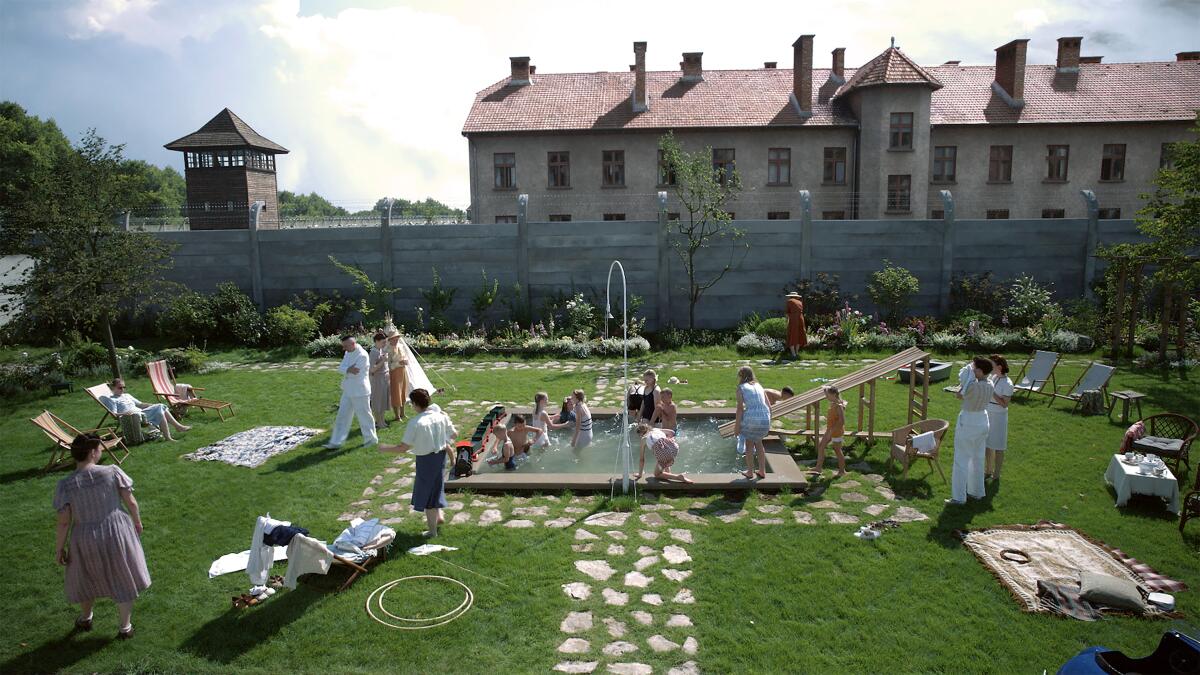
Jonathon Glazer’s acclaimed film, The Zone of Interest, is about the commandant of Auschwitz, Rudolf Höss, who lives right next door to the camp, where he and his wife Hedwig have built an idyllic family life.

Based loosely on Martin Amis’s novel of the same name, it creates an incredibly effective picture of the casual barbarism. On Höss’s birthday, for instance, he holds a meeting with engineers to discuss plans for more effective crematoria at the camp, before being toasted by his fellow officers and enjoying cake with his family later that day.


Hedwig is more than happy to receive clothes taken from camp inmates. We see her try on a fur coat and, finding a lipstick in one pocket, try that too.


Her visiting mother muses, almost jokingly, whether a Jewish woman she knew, and whose book events she attended, had been sent to Auschwitz. And in a throw-away comment, she notes that she was out-bid for the woman’s curtains in a street sale.


It is the normalisation of the dehumanisation that’s vital for genocide.


Repeatedly, the camera tracks a figure down one length of the vast garden, alongside the wall of the camp, with its buildings, chimneys and guard towers rising above.


Hedwig happily takes her youngest child around the magnificent garden, introducing her to flowers, while in the distance, we hear the sounds of the camp.


Glazer didn’t want to show the inside of Auschwitz – and he doesn’t have to for the film to convey a real sense of horror.


Sound designer Johnnie Burn put together a 600-page document in order to understand the camp layout and witness statements, together with a sound library that included the sounds of crematoria, machinery, historically correct gunfire, cries of pain and trains.


It is a soundscape that means however perfect the Höss family’s life looks, the viewer can never see it without being reminded that it happened within earshot of industrial mass murder – and that they all choose to ignore this.


And then there are the two central performances. Christian Friedel as Höss is so utterly engrossed in work that it is a mission – no matter the horrific reality of it, and Friedel portrays him as cold when on that mission, yet a dedicated and loving father. Sandra Hüller as his wife is also superb – little wonder that she has picked up a raft of award nominations – as a woman who is happy to bring up her children in such proximity to mass murder.


Łukasz Żal’s cinematography is deceptively simple – almost ‘flat’. Yet the look works incredibly well.


Glazer – who also wrote the film – has received nominations too. The film itself has already picked up awards, including the unique double of best British film and best film not in the English language at the recent Baftas.


Burn, together with Tarn Willers, have also been rewarded for the sound.


It is in many ways a very calm film, but most certainly not a comfortable one. It is, without doubt, an extraordinary piece of filmmaking that will not be easy to forget.