Showing posts with label Joël Robuchon. Show all posts

Sunday, 28 December 2014

Christmas fodder – with last year's lessons learned


Pheasant two ways, with sauce, leeks and redcurrants
Last year, Christmas Day proved to be – in culinary terms at least – something of a catalogue of errors.

Over ambition led to The Other Half spending a ludicrously long time sitting on his own at the dining table as I stressed out in the kitchen between every course, trying to produce dishes that, if not beyond my skill level, were far too ambitious in terms of planning.

And of course, needless to say, my own enjoyment of the meal – and of the day as a whole, and of the days, given my frenetic running up to the main day itself – were all affected negatively.

So how did I avoid that, without compromising on quality and taste?

The big thing to learn is planning.

This year, I started from a point of Christmas Day’s main course as being a chicken, roasted for three and a half hours, as per the River Café and as I’ve done many time previously.

Okay, I changed the stuffing from a Mediterranean-style one to pre-cooked chestnuts, masses of sage and a chopped onion, but the method was one I knew well.

The Other Half had been angling for me to try a chocolate fondant as dessert: we’ll return to that later.

For a starter – well, I wasn’t even sure about doing one, until very late in the piece (the Saturday before Christmas) when I happened on some London gin-cured duck charcuterie on Broadway Market from the London Charcutier (find out more via@LDNCharcutier on Twitter).

No, it wasn’t cheap, but it screamed an easy, high-quality starter. I already had a load of pickles in the cupboard and I could instantly envisage serving it on my oblong slates. All it would need besides was bread.

Now for me, Christmas Eve screams game. The weekend before, since they had no breasts, I’d picked up a whole pheasant from the new Broadway Market game stall (glory hallelujah!).

Now it’s a nightmare trying to roast such a bird whole because of the different cooking needs of different parts of the bird – which is why chefs do different bits separately – so I quickly came to the conclusion that I could do the breasts in butter (as I’ve done many times now) and the legs as a confit.

Bt this still left me with the interesting challenge of butchering the bird.

I swotted via the internet: most was simple, but I discovered that one of the reasons the legs can be so difficult is that the muscles in them make them tough.

You can, though, remove the muscles – and I have the Wüsthof cooking tweezers for the job. It was fiddly – yet oddly fascinating: how many of us know what muscles look like?

The upper leg bones were snipped out and they rest was salted for half an hour.

That was then brushed off and the legs were simmered in duck fat for two hours. Easy. To serve, they were simply heated in a medium oven for 20 minutes.

On the side, were leeks, a sprig of redcurrants and a red wine and redcurrant sauce.

But what I also set out to do on Christmas Eve was try fondants.

Duck charcuterie and pickles
I have recipes by Michel Roux Snr and Raymond Blanc.

The former – which demands vast amounts of eggs – gives no help on how to time it in terms of a wider meal.

Blanc, however, does precisely that, providing a method of mixing that allows you to then chill the mixture for up to 24 hours or cook within a couple.

This won out. I made the mix according to Blanc – it requires far fewer eggs, but does need arrowroot – and then divided it between four rings: two for that night and two for Christmas Day itself.

After a required chilling of at least 30 minutes, the first pair were cooked at 190˚C (fan) for five minutes and then cooled and chilled, before being cooked again for eight minutes at 170˚C (fan) when we needed them.

They collapsed slowly when the rings were lifted away after the first cook, and were not actually liquid in the middle, but they were were thoroughly tasty.

Lesson learned though: the initial cooking needed to be at a higher temperature – since there were no notes on the recipe I used (an online version of a slightly more complex one in a book on the shelf) I had assumed that the temperatures for the cooking were for an ordinary oven.

Anyway, the pheasant was good and the fondant, although floppy, was very morish.

Christmas Day itself was the easiest it’s been in years.

Christmas roast – with neatly turned carrots!
We had a proper breakfast this time – I didn’t need to occupy the entire kitchen for the entire day – and having two ovens and a separate grill was also a help.

The bird was the expected doddle. On the side we had spuds roasted in a little duck fat with a few leaves of sage to continue flavour themes.

Sprouts had been done in the morning à la Joël Robuchon: soak for two minutes in water with a glug of malt vinegar; drain and rinse, then blanch for a minute in boiling salted water.

Refresh and stop the cooking by plunging them into iced water, then cook for 20 minutes in fresh boiling, salted water, just allowing the water to bubble.

Plunge once more into iced water and then drain and gently dry. Robuchon says that this method improves the ‘digestibility’ of the sprouts, Or the fart factor, as we might less politely refer to it.

It does – but it’s also a very good cheffy trick for being able to cut down work later on. Come the time, just heat some butter and sauté the little emerald gems – as I did, with some sliced pancetta and more chopped chestnuts.

The only other thing I added was a portion of carrots, which I prepped early, actually managing to turn them, and then cooked very gently, with water to cover, a knob of butter, a pinch of salt and a pinch of sugar, for 30 minutes while we ate our starter and I finished the rest of the main.

Collapsed – but still tasty. The fondant
That starter was easy: slice some bread, put some of the charcuterie on a slate with some pickled beetroot, cornichons, tiny onions and some very nice fig, apple and Balsamic chutney, and it was done.

Before doing the roast potatoes, I’d given the fondants their first cook, which then allowed them the minimum chill between sojourns in the oven.

They still collapsed when I was actually trying to serve them, but did have a liquid centre. More arrowroot may be required. We had cape gooseberries, redcurrants and a small amount of top-quality vanilla ice cream on the side.

And on Boxing Day, the usual boiled ham with a sour brown shallot sauce, which was hardly onerous, and which was served this year with plain boiled spuds and sauerkraut on the side.

So, that was the Christmas food: lessons learned, ambitions tempered – and results just as good (if not better) and certainly more enjoyable for all.

It can be done!


Sunday, 17 November 2013

Put some squeak in your bubble


Bubble & squeak balls, with sausages & mustard. Yummy
Bubble and squeak may not be a dish of great visual beauty, but by gum, it’s a treat for the taste buds.

And it should, by rights, be an absolute doddle to make.

After all, what could possibly be difficult about some leftover spuds, some leftover veg and a pan with some melted fat?

Well, that’s the stage at which mine gets problematic – the bit where, after heating the fat, you squish the squeak into the pan.

Okay – that’s not the problem: the problem is turning it over or out. It won’t. It simply collapses. I don’t know why – I have followed the recipe in my Two Fat Ladies cookbook to the letter, but it never turns out properly.

Now I have no idea whether this is a universal culinary enigma, but I have found a solution – and it’s every bit as tasty as any other.

But before we get to that, let’s discuss a related issue: sprouts.

What is it with the British? We eat loads of these delicate, gem-green cabbages – not least at Christmas – yet so many people detest them.

Is it a condition of national masochism? ‘Oh, I don’t like them but you have to have them at Christmas.’ Why – not least at that time of year – would you eat something that you don’t like?

That aside, they may get a bad rap for causing flatulence, but that doesn’t seem to have put huge swathes of the population off beans.

Perhaps it’s a generational thing, where early memories are of so many vegetables boiled to a grey pulp that lacked in texture or taste?

Indeed, it’s worth noting that peculiarly British obsession with cooking vegetables ‘al dente’ – or as it often means on these shores, barely bloody cooked at all.

On the latest series of Masterchef: The Professionals, Michel and Monica have already faced undercooked vegetables at least once – and presumably they have a clue what they’re on about.

But maybe it’s a reaction to that overcooked cabbage.

Personally, I’ve long loved sprouts, but in the last couple of years I’ve found a cooking method that seems to make such a radical difference that The Other Half enjoys them more now too.

So, thanks to Joël Robuchon – another French gastronomic giant who can be assumed to know what he’s on about – here’s a wonderful method.

Take your sprouts, trim the stalk and remove the outer leaves. You don’t need to make an incision at the top though; it makes no difference.

For four people, as an accompaniment, use 400g sprouts and put a litre of water on to boil with a teaspoon of course salt.

Pop them in a bowl of cold water with some malt vinegar – two tablespoons to the litre – and leave for two minutes.

Rinse and drain.

Once your water has reached a boil, pop them in and cook briskly for a minute.

Remove into a prepared bowl of iced water, leave for a minute and then drain.

Bring another litre of water to the boil with the same amount of salt and, when that’s just bubbling, pop in the sprouts.

Simmer for 20 minutes – but don’t let the water bubble vigorously this time: gently does it.

Fill another bowl with iced water and pop the cooked sprouts straight in that, drain and then lie out on paper towels or a clean cloth.

When you’re nearing serving your meal, melt around 15g of butter in a pan, add the sprouts, turn the heat to low, add two pinches of salt and one of pepper, and cook, turning gently, for five minutes.

Now you’re probably going to roll your eyes and say: ‘what a fuss’. But one of the advantages of this rather cheffy way of doing them is that you can prepare them well in advance and then just finish them off quickly – which is particularly perfect if you’re a sprouts-on-Christmas-Day kind of person and are juggling loads of thing in the kitchen for the year’s biggest meal.

It goes without saying that, on that occasion, you can also add some diced bacon or some chestnuts to the final cooking in order to ratchet up the festive taste.

But back to good old bubble and squeak, when all of this will already have been done and the vegetables are sitting rather mournfully in a dish feeling not simply left over, but forgotten (it’s worth making extra in the first place just so you have enough for such a ‘left-over’ dish).

Take your sprouts and your spuds and mash them together, with a little extra seasoning if needed.

Heat a generous amount of lard in a frying pan. Yes – lard. This is no time to think about anything as dreadful as marg or even oil, which wouldn’t give you those wonderful crispy bits. And butter can burn too easily. Lard it must be. Or dripping, obviously, and if you have a surfeit and feel posh, then you could probably get away with duck fat.

So heat whatever lovely fat you choose.

And in the meantime, roll your mashed mixture into balls – around the size of a large plum: make them as smooth and as compact as you can. If the mixture is a little dry, add some melted butter, and you may wish to add further seasoning – plenty of pepper anyway.

If you have time, pop them in the fridge for a few minutes to firm up a little.

Then roll them in plain flour and into the hot fat they go. Don’t roll them around too much or too quickly – you want those crispy bits, after all.

Okay, they’ll still leave a little behind in the pan, but nowhere near as much.

And if that doesn’t really make your bubble squeak, then nothing will.

Thursday, 7 November 2013

Something for the weekend – or midweek


A classic veal blanquette (not mine)
Veal is making a long overdue comeback, now that people realise that it’s not all raised in crates and that, if you use dairy, then it is an inevitable byproduct of farming that would otherwise be wasted – and the calf have no life at all.

So it’s the perfect opportunity to explore ways of cooking this delicate but tasty meat – and in ways other than as a wiener schnitzel.

Perfectly fitted for such a culinary experiment is the veal blanquette, a classic French ‘white stew’, where neither the meat nor the butter that it is sealed in are browned.

“Because this is a classic ‘white stew’ there is a prejudice to serving it with any items that would add color (ie carrots or peas),” claims Wikipedia.

Which is somewhat erroneous, given the recipes that exist by some exceptional chefs who presumably know.

In French Country Cooking, for instance, those culinary slouches, the Roux brothers, include quite a lot of vegetables. As does Joël Robuchon in The Complete Robuchon. And so too does Bruno Loubet, in the recently-published Mange Tout.

For Loubet in particular, there are carrots and lots of celery, together with the green part of a leek or two, plus chervil.

So even if you say that the traditional onion and button mushrooms are entirely in keeping with the whiteness, there’s still colour to be seen, and to be seen rather clearly.

It was Bruno’s book that inspired me to finally try a blanquette and indeed, this is not a fine dining restaurant dish for him, but something that his grandmother used to cook, while for the Rouxs, it’s packed with memories of their grandmother.

Not that it won’t have been served in some rarified culinary environs: Escoffier, somewhat predictably, provides more than a single recipe, while a look at Larousse Gastronomique reveals that there are several other blanquettes, including lamb and monkfish.

I used Bruno’s recipe to guide me, but I’m not going to detail that here, beyond saying that he uses lots of celery, because his grandmother did, and that if you can’t find chervil, flat-leaf parsley makes an entirely acceptable substitute.

I’ll say it now – if you’re looking to buy a cookbook for Christmas, I really do recommend Bruno’s book.

The monkfish version is much quicker, but as I’m not a believer in undercooking vegetables, this really means that you need to do it in two parts.

So, for my version of a monkfish blanquette

Heat some butter gently in a pan, and add chopped carrot, onion, garlic and celery, and let it all cook gently until the vegetables are softened, but without colouring.

Sprinkle a little plain flour over and stir to cook for about a minute, before starting to add chicken, fish or vegetable stock, little by little, until the sauce has stopped thickening quickly.

Pop a lid on and leave to gently cook for about 20 minutes or so, until the carrot is starting to get tender.

In the meantime, heat some more butter in another pan and seal your monkfish, which has been cut into pieces, but remembering not to colour.

When the carrot is starting to get tender, add the fish and some button mushrooms, pop the lid back on and give it around 12-15 minutes.

Check the fish is cooked. Check the seasoning and adjust if you need to.

Take it off the heat and stir in some really thick cream. Pop it back on the heat and allow everything to warm through thoroughly, before giving a squeeze of fresh lemon juice to just add a little edge.

Serve with plain or basmati rice to keep the white theme going – and to mop up the juices – and a garnish of chopped parsley if it takes your fancy.

And there you have it – a very simple blanquette that could also be done with any meaty piece of white fish, and which makes a hearty and healthy midweek dinner.

Thursday, 11 October 2012

Keeping well fed


Eggs taking centre stage.
Knowing what a good-hearted bunch you all are, it occurs to me that some of you may be worried that I’m currently eating poorly – or at least less enjoyably – than previously.

Well, you need have no fear on that score.

Eggs – good eggs – are a delight, and for breakfast, they have to be better than some ‘bread’ product and whatever filling is available, or even a bit of Chorleywood toast and some spread.

Likewise, lunch is often now centred on fish or cheese. And you know me – I love both.

Tinned sardines (olive oil only) are not to be sniffed at, while proper smoked mackerel is something I love. Now, it’s as though I actually have more opportunities to eat such things.

And oh, I have discovered that Ocado supply tins of duck confit from the south west of France: the only ingredients are duck, duck fat and salt – exactly as it should be.

We had some on Monday night, with a few baby new potatoes (a tin) drained and rinsed and dried, then finished in a little of the duck fat (the rest gets stored in a tub in the fridge).

The duck goes in the oven at 160˚C (fan) for around half an hour – for half of that, it was joined by a tin of rinsed and drained cannellini beans.

If you think that beans and duck sounds a bit bonkers, then think of a cassoulet, where they come together with other ingredients to create a perfect dish.

But on Monday, we also had some red cabbage, done as per Joël Robuchon: slice thinly and blanch in boiling, salted water for two minutes. Drain and plunge under cold water. Then cook in more boiling, salted water for 15 minutes.

You can then drain and cool again, finishing in a sauté pan with butter when you’re almost ready to serve, but I served (with butter) straight after the second boil.

Robuchon says that the blanching improves digestibility. Well, I don’t know about that, but I do know that this method produces a super result – cabbage that is tender but still retaining texture.

I had just a very few of the potatoes.

On Tuesday, it was lamb chops, grilled, and served with carrots and peas. For The Other Half, I did a few potatoes, but I decided to forgo them myself and see how I felt.

Now I love potatoes, but the result was undeniable. What I have, in the past, thought was ‘fullness’ could well have been bloatedness. Because on Tuesday night, without any starchy carbs in my main meal, I felt sated but utterly unbloated.

Now that I’ve recognised this, the difference is really quite dramatic.

Don’t get me wrong – I’m not saying I’m not going to eat potatoes or pasta or rice again, but it seems sensible to think of limiting them.

But two more things have struck me.

Shopping earlier on Tuesday, I was hanging around in a shop while they refilled by washing up liquid bottles, and I spotted some Suma organic tinned sweetcorn.

I was instantly tempted – I love sweetcorn – but suddenly I remembered something. Corn – that’s a bit like wheat, isn’t it? And I cannot digest sweetcorn. I know this because, to put it as politely as possible, it exits my body in pretty much the same condition as it enters it.

The second moment of revelation came yesterday at lunch time. The Other Half and I usually have a couple of lattes at a local café. I have no sugar or sweetener.

But for various reasons, this afternoon was the first milk I’ve had, at all, since last Thursday.

Now I’ve noted before that those two glasses of milky coffee would leave me feeling ‘full’, but today I realised that it’s the same bloatedness. Perhaps the very fact that it’s been almost a week since I last had milk accentuated the impact, but it was certainly there.

And when considered in light of that Mars attack, it makes more sense.

Am I becoming a faddy eater almost overnight?

I don’t think so.

I have heard – although I have nothing to back this up – that whole milk is the form of cow’s milk that human’s can most easily digest. In his most recent book, Dr John Briffa says that it’s more digestible if it’s raw (unpasturised) or if it’s sheep or goat milk.

It’s increasingly easy to believe this.

The evening’s dinner was just as easy: minced beef, onion, a tin of (organic) tomatoes; a dash of HP sauce, a dash of that Daylesford organic ketchup again; voila!

It’s becoming clear from conversations with a number of people that I’m far from the only person to have noticed such responses to certain foods.

It does, however, beg the question of just how many people experience similar things, but don’t realise that fullness and bloatedness are not one and the same thing and have simply become used to the latter.

Sunday, 29 January 2012

Cometh the hour, cometh the cassoulet

It was July. The weather had been mixed as we had trundled from Bordeaux to Carcassonne by train. It was late afternoon when we disembarked, with no obvious method of getting to the hotel other than Shanks's Pony, so we walked, using iPhone 'sat-nav' to guide us.

After checking in, we'd walked over the bridge to the village that lies beneath the plug of rock that bears La Cité itself. Everything was shut. Reluctantly, we adjourned to the hotel restaurant and, expecting nothing to match the view as night descended on the ancient city, ordered cassoulet.

It went way beyond our expectations. We'd had the tinned stuff before, but this was a first 'proper' taste of a treasure of French regional and national cuisine.

Two days later, when we boarded a train for the mountains, we took with us a carefully wrapped cassole, the traditional earthenware cooking pot for the cassoulet.

Back home, in the autumn, I laid in duck confit, but the haricot bean - at the heart of this hearty dish - proved elusive. And then, just as the weather started its dip to the sort of temperatures one could expect in January in northern Europe, I found some.

The moment had arrived.

Cassoulet was, the great cook Prosper Montagné declared, "the god of south-western food" in France.

Initially, it would have been made with fresh broad beans, until white beans arrived from across the border in Spain in the 16th century. And the haricot had since become the established bean for the dish. It remains arguably one of remarkably few absolutely crucial ingredients.

This culinary adventure began in seemingly sensible manner - checking recipes in my own library.

I turned first to the version in Hot Sun Cool Shadow by Angela Murrills; then to one in Goose Fat & Garlic by Jeanne Strang and yet another in Paula Wolfert's The Cooking of South-West France.

Stephanie Alexander had produced her own version in Cooking & Travelling in South-West France, which was the last of my collection of books dedicated to that area - and, as far as I know, the only ones published in English.

If I was getting a little dizzy by now, it was but the start.

In French Country Cooking, the Roux brothers used pork and lamb and no confit. Joël Robuchon's version includes lamb shoulder and lamb neck, and involves topping the final dish with crushed melba toast mixed with parsley, which sounds close to heresy, if you ask me.

Bruno Loubet presents a simplified version in Cooking from l'Odeon, to be cooked not in a traditional earthenware pot, but in something like Le Creuset and presented at table in exactly that.

In The Complete Guide to the Art of Modern Cookery, Auguste Escoffier gives instructions for a cassoulet dominated by mutton and with the option of "goose or chicken".

In European Peasant Cookery, Elisabeth Luard's version is informed by her year living in the Languedoc and the instruction of her neighbour there.

And of course, we cannot forget the divine Mrs David, whose French Provincial Cooking goes into some detail about the history of the dish, as well as providing relatively straightforward instructions from a period when Toulouse sausage was something you could only hope to find in a very limited number of shops.

Culinaria France crams it all into a very terse recipe, while The Food of France, like Murrills, simplifies.

Larousse Gastronomique prefers far more detail, and quotes Montagné as having said that cassoulet could be divided into three types - a 'Trinity'.

The 'Father' came from Castelnaudary. The oldest version, it included pork - loin, ham, leg, sausages and fresh rinds - with "perhaps some fresh goose".

The 'Son' of Carcassonne used leg of mutton and, in the shooting season, partridge.

The 'Holy Ghost' of Toulouse uses the same ingredients as in Carcassonne, but in smaller quantities and with the addition of "fresh lard, Toulouse sausage, mutton and duck or goose".

These are the main versions, but as Larousse makes clear, it is far from being a finite list. There is even a salt cod version, with the fish replacing the duck or goose.

But while this so clearly reveals its peasant roots, the French being the French, there has had to be some formalising of what was already a classic - well beyond its home region - into an institution.

In 1966, the États Généraux de la Gastronomie française decreed that a cassoulet had to be made up of at least 30% pork (which could include sausage), mutton or preserved goose, together with 70% haricot beans and stock, fresh rinds, herbs and flavourings.

All of which still leaves things about as clear as mud for the beginner.

So, which path did I follow?

In the end, it was largely Luard, with hints from Robuchon and David.

Prep had started yesterday with the beans. I usually use tinned ones, so I was grateful to read on the packet that 40g of dried haricot would turn into 80g of cooked pulses, which is generally regarded as a 'portion'. Seeing 80g weighed out, I decided to add another 20g for good measure. These was then decanted into a bowl with plenty of cold water and left overnight.

And so to this afternoon.

The pulses were rinsed, drained and popped into a large pan with plenty of cold water, a peeled and sliced carrot, a stick of sliced celery, an onion studded with two cloves, a sachet of bouquet garni, six crushed garlic cloves and the small amount of pork fat Matthew had been able to give me yesterday.

It's heated quickly and then, just before it starts to boil, the temperature is reduced to leave it barely simmering. And so it stays for an hour.

In the meantime, the meats are prepared. Now, this was dinner for two people with smallish appetites, so I'd got a small piece of lean pork, which I diced, plus two Toulouse sausages.

One of the confited duck legs was placed, dripping, into a frying pan, where it gave off all of it's coating of creamy fat, before being removed to a plate. Then the pork and the sausages were fried in this fat, together with another four crushed garlic cloves.

The duck leg was stepped of its flaking meat; the sausages were sliced thickly. A diced onion was cooked in the fat after the meats had all been removed.

Don't throw the fat away - you need it later.

Next up, skin, deseed and chop a large, beefy tomato.

Heat your oven to 120˚C.

When the beans are ready, strain. Get rid of the vegetables and bouquet garni. Keep the pork fat.

Take your pot/casserole and put the fat in the bottom, fat side down. The theory is that, starting with some beans, you layer the ingredients. For just two of us, that meant a layer of beans, then everything else forming on thick layer, to be topped with more beans.

Oops. A problem. There were nowhere near enough haricot to top the dish. It was rather too late to contemplate a minimum four-hour soak for more beans, followed by an hour simmering.

I cheated in the only way possible, rinsing of a tin of cannellini beans and using them to fill in the gaps.

The dish is covered (with foil, if you don't have a lid) and placed in the oven for two hours. Check a couple of times and, if the beans look a little too dry, add a little boiling water.

After two hours, remove from the oven and turn up the heat to 160˚C. Spread a layer of breadcrumbs over the top and drizzle with the melted goose/duck fat from the duck confit that you'd reserved.

Leave the lid off and pop back in the oven. Give it 30 minutes, by which time it should have a nice, golden crust, then remove and stir the breadcrumbs gently into the beans. Back in the oven it goes for at least another half an hour.

The key here is patience. But every 10 to 15 minutes, give it another stir.

This breaking the crust is considered to be really authentique: they do it seven times in Castelnaudary and eight in Toulouse. It's now been set at three times in Hackney.

Remove, serve and eat.

For a first effort, I was very pleased. It wasn't perfect - the shortage of haricot being an obvious point. But I'd also be inclined to increase the initial bean cooking time by 30 minutes, as suggested in at least one recipe, to ensure they're just a little softer.

And the pork and sausages need to be cooked initially for a shorter time but at a higher heat.

But that apart, I was chuffed. My first effort was no insult to the lovely, half-glazed dish that has graced the kitchen since our return last August. And it certainly won't be long before I give it another go.

Monday, 9 January 2012

Some educative cooking

In his book, A Life in the Kitchen, Michel Roux Jr comments on the danger of basic losing culinary skills. Developing his theme, he suggests that, while anyone can make a dessert from a recipe, a declining number of people really know how to cook meat or fish.

He has a point. There’s an extent to which much baking and patisserie, for instance, has such a near-scientific precision that it’s not impossible to simply follow a recipe carefully – although that doesn’t mean that no skills are required and no calamities possible (as I’ve found, more than once).

But where and how do you learn those things about cooking meat? For instance, where you learn how to test for doneness with your finger?

Browning meat properly and getting a maillard reaction is more difficult than it seems – or certainly if you haven’t been brought up simply knowing how to do it as a habit so it becomes instinct.

I made some steps forward this last year – not least on getting a maillard reaction. That was massively thanks to Raymond Blanc, as I’ve explained here more than once. And his advice is illustrative of why it’s possibly difficult to learn such things – because the key is to engage more than one of our senses when cooking, and it takes a bit of practise to learn to do this and then to remember to do it every time. Well, it does for me!

But with all this in mind, I’d already decided that I would try to improve some apparently basic skills this year.

First up – fish. Now I love fish, but frequently feel that I’m not much cop at cooking it – and that it’s easy enough to mess up. Meat is a tad more forgiving.

But what had started to dawn in the final months of last year had been the realisation that it also helps if you cook something regularly – not just once every couple of months.

Because of those feelings of piscine inadequacy, I had rather lapsed into cooking fish less frequently. When I did, the emphasis was on poached salmon or pan-fried tuna, with very occasional sole or plaice, grilled with a little butter.

But in recent months, after reading Nigel Slater on the subject, I’ve made a couple of attempts to pan fry cod – with largely improved results.

So on Saturday, taking a lead from Joël Robuchon, I tried the same approach with salmon.

It involved slashing the fillets on the skin side, to just beneath the skin. Then seasoning – and then frying in a small amount of hot, neutral oil for three minutes on the skin side and then a recommended one on the other side – with an allowance that if you want it a bit better done, a further minute is acceptable before it is overcooked.

Such precision in instructions can really help. The result was not bad at all – far better than the last time I attempted to pan fry salmon.

It was served on a bed of Savoy cabbage, which, like sprouts, gets the blanching treatment by Robuchon. Cutting the cabbage up – removing the leaves one at a time and then slicing the core out – it dawned on me how many people probably don’t do that, but then boil it either not enough to properly cook that tough stalk or too much for the more delicate leaf.

The blanching process also helps keep a vibrant colour. After its pre-cooking, the cabbage is squeezed dry and later, cooked for a few minutes in a little butter, before having seasonings and crème fraîche added, lending it a buttery quality, but without too much sweetness.

With a sharp sauce of sherry vinegar, white wine and shallots, finished to glossy glory with crème fraîche and a little butter, this was a pleasing dish. And one that I felt I learned things from.

Continuing the educational theme, for Sunday, I’d bought a leg of lamb. I usually use Delia’s timings – which mean 30 minutes at 190˚C (fan oven) and then 30 minutes per 450g at 160˚C.

I had considered taking Robuchon’s instructions – a much shorter cooking time at a much higher temperature (240˚C – ordinary oven) – but chickened out on the basis of my fears about my oven’s apparent ability to cook things in the time given in some recipes.

However, I did put some lamb trimmings in the roasting dish, and oiled and seasoned the meat à la Robuchon, using sprigs of thyme instead of my old standby of rosemary.

When it was done. I left it on a rack to drain, seasoned with a little fleur de sel, under a tent of foil for 20 minutes, while I finished off everything else.

The trimmings are removed from the roasting tin, together with most of the fat. Add eight tablespoons of water, stir round to scrape any meat from the dish and pop back into the oven, which you’ve turned off.

By the time your meat has rested and you've plated up, you’re left with a very pleasant jus.

In the meantime, there were a couple of potatoes to purée and some sprouts to finish, à la Robuchon again. Getting them to within five minutes of completion earlier in the afternoon was a helpful prep thing. To the pan of seasonings and melted butter I also added four halved artichoke hearts.

And remember what I mentioned a few days ago about how Robuchon asserts that such a process helps digestion? Well, yet again, there was none of the 'traditional' after effect of sprouts. Perhaps he's right? Even ignoring the fart effect – or lack thereof – they taste great: cooked properly, yet with some bite left. Love it!

To finish, I’d made a little sauce, simmering redcurrants in a little water and with a tiny amount of sugar and a couple of sprigs of thyme until it was fit to strain through a sieve.

It was completed with a touch more sugar and some drizzling Balsamico, and then gently reheated just before serving. And very pleasing it was too, contrasting very well with the sweet meat and also adding a shot of vivid colour to the plate.

It wasn’t from any specific recipe, but what gave me a lot of satisfaction was that making it suggested I’d inwardly digested a couple of skills and also some sense of flavour and of combining flavours.

The lamb, I have to say, was wonderful, with utterly glorious fat – crisp and sweet and light as air. Personally, I had just two smallish slices – the fat makes me feel so delightfully sated so quickly. And there's loads left for the coming days.

I will try roasting lamb the Robuchon way – and if I do it relatively soon, so that hopefully it will mean that I can remember this one well enough to understand the differences and make comparisons.

Education is good for you. Good food is possibly even better.

Wednesday, 4 January 2012

Going German in the kitchen again

With the new year now well under way, it’s nice to find something different to eat.

Boxing Day left behind it a wake of ham: a boiled ham with sour brown shallot sauce is our one guaranteed Christmas eating tradition – and the only one with big left overs.

We started with ham, with jacket potatoes and pickles on the side – the pear chutney I’d made back in September was finally opened and proved to have lovely depth of flavour.

Then there was ham, egg and chips – with the latter cooked in dripping from Mary.

It's worth pointing out (again) at this point that real chips are just so, so much better than the frozen ones – and cooking them now involves no more hopeful cubes of bread tossed into the fat to see if it’s hot enough. This time, I remembered that one of my cook’s thermometers would tell me exactly the right moment.

Ham, of course, can go between slabs of bread. And it can sit on a plate with sautéed potatoes and carrots à la Robuchon.

These are sliced no thicker than 0.5cm and cooked gently for 25 minutes in a pan with butter, sugar, a pinch of salt and water just to cover, and topped with a disc of parchment paper that’s cut to shape and has four holes speared into it.

The disc is then removed and the cooking continued at a slightly higher temperature for a further five minutes.

And then there are the pickles again.

By which point, one is getting a tad bored of ham – thank goodness it’s now done!

And what better way to celebrate the end of something that started with a German dish – that sour brown shallot sauce gets a mention in Thomas Mann’s Nobel-cited Buddenbrooks – than with another German dish?

Indeed, some of you may have spotted that, for all my love of French food, lunch on Christmas Day was a bit northern European/Baltic in fashion.

Much as I am a Francophile in so many ways, the older I get, the more I feel a sense of northern-central European roots.

So today was the perfect time for herring with a bacon gravy – or Hering mit speckstippe as it is properly known.

It is a dish that I was introduced to some years ago by George, and it combines sweet with sharp quite beautifully. It's also enormously comforting.

Dice some streaky bacon – smoked or not, that’s your choice.

Take an onion or two and chop to similar-sized dice – not too small, because you don’t want this all to melt away.

Pop these into a pan with a little fat and cook very gently until they’re soft and caramelised.

When he ontroduced me to the dish, George suggested vegetable oil: I suspect he realised that, at that stage in my culinary development, lard would have been a step too far.

Serve over plain boiled potatoes and herrings decanted from the container you bought them in.

I used Mrs Elswood's sweet herring fillets (£3.99 for 500g). You'll often find them in the kosher sections of shops.

The bacon was unsmoked (12 rashers for £1.85). I used six.

I admit that the onions were a bit of a treat – I'd spotted Roscoff onions in La Bouche just before new year and bought a string; many chefs recommend them. Okay, not as cheap as your usual onion (they actually have AOC recognition in France), but boy, are they gorgeously sweet!

So was it good? Was it ever!

It's a magnificent, simple dish – but not one you're likely to find in any cookbook. And thus I have George to thank for telling me about it in the first place – and thus being allowed to spread the word.

I did some frozen peas on the side too, so that it provided two portions of fruit and veg for the day, plus loads of other goodies. And as illustrated above, it's not expensive.

But it really is a wonderful dish.

Monday, 2 January 2012

Learning with the two Rs

One of the things that materialised in my Christmas stocking last year was a copy of Michel Roux’s new volume, Desserts.

With Sauces, Eggs and Pastry having already more than proved their worth in the kitchen, this was a most welcome addition – and it didn’t take long before it was being put to practical use.

The first experiment hardly seemed particularly challenging – individual, cardamon-scented rice puddings with caramel.

Rice pudding has been on my to-do list for some time. I only have vague memories of it from childhood and, to be honest, can’t really remember whether those are of maternal efforts or of school dinners.

So there was an unopened bag of pudding rice in the cupboard, together with all the other necessary ingredients.

Suffice it to say that it was a disaster. Well, the caramel worked well enough – much easier now I have a proper thermometer so I can see what’s going on in the pan in terms of temperature (a boon too when I made chips a day or so later).

But when I went to decant them, the rice had sunk to the bottom, with the milk above, with only a thinnish skin on top.

The key problem, I think, was in mis-interpreting an instruction to cook the rice and milk gently as too gently.

But there you go: you learn by your mistakes.

The following day, I tried something different. This time, a pear and chestnut ‘minestrone’. Now I have no idea why M Roux called it that, but that's what it it is called.

The dish involved puréed pear with cinnamon, topped with diced, poached pear and caremalised chestnut pieces. The nut was perhaps overdone, but the pear was lovely.

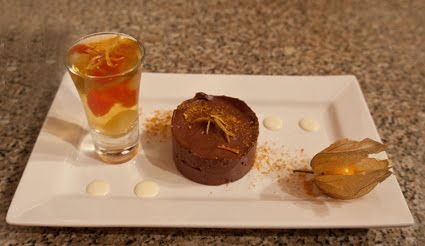
So for my next experiment, I moved onto jelly. Very grown-up jelly, it’s worth noting: it’s made from Sauternes, but with tiny pieces of citrus fruit ‘floating’ in it.

You soften the gelatine leaves in cold water and then, having squeezed them, add them to a small amount of your wine, which has been carefully warmed.

Give it 10 minutes and then add that to the rest of the wine and sit the bowl in a bigger bowl of iced water. Stir every two or three minutes and wait for it to start thickening.

In the meantime, you’ve segmented a pink grapefruit and a lemon, then cut the segments into smaller pieces and popped them into the fridge to chill.

The glasses I was using were already chilling in the freezer.

Commeth the moment when the wine has started becoming syrupy, it’s time to decant it into the glasses and start poking bits of the well-drained fruit into each glass with a knife or skewer.

I had a test glass ready too, so after the first attempt saw the fruit float back to the surface, I knew to leave it a little longer. When it’s ready, then getting the fruit where you want it is quite easy – and it looks lovely.

This was the starting point for the New Year's Day dessert. To go with it, I made another chocolate mousse - the same basic Roux recipe I'd used for Christmas Day.

Then it was simply a case of using more of the mandarin dust and the candied citrus peel, with a cape gooseberry to garnish and a few careful dots of double cream. Hey presto!

The jelly was very lightly set and had a sweet freshness, which contrasted well ith the bitter richness of the mousse.

But I also realised that learning from one great R was not enough – and decided that it was also time to start learning from another one: Joël Robuchon.

The Complete Robuchon has been on the shelf since last Christmas, but I haven’t invested the time needed to start really benefiting from it. It’s not, after all, a book with a single illustration in.

This holiday, I’ve spent a little time reading it. And the thing you start to realise quite early is that it’s not just haute cuisine. Indeed, far from it.

I tried a potato dish. Take your spuds, peel and then slice thinly – no thicker than 0.5cm. Rinse and dry them. For this one, you don’t want the starch.

Melt some lard in a pan – around 50g, so not just a tiny amount. Then you cook the potato in the lard, with lardons and a sprig of rosemary. Works very well.

But his recipies for vegetables intrigued me the most. After all, this is a man with a record 26 Michelin stars, so if he suggests an apparently complex way of poking sprouts, there's probably a reason.

The first thing I tried wasa rack of lamb for New Year's Day - but I should have either added a further 10 minutes to compensate for my oven or even switched it to grill or a final blast.

I don't like my meat overdone, but this was going to the other extreme, even though I'd followed the instructions of medium rare.

Mind, experience tells me it'll have been the oven - I just don't know how and what to factor in for any given dish: doing a créme caramel today, I had to give them an extra 15 minutes - but in that circumstance, you don't have other things waiting.

We saved half the lamb for today and I stuck it under a hot grill for five minutes, turning once, as the flesh cooked through properly and the fat crisped up from the rather jelly-like texture it had had. Indeed, it was utterly gorgeous - I don't know whether it had actually benefitted from being cooked in two stages over 24 hours or whether it was just a stunning good piece of meat. It was the first lamb I've bought from The Ginger Pig at Borough Market.

On the side, I sautéed some left-over potatoes - and then decided to concentrate some attention on Robuchon's sprouts.

After the usual prep, they spend about two minutes in a bowl of cold water with malt vinegar - two tablespoons to a litre of water. Then they go into boiling salted water for one minute.

Decant into cold water resting in a bowl of ice. Bring a fresh pan of salted water to the boil. Give them 20 minutes at a very gentle simmer.

Stop the cooking again by popping them carefully into icy water, then rinsing, draining and patting dry very gently in kitchen paper, before finishing off for five minutes in melted butter, with a couple of pinches of salt and one pinch of pepper - yes, the seasoning is that specific too.

Amazingly, given the cooking time, the sprouts were cooked but still with bite, as well as being very tasty.

Robuchon's says that some vegetables benefit from the blanching because it aids digestion. Well, I can only say that there has been no evidence of the notorious side effect of sprouts since dinner. So perhaps this approach has a serious point.

One thing's for certain - I'll be cooking with both the Rs again. And it won't be long before I do so either.

Friday, 31 December 2010

Forget the teeth – just chew!

Imagine a food that would make you forget everything else – even the discomfort of eating it. What would that food be for you – what would send you into such raptures that you'd forget anything else but the taste?

This isn't an entirely academic question. I probably wouldn't quite have realised it before yesterday, but blinis, warmed and topped with crème fraîche and lumpfish roe, is the sort of food hit that does it for me.

As explained some time ago, I'm currently in the middle of long process of dental treatment, tackling the results of the undiagnosed (and un-dealt with) gum disease of a couple of decades.

We're at the half-way point now, as I get used to a full set of gnashers up top for the first time in some years. They aren't wonky either – or at least not since I tried some fixative. Having said that, several of my remaining bottom teeth are most definitely wonky – and if anything, that's increasingly obvious.

But hey – we're on the way. And if you asked me, this time last year, whether I'd be this far down the dental road, I don't think I'd have even wanted to have the conversation.

So that has to be one of the most important things that happened to me in the last 12 months. Not just on a food front – although it's going to have a massive impact as the treatment progresses to its logical conclusion – but in other ways too. I'm beginning to be able to smile again, for instance – although if I see myself in the mirror doing it, I barely recognise the face looking back.

But setting all that aside, what have been the big experiences/lessons of the last year?

Well, the Orient Express was certainly an experience – although personally, I think that Venice was more affecting. And of course, to eat in Italy was a revelation.

Grilled sardines on a sailing boat off the Spanish or French (depending on who you believe) coast – perhaps that was culinary nirvana.

Bistrot Bruno Loubet gave me the best eating out experience I've enjoyed in the UK – a quality of food and cooking (and a price, come to that) that I've only experienced previously on the Continent.

Reaching a point where looking at a recipe by the likes of Joël Robuchon or Michel Roux or even Escoffier doesn't frighten the life out of me. I'm not entirely sure when that happened, but it does seem to have taken root. It doesn't mean I'm a good cook, but I think it illustrates progress of some sort, and a learning curve that hasn't ground to a halt a mere few metres after beginning.

My food photography has developed hugely this year – and here's another in the style I've been creating for myself.

Very Dutch Old Master, as someone described the style elsewhere.

The whole black background thing was an accident, but it works rather well, I think. Indeed, it does invoke those wonderful old still life paintings that you can find in the galleries. And I want to explore it much more.

Then again, I didn't start photographing food in a particularly serious way – so what I've done thus far is a real plus, and leaves me a real challenge on building on that.

On the wine front, I started to get a better understanding of what wine is about – and how to taste it. I have a long way to go – but what a pleasant journey lies ahead!

Finally, I think it started to dawn that on me that there is not so much of a divide between what we think of as everyday food and what we see as 'posh' food. The gap continues to narrow for me. How much I can personally bridge that space remains to be seen.

And as my rather light research illustrated toward the end of the year, it's something that has filtered into the mainstream eating life of this country, with many people falling for the con that they cannot afford quality – yet shelling out no small amount of cash for inferior food.

Entirely apropos of nothing that has just gone, I was down at Borough Market earlier today, for my final food shop of the year. Amongst various other things, I got some pressed tongue. It was, as it happens, the first thing I've bought from acclaimed butcher The Ginger Pig.

But 'lunch tongue', as I've always heard it described before, has long been something I've liked. On the other hand, after tasting this – from a stall that had full tongues for sale too – it could become something I love. The quality is just wonderful: moist and flaky and full of flavour. It'll all be gone before I have time to make an actual sandwich.

And so we near the end of 2010.

I'm not, at this stage, going to set myself a specific serious of challenges and tasks for the year ahead. I don't want food and cooking to become Too Serious. It should be fun – and always a pleasure, even a pleasure that you take pretty seriously. If it stops being a joy, though, you might as well just pop something into the microwave and watch the telly while you consume it, ignoring the question of its taste.

So to one and all of you – thank you for reading this blog. I can only assume that you're not a bunch of complete masochists, but that you do find something here to enjoy and amuse!

So have a wonderful 2011 – and the very best of eating to you all!

Wednesday, 29 December 2010

A French chef cooked WHAT?

Let's be honest. When you pick up a book of recipes by a serious chef – and perhaps particularly a chef from Frenchland – you do not generally expect to find a page devoted to explaining the best way to make ham and egg.

Okay, you might expect it from Heston Blumenthal, but then he's not French and besides, in his world, the eggs alone would involve frying the white and yolk separately.

But no: this is Michel Roux we're talking about and he has ideas about exactly that humble dish – and they work really rather well too.

The Other Half fancied ham, egg and chips and, seeing as we had plenty of ham left and I'm an obliging sort (some of the time), I decided to do just that.

But browsing through the Roux book on eggs (it's in danger of already becoming a household bible), I spotted that the man himself had written down a recipe for the dish I was intending to toss together.

Now, I don't know whether it's just me, but it would not even have crossed my mind to warm the meat. My approach would, simply, have involved plonking some cold-cut ham on a couple of plates, frying eggs and serving them atop the aforementioned meat. Simples, as the meerkat says.

But Monsieur Roux was having none of that. He suggests that you heat some butter gently in a pan, then warm the ham for a minute on one side, turn and gently place an egg (from a ramekin) onto each piece of ham and give it until it's cooked to suit your taste.

Taking account of his general instructions for fried eggs, I lidded the pan at this juncture, allowing steam to help cook the eggs. It's obvious when you think about it. And the result was excellent – eggs beautifully cooked, but not crozzled. Ham warmed through nicely.

On the side, chips à la Delia as is my usual – in other words, twice fried. And earlier in the day, I'd made mayonnaise for the first time. Yes, I've made aïoli often enough, but not 'original' mayo. And given the menu, I like mayo with my fries.

My introduction to mayo with chips wasn't in France, but some years earlier in Amsterdam – where you can also get sauerkraut with hot dogs as an example of really top street food. Once I'd tried the mayo option, though, I've been addicted to chips this way since.

Having long put off making my own mayo – the process seemed rather more complicated than that for aïoli – I decided to follow Joël Robuchon's instructions. Yet again, it seemed far easier than I had assumed.

Take an egg yolk, a teaspoon of mustard (I used a medium German one rather than Dijon), a pinch of salt and pepper and a few drops of any vinegar (a white wine one with tarragon, in my case) and then mix together. One of those hand-held electric whisks makes really light work of jobs like this.

Once it's all mixed together, start slowly adding a neutral oil (sunflower), just a little at a time. Once the emulsion has come together, you can add more, a little more quickly.

Mayonnaise is one of those things that does actually cost more to make your own than to buy. But having said that, what you get in a jar bears little resemblance to what you can produce yourself.

Decanting the unctuous mixture into a jar, I was close to scoffing the lot in the sort of foodie 'oh-my-god' state that is not a million miles removed from orgasm.

So, ham, egg and chips – the posh version. Or not, really. This latest batch of books is proving a revelation, starting to close a gap that exists in my mind between Good/Proper Cooking and 'ordinary' cooking.

Not that the day's fodder was all quite so down to Earth. The same Roux book also brought forth another dessert: this time, a chocolate and orange mousse.

In the morning, I actually left the flat and pottered up to Broadway Market – almost blinded by the natural (albeit rather grey) light – to pick up a few bits and pieces, including liquid glycerine from the chemist (The Other Half suggested I might find some there). It's the first time I've purchased a product that declares itself as being for "skincare and food preparation".

However, one tablespoon was added to two yolks and two tablespoons of warm water.

150g of good, dark chocolate is melted gently in a bowl over hot water, while 150ml of double cream is mixed with 30g icing sugar.

Then put the egg and glucose mixture into the chocolate mixture and, once that's combined, gently add the cream and sugar, decant into containers and chill.

Clever clogs here mixed the cream alright, but forgot to add the sugar (and probably over-mixed the cream itself too).

Now the original recipe also involved creating a syrup with the zest of an orange and putting a couple of 'layers' of this in with the finished chocolate mix, before topping with more of the same.

My deliberate deviation from the written word saw me scrub an orange to get rid of any wax (and release the lovely scent) and then finely grate it, stirring most of that into the chocolate mixture and leaving just a little to garnish.

It gave a wonderful flavour, although the mousse itself was so dense that it was more like a torte (probably either my forgetting the sugar, over-whisking the cream or a combination of both). But then again, I'd eat a chocolate torte with no complaint, so it was hardly to be consumed under sufferance!

So, the lessons of the day:

1) 'chef' food isn't all complicated and fiddly stuff that's just for 'special' occasions, while there's something else called 'ordinary' food for 'ordinary' days;

2) read the bloomin' recipe carefully – several times before you start and then carefully again while you're working from it!