Showing posts with label Courtauld Gallery. Show all posts

Tuesday, 5 May 2015

Goya's visions from a troubled mind

Mirth
Reading about art over the last couple of years, one thing that I’ve come to realise is that defining anything in the art world is rarely as easy as might first appear – and not least when you take into account tension between the academic world and the non-academic one.

That’s particularly the case in terms of ‘modern art’.

The question has long been asked as to what modern art is – or more to the point, when it started – and there are probably as many different answers as people who’ve asked it.

And since relativism is not the aim here, its important to note that some are simply based on unthinking and uneducated stupidity.

Only a week or so ago, I came across a response to a national newspaper art review where someone had dammed all ‘modern art’.

I admit to having posted a sarcastic riposte that, since many regard Manet as the father of modern art, the poster making the comment presumably considered Impressionism as a whole to be a load of old cobblers.

Just can't go on at the age of 98
Of course, what many people mean by ‘modern art’ is actually contemporary art – and even more specifically than that, non-figurative art and conceptual art.

But going back to the more academic approach – that the father of the modern was Manet (1832-1883) – that doesn’t mean that what he did came out of a vacuum.

We can see the roots of modern art in the likes of Turner (1775-1851); in the works of the much earlier El Greco (1541-1614) and in those of Goya.

Francisco Goya (1746-1828) was a Spanish romantic painter and printmaker, regarded as being both the last of the Old Masters and the first modern one.

While paintings such as The Third of May 1808 (1814) have become iconic, he’s not an artist that has made any great impression on me personally – to be frank, I cannot really recall seeing any of his works in life, although it’s probable that I have, since I’ve visited the National Gallery more than once.

Mother Celestina
But the Courtauld Gallery in London has recently been hosting an exhibition of some of his late work, which I’d noted in the autumn and fully intended to see.

It’s been the nature of the last few months that I had all but forgotten what was on in any of London’s galleries this spring. In the case of this Goya exhibition, it was only by chance – walking past Somerset House a couple of weeks ago – that I remembered and dashed in to ensure I caught it.

This is the first time that all the surviving drawings from the Witches and Old Women Album together since they were broken up after the artists death.

In 1799, Goya had published a series of 80 prints, titled Caprichios, illustrating what he described as the “innumerable foibles and follies to be found in any civilised society, and from the common prejudices and deceitful practices which custom, ignorance, or self-interest have made usual”.

One of a number of albums drawn in the last decade of his life, the pieces in Witches and Old Women Album – produced around 1819-23 – were, unlike the Caprichios, never meant for public consumption.

Working essentially for himself, Goya gave free rein to his creativity, inventing images that range from the humorous to the downright macabre.

I can hear snoring
These remarkable drawings act as a commentary on human hopes, fears and delusions – not least, the fear of aging and mortality.

There’s a dark bite to some of his visions. One drawing satirises an elderly woman deluding herself that shes still likely to meet and marry a dapper young man, while others portray witches carrying off or even preparing to eat babies.

Whatever the exhibition title suggests, though, the targets of these pieces were not limited to members of the fairer sex: there are plenty of men represented here too – including a number of clerical figures, and religion is certainly one of the themes that can be seen here.

The pictures are merciless and manic – yet among the darkness there are also scenes of joyfulness.

But whatever the subject matter, the drawings are deceptively simple, possessing great sophistication. And his use of washes is an education to behold.

Dream of a good witch

The exhibition as a whole includes other works by Goya that help to provide further context, but the core exhibit includes, as an example, the following: Just can’t go on at the age of 98 features an elderly man with two sticks.

It’s a sublime piece of work: just look at how few marks there are to convey so completely the subject.

Mother Celestina – a name that recurs – adds complexity, since Celestina is a Spanish name associated with a procuress/bawd, thus being one of the ways that Goya brought sex into the equation. In the picture I’ve used here, the character sits, waiting, grasping something – a pouch of money, perhaps?

The ironically-titled Dream of a good witch shows a hag bearing a bundle of babies.

I can hear snoring has an elderly man waking at the sound of his own snoring. Who hasn’t experienced that?

Mirth, on the other hand, portrays an elderly couple appearing to dance in a space. It’s a joyous image.

While She won’t get up till she’s finished her prayers presents us with an old woman praying with her rosary – and just look at the use of light and shade here.

She won't get up till she's finished her prayers
Goya was ill during the final years of his life. Some have suggested the cause was cumulative and severe lead poisoning, given the amount of lead white paint he used in his work, while other analyses since his death have pointed toward paranoid dementia.

Against such a background, it hardly seems farfetched to suggest that these works are not simply satires in the conventional sense, but also shine some light into the dark and troubled corners of the artist’s own mind.

In looking at pictures like these; in exploring darker aspects of human experience; in seeing the violence and the brutishness that some of them show, there is something that we can perhaps see as a harbinger of the modern world and art’s response to it.

That, though, plays to a view that the past was rosier than it was in reality.

But however you interpret the pictures, this is a fascinating exhibition that’s well worth catching if you have the chance in the next couple of weeks – and one where buying the catalogue genuinely pays dividends, because you really will want to look back at the pictures.

And the Courtauld should be applauded for bringing together the long-scattered pages of this album.


Thursday, 14 August 2014

Mona Lisa smile – please!

Have you ever wanted to take a photograph in a gallery – and found that you couldn’t?

While many museums and galleries do ban any photography, others don’t. Still others allow some – Tate Modern, for instance, will allow visitors to snap the permanent exhibits, but not the special exhibitions.

But the announcement that, in future, the National Gallery in London is to allow photography has inspired indignation from some visitors, and allowed the Telegraph to provoke a small measure of ire, as well as agreement, in an opinion piece on the decision.

In one sense, it’s quite amusing that publicising a quiet decision – made in part because it’s increasingly difficult for staff to know whether a visitor is using an electronic device to photograph an exhibit or look for information about it – might actually increase the likelihood of people now taking pictures in the gallery by raising awareness of it.

The issue, however, is not really about photographing exhibits, but in many ways, about what galleries are for and how we look at art and what we expect or want from art.

There’s nothing wrong per se with photography in a gallery. Allowing photography doesn’t suddenly mean that every painting is going to be obscured by people taking snaps of it – with or without the added ‘selfie’ element.

Some might ask why you’d photograph anything in a gallery.  

I do so on occasion – almost always for later reference. Many galleries don’t have general catalogues or postcards of every single work. And that’s particularly true of smaller galleries outside major cities.

Sometimes I might make notes – on my phone or even (say it quietly) in a little, old-fashioned notebook. With a pen.

But sometimes, when it’s less likely that you’ll be able to find a reproduction online, a might take a snap.

As an interesting contrast, in Paris, photography is banned in the Orangerie and the Orsay, but not in the Pompidou.

On a personal level, it was helpful in July, in the latter, to be able to take a few photos – and I didn’t get in the way of anybody else and nobody got in my way.

I don’t think it made any difference not to be able to in the Orsay, but in the Orangerie, where there’s a specific effort to create a peaceful, almost meditative space around Monet’s vast Nymphéas canvases, it would have been totally out of place.

There is an element of snobbery involved in at least some of the complaints. Nobody, I suspect, grouches about a visitor sitting quietly in a gallery and sketching a work.

That, of course, has a sort of discipline about it – it was one aspect of a traditional art education, so has a certain ‘legitimacy’.

The big problem in major galleries, though, is not photography, but overcrowding. And I mean when it’s 10 deep near a famous work.

Scrum at The Night Watch
Then, as I’ve said before, I do start feeling irritated by the ‘selfie with Rembrandt’ syndrome, as it occurred when we were visiting the Rijksmuseum last year and you had no chance of really seeing The Night Watch and a bloody struggle to get near any Vermeer.

I actually had to get rather rude myself and push through a crowd, pulling The Other Half behind, so that he could actually get to see The Milkmaid, which he loves.

Equally, when visiting the Courtauld in London last year, I was revelling in being alone in the gallery of gothic and medieval works, when the door opened and a group of tourists flooded in and I was pushed out of the way so that people could start snapping the exhibits.

I fled upstairs, only to be interrupted by them again as their guide nearly sprinted them around the place, barely allowing enough time to cast more than a cursory glance at anything – oh, apart from taking pictures of each other in front of Cranach the Elder’s Adam and Eve, making crass gestures at the picture.

This is not a question of expecting people to genuflect toward works of art, but of basic good manners and a little bit of respect for the others you’re sharing a gallery space with.

In the Courtauld, I eventually sat it out in the Cézanne room. There are worse things in life.

But it begged a question that why people visit galleries – particularly in those sort of groups – and what art is for.

Is art simply another commodity – an attraction to boost tourism, for instance? Or does it have a value beyond that? In our price-of-everything-value-of-nothing world, I suggest that there is clash between these two.

If, as Picasso said, “art washes away from the soul the dust of everyday life”, then that implies the need for some sort of contemplation. In the Orangerie, with those Monets, it could hardly be truer.

I get the sense that, with the likes of that Courtauld group – and others I’ve seen being dragged around cities on tours, led by bored individuals carrying a brolly or a plastic flower aloft to identify themselves – this is tick-box tourism and has nothing to do with really seeing or experiencing what they’re looking at.

At the heart of this, ultimately, is the gross over-commercialisation of our society, with its attitude of instant gratification and the dumbing down that goes with that.

These are problems that spread across all sorts of realms of life, not just art, but one small illustration of it is the use of ‘selfie’ to describe a self-portrait by someone like Rembrandt, effectively removing any appreciation of the skill involved or even what self-portraiture is really about.

Not that this should be any surprise. After all, concentration camps are on tourists trails these days, while visitors stand grinning as they’re photographed next to the statue of Anne Frank outside the Westerkerk in Amsterdam.

And all this works in combination with the technical/digital revolution, leading to a world in which people visit cultural icons – not to look at them and wonder at what made them such, but, in effect, to digitally play a version of I spy, before moving rapidly to the next one.

There is another problem with that. Let’s shrug our shoulders and say that, well, if someone wants to race around a gallery and merely glance at stuff, then that’s up to them and they are free to do so.

Which is entirely true, of course.

But at what point does the sort of behaviour and crowd chaos outlined above become unacceptable where it impinges on the experience of other visitors?

You can ask the same question another way: why should someone have the right to play their music so loudly that all their neighbours have no choice but to hear it too?

Those are the problems: not photographing the exhibits in galleries.


Monday, 28 October 2013

Finally 'getting' the modern


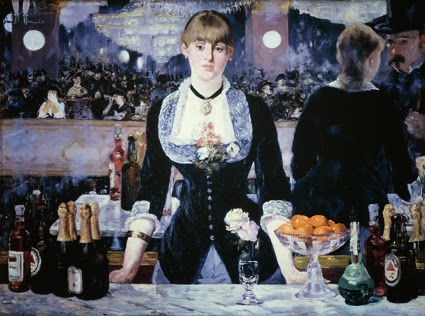
Bar at the Folies-Bergere, Manet
At the end of a production period, when you’ve safely tucked up the publication in bed, a little relaxation is always in order.

And what could be better than the opportunity to gaze at some top-notch art for an hour or so?

That was the situation by mid-afternoon on Friday and, with dinner at Joe Allen and theatre to follow, I had a nice little gap in my calendar.

And given that I’d later be heading to the Aldwych/Strand, the best possible solution presented itself in a first ever visit to the Courtauld Gallery.

Based in the part of Somerset House that was originally designed for the Royal Academy, which itself was founded 1768, it houses the art collection of the Courtauld Institute of Art, a self-governing college of the University of London that was founded in 1932.

Autumn Effect at Argenteuil, Monet
It has a small, but renownedly fine collection and, for some reason or other, I’d never visited.

First up was the medieval room, which was devoid of any other human life when I entered, and fabulously quiet.

But just as a started gazing in wonder into a cabinet of remarkable carvings, the door was shoved open and in burst a group of Russian tourists, cameras and phones ready to snap anything and everything – and woe betide anyone who was in their way.

Bang went my chance of seeing anything properly, as I was shoved out of the way from two sides (there was at least one brief apology), by phone-toting visitors determined simply to snap, snap and snap again. They were not, I hasten to add, youngsters.

Adam and Eve, Cranach the Elder
I retired quickly to the first of the upstairs galleries, only to find them catch up with me almost instantly.

Again, the same pattern.

Having spent a few minutes looking at Peter Bruegel the Elder’s Landscape with the Flight into Egypt (1563), which I realised that I remembered from school, I approached Lucas Cranach the Elder’s Adam and Eve (1526), only for a group to surround it with no interest in anything other than having a picture taken beside it, making funny signs with hands near Adam’s groin.

Quickly on then, through the rooms with the Gainsbroughs and the Rubens, into the smaller, square Cézanne Room, where I plonked myself firmly on the square bench in the middle and stayed put to wait them out.

Art’s for everyone, and all that – and I’d love more people to see stuff like this and enjoy it, but what the hell is the point of visiting a gallery or museum and behaving like this?

Montagne Sainte-Victoire, Cézanne
What do you get from it – and it had better be pretty damned special if you’re going to make such a negative impact on other visitors.

While doing that ‘waiting out’, I set myself to concentrate on the painter’s Montagne Sainte-Victoire from around 1887, sketching a very rough outline of it with a pen on the lined page of a notebook in an effort to better understand the composition. Which actually does work.

The gallery’s Cézanne collection alone is worth the (£6) admission, and covers a wide period in his productive life, up to a very late landscape, Route Tournante, from 1904, which looks unfinished as well as quite abstract, and also includes the wonderful Man with a Pipe from 1896.

Nevermore, Gauguin
Looking at these, I found it much easier to start to understand the difference between Impressionism and post-Impressionism: it starts to make sense.

There was no shortage of treats in just three rooms, including some Renoir and Degas, with Monet’s beautiful Autumn Effect at Argenteuil (1873), plus Manet’s vivid explosion of colour, Banks of the Seine at Argenteuil (1874) and the iconic A Bar at the Folies-Bergere (1881-82) being stand outs, along with a sculpture by Rodin, van Gogh’s disturbing Self Portrait with a Bandaged Ear (1889) and the lovely Peach Trees in Blossom from the same year.

Self-portrait with a Bandaged Ear, van Gogh
But for me, one of the most important ‘new’ experiences was seeing two of Gauguin’s Tahitian paintings in the ‘flesh’. The colour palate really reminded me of Survage’s Collioure pictures, and they also have a sense of mystery about them that adds to the fascination.

I don’t know why – now – but I’d long assumed that they were quite exploitative, but when you see them, you also see the dignity of the women in them. I was wrong on that score, most defininately.

There’s also a realism combined with a decorative element that makes a particularly interesting contrast with The Haystacks, which the artist painted in Brittany in 1889, which has a palate that seems closer to van Gogh than what we perhaps most obviously think of Gauguin.

Upstairs, though, came an unexpected treat.

As I walked into a room of 20th century art and turned back to look what was hung on the left of the door, it was to see André Derain’s Fishermen at Collioure, painted in 1905, in that summer that, in effect, saw the beginning of Fauvism.

The Red Beach, Matisse
And on the other side of the same door, The Red Beach by Matisse, also from 1905, and quite recognisably of Port D’Avall.

After all the hunting for work in London by Matisse, finally here was not just ‘any old work’, but something that I could comprehend and appreciate on a specific and quite personal level.

I was thrilled almost to the point of tears – and telling innocent bystanders: Ive sat on that beach, I ave.

Other exhibits that made an impact also include some Kandinsky, some Kirchner and a room of Walter Sickert (a revelation) and Modigliani’s rather wonderful Female Nude Sitting from 1916.

Slowly I seem to ‘get’ modern art. Or actually, not so much slowly, but all in a relatively short burst, after having spent decades – including my time studying art formally at school – not doing so.

It’s really rather enjoyable.