Showing posts with label review. Show all posts

Sunday, 2 February 2025

Philomena – Dench and Coogan in heart-rending, heart-warming drama

Time for more catch-up cinema – this time, Philomena, the 2013 adaptation of Martin Sixsmith’s book The Lost Child of Philomena Lee from director Stephen Frears, which by and large sticks to the true story that Sixsmith wrote about.

In 1951, after becoming pregnant, Irish teenager Philomena Lee (Sophie Kennedy Clarke) is sent by her father to Sean Ross Abbey in Roscrea, where she gives birth to a baby boy, Anthony. Forced to work in the abbey laundry, she has limited contact with her son, before the nuns give him up to a wealthy American couple for adoption.

Fifty years later, Jane, the daughter of the now retired nurse Philomena, spots journalist and former Blair government advisor Martin Sixsmith at a party and suggests to him that he investigate. Initially put off because it’s a “human interest story”, he changes his mind after meeting Philomena.

With a screenplay by Jeff Pope and Steve Coogan (who also co-produced), and coming in at a tight 98 minutes, Philomena is an examination of a multitude of themes: grief and loss, sin and guilt, anger and forgiveness, faith and hypocrisy, and snobbery.

The central characters are nuanced and the film rests squarely on the shoulders of its two stars – Coogan himself is excellent as Sixsmith, while Judi Dench is simply outstanding as the elderly Philomena, in a performance that understandably earned her a seventh Academy Award nomination.

It is a deeply moving film, but never mawkish, includes moments of humour, plenty of good for thought and is ultimately heart-warming.

Very much worth watching and available to stream in the UK on various platforms.

Saturday, 18 January 2025

Kneecap: A craicing political movie about Ireland

Saturday evening – and what better than catching up with another film? In this case, writer and director Rich Peppiatt’s 2024 Kneecap, about the real-life rise of Belfast’s Irish-language hip-hop trio of that name and starring them as themselves.

It starts in the late 2010s in Northern Ireland/the north of the island of Ireland, where there’s an ongoing political issue of having the Irish language being accorded the same rights as the Scottish and Welsh languages in their respective parts of the UK.

Post-Good Friday, working-class lads Liam and Naoise are essentially estranged from society and living in a world of drugs and raves. As children, they had learned to speak Irish Gaelic from Naoise’s father Arlo, a Republican who then went on the run to avoid arrest, thereby refusing to accept his own parental responsibility.

Liam has been keeping a diary, in Irish, which amounts to a sort of poetry. When he’s arrested by the NI police, having been at a rave, and refuses to answer any questions in English, Irish speaker and music teacher JJ O Dochartaighn is called to translate.

Ó Dochartaighn realises that Liam has real talent and, as a musician himself, invites the lads to his own improvised studio in a garage, where they record a track.

However, even as the trio gains in popularity, it faces real threats from Republican factions, the Northern Irish police and assorted others.

Perhaps surprisingly, the central trio – Naoise Ó Cairealláin, Liam Óg Ó Hannaidh and JJ Ó Dochartaigh, as themselves, are really excellent, with nice turns from Simone Kirby as Naoise's mother, Dolores, Michael Fassbender as Arlo and Josie Walker as a detective.


Shot in an anarchic fashion, with no shortage of swearing, lots of drug use, plus nudity and sex, it's very good and very funny indeed. Not really my kind of music, but very enjoyable.

Friday, 3 January 2025

A look at 2024 in films

Since 2024 is now history – and since I watched more films then than in any previous year of my life – it seemed like a good idea to look back on what I appreciated most.

Most were seen in cinemas, but a few here I saw for the first time either on disc or by streaming.

So in no particular order, other than chronology of viewing …

The first big hitter of my viewing year was Poor Things (above). Given that I saw it twice in eight days, that’s probably a clue as to just how much of an impact it – not least for Emma Stone’s wow of a performance.

Next on this ‘best of’ list is The Holdovers (just watched again as part of the actual festive season).

In some ways, such a small film, but it’s a bittersweet heart-warmer, with three cracking performances at the heart of it.

Next up chronologically is Blue Velvet, which I had never seen before – indeed, I’d avoided it largely on the basis of how that iconic scene with Dennis Hopper made it look horrific. But my niece had given me a copy as a present, so I decided to give it a go – and was surprised to find it vastly better than I had been expecting.

Perfect Days (left) is an absolute gem from Wim Wenders, following a toilet cleaner in Tokyo (and thus giving the German auter, with an astonishing performance from Kôji Yakusho.

I am grateful to a friend, who is also a film reviewer, for inviting me to be his second ticket for a Soho preview.

As with Downfall, one viewing is enough, but Zone of Interest is a really important work that probes the attitudes of Nazis toward the industrial murder of the Holocaust. It's arguably interesting how we define cinematic horror. This wouldn't fit a conventional narrative of how we define a 'horror film', I don't think – it is generally very calm and avoids physical, on-screen violence (that's what you hear in the background) – but it is, without doubt, utterly horrific, and very important for that.

By complete contrast, I also watched My Neighbour Totoro for the first time (my third Ghibli after The Boy and the Heron on Boxing Day the previous year). It is an utter joy. Indeed, I saw it again, later in the year, at a cinema during an anniversary re-release.

A similar catch-up viewing came with Mädchen in Uniform, an extraordinary piece of Weimar cinema, where Prussianism meets lesbianism in a girls’ school. It was a fascinating discovery for LGBT+ History Month.

Another personal discovery came with Rashomon, having only ever previously seen Kurosawa’s Seven Samurai.

April brought the charm of Robot Dreams (left), the subtle, affecting and sensitive Monster, and the stranger than strange Evil Does Not Exist – the most enigmatic ending of all time? – all of which have stuck with me since.

Summer saw the taut sexiness of Rose Glass’s Love Lies Bleeding, Crossing, from Georgian-Swedish writer and director Levan Akin – a tale of a retired Georgian teacher who travels to Istanbul in search of her missing trans niece and, in complete contrast, Kensuke’s Kingdom, the hand-drawn adaptation of Michael Morpurgo’s book.

Another piece of catch-up cinema that really grabbed me was A Taste of Honey, with Dora Bryan in majestic form as the horrifying mother and Rita Tushingham extraordinary on her screen debut.

Finally, my film viewing year was effectively bookended by another cinema outing that I repeated in short order, with Conclave (left), a cracking piece of entertainment, aimed squarely at an older audience, and one that has been very successful.

I made it past the 100 films in a year for the first time ever  – after re-totting and double-checking between a personal list and the Letterboxd app, it came in at 103.

It’s interesting to see how many of my choices have appeared in some of the lists I’ve seen in the last couple of weeks or so. Obviously, a lot of this is down to personal taste etc, but I was surprised that Monster didn't seem to be getting any mentioned – only to discover that was initially released in 2023 and appeared on a number of top 10 lists at the end of that year.

I also feel quite chuffed at the variety of films – not only in this list, but in my list for the whole year. I feel I’ve really taking my viewing habits to new levels. So here's to 2025’s viewing! 


Wednesday, 1 January 2025

Inspiring call for LGBTQI people to be authentic

Admittedly I started it in December, but New Year’s Day found me with the mental space to read 230 of its 287 pages, so filing this as the first read of the year really does count.

Life as a Unicorn – Amrou Al-Khadi’s memoir, first published in 2019, is the story of a non-binary, gay, British-Iraqi writer, actor, drag artist and filmmaker, and their struggles to find a way to live as their authentic self.


While their parents are not fundamentalist Muslims – in the sense that (much, if not all) Western media likes to portray Muslims – they still inherited a belief from quite early in their childhood that their queerness was going to send them to a fiery hell.


And what signs they gave off in terms of that queerness, their parents policed heavily.


Indeed, there are elements of this where Amrou’s story is like reading that of any dissenter in a dictatorial society, where they are being observed and reported at every turn.


How they eventually come through this is inspirational and deeply moving.


As a white, essentially middle-class English person, I clearly cannot appreciate the racist elements of Amrou’s experience, but there’s a huge amount from the homophobic aspects of their story that I felt that I could relate to (I was blubbing at the end) and also to the religious aspects, given my background.


For those who don’t already now, my father was an ordained, evangelical Methodist clergyman, who was homophobic, Islamophobic, racist, antisemitic, misogynistic … and just about every other kind of phobia that suited a white, English exceptionalist, cis, straight, male Christian (even though he’d come from an essentially Cornish peasant background).


I have thought for some time that, if I had ever come out to my parents, I would have been exposed to some form of conversion therapy. Indeed, I arguably was – being taken, in my early teens, to four evangelical ‘crusade’ meetings within a couple of weeks, with the explicit intention of being ‘converted’ – ‘born again’. And of course, it happened. The emotional blackmail of it was too much to eventually resist.


Life as a Unicorn is ultimately a wonderfully uplifting read about how to live as your own, authentic self. The section about marine life is staggeringly informative – I learned so much!


Al-Khadi is also absolutely spot on about the patriarchy, throughout the world and across cultures. It’s not just misogynistic, but also homophobic and transphobic. It’s no coincidence that we see the far right in Britain and the US, from Badenoch to Trump, engaging in ‘culture wars’ and taking particular aim at trans people and drag culture.

Monday, 25 November 2024

A sensitive exploration of what being queer means


Layla is the feature debut from non-binary British-Iraqi drag artist and film maker Amrou Al-Kadhi, and uses a deceptively traditional romantic story to explore the difficulties of navigating a life caught between queer and religious/ethic identities.

Layla (deadname Latif) is a non-binary drag queen from a Muslim family, who is living in London with three queer friends and has already become a star within their community.


However, they’re also trying to balance this with not being out to their family and, when they go back to visit, perform a conventional straight cis role. They are convinced that they cannot possibly be who they really are with their own family.


When they meet Max after a performance at a corporate London Pride do that goes spectacularly – and very funnily – wrong, the pair quickly start developing a romantic bond. But they’re also streets apart in terms of their lives. Max is from a well-to-do, white, middle-class family who are accepting of his rather beige gayness, but when Layla meets them, it’s clear that there are underlying issues around racism, Islamophobia and class.


And to add, Layla’s newly-married sister is moving to London with her husband.


This is a very sensitive film, while also being very frank. It is very unjudgmental and also helps to really explain what, for many LGBT+ people, ‘queer’ means.


Al-Kadhi’s direction and screenplay are excellent. Bilal Hasna as Layla is simply superb, while Louis Greatorex as Max is also very good. Indeed, It’s a very fine cast all around.


This was screened earlier this year at the BFI’s Flare festival and is now on more general release. It’s a very good addition to LGBTQI film.

Tuesday, 12 November 2024

Would you be a friend of Dorothy?

A hugely hygge weekend offered the opportunity for loads of reading. Having finished Bernadine Evaristo’s fabulous Mr Loverman on Saturday afternoon, I dived straight in to Sandi Toksvig’s new novel, Friends of Dorothy.

Police officer Stevie and paramedic Amber are not long married and they believe they’ve found the perfect home at 4 Grimaldi Square in London – albeit the square is generally rather run-down and with a nosy neighbour who’s shocked to discover she’s now living next door to married lesbians, and a nearly dead pub on one corner.

But when they go to move in, they find that Dorothy, the 80-year-old, foul-mouthed, straight-talking, wise-cracking woman they had bought the house from – has decided that she’s not moving out.

What follows draws in more local characters and develops into a sort of ‘caper’ book. I’ve heard the phrase ‘caper film’ more than once, but this really is the first time I can recall thinking of a book as a ‘caper book’. But I can’t think of it as anything else, given some of the scenes – and one late scene in particular.

Yet don’t let that con you. It is also remarkably subtle too. Toksvig uses her story to touch on class, race – and, of course, LGBTQ – issues, without being heavy-handed about it.

There are a number of interweaving stories here, all of which Toksvig uses to illustrate her central premise of “logical, not biological” families. The old saying is that ‘you can choose your friends but not your family’, yet some in the LGBT+ community are challenging that idea and what constitutes your family and how you organise/deal with such relationships.

It might sound ‘light’ – and it is, in many ways – but Toksvig is a really skilled storyteller and that’s why it never feels like you’re being lectured to. As a tiny example, while she never says whether Grimaldi Square is in north, south, east or west London, it felt so recognisable to me that I had a sense of ‘knowing’ that it was not far from where I live in east London.

It’s a funny story, but with real, real heart. A lovely, humane read. I got through its 350 pages in less than 24 hours, which should tell you something.

Monday, 26 August 2024

The Man with the Answers is utterly charming

The Man with the Answers
 is writer and director Stelios Kammitsis’s quirky and charming 2021 film that combines being a gay romantic drama with a beautifully photographed road movie.

It opens in Greece, where Viktorias, a former champion diver, is now working in a furniture factory. His mother left Greece some years before to go and live with her new partner in Bavaria and, when her mother dies, she doesn’t bother to either return for or contribute to the funeral, leaving Viktorias to sell his diving medals to pay for the send-off for his beloved grandmother.
 
Grieving and depressed, he decides to take his mother’s abandoned Audi and drive to Germany to visit. On the ferry from Greece to Italy, he encounters Mathias, an eccentric German student who persuades Viktorias to let him join the trip – and from there, to guide him away from the motorways and into a more scenic route as they head north, in what becomes a much more enlightening trip.
 
It's a gentle film that uses its 80 minutes to delicately plot the development of the relationship between the two men, which is often fraught – and perhaps particularly the development of trust.
 
Vasilis Magouliotis and Anton Weil as Viktorias and Mathias respectively are thoroughly engaging and convincing. Stella Fyrogeni as Angeliki, Viktorias’s mother, gives a nice performance in the late stages of the film.
 
Antonis Kataris as the funeral director is worth a mention as for being quite effectively creepy at seeing the death as a way of mounting up the profit.

And Thodoros Mihopoulos’s cinematography is excellent.
Really enjoyable – and currently streaming on Sky.

Sunday, 11 August 2024

Kensuke's Kingdom is pitch-perfect film-making

Initially premiered at the Annecy International Animation Film Festival in June 2023, before being seen at last October’s BFI London Film Festival, this film based on Michael Morpurgo’s children’s book – originally published in 1999 – has now made its way to a more general release.

It tells the story of Michael, an 11-year-old boy, who sets off with his parents and older sister on a sailing trip around the world, after Mum and Dad both lose their jobs.

But Michael is less than happy – not least as his beloved sheepdog, Stella, has had to stay at home, or so we are initially led to believe.

One night, as a storm rages, Michael and Stella are washed overboard, only to wake on an apparently uninhabited desert island.

However, they find help – albeit reluctantly – from Kensuke, an elderly Japanese man who was washed up on the island decades before. Gradually their relationship evolves, as Michael learns to respect and value the environment he finds himself in, together with its wildlife, which Kensuke helps to protect. And as we discover, there are varied reasons it needs protection.

It's an excellent screenplay by Frank Cottrell-Boyce, who has changed aspects of the original novel, but which certainly make sense here. For instance, in the book, the two central protagonists learn to speak each other’s language. Here, they learn only each other’s name, with communication being based more on emotion and expression.

There is also a love of art that they share and helped them learn about each other.

And their art allows the animators to be incredibly creative, from Michael’s log-book drawings coming to life on an origami boat that moves around a map of the world, to an extraordinary sequence of Japanese-inspired ink works that give the audience an insight into Kensuke’s own past.

The animation is superb – hand-drawn and combining 2D and 3D styles, which hark back to early Disney: think the 1937 Snow White and Bambi, both with lush painted backgrounds and 2D characters. As touched on above, here, there is a melding of different approaches throughout and including some simply beautiful vistas.

Directed by Neil Boyle and Kirk Hendry and with a super score by Stuart Hancock, it comes in at a very pleasingly trim 85 minutes.

In terms of the voice cast, Sally Hawkins is Mum, Cillian Murphy is Dad, and Raffey Cassidy is Becky, Michael’s sister.

But the film rests firmly with Michael and Kensuke, and Aaron MacGregor and Ken Watanabe get it absolutely nailed on.

Kensuke’s Kingdom is a beautiful film – both to look at and in terms of its humanity, compassion, exploration of what family/community means, and its advocacy for the natural world.

Very, very much worth seeing.


Saturday, 20 July 2024

Crossing – a class piece of queer cinema

Lia, a retired teacher in a small Georgian town near the border with Turkey, is starting a search for her estranged niece, Tekla, who is trans. She had promised her dying sister that she would find her and bring her home.

Teaming up with Achi, the layabout brother of a former pupil, who claims to know that Tekla has gone to Istanbul and to have her address there, they cross the border into Turkey and take a coach along the Black Sea to that historic city.


There, they face dead end after dead end, but then they meet Evrim, a trans woman with a law degree who volunteers for trans rights group Pembe Hayat (Pink Life, a real organisation, founded in 2006), who agrees to help them.


The film also shows us children trying to eke out a living on the streets – in particular, Izzet and Gülpembe (Bünyamin Değer and Sema Sultan Elekci), with Evrim having to use her legal training when the former is arrested for alleged pickpocketing. This is important, in going against an idea that trans (and LGBT+ generally) activists are only interested in a single issue.


Crossing is Georgian-Swedish writer and director Levan Akin’s fourth feature. It premiered at this year’s Berlinale in February, winning the Teddy jury prize for best queer film in Berlin, before going on to pick up further awards at further festivals.


It’s very much character driven and, although it’s comfortably under two hours, it still takes the time to do this without rushing.


The title might seem obviously related to being trans, but it’s also about other forms of transition – and very much of growth. Lia and Achi both grow in ways that are unexpected – and delicately developed. It’s also worth noting that Akin’s portrayal of the small trans-female community in Istanbul is empathic, dignified and far from simplistic.


The film is beautifully shot by cinematographer Lisabi Fridell, showing us an Istanbul that pulses with life – largely working-class – including cats.


But ultimately, the success of the film rests on the performances of the three main characters.


Lucas Kankava is excellent as Achi: on the one hand, street wise, while on the other, naïve, and desperately lacking affection in his life.


Deniz Dumanlı as Evrim is also excellent, giving the character real complexity: full of positivity and without any sense of victimhood.


But at the heart of this is Lia, and Mzia Arabuli gives a performance that manages to be both incredibly understated and yet an absolute powerhouse of emotion.

All in all, a really good film – and definitely one that goes straight into the lists of important LGBT+ movies.

Sunday, 2 June 2024

Supernova – an incredibly beautiful and sensitive film about dementia

Tusker and Sam have been a couple for years and are taking a campervan trip to the Lake District to revisit some of their favourite places and reconnect with family and friends.

After that, Sam – a classical pianist – is to give a recital that he insists will be his last, as he is determined to care for his partner, who has been diagnosed with early onset dementia.

But Tusker – a writer himself – has other plans which, as they head north, he hasn’t shared.

Written and directed by Harry Macqueen, this is an incredibly sensitive exploration of a couple facing not simply mortality, but the incremental nature of the mortality that dementia inflicts on people.

It is never mawkishly sentimental, but is intensely moving – not least in being an unflinching look at a relationship of length, with the joking and bickering as well as the tenderness.

The cinematography from Dick Pope is beautiful. I was born just to the east of the Lake District: my family moved to Bolton when I was three, but we visited regularly for a substantial part of my childhood and youth, staying with family friends who ran a corner shop in Tebay or those who had a fell farm not far away.

The latter stays in particular were some of the happiest days of that part of my life. Though I haven’t been back for many years, it all felt instantly familiar, and the lingering shots of the nature of the area are simply gorgeous.

While there’s a section of the film where there is a – very good – supporting cast, this is essentially a two-hander. And Colin Firth and Stanley Tucci as Sam and Tusker respectively are both on absolutely superb form. Enormous subtlety and nuance from the pair.

The film originally premiered at the 68th San Sebastián International Film Festival in 2020, and then the following year in US and UK cinemas, Supernova is now streaming on Netflix.

It’s a difficult subject, but Macqueen and team have made a very, very fine film – and ultimately, an uplifting and grown-up one about love. Make sure you have tissues close by.

Thursday, 30 May 2024

Evenings and Weekends: A brilliant debut novel about queer life from Oisín McKenna

London; 2019. As a beached whale lies beside the Thames, a sweltering summer is leaving the city’s residents with a sense that something – whatever that is – is going to happen, and when it does, it will be as explosive as a thunderstorm.

For Maggie, it’s about being pregnant and broke, and facing the prospect of returning to the hometown just beyond the city that she had fought so hard to escape; this time, with her partner Ed, who has his own demons.

Then there’s Phil, Maggie’s best friend, who is struggling to make sense of his own life as a gay man. His brother Callum is about to be married, but there are problems on that front too.

Oisín McKenna’s debut novel, Evenings and Weekends, begins on a Friday afternoon as the weekend approaches. Apart from a short coda, it essentially concludes at the end of that weekend. But don’t let that give you the impression that the 352 pages are in any way slow.

It’s a beautifully paced exploration of characters who are by no means unflawed, but feel completely authentic, as they try to work their way through particularly intense periods of their lives.

The central characters are all from working-class backgrounds and McKenna is excellent at weaving this into other aspects of their experiences – particularly in terms of sexuality and gender, but with ethnicity featuring too, via a strong backstory.

McKenna is a spoken-word artist, and this comes through in the musicality and rhythm of the language in the book, which is not only very effective, but joyful.

A gritty work, it’s sexually explicit in places, but always empathic, while never pretending that every relationship doesn’t have its difficult elements.

It’s also a love letter to London – particularly the east of the city – almost a walking tour of the Hackney I live in, really capturing, in detail, many places I know, together with introducing me to ones I will now check out!

The book came out early this month, but it’s taken me a while to feel that I’ve processed my thoughts together coherently enough to review it. It made me think of Virginia Woolf’s Mrs Dalloway – particularly in terms of the timeframe of the story.

The book was recommended to me just before publication, by a friend who’s a friend of the author. I’ve been struggling with reading in recent months but am glad that I didn’t put off getting a copy. Indeed, I read it over three days – which in present circumstances, is a minor miracle.

Ultimately, I think that Oisín McKenna has given us a queer novel that it is not only brilliant, but links back to that iconic work by Woolf. The key difference here being its exploration of working as opposed to upper class, plus sexuality and gender, yet all within a similarly limited timeframe. And of course, the Bloomsbury Set, of which Woolf was a central figure, was sexually and gender diverse.

I cannot recommend this enough.

Saturday, 25 May 2024

Beryl Cook/Tom of Finland: a stimulating exhibition

It might seem a strange idea to stage an exhibition of works by both Beryl Cook (1926-2008) and Touko Laaksonen, who was better known as Tom of Finland (1920-1991), but that’s what Studio Voltaire in Clapham has done. And it works a treat.

It’s a concise selection, but carefully chosen and with curator’s notes that avoid the pretentious and actually provide good context.

Cook is famous for her paintings of voluptuous women, predominantly working class. They’re often skimpily attired and seen with very high heels, drinks and/or fags in hand. Importantly, there is no sign of them being ashamed of their bodies – and they have the temerity to be having fun.

Victoria Wood described Cook’s paintings as being “like Rubens with jokes”.

She was self-taught and, entirely predictably, like LS Lowry, the British art establishment was sniffy. Even when she died, obituaries referred to her saucy seaside postcard as ‘naïve’. But she was – and continues to be – incredibly popular, while some major galleries now display paintings by her.

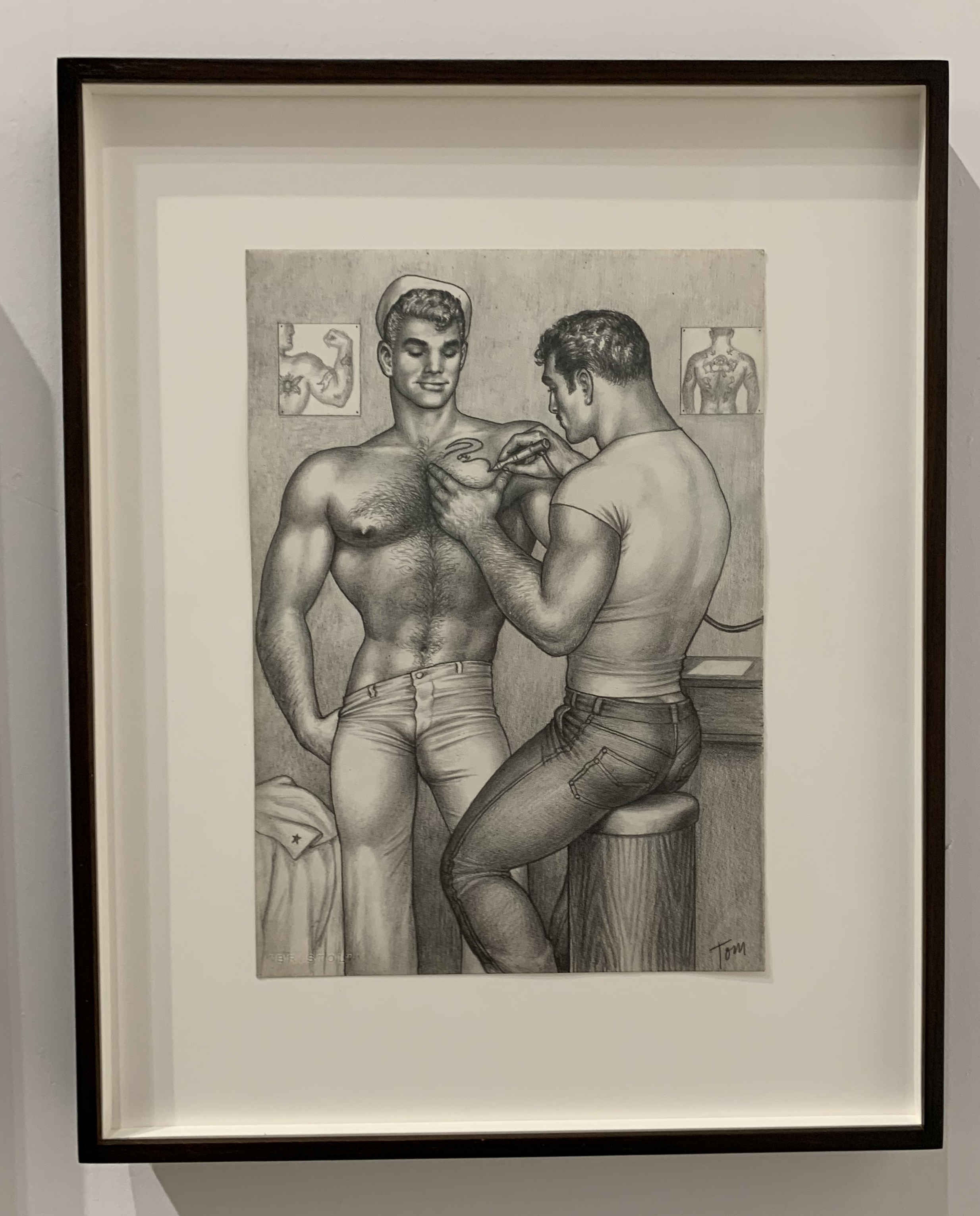
Tom’s works are more overtly and explicitly sexual. He took his name for the sake of anonymity, when by the late 1950s, he was an illustrator for US magazine Physique Pictorial, which portrayed muscled men in homoerotic activities that would just scrape past the censor.

Looking at his works of extremely muscled and well-hung hunks now, it’s easy to think of them as reflecting tropes of gay culture: the cowboy, the sailor, the leather man. All very Village People. But then that’s because Tom helped create such an incredibly influential aesthetic.

Like Cook, his figures are predominantly working class. The hyper-masculine nature of them was a direct challenge to the idea that gay men were effeminate. They are also clearly happy in their own bodies – and they’re having fun.

The styles of both artists are very different. But they’re instantly recognisable, beautifully executed and absolutely suit their subjects.

Of the works on display, there are several standouts. Cook’s 1976 painting The Lockyer Tavern (pictured at the top of this review), shows women drinking in a Plymouth gay pub – the artist was very much an ally – is iconic.

Personal Services
There’s also Personal Services from 1987, inspired by the life of famous madame and dominatrix, Cynthia Payne. It was used as a poster for the Terry Jones film about Payne, of the same title.

Ladies Night (Ivor Dickie) from 1981 portrays women surrounding a male pole dancer/stripper and laughing and straining to see as he pulls down his thong.

There’s also a display of some of the photos she took to help her work, which is illuminating.

Much of Tom’s work was graphite on paper – and untitled. I have selected three to include here, all of which showcase his skill and the points I’ve made above, but all of which are (just about!) ‘safe’ to see.

Studio Voltaire is a small exhibition space and this is a small exhibition. But that doesn’t mean it doesn’t offer an experience that breaks away from mainstream exhibitions to represent and celebrate communities and groups in a way that is really welcome and thoroughly life-affirming.

Ladies Night (Ivor Dickie)


Beryl Cook/Tom of Finland is at Studio Voltaire until 25 August.

It includes explicit artistic representations of gay sex.


Saturday, 18 May 2024

Love Lies Bleeding: A taut, sexy thriller

It’s 1989 in a small town in America: Louise ‘Lou’ Langston is the manager of a gym, where she spends an inordinate amount of time unblocking toilets and has a sideline in dealing steroids. But change is in the air when Jackie Cleaver hitches into town on her way to a bodybuilding contest in Las Vegas, and walks into the gym to keep up her training regime.

Lou is instantly smitten. After she rescues Jackie from a homophobic incident outside the gym, she takes her back to her own home. Since Jackie plans on staying until it’s almost time for the competition, she takes a job at a local gun range, not knowing that it’s owned by Lou’s father, Lou Langston Snr, who also runs a violent criminal enterprise.

Also employed at the range is JJ, the husband of Lou’s sister, Beth, who is violently abusive to his wife. After another violent episode, things get out of hand, with huge ramifications for Lou and Jackie.

Directed by Rose Glass from a screenplay that she co-wrote with Weronika Tofilska, Love Lies Bleeding taut, sexy thriller, with themes of domestic abuse, homophobia, misogyny and revenge.

It also riffs brilliantly on tropes of lesbian lives. Here, it’s Lou – while physically much smaller than the big and muscled Jackie – that’s the butch and Jackie the femme.

If all that were not enough to recommend it, Kristen Stewart turns in a superb performance of real subtlety as Lou.

Katy O’Brian – who’s also a martial artist – is very good as Jackie, her first major screen role.

The rest of the central cast is also very good: Ed Harris doing a fine job as the creepy Lou Snr; Anna Baryshnikov as a ditzy – but dangerous – lesbian who wants Lou for herself; Jena Malone as Beth and Dave Franco as JJ.

Ben Fordesman’s cinematography conveys a sense of brooding – and also one of the vastness that surrounds the characters, suggesting a lostness in the universe. Music by Clint Mansell also adds to the tension.

Having done some bodybuilding in my time – and having once been to watch a competition – the way the gym and contest scenes are handled is excellent.

The scenes at the gun range also provide a commentary on the relationship between Americans and their guns.

All in all, a really excellent film.

Saturday, 27 April 2024

Brilliant: Salman Rushdie on The Wizard of Oz

“There’s no place home; there’s no place like home.” It’s an iconic line – and sentiment – from The Wizard of Oz, and certainly from the classic 1939 film version. But what does it actually mean?

Back in 1992, the British Film Institute launched the first four in an ongoing series of slender volumes about specific films – BFI Film Classics. That initial quartet were Double Indemnity, Went the Day Well, Stagecoach … and The Wizard of Oz.


The last of those was penned by Salman Rushdie, with an updated edition published in 2012.


Since starting a deep(er) dive into film than at any stage previously in my life, I have been getting some of these and reading them. Well … in the first case, trying to read. That was Michael Atkinson’s monograph on Blue Velvet, which I gave up on, not least because – in my opinion – it’s appallingly badly written.


The next one was by Dirk Bogarde biographer extraordinaire John Coldstream, on that star’s career-changing and social-challenging film Victim, which was eminently readable and informative.


And so to Rushdie’s contribution. Rolling in at 69 pages – without a few more including the full film credits, which all the books have – it is very, very good indeed and packed with philosophical insights in two sections. First, in an essay about the film and second, in a short story, which is effectively a very clever, and funny futuristic fantasy tale/satire about an auction for the ruby slippers. Both are centred on the concept of home.


If there is “no place like home”, what does that actually mean?


The essay starts with fascinating autobiographical insights, including some making links between the film and the cinema of India, where Rushdie grew up, and how it influenced him from early in his life.


He is detailed. He notes, for instance, a mention in the later stages of the film by the Wicked Witch of the West of “an insect” that she has sent on to take on our heroes. But there’s nothing else about that in the film.


As he points out, it relates to a cut musical number, The Jitter Bug. Bad editing! Though you can find grainy footage of said cut number here.


Now here I am going to go off piste a tad. I know that song.


I had loved The Wizard of Oz since being taken to the cinema to see a re-release of it as a child.


In the mid 1970s, at Fairfield High School for Girls, I played the Munchkin mayor in a school production.


Then, in late 1981, a couple of years after my family had moved to Lancaster, I was encouraged by Noel McKee, my wonderful music teacher at Lancaster Girls’ Grammar School, to audition for the annual Lancaster Footlights’ Christmas show – that year, to be The Wizard of Oz. So, with blesséd parental permission (it was the first time for a non-school production), I went along, prepared to audition for Gloria (she doesn’t appear in the film, but gets to sing Evening Star in the stage version – perfect for a mezzo like me).


I was 18, going on 19.


But something unexpected happened. While at packed auditions, I was asked if I’d read in the Wicked Witch of the West’s lines in an exchange with the Good Witch of the North, for auditions for the latter part. With no pressure on me – I wasn’t auditioning, after all – I thoroughly enjoyed doing full panto cackles and ‘witchy’ voice.


I landed the role (pictured left, centre) – without even trying for it! The Christmas production was always staged for a week, with the Saturday having a matinee as well as an evening production (often punctuated by dinner at Pizza Margherita on nearby Moor Lane). It was an utter joy.


I remember descending the steps from the stage to the stalls, in full costume and green face paint, with children backing up into their seats as I did so.


Weeks later, I was in Lancaster’s department store with my mother, when a young lad came up to and said, in awe: “You’re the witch!”. I played along, hissing back at him: “Tell nobody!” His mother, just behind, was at first embarrassed and then tickled pink. The power of theatre. The power of The Wizard of Oz.


So that’s my personal connection. Now, back to Rushdie’s own monograph.


He gets pissed off at the sentimentalised ending: why would Dorothy need to flee home only to be told, at the end, that the lesson is that she should never have wanted to. Is that really the only concept of home – that is limited to where you initially come from?


Contextually, bear in mind that, for Rushdie himself, this was written after the fatwa against the author for writing the Satanic Verses (published in 1988) was announced in early 1989 – effectively driving him away from ‘home’.


A number of things occurred to me.


First, Rushdie shows, in many ways, that The Wizard of Oz is a rebellion against simplistic ideas of ‘home’. Dorothy flees home to protect what is most important to her – Toto. It occurs to me, what happens to Toto when she returns? Is Miss Gulch still there to demand his death? If so, what are her values?


Rushdie points out that, in the series of books by Frank L Baum, Oz eventually becomes home – not just to Dorothy, but also to Aunt Em and Uncle Henry.


I did some checking: is this less a British/US understanding of ‘home’ and more a German one? ‘Heimat’ is one of those German words that holds within it layers of meaning. At its very simplest, it could be said to mean that home is ‘wherever you hang your hat’. Not ‘where you originate from geographically or in any other way’.

And then look at Baum’s name – and yes, he did have German heritage: ‘Baum’ is ‘tree’ in German.


To go further on the subject of home: given that ‘the friends of Dorothy’ is a euphemism for gay men, can we also, at this time, see that ‘home’ can refer to any community of which we choose/feel ourselves to be a part? Again, a sort of riff on heimat.


And finally, after re-watching the film, it struck me that the move from monochrome to colour is like a move from binary to non-binary. Indeed, the land of Oz is a vastly more diverse place than Kansas. Further, the Cowardly Lion is effeminate, though we learn that he is also not a coward.


Of the central four characters, Dorothy is the least camp, while many of the Munchkins are quite androgynous.


There are few books – let alone ones with so few pages – that can set readers thinking like this, but this is superb. And of course, it’s also superbly written.