Showing posts with label Rothenburg ob der Tauber. Show all posts

Wednesday, 6 April 2016

Heigh-ho, heigh-ho, it's off to fairytale land we go

Been there!
Once upon a time, after wandering around a medieval town for several days, someone thought that it would be a good idea to binge on fairytale films.

Easter, of course, offered the perfect opportunity to indulge, so a list was prepared, cushions plumped and the cupboard checked for appropriate amounts of nettle tisane.

In the event, the list was overtaken at the start by the discovery that Hansel and Gretel: Witch Hunters (2013) was on the telly.

Fascinated by the idea of updating fairy and folk tales – or to be more specific, allowing them a space in which to continue evolving – this seemed like a perfect place to begin.

In the event, that perfection was in illustrating how to get things wrong.

A US-German collaboration, written and directed by Norwegian Tommy Wirkola, it brought together creative talent from those countries, plus the UK, Netherlands, Sweden, Iceland, Poland, New Zealand, Canada, Finland and more.

The idea of the children growing up and becoming witch hunters is fine – and full of potential. It might be over egging the pudding a bit to make the adult Hansel a diabetic as a result of the witch’s attempts to fatten him for the oven, but we can let that slide.

Tarantino. Without the laughs.
However, it’s all over the place in terms of any sense of time and place. Poor old Augsburg is a specifically-named location in the story – presumably because it’s nicely medieval – which is then screwed all over by a sort of semi-steampunk aesthetic that’s at least a century too late (and I like steampunk). 

The director apparently thought the weapons should look as though H&G had made them. They dont. Black leather dusters are seriously cool – but out of place here.

Fairy tales can be seriously dark and violent – I am entirely happy with both – but this uses violence gratuitously and in a way that makes you think it’s actually trying to be a Tarantino film. Without any of the wit.

There are other irritants.

The international nature of the cast is fine – but then why have Brit actor Gemma Arterton, who plays the adult Gretel, using a faux American accent?

And oh god the constant pronunciation of Hansel with a long, American ‘A’, grated almost to the point of a foot going through the telly.

I was close to shouting about ‘cultural appropriation!’ – and that’s something I consider to be a bonkers idea, since it assumes cultures come in locked geographic/ethnic pigeon holes that have never mixed and informed each other (until now) and never should.

So, just to be clear, I hated it.

Still, if you never experience dross occasionally, how can you judge quality?

Anyway, next up was The Wonderful World of the Brothers Grimm, a 1962 MGM affair, filmed in Rothenburg ob der Tauber itself (and with a glance at Neuschwanstein), so enabling a spot of ‘been there!’ film tourism.

Brothers Grimm – with Rothenburg and skewed perspective
It’s a pleasant enough film about the brothers – and interestingly, the four tales that were included were not the most famous ones – but it suffers from having been filmed in Cinerama, which turns the television screen into a sort of triptych, warping some of the perspective.

In contrast to Hansel and Gretel, the international cast is allowed to use whatever accents they’re used to: that the brothers (Lawrence Harvey and Karlheinz Böhm) speak in received English and with a German accent is not remotely problematic.

Not sensational, but worth seeing nonetheless.

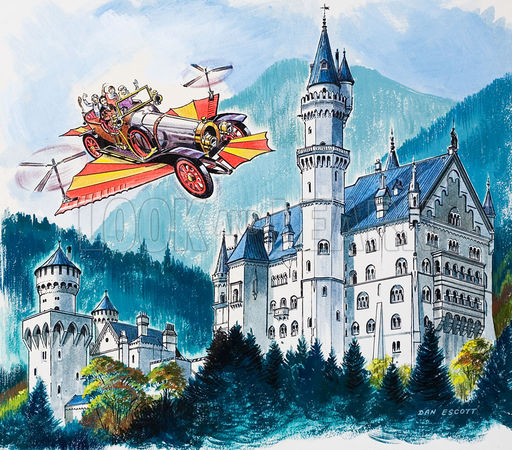
Next up was Chitty Chitty Bang Bang - a film I haven’t sat down to watch from A to Z for donkey’s years, and one that was, to be perfectly honest, rather shoehorned into this selection because its locations included, err, Neuschwanstein and Rothenburg ob der Tauber.

But actually, given the lack of any real character development of authot Ian Fleming, it works rather well as a fairy tale, since these are full, after all, of types, rather than 3D characters.

That’s not to say I don’t like it – in fact, a proper viewing restored my pleasure in it and reminded me that the dire matteing on the flying sequences should not be allowed to overshadow what is, by and large, a delightful film.
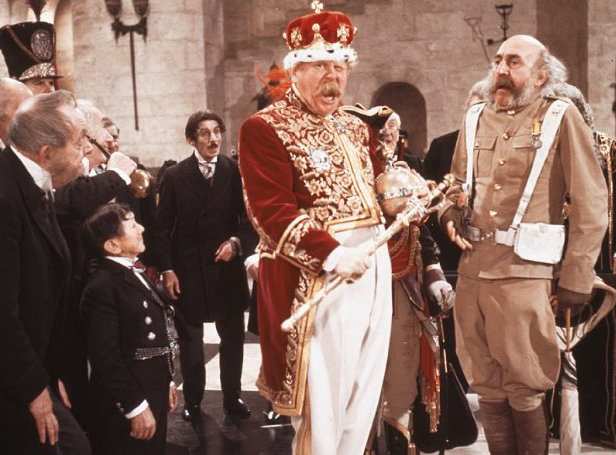
Gert Fröbe, Lionel Jefferies and mad scientists (inc Max Wall)
This is another international cast, but thankfully, Dick van Dyke was not, on this occasion, told to try any accent but his own. And it doesn’t matter that he has a soft American burr, while the rest of his family have pretty cut-glass accents.

Gert Fröbe is wonderful as Baron Bombast, James Robertson Justice is, well, James Robertson Justice (his real-life story would probably astonish you – look it up), Robert Helpmann is fabulously creepy as the Childcatcher, Lionel Jefferies is a super Grandpa and Benny Hill illustrates the point that comics can turn in serious performances.

And so what could possibly follow that?

Well, one of the things I’d been tempted into getting was 2014’s Maleficent - although I’d also been tempted to buy Hansel and Gretel: Witch Hunters on the grounds that it looked a really interesting take on the story, as recorded by the Grimms.

I put it off for a few days after the H&G experience, but eventually decided that it had to be watched.

And I’m very glad I did. It’s a fascinating take on Sleeping Beauty – so much so that there is a great deal of material around involving really very serious discussion of its themes.

Angelina Jolie – and a raven!
When the fairy Maleficent has her wings cut off, it can be viewed as a metaphor for rape – the writer and star, Angelina Jolie, certainly thought so, so it’s not just a viewer’s interpretation.

But the problems begin if you start reading the rest of it too literally from that point. I saw one writer complaining that, while the rape metaphor was clear, the subsequent story made it appear that the only way for a female rape victim to recover was by enacting revenge.

It’s fine to make the comparison, but this is also a fairy/folk tale – and indeed, such a reading of the film rather simplifies what actually does happen and how the characters develop.

And if you want to look for themes in it, then one of the others is the question of a nature-based world v an imperialistic/capitalistic one. This was certainly something that occurred to me when watching it (and it’s not a unique observation), but if you try to take it too far, then you’d do your head in.

It’s sumptuous to look at – the CGI works so well; conjuring worlds, but never detracting from the human.

Jolie is really in fine form – it’s a cracking performance. And she turns in a perfectly comfortable non-American accent (a tad softer than as that other very modern fairy tale character, Lara Croft).

Actually, accents are an interesting point here – we have a mixture between English and Scottish in an international cast. And no, it’s not one that comes down on simple good v bad lines. But directing actors to use specific accents here makes a kind of consistent sense, whereas the issue in H&G does not.

German vultures. No, seriously.
After that, I happened upon Channel 5 showing Disney’s iconic 1937 Snow White, which I haven’t seen in absolutely decades (it was one of the first films I ever saw, on a cinema re-release).

The plot is maintained pretty straightforwardly from the Grimms – one of the major changes is in giving the dwarves names and personalities; the character drawing is better than the late ’70s era Disney and the backgrounds are beautiful and delicate, while the witch is still, I’m sure, terrifying for young children.

The only thing I found myself muttering about was the presence of two vultures: there are no vultures in Germany – and it grates a tad. 

Mind, crows or ravens dont have yellow legs and beaks either – well, not in Europe, at any rate.

But it remains a standard of the fairy tale film genre and formed a perfect addition to the list I had set out to consider.

There are still two definite films to come from that original list but for the time being, that’s a good chunk of fairytale viewing under my belt.


Thursday, 24 March 2016

Wooden it be nice?

Nature's own sculpture
Not only do I not fly very often (thankfully), but it seems to have been a very long time since I sat next to an airplane window, in daylight, on a clear day.

But that happened when we flew back to the UK from Germany last week. And as we headed north west, the world below offered further evidence of something I’ve been aware of for a few years now: German towns and villages are never far from woods and forests.

Not only are forests at the heart of the German psyche, but it’s also reflected in the country’s love of wood as a material – and in particular, as a vehicle for art.

My maternal grandparents visited the Alpine region in the years after WWII and brought back a few small pieces, which my mother still has. So I’ve been familiar for years with the angular planes of wood on a carved mountain goat.

In 2000, my own parents went to Germany – the trip was my father’s retirement gift from his parishioners, and included tickets for the Oberammergau Passion Play.

They brought me back a pair of carved edelweiss flowers and a man with lantern and donkey, which owes something to the sentimental style of porcelain Hummel figures (if memory serves, my mother has a couple of those stashed somewhere too).

The central part of the Holy Blood altarpiece
When we headed into Bavaria for the first time last year, I expected to see plenty of wood carving, but in the event, the only obvious thing to be seen was cuckoo clocks.

This was not a trip where we were able to spend any time wandering in woods, but one of the specific things that we had penned in to do was to visit the Jakobskirche for some rather more polished wood.

The city’s main church, it’s Lutheran, although part of the many official pilgrimage routes to Santiago de Compostela.

Built between 1311 and 1484, in 1525, the church saw the peasant leader Florian Geyer (a Franconian noble) read aloud the articles of the revolting peasants during the German Peasant’s War.

But if you climb up the stairs to a gallery behind the vast organ, you’ll find a Holy Blood altarpiece, carved by Tilman Riemenschneider between 1500-1505.

The raw material
Riemenschneider has been dubbed ‘Germany’s Michelangelo’ and his work is always worth seeing. This is one of his seminal pieces – Andrew Graham-Dixon goes into some detail about in in his TV series, The Art of Germany. The artist’s ability to create highly realistic faces that seemed to have an inner life puts him head and shoulders above many others.

The church is also home to a high altar created in 1466 by Friedrich Herlin, a pupil of Rogier van der Weyden, but the Riemenschneider is the undoubted star here.

Flanked by two relief panels showing scenes from the Easter story, the central section of the altarpiece is a vast, 3D representation of the Last Supper. But what lends this version so much power is the figure of a disciple looking away from Christ and down toward us. As Graham-Dixon explained, it is a direct challenge to anyone looking at it.

Art historian Kenneth Clark considered that Riemenschneider’s works showed an idea of German piety in the 15th century and were harbingers of the coming Reformation.

Wooden woodsman and mushroom
The challenge created by the disciple breaking through the fourth wall (in effect) is a personal one that can be seen as indicative of the ideas of a personal relationship with God that would develop.

Away from religion, we did spot one or two wood carvings – although one small shop was still closed for the winter.

But I did find a small woodsman, which has now safely made the journey back to London, where he’s joined by a small wooden mushroom, which I was charged just €1 for, after the woman in the shop we were in was so delighted by The Other Half making a substantial Christmas decoration purchase.

However, aside from wooden Christmas decorations that were purchased away from Käthe Wohlfahrt, Germany’s biggest Christmas decoration manufacturer, which has its headquarters in Rothenburg, together with a number of shops and a Christmas museum.

One visit convinced us that it is grossly overpriced and nowhere near the best quality around. Indeed, the owner of one independent shop told us that the company, via marriage, was effectively in Japanese hands and that Japanese tourists expect things to be expensive as a guarantee of quality.

Nature and time, wrought in wood
What we did come away with – well, what I insisted on coming away with – was a cuckoo clock: a genuine, hand-made one from the Black Forest (which isn’t that far away).

I picked the smallest one I could find; not one made to look like a chalet; with no painting on it. Not only is it made from wood – the traditional design reflects the woods and forests.

Back in London, I took my time getting it out of the box and mounting it on the wall. There is something ridiculously fascinating, in these technological times, in having something that requires no batteries or plugs – it’s almost a revelation that leaves you wondering how anything can work without that confounded electrickery.

It delights me that it’s properly hand made; that when you open the back, the inside reveals once more how it not mass produced. It is, then, thus evidence that real craftsmanship has not been lost.

It’s hardly a Riemenschneider, but it is an authentic piece of Germany in its own way, and in an era of  smart this and smart that, it’s a real pleasure to have.


Friday, 18 March 2016

In search of the world of the Brothers Grimm

The iconic Plönlein
The tour party flowed into the town square, streaming past their guide, leaving him standing rather lamely on the cobbles holding aloft a little paddle so they wouldn’t get lost; a 21st-century pied piper whose tune had – temporarily at least – lost its power.

There would be little time to see much. If they were quick, they’d be able to snap off a couple of selfies on Plönlein, where the road splits in two and exits the old city through different gates, and in the square itself, where the Rathaus stands on one long side and two large, half-timbered buildings make a perfect medieval corner.

It is doubtful that they would be able to make it into the Jakobskirche to see the wondrous wooden altarpiece by Germany’s Michelangelo, but there would doubtless be the opportunity to nip into one of the town’s many Käthe Wohlfahrt shops to pick up some extremely overpriced Christmas decorations as a souvenir as an arranged part of their trip, before heading back to the coach and the next stop on their whistlestop tour of Germany or Europe ...

Market place – Rathaus to the right

Such tourists bemuse me: it’s the same as with people in galleries, taking selfies in front of famous paintings – what do they honestly get out of it?

There may be a reason that Plönlein comes up as the main result in a Google image search for Rothenburg ob der Tauber.

You could be forgiven for imagining that it was the main (if not only) medieval vista in the old city. But to find some of the others, you have to scroll down further on that search – and you need to spend longer in the city itself than a coach visit will allow.

US travel writer Rick Steves has noted that, while millions visit Rothenburg, far, far fewer spend even a single night in the city.

For those who do, the benefits are obvious: whatever time of the year, after the tour guides pipe their charges back aboard buses, the city is yours as the sun falls.

Steves says that, after dark, you can almost feel the past. I beg to differ, but only ever so slightly: there were moments in the daytime when the centuries seemed to spin past, leaving me almost dizzy with a sense of times long gone.

Markusturm – complete with storks' next
Rothenburg ob der Tauber – there are other Rothenburgs, so its relationship to the river Tauber is important – is somewhat on the old side.

A prosperous, independent city state, it was besieged during first the Peasants’ War and then the Thirty Years’ War, before a subsequent burst of the Black Death effectively halted its development, leaving us with the most perfectly intact medieval city anywhere.

‘Rediscovered’ in the 19th century and, in the 1930s, it was raised by the Nazis to a semi-religious level as a perfect, idealised German town.

In 1945, bombing did much damage, but it was spared worse when the German commander defied Hitler’s orders and accepted a US army promise that surrender would spare the city.

It is one stop on Germany’s Romantic Road, a 350km route through the forests and mountains of Baden-Würtemburg and Bavaria.

Starting in Würzburg, it ends in Füssen, where we spent a few pleasant days last March, walking in the Alps and visiting Ludwig II’s Neuschwanstein – a visit that had led directly to this one.

Old bridge
We left London early on a Thursday evening, and spent the night comfortably in a hotel at Stuttgart airport before setting off the following morning by train – first to central Stuttgart and then, from there, to Bavaria and Rothenburg ob der Tauber itself, via three trains.

Our hotel was in the centre of the old city, just above an ancient gate leading to a park and, after unpacking as rapidly as possible, we set off for a first orientation.

It’s impossible not to be instantly struck by the city. Plönlein actually feels rather understated in medieval terms, such are the other sights to be encountered, but in general, this is like walking through a fairy tale.

Hardly surprising, indeed, that MGM’s Wonderful World of the Brothers Grimm was filmed here in 1961, while the village scenes in Chitty Chitty Bang Bang were also shot in its streets.

A view from the city walls
The latter, incidentally, also saw filming at Neuschwanstein, adding another sense of continuum to this trip.

If Neuschwanstein gave Disney the template for its castle, then Rothenburg gave Hollywood as a whole an architectural aesthetic for fairy tales.

The half-timbered, slanting, sloping, tiled buildings are what you expect. You’ve seen it all before before – on a small or a big screen – but wandering around, you have to keep reminding yourself that this is no theme park, but a real, living town, full of real, living people.

The Markusturm is one of the city’s gates, surrounded by half-timbered buildings in bright colours. Perched atop an adjoining roof is what looks to be a metal wheel, lying horizontally.

Burgator, leading from the garden to the city
In fact, it’s a frame for a stork’s nest: these huge birds have returned to the area in recent years and a couple of days before our arrival, a pair had just returned from their winter sojourn to Africa, triggering excitement among local people.

The previous year, “Mr and Mrs Stork” had produced four chicks, to the evident delight of the community. Another nest, opposite our hotel room, was still awaiting birds when we departed, but the sight of the birds taking off and returning to their nest at the Markusturm could only add to the magical sense of the place.

Anyway, after that initial stroll into the past, our first night’s repast in Rothenburg saw us dine at an old tavern, filled with local people and with a waitress dressed in a dirndl, serving properly hearty German food.

For me, that was a piece of pork shoulder, flaking off the bone and accompanied by red cabbage, gravy and potato dumplings, with a dunkel (dark beer) on the side.

And then we slept in the peace of our centuries-old hotel, dreaming the dreams of fairytales all around us.