 It was 27 years ago when the National Theatre last produced
August Wilson’s breakthrough play, Ma Rainey’s Black Bottom, with Hugh Quarshie
wearing tights trousers to strut his stuff on top of a table.
It was 27 years ago when the National Theatre last produced
August Wilson’s breakthrough play, Ma Rainey’s Black Bottom, with Hugh Quarshie
wearing tights trousers to strut his stuff on top of a table.
I saw it twice: the first time to review, and the second –
under the leaking roof of the Hackney Empire, to growl quietly in appreciation at Mr Quarshie.
This new production offered a welcome chance to reappraise it.
It’s Chicago, 1927. A quartet of four musicians meet in a studio for a recording session with Ma Rainey – the ‘Mother of the Blues’ – and, while they wait for the diva to arrive, the good humour of their banter thins to reveal underlying tensions.
The ingredients are simple: four talented men (and one woman) who are of use to white music bosses as long as their music produces cash dividends.
But the three older members of the quartet – bookish pianist Toledo, band leader Cutler and bassist Slow Drag – have all found ways of dealing with their situation as black men in the US.
Trumpeter Levee, however – hardly a boy at 32, but still the youngest of the four – is caught between rage at the situation and an ambition to have his own band and write his own material that sees him act with overt deferentiality toward the studio boss.
While the central theme here is an exploration of the African-American experience, it also does much more.
One of the interesting things here is how stories provide a defence.
Toledo, Cutler and Slow Drag tell stories that, to varying degrees, have an aura of folk tale or myth about them. Religion features, but not simply as comfort (it is the reason why Toledo’s wife left him, for instance) and often bound up with folktales.
When Cutler tells them a Faustian tale from his own home town, Toledo nods vociferously, noting that he’s heard the same thing, hundreds of times.
The stories reflect a shared experience and sense of community – beyond the purely historical, biographical and rational – and they appear central to the men’s sense of self and their ability to weather the indignities that are thrown at them.
This new production offered a welcome chance to reappraise it.
It’s Chicago, 1927. A quartet of four musicians meet in a studio for a recording session with Ma Rainey – the ‘Mother of the Blues’ – and, while they wait for the diva to arrive, the good humour of their banter thins to reveal underlying tensions.
The ingredients are simple: four talented men (and one woman) who are of use to white music bosses as long as their music produces cash dividends.
But the three older members of the quartet – bookish pianist Toledo, band leader Cutler and bassist Slow Drag – have all found ways of dealing with their situation as black men in the US.
Trumpeter Levee, however – hardly a boy at 32, but still the youngest of the four – is caught between rage at the situation and an ambition to have his own band and write his own material that sees him act with overt deferentiality toward the studio boss.
While the central theme here is an exploration of the African-American experience, it also does much more.
One of the interesting things here is how stories provide a defence.
Toledo, Cutler and Slow Drag tell stories that, to varying degrees, have an aura of folk tale or myth about them. Religion features, but not simply as comfort (it is the reason why Toledo’s wife left him, for instance) and often bound up with folktales.
When Cutler tells them a Faustian tale from his own home town, Toledo nods vociferously, noting that he’s heard the same thing, hundreds of times.
The stories reflect a shared experience and sense of community – beyond the purely historical, biographical and rational – and they appear central to the men’s sense of self and their ability to weather the indignities that are thrown at them.
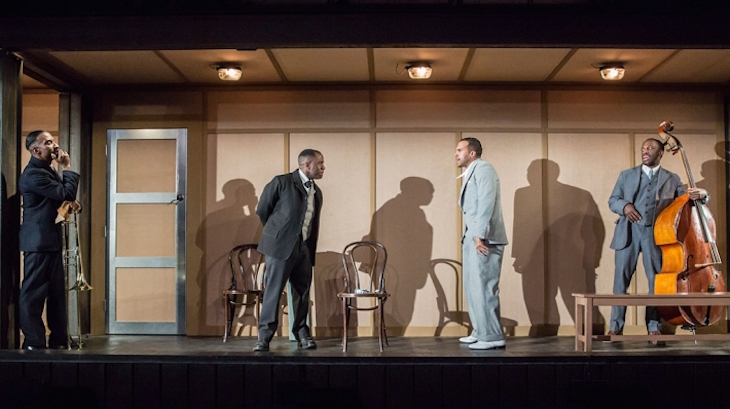 |
| Cutler, Toledo, Levee and Slow Drag |
Even Toledo’s book-learned philosophy and history add to
his defences.
But Levee, however, has no such stories and no such learning.
He joshes at the others until, challenged over his attitudes toward white people, he reveals how, as an eight-year-old child, he had seen his mother gang-raped by white men, and his father was subsequently hung and burned for daring to exact revenge.
There is no mythology here; nothing other than a raw, horrifying description of what a child witnessed; no shield against the weeping sore at the core of Levee’s being. He has no defence against his experiences.
Religion offers no comfort: when a row breaks out over his perceived blasphemy, we discover that his mother cried for divine help as she was raped, so he continues to challenge God to strike him down.
In all that he does, Levee pushes boundaries, as though deliberately daring those around him to respond negatively.
And when the levee eventually – and inevitably – breaks, it is with tragic, if unexpected, consequences.
This is a superb drama – a tragedy that operates on many levels – with dialogue that possesses a music of its own to counterpoint that blues that the characters are together to record.
And the National has – once again – given Wilson’s play the cast and production that it deserves.
Dominic Cooke’s direction never lets it sag. Ultz’s set is pared back and cleverly allows a sense of the liberating nature of the music (in a space that seems never to really end), the claustrophobic nature of the limits placed on black lives, and the social relationship between black and white men.
Title apart, Ma Rainey is not the central character here, but while she is on stage, she needs to exert a big, powerful influence – and Sharon D Clarke is marvelous in the role. Thank goodness too, that she gets one full song to show us what a fantastic voice she has.
Clint Dyer as Cutler, Lucian Msamati as Toledo, Giles Terera as Slow Drag and O-T Fagbenle as Levee all turn in top-notch performances – in terms both of their musicianship as well as acting.
You have until 18 May to catch this. It is very much worth the effort.
But Levee, however, has no such stories and no such learning.
He joshes at the others until, challenged over his attitudes toward white people, he reveals how, as an eight-year-old child, he had seen his mother gang-raped by white men, and his father was subsequently hung and burned for daring to exact revenge.
There is no mythology here; nothing other than a raw, horrifying description of what a child witnessed; no shield against the weeping sore at the core of Levee’s being. He has no defence against his experiences.
Religion offers no comfort: when a row breaks out over his perceived blasphemy, we discover that his mother cried for divine help as she was raped, so he continues to challenge God to strike him down.
In all that he does, Levee pushes boundaries, as though deliberately daring those around him to respond negatively.
And when the levee eventually – and inevitably – breaks, it is with tragic, if unexpected, consequences.
This is a superb drama – a tragedy that operates on many levels – with dialogue that possesses a music of its own to counterpoint that blues that the characters are together to record.
And the National has – once again – given Wilson’s play the cast and production that it deserves.
Dominic Cooke’s direction never lets it sag. Ultz’s set is pared back and cleverly allows a sense of the liberating nature of the music (in a space that seems never to really end), the claustrophobic nature of the limits placed on black lives, and the social relationship between black and white men.
Title apart, Ma Rainey is not the central character here, but while she is on stage, she needs to exert a big, powerful influence – and Sharon D Clarke is marvelous in the role. Thank goodness too, that she gets one full song to show us what a fantastic voice she has.
Clint Dyer as Cutler, Lucian Msamati as Toledo, Giles Terera as Slow Drag and O-T Fagbenle as Levee all turn in top-notch performances – in terms both of their musicianship as well as acting.
You have until 18 May to catch this. It is very much worth the effort.


