Based loosely on Martin Amis’s novel of the same name, it creates an incredibly effective picture of the casual barbarism. On Höss’s birthday, for instance, he holds a meeting with engineers to discuss plans for more effective crematoria at the camp, before being toasted by his fellow officers and enjoying cake with his family later that day.
Hedwig is more than happy to receive clothes taken from camp inmates. We see her try on a fur coat and, finding a lipstick in one pocket, try that too.
Her visiting mother muses, almost jokingly, whether a Jewish woman she knew, and whose book events she attended, had been sent to Auschwitz. And in a throw-away comment, she notes that she was out-bid for the woman’s curtains in a street sale.
It is the normalisation of the dehumanisation that’s vital for genocide.
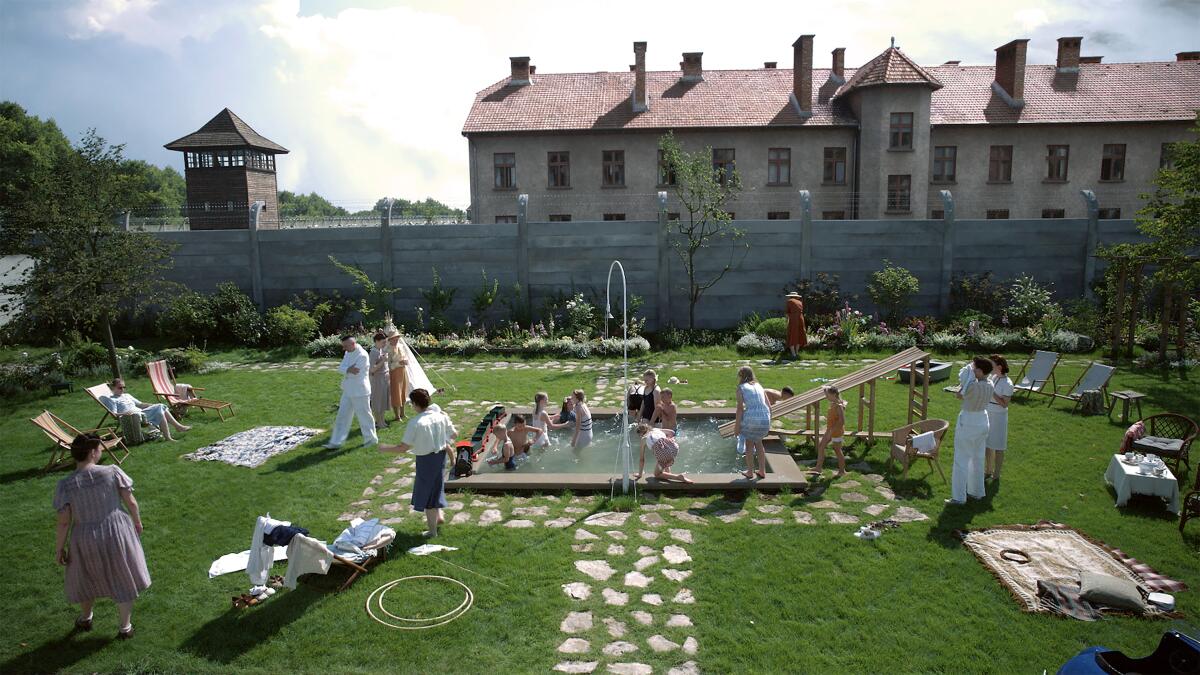
Repeatedly, the camera tracks a figure down one length of the vast garden, alongside the wall of the camp, with its buildings, chimneys and guard towers rising above.
Hedwig happily takes her youngest child around the magnificent garden, introducing her to flowers, while in the distance, we hear the sounds of the camp.
Glazer didn’t want to show the inside of Auschwitz – and he doesn’t have to for the film to convey a real sense of horror.
Sound designer Johnnie Burn put together a 600-page document in order to understand the camp layout and witness statements, together with a sound library that included the sounds of crematoria, machinery, historically correct gunfire, cries of pain and trains.
It is a soundscape that means however perfect the Höss family’s life looks, the viewer can never see it without being reminded that it happened within earshot of industrial mass murder – and that they all choose to ignore this.
And then there are the two central performances. Christian Friedel as Höss is so utterly engrossed in work that it is a mission – no matter the horrific reality of it, and Friedel portrays him as cold when on that mission, yet a dedicated and loving father. Sandra Hüller as his wife is also superb – little wonder that she has picked up a raft of award nominations – as a woman who is happy to bring up her children in such proximity to mass murder.
Łukasz Żal’s cinematography is deceptively simple – almost ‘flat’. Yet the look works incredibly well.
Glazer – who also wrote the film – has received nominations too. The film itself has already picked up awards, including the unique double of best British film and best film not in the English language at the recent Baftas.
Burn, together with Tarn Willers, have also been rewarded for the sound.
It is in many ways a very calm film, but most certainly not a comfortable one. It is, without doubt, an extraordinary piece of filmmaking that will not be easy to forget.

