Showing posts with label corruption. Show all posts

Sunday, 1 December 2024

Conclave is top-class, grown-up entertainment

Conclave, adapted from Robert Harris’s 2016 novel, is possibly not the sort of film I would usually think of watching – though I enjoyed The Two Popes when I streamed it in February. I might not have any faith left myself, but given my heavily religious background (very evangelical Methodist) I can still understand and appreciate Biblical debate, and almost inevitably find myself retaining an interest in religion in general.

I only really became aware of this film when seeing the trailer last week and, finding some of the rave reviews it’s been getting (including from the likes of Mark Kermode), decided to give it a go.

It opens with Cardinal-Dean Lawrence (Ralph Fiennes) hurrying toward the Vatican to oversee arrangements after the pope has died. Aside from mourning his religiously progressive leader, it means that Lawrence will now have to organise and oversee the conclave of the world’s Catholic cardinals that elects the next pope.

The cardinals have been readying themselves for this – positioning themselves for possible election and campaigning among the rest of their number. The primary contenders are Aldo Cardinal Bellini, an American liberal (Stanley Tucci); Joseph Cardinal Tremblay, a Canadian moderate (John Lithgow); Goffredo Cardinal Tedesco, a right-wing Italian who wants the Mass to be said in Latin again (Sergio Castellitto); and Joshua Cardinal Adeyemi (Lucian Msamati), a popular Nigerian candidate with conservative social views.

But on the eve of the conclave, one Vincent Cardinal Benitez (Carlos Diehz) arrives in the Vatican – a Mexican archbishop apparently appointed by the late pope without anyone else knowing – and working as the cardinal of Kabul in Afghanistan. Suspicions are raised.

There were already whispers about the pope’s last hours and final meeting, and Benitez’s presence only adds to the suggestions of conspiracy and dodgy doings.

The scheming between the candidates and their supporters is barely hidden – though it involves noir whispered talks in quiet corners and comments that only a cardinal that didn't want to be pope would be a suitable one. But who doesn't, at some level, harbour the ambition?

In terms of the performances, it is a wonderful ensemble cast – and that absolutely includes not only all the actors named above, but also Isabella Rossellini as senior nun Sister Agnes, who gets to deliver a truth bomb that is magnificent – and conclude it with a gesture that has seen audiences laughing at screenings (not just the one I attended).

Edward Berger’s film is pretty much perfect as a piece of grown-up entertainment. It’s intelligent. It’s quite easy to see that the world of the Catholic church presented here could also be the corporate or political worlds, so this is not ‘about’ religion. It’s about ambition, power and the gaining and use of that by human beings who, even at their best, are not perfect.

I’ve tended to avoid films of much over 90 minutes in the last year: this comes in at two hours, but Berger’s direction means this doesn’t feel close to that. The pacing is spot on for the tension. Peter Straughan’s screenplay from Harris’s novel is superb: dryly witty, never condescending. It feels so timely, given what the world is seeing today in terms of regressive politics.

Similarly, Volker Bertelmann’s soundtrack is spot on. Stéphane Fontaine’s cinematography is a joy. The mostly muted colours – creamy marble, greys and whites – set against cardinal red – are stark. Some scenes have a feeling of having been choregraphed to almost Busby Berkley levels – cardinals in the rain with their uniform white umbrellas, shot from above, is just one, while the ceremonial aspects and rituals are superb, treated with complete seriousness and respect, yet also revealing the performance and theatre at the centre of church life.

A little personal note here for context (well, I did start this post with one!).

Until I stopped attending church altogether in my mid-twenties, I had drifted away from evangelical Methodism and toward high Anglicanism. I appreciated the theatricality, performance and ritual of services. And I continue to very much appreciate religious music – not the Gospel songs of Billy Graham-style crusade rallies, which haunt me unpleasantly, but works such as the requiems of Mozart, Fauré and Britten.

But let's get back to the review.

If I have any slight complaint, it's that the character of Tedesco is perhaps made to be overly obviously awful. He stands in the refectory vaping, yet refuses to stand for prayers in the Sistine Chapel – just two shows of contempt for most of his brother cardinals, despite he himself being the one that wants 'tradition' brought back. But perhaps that's being over sensitive when we live in a world full of real pantomime villains who are actually very dangerous.

As Lawrence, Fiennes is outstanding. For all the very carefully played camp of the film in general (it's a balancing act Berger gets spot on), his is a stunningly subtle performance. Acting with the eyes, as it were, is an absolute art and he is as good at it as Anthony Hopkins. His own inner struggle so often needs no words to be crystal clear. If he isn’t in the Oscar noms next spring, there’ll be something wrong with the film world.

And the ending – true to the book – is done with real class, even though it may not be quite what some would expect, given its extraordinary topicality.

I cannot recommend it highly enough. Seriously superior entertainment, with an actual ethical heart and message.

Wednesday, 30 April 2014

Kipper baiting still leaves the mainstream in a fishy state

Taking the proverbial is not difficult
Nobody should be surprised at the likelihood of a substantial vote for UKIP in the forthcoming local and European elections.

And although it’s come close to being a national sport for people and media from across the political spectrum, it seems facile to invest too much time in pointing out the more ludicrous comments and opinions that have come from ’Kippers, as supporters themselves have become known.

They have loons in their midst, but they aren’t going to poll more than a handful of votes because everyone who votes for them believes that Lenny Henry should ‘go to a black country’ or because they want to ‘hate those dastardly gays just like you can hate a cup of Earl Grey’.

The rise of UKIP – just like the rise of assorted unsavoury parties across the continent – is symptomatic of a general disillusion with mainstream politics, further revealed in the UK by increased use of ‘ConLibLab’ to describe those parties.

What that reveals is a belief that there’s so little distance between the three main parties that you could barely slip a cigarette paper between them.

In other words, there’s little meaningful choice.

And so we have a party that claims to speak straightforwardly, and promises to lift up Britain once more by stopping (most) immigration and hauling the country out of the European Union.

The main reasons for the UKIP leadership wanting us out of the EU don’t really matter to those for whom all this country’s real or perceived ills are down to Brussels.

However, the UKIP leadership wants to be able to reduce – or cut altogether – employment rights, from paid annual leave to sick pay to maternity leave.

It’s debatable whether they really do think that these are what is holding the country back or whether those of them who are employers simply want to be able to reduce their own labour costs.

Such an approach, together with a commitment to reducing the state still further, is entirely reminiscent of free-market fundamentalists in the US and indeed, a great deal of the language to be found on forums in the UK is borrowed from them.

But on UKIP’s part, it hardly seems ‘patriotic’ to want to butcher the rights of the same British workers that they like to pretend they’re on the side of, does it?

The EU as a political entity is fraught with problem – not least legislation that, in effect, enshrines neo-liberalism, irrespective of the democratic wishes of individual electorates.

But then it’s not neo-liberalism that offends UKIP – the party’s leadership wants to plunge ever further down the marketisation path, to scrap vastly more public services than current Chancellor George Osborne, and sack as many public service workers as possible.

But such pesky facts are not getting a very wide outing – and there’s a reason for that. They’re not necessarily obvious vote winners, while there’s a fair few other politicians in the mainstream parties, and more than one media proprietor, who would be in almost total agreement.

How have we reached this state?

The spin – and the perception of spin – from all the mainstream parties has been contributory, as has a perception that none of those same parties really cares about Joe and Joanne Public.

Election at Eatanswill (Pickwick), 1836, Phiz
A generation and a half has seen both Conservative and Labour parties change from what the majority of their followers – certainly the older ones – would consider those parties to be.

The Lib Dems earned themselves an increase in votes at the 2010 general election, primarily because people saw, in their commitment to electoral reform, a possible way to give a kick in the pants the system, but they had counted without the fact that Nick Clegg and many of his MPs proved to be interested only in an illusion of power.

The Conservative Party has become the out-and-out supporter of marketisation and big business: that is now its prime constituency, other than on election days.

Look back at it’s actions in office over the last four years and you will see this borne out time and again, from the privatisation of the NHS to the so-called lobbying bill, which has been used not to do what was intended, but instead to gag a whole range of groups from commenting on politics in the run-up to the 2015 general election.

Having, in opposition, rightly opposed assorted attacks on civil liberties and privacy, one talk from GCHQ has convinced it to champion mass invasions into private communications, while also using the porn panic to introduce censorship by the back door.

Labour, on the other hand, seems like the proverbial headless chicken.

Its leadership seems unaware that there is any alternative to neo-liberal marketisation, however much it might make a few noises about the problems of a low-wage economy.


Indeed, it seems to be as wedded to such approaches as the Conservatives, but with just an iota of embarrassment at such a betrayal of the party’s own history and its traditional followers and a belief that a tiny bit of tinkering around the edges will ease any problems.

The steady drip drip of stories about the venality and greed and absolute lack of ethics on the part of politicians has also had an unsurprising impact on public trust, who generally seem to harbour the illusion that it was not always thus.

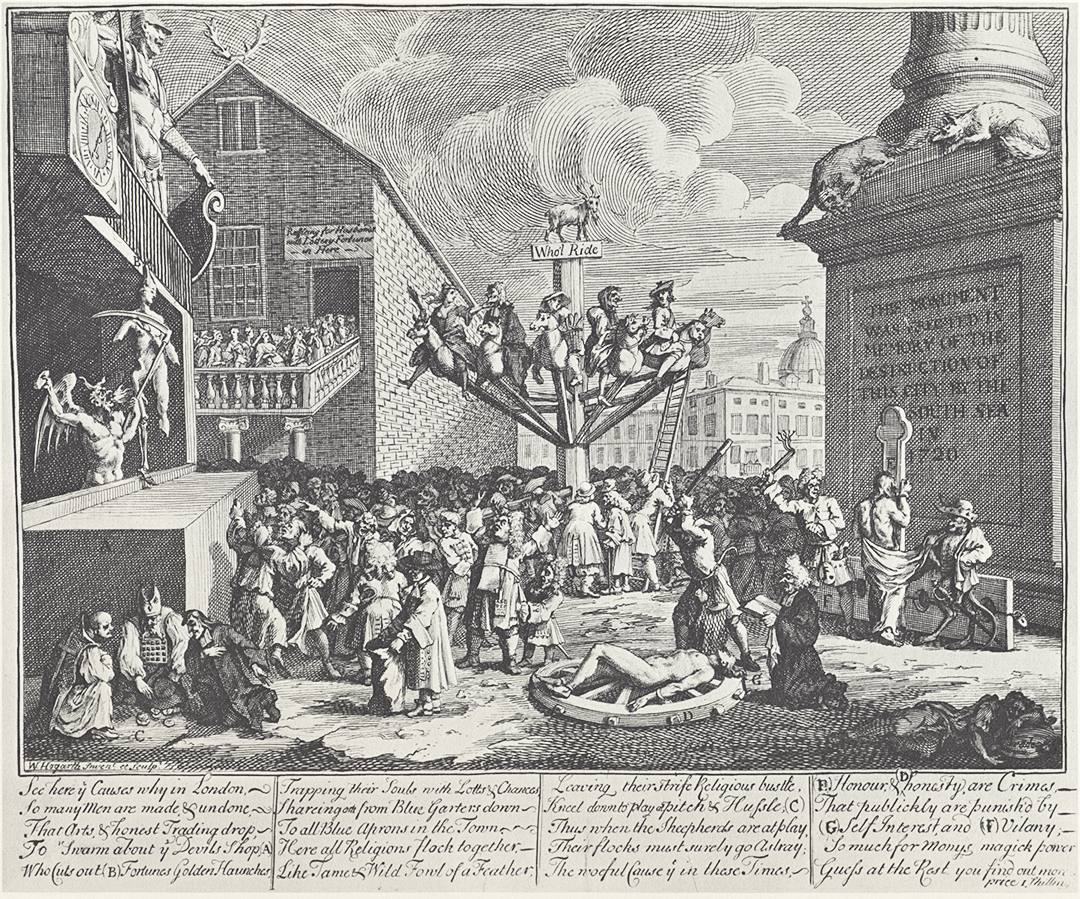
Take a look at Hogarth and read Dickens’s Pickwick Papers if you believe that politicians behaving badly is new.

The South Sea Scheme (c1721), Hogarth's 'casino economy'
But it’s all well and good condemning any or all the above, if people themselves do not get involved and take responsibility.

The minimum that can be done is to use your vote – preferably after paying at least a few minutes examining what all the candidates you can vote for are promising and/or claiming to have done.

It takes perhaps a little more effort not simply to believe everything that you read in your newspaper of choice, but to look beyond a simplistic headline and story that confirms any personal opinions, and explore an issue in different media.

It takes yet greater effort to get involved in local politics – which doesn’t mean any of those mainstream political parties or even any smaller parties, but can involve community groups, for instance, or local campaigns.

It’s simple: an investment of time is required to educate ourselves and be involved politically – the things that offer us the possibility of having an influence and even of changing something.

But when the electorate becomes disenchanted to the extent that few even bother to vote outside general elections – although millions spend the money to vote for a contestant on Britain’s Got Strictly X Factor Talent – then perhaps the point that needs to be made is that we get the politicians that we deserve.


It’s easy to simply accuse those saying they’ll vote for UKIP of racism for worrying about immigration.

Far easier, indeed, than it is to try to get across the real reasons why, among other things, incomes for the majority have been declining for 30-plus years, the cost of housing has increased to such an extent, job security has disappeared and nothing comparable has replaced all the decently-paid, skilled manual jobs that formed a major strand of the national economy until de-industrialisation was commenced for ideological reasons in the 1980s – let alone to attempt to posit real alternatives.

And viewed from that perspective, taking the piss out of UKIP smacks of political onanism rather than a meaningful consideration of what has allowed that party to grow and how the situation can be changed.


Wednesday, 7 November 2012

A loss of faith

Poster seen at the 20 October TUC march.

A few weeks ago, after details were revealed about what really happened at Sheffield Wednesday’s Hillsborough stadium in 1989, when 96 Liverpool football fans died, my mother was on the phone.

A St Helens lass herself, she’s no football fan as such, but has always held a soft spot for both Liverpool FC and the city itself.

For pretty much the same length of time, she’s been a staunch C/conservative and believer in the inherent rightness of the Establishment. But the revelations had left her shocked – perhaps more than I’ve ever known before.

“How could they?” she asked, of the police decision to blood-test every victim, including children, to see if they had alcohol in their bodies. “How could they?”

But if she was struggling to come to terms with the enormity of what had been revealed about Hillsborough, then what has been trickling out since the first public allegations about Jimmy Savile must be taking her breath away.

If you’re looking for names in connection with allegations of abuse in North Wales some years ago, you won’t find them here – partly for the obvious legal reasons, but also because, even if not true, such suggestions can particularly severely tarnish the innocent.

And the issue as a whole is (or should be) way beyond the tribalism of partisan politics.

But if it is true that senior government figures were involved in abuse, then it goes further than individual politicians themselves.

It would be difficult to believe that the security forces didn’t know – certainly those on protection duties. The same can be said of the police.

If, as is now clear, many in the mainstream media knew about Savile, did nobody know about any implicated politicians – particularly given that we are now rather more aware of the links between press barons and police and politicians?

The tendrils of corruption seem to spread a long way.

In truth, there was never a total lack of corruption in this country. That is a myth. Read Dickens. Look at Hogarth. It’s there.

But there has been a belief constructed that this was never the case. And perhaps that is part of the problem – that in so doing, abusers have been protected.

It also seems worth questioning whether the culture of the English (male) public school is also an issue.

Some years ago, Channel 4 screen a very lengthy and heavyweight documentary called Sex and the Holy City. One of the issues that it looked at was child abuse by priests.

The point was made that if (as happened) parents threw children into seminaries, having decided, for them, that they would become priests and, therefore, be celibate, it halted their natural “psycho-sexual” development.

This makes a deal of sense – and I do wonder whether the English public school system does something similar.

Take the example of Andrew ‘Plebgate’ Mitchell MP.

It seems that Mitchell, who attended Rugby School, was known as ‘Thrasher’, because of what a disciplinarian he was.

Now this is someone who was a child/adolescent, who had the authority to deal with discipline toward other children/adolescents in the school. That nickname suggests that the discipline was meted out in physical fashion.

What sensible adult hands responsibility for disciplining other children or adolescents to a child or adolescent?

Seriously?

It doesn’t seem irrational to suggest that that would be a situation that is absolutely tailor made for abuse and bullying.

But let’s move on.

Given the way in which the Savile case has been grasped by some on the right as a way of beating up the BBC (calls for it to be dismantled, the licence scrapped etc), David Cameron seemed strangely reluctant to announce any review of Auntie.

It was the correct decision, because it would be naïve to imagine that the abuse of children and young people was unique to one organisation. Indeed, a great deal of what has emerged makes it quite clear that this is not the case.

But calling such an inquiry would have made a lot of sense in terms of pleasing a core of supporters.

And now it has been announced that there will be an inquiry into the Waterhouse inquiry that investigated abuse in North Wales and reported in 2000.

That inquiry decided that alleged abusers could not be identified in public.

It seems suspiciously as though the Prime Minister has been made aware of just what could come out and is desperately engaged in an exercise of attempting to bail water out of a boat that’s shipping a great deal more.

None of what is trickling through should really be any massive surprise to people. The Leveson Inquiry has pretty efficiently shone light on the links between politicians, media tycoons and editors, and the police.

Which is why Leveson is so important.

Elements of the media – the Sun, specifically – were complicit in smearing the victims and survivors of the Hillsborough disaster. The police made up lies about what happened: Rupert Murdoch's paper spread them.

Many in the UK, like my parents, have existed in a cosy bubble of belief in the innate superiority and incorruptibility of these islands.

You could point at the likes of Italy and laugh. But corruption in the UK was, if not unheard of, but a very quiet cry.

My mother’s own faith in the Establishment is such that, back in 1990, she preferred, quiet openly, to believe a Daily Mail report of what happened on the night Islington Council met to set the poll tax to what I saw that night, as a platform steward at the rally outside the town hall.

To précis: there had been no trouble early on. The local police were doing a perfectly good job, refusing to react to the few hecklers at the front of the rally.

The trouble only started when the Met came around the corner on horseback and in full riot gear.

That, at least, is what I saw. I got out of the way quickly after that.

But my mother was convinced that I was so politicised (as opposed to herself) that I could not be trusted: in effect, I would lie to my parents for political effect.

So for the likes of her, what we are seeing now must be particularly shocking.

And it is not going to go away – or get any ‘better’ any time soon.

The North Wales case is being talked of widely. It seems that, at the time, there were rumours of people dying in odd circumstances or disappearing.

Where it will end is impossible to guess.

And there are other cases that are similarly linked to widespread, inter-agency corruption, and which are also refusing to conveniently just go away quietly.

The murder of Daniel Morgan is just one such case. For an introduction to that, here is the first in a series of excellent posts by lawyer David Allen Green.

The Justice for Daniel campaign can be found here.

It’s difficult to avoid the feeling that something is rotten in the state of Britain.

You watch it unfold with a mixture of fascination and horror. But the loss of faith for some will be not be easy.