Showing posts with label popular culture. Show all posts

Friday, 26 October 2018

A rhapsody about the ultimate queen

Queen were a revolutionary band. This is not really a matter for dispute. And if you don’t believe it, I suggest you listen to A Night at the Opera and A Day at the Races.

However, the launch of Bohemian Rhapsody, the new film that’s essentially a biopic of the band’s iconic lead singer, Freddie Mercury, has quickly been accused of not itself being revolutionary enough.

There’s a badly flawed logic here: the band were revolutionary, yes … but why should any film about that band *have* to be a revolutionary piece of cinema itself? Seriously – why?

Why not just let the revolutionary band’s revolutionary music tell the story?

And this, in essence, is primarily what happens. The late stages of the film recreate pretty much Queen’s entire Live Aid set, which finally got the phones buzzing for that charity fundraiser and on screen, is one of the most adrenalin-pumping things you will witness in a cinema this year.

What you don’t get is dwarves wandering around Freddie’s parties with silver trays on their heads, heaped with cocaine.

What you do get is hints of this, plus fetish clubs and much more.

But hey, this is not a hagiography – and thank goodness for that.

What we have is a really entertaining film that also manages to show some of the problems that Freddie Mercury faced in his life: he was the archetypal flawed genius … arrogant certainly, yet also incredibly vulnerable and desperate for love and genuine friendship; and in his own way, very loyal.

Like Abba, Queen transcend generations – and generalisations. Their music will be around after I’m gone, for instance. Of that I have no doubt.

For me, this is a superbly entertaining movie – and very, very moving in places.

Initially, I didn’t want to see it.

I fell in love with Queen in around 1974-75, when I heard Bohemian Rhapsody for the first time, at the Christmas disco of my then girls’ school. I stopped still, on my own, in the middle of the floor, as my mind was blown.

I seem to lack much in the way of memories for huge swathes of my life up to about 40, yet I can remember that moment as if it were yesterday.

I can remember too, going to pubs in Lancaster with my then boyfriend and feeding the jukebox to play Friends Will Be Friends – and being absolutely convinced that that was hardcore rock ‘n’ roll ... though to be fair to myself, if you know that my core musical love is classical, then it really was hardcore.

Later still, I remember when Margaret Thatcher resigned as prime minister, feeding another juke box, in another place, to blare out Another One Bites the Dust.

I’ve never stopped being a Queen fan. I never got to a concert, although I’ve been at a party with Brian May and Roger Taylor (very sedate), but I’ve long regretted never seeing Freddie in the flesh.

When he died, I retired to my Bloomsbury bedsit with two bottles of Bulgarian cabernet sauvignon (it was cheap but decent), put my headphones on and listened to him for hours while getting steadily pissed. It is the only time, thus far, that I have mourned a celebrity in such a way.

The concert sequences here, seen on a big screen, gave me a buzz I hadn’t expected.

And while the the cast as a whole is very good (and the costumes and hairdressing are fabulous), it has to be said that Rami Malek, as Freddie, turns in a performance that would not be out of place in next year’s Oscar nominations.

If you don’t like Queen, then it’s really simple: don’t go. But don’t pretend that this isn’t glorious entertainment and a wonderful reminder of just what a genius Freddie – and the rest of the band – were and are.


Wednesday, 30 April 2014

Kipper baiting still leaves the mainstream in a fishy state

Taking the proverbial is not difficult
Nobody should be surprised at the likelihood of a substantial vote for UKIP in the forthcoming local and European elections.

And although it’s come close to being a national sport for people and media from across the political spectrum, it seems facile to invest too much time in pointing out the more ludicrous comments and opinions that have come from ’Kippers, as supporters themselves have become known.

They have loons in their midst, but they aren’t going to poll more than a handful of votes because everyone who votes for them believes that Lenny Henry should ‘go to a black country’ or because they want to ‘hate those dastardly gays just like you can hate a cup of Earl Grey’.

The rise of UKIP – just like the rise of assorted unsavoury parties across the continent – is symptomatic of a general disillusion with mainstream politics, further revealed in the UK by increased use of ‘ConLibLab’ to describe those parties.

What that reveals is a belief that there’s so little distance between the three main parties that you could barely slip a cigarette paper between them.

In other words, there’s little meaningful choice.

And so we have a party that claims to speak straightforwardly, and promises to lift up Britain once more by stopping (most) immigration and hauling the country out of the European Union.

The main reasons for the UKIP leadership wanting us out of the EU don’t really matter to those for whom all this country’s real or perceived ills are down to Brussels.

However, the UKIP leadership wants to be able to reduce – or cut altogether – employment rights, from paid annual leave to sick pay to maternity leave.

It’s debatable whether they really do think that these are what is holding the country back or whether those of them who are employers simply want to be able to reduce their own labour costs.

Such an approach, together with a commitment to reducing the state still further, is entirely reminiscent of free-market fundamentalists in the US and indeed, a great deal of the language to be found on forums in the UK is borrowed from them.

But on UKIP’s part, it hardly seems ‘patriotic’ to want to butcher the rights of the same British workers that they like to pretend they’re on the side of, does it?

The EU as a political entity is fraught with problem – not least legislation that, in effect, enshrines neo-liberalism, irrespective of the democratic wishes of individual electorates.

But then it’s not neo-liberalism that offends UKIP – the party’s leadership wants to plunge ever further down the marketisation path, to scrap vastly more public services than current Chancellor George Osborne, and sack as many public service workers as possible.

But such pesky facts are not getting a very wide outing – and there’s a reason for that. They’re not necessarily obvious vote winners, while there’s a fair few other politicians in the mainstream parties, and more than one media proprietor, who would be in almost total agreement.

How have we reached this state?

The spin – and the perception of spin – from all the mainstream parties has been contributory, as has a perception that none of those same parties really cares about Joe and Joanne Public.

Election at Eatanswill (Pickwick), 1836, Phiz
A generation and a half has seen both Conservative and Labour parties change from what the majority of their followers – certainly the older ones – would consider those parties to be.

The Lib Dems earned themselves an increase in votes at the 2010 general election, primarily because people saw, in their commitment to electoral reform, a possible way to give a kick in the pants the system, but they had counted without the fact that Nick Clegg and many of his MPs proved to be interested only in an illusion of power.

The Conservative Party has become the out-and-out supporter of marketisation and big business: that is now its prime constituency, other than on election days.

Look back at it’s actions in office over the last four years and you will see this borne out time and again, from the privatisation of the NHS to the so-called lobbying bill, which has been used not to do what was intended, but instead to gag a whole range of groups from commenting on politics in the run-up to the 2015 general election.

Having, in opposition, rightly opposed assorted attacks on civil liberties and privacy, one talk from GCHQ has convinced it to champion mass invasions into private communications, while also using the porn panic to introduce censorship by the back door.

Labour, on the other hand, seems like the proverbial headless chicken.

Its leadership seems unaware that there is any alternative to neo-liberal marketisation, however much it might make a few noises about the problems of a low-wage economy.


Indeed, it seems to be as wedded to such approaches as the Conservatives, but with just an iota of embarrassment at such a betrayal of the party’s own history and its traditional followers and a belief that a tiny bit of tinkering around the edges will ease any problems.

The steady drip drip of stories about the venality and greed and absolute lack of ethics on the part of politicians has also had an unsurprising impact on public trust, who generally seem to harbour the illusion that it was not always thus.

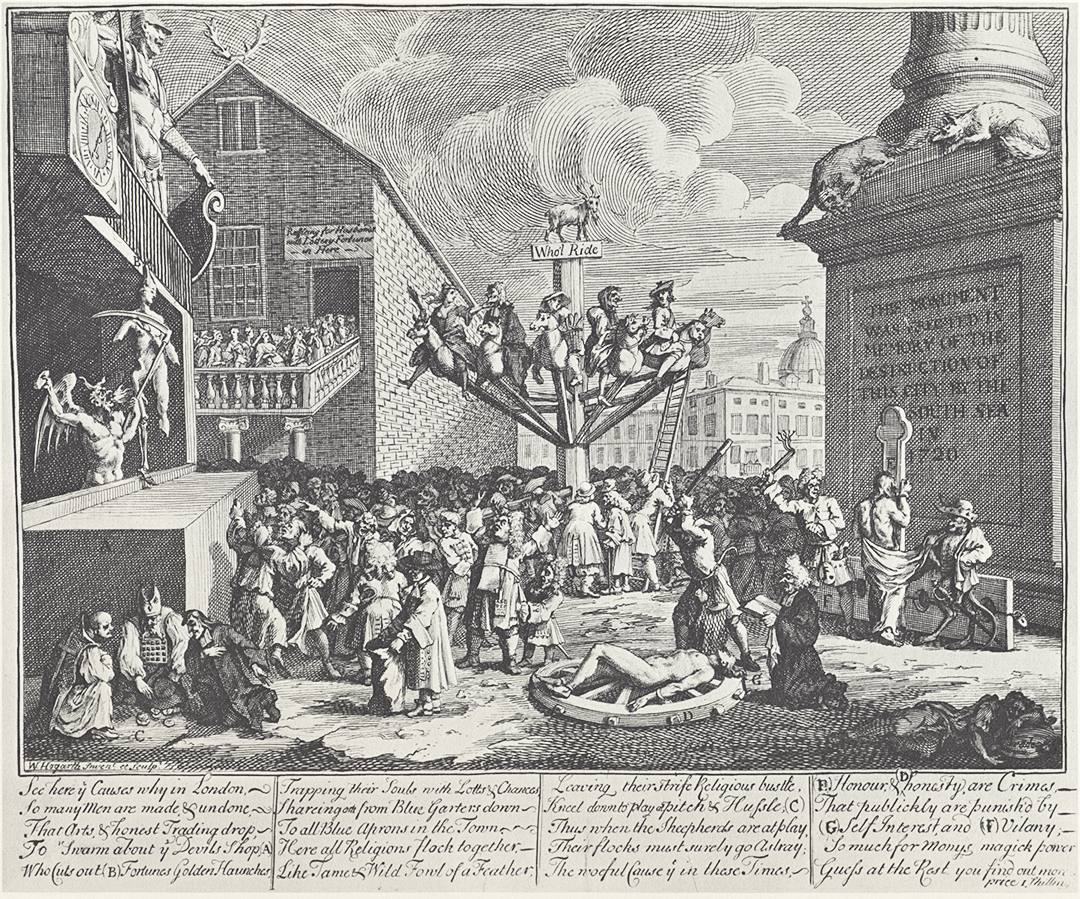
Take a look at Hogarth and read Dickens’s Pickwick Papers if you believe that politicians behaving badly is new.

The South Sea Scheme (c1721), Hogarth's 'casino economy'
But it’s all well and good condemning any or all the above, if people themselves do not get involved and take responsibility.

The minimum that can be done is to use your vote – preferably after paying at least a few minutes examining what all the candidates you can vote for are promising and/or claiming to have done.

It takes perhaps a little more effort not simply to believe everything that you read in your newspaper of choice, but to look beyond a simplistic headline and story that confirms any personal opinions, and explore an issue in different media.

It takes yet greater effort to get involved in local politics – which doesn’t mean any of those mainstream political parties or even any smaller parties, but can involve community groups, for instance, or local campaigns.

It’s simple: an investment of time is required to educate ourselves and be involved politically – the things that offer us the possibility of having an influence and even of changing something.

But when the electorate becomes disenchanted to the extent that few even bother to vote outside general elections – although millions spend the money to vote for a contestant on Britain’s Got Strictly X Factor Talent – then perhaps the point that needs to be made is that we get the politicians that we deserve.


It’s easy to simply accuse those saying they’ll vote for UKIP of racism for worrying about immigration.

Far easier, indeed, than it is to try to get across the real reasons why, among other things, incomes for the majority have been declining for 30-plus years, the cost of housing has increased to such an extent, job security has disappeared and nothing comparable has replaced all the decently-paid, skilled manual jobs that formed a major strand of the national economy until de-industrialisation was commenced for ideological reasons in the 1980s – let alone to attempt to posit real alternatives.

And viewed from that perspective, taking the piss out of UKIP smacks of political onanism rather than a meaningful consideration of what has allowed that party to grow and how the situation can be changed.


Saturday, 15 March 2014

Angela Lansbury lights up London


Dame Angela gets into the spirit of things
The West End has not seen crowds queuing outside a stage door as they are at the Gielgud Theatre for many a year, according to some.

In which case, they clearly didn’t see the crowds waiting to catch a glimpse of Daniel Radcliffe or Jude Law after The Cripple of Inishmaan and Henry V respectively.

But it says an awful lot about the star billing of Dame Angela Lansbury that the crowds outside the venue for Noël Coward’s Blithe Spirit have been so large that barriers have been required.

For anyone who doesn’t know, Coward’s farce features a writer, Charles Condomine, who invites a medium to his house for an evening, as part of his research for a new novel.

Unfortunately, although he, his wife Ruth and their neighbours, the Bradmans, are set for a good, sceptical giggle, the séance goes awry when Madame Arcarti actually brings forth the ghost of Elvira, Condomine’s dead first wife.

Since nobody else can see or hear her, he initially passes his own startled reaction off as a bit of a wheeze, but Elvira has a plan of her own in mind.

Suffice it to say that mayhem ensues.

This revival is an unalloyed pleasure. While Lansbury is the big name here, there is not a weak member of the cast.

Although most of the names may not be household ones, the rest of the cast is stacked with experience – apart from Patsy Ferran as the maid, Edith, for whom this marks her professional debut.

She is, though, absolutely wonderful, and shows both great comic timing and skill in physical comedy.

Simon Jones and Serena Evans as the Bradmans make the most of the most limited roles in the piece, while Jemima Rooper as Elvira, Charles Edwards as Charles and Janie Dee as Ruth are all wonderful.

And then there is Dame Angela herself.

I booked primarily because of this opportunity – it’s 40 years since she last graced a stage in her home country; little less than the time since I was taken to the cinema to see Bedknobs and Broomsticks.

Her performance then as Eglantine Price, a sort of prototype Harry Potter, gave me enormous pleasure at the time and has continued to do so down the subsequent decades.

There have been films and TV and theatre aplenty since then. She has ranged from Cold War villainess Mrs Iselin in  The Manchurian Candidate, to light-hearted detective fiction writer and crime solver Jessica Fletcher in Murder She Wrote, to starring in Broadway musicals from Mame to the original version of Stephen Sondheim’s chamber opera, Sweeney Todd, to voicing a tea pot in Disney’s Beauty and the Beast.

Why wouldn’t you love her?

Anyway, she doesn’t disappoint. Great presence, exemplary timing and wow, delightful physical comedy – at 88!

Her Arcarti is a deliciously dotty early hippy – who quaffs martinis in seconds and is addicted to cucumber sandwiches.

Bedknobs & Broomsticks: my falling-for-Angela moment
Director Michael Blakemore, who directed her in the same role on Broadway in 2009 – for which she one of her five Tonys – does a magnificent job here.

Coward’s comedy relies on absolutely perfect timing – and that’s what we experienced.

Blakemore has also made a subtle but very effective decision not to have the cast speaking in the sort of overly clipped tones that one associates with the writer himself.

Yes, it’s all proper Home Counties accents, but that does mean it has a touch less obvious theatricality about it.

And a final note of praise for the design and costumes by Simon Higlett, Bill Butler and Martin Pakledinaz. Goodness – the gorgeous lilac velvet number worn by Ruth in the opening scenes is almost enough to make me renounce my inner beach bum!

Blithe Spirit may be light as a feather – it cheered audiences up throughout most of WWII – but goodness, life is far too short to be perpetually serious. And laughter is a wonderful medicine.

Since Lansbury – along with that other British National Treasure, Julie Andrews – has been labeled ‘high kitsch’ by some who, presumably, consider themselves as being part of a cultural elite, I conclude here with a link to footage from the 1987 Tony Awards, together with Bea Arthur, reprising their duet, Bosom Buddies, from Mame.

After all, if Dame Julie is ‘high kitsch’, there can be no doubt that Bea qualifies too, and if I love them all and that makes me a lover of ‘high kitsch’, then so bloody be it.

And that clip is a perfect example of why any snobbery over such entertainment is totally misplaced.