Showing posts with label memories. Show all posts

Monday, 8 March 2021

New poem: Cold etchings


Cold etchings


The house faced east across the valley,

Stoic against the Pennine winters of childhood

When bitter winds would blast across the space

to bite at fingers blue and

Clog the arteries between towns

with snow that

Drifted and swirled and blotted out the view.


A plug-in Dimplex made bearable

the move from day to night,

Wan warmth radiated out to battle goosebumps

Until safety was reached

under flannelette and honeycomb and eiderdown,

With a piping bottle for frozen feet.


By morning, the large bow window would be frosted fast.

Frayed old towels folded on the sill below

Set to mop up when it thawed at last.

But before then

I’d dare to etch my initials on the glass.


This year, the cold snapped late.

But it was sharp enough when it arrived

To save some bees from neonics intended to beat a beet pest.


Locked down locked in I only saw

the rime through slatted blinds.

No early morning walks to the bus stop

Diverting slightly to surreptitiously

            etch messages on frosted cars

Under cover of decaying dark

As a fox barks in the nearby park.


8 March 2021


Tuesday, 1 October 2019

The wonderful ... WONDERFUL Wizard of Oz

We didn’t go to the cinema a lot when I was child, but memory suggests that the most regular period for family film-going was from around about 1968-1971 when we lived in west London and would pop over the river to a cinema in Putney. It was during that period I saw Disney’s Snow White on re-release – and was terrified.

This was still the era of two-film programmes: Snow White was my first cinema trip and it was paired, if I remember correctly, with MGM’s Tom Thumb (Russ Tamblyn, Terry-Thomas, Peter Sellers et al).

It seems fairly safe to think that I saw The Wizard of Oz at around this time – 1969 would have marked the 30th anniversary of the film’s release and explain why it was back in cinemas.

Wizard of oz t captured my imagination then and has never stopped being an important part of my cultural life since – which includes being in two stage productions (as the Mayor of Munchkinland in a girls’ school production and later, as the Wicked Witch of the West, before you ask).

Last weekend, The Other Half and I went to our usual cinema to watch a single screening for the 80th anniversary.

I know the film so well that I can mouth along with the songs and a load of the lines, but seeing it on the big screen for the first time in ... gulps ... 50 years was a fascinating experience.

Being in a cinema makes you pay closer attention than if you’re watching at home, with all the distractions. Never before, then, had I really appreciated Harold Rosson’s cinematography – particularly in the opening sepia section of the film.

As times change and history moves on, you can view cultural works through a changing prism.

Today, Frank Morgan’s blustering conman wizard seems like a harbinger of politicians and political leaders for whom bluster and empty rhetoric is all they have.

Terry the cairn terrier – cast first and paid best of all her co-players – really is more than a set-dressing. Shes in is much of the film. Apparently, when she broke a paw during filming, she convalesced at Judy Garlands home – and Garland desperately tried to adopt her.

Margaret Hamilton’s Wicked Witch of the West remains scary – there is nothing to make her more ‘child friendly’ at any stage. There’s nothing to blunt the fact that, for instance, she is a torturer – not least in her psychological torture of Dorothy as the film builds to a climax.

And so to Dorothy and Garland’s iconic performance. Somewhere Over the Rainbow retains its magic – not least in her rendition.

She produced an extraordinary performance: there is nothing brattish about Dorothy: she’s a serious young girl – an orphan with (apparently) no friends of her own age; vulnerable at the same time as being self-reliant and with a simple yet strong sense of what’s right and what’s not.

There is an extent to which The Wizard of Oz is like Casablanca: there are many ways in which it shouldn’t work – or at least, not have travelled well down the decades.
The message of there being “no place like home” is twee and limiting. The film as a whole is arguably over long and, with the introductions of the Scarecrow, Tin Man and Cowardly Lion, repetitious.

And yet, and yet ...

At the cinema we went to, a new generation was seeing it on a big screen for the first time
Eight decades on, The Wizard of Oz defies so much and, in retaining its own magic, reveals for us again why cinema as a whole can be such a magical experience.

Sunday, 4 February 2018

A shimmeringly good start to the Debussy centenary

A Christmas present to make you feel grown up
In this centenary of the death of the great French composer Debussy, one thing is assured: there will be no shortage of recordings of his works.

If Debussy has never quite been my favourite composer, he’s been hovering not far away from the top of my personal pantheon since around 1980. I had embarked on A level music studies at Lancaster Girls’ Grammar School and one of the first works that we were introduced to was Prélude à l'après-midi d'un faune.

It was a Deutsche Grammophon recording, with Herbert von Karajan wielding the baton and the Berlin Philharmonic Orchestra providing the gorgeously lush sound that stunned this then teenage listener.

It was the start of love affairs with all four component parts of that musical equation.

My mother, whose own classical music appreciation largely went little further than Handel’s Messiah (played every year as we put the Christmas decorations up) and Gilbert and Sullivan, was delighted in my interest and happy to buy me albums at Christmas and birthday.

The mantra was established instantly: DG, Von K, the Berlin. Most arrived on cassette, since I had one of those handheld ones that I later took to college. Such tech has gone the way of all flesh, but my vinyl recordings still survive – including one of those joint Debussy-Ravel programmes that seem to have been the light-classical norm for years.

In a general sense, I always loved DG covers – and still do: so much cleaner and brighter and more modern than those that, for instance, had a reproduction of a painting of an eighteenth-century street because it was a recording of something or other by Mozart. And while of course I would not wish to suggest that I am swayed by covers alone, I do still think that DG produces the classiest covers around, even when they’re predominantly artist portraits. 

Before the centenary got underway, DG had released Seong-Jin Cho’s new collection of piano works, Debussy, comprising Images I and II, Children’s Corner and Suite bergamesque.

In January, this was followed by Daniel Barenboim’s heavily-touted Claude Debussy, with a programme of Estampes, Clair de lune (from Suite bergamesque), Le plus que lente, Elégie and Préludes, Book 1.

Since the composer is standardly described as an Impressionist, it’s easy to think of his work in terms of paintings rather than the literature that was his inspiration. It was a poem by Mallarmé that gave birth to Prélude à l'après-midi d'un faune, for instance.

But it can be difficult not to see pictures in the mind’s eye when listening to his work. To be honest, I dont think that counts very high on a list of problems.

On a different note, I have made the mistake, for some time, of treating music as background – something to play on headphones when working so as to aid concentration – and forgotten the value of setting aside time to really listen.

This weekend, I decided to actually sit down and pay attention to these two new discs.

Now Cho is new to me, whereas Barenboim is an established household god who I have had the very great joy and privilege of seeing play live.

The programmes are different – except for Clair de lune. Both are wonderfully meditative: a proper listen is seriously de-stressing stuff.

I have no preference over that one shared piece. But there is something in Cho’s playing that is so subtle, yet utterly devastating.

The thing I kept thinking of when listening was, ironically, not in his programme – Le Cathédrale engloutie (The Submerged Cathedral), which is is the tenth piece in Préludes, Book 1. Yet it is what I thought of, time and again, while listening to Cho.

Barenboim is wonderful, with the contrasts that you would expect, but there is an ethereal, shimmering quality to Cho’s interpretation that takes the breath away – thats if you’ve not already found tears streaming down your cheeks.

I was constantly half-thinking of light on rippling water – and yes, of submerged buildings.

In this year of Debussy, these two have already set the bar very high. Get/stream both, if you can. But if you have to choose, go for Cho and then invest the time away from anything else, simply letting yourself be drawn in to the utterly beautiful music and this quite extraordinary performance.

And one can only hope that this is indicative of the quality that we’ll be treated to over the coming months.


Tuesday, 27 December 2016

Star Wars and Carrie Fisher – such a part of our lives

Star Wars was a global phenomenon. It’s such an obvious thing to say, now, 40 years on, that it’s hard to remember just what a shock to the system it was; a bolt out of the blue.

It was the first film that I ever saw without an adult relative. My sister (three years younger) and I saw it one afternoon in Ashton-under-Lyne, delivered there by my father and picked up by him later. How grown up we felt.

The cinema was packed. I remember so much – and yet so little. It’s fair to say, though, that it had a huge impact on my life, possibly to the point of changing it.

My teachers had decided I was set for a career in graphic arts, but I had already rejected that.

I thought ‘graphic arts’ meant designing adverts, and there was no way that I was doing that. I also thought, with the pretentiousness of youth, that I had ‘the soul’ of a fine artist, but, rather less characteristic of that age, considered that I had none of the talent.

I gave up art.

Yet for a while, I seriously hankered after going to work in the States, building models of spaceships for the likes of Star Wars.

However, there was nobody around to tell me that this might have been possible or to point me in the relevant direction – any more than they could point out that ‘graphic art’ could include animation or comics or so much more.

It has taken me until my fifties to work all this out. I’m a slow learner. Although in my defence, I’ll point out that, with no private income and no trust fund or similar, when I was thrown out of polytechnic after a year for having had the temerity to be injured as a direct consequence of the course, the only thing that I could hope to focus on was getting a job – any job. And this was the beginning of the ‘you’re overqualified’ era .

Yet for a few years I nurtured a dream of putting together a book about the blossoming of fantasy film. Before my polytechnic career turned very sour, I had been to the cinema on my own to see Jim Henson’s Dark Crystal, and remain in love with it to this day.

And yet …

Yet reality can batter you. As can the edict learned so well from both my father’s pulpit sermons and his dinner table ones. I have been so suckered by that stuff from 1 Corinthians 13:11.

“When I was a child, I spake as a child, I understood as a child, I thought as a child: but when I became a man, I put away childish things.”

I have wasted so many years believing that I should be so bloody bleeding boringly ‘grown up’!

True, I have reviewed and appreciated work by others that has included sci-fi and fantasy and that area where the two intersect. But probably until the last 12 months or so, any thoughts that I might produce any sort of work along such lines had lain dormant so long I had forgotten about it.

I have even attended events where I’ve met members of the cast of the first three films.

Yet this year it has all awoken again. And while I wouldn’t remotely suggest that that’s ONLY because of Star Wars: The Force Awakens that this is the year in which art – graphic art – has become a part of my working life, I have few doubts that it hasn't been part of a wider process. It was a reawakening of a certain kind of dream – of a certain kind of modern mythology.

For me, all those years ago, George Lucas’s vision opened a door to me – a teen still struggling in a home environment that was more of the 1930s than the 1960s and ’70s; an environment that considered any form of adults having pleasure with suspicion, that saw me carted to evangelical meetings in the hope that I would succumb to the emotion (I did).

Never mind air guitar –  my counterpoint to religion saw me wield an air light sabre and dream that The Force was real.

Since September, I have been using art – graphic art – in my work. Not something I expected. But it's been a massive leap forward.

On 1 January this year, when The Other Half and I got to see The Force Awakens, within a few moments of leaving the cinema I had declared, in a state of giddiness, that JJ Abrams had given us Star Wars back.

It was a quiet cinema when we saw it, but I wanted to cheer when Leia arrived on screen.

It’s been a shit year for the deaths of people whose talents and works have shone light on the light of others.

For me, not all of those people have meant a great deal, but even those who have not made the greatest impacts on me personally have added something to the creative mix.

Personally, I feel as though I have been most hit by the deaths of Alan Rickman and Victoria Wood.

And now, by the loss of Carrie Fisher.

Carrie … you were a crucial, feisty, fabulous part of all this: one of the few real and meaningful awakenings my teenage spirit felt – and that has been renewed in the last 12 months.

Wherever you are – go well: may the force be with you.

And thank you.

Saturday, 7 May 2016

It's a swinging time with Disney's new Jungle Book

It has been bad enough seeing the current Halifax advert: quite apart from the apparent message that all you need to do in order to get a mortgage is to spin a wide boy tale of suffering and accompany it all with a tear-jerking violin solo, that it has Top Cat selling this new era of banking responsibility really set my teeth on edge.

And when I then saw what they have done to one of my childhood favourites in the forthcoming Top Cat film ... well, lets just say that I’m not a happy bunny.

Like most people, I suspect, I can be more than a tad precious about things that were happy parts of my childhood.

The day we got a colour TV, I walked into the living room after school to find Top Cat playing – and was astonished to discover that he was yellow, with a purple waistcoat.

The disappointment of George Lucas’s second Star Wars trilogy and the subsequent pleasure at the revival of the franchise under JJ Abrams, is testament to just how much the original trio meant to me as a teenager and young adult.

But I can get it very wrong too.

When the BBC premiered Sherlock, I had a grand funk at the mere idea of it being updated, and refused to watch. This was particularly barmy, since I’d originally loved the Basil Rathbone screen incarnation, which included episodes of Holmes v the Nazis (as well as that woefully inaccurate cliché of a dumb Watson).

Rathbone, it’s true, had long been overtaken in my personal pantheon by the wonderful Jeremy Brett, but when I eventually gave in and watched Sherlock, it was to fall completely in love with the updating and Benedict Cumberbatchs performance.

For me, The Jungle Book has probably been my favourite Disney film since childhood, when seeing it with my parents was followed, uniquely, by seeing it again at the cinema with a much-loved great aunt. It is the only classic Disney animated film that I own a copy of.

I have not, until now, had to clarify that by all this, I mean the 1967 Disney cartoon.

On first hearing that Disney was making a new version, I had something approaching another Sherlock-style funk. But then, a few weeks ago, I saw a trailer on the internet and then again on the big screen. It was impossible not to be intrigued.

The discovery that at least some of the original songs were also involved this time around provoked even more interest.

A colleague with whom I’ve been discussing films lately asked whether I was tempted – on the basis that he was, but remained unsure.

The Other Half and I decided that the best way to deal with temptation is to give in to it.

I’m glad we did.

Because the 2016 incarnation of The Jungle Book is an absolute joy.

We saw it in 3D – and that certainly added to the experience.

The CGI is astounding. The animals are staggeringly realistic – they seem to have weight and fullness; they move wonderfully. The jungle itself is also beautifully realised.

Such lushness alone would not be enough to make this the hit that it is, but director Jon Favreau has ensured that it has heart by the bucket load.

The characters are not sketches, but are drawn in depth and voiced by a top-notch cast, including Ben Kingsley as Bagheera, Bill Murray as Baloo, Christopher Walken as King Louie, Idris Elba as Shere Khan, Lupito Nyong’o as Raksha, Mowgli’s adoptive wolf mother and Scarlett Johansson as Kaa.

The relationships between all the characters have nuance and subtlety.

The human element relies on Neel Sethi as the man cub – and the youngster turns in a really wonderful performance that is engaging and utterly believable, without ever drifting into annoying screen child syndrome.

I haven’t read Rudyard Kipling’s original stories, but this has a sense of being closer to those than to Hollywood: that the animals have their own ‘laws’ and their own mythology adds to a hint of something mystical.

That we have a back story for both Mowgli and Shere Khan is also a welcome development.

There are laughter and tears, darkness and light here, together with moments that only the adults will spot, such as the intended nod to Brando’s Colonel Kurtz from King Louie, plus reverential nods back to the animated classic.

It can be no surprise that, at the time of writing, The Jungle Book is topping the UK film charts for the third week running.

So, my childhood memories remain unsullied and, on the basis of this, I can now look forward to seeing the new Disney version of Pete’s Dragon (the original was never that great anyway) when it opens later this year.

You can still keep that new Top Cat, though.


Friday, 8 January 2016

Star Wars – the excitement reawakens

It was the summer of 1977 and I was 14. With my sister – three years younger – we had persuaded my parents that we should be able to make our first visit to the cinema on our own, and thus we joined the crowds in Ashton-under-Lyne to see that year’s massive hit, Star Wars.

It’s been pointed out since – more than once – that George Lucas’s iconic films don’t bear too much scrutiny; certainly not for the scripts.

But then again, that was never what they were about.

The response all those years ago was all about – well, the excitement of the piece. The action, the adventure, the effects, the humour, the characters, the classic goodies v baddies nature of the thing ...

This was Saturday matinee stuff done with all the pizzazz that Hollywood could muster in 1977 – indeed Lucas had had to set up a new company, Industrial Light and Magic, simply in order to realise his vision.

The old and the new
And that company set the standard for special effects for years after.

But back to Star Wars. Aimed fairly and squarely at youngsters – not at their parents – this was no ‘family film’ in the sense that that had meaning in those days.

Irrespective of the literary merits of the script, it was a film that had a huge impact on the lives of many who saw it.

I probably wasn’t as obsessed as many, and while I managed to get my hands on model kits of both C-3PO and R2-D2, plus the novelisation and the first two sets of trading cards – and my father somehow got a cinema poster for me – I didn’t have the wherewithal to ‘invest’ in much else.

But in the meantime, I played air lightsabre and fantasised about being a Jedi Knight.

The robots died years ago, victims of the many moves my earlier life involved, while the trading cards and poster went much the same way, although in more recent years, Ive got quite a few autographs from original cast members.

I nursed a brief, rather fantasy-like ambition of going to work for Industrial Light and Magic (imagine getting paid to build models?), but that didn’t survive any more than my teachers’ belief that I should go and study graphic art.

So good to see old friends again
But I still have that ‘novelisation’ on the shelf – battered though it is – and I’ll admit to a lightsabre app on my phone.

And now – in recovery from the ‘you’re over 13 and can’t have toys’ (that passage of Corinthians about ‘giving up childish ways’ has haunted me for most of my life) – I have a Funko Pop New Order stormtrooper, which arrived in my Christmas stocking.

I saw The Phantom Menace at the cinema twice. First, because the Other Half and I wanted to see it – and then because taking her was the only way that my niece was going to see it.

It was awful. I didn’t even bother going to the cinema for the next two of Lucas’s prequels.

Leia muses – the fans enthuse
I’ve seen them since on TV and they’re as slick as hell, but they are not Star Wars. Okay – they’re not my Star Wars. Or, given the general attitude toward them, pretty much anyone else.

Just because I’m fascinated by the history of a trading body such as the Hanseatic League doesn’t mean that I want trade disputes in the Star Wars universe!

Of course, probably worse than that (yes – worse even than the creation of the execrable Jar Jar Binks) was Lucas’s attempt to wipe all original copies of the first trilogy from existence and replace them with his seriously remastered versions.

Now this posits an interesting philosophical question.

At what point does a work of art belong to the public/fans and not the artist/creator?

And make new friends – Rey, BB-8 and Finn
In essence, Lucas’s core ‘crime’ was finding that new technologies made his mental visions more and more possible.

However, where many might simply have released a ‘director’s cut’ he tried to change history.

Bad move. As you might have gathered from the top of this post, the original films were important for youngsters of their day – my love of them is far from being unique.

Now I’m not into a heavy bad-mouthing of Lucas – I like to think that I have a clue as to why he did what he did (I can ask the philosophical question, after all) – but I approached the latest installment with, at first, complete disinterest, then trepidation and, only quite late on, excitement.
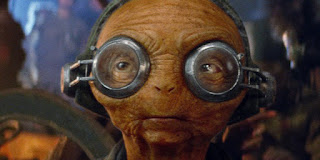
Maz Kanata
And so to Star Wars: The Force Awakens – is it any good?

Well, if you’re looking for spoilers, you won’t find them here.

For me, it was the start of the new year: The Other Half and I saw it on New Year’s Day at the BFI IMAX – thus ensuring it was an ‘event’, since we’d never been to the UK’s biggest screen before and since we’d never had the ‘immersive’ cinematic experience before.

I came out feeling like a wrung-out dish rag and then, within around half an hour, found myself bubbling like an excited teenager again.

The plot may not be staggeringly original – but there are no bloody trade wars!

Kylo Ren
The two new leads, Daisy Ridley as Rey and John Boyega as Finn, are good: it’s joyous seeing Han Solo, Chewie, Leia (and even Luke) again.

The wonderful Max von Sydow gives it all some classical actor authority, à la Alex Guinness.

I like Maz Kanata (Lupita Nyong’o); the first appearance of an x-wing had my eyes pricking, C-3PO is as irritating as ever, while new robot, BB-8, manages to be both cute and funny, while Kylo Ren (Adam Driver) establishes himself as a bad enough baddy – with a tad more complexity and a few more obvious issues than old Darth.

John Williamss iconic score is back – hearing the themes again sets the spins a tingle, as does the opening moments, when the words head off into deepest space above us.

Action – and ships – to make the heart thump and eyes prick
The action sequences are exciting and the whole film is imbued with the humour and good spirits that drew us in back in ’77.

In a nutshell then, JJ Abrams has given us back Star Wars.

It may win no awards for originality, but as the box office take and the response have shown, that is not what was wanted.

Lucas does not, apparently, like the “retro” feel, but that illustrates once more the tension that has existed for some years between the creator and the fans of his creation.

What will be interesting is to see if he now takes this opportunity of his child having finally left home to spread his creative wings once more and produce something new and, if he is so inclined, entirely different.


In the meantime, I’ll look forward to the Blu-Ray release – and wonder what will happen in the next instalment.