Monday, 19 August 2013

History and a load more art


Royal Chateau, Collioure
In a change of mood that could almost be seen as a case of morning after the night before, Saturday morning brought a spell of sustained and heavy rain to follow the fireworks and festivities.

Having taken the opportunity for a lie in, as the rain petered out, we decided then to amble around to Boramar for … well, pretty much anything that took our fancy.

By the time we sat down at one of the cafés overlooking the village’s central beach, the weather had not simply improved – it had turned into a glorious day.

A refreshing Coke later, we took the opportunity to make our way up to the chateau.

Vauban's work at Villefranche-de-Conflent
Part palace, part fort, the latter was begun in the first years of the 13th century by the Knights Templar and integrated into the royal castle in 1345.

Added to and changed over the following centuries, after the French finally annexed Roussillon in 1659, Vauban – his age’s number one artist when it came to military engineering – took it in hand.

Marshall of France to Louis XIV, he added substantially to its structure as well as upgrading Fort Saint-Elme, which watches over Collioure and Port Vendre from a nearby hill, while Fort Miradou, which stands at the back of the village’s Mouré quarter, also bears his hallmarks.

As I’ve said before, this part of the world is peppered with fortifications – a sign of its importance over centuries of tiffs between France and Spain as they fought to gain control of Catalan country.

You can pick out Vauban’s work quite easily: the chateau had thick walls added that also make it into a star fort – a form that made it harder for canon fire to do serious damage, while also allowing defenders to lay down overlapping fields of fire.

View across Port d'Avall
And then there are the classic Vauban sentry boxes, which I swear I’d recognise anywhere, having seen them not only in Collioure, but at Villefranche-de-Conflent too.

There, Vauban not only fortified the tiny town itself, but also built Fort Libéria on the hill above it to defend this crucial area in the Pyrénées, with the rivers Têt and Cady nearby and the plain not far away.

Anyway, back to Collioure.

We’ve been around the chateau before – and even attended a concert there – but it’s well worth a ramble around in it’s own right, plus there is usually an exhibition being staged. Or in this case, two exhibitions. So all that for €4 – you simply cannot go wrong.

One was made up of photographs of Dalí, who was born not far away, over the border, at Figueres.

Sculpture, Félix Valdelièvre
Now I don’t mind a spot of Surrealism, and some of his earlier work (The Persistence of Memory, Dream Caused by the Flight of a Bee Around a Pomegranate a Second Before Awakening etc) I actively like, while it also makes me wonder how much of an influence he was on the likes of Chris Foss and other sci-fi and fantasy artists.

This exhibition provides no revelations, but it does remind you – should it be needed – that Dalí’s main work was himself, and that his was an ego that could make Picasso seem like Uriah Heap.

And this without mentioning that Dalí’s politics were, to put it mildly, highly dubious, given his admiration for Franco.

‘Stark staring bonkers,” we kept muttering. But very, very clever too.

There was one actual Dalí work there – a piece that, frankly, looked like a Rorschach test, with title and signature daubed in the corner.

We all, to a greater or lesser degree do what Dalí did: we make decisions about how to present ourselves to the world. If we choose, for instance, to follow fashion, we are making one statement. But if we choose not to follow fashion, then it’s every bit as much a statement; a deliberate attempt to convey something; to say something to the world about who we are.

Dalí took that and commoditised it – more than any other artist, his own face is iconic.

If the ability to paint the wildest imaginings influenced some artists, how much did the artist as a work of art influence others, such as Tracey Emin, who has subsequently commoditised herself and others in her own career?

Sculpture, Félix Valdelièvre
After musing over the photos, we made our way further up through the chateau, past the bakery – a tiny little room with a double ‘oven’ that is, in effect, outside the main part of the building – and to the highest points of the chateau.

From there can be enjoyed magnificent vistas. And if you want a single reason for our continuing love affair with Collioure (and there are many) look at the sea at Port d’Avall.

Photographed on an iPhone and with no adjustments to the colour, that really is what it’s like.

Having wandered around Vauban’s walls, we made our way down to the chapel, to see the other exhibition.

This was a very different affair.

Félix Valdelièvre is a sculptor from the south of France, whose first exhibition was in 1999.

The works on show here were from his Volumes selection. And the more you look at them, the more intriguing they become.

Not only are the shapes themselves interesting – and many of them appear to defy gravity – but the manner in which he achieves and uses different textures is too.

Anchovies, Au Casot style
They seem to be primarily created from pieces of stone that are then sliced and polished or roughed up, to provide some of the contrasts, with contrasting stones and metals used sparingly to offer further contrasts.

In art speak, his website explains that he “puts the asymmetry in symmetry, the elevation in the straights, while recognising a taste for contradiction”.

Well, I found myself ‘seeing’ insect cocoons, torpedoes, sci-fi creations and strange armour. As I said, very interesting.

These were firmly non-figurative, but Valdelièvre’s work also includes more figurative pieces.

You can find out more here.

Suffice it to say that art can be found in many things. And later, when were headed to my beloved Au Casot for our first evening meal out of the holiday – and our first return visit to this restaurant – there was art on a plate too.

Squid, delightfully presented – superbly cooked
After enjoying an exquisite starter of two varieties of anchovy, with hard-boiled egg, roasted red peppers and black olives (pretty much a Collioure salad), it was on to baby squid with a persillade dressing.

Now go on – tell me that doesn’t look like art? It tasted like it too, because the chef at Au Casot keeps food simple, but knows how to top-quality, regional ingredients to absolute perfection.

Oh – and the coffee ice cream and apricot sorbet (my own special combo) that I had to finish was the highest quality too.

There’s no end to the art that’s available to enjoy here in Collioure.

Sunday, 18 August 2013

Homme cuisine and feu d'artifice


After Friday morning’s procession around the bay, the Fêtes de St Vincent reached its spectacular climax with that evening’s firework display over the same water.

Having made the gargantuan mistake last year of imagining that we would easily be able to find somewhere to eat, and then discovering that this was far from the case, as thousands of people pour into the village, we had resolved to eat at ‘home’.

One of the major selling points of the place we’re renting is that it has a small roof terrace – delightfully private and a total sun trap. And on that terrace is a small barbeque.

I’d picked up a large steak (quite enough for the two of us) and a length of the local Catalan sausage, and we marinaded the former in garlic, oil, a squeeze of lemon juice and pepper.

And then it was time for a spot of homme cuisine.

The Other Half got a little fire going and eventually, popped on the meat. Since there was no through draft and because it was so small, it turned out to be a tad more awkward than he had imagined, given his experience in these matters.

However, he got there and we dined pleasantly at the window, as people continued to cram into whatever space they could find to watch the display.

One of the other selling points of this house is that the aforementioned roof terrace is part of an added third floor, linked to the rest of the house by a small room, which has a wine fridge that keeps nothing very cold – but also two huge windows that give a wonderful vista right over the bay.

From the moment we’d spotted this particular place, we know that it would fully come into its own for the fireworks.

Indeed, when the display was underway, we could almost feel it.

Fountains of light cascading down Collioure’s iconic bell tower, chateau and lighthouse; gold exploding in the velvet heavens.

Red, green and blue flowers bursting into bloom and fading away in seconds; purple streaking into the sky above, reflected in the mill pond sea below.

And, as with last year, red hearts above.

I never used to be much of a fan of fireworks, but done like this – as opposed to your father fiddling around in the back garden with a rocket or two and a catherine wheel on 5 November – they’re quite wonderful.

The added bonus was that having such a view also enabled me to rest my arms on the window sill and keep steady as I photographed it.

This is not quite the end of the festival – there were more sardanes yesterday and a ‘traditional ball’ in our part of the village at night.

As we returned from eating out, we found the carpark at the back of the beach full of dancers (there was even an example of French dad dancing) as a band played on the stage that had been erected next to the pétanque court.

It was more of the same boisterous fun, with a touch of anarchy, that characterises the festival – and seems to be a reflection of Collioure as a whole.

Friday, 16 August 2013

A piece of Collioure tradition


Listening to mass
The Fêtes de St Vincent enters day three with mass at the tiny Chapelle Saint-Vincent.

It stands atop what was once a minute, rocky island, but it was joined to the rest of the land many years ago, and now watches quietly over the sun worshippers on the two beaches on either side of the spit of land that links it to Collioure's iconic Notre Dame des Agnes.

There was not a huge crowd attending, but still far too many to crowd into the chapel, so they stood outside and listened.

Barques at the beach
But the main event is less the service itself and more the procession sur mer that follows it.

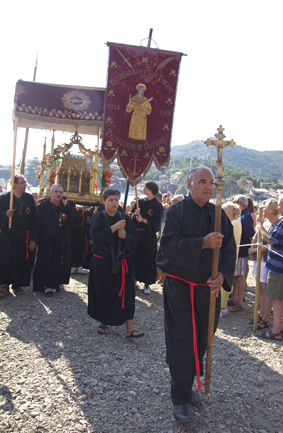
The little chapel empties as members of a confraternity appear, some bare-footed. Led by an elderly man in a red robe with a bell, a man with a cross and a young boy in black carrying a banner, they make their way down the steep steps onto the beach, carrying a reliquary with (apparently) a piece of St Vincent’s bones in it.

All glistening gold, with red flowers sticky-taped to each corner, it’s transported then beneath a canopy to the shore, there to meet and board one of the waiting barques (traditional
Making sure it's all ship shape
Catalan fishing boats) that are decked out with the red and yellow striped Catalan flag.

It's no mean feat to get the reliquary up a gangplank and safely onto the boat – this year, even mayor Michel Moly had to lend a hand, although the senior clerics didn’t, of course.

The mayor was then joined on board by at least three clergy, plus male members of the confraternity.

The men have been followed by a number of women, dressed in traditional, lacy Catholic black, which manages to look a tad Mafia-like when accompanied by designer sunglasses.

The boats push off, back into deeper water, and process around the bay in convoy. It seems probable that each beach gets a blessing.

Last year, when we witnessed this for the first time, they headed straight for Boramar – in effect, around the corner and pretty much
right next to Notre Dame des Agnes.

This time, the little flotilla made its way across the bay to Port d'Avall, following the arc of the land around, before heading finally to land at Boramar. Perhaps the sea was less frisky than last year?

As they drew toward the shore, a young couple played traditional Catalan instruments in welcome.

At the water’s edge, the boats are greeted by swimsuited holidaymakers and elderly locals in traditional dress – the latter are there as a choir to ensure that the subsequent hymn sounds decent.

Then, after a couple of prayers led by the senior cleric present – and as slight aside, you can tell the Lord’s Prayer just by the rhythm, regardless of the language – they take up their positions in the procession again and make their way to Notre Dame des Agnes, where a final service awaits.

There was a rather funny moment as the reliquary-carrying group passed me, camera at the ready, and one suddenly said, out loud and in obvious surprise: “Manchester City!” Hey, I’ve become known here for wearing footy shirts.

Although I’m not entirely convinced that football was really what should have been on his mind at that moment.

So, that is, in effect, the religious content of the festival.

I don’t believe any of it for a moment, but there’s something rather delightful about seeing it.

The mayor lends a hand
In his book The Sign of the Cross: Travels in Catholic Europe, Colm Toíbín talks about visiting Seville for one of the major festivals, and being fascinated to discover that some of the men willingly carrying the statues of the Virgin and assorted saints were communists and atheists.

When he asked why they did it, their answer was simple: it was tradition.

I can enjoy carols at Christmas – I don’t need to believe all the various bits and pieces that were cribbed from assorted cults and other religions.

And I can appreciate this too, in the same way: it’s traditional and of its place and its culture. And for a good little Protestant girl like me, there is most certainly a touch of the exotic.

Nor is it discomforting in the same way that the sanche is. That ‘march of the penitents’, which takes place on Good Friday in many parts of the region (we’ve seen it in nearby Perpignan) includes very small children – something that I do not like at all.

But this leaves one with the hope that just enough people continue to join the confraternities to allow
them to maintain such colourful traditions.

Anyway, enough of that: here I’ve included a selection of the morning’s photographs. Not easy, since the light is in the ‘wrong’ place for much of it but c’est la vie, as the French themselves might put it.

There are advantages to photographing something with which you’re at least vaguely familiar, and I am particularly pleased with the shots of the two elderly female members of the confraternity.

There's also a candid that was taken on the beach
at Boramar, of another elderly lady talking with a man. I've included her here because I think she provides a nice contrast to the others.

Minstrels


A brief chat
'Don't think about the football'
Michel Moly and member of the clergy


Thursday, 15 August 2013

Something wacky this way floats


Something a bit Wacky Races in the bay of Collioure
Sitting on the beach on Sunday afternoon, a man walked past, resplendent in medieval attire and with two dogs on leads of the sort that seemed entirely bred to be appropriate accessories to his costume.

Were it needed, it was a reminder that Collioure has an eccentric air, and that the village was preparing for the annual Fêtes de Saint Vincent, which manages to combine drinking, art, music, dancing, fireworks, religion and an all-round party atmosphere.

Oh: and people walking around looking medieval. I’ve seen on a previous visit, when, having just come out of Carrefour, two knights on horseback passed me in the street, with pages on foot.

A small procession had passed along the front on Saturday evening, a lone drummer in front, as we were looking out of the window and over the harbour. That was all it took for an appropriate Monty Python quote to break forth from The Other Half’s lips: something about “k-nigets’.

The festival was first celebrated in 1701, when the relics of the village’s patron saint, one Vincent, were returned to the village, to lie in the tiny St Vincent chapel, which now sits above a beach.

Vincent was, according to the Catholic Encyclopedia, the deacon of Saragossa, before being martyred under Diocletian in 304.

When torture didn’t manage to shake his faith, it only remained for him to be placed in a luxurious bed, whereupon he went and died. His mortal remains were thrown onto the rocks, to be fed on by the vultures, only for his corpse to be defended stoutly by ravens.

Medieval-style entertainment, complete with belly dancer
The cult of Vincent spread, up to and beyond the Pyrenées, and as far north as Narbonne and Béziers, passing Collioure on the way.

And with it spread bits of his body too.

In 1175, his relics were taken to Lisbon, so the story goes, although there are other claims that the relics were taken to Castres in 864, while Cremona, Bari and other cities have also claimed to have relics to have various bits and pieces of him – plus, of course, whatever is in the reliquary in Collioure.

And not to be left out, there’s a leg bone that’s supposed to be his in Notre Dame, Paris.

You wonder what the ravens bothered for.

It rather brings to mind the Roman emperor Julian’s description of Christian churches as “charnel houses”, given the obsession of the faithful for sticking bits of dead people in them.

Get up and start dancing
Vincent, the patron saint of wine makers, has his feast day, for Catholics and Anglicans, on 22 January, and on 11 November for Orthodox believers.

And then, very much in the land of the living, this festival comes along in August, although the religious aspect of it is hardly central.

All sorts of things have been and are happening, although the corrida no longer takes place. We never made it to such an event, but in the last summer before the little bullring was dismantled, we did go to the toro piscine, which is a sort of bull run for youngsters and children, involving very young bulls.

It was a fascinating and fun experience.

While I have reservations about actual bullfighting, I get a tad tetchy about the attitude of the women who run a local ex-pats’ publication down here, and who applaud madly that it has ended. If you don’t like the culture of somewhere in the first place, don’t go and live there.

And frankly, if you want to start worrying about cruelty to animals, start tackling the industrialised, ultra-centralised abattoirs that are pretty widely acknowledged as being dreadful. A bull that dies in the ring has probably had a damned sight better life than one that has been reared and slaughtered in an intensive and industrialised manner.

Anarchy afloat
We possibly ate meat from just such a bull once – not here, but in Nîmes, two years ago, where the boeuf à la gardiane that we ate was advertised as coming from a toro and, nearby, stood the arena, built by the Romans in 100CE and still used to this day.

The fêtes started yesterday evening, with an opening in the Place du 18 juin – named for the day, in 1940, of Charles de Gaulle’s iconic radio appeal to his compatriots from London). It’s officiated at by Michel Moly, the town’s mayor.

But before he spoke, we were entertained by a group of medieval-style entertainers – stilt walking (and dancing), juggling, music and singing – and jolly good they were too.

Then M Moly introduced local artist Marc-André2Figuères, who had designed the posters for this year’s festivities, which also means it’s on the special fêtes wines and the ‘goblet ecologique’, which you can wear on a lanyard as you totter between wine tastings.

He then welcomed François Bernadi, who had designed this year’s bandana.

'I'm not interested in those stupid boats – put me down!'
An elderly artist, he grabbed his moment in the sun by grabbing the microphone and launching into a lengthy reverie on how hard life had been for his father, who had been a fisherman.

He almost had to be hauled away as a band prepared to play some thoroughly ebullient music and we waited for the canon fire from the nearby Fort Miradou to formally open the festival.

This is the ideal moment to point out that, while I could see what he’d tried to do with his design, by lining angles of the church tower and the mast of a traditional Catalan barque up against the angles of the triangular bandana, it didn’t really come off. And besides, the fireworks look far too like pastel version of Van Gogh’s starry skies.

This is also the part of the celebrations where the mayor announces who is to become the 'honorary' mayor for the duration. This year, M Moly announced, although they'd had seven candidates (it's usually a local celebrity) it was going to be us!

After a snifter on Boromar watching the sun go down, we ambled back to the house and consumed little soles that I’d bought that morning at market, with tomatoes on the side.

A boat with the iconic Collioure bell tower
This afternoon brought the opportunity to watch the inaugural ‘Coulapic’ – the first world championship of ‘unidentified floating objects’.

In other words, races on the bay between improvised ‘boats’: a sort of ‘flugtag’ for the water. And the ‘Titanic’ did indeed sink.

There were all manner of floating rafts, made from rubber tubes to bamboo. A great deal of time and effort had been put into building both these craft, and working on the costumes. And the crowd loved it.

It was a hoot, and rapidly descended into the sort of anarchic chaos that seems utterly fitting for Collioure.

Various sardanes – the traditional Catalan dance – are taking place throughout the village, and there is music everywhere as bands wander around, stopping every so often to play.

None of it feels remotely organised and all of it feels ebullient and quite joyful.

Even as I write, another band has begun playing on the front just below our window. Then another band struck up just a few metres further along the promenade – playing, among other things, Roll Out the Barrel, which given the part of the world we live in, felt frankly surreal.

Later, as I opened the door from the kitchen onto the street, ready to cook duck breast, another band was heard around the corner, where residents and holidaymakers were joining in an impromptu party, complete with glasses of Pastis. I was dancing while trying to cook!

Wonderful stuff – and even more to come tomorrow.


Monday, 12 August 2013

Èdouard Pignon: capturing Catalan women


La Catalane, 1945
If there’s a particular value to seeing exhibitions of work by a single artist, and a further value to seeing exhibitions from a particular period of a single artist’s oeuvre, then imagine how fascinating it is to see successive such exhibitions of different artists, where the linking theme is that of a single place.

Collioure’s Musée d’Art Moderne may perhaps not have intended it to be quite so much the case, but this summer’s exhibition, Édouard Pignon, femmes en Méditerranée: Catalanes à Collioure, étés 1945-1946, is the perfect sequel to last year’s Les années Collioure: 1925-1932, which presented the Collioure paintings of Leopold Survage.

Pignon was a fascinating character. Born in Bully-les-Mines in 1905 (the year Matisse arrived in Collioure) he was the son of a militant miner.

Leaving for Paris in 1927, he worked in the Renault and Citroën car factories, studying art in the evenings.

Femme assise (Catalane), 1945
In 1931, with the Depression taking effect in France, he joined the Association des Ecrivains et des Artistes Revolutionnaires, while the decade also saw him meeting and moving much closer artistically toward Picasso.

But although a founding member of the influential Salon de mai and considered a leading figure in young French painting of the time, by 1945, Pignon was feeling the need for change.

He spent that summer in Collioure and then, inspired, the following months back in Paris painting a series of works based on his trip. The following summer, he returned, and the Collioure series continued.

The Catalanes paintings, almost exclusively of women, formed a solo exhibition in Paris in 1946. After that, they’ve never been seen together in this number until the Musée d’Art Moderne brought them back together for this exhibition.

Femme assise, 1946
They reveal not only a serialist approach – the artist working and reworking the same themes – but also a return to a much more figurative art.

Here we have something that happened with Survage's work too. When he arrived in Collioure, he found himself returning to a more classical way of capturing the world that he saw around him in the village.

And the links continue in other ways. Where Survage’s recurring theme was the Pêcheuses, or women with fish, Pignon took a number of themes for his Catalan women.

But one of them is Remailleuses – in effect, women making or mending fishing nets – in a variety of media (charcoal, oil, gouache, water …), which absolutely echoes and compliments Survage's women with fish.

The exhibition also brings together subsets of Pignon’s Collioure work: a series of both elderly women and a series of rather younger women.

The older women are pictured in traditional, dark dress, with lined faces and toothless mouths. Most are pictured seated, some with hints of stoves and pans to their right as we look at them.

They pose with decorum for the artist, but their faces are strong and the expressions direct.

Les Remailleuses de filets, 1946 (detail)
La Catalane, from 1945 (see top), is a particularly strong example: dignity, decorum – look how the hands, coarsened by working on the nets, are held – but the lips are still sensuous and the eyes challenging.

The surroundings and the colours bring to mind Matisse, while the style of the face displays the influence of Picasso, yet Pignon’s whole becomes something else.

In the second group – the younger women – many of the poses echo those of the older women, but there is also an element of flirtatiousness here, while the dress is not dark and their props are not so practical either: this is a not a generation, Pignon seems to be saying, that will spend their lives mending nets or cooking for their menfolk.
Catalane, 1946

Indeed, not one young women is pictured making or mending the nets.

Femme assise, from 1946, is the least conventional and the most sexual.

Yet even here, with one shoulder raised and, therefore, one breast higher than the other, she echoes the paintings of her foremothers.

The exhibition has a number of sketches and studies too, which allow the visitor to appreciate the artistic process that Pignon used in order to realise his finished works.

Like other artists who came to Collioure before and after him, he discovered his own palette to reflect the Mediterranean light and colours.

Seeing the dusky, burnt and burnished hues of Catalanes au filet, from 1946, brought Survage instantly to mind.

Personnages, Collioure, 1945
Personnages, Collioure, from 1945, with a greeting or bidding farewell to a fisherman, is also reminiscent, in its use of browns and yellows, of Survage.

If Survage saw something religious in his Collioure women – there are hints of pietàs in more than one – Pignon seems to have seen something different; a much more secular world, which seems in keeping both with his politics and also with what the world had just experienced.

Yet it is as though Pignon took up where Survage left off; as though Pignon painted the same women as Survage had, but as far older women, with their granddaughters now present in a changed and changing world.

There is sense of continuum here, but there is also a sense of finality.

Catalanes au filet, 1946
The way of life that Survage had painted was dying.

It could not stay the same in the post-war period, and Pignon’s pictures of younger women reflect that and illustrate the passage of time and the process of change.

It’s a subtle and fascinating exhibition, which also includes some of the artist’s pots and vases that pick up the same theme of the older women and the fishing boats, and which additionally marks the twentieth anniversary of the Pignon’s death.

It’s not a vast display, but at just €6 it’s a bargain and excellent cultural food for thought. If you’re in the area, it’s most certainly well worth a visit.