Thursday, 7 November 2013

Something for the weekend – or midweek


A classic veal blanquette (not mine)
Veal is making a long overdue comeback, now that people realise that it’s not all raised in crates and that, if you use dairy, then it is an inevitable byproduct of farming that would otherwise be wasted – and the calf have no life at all.

So it’s the perfect opportunity to explore ways of cooking this delicate but tasty meat – and in ways other than as a wiener schnitzel.

Perfectly fitted for such a culinary experiment is the veal blanquette, a classic French ‘white stew’, where neither the meat nor the butter that it is sealed in are browned.

“Because this is a classic ‘white stew’ there is a prejudice to serving it with any items that would add color (ie carrots or peas),” claims Wikipedia.

Which is somewhat erroneous, given the recipes that exist by some exceptional chefs who presumably know.

In French Country Cooking, for instance, those culinary slouches, the Roux brothers, include quite a lot of vegetables. As does Joël Robuchon in The Complete Robuchon. And so too does Bruno Loubet, in the recently-published Mange Tout.

For Loubet in particular, there are carrots and lots of celery, together with the green part of a leek or two, plus chervil.

So even if you say that the traditional onion and button mushrooms are entirely in keeping with the whiteness, there’s still colour to be seen, and to be seen rather clearly.

It was Bruno’s book that inspired me to finally try a blanquette and indeed, this is not a fine dining restaurant dish for him, but something that his grandmother used to cook, while for the Rouxs, it’s packed with memories of their grandmother.

Not that it won’t have been served in some rarified culinary environs: Escoffier, somewhat predictably, provides more than a single recipe, while a look at Larousse Gastronomique reveals that there are several other blanquettes, including lamb and monkfish.

I used Bruno’s recipe to guide me, but I’m not going to detail that here, beyond saying that he uses lots of celery, because his grandmother did, and that if you can’t find chervil, flat-leaf parsley makes an entirely acceptable substitute.

I’ll say it now – if you’re looking to buy a cookbook for Christmas, I really do recommend Bruno’s book.

The monkfish version is much quicker, but as I’m not a believer in undercooking vegetables, this really means that you need to do it in two parts.

So, for my version of a monkfish blanquette …

Heat some butter gently in a pan, and add chopped carrot, onion, garlic and celery, and let it all cook gently until the vegetables are softened, but without colouring.

Sprinkle a little plain flour over and stir to cook for about a minute, before starting to add chicken, fish or vegetable stock, little by little, until the sauce has stopped thickening quickly.

Pop a lid on and leave to gently cook for about 20 minutes or so, until the carrot is starting to get tender.

In the meantime, heat some more butter in another pan and seal your monkfish, which has been cut into pieces, but remembering not to colour.

When the carrot is starting to get tender, add the fish and some button mushrooms, pop the lid back on and give it around 12-15 minutes.

Check the fish is cooked. Check the seasoning and adjust if you need to.

Take it off the heat and stir in some really thick cream. Pop it back on the heat and allow everything to warm through thoroughly, before giving a squeeze of fresh lemon juice to just add a little edge.

Serve with plain or basmati rice to keep the white theme going – and to mop up the juices – and a garnish of chopped parsley if it takes your fancy.

And there you have it – a very simple blanquette that could also be done with any meaty piece of white fish, and which makes a hearty and healthy midweek dinner.

Sunday, 3 November 2013

Irresistible Brecht with a message for now


Henry Goodman as Artuto Ui
It’s not often that you find agit-prop in the heart of London’s West End but, for a brief season only, the Duchess is playing host to Brecht’s The Resistible Rise of Arturo Ui.

It’s a classic mistake of many British productions down the decades to treat Brecht with a kind of awed reverence, but there’s no such mistake in this transfer from The Chichester Festival Theatre.

Although he began work on it while in exile in Finland in 1941, Ui was not preformed until 1958, two years after the playwright’s death.

Brecht himself called it a “history farce”, and it's not difficult to see why.

Using a background of Jazz Age Chicago, it tells the story of how the eponymous Ui, a no-mark of a gangster.

But Ui has ambition and, seeing an opportunity, sets out to use the regional cauliflower trade to rise to power on the back of a protection racket and violence.

This might be a parable of the rise of Hitler, but it’s broad comedy, owing more here to Mel Brooks than to anything serious.

And then, as the second act concludes, the play – and production – provides one massive, gut-constricting punch that tells the audience, quite clearly: ‘don’t think this is just history you’ve been laughing at’.

Or, as the final words state of Hitler: “the bitch that bore him is in heat again”.

William Gaunt and Henry Goodman
In a world where nationalist and far-right parties are on the rise, and where bankers and big business profiteer on a scale and with an arrogance never quite seen before, and all with the active aid of ideologically-approving governments and media that plays divide-and-rule by demonising the poorest in society, or unhampered by other governments that are too scared or confused to do anything more than tinker at the edges occasionally and hope for a good headline, Brecht’s warning from history is as apt as ever.

The Uis/Hitlers of this world can be resisted and must be resisted is his message.

This is a fun production with a very good cast. It gets clunky in the second act, briefly, after the murder of Dullfoot, but picks up instantly.

It can help to know some history to spot the sketches of assorted historical figures and events: Dogsborough is Hindenburg, Roma is Röhm, Giri is Göring, Givola is Göbbels and the warehouse fire is the Reichstag fire of 1933.

The translation is not the newest, but is George Tabori’s, with slight changes by Alistair Beaton – incidentally, it’s fun playing spot-the-Shakespeare-reference/quote – and director Jonathan Church has done away with Brecht’s surtitles that made the Nazi-era references explicit, primarily to make it easier to see this as being a warning for the future and not just about the past.

Michael Feast and Henry Goodman
Of the cast, particular mentions go to William Gaunt, Joe McGann and Michael Feast, who are excellent as Dogsborough, Giri and Roma respectively.

Henry Goodman in the title role is on superb form. It’s a masterclass in physical comedy, while the transformation from the silly man you ignore to the tyrant who wields power over you remains subtle.

The scene where an ageing classical actor teaches him to walk, stand and speak is an absolute hoot.

As mentioned at the start, it’s not often you get a play like this in the West End, and it illustrates that Brecht is both damned good fun, and every bit as relevant as he ever was.

It’s on for a few more weeks, so there’s still some time to catch it on a very short run.

• At the Duchess Theatre until 7 December.

Friday, 1 November 2013

A sensible decision – and an outbreak of stupidity


Caster Semenya: living proof of gender/sex complexity

It’s a move that will, hopefully, help to avoid situations where parents are forced to make a decision on gender, with the result that doctors may then perform drastic and irreversible surgery that may not actually tally with what the individual feels as they grow up.

You could be forgiven for thinking that it would be difficult to view this as anything other than a sensible and sensitive decision.

The very recent case of South African athlete Caster Semenya should illustrate how the matter of sex is not always a matter of absolutes – and Semenya is far from unique.

And the life and early death of David Reimer (and his brother) is another example of the tragic consequences of an obsessive need to categorise gender/sex too early (and of male circumcision).

So what could possibly be controversial about the news of this decision in Germany?

Well, when the BBC allowed comments after publishing the story earlier today, it unleashed a remarkable mount of ignorance and downright bile.

“This says everything you need to know about Europe and its God despising politicians. We need to get out of the EU IMMEDIATELY,” screamed one poster.

“This will just confuse the children even more. Look to the Lord God our Savior and let Him decide.
Man should not be making these sorts of decisions, the rapture will come soon to punish those acting in the name of the Lord God Our Father,” said another.

“Next we'll have legal marriage between three people under the banner ‘we deserve it it’s our right’ – what a joke. Are we going to have have to fit everywhere with 3 sets of toilets: ‘Male’, ‘Female’, ‘Not quite sure’ – life is tough, get on with it,” read another.

Then there was this little classic: “God created WOMEN from the rib of MAN. God did NOT create another gender. THIS IS BLASPHEMY.”

And this simplistic summing up: “Ridiculous – they either have a Y chromosome or not – end of story. The sooner people stop thinking that gender is a matter of choice the better.”

Then this fantastic piece of expert medical advice: “A boy is medically different from a girl, just ask the doctors to put their glasses on! It’s only in extraordinary circumstances that we should meddle.”

And this piece of paranoid lunacy: “And so depravity rules eh.....Haarp anyone? Something in the water. SIck society, the end is nigh.”

This one starts with a good old laugh at those Jerries: “Well their language works like that so masculine, feminine and neuter probably seems more natural to them,” before going into loony terrain: “Meanwhile back in the real world outside of the halls of the BBC and Westminster, a third gender is creepy and unnatural. why do we have to keep putting up with this nonsense in Western society?”

I have quite deliberately not edited a single one of these: they are exactly as published.

To be clear, there were also many, many comments that reflect compassion and, if not a scientific understanding, then a readiness to accept that the issue exists and that this is a sensible and sensitive way to deal with it.

But boy, oh boy, there are also a remarkably large number of these negative comments. Well, not simply “negative”, but stark staring bonkers.

Even within their apparent own belief systems, some fail to exert internal logic.

For instance, if you believe in a god that is – as the Christian god is traditionally believed to be – omniscient, omnipresent and omnipotent, then it was that god that created those babies whose sex/gender is not clear at birth.

Are some people really trying to pretend that no babies are ever born with, say, genitalia that is not limited to one sex, and are thus saying that this story is based on a lie to start with?

The EU comment is simply the sort of raving bonkersness that probably comes of care in the community.

Not that such people limited themselves to simply posting such crap.

For instance, you have to wonder at the mentality of whoever it was who, within seconds of this calm and sensible comment being posted, marked it down:

“Generally speaking, unless there is impaired functionality (as with cleft palate or “hare lip”,congenital cardiac defects &c.) “correcting” inter-sex features immediately upon birth might be -- in some cases -- more traumatic than beneficial.It will require a lifetime of medication with hormones.May be better to provide effective counselling to parents & focus on psychoemotional &social aspects1st.”

What? In marking it down you suggest that you think (I use the word loosely) that instant surgery is absolutely the best option, regardless of any later problems that it creates if it turns out the physical characteristics that you’ve chosen for the child do not meet the emotional ones that they subsequently possess?

I mean – come on: really?

This isn’t about ‘creating’ a third sex – it’s about a country finding a way to help ensure that children who are born with indeterminate sex are not rushed into situations that could be negative for them in later life.

These children exist – the condition exists.

What’s to get so hot and bothered about?

A century ago, Magnus Hirschfeld – the world’s first sexologist – was campaigning to increase understanding, decriminalisation and greater tolerance of homosexuality and homosexuals.

We’ve come a long, long way in the time since – at least in some parts of the world. As Stephen Fry’s recent look at homophobia showed very clearly, there’s still a very long way to go in some places in particular, but you do look at these sort of comments – and there are plenty of them – and you wonder at the continuing intolerance, deliberate misunderstanding and just downright stupidity that seems to exist among sizable amounts of the population.

Is it really too optimistic to hope that, at some time, we could actually have entire populations that are educated to a point where they don’t come out with such drivel?

Or will we need to develop a fourth way of categorising people for those who are simply stupid beyond help?

Wednesday, 30 October 2013

A real horror story for Halloween


A victim of the cult of paranoia
A day ago, reports emerged that two men have now been convicted of murder and are awaiting sentence. While always involving tragedy, this particular crime had a particularly nasty element to it.

To précis: Bijan Ebrahimi, a disabled man living on the outskirts of Bristol, thought that he saw local youngsters vandalising his flower baskets and decided to take pictures of them doing so. Evidence, you might think.

But a neighbour saw him and decided that it was obvious that photographing youngsters meant that he was a raving paedophile. And the neighbour then spread the word. And other neighbours fell for it – happy to believe that taking photographs of youngsters means you’re a kiddy fiddler.

Ebrahimi told the police about the vandalism – and about the harassment that had started, but he was the one who was arrested on suspicion of breaching the peace, as a mob cried ‘paedo, paedo’.

More rumours were running around, with claims that he’d been burned out of a previous home.

Released from police custody with absolutely no charge against him – and the police had checked his camera and his computer and found absolutely nothing of a dubious nature – he was dead within two days, after being beaten into a state of unconsciousness before white spirit was poured over him and he was set ablaze.

Lee James, a 24-year-old father, has admitted murder, and his neighbour, Stephen Norley, has admitted assisting in the crime.

Various police and call centre staff are being investigated for their role in the entire debacle, because they ignored Ebrahimi’s pleas for help.

And at the heart of this horrific series of events is the apparent reality that merely taking pictures of youngsters or children is now deemed, by some individuals – who then become the mob – as absolute proof of paedophilia.

It is difficult to know where to start with this.

Salem, the Nazis, McCarthyism – we never seem to learn.

A widespread climate of paranoia exists about child abuse – even after the Paulsgrove riots and the case of the Welsh paediatrician who was driven from her home because some intellectually challenged individuals ‘thought’ that paediatrician and paedophile were one and the same, and then further ‘thought’ that they should do something about it.

Or to be more accurate, this is paranoia about child abuse by strangers – so-called ‘stranger danger’.

Yet the fact remains that the overwhelming majority of the abuse of children happens in the home and is perpetrated by family or friends.

Did you get that? The fact is that the vast majority of abuse is by someone known to the child – not a stranger.

So how do we deal with this? How do we stop it happening again?

Well, to start with, greater responsibility from mainstream news media would be welcome.

Part of the current culture of fear is down to sensationalist reporting of a very few cases where abduction has been involved. It can, at the least, create a perception of the dangers as being far more widespread than they are.

At worst, it helps to provide the climate in which the mob mentality can take over, and it can provide a sense of legitimacy for those who might want to move toward actual vigilantism.

But then we see much the same thing in coverage of other issues – not least at present, welfare.

As government has started a process of demonising the disabled and anyone else on benefits, so much of the media has been complicit: choosing, for ideological reasons, not to challenge statistics that, in some cases, have subsequently been shown to be fictions.

The joys of a ‘free’ press, eh?

Innocent people ‘monstered’ and demonised – dead as a result – and a point where merely pointing a camera at youngsters or children can see you branded a paedophile.

And the mob doesn’t even question it.

Indeed, some commenting online have sought to suggest that Ebrahimi was obviously ‘dodgy’ for photographing the youngsters or children from inside his house.

That’s right – blame the victim.

The police have categorically stated that there were no indecent pictures on his camera or computer, yet still people question why he was taking pictures at all – and suggesting that that in itself is now an inherently dubious thing to do.

What an utterly crazed idea. Do people really look at someone taking pictures in the street and think, if there’s a child anywhere near: ‘what’s that nonce doing?’

The facts of Ebrahimi’s death are hideous enough – and by god I hope that some people in that area are feeling some damned serious guilt and shame right now – but the fact that an entirely innocent action is being seen as an indicator of something as serious as child abuse is pretty nearly as sick.

The media need to show responsibility – but so do we, in stopping to actually think before we leap to conclusions based on anything the media tells us and anything any neighbour tells us as gossip.

And we need to constantly ask the question of why on earth anyone would imagine that pointing a camera is indicative of an act of abuse in the first place.

And we think we live in a civilised society?


Tuesday, 29 October 2013

'A very debauched walk on the wild side'


Thomas de Quincey, haggard through drugs
Thanks to the joys of time travel, we can now go back in time to find out how the Daily Mail marked the death of another artist who used drugs, other than Lou Reed.

Thomas de Quincey

August 1785-December 1859

Thomas de Quincey, the notorious drug addict whose writings glamorised heroin for thousands of readers and triggered so-called ‘addiction literature’, has died at the age of 74.

The son of a Manchester merchant called Penson, de Quincy’s father died when he was just eight.

Thomas was a sensitive and sickly child whose mother was very strict and gave her children little sense of being loved. More concerned with her own intellectual pursuits, three years after being widowed, she changed her name to de Quincey and moved herself and her two sons to Bath, where Thomas was enrolled at King Edward’s School.

Later, mental weakness produced bouts of depression and he fled school and headed off to find his hero, William Wordsworth, but gave up quickly and spent time living as a vagrant.

It was in 1804, while at Oxford, that he started experimenting with heroin, claiming that he did so in order to cope with various ailments.

But de Quincey’s lack of discipline struck again and he quit university after failing to graduate, leaving to seek out a Bohemian lifestyle and the acquaintance of poets.

When he was 21, he received £2,000 from his late father’s estate, but spent it unwisely, being overly generous and having an addiction to buying books. In his later years, he had to hide, on occasions, in order to avoid the debt collectors.

In 1816, aged 31, he married Margaret Simpson, and although he had no money, his appetites took hold and they had eight children before she died in 1837.

It continues to defy belief that a healthy, hearty woman of childbearing age could simply die, as it is claimed she did.

De Quincey struggled to hold down a proper job, gaining the position of editor of the Westmorland Gazette in 1818, but resigning just a year later after the owners complained about his performance.

In 1821, he went to London to work as a translator, but the publication – initially anonymous – of Confessions of an English Opium-Eater brought him fame and a way of sustaining himself financially, being asked to write for various publications after its publication.

Until the end of his life, his periods of most creativity coincided with his heaviest drug use.

De Quincey influenced various people – from the macabre American writer Edgar Allen Poe to the scandalous Frenchman, Baudelaire and even the disabled and sexually confused Argentinian, Jorge Luis Borges, while Berlioz’s morbid Symphonie fantastique is based on de Quincey’s drug-addled work.

It’s said that you reap what you sow – it is simply a wonder in de Quincey’s case, that it took so long.

But de Quincey, like other artistic, ‘sensitive’ types, legitimised and promoted the anti-establishment, anti-religion, anti-family excesses of the so-called ‘romantic’ movement, whose leading lights included the depraved Lord Byron.

“Oh! Just, subtle, and mighty opium! That to the hearts of poor and rich alike, for the wounds that will never heal, and for ‘the pangs that tempt the spirit to rebel,’ bringest an assuaging balm; eloquent opium! That with thy potent rhetoric stealest away the purposes of wrath; and to the guilty man, for one night givest back the hopes of his youth, and hands washed pure of blood....”

Those were the words of de Quincey. A man who made no apology for a life lived at full throttle. A man for whom the harvest took a long time coming.


Monday, 28 October 2013

Finally 'getting' the modern


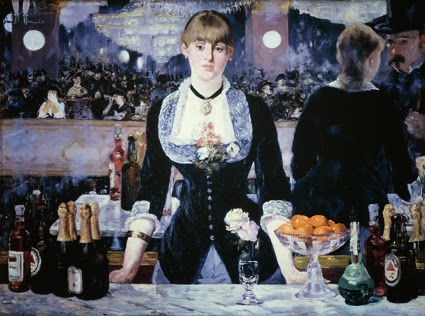
Bar at the Folies-Bergere, Manet
At the end of a production period, when you’ve safely tucked up the publication in bed, a little relaxation is always in order.

And what could be better than the opportunity to gaze at some top-notch art for an hour or so?

That was the situation by mid-afternoon on Friday and, with dinner at Joe Allen and theatre to follow, I had a nice little gap in my calendar.

And given that I’d later be heading to the Aldwych/Strand, the best possible solution presented itself in a first ever visit to the Courtauld Gallery.

Based in the part of Somerset House that was originally designed for the Royal Academy, which itself was founded 1768, it houses the art collection of the Courtauld Institute of Art, a self-governing college of the University of London that was founded in 1932.

Autumn Effect at Argenteuil, Monet
It has a small, but renownedly fine collection and, for some reason or other, I’d never visited.

First up was the medieval room, which was devoid of any other human life when I entered, and fabulously quiet.

But just as a started gazing in wonder into a cabinet of remarkable carvings, the door was shoved open and in burst a group of Russian tourists, cameras and phones ready to snap anything and everything – and woe betide anyone who was in their way.

Bang went my chance of seeing anything properly, as I was shoved out of the way from two sides (there was at least one brief apology), by phone-toting visitors determined simply to snap, snap and snap again. They were not, I hasten to add, youngsters.

Adam and Eve, Cranach the Elder
I retired quickly to the first of the upstairs galleries, only to find them catch up with me almost instantly.

Again, the same pattern.

Having spent a few minutes looking at Peter Bruegel the Elder’s Landscape with the Flight into Egypt (1563), which I realised that I remembered from school, I approached Lucas Cranach the Elder’s Adam and Eve (1526), only for a group to surround it with no interest in anything other than having a picture taken beside it, making funny signs with hands near Adam’s groin.

Quickly on then, through the rooms with the Gainsbroughs and the Rubens, into the smaller, square Cézanne Room, where I plonked myself firmly on the square bench in the middle and stayed put to wait them out.

Art’s for everyone, and all that – and I’d love more people to see stuff like this and enjoy it, but what the hell is the point of visiting a gallery or museum and behaving like this?

Montagne Sainte-Victoire, Cézanne
What do you get from it – and it had better be pretty damned special if you’re going to make such a negative impact on other visitors.

While doing that ‘waiting out’, I set myself to concentrate on the painter’s Montagne Sainte-Victoire from around 1887, sketching a very rough outline of it with a pen on the lined page of a notebook in an effort to better understand the composition. Which actually does work.

The gallery’s Cézanne collection alone is worth the (£6) admission, and covers a wide period in his productive life, up to a very late landscape, Route Tournante, from 1904, which looks unfinished as well as quite abstract, and also includes the wonderful Man with a Pipe from 1896.

Nevermore, Gauguin
Looking at these, I found it much easier to start to understand the difference between Impressionism and post-Impressionism: it starts to make sense.

There was no shortage of treats in just three rooms, including some Renoir and Degas, with Monet’s beautiful Autumn Effect at Argenteuil (1873), plus Manet’s vivid explosion of colour, Banks of the Seine at Argenteuil (1874) and the iconic A Bar at the Folies-Bergere (1881-82) being stand outs, along with a sculpture by Rodin, van Gogh’s disturbing Self Portrait with a Bandaged Ear (1889) and the lovely Peach Trees in Blossom from the same year.

Self-portrait with a Bandaged Ear, van Gogh
But for me, one of the most important ‘new’ experiences was seeing two of Gauguin’s Tahitian paintings in the ‘flesh’. The colour palate really reminded me of Survage’s Collioure pictures, and they also have a sense of mystery about them that adds to the fascination.

I don’t know why – now – but I’d long assumed that they were quite exploitative, but when you see them, you also see the dignity of the women in them. I was wrong on that score, most defininately.

There’s also a realism combined with a decorative element that makes a particularly interesting contrast with The Haystacks, which the artist painted in Brittany in 1889, which has a palate that seems closer to van Gogh than what we perhaps most obviously think of Gauguin.

Upstairs, though, came an unexpected treat.

As I walked into a room of 20th century art and turned back to look what was hung on the left of the door, it was to see André Derain’s Fishermen at Collioure, painted in 1905, in that summer that, in effect, saw the beginning of Fauvism.

The Red Beach, Matisse
And on the other side of the same door, The Red Beach by Matisse, also from 1905, and quite recognisably of Port D’Avall.

After all the hunting for work in London by Matisse, finally here was not just ‘any old work’, but something that I could comprehend and appreciate on a specific and quite personal level.

I was thrilled almost to the point of tears – and telling innocent bystanders: ‘I’ve sat on that beach, I ‘ave’.

Other exhibits that made an impact also include some Kandinsky, some Kirchner and a room of Walter Sickert (a revelation) and Modigliani’s rather wonderful Female Nude Sitting from 1916.

Slowly I seem to ‘get’ modern art. Or actually, not so much slowly, but all in a relatively short burst, after having spent decades – including my time studying art formally at school – not doing so.

It’s really rather enjoyable.