Showing posts with label sexuality. Show all posts

Monday, 25 November 2024

A sensitive exploration of what being queer means


Layla is the feature debut from non-binary British-Iraqi drag artist and film maker Amrou Al-Kadhi, and uses a deceptively traditional romantic story to explore the difficulties of navigating a life caught between queer and religious/ethic identities.

Layla (deadname Latif) is a non-binary drag queen from a Muslim family, who is living in London with three queer friends and has already become a star within their community.


However, they’re also trying to balance this with not being out to their family and, when they go back to visit, perform a conventional straight cis role. They are convinced that they cannot possibly be who they really are with their own family.


When they meet Max after a performance at a corporate London Pride do that goes spectacularly – and very funnily – wrong, the pair quickly start developing a romantic bond. But they’re also streets apart in terms of their lives. Max is from a well-to-do, white, middle-class family who are accepting of his rather beige gayness, but when Layla meets them, it’s clear that there are underlying issues around racism, Islamophobia and class.


And to add, Layla’s newly-married sister is moving to London with her husband.


This is a very sensitive film, while also being very frank. It is very unjudgmental and also helps to really explain what, for many LGBT+ people, ‘queer’ means.


Al-Kadhi’s direction and screenplay are excellent. Bilal Hasna as Layla is simply superb, while Louis Greatorex as Max is also very good. Indeed, It’s a very fine cast all around.


This was screened earlier this year at the BFI’s Flare festival and is now on more general release. It’s a very good addition to LGBTQI film.

Saturday, 25 May 2024

Beryl Cook/Tom of Finland: a stimulating exhibition

It might seem a strange idea to stage an exhibition of works by both Beryl Cook (1926-2008) and Touko Laaksonen, who was better known as Tom of Finland (1920-1991), but that’s what Studio Voltaire in Clapham has done. And it works a treat.

It’s a concise selection, but carefully chosen and with curator’s notes that avoid the pretentious and actually provide good context.

Cook is famous for her paintings of voluptuous women, predominantly working class. They’re often skimpily attired and seen with very high heels, drinks and/or fags in hand. Importantly, there is no sign of them being ashamed of their bodies – and they have the temerity to be having fun.

Victoria Wood described Cook’s paintings as being “like Rubens with jokes”.

She was self-taught and, entirely predictably, like LS Lowry, the British art establishment was sniffy. Even when she died, obituaries referred to her saucy seaside postcard as ‘naïve’. But she was – and continues to be – incredibly popular, while some major galleries now display paintings by her.

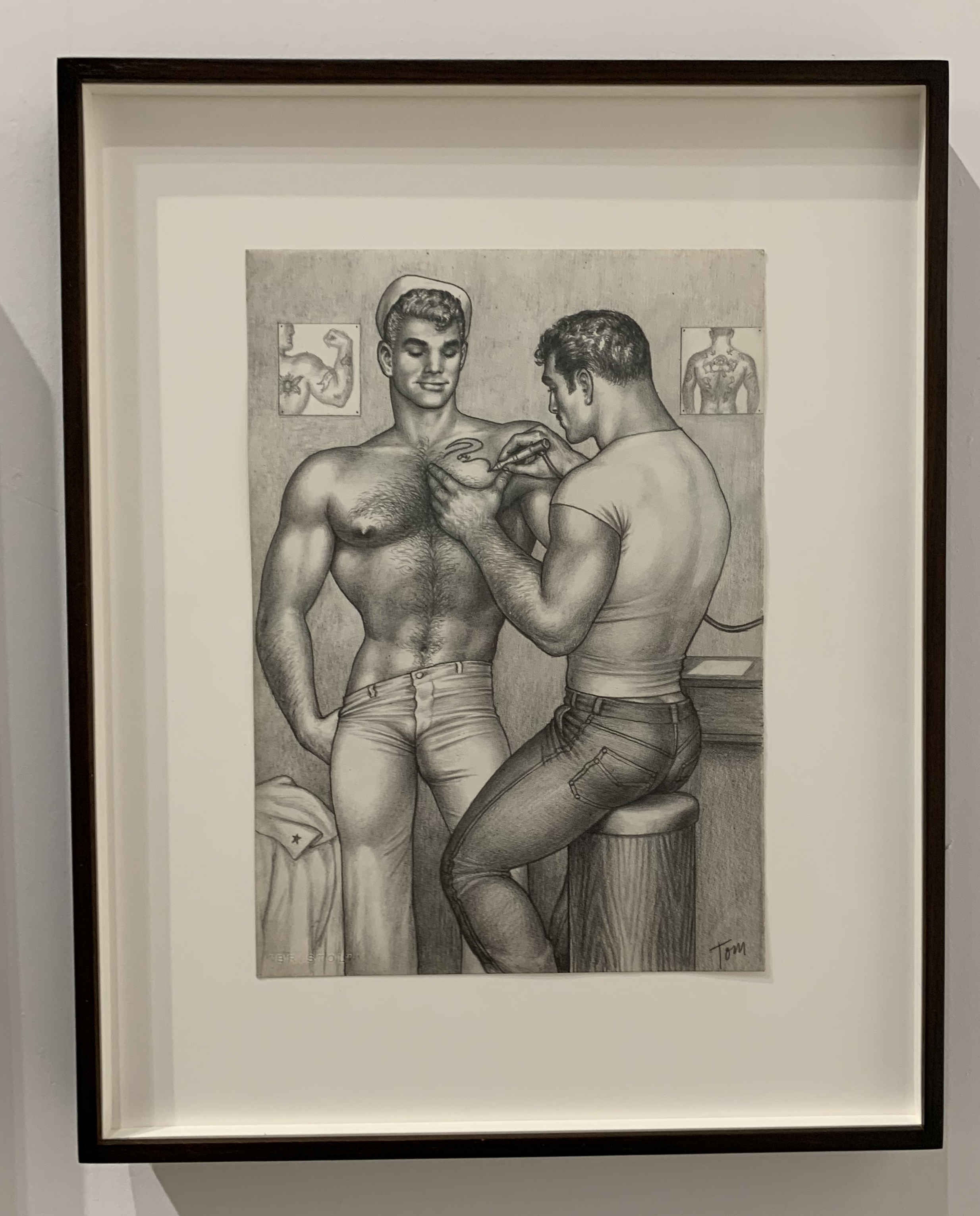
Tom’s works are more overtly and explicitly sexual. He took his name for the sake of anonymity, when by the late 1950s, he was an illustrator for US magazine Physique Pictorial, which portrayed muscled men in homoerotic activities that would just scrape past the censor.

Looking at his works of extremely muscled and well-hung hunks now, it’s easy to think of them as reflecting tropes of gay culture: the cowboy, the sailor, the leather man. All very Village People. But then that’s because Tom helped create such an incredibly influential aesthetic.

Like Cook, his figures are predominantly working class. The hyper-masculine nature of them was a direct challenge to the idea that gay men were effeminate. They are also clearly happy in their own bodies – and they’re having fun.

The styles of both artists are very different. But they’re instantly recognisable, beautifully executed and absolutely suit their subjects.

Of the works on display, there are several standouts. Cook’s 1976 painting The Lockyer Tavern (pictured at the top of this review), shows women drinking in a Plymouth gay pub – the artist was very much an ally – is iconic.

Personal Services
There’s also Personal Services from 1987, inspired by the life of famous madame and dominatrix, Cynthia Payne. It was used as a poster for the Terry Jones film about Payne, of the same title.

Ladies Night (Ivor Dickie) from 1981 portrays women surrounding a male pole dancer/stripper and laughing and straining to see as he pulls down his thong.

There’s also a display of some of the photos she took to help her work, which is illuminating.

Much of Tom’s work was graphite on paper – and untitled. I have selected three to include here, all of which showcase his skill and the points I’ve made above, but all of which are (just about!) ‘safe’ to see.

Studio Voltaire is a small exhibition space and this is a small exhibition. But that doesn’t mean it doesn’t offer an experience that breaks away from mainstream exhibitions to represent and celebrate communities and groups in a way that is really welcome and thoroughly life-affirming.

Ladies Night (Ivor Dickie)


Beryl Cook/Tom of Finland is at Studio Voltaire until 25 August.

It includes explicit artistic representations of gay sex.


Thursday, 15 February 2024

Andrew McMillan's debut novel, Pity, packs a big punch

Pity, award-winning poet Andrew McMillian’s debut novel, is, at under 200 pages, feels hardly much longer than the archetypal ‘slender volume of verse’ –  but don’t let that deceive you, because this packs a powerful punch.

Set in a former mining village near Barnsley (where the author hails from), it tells the story of the men of three generations of the Banks family: Brian, his sons Brian and Alex, and Alex’s son, Simon.

The brothers had followed their father down the mines – there being little alternative at the time. Simon, born into an era after the miners’ strike and the pit closures, works in a call centre by day and as a drag performer at night. He has recently started a relationship with Ryan, a security guard in a local shopping centre who wants to become a policeman.

A group of patronising, nameless academics, spending time in the village to record the memories of those who lived through the tumultuous 1980s, observe that the years since the strike have seen almost every trace of the industry that once sustained have been obliterated.

And they are bemused that the locals they talk to are reluctant to talk of those times – and not least of a disaster that hit one of the local pits.

McMillian tells his story in sparing terms – though throughout the book, there are brief sections that describe the local men leaving their homes in the morning to go to work, over and over; the grim reality of the ride down the pit shaft in the cage, and the bleak, dangerous work, as the coal dust works its way into the lungs of the miners.

These sections have an incredible poetic quality. Not that they romanticise the industry – quite the opposite. It feels like a nod to WWI poetry.

In the first such section, as the men walk to their work, McMillan writes: “The village, on their shoulder now, still asleep, not watching the migration of tired bodies. One of the men once said that he thought he could hear the coal ticking. Another man told him to stop talking daft. And beneath their feet, a mile down, history; waiting to be hacked into chunks and pulled out.”

It’s a motif that is repeated with slight variations throughout.

Part of the power of the novel is that it doesn’t pander to any sentimental attachment to the industry – or indeed, to the strike – while also portraying the contemporary world of work as far from perfect.

It also doesn’t seek our ‘pity’ and portrays the men as strong, yet also vulnerable and flawed.

There is little in these crucial passages to suggest that any of the men would regret not having to trudge to the mine. Yes, there’s an element of community, but it comes across more as something comparable to men going into battle rather than something remotely joyous.

And within this context, McMillian makes a wider exploration of male identity, community, relationships, sexuality and fear. In maintaining an emotional distance from his characters, he has increased the power of this. And in a splendid example of how this can work (see Thomas Mann’s Death in Venice), by the end you really do care about these men.

This is a seriously good novel about working-class, male experience in the late 20th and early 21st century. Very much worth reading.


Saturday, 1 July 2023

A superb history of trans and non-binary lives

Before We Were Trans by Kit Heyam is a remarkable achievement. First published last year and now out in paperback, it is an attempt to map out a history of trans and non-binary people – not just within the white West, but taking in cultures around the world.

Heyam works scrupulously to avoid imposing contemporary, white Western values and ideas about gender onto people from different cultures and living in very different societies (and times), reminding readers that to do so is dangerous in terms of a meaningful understanding of history, but that it also risks colonising – or re-colonising – those lives.


It is full of revelatory information. For instance, I had no idea that in Swahili, “all pronouns are gender neutral”. Or that “The Daughters of Bilitis, an American lesbian activist group founded in 1955, described butch lesbians as ‘the worst publicity we can get’.”


Records from WWI internment camps on the Isle of Man provide a wealth of information from the German civilians imprisoned there for years with no ‘biological females’.


The author explains in detail how, in some cultures, from First Nation to South Asian ones, gender non-conformity is often intrinsically linked to spirituality. No matter how difficult some in the West might find it to understand this, we should not pretend it is not the reality for people who experience gender in such a way.


Heyam is also determined that we should not simply assume that in every – and there are plenty – historic example of gender non-conformity, we should assume that the person involved was trans or non-binary.


They point out that there could have been motives for being gender non-confirmative that could have involved coercion, the need to make a living and more. But as they point out, it’s also a major likelihood that at least *some* were what we would now describe as trans or non-binary.  


Initially, I found it a bit annoying to be reminded of these things quite frequently, but I came to understand the value of such reminders. I read history books on a reasonably regular basis, but have never read one like this, and ultimately it benefits from it. It has helped me think quite seriously about number of things I have not thought through before.


But Heyem also hits the proverbial nail right on the head in an understanding of why Western, non-binary people might be easily tempted to appropriate the experiences of non-Western, non-gender conforming people, given the assaults on trans and non-binary people currently being experienced – not least in the US and UK.


We need to construct a more nuanced dialogue in order not to appropriate, while still celebrating the range of non-gender conforming lives and understanding that in terms of our own relationship to the wider LGBT+ community.   


Heyam Is to be applauded for taking a complex subject and approaching it in such a way as to make it informative, challenging and, as they suggest at the end, ‘kind’, to those in the past as well as those living now and, indeed, those in the future.


A very different and valuable history – and one to be heartily recommended.

Friday, 12 August 2022

Outrageous! Section 28 as a warning from history

Outrageous! The story of Section 28 and Britain’s battle for LGBT education by Paul Baker manages to be both a detailed history of the notorious, homophobic legislation and a memoir that is often very funny, recounting how the author grew up under what, before being passed into law, was Clause 28.

It was a badly drafted clause in the Local Government Act in 1988, banning local authorities – which have responsibility for local state schools – from ‘promoting’ homosexuality and the “acceptability of homosexuality as a pretended family relationship”.

That ‘promoting’ bit was a major difficulty – did acknowledging homosexuality exists equate with ‘promotion’? If you played pupils a bit of Tchaikovsky, would that amount to ‘promotion’?

In the House of Commons, Labour MP Tony Benn put it like this: “... if the sense of the word promote can be read across from describe, every murder play promotes murder, every war play promotes war, every drama involving the eternal triangle promotes adultery; and Mr Richard Bransons condom campaign promotes fornication. The House had better be very careful before it gives to judges, who come from a narrow section of society, the power to interpret ‘promote’.”

Then of course, there was the whole idea that an LGBT relationship was a ‘pretend’ one. Baker points out that the pace of social change since the 1960s – decriminalisation of homosexuality (albeit with strictures in place) only came in 1967 – had left many older people struggling in such a rapidly shifting landscape and in what many saw as ‘the permissive society’.

The process of how something comes to be on the statue book is explained in a good bit of civics showing how the Westminster Parliament works in terms of both houses.

Baker uses interviews with key figures, including Sir Ian McKellen, Angela Mason and Lord Chris Smith, to recount what happened, together with many quotes from speakers in both the House of Commons and the Lords when the subject was being debated.

Many of those quotes still have the power to shock now, with their brazen and even violent hatred. The usual names come up – Mary Whitehouse, Lord Longford, Malcolm Muggeridge … together with ones that will be less well known to the wider audience, such as Dame Elaine Kellett-Bowman, who was Baker’s MP when he went to work at Lancaster University, and mine too when I lived in that area.

She was a sort of handbagging Margaret Thatcher clone on ’roids – a deeply unpleasant woman that I personally had contact with when writing to her in the 1980s about Campaign for the Arts. It might have been a non-party campaign, but that didn’t stop her snotty reply effectively accusing me of being a ‘loony lefty’. I was barely getting over having started my political life, courtesy of my background, as a Tory, but she helped me further along that road.

Baker takes great care to be as understanding as possible of the motives of many who so strongly backed Section 28 and never falls into the easy trap of simply lambasting him, though is less obviously forgiving of their friends in the media who peddled a diet of hate to their readers.

But central to the book are the stories of those whose lives were negatively affected by Section 28 and the homophobia that it enabled. It had a lasting impact for many.

However, brought together disparate parts of the LGBT community to fight back against and, in the process, build the case – and support for – greater equality, with a campaign including some incredibly inventive, non-violent protests.

Following the repeal of the clause in devolved Scotland in 2000, it finally came off the books elsewhere in 2003.

Reading this today feels like having a premonition.

Toward the end of Outrageous! Baker says that “Tristan Garel-Jones, the deputy chief whip for the Conservatives, apparently called it [Section 28], a piece of meat thrown by Mrs Thatcher to her right-wing wolves”.

I finished the book the same day on which reports leaked out that Tory Party leadership frontrunner Liz Truss had said – according to her supporter and former party leader Iain Duncan Smith – that she regretted her involvement in the Bill to ban conversion ‘therapy’.

Duncan Smith – a Catholic convert who once used the word “sin” in a discussion on unemployment – suggested that she would like to bin the legislation altogether.

This was subsequently denied by her team, according to North London Tory MP Mike Freer, who told his local newspaper that he had asked.


Other reports have suggested that, if elected as Tory leader (and thus prime minister), Truss would also elevate the culture war loving, LGBT+ despising Kemi Badenoch to her front bench.


This is, of course, precisely the sort of raw red meat that Garel-Jones mentioned. The Conservative Party had a maximum membership of 180,000 as of 2019 (the party is not open about its membership) as opposed to 47.6 million Parliamentary electoral registrations in the following year.


Those who will select the new Tory leader/PM are a tiny minority of the electorate as a whole and, on the basis of their likely preferred news reading being the Telegraph, the Mail and the Express, they are still being fed a toxic diet of homophobic – and particularly transphobic – bile.


The first two of those, together with the Sun, have been cited as the biggest new media defenders of Section 28.


In the last couple of days, Suella Braverman, the attorney general, has stated that schools that talk about gender change could face Ofsted sanctions. Nothing like Section 28 at all, then.


Yet even within this constituency of the Conservative Party membership, YouGov polling has shown that just 8% of those members want “combatting the woke agenda” prioritised, so it’s difficult to see who is being appealed to here. A wider constituency of far-right voters that switched from the likes of UKIP and helped the Conservatives to a massive majority in 2019? Religious fundamentalists from across faiths who hate anything that isn’t heterosexual marriage? Groups that might vote for the Conservatives at the next general election?


It’s difficult not to feel deeply concerned about what the coming period will bring in terms of equality and for the LGBT+ community. Or not to feel that, once again, campaigns and protests might need to be organised.


Baker’s book is a salutary reminder of the harm of such intolerance – but also of how the fight back can succeed. It is very much worth a read.


• Outrageous! The story of Section 28 and Britain’s battle for LGBT education by Paul Baker is published by Reaktion Books


Tuesday, 6 August 2019

A bona read!

Fabulosa! The Story of Britain's Secret Gay Language

Paul Baker

Reaktion Books

‘How bona to vada your dolly old eke!’ If you know what this means – or at least recognise something about the words – then a new publication from Reaktion Books might well be for you. If you don’t, then it still might be for you. 

But there is a proviso: Fabulosa! The Story of Britain's Secret Gay Language by Paul Baker will make some people uncomfortable. Polari, a slang that was used predominantly by theatre workers and camp gay men (mostly working class), was not for prudes.

The sentence that opens this post means ‘how nice to see your lovely old face.’ So nothing to worry anyone there.

But here’s another phrase I can remember without making an effort to learn: ‘Scharda there’s nada to vada in the larder’.

Literally, ‘a shame there’s nothing to see in then larder’. Euphemistically: ‘a shame he’s got a small penis’.

It’s a highly sexualised code and full of bitchy potential.

But then, as Baker explains, it was used by people who were outlaws within UK society – derided and persecuted on the basis of who they fancied/had sex with and how they presented. And Polari was not only an incredibly important way to communicate discretely, it also had a sense of in-your-face ‘fuck ’em’ in its bitchiness.

Baker, who has spent 25 years studying his subject, starts this book by carefully explaining the sort of technical stuff about what constitutes a language and, indeed, how Polari developed and from what roots. 

That’s fascinating enough – and it most certainly is – but in many ways, the book really gets into its stride when he starts to look deeper into why it developed: why, indeed, it was needed and what it gave to its users.

Polari has all but died out as a gay language since the end of the 1960s – partly because of decriminalisation (although Baker makes clear that that was far from the magic pill it can sound like now), but that that  also came at the end of its greatest prominence, when used as part of the Julian and Sandy sketches in the classic radio comedy, Round the Horne.

Kenneth Williams and Hugh Paddick were the eponymous pair: Baker interviewed co-writer Barry Took late in the latter’s life, and Took makes clear that the duo were the ones who knew Polari and fed that into the sketches. Took was apparently also rather shocked at some of the (possible) double, double meanings Williams in particular seems to have contributed, not least via ad-libbing.

But that actually emphasis how playful Polari was … how playful it IS.

One of the gay-friendly pubs in London, from the first half of the 20th century, that Baker mentions in the book – the Royal Oak on Columbia Road – was the first place I heard Polari: drinking with gay men who rattled off bits of Julian and Sandy as late as the 1990s.

I’ve long loved the camp bitchy thing – Priscilla, Queen of the Desert remains a favourite film, as does Victor/Victoria (even if the latter is not quite so camp bitchy). I don’t generally do personal ‘pride’ in much – but I do remain bloody chuffed with a couple of times I set the Oak crowd roaring with a comment.

Fabulosa! is an easy read – in places, very, very funny. But it is also a welcome social history that is a reminder of what gay men in the UK faced.


Very much recommended.


Saturday, 9 May 2015

Marlene Dumas – the image as challenge


Great Britain
If ‘better late than never’ was the case with my recent visit to the Goya exhibition at the Courtauld Gallery, then it was ever more true with a Friday evening trip to see an exhibition at the Tate Modern.

Marlene Dumas: The Image as Burden, has been on since February and finishes tomorrow.

I had half thought of visiting, but the first few months of the year have been manic, for various reasons. And I admit that, against that background, a combination of not being familiar with the artist and feeling slightly put off by the publicity image used, I hadn’t got past that half thought.

Rejects
Fortunately, when visiting the Tate Modern last week to see the Sonia Delaunay retrospective, I’d picked up enough visual information to decide that I needed to see the exhibition.

And so it was that, after work on Friday, The Other Half and I headed back to the South Bank, for what was probably my first major exhibition by a living artist.

Dumas was born in born in 1953 in Cape Town, South Africa, leaving the country for Amsterdam in 1976, the year of the Soweto uprising.

Amy Blue
Here, the Tate has gathered together a body of work that encompasses her career to date – a career that clearly illustrates the influence of that background.

Dumas doesn’t paint from life, but from photographs: some she takes herself, others that she sources from various media.

These are far from being copies, however, but merely a starting point. And where the images remain figurative and, in cases of famous people, entirely recognisable, Dumas imbues them with a power and haunting quality that raises many questions – not least, how we look at our fellow human beings.

We begin with Rejects, a series of ink and graphite ‘portrait heads’, which includes the image used for the exhibition publicity material and which, within this wider context, makes sense.

These are not ‘rejected’ people, but primarily created from works that were initially rejected or incomplete, and the set was inspired by her home country’s ‘reject stores’ where you can by clothes with faults.

The Teacher
Once you know that, you start to understand what she’s exploring. Because exploration is what it is – there is nothing polemical about Dumas’s work: it is a starting point for contemplation or discussion.

One of the most perfect examples of this is in the two canvases that form Great Britain (1995-97). One is taken from a fashion shoot with Naomi Campbell and the second, from a royal portrait of Princess Diana.

Seen as a single piece – not initially the artist’s intention – they create a serious dialogue about ideas and representations of femininity and female sexuality. And because neither of them shows a representation of women that is highly sexualised, it makes that dialogue all the more interesting.

The Widow
In The Painter (1994) we are presented with a picture of the artist’s young daughter, hands covered in bright paint, a petulant stare challenging the viewer.

Part of what struck me about this was the simplicity of the grey sweep of paint that creates the child’s lower face, giving it that petulant expression. Indeed, it brought to mind the simplicity of Goya’s washes in the pictures I’d seen just a few short weeks ago.

Early this century, Dumas turned to more obviously political subjects. Two versions of a painting, The Woman of Algiers (2001) and The Trophy (2013) show a young woman being held, naked, for cameras.

Against the Wall
The Widow (2013) shows Pauline Lumumba walking bare-breasted through Kinshasa in 1961, in an act of mourning after the murder of her husband, Patrice, the first democractically-elected prime minister of the Democratic Republic of the Congo.

Against the Wall (2010) shows Jewish men waiting to go to prayer, standing alongside the Israeli security barrier – a visual reminder of the Wailing Wall.

The same room houses another large painting, The Mother (2009) – this time showing an anonymous woman in black, kneeling before an empty grave, with a framed picture of a young man near her. She is surrounded by more empty graves.

The Mother
She takes a classical theme of art in Forsaken, with a crucifixion, which has the Christ on the cross utterly alone, and is hung here in the same room as Great Men, a series of delicate portraits of notable gat men from both 19th and 20th centuries, which was created in response to attitudes towards homosexuality in Russia, and was first exhibited there in 2014.

One room contains a number of works that explored the dynamic of the naked figure (male and female) in art, pin-ups and pornography.

Again, this challenges the viewer to consider precisely how they view.

For me, The Teacher (Sub A) (1987) strikes a note of great familiarity, showing as it does a conventional school photograph (how I remember them!), while her portrait of Amy Winehouse, Amy – Blue (2011) is another striking work.

Her palette is muted, her sense of scale vast. But Dumas illustrates the power of the figurative in a world that sometimes seems to have forgotten it.

She paints terrorists and suspect, victims and more, constantly challenging us to consider our relationships with those pictures. Her work is full of questions about life, death, sexuality and power.

And one of Dumass greatest strengths is that she so carefully avoids the polemical; she doesn’t patronise the viewer, but instead invites you to consider.


Better late than never, as I said. This was a challenging exhibition that has left me with much to mull over. I’m very glad I made it.


Friday, 23 January 2015

Insulting gods – it's 'punching up'


Never mind the politicians: this was the people in Paris
The murders in Paris just over a fortnight ago have already illustrated a number of things – one of which was how the presence of 40 global leaders on the city’s massive march a few days after the killings merely served to highlight a great deal of hypocrisy over freedom of speech from a substantial number of them.

Indeed, the sycophantic sounds heard from many of the same politicians in the wake of the death of Saudi Arabia’s King Abdullah – the monarch of a country that routinely beheads people in public and flogs others for the ‘crime’ of expressing non-violent opinion – was, to put it politely, nauseating.

But setting this issue aside for the sake of today’s post, one of the most extraordinary things that has happened in the aftermath of the attack on satirical magazine Charlie Hebdo has been the attitude among some on the political left in the UK of criticising that publication as racist, Islamophobic and a clear case of ‘white men punching down’.

Now I’m going to assume that the last piece of jargon is understandable to all – although obviously, if you’re white and male, you cannot comment on it. Given that I’m female, I have more points than you and therefore will comment.

Various writers have attempted to correct these assertions, using something as unfashionable as facts.

The facts in question include pointing out that the magazine satirises all religions – and also (on a particularly regular basis) the French far right and its anti-immigrant stance, while also calling an amnesty for all illegal immigrants. On a slightly different tack, the same magazine published articles by economist Bernard Maris (one of the victims) opposing austerity and damning of the way in which Greece has been treated.

But still the shrill little cries about it being racist persist.

It appears that you (well, not if you’re white and male, obviously) must never, ever insult someone’s religion – or at least not if that religion is Islam, which is the religion of choice (or not) for a great many people in the world, of whom many exist in poverty.

But what are the ‘insults’?

The problem is of publishing pictures of ‘the prophet’ – Muhammed – and the problem is twofold.

Nowhere in the Qu’ran is there anything forbidding images of Muhammed or Allah, but these occur in the hadith – a record of sayings and actions of Muhammed and his companions, which was written over the years after his death.

The key idea here is that, since Muhammed was a man and not god, portraying him may lead to worship of Muhammed rather than of Allah.

So at its core, it’s about idolatry, in other words.

Islam is far from being alone in a fear of idolatry. Judaism shares the same fear, up to and including any representations of Yahweh.

In Christianity, the early church was also aniconist, as was the 8th century Byzantine church, while the likes of Calvin and Luther proscribed images in churches after the Protestant Reformation. To varying degrees, this continues today in some sects.

And the bar on images of Muhammed and Allah also extends to Moses and Christ, both of whom are revered as prophets in Islam. This is a large part of why the film Exodus: Gods and Kings has been banned in Morocco and Egypt (apart from the ‘historical inaccuracies’, but let’s not go there).

Aniconism in Islam, though, is nowhere near universal. Sunni Muslims are considerably more likely to believe it than Shias. Shia Islamic tradition is far less strict and there were, for instance, images of the prophet produced in 7th century Persia.

On Islamic representations of the prophet, Omid Safi, a religious studies professor at Duke University, told CNN: “We have had visual depictions of the prophet in the form of miniatures and pictures in the Iranian context, the Turkish context, the central Asian context. The one significant context where depictions of the prophet have not been image-related has been in the Arab context”.

This tallies with the spread of Wahhabism, a particularly austere and fundamentalist version of Islam that arose from the Middle Eastern deserts, which has been actively spread by the likes of Saudi Arabia for years and which provides the theological basis for the likes of Islamic State (IS).

But if idolatry is a fear, how does a cartoon – let alone a satirical one – encourage that? Is someone really likely to worship Muhammed rather than Allah on the basis of any cartoon?

There is no obvious connection – although perversely, the murders have now made the post-massacre Charlie Hebdo cover an icon in its own right, complete with its portrayal of the prophet.

And as Hussein Rashid, a professor of Islamic studies at Hofstra University in New York, told CNN, there’s a “bitter irony” in violent attacks against portrayals of the prophet, since they become, in effect, a “kind of reverse idol-worship, revering – and killing for – the absence of an image”.

So the murders have created one of the things that were feared in the first place.

The second theological response is that picturing the Prophet is a direct insult to Allah.

This is the point at which many will have real difficulty. How do you insult something that doesn’t exist? Or, if such a god does exist, then isn’t he big enough and powerful enough to take issue with any mere mortal who does ‘insult’ him?

Besides, how do you insult a god? And why would a god be so thin-skinned anyway?

Mind, if that’s what the Charlie Hebdo cartoonists were doing, I think it counts as the ultimate ‘punching up’.

But there is a further matter of context. Take a Charlie Hebdo cartoon of the prophet about to be beheaded by someone dressed as we’re used to seeing IS insurgents attired. The word bubble has him complaining that he is the prophet.

It’s pretty clear that what’s being suggested here is that the likes of IS are the ones doing damage to Islam – in terms both of reputation and, indeed, in the murder of so very many other Muslims across Syria, Iraq, Pakistan, Nigeria and so on.

Let’s ignore the nonsense accusations of racism, which start from a position of ignoring the fact that Islam is no more a race than Christianity.

And as for the faux empathy with ‘poor Muslims’ – a particularly patronising bit of Western, liberal guilt – would the same people condemn Charlie Hebdo cartoons satirising the Pope, given that many millions of Catholics live in abject poverty and squalor, even as the current Pope is telling them that no, they still shouldn’t use contraception, but not to ‘breed like rabbits’?

Have they forgotten (if ever they knew) that, while religion might well be the “sigh of an oppressed creature”, it is also “the opium of the people” – in other words, part of the problem.

The people who are now getting upset about the post-murders Charlie Hebdo cover are being whipped up by powerful religious leaders with their own agendas – and those agendas have nothing to do with promoting equality, education, opportunity or pretty much anything else that is in contradiction to their power and to the version of their religion that they use to control people.

Indeed, so successful is that winding up, that people have burned down churches in an entirely different country in protest at a cartoon – a country that hasn’t got enough of it’s own troubles with Islamic terrorists in the shape of Boko Haram, who think nothing of mass murder, mass kidnapping etc.

Priorities, eh?

'Weapons of Choice'
But then again, protests against the post-massacre cover are now also being whipped up in Pakistan, the site of December’s Peshawar school attack, when the Taliban – precisely the sort of fundamentalist goons who get het up about cartoons – massacred 141 people, of whom 132 were children, not because of Western imperialism, but precisely because they want to keep people uneducated.

It’s impossible not to remember Luther’s description of reason as the devil’s whore, as I point out what should by now be bleedin obvious: that pissing off shit-stirring clerics and religious leaders, who have power and use it negatively to keep people in an oppressed state, is punching up – not down.

Incidentally, the phrase the “opium of the people” was not new when Marx wrote it in the 1840s. In 1797, in his novel Juliette, Marquis de Sade has his eponymous character tell the king that ignorance is “This opium you feed your people, so that, drugged, they do not feel their hurts, inflicted by you”.

Sade spent a great deal of his adult life in prison. His repeated ‘crime’? That’s right: offending religious sensibilities – and his relatives were among those who were desperate to get him imprisoned.

And so we return to the question of offence. Who gets to decide what is allowed and what is not?

Freedom of speech must have limits, surely?

Well there’s an old philosophical point that you cannot just get to yell ‘fire!’ in a crowded building for the sake of it. The reasons should be obvious.

Many cartoons are grotesque – see the work of Ralph Steadman or Steve Bell. Should we ban them because of that? Only last year, the Times was forced to grovel an apology for a scathing Steadman cartoon on the state of Israel’s assault on Gaza.

I’d suggest that it was a pity they didn’t have more balls in the face of the offence taken by some.

There have been examples of cartoons by Muslims that are downright objectionable in their portrayals of Jewish people. Is this ‘punching up’, on the basis that those drawing them are probably ‘brown’ and those being drawn probably white?

But at what stage do we say that someone’s offense is reason to bar something? If so, who gets to choose?

Unless something is a direct incitement to violence against a particular group – and we have laws for that – then why ban anything?

Should we ban Bell’s portrayals of politicians if their party’s followers feel offended by them? Or only if he is unpleasant about something or someone we like?

Subjectivity should never be a basis for law or for banning anything or restricting free speech. And once we start down that path, there is no logical – or reasonable – reason to not ban anything and, ultimately, everything.

And don’t forget how glorious mockery can be too – for instance, in the wonderful Twitter reaction to Fox News’s uncritical allowing of a so-called extremism ‘expert’ to say that Birmingham was 100% Muslim and a no-go area for any non-Muslim?

Although given the ownership of Fox, that would probably also count as ‘punching up’.

But Twitter has also been on fire when countering factually incorrect and racist content from the likes of the EDL.

However, the EDL is not a sort of group that attracts powerful, middle-class people, but many who feel powerless and economically disenfranchised, and who look for scapegoats to why they’re not doing well. It’s classic kick-the-cat syndrome, and it’s also as old as the hills (hence the tragic rise in anti-Semitism and other forms of prejudice).

Does ridiculing EDL then, become ‘punching up’ because they’re racists and Islamophobes (and often sexists and homophobes too) or ‘punching down’ because of their lack (perceived or otherwise) of opportunity in a de-industrialised society that has never replaced all the skilled, manual jobs that formerly paid a decent and dignified wage?

We can – or at least should – be able to condemn the racism and see what feeds that at the same time.

Just as we should be able to empathise with the lives of the millions of Muslims who are living in poverty, in brutal dictatorships or theocracies – many being slaughtered or driven from their homes by Islamic fundamentalists – without pretending that religion is not a tool used by oppressors to maintain oppression, and without adopting an attitude that the ‘problem’ is cartoons that offend on the most spurious of grounds.

And we should be very wary of patronising certain groups by suggesting that their religious sensibilities deserve special consideration.

If we go down that route, what would the opinion be about Lillian Ladele, the Islington registrar who objected to the mere idea of performing a civil partnership ceremony for lesbian or gay couple – on the basis that it ‘offended’ her religious sensibilities?

Her employer – Islaington Council – disciplined and threatened to dismiss her. She claimed it was discrimination.

Eventually, some appeals and counter-appeals later, she lost her case on the grounds that, in essence, she wanted to be discriminated for on the basis of her religious sensibilities: she wanted different treatment from her colleagues, because of what she chose to believe.

Indeed, given that Ms Ladele had had a child out of wedlock it could be taken as her being a tad choosy about which bits of theology she chose to consider important and those she chose to ignore (always a problem with all religions).

Which leaves one thinking she might just have been a bigot.

So, were the unions involved and later, the assorted tribunals/courts, wrong?

Should she have been allowed special treatment because of what she chose to believe and how she chose to interpret her religion?

To apply the same stance as that of some on Charlie Hebdo, then she should have been treated differently because, well, you know, she’s black and, you know, many of ‘them’ are religious and obviously we can’t say anything ‘offensive’ about that.

See what I mean about patronising?

To conclude this particular post, some on the left might perhaps benefit from learning what happened to secular opponents of the Shah in Iran after the Iranian Revolution of 1979, when their use to the theocrats had ceased.

• Note: no divinities have been insulted in the making of this post. I tweeted and re-tweeted a number of Charlie Hebdo cartoons in the immediate wake of the murders, but using some here as illustrations had the potential to get in the way of the argument.

• A further post is in development looking at the causes of Islamic extremism.