Showing posts with label Germany. Show all posts

Tuesday, 12 April 2022

Stars: looking up at the heavens

Stars


‘We are all in the gutter,’ said Wilde

‘But some of us look for the stars’


Yet the heavens are blank over London

Since light cancels out such a view


So I travelled to Travemünde

And I stood on the Strand after dark


Below pollarded trees in the cold

Ursa Minor winked down from above


The sight made me breathless with joy

And I wept with a new sense of life


• Image courtesy of Wikipedia


Saturday, 9 April 2022

Spring 2022: A poem for a troubled season


Spring 2022

A furious wind screams in across the Baltic,
Winter’s raging farewell that cuts clean to the bone.
Crows scythe through the air, scanning for mussels,
While decaying munitions dream beneath the churning grey
And the Gustloff lies at sleep.
Halyards yammer against poles on the Strand, as the flags,
Wrapped round and round and round,
Cling on for dear life.
Yet blossoms still prick through the eye of the storm,
And a sheen of green can just be seen caressing the skeletal trees.
Two and a half thousand kilometres south east
It is a different storm and a different spring.
There, fire is in flower and blood blossoms across pavements.
A pall of dust hangs over blasted ruins and
Settles on the charred bodies and cars in the graveyard streets.
Once more, the world wonders where the hatred springs from and
How to make it stop.
Seemingly impotent in the face of the tempest,
Fingers cross with the hope that it will blow itself out
So spring can come once more.
Until the seasons turn again.


4 April 2022

Photo: The Baltic at Travemünde, by the author

Monday, 22 February 2021

Praising grown-up Germany in the age of Brexit


Why the Germans Do it Better

John Kampfner


Atlantic Books


If you wanted to create a more provocative title, then it’s hard to see how you could better than that for this volume, which was published late last year.


It will inflame hardcore, Brexit-loving exceptionalists (never a bad thing), but it also won't be particularly popular with most Germans.


The latter group does not generally want to view its country in such terms: where the past lies so heavy, nationalistic bragging is out of the question for the majority.


Rather, there is continued reflection and concern – a situation not seen in the UK, where a loud minority feels free to howl some sort of superiority and, as Iain Duncan Smith did in January, at the end of the Brexit transition period, to hail the opportunity for Britain to dominate the world once more.


How Christ-like can you be? And I only ask the question, since IDS is supposedly a Christian.


So the history of the UK remains largely unfaced, to be seen only as one long, glorious victory. Raising the issues of statues to slavers is, for the right-wing elements of the press, 'woke’ and, of course 'cancel culture’.


But for author John Kampfner, it has, since the end of WWII, punched above its weight morally and ethically – and therefore, it’s not difficult to see why this is a legitimate suggestion.


It’s actually worth stepping back a bit to start with, noting that Kampfner is the son of a Jewish father who escaped eastwards from the Nazis, where he met the author’s English Protestant mother, who was a nurse in Singapore, where he himself was born.


Kampfner’s own CV is seriously impressive: he has worked as a journalist for Reuters, The Telegraph (initially in East Berlin), the FT, the BBC, and has been the editor of the New Statesman and current affairs editor of the British Society of Magazine Editors.


In other words, we can fairly approach this work without assuming an impinging and overriding personal/political ideology.


It is a fascinating book, combining elements of memoir, interview, data, history and lots more.


From a personal perspective and as a Germanophile myself, I am probably far better read on German history than the overwhelming majority of my compatriots. Indeed, I was whooping out loud when Kampfner described the lack of German history beyond 1933-1945 being represented in most British bookshops.


For a couple of decades now, that has been a way in which I judge a bookshop. I am not alone.


However, butting into this, I would take issue with Kampfner’s simplistic comparison of Prussia with Nazism. If you want to read more on that, then I can never recommend Christopher Clark’s superb Iron Kingdom highly enough. To be fair, I'd say read it anyway – it's the best history I've read.


I would suggest that he equally wrong on the green movement in Germany – in terms of timing. As Günter Grasss 1986 novel The Rat illustrates, Germans were first spurred into action on the environment by realising that their forests were dying because of acid rain. And for Germans, forests are a massively important issue – as Kampfner does point out fleetingly.


He also stresses that, in Germany, free issues are not just the preserve of the political left. The environment has brought many together, including conservatives – hence the electoral success of the German greens. 


However, for all my pickiness, this is a brilliant volume in so many ways. If you sit anywhere to the left of centre – and frankly, I think that many of those on the right of centre would feel the same – this is actually a clarion call for conservatism. Note the small ‘c’. And it's not a bad vision or, in Germany, reality.


There are many things I recognised – as well as many that were new to me – and also many that I found myself longing for.


Kampfner is very good on the social market and, while it’s briefer in terms of pages, he’s even better on Germany’s verein – the clubs. Apparently, Germany expects all citizens to be part of community organisations. Reading this section, I found myself longing for such a sense of community in the UK.


I recall a boat trip around Lübeck on a Sunday morning and seeing all the local boating clubs active. And other individuals out waking and running and running and more.


Nothing since has suggested to me that Germans have it, in essence, wrong – and this book provides the facts to back this up.


Kampfner is not simply rosy-tinted about his subject – he see its faults and sets them down clearly. But even while admitting to being “more of a child of Thatcher” than he would have imagined, in his impatience with the German way of doing things economically, he now points to how the country has largely stuck to its beliefs on the social market – even as many other countries now start to make at least noises about the importance of community etc.


It’s clear that Germany is aided in being more ‘grown up’ by having none of the distrust and dislike of intellectual activity that is particularly rife in English life. He describes how Angela Merkel loves to discuss high culture – and contrasts that to David Cameron, who was embarrassed to admit, at a dinner with the Kanzellor, that he just watched telly when off duty.


As Kampfner goes on, it’s a perfect was to illustrate how a liking for high culture is generally disparaged in the UK as elitist etc – where the situation in Germany is quite different (the number of small towns in Germany with opera houses is a succinct illustration of this).


But then again, German conservatism is ‘girly swot’ Merkel and here, it’s Boris Johnson and his rabble of an untalented Cabinet that happily trashes ‘experts’ at the first opportunity.


In the age of Brexit and Johnson, Kampfner’s book is an important read and corrective.


Sunday, 10 November 2019

All badged up

The overarching message from today’s exercise in re-badging my leather jacket, now returned from the cleaners, seems to have been that you can make statements without appearing to do so.

I started badging it some years ago, seeing it as a very personal form of ‘rock chic’ and absolutely refusing to add any obviously ‘political’ badges.

Over the last few years, it’s attracted plenty of comment and enquiry. Perhaps counter-intuitively, I think it says more about me and what I believe in than if I’d dressed the jacket in rather more obvious pins.

Loosely, there are themes. And as Thomas Mann once said: “Everything is politics”.

So here’s a guide to my newly badged jacket.

From top left (approximately) – travel is good. We start with a flag pin representing Lübeck. This was my destination as a 50th birthday ‘thang’: I’d never been out of the UK on my own before this and it was a (long overdue) rite of passage to prove I could travel to ‘Abroadland’ all on my own.

I chose Lübeck because of Mann and Günter Grass and because I’d spent around 10 years teaching myself a bit of German so felt a certain confidence in the idea that I might be able to communicate at a basic level.

It was a fabulous and seminal trip.

Füssen? More German stuff – Bavaria; the Alps; simply gorgeous. Ties in with the edelweiss pin.

Then Thomas Mann – I have spares ope this pin; that’s how important it is to me. I loved Buddenbrooks … but then I read Death in Venice and my mind was well and truly blown.

The travel section includes Collioure – of course – plus Vienna, Sorrento and Sicily: all are special to me.

Beethoven is crucial: I love classical music and Ludwig in particular. And his 250th birthday is next year, so it would be poor tom leave him out.

That Concorde? A lovely pin, bought in Folkstone, together with a Spitfire pin. But at present, wearing a Spitfire could send out all the wrong signals, while this suggests European co-operation.

The Royal Opera House? Well, if you read this blog regularly, you’ll know why.

The Haring ‘resist’ pin? Haring at Tate Liverpool was my art revelation this year and resisting the Establishment and racism and bigotry in general is good.

The birds? Well, I saw a kingfisher this year and interacted with a raven (my absolute top bird). I love corvids in general, including those beauties, magpies. Red squirrels – only seen in Germany and Austria – but wonderful nonetheless.

Stephen Sondheim is a god, Star Wars is a big part of my cultural life, along with The Wizard of Oz (and as some of you will know, I’m a ‘friend of Dorothy’), while Captain Haddock represents comics and cartoons, and Shakespeare … well, I ‘dig’ The Bard big time.


This is how to make comments about yourself but leave others imply enjoying the colour!

Monday, 11 April 2016

The Eagle has landed to leave the establishment flustered

For those of us who are long enough in the tooth, memories still exist of the career of Eddie ‘The Eagle’ Edwards, Britain’s lone ski-jumping competitor in the 1988 Winter Olympics.

In most cases, that’ll not so much be for his actually managing to land some jumps – and set new GB records in the process – but more for his excited, flapping celebrations after jumping.

It might not be the main aim of Dexter Fletcher’s ‘dramedy’, Eddie the Eagle, to rectify that situation, but one of the things that the film does achieve is to remind us that Eddie (real name Michael) was not quite the sporting buffoon that most will recall.

In reality, this son of a plasterer and a factory worker was a good downhill skier, who had a number of medals and trophies to his name and had only narrowly missed selection for the 1984 Games.

The film makes sure we’re aware of this – and then takes us on a journey with Eddie as he converts to ski jumping and sets his sights on exploiting a loophole in British Olympic rules that means he only needs to compete in order to gain selection for the 1988 team.

That, however, is without taking into account the British Olympic Association’s stubborn commitment to avoiding having someone from such a background sullying the team.

As only a slight aside, it reminds me of people in Lancashire saying that the only reason that the likes of David Hughes and Jack Simmons never got called up to the England cricket team was because the sport’s rulers were worried ‘they’d eat their peas with a knife’.

How Eddie gets on in Calgary is familiar terrain, but the story that has been forgotten is just how he got himself there in the first place.

It took real guts – or a slate loose, as they say of goalkeepers: make up your own mind – to do what he did, with no funding and against a background of being considered a joke.

The films adds a character in Bronson Peary, a washed-up former US ski jumper who finally agrees to coach Eddie, but this is pretty much crucial to allowing the eponymous dreamer someone to build a relationship with and bounce off in the film, as well as providing a sub plot.

The pace is good and it offers the chance to revel in some wonderful Bavarian Alpine scenery – Garmisch-Partenkirchen is Garmisch-Partenkirchen, while Oberstdorf stands in for Calgary.

Taron Egerton does a fine job as Eddie – complete with all his little tics and quirks.

Hugh Jackman adds a bit of Hollywood glamour as Peary, with more coming from Christopher Walken as his former coach – and all of which stardust presumably helps broaden the film’s potential market (it’s already earned its money back, apparently).

Tim McInnery is superb as the odious British Olympic official who takes a particular dislike to Eddie, while Jim Broadbent lends some delightful warmth (if more were needed) as a British TV commentator at the Games.

Keith Allen and Jo Hartley are in fine form as Eddie’s parents, and Iris Berben adds further class as the bar owner who gives Eddie a job while he’s training in Garmisch.

It even has the advantage of a sort of ‘companion’ album (not the soundtrack, per se) of new songs from ’80s stars, including the likes of Midge Ure, Marc Almond and OMD’s Andy McCluskey – plus a duet from Egerton and Jackman.

All things considered, it is a heart-warming, life-affirming film – and that would be enough to make it worth an evening out.

But there’s a little something else here too – a bit of steel at the core of what could otherwise be viewed exclusively through a potentially sentimental prism.

In being on the side of the ‘little man’, it gives one big finger to the British sporting establishment; to the snobbery and arrogance not just of the officials, but also the sort of people who were acceptable competitors.

It raises the question of just what constitutes the Olympic spirit: an elite sportsperson, subsidised heavily so that they can train and compete all year round, or someone who has to sleep in a van just to be able to get on the snow?

And that’s without getting into the question, which the film touches on, of establishment hypocrisy over ‘amateurism’.


All in all, Eddie the Eagle is well worth a viewing.

Wednesday, 6 April 2016

Heigh-ho, heigh-ho, it's off to fairytale land we go

Been there!
Once upon a time, after wandering around a medieval town for several days, someone thought that it would be a good idea to binge on fairytale films.

Easter, of course, offered the perfect opportunity to indulge, so a list was prepared, cushions plumped and the cupboard checked for appropriate amounts of nettle tisane.

In the event, the list was overtaken at the start by the discovery that Hansel and Gretel: Witch Hunters (2013) was on the telly.

Fascinated by the idea of updating fairy and folk tales – or to be more specific, allowing them a space in which to continue evolving – this seemed like a perfect place to begin.

In the event, that perfection was in illustrating how to get things wrong.

A US-German collaboration, written and directed by Norwegian Tommy Wirkola, it brought together creative talent from those countries, plus the UK, Netherlands, Sweden, Iceland, Poland, New Zealand, Canada, Finland and more.

The idea of the children growing up and becoming witch hunters is fine – and full of potential. It might be over egging the pudding a bit to make the adult Hansel a diabetic as a result of the witch’s attempts to fatten him for the oven, but we can let that slide.

Tarantino. Without the laughs.
However, it’s all over the place in terms of any sense of time and place. Poor old Augsburg is a specifically-named location in the story – presumably because it’s nicely medieval – which is then screwed all over by a sort of semi-steampunk aesthetic that’s at least a century too late (and I like steampunk). 

The director apparently thought the weapons should look as though H&G had made them. They dont. Black leather dusters are seriously cool – but out of place here.

Fairy tales can be seriously dark and violent – I am entirely happy with both – but this uses violence gratuitously and in a way that makes you think it’s actually trying to be a Tarantino film. Without any of the wit.

There are other irritants.

The international nature of the cast is fine – but then why have Brit actor Gemma Arterton, who plays the adult Gretel, using a faux American accent?

And oh god the constant pronunciation of Hansel with a long, American ‘A’, grated almost to the point of a foot going through the telly.

I was close to shouting about ‘cultural appropriation!’ – and that’s something I consider to be a bonkers idea, since it assumes cultures come in locked geographic/ethnic pigeon holes that have never mixed and informed each other (until now) and never should.

So, just to be clear, I hated it.

Still, if you never experience dross occasionally, how can you judge quality?

Anyway, next up was The Wonderful World of the Brothers Grimm, a 1962 MGM affair, filmed in Rothenburg ob der Tauber itself (and with a glance at Neuschwanstein), so enabling a spot of ‘been there!’ film tourism.

Brothers Grimm – with Rothenburg and skewed perspective
It’s a pleasant enough film about the brothers – and interestingly, the four tales that were included were not the most famous ones – but it suffers from having been filmed in Cinerama, which turns the television screen into a sort of triptych, warping some of the perspective.

In contrast to Hansel and Gretel, the international cast is allowed to use whatever accents they’re used to: that the brothers (Lawrence Harvey and Karlheinz Böhm) speak in received English and with a German accent is not remotely problematic.

Not sensational, but worth seeing nonetheless.

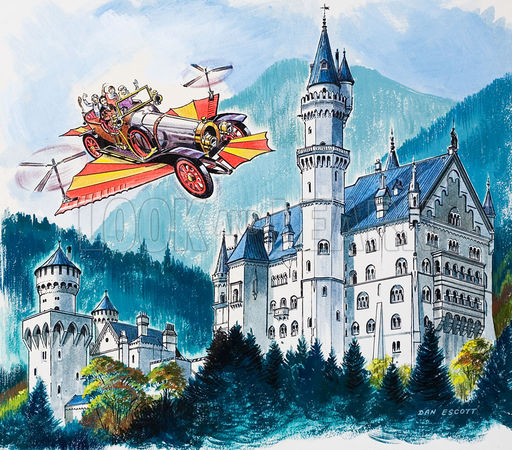
Next up was Chitty Chitty Bang Bang - a film I haven’t sat down to watch from A to Z for donkey’s years, and one that was, to be perfectly honest, rather shoehorned into this selection because its locations included, err, Neuschwanstein and Rothenburg ob der Tauber.

But actually, given the lack of any real character development of authot Ian Fleming, it works rather well as a fairy tale, since these are full, after all, of types, rather than 3D characters.

That’s not to say I don’t like it – in fact, a proper viewing restored my pleasure in it and reminded me that the dire matteing on the flying sequences should not be allowed to overshadow what is, by and large, a delightful film.

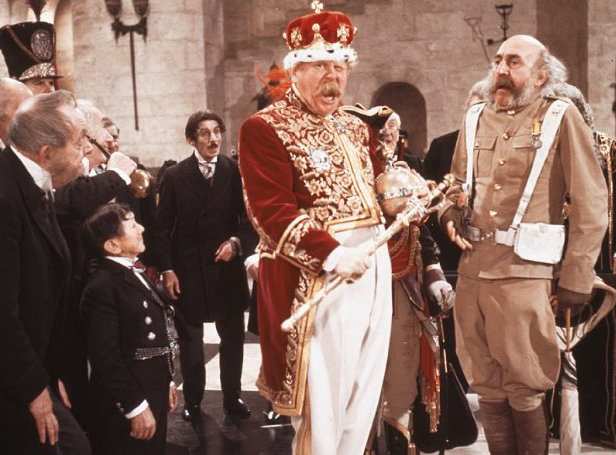
Gert Fröbe, Lionel Jefferies and mad scientists (inc Max Wall)
This is another international cast, but thankfully, Dick van Dyke was not, on this occasion, told to try any accent but his own. And it doesn’t matter that he has a soft American burr, while the rest of his family have pretty cut-glass accents.

Gert Fröbe is wonderful as Baron Bombast, James Robertson Justice is, well, James Robertson Justice (his real-life story would probably astonish you – look it up), Robert Helpmann is fabulously creepy as the Childcatcher, Lionel Jefferies is a super Grandpa and Benny Hill illustrates the point that comics can turn in serious performances.

And so what could possibly follow that?

Well, one of the things I’d been tempted into getting was 2014’s Maleficent - although I’d also been tempted to buy Hansel and Gretel: Witch Hunters on the grounds that it looked a really interesting take on the story, as recorded by the Grimms.

I put it off for a few days after the H&G experience, but eventually decided that it had to be watched.

And I’m very glad I did. It’s a fascinating take on Sleeping Beauty – so much so that there is a great deal of material around involving really very serious discussion of its themes.

Angelina Jolie – and a raven!
When the fairy Maleficent has her wings cut off, it can be viewed as a metaphor for rape – the writer and star, Angelina Jolie, certainly thought so, so it’s not just a viewer’s interpretation.

But the problems begin if you start reading the rest of it too literally from that point. I saw one writer complaining that, while the rape metaphor was clear, the subsequent story made it appear that the only way for a female rape victim to recover was by enacting revenge.

It’s fine to make the comparison, but this is also a fairy/folk tale – and indeed, such a reading of the film rather simplifies what actually does happen and how the characters develop.

And if you want to look for themes in it, then one of the others is the question of a nature-based world v an imperialistic/capitalistic one. This was certainly something that occurred to me when watching it (and it’s not a unique observation), but if you try to take it too far, then you’d do your head in.

It’s sumptuous to look at – the CGI works so well; conjuring worlds, but never detracting from the human.

Jolie is really in fine form – it’s a cracking performance. And she turns in a perfectly comfortable non-American accent (a tad softer than as that other very modern fairy tale character, Lara Croft).

Actually, accents are an interesting point here – we have a mixture between English and Scottish in an international cast. And no, it’s not one that comes down on simple good v bad lines. But directing actors to use specific accents here makes a kind of consistent sense, whereas the issue in H&G does not.

German vultures. No, seriously.
After that, I happened upon Channel 5 showing Disney’s iconic 1937 Snow White, which I haven’t seen in absolutely decades (it was one of the first films I ever saw, on a cinema re-release).

The plot is maintained pretty straightforwardly from the Grimms – one of the major changes is in giving the dwarves names and personalities; the character drawing is better than the late ’70s era Disney and the backgrounds are beautiful and delicate, while the witch is still, I’m sure, terrifying for young children.

The only thing I found myself muttering about was the presence of two vultures: there are no vultures in Germany – and it grates a tad. 

Mind, crows or ravens dont have yellow legs and beaks either – well, not in Europe, at any rate.

But it remains a standard of the fairy tale film genre and formed a perfect addition to the list I had set out to consider.

There are still two definite films to come from that original list but for the time being, that’s a good chunk of fairytale viewing under my belt.