Showing posts with label Füssen. Show all posts

Sunday, 10 November 2019

All badged up

The overarching message from today’s exercise in re-badging my leather jacket, now returned from the cleaners, seems to have been that you can make statements without appearing to do so.

I started badging it some years ago, seeing it as a very personal form of ‘rock chic’ and absolutely refusing to add any obviously ‘political’ badges.

Over the last few years, it’s attracted plenty of comment and enquiry. Perhaps counter-intuitively, I think it says more about me and what I believe in than if I’d dressed the jacket in rather more obvious pins.

Loosely, there are themes. And as Thomas Mann once said: “Everything is politics”.

So here’s a guide to my newly badged jacket.

From top left (approximately) – travel is good. We start with a flag pin representing Lübeck. This was my destination as a 50th birthday ‘thang’: I’d never been out of the UK on my own before this and it was a (long overdue) rite of passage to prove I could travel to ‘Abroadland’ all on my own.

I chose Lübeck because of Mann and Günter Grass and because I’d spent around 10 years teaching myself a bit of German so felt a certain confidence in the idea that I might be able to communicate at a basic level.

It was a fabulous and seminal trip.

Füssen? More German stuff – Bavaria; the Alps; simply gorgeous. Ties in with the edelweiss pin.

Then Thomas Mann – I have spares ope this pin; that’s how important it is to me. I loved Buddenbrooks … but then I read Death in Venice and my mind was well and truly blown.

The travel section includes Collioure – of course – plus Vienna, Sorrento and Sicily: all are special to me.

Beethoven is crucial: I love classical music and Ludwig in particular. And his 250th birthday is next year, so it would be poor tom leave him out.

That Concorde? A lovely pin, bought in Folkstone, together with a Spitfire pin. But at present, wearing a Spitfire could send out all the wrong signals, while this suggests European co-operation.

The Royal Opera House? Well, if you read this blog regularly, you’ll know why.

The Haring ‘resist’ pin? Haring at Tate Liverpool was my art revelation this year and resisting the Establishment and racism and bigotry in general is good.

The birds? Well, I saw a kingfisher this year and interacted with a raven (my absolute top bird). I love corvids in general, including those beauties, magpies. Red squirrels – only seen in Germany and Austria – but wonderful nonetheless.

Stephen Sondheim is a god, Star Wars is a big part of my cultural life, along with The Wizard of Oz (and as some of you will know, I’m a ‘friend of Dorothy’), while Captain Haddock represents comics and cartoons, and Shakespeare … well, I ‘dig’ The Bard big time.


This is how to make comments about yourself but leave others imply enjoying the colour!

Tuesday, 7 April 2015

We love to go a wandering

The way ahead
After a day’s rest for the feet, further studious study of the weather forecast revealed that Thursday and Friday were set to see precipitation of one sort or another.

That meant one thing: if we were to undertake another proper walk, it would have to be on Wednesday.

Helpfully, The Other Half – who had spent weeks studying online maps for precisely such ends – had just such a walk planned. So off we went, having this time remembered to take bottles of water with us but, unfortunately, no Kendal Mint Cake. I should have taken a slab to Bavaria on principle.

Our destination was another small Alpine lake, the Alatsee, and the start of the walk took us through the park at the back of summer palace of the bishops of Augsburg before we crossed a small, wooden bridge and climbed gently upwards onto a wooded ridge.

Germans, as I’ve mentioned before, care passionately about forests – it’s an essential part of the national psyche. Woods are so central a part of German life that, when it was discovered, in the 1980s, that the woods were dying from pollution, there was a united commitment to doing something.

Woodland delicacy
That the country is now a major producer of renewable energy is, in part, a result of that – and also an indicator that green politics is not seen as overtly as ‘left’ in the way it is elsewhere, not least in the UK.

For British townies in particular, we have, in general, long lost that sense of connection with nature.

But in Germany, no town or city is far removed from a wood or forest in which to spend time.

And these are maintained and looked after with great dedication, as are the footpaths that wend through them.

My mental musical theme for the week – with the exception of a burst of Wagner when at Neuschwanstein – was The Happy Wanderer.

Mein Vater war ein Wandersmann, to give it its original German title, was originally penned by Florenz Friedrich Sigismund (1788-1857), while the tune we’re familiar with was composed after WWII by Friederich-Wilhelm Möller.

Wood – smelling beautiful
A 1953 performance of the piece by the Obernkirchen children’s choir at the Llangollen International Musical Eisteddfod, broadcast on BBC radio, saw the song become an instant hit and staying in the singles chart (a top 12 at the time) for 26 non-consecutive weeks.

As we wandered through woodland, for a long while, with the sounds of the traffic of Füssen intermittently drifting upward to us, yet already in a different world, it drifted into my head again and even, quietly, from my lips: a song from childhood memory, suddenly taking on a new life.

Away from it all
We stopped to inspect tiny flowers alongside the path; to listen to the birds around us; to watch as a small deer sprung away through the trees, glancing back over its shoulder to check us out.

It wasn't a busy road
The process of maintaining the woods means that some trees are felled. Clearly there had been recent work done in this department, as we saw logs stacked neatly between pairs of standing trees.

Walking past one such stack – clearly very recently cut – the smell was astonishing. Forget those ghastly ‘air fresheners’ in cars and elsewhere: this is what trees smell of and it’s intoxicating.
Perfect for lunch
As we made our way, the road sounds drifted away entirely: the tranquillity was wonderful and eventually the tinkling of a beck made it’s way up to our ears.

Having discovered (the hard way) the result of the lack of contour lines on Google maps, we made a decision after some time to take a path down the side of the ridge to meet a road that then went on to the lake, rather than take what looked to be a harder path that would take us back up before coming down near the lake.

I say ‘road’, but I don’t recall a single vehicle passing us as we strolled along it, the metal points of our walking sticks now striking the tarmac surface.

Brilliant beer ....
The trees to our left eventually fell away, leaving us with views of Alpine pasture filling the space between the ridge we come along and the rather higher hill side opposite.

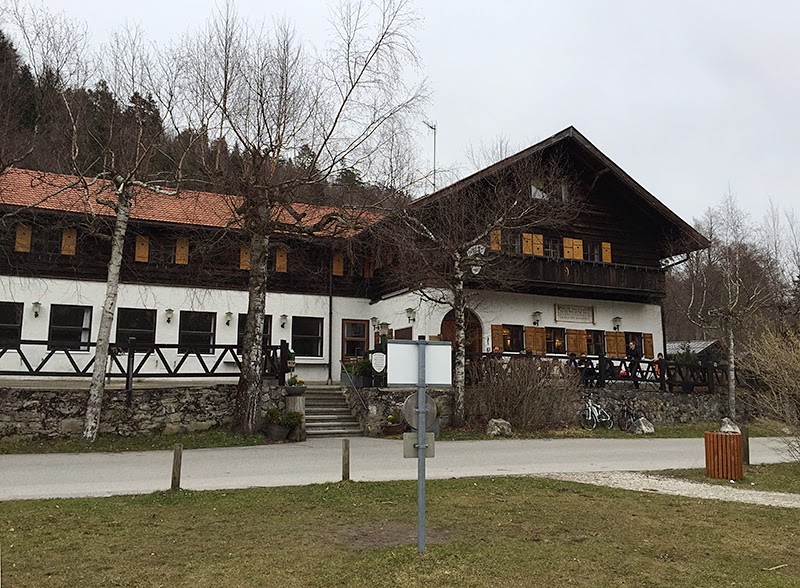
We made it to the lake for around 1pm – perfect, since the hotel there also has a restaurant and The Other Half had fully factored this into his plans.

With the temperature ludicrously mild, we sat outside the chalet-style building and ordered drinks while scanning the menu.

The beer was a caramel-coloured dunkel from the Aktienbrauerei – the oldest existing brewery in Kaufbeuren, first mentioned in 1308, a whopping 208 years before the Reinsheitsgebot – and was the best beer of the week, with an absolutely wonderful taste.

As we sipped, we could hear the sound of The Other Half’s schnitzel being beaten out in the nearby kitchen. Oh, this was going to be freshly cooked.

... and fabulous fodder
For myself, I had leapt at the opportunity to try spätzle for the first time. A sort of soft egg noodle from the south of Germany (and areas to the east), I knew it by legend alone.

It came as the bed on my (large) plate, dressed in melted butter and with a vast mound of gloriously crisp and wafer-thin fried onion rings atop a piece of absolutely superb beef that had been cooked to perfection: beautifully seared on the outside and melting to very pink the further in I got.

It was the perfect illustration of how good food doesn’t have to be haute cuisine. This was perfection.

Sated, we sat awhile, quietly taking in the view.

The Alatsee spread put in front of us, with a snow-capped
Austrian berg soaring beyond the wooded ridge that marked the border, and the wooded hills around the lake split in one place by a wedge of pasture.

The Alatsee
It was still largely iced over, although where the thaw had set in, the water was that rich malachite green again, and crystal clear at the edge, creating a perfect mirror to reflect its surroundings.

It’s apparently a meromictic lake – meaning that it has layers of water that do not mix, which in turn means that it can include within it radically different environments for organisms.

Snow ahead
Such bodies of water were only really named in the early 20th century. They may occur where the basin sides are unusually deep and steep compared to the lake’s surface, and where the lower layer of the water is highly saline and denser than the upper layers.

The Alatsee is 868m above sea level, with a surface area of 12 hectares and a maximum depth of 32.1m. There are such toxic organisms living in the lake that they’ve been blamed for a number of divers have died or disappeared in its waters.

And as if this were not enough, it’s one of the (many) spots that’s alleged to be hiding ‘Hitler’s gold’ – although Lake Toplitz in Austria beats it for plausibility, given that forged British banknotes were found by divers in chests, together with a printing press, in 1959.

You see – travel broadens the mind: or at least the knowledge base.
The Obersee
Eventually, we set off again. This time, the intention was to walk back along the valley floor on the opposite side, along the Faulenbach and passing the smaller Obersee and the positively diminutive Mittersee before reaching Füssen.

This route had been less exposed to the sun, meaning that snow several inches deep still lay in patches over the path. Those walking sticks were proving very handy.

There was evidence of winter tree fall from the steep, rocky ridge now to our right, and also where the local forestry management teams had come in and removed the section of a tree that had fallen across the path, leaving the rest where it lay.

Looking back from the Obsersee
Again, the sounds of trickling water and bird song were the dominant ones, leaving city natives to feel almost out of kilter at the absence of urban drone. It’s a long time since I spent so long away from the sounds of traffic.

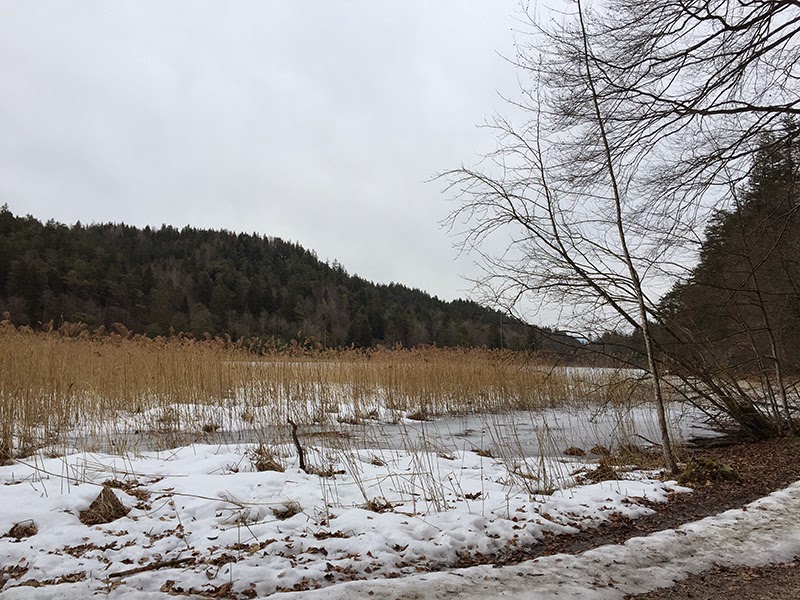
The Obersee was almost completely iced over, with reeds rearing up to tell you that there was marshy land beneath the frozen white.

And so we continued toward the town; another satisfying walk under our belts – another day gazing at this extraordinary landscape and feeling awed by it. Happy wanderers indeed.


Friday, 3 April 2015

Of hats and hockey

The abbey from the bishops' summer palace
We’d decided that, irrespective of the weather, Tuesday would be a day off – or to be more specific, would not involve a long walk.

It had taken half an hour or more the previous evening just for my feet, once out of boots, to stop throbbing. A phone app said that, all told, we’d done nearly 19km the previous day, including 15 flights of stairs (that’s ascending – it doesn’t register going down).

A very great deal of water has passed under the bridge since I’ve done anything like such a lengthy walk. I like walking – but London is not really conducive to the sort of walking I like, a point not helped by crowded pavements, or cyclists trying to mow you down, even on the canal towpaths, where pedestrians are supposed to enjoy right of way.

So we set off at a gentle pace to do more exploring of the old town, with stops for bowls of milky coffee as required.

That walk took us into the inner courtyard of the summer palace of the bishops of Augsburg for the first time. At this time of year, it’s only open to the public on a Friday afternoon, though much of it – together with parts of St Mang’s Abbey next door – serve as civic office space.

Summer palace of the bishops of Augsburg
The inner court was built between 1490-1504 by bishop Frederic of Zollern, but what makes it most distinctive is the illusionistic paintings on the outer facades, which date from 1499 and are unique in German late-Gothic architecture.

These trompe-l’oeil windows, brickwork and door frames are extraordinary, but while they are unique, painting on buildings in the Alps is hardly rare, and we saw plenty of delicate work on walls around the town, including clearly recent work that maintains the tradition.

And talking of tradition, there is plenty in the area – and not least sartorially.

In Munich on the Saturday, we’d even seen a gaggle of young men walking around in bits of regional dress, with soft, brimless caps. Students, we concluded, in a fraternity.

Looking into the palace courtyard
There was also a group of young women with matching clothing walking around too.

Alpine-style jackets were visible all over the place – some more traditional than others. We even spotted one man wearing a tracksuit top that had a round Bavarian collar and was trimmed in green, while hip, young men were wearing them with jeans.

There was even a smaller amount of lederhosen on view, and many eateries in the region see female staff wearing the dirndl.

I like it: I like what feels to be a statement against the globalising homogeneity. And that aside, a lot of it looks damned good.

Then there are the hats.

There are various types of regional headgear, as this hat lover had discovered via the internet by way of pre-trip research.

View of the palace from our room
We’d only been in Munich a short time before I managed to get one on my head. Indeed, this was such a specific hat that it an Allgäuer loden hat – from the very region of Bavaria that we were on our way to.

Loden is becoming familiar in the UK as a shade of green, but it’s actually a material. Items made from loden are often a dark hunter green or an olive green, certainly, but not always.

The word comes from the German ‘loda’ for a cilice, a coarse, rough garment worn by medieval monks to show repentance.


Once that’s complete, it becomes a dense but light fabric that can repel water, while also cheating wind and keeping the wearer warm. It’s sheered and brushed up to 20 times to gain the desired nap.

War memorial between the abbey and palace
Long viewed as the fabric of peasants, it emerged from the mountains in the 18th century, making its way into civil jackets and military uniforms, before becoming acceptable in the upper circles of society when worn by Austrian emperor Franz Josef in the 1870s.

So, that’s loden for you. The shape of the hats vary a little, but many come with a cord ‘band’ and it is traditional to dress them with brushes, feathers, brooches and pins – the latter often being linked to walking clubs.

I’d already decided I wanted a brush for mine, and found a super one in the shop where I bought it: boar hair set in a pewter brooch.

Then, as we were rambling around the city, I stopped to browse at an antique shop. The owner had seen me coming, new hat and all, and pointed out to me some delicate, carved edelweiss pins.

One, he said, was about a century old. It was carved from bone or horn and, when he told me that it was just €20, I decided not to resist.

Trout – there was a large bowl of salad with it
A few days later, after visiting Neuschwanstein, I added a further brush and feather combination, held in a mountain goat brooch, sold to me by a woman who was managing to dance and sing to Status Quo’s In the Army Now.

The final pin was added from a shop in Füssen and is a metal walking stick and hat, with fir leaves and ‘Neuschwanstein’ on a slender strip, with a single crystal hanging below.

It’s a cracking statement hat.

We took a rather fuller lunch on Tuesday, sitting outside Nostalgie-Restaurant Madame Plusch, where I enjoyed some trout, with mental accompaniment by Schubert.

We’d decided to make this our main meal of the day because we’d spotted a poster on
Sunday that had given us an idea for an evening out.

Ice cream van outside the old fire station, now a market
The local ice hockey team, EV Füssen, were due to play a home match on the Tuesday evening against EV Weiden in a Oberliga ‘best of five’ game.

Neither of us have ever seen an ice hockey match before, but it seemed an ideal cultural counterpoint to seeing a piano Wagner had played.

We snacked on more cake and coffee at Kurcafe and then headed off, managing to take the scenic, but ridiculously long, way around to the stadium. It did, however, provide another good sunset shot.

Another lovely sunset
EV Füssen was founded on 11 December 1922 and are historically one of the most successful ice hockey teams in Germany, having won 16 titles before slipping into the third tier.

Nicely, their shirts bear a silhouette of Neuschwanstein.

We took our seats as the players were warming up and in time to see the opposition manage to shatter one of the glass panels around the edge of the rink, which provided entertainment of a different variety as staff worked to replace it before the game could kick – puck? – off.

Having not a shred of knowledge of the rules between us – not bad for two former sports journalists – didn’t hamper our enjoyment and, at the end of the first period of play, Wikipedia came into its own with a run down of the sport.

EV Füssen take to the ice
We were obviously lending our support to our hosts – The Other Half had rapidly decided that their colours could pass for Castleford Tigers, making it even easier to get behind them, particularly when he also decided that the opposition could pass for Wakefield Trinity Wildcats.

Unfortunately, by the end of that first period of play, Füssen were 4-0 down. By the end of the second period, they’d pulled back two goals, and the third ended with a final score of 6-4 to the visitors.

Hopefully, it wasn't our presence that had jinxed them. We did, however, see a couple of superb goals from distance. And all in all, it was fast, furious and hugely entertaining.

I’ll say this though: if ever I go to an ice hockey match again, I need to wrap up more warmly – it was freezing in the stadium!


Thursday, 2 April 2015

Castle in the air – an eccentric's Wagnerian legacy

Neuschwanstein
Monday dawned, but not particularly bright or fair. The cloud, although showing the vaguest signs of an inclination to shift, was nonetheless clinging to the tops of the ridges that stand between Füssen, the mountains and the castles.

But we had made our plans and, after breakfast, headed to catch a bus that would take us the short distance to Schloss Hohenschwangau.

This castle – the name translates as High Swan County Palace – was built between 1833 and 1837, although additions were made until 1855 on the orders of Maximillian II of Bavaria.

He had come across the site while walking. It bore the ruins of a fort that was first mentioned in 12th-century records, and had been built by a family of knights.

Indeed, the king’s family traced it’s own roots back seven centuries in the area, so the appeal was obvious.

The Other Half at Hohenschwangau
And there it was that Maximillian and his Prussian wife, Marie, spent summers with their two sons, Ludwig and Otto.

Marie, in trend-setting mode, used to enjoy mountaineering: when I asked, our guide explained that, while she’d wear a long skirt as normal on top, she’d have “a man’s pantaloons underneath”.

But as our guide – a large man with a bullet head and garbed in a long, loden overcoat – acknowledged with a wry comment, this was not a case of happy families.

Many tour guides are not scintillating, but good ones are a joy. This one was in the latter category.

When the group we were included in was assembled in the first room, he informed us, in excellent English but with a German accent, that “all the contents of the rooms are genuine antiques. So please do not touch – everything is poisoned”.

Hohenschwangau to Neuschwanstein
It was glorious looking around at other visitors to see how much they ‘got’ this very dry German humour. Some confusion was evident.

But if you want further evidence of the dysfunctionality in the royal family, then it’s worth noting that, in later years, Ludwig referred to his mother as “my predecessor’s consort”. Which doesn’t say much for his attitude toward his father either.

Maximillian died in 1864, leaving Ludwig the Bavarian throne. Four years later, his grandfather Ludwig I died, leaving him the sort of money that made his castle-building aspirations possible.

Like Hohenschwangau, Neuschwanstein stands on the site of old remains – in this case, of twin medieval forts.

Begun in 1869, it was never completed, although Ludwig was able to move into it for a short time.

The Alpensee
But in 1886, in response to the concerns of ministers – not least at his almost total lack of interest in matters of state – he was classed as insane by doctors, and confined.

Within days, Ludwig was dead in mysterious circumstances, found in the shallow waters at the edge of a nearby lake, but with no water in his lungs according to the autopsy, and with rumours abounding of his having been shot trying to escape.

Neuschwanstein
With his younger brother Otto also declared insane and, from 1883, confined under medical supervision until his death in 1916, Bavaria was ruled by their uncle Luitpold as prince regent from 1886-1912.

Our guide suggested that Ludwig was not really “mad”, but that “today he would have been called eccentric.”

Later, he observed: “he was born either 200 years too late or 100 years too early”, which might have been a reference to Ludwig’s sexuality.

The kings diaries make it clear that he struggled with his homosexuality, trying to abide by the teachings of the church. He broke of an engagement and “spent his time building castles instead”.

Inner courtyard, Neuschwanstein
Whatever the reality, the rumours, mysteries and myths surrounding the castles – and Neuschwanstein in particular – only add to their allure.

The new castle was originally called New Hohenschwangau Castle by Ludwig – only after his death was it renamed Neuschwanstein.

Seeing Hohenschwangau, with its murals of German mythological tales, it’s not difficult to get a sense of the background to Ludwig’s obsession with that mythological past.

But it’s also impossible, standing at Hohenschwangau and looking up at Neuschwanstein, towering above; bigger – much bigger – and higher than his father’s castle, not to see it as a statement of a son to his dead father, and very obviously a statement of dysfunctionality.

The phallic nature of the towers take on even greater meaning when viewed from such a perspective.

Starting back to Füssen
Of course it’s more complex than that: in part, Neuschwanstein was a homage to Wagner, whose operas Ludwig adored.

At one of his others castles, Linderhof, he had a ‘Venus Grotto’ built in the park so that he could be rowed about in a golden swan boat as though in the composer’s Tannhäuser, while there was a ‘Hundling’s Hut’ in the grounds too, inspired by the first act of Die Walküre.

Wagner visited the king at Hohenschwangau – I wonder if that piano that he had played really was poisoned? Oh, how to reach out and just touch it – but as our guide explained, he never stayed in the bedroom next to that of the king, because Ludwig never liked anyone staying that close to his own quarters.

However, one notable guest at the castle who did sleep in the bed we were looking at was Hans Christian Anderson, who was a guest during Maximilian’s life and who was probably, our guide mused, inspired to write the Princess and the Pea by the rather lumpy-looking mattress.

Castles, mountains, trees and a lake
Yes, there really are fairytale connections to these castles.

The nature of the ticketing at the castles means that you have a set time in Hohenschwangau and then, a 50-minute gap in which to walk up the hill to Neuschwanstein.

That sounds plenty – but only if you don’t leave the first castle, amble down to the Alpensee behind it, stopping to get excited about seeing a red squirrel, tufty ears and all, in it’s black winter coat, then sit by the lake for a while musing on the beauty of it, only to find that the hill to Neuschwanstein is very steep and you aren’t going to make it in time.

Not swimming weather
That said, the outside is really what I wanted to see – and it is awesome. You might be used to seeing pictures of it or remember it from Chitty Chitty Bang Bang, but nothing can prepare you for standing next to it.

With Tegelberg soaring up behind, and the Pöllat river tumbling down a waterfall and into the gorge between, it could scarcely be a more dramatic setting.

Somehow – perhaps because I had no expectations of finding it peaceful – even the crowds of tour groups, decanted from coaches below, couldn’t dampen the awe I felt. In the height of summer, the castle can see 6,000 visitors pass through each day.

I was impressed when a young girl nearby suddenly said to her parents: “It’s Cinderella’s castle!” Good visual recognition, that – and also a good indicator of how much Disney has been inspired by Neuschwanstein.

Into the woods
After spending some time outside the castle and in the inner courtyard, we took the easy option of sitting in a horse-drawn trap to make the descent.

A quick, late lunch of bratwurst in a roll, eaten standing, followed, and a visit to one of the souvenir shops that now sit next to the carparks and eateries below Hohenschwangau, and then we set off back toward Füssen.

Moving off, the sun finally started to break through and the clouds dissolved into delicate ribbons across the revealed mountains. The views were simply breathtaking.

The plan was to walk – Google maps seemed to suggest that there was an easy path around the base of one of the wooded ridges, which would bring us out alongside the Lech on the opposite side to the town.

Lesson number one: don’t trust Google maps when planning a walk.

Sunset looking toward Austria
To start with, they have no contour lines so give no indication of whether or not you’re climbing, and it’s almost impossible to judge distance while looking at a map on a phone.

In future, we’ll get the old-fashioned folded paper sort for planning any such walk.

In the event, the first part of the walk was occupied with turning around regularly to soak up the views.

But then we headed into the woods and started climbing. And went on climbing. And then climbed some more. And, just as we thought we must be as high as we’d be going, we’d find that the path was continuing in an upwardly direction.

At long last we rounded the hill and emerged pretty high above the Lech, getting down to road level in time to see a glorious sunset as we looked back up the river toward Austria. It was some compensation for screaming feet.

A sauna and schnitzel followed. But I don’t think that anything will make me forget that landscape of castles, forest, mountains and lakes revealing itself as the day passed.

Awe-inspiring would be a gross understatement.