Showing posts with label LGBT. Show all posts

Monday, 26 August 2024

The Man with the Answers is utterly charming

The Man with the Answers
 is writer and director Stelios Kammitsis’s quirky and charming 2021 film that combines being a gay romantic drama with a beautifully photographed road movie.

It opens in Greece, where Viktorias, a former champion diver, is now working in a furniture factory. His mother left Greece some years before to go and live with her new partner in Bavaria and, when her mother dies, she doesn’t bother to either return for or contribute to the funeral, leaving Viktorias to sell his diving medals to pay for the send-off for his beloved grandmother.
 
Grieving and depressed, he decides to take his mother’s abandoned Audi and drive to Germany to visit. On the ferry from Greece to Italy, he encounters Mathias, an eccentric German student who persuades Viktorias to let him join the trip – and from there, to guide him away from the motorways and into a more scenic route as they head north, in what becomes a much more enlightening trip.
 
It's a gentle film that uses its 80 minutes to delicately plot the development of the relationship between the two men, which is often fraught – and perhaps particularly the development of trust.
 
Vasilis Magouliotis and Anton Weil as Viktorias and Mathias respectively are thoroughly engaging and convincing. Stella Fyrogeni as Angeliki, Viktorias’s mother, gives a nice performance in the late stages of the film.
 
Antonis Kataris as the funeral director is worth a mention as for being quite effectively creepy at seeing the death as a way of mounting up the profit.

And Thodoros Mihopoulos’s cinematography is excellent.
Really enjoyable – and currently streaming on Sky.

Thursday, 30 May 2024

Evenings and Weekends: A brilliant debut novel about queer life from Oisín McKenna

London; 2019. As a beached whale lies beside the Thames, a sweltering summer is leaving the city’s residents with a sense that something – whatever that is – is going to happen, and when it does, it will be as explosive as a thunderstorm.

For Maggie, it’s about being pregnant and broke, and facing the prospect of returning to the hometown just beyond the city that she had fought so hard to escape; this time, with her partner Ed, who has his own demons.

Then there’s Phil, Maggie’s best friend, who is struggling to make sense of his own life as a gay man. His brother Callum is about to be married, but there are problems on that front too.

Oisín McKenna’s debut novel, Evenings and Weekends, begins on a Friday afternoon as the weekend approaches. Apart from a short coda, it essentially concludes at the end of that weekend. But don’t let that give you the impression that the 352 pages are in any way slow.

It’s a beautifully paced exploration of characters who are by no means unflawed, but feel completely authentic, as they try to work their way through particularly intense periods of their lives.

The central characters are all from working-class backgrounds and McKenna is excellent at weaving this into other aspects of their experiences – particularly in terms of sexuality and gender, but with ethnicity featuring too, via a strong backstory.

McKenna is a spoken-word artist, and this comes through in the musicality and rhythm of the language in the book, which is not only very effective, but joyful.

A gritty work, it’s sexually explicit in places, but always empathic, while never pretending that every relationship doesn’t have its difficult elements.

It’s also a love letter to London – particularly the east of the city – almost a walking tour of the Hackney I live in, really capturing, in detail, many places I know, together with introducing me to ones I will now check out!

The book came out early this month, but it’s taken me a while to feel that I’ve processed my thoughts together coherently enough to review it. It made me think of Virginia Woolf’s Mrs Dalloway – particularly in terms of the timeframe of the story.

The book was recommended to me just before publication, by a friend who’s a friend of the author. I’ve been struggling with reading in recent months but am glad that I didn’t put off getting a copy. Indeed, I read it over three days – which in present circumstances, is a minor miracle.

Ultimately, I think that Oisín McKenna has given us a queer novel that it is not only brilliant, but links back to that iconic work by Woolf. The key difference here being its exploration of working as opposed to upper class, plus sexuality and gender, yet all within a similarly limited timeframe. And of course, the Bloomsbury Set, of which Woolf was a central figure, was sexually and gender diverse.

I cannot recommend this enough.

Saturday, 25 May 2024

Beryl Cook/Tom of Finland: a stimulating exhibition

It might seem a strange idea to stage an exhibition of works by both Beryl Cook (1926-2008) and Touko Laaksonen, who was better known as Tom of Finland (1920-1991), but that’s what Studio Voltaire in Clapham has done. And it works a treat.

It’s a concise selection, but carefully chosen and with curator’s notes that avoid the pretentious and actually provide good context.

Cook is famous for her paintings of voluptuous women, predominantly working class. They’re often skimpily attired and seen with very high heels, drinks and/or fags in hand. Importantly, there is no sign of them being ashamed of their bodies – and they have the temerity to be having fun.

Victoria Wood described Cook’s paintings as being “like Rubens with jokes”.

She was self-taught and, entirely predictably, like LS Lowry, the British art establishment was sniffy. Even when she died, obituaries referred to her saucy seaside postcard as ‘naïve’. But she was – and continues to be – incredibly popular, while some major galleries now display paintings by her.

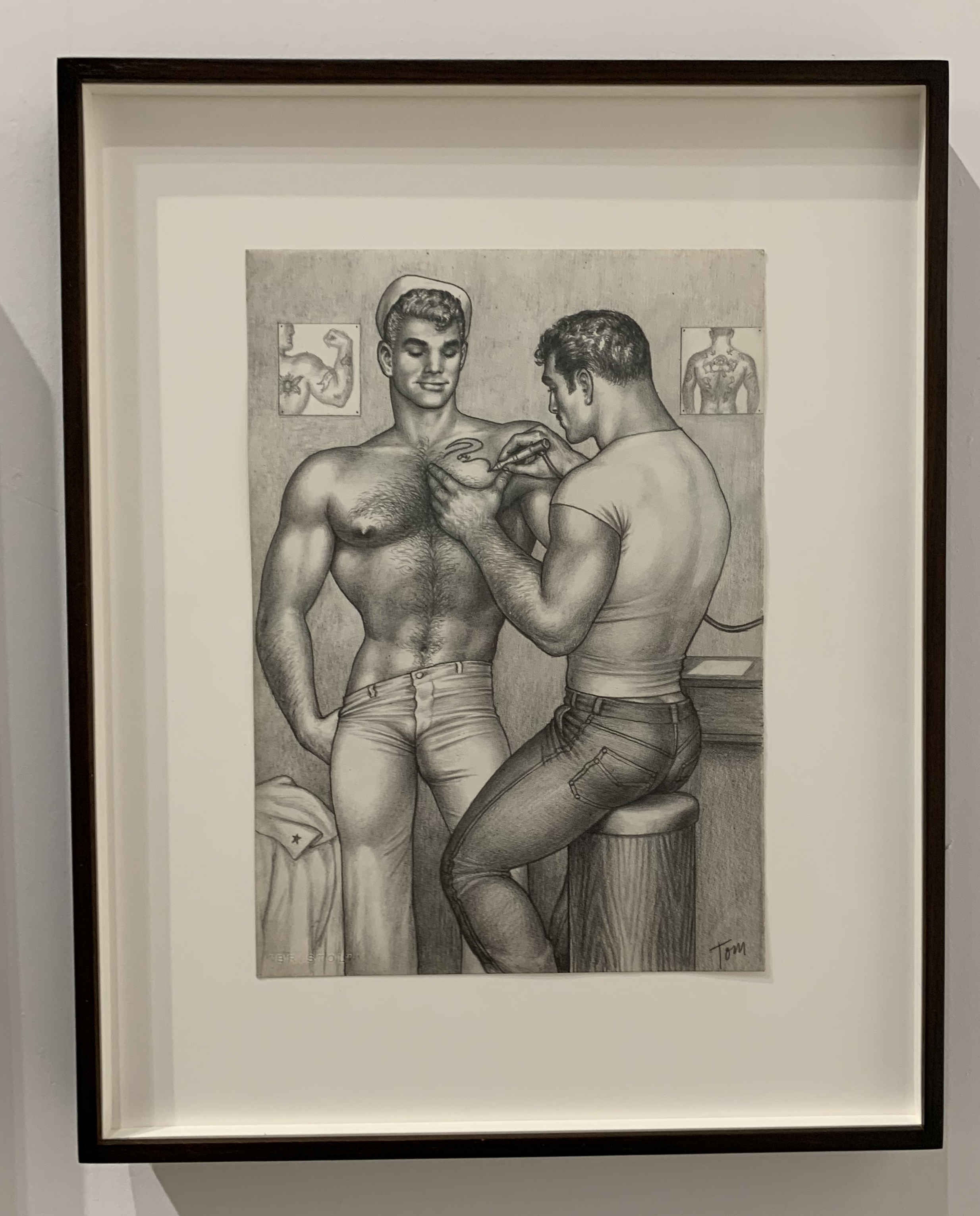
Tom’s works are more overtly and explicitly sexual. He took his name for the sake of anonymity, when by the late 1950s, he was an illustrator for US magazine Physique Pictorial, which portrayed muscled men in homoerotic activities that would just scrape past the censor.

Looking at his works of extremely muscled and well-hung hunks now, it’s easy to think of them as reflecting tropes of gay culture: the cowboy, the sailor, the leather man. All very Village People. But then that’s because Tom helped create such an incredibly influential aesthetic.

Like Cook, his figures are predominantly working class. The hyper-masculine nature of them was a direct challenge to the idea that gay men were effeminate. They are also clearly happy in their own bodies – and they’re having fun.

The styles of both artists are very different. But they’re instantly recognisable, beautifully executed and absolutely suit their subjects.

Of the works on display, there are several standouts. Cook’s 1976 painting The Lockyer Tavern (pictured at the top of this review), shows women drinking in a Plymouth gay pub – the artist was very much an ally – is iconic.

Personal Services
There’s also Personal Services from 1987, inspired by the life of famous madame and dominatrix, Cynthia Payne. It was used as a poster for the Terry Jones film about Payne, of the same title.

Ladies Night (Ivor Dickie) from 1981 portrays women surrounding a male pole dancer/stripper and laughing and straining to see as he pulls down his thong.

There’s also a display of some of the photos she took to help her work, which is illuminating.

Much of Tom’s work was graphite on paper – and untitled. I have selected three to include here, all of which showcase his skill and the points I’ve made above, but all of which are (just about!) ‘safe’ to see.

Studio Voltaire is a small exhibition space and this is a small exhibition. But that doesn’t mean it doesn’t offer an experience that breaks away from mainstream exhibitions to represent and celebrate communities and groups in a way that is really welcome and thoroughly life-affirming.

Ladies Night (Ivor Dickie)


Beryl Cook/Tom of Finland is at Studio Voltaire until 25 August.

It includes explicit artistic representations of gay sex.


Saturday, 18 May 2024

Love Lies Bleeding: A taut, sexy thriller

It’s 1989 in a small town in America: Louise ‘Lou’ Langston is the manager of a gym, where she spends an inordinate amount of time unblocking toilets and has a sideline in dealing steroids. But change is in the air when Jackie Cleaver hitches into town on her way to a bodybuilding contest in Las Vegas, and walks into the gym to keep up her training regime.

Lou is instantly smitten. After she rescues Jackie from a homophobic incident outside the gym, she takes her back to her own home. Since Jackie plans on staying until it’s almost time for the competition, she takes a job at a local gun range, not knowing that it’s owned by Lou’s father, Lou Langston Snr, who also runs a violent criminal enterprise.

Also employed at the range is JJ, the husband of Lou’s sister, Beth, who is violently abusive to his wife. After another violent episode, things get out of hand, with huge ramifications for Lou and Jackie.

Directed by Rose Glass from a screenplay that she co-wrote with Weronika Tofilska, Love Lies Bleeding taut, sexy thriller, with themes of domestic abuse, homophobia, misogyny and revenge.

It also riffs brilliantly on tropes of lesbian lives. Here, it’s Lou – while physically much smaller than the big and muscled Jackie – that’s the butch and Jackie the femme.

If all that were not enough to recommend it, Kristen Stewart turns in a superb performance of real subtlety as Lou.

Katy O’Brian – who’s also a martial artist – is very good as Jackie, her first major screen role.

The rest of the central cast is also very good: Ed Harris doing a fine job as the creepy Lou Snr; Anna Baryshnikov as a ditzy – but dangerous – lesbian who wants Lou for herself; Jena Malone as Beth and Dave Franco as JJ.

Ben Fordesman’s cinematography conveys a sense of brooding – and also one of the vastness that surrounds the characters, suggesting a lostness in the universe. Music by Clint Mansell also adds to the tension.

Having done some bodybuilding in my time – and having once been to watch a competition – the way the gym and contest scenes are handled is excellent.

The scenes at the gun range also provide a commentary on the relationship between Americans and their guns.

All in all, a really excellent film.

Saturday, 6 April 2024

Just who is the Monster?

Saori Mugino is a widow, raising her young son Minato and working in a laundry in a small city in the Nagarno region of contemporary Japan. When the boy starts behaving oddly – and returns home from school one day with an injury – she grills him until he says that his new teacher, Mr Hori, had inflicted it.

Saori goes to the school, demanding action against the teacher, but only receives overly deferential apologies, particularly from the principal, who herself seems oddly distant.

But when Hori himself claims that Minato is bullying sensitive classmate Yori, she becomes ever more determined to get at the truth and the situation escalates.

Written by Yuji Sakamoto and directed by Hirokazu Kore-eda, the story is told three times. First from Saori’s perspective, then from Hori’s and finally, from that of the two boys.

It is subtle, affecting and very sensitive. Kore-eda himself has denied that it’s an example of the Rashomon effect – storytelling centred on the unreliability of witnesses – and certainly it’s more of a jigsaw than an enigma.

There are manifold themes here: respect, acceptance – not least of self-acceptance – bullying, grief and loss, the concept of rebirth in Japanese Buddhism, and the problems that can be caused by overly strict structures.

Kore-eda’s direction is excellent – not least of his child actors. He coaxes an extraordinary performance in particular from Soya Kurokawa as Minato, who won the best newcomer at Japan’s Blue Ribbon Awards, as well as from Hinata Hiiragi as Yori.

Sakura Ando as Saori, Eita Nagayama as Hori and Yuko Tanaka as the school principal also produce fine turns.

The film includes the last music for film written by legendary composer Ryuichi Sakamoto – delicate piano pieces that add to the poignant atmosphere.

Monster’s world premiere was at Cannes last year, where it competed in the Palme d’Or. It won the Queer Palm and the award for best screenplay. It’s not difficult to see why. It is a very special film.

Monday, 1 April 2024

Robot Dreams is a an absolute charm

Dog is a lonely hound living on his own in a third-floor New York apartment in the 1980s. In the evenings, he plays Pong on his own. But one night, flicking through channels on TV while eating his usual meal of microwaved macaroni cheese for one, he spots an ad for a build-your-own-robot as a friend, and immediately orders one.

When he’s completed the build – hilariously watched by pigeons on his windowsill – and worked out how to activate his new buddy, their life together begins as they set out to explore the city.

Robot is fascinated and thrilled by everything, and passes on that zest for life to Dog. The pair roller-skate in Central Park, dance together, watch The Wizard of Oz together and, after Robot learns not to squeeze Dog’s paw too tightly, hold hands.

But on a trip to Long Beach at the end of summer, the pair are separated after too much enthusiastic play in the water from Robot. Try as he might, Dog can’t help his friend and, when he returns the following day with tools and manuals to do so, he finds that the beach is now locked until 1 June the following year.

How they cope without each other and learn to live again is the core of the film.

Do Androids Dream of Electric Sheep? Who knows. But Robot certainly dreams – not of sheep, but of finding his way back to Dog; dreams that are worked and re-worked from his time-limited experience of life. One in particular is gorgeous – he finds himself in The Wizard of Oz, surrounded by tap-dancing flowers doing a routine straight out of Busby Berkeley, as New York shimmers in green – seen like the city of Oz – on the horizon.

Between the Oz references, the trope of the gay love of musicals – here, Oz (don’t forget ‘friends of Dorothy’) and the Berkeleyesque routine – plus the holding hands, it’s little wonder that there is online speculation that this is a subtle and tender gay love story.

To be clear, there’s no mention of the gender of either Dog or Robot, but female characters in this anthropomorphic New York are pretty easy to spot. And the beach scenes clearly show Dog is male – watch out for a very funny swimming costume change gag.

Robot Dreams is Pablo Berger’s first animated feature and is based on Sara Varon’s comic of the same name. Entirely hand-drawn in 2D style, it has won plenty of plaudits – and rightly so. It’s a sweet, charming story, which depends on the visual, as there is no dialogue. It also references Isaac Asimov’s collection of short stories – and specific short story – of the same name. There’s a lot going on here. It’s not remotely a ‘kid’s movie’.

Don’t be misled by the animation being ‘old-fashioned’. It is fabulously done and gorgeous to watch – 1980s New York itself has been so lovingly created, while the cast of thousands has been given such wonderful attention to detail. There are couple of scenes where Dog is on a scooter with another character, riding into the countryside, where the trees coming over the horizon is simply stunningly done.

And while the comedy is gentle rather than LOLZ, it is certainly there. There’s a lovely scene about photo booths that will take those of us of a certain vintage back!

The ending is perhaps not what you’d expect, but shows a nice sophistication. The ’80s soundtrack is great.

Robot Dreams is a gentle, charming, really well-paced joy. My only personal surprise (disappointment?) as I came out of the cinema was that so many reviews have said: ‘Bring tissues – you will cry as well as laugh’, yet I didn’t.

Given how easily I blub at films (though I hate it when I feel my tear ducts are being deliberately tweaked), I walked home wondering if the absence of even a pricking meant it was not quite of the calibre so many have stated. Writing this, thinking back over the film itself, I have realised that it not bringing forth an instant deluge does not mean it’s not very good indeed.

I took lots of tissues to The Zone of Interest, expecting to find that would set me off, but it didn’t, yet it is one of the best (and most important) films I’ve seen thus far this year.

Robot Dreams is a wonderful film that I suspect is going to stay in my mind for a long time. And of course it’s gay!


Sunday, 17 March 2024

A mixed bag from this lesbian road/caper/crime comedy

Well. Where to start? Ethan Coen’s second feature without his bro, Joel, is a bit of an oddity. Drive-Away Dolls is a lesbian road/caper/crime comedy – not that that that is a bad thing, but it seems too have something of an identity crisis. 

Coen directs, but the screenplay was written jointly with his wife, Tricia Cooke, who has worked as an editor or associate editor on many of the Coen brothers’ films.

This is one case where I’m going to mention people’s personal lives, because the couple are quite open about this and it seems relevant to the film.

Cooke and Coen have two children, but she identifies as lesbian and queer, and describes her marriage as “non-traditional”. They both have other partners.

The point being that this is not some some sort of straight riff on lesbian lives.

Bu back to the film. It’s Philadelphia in 1999. After permissive Jamie is kicked out of her relationship with cop Sukie, she learns that her up-tight friend Marian is planning a trip to Tallahassee, Florida, to visit a relative and enjoy some birdwatching, and decides they should make the trip together.

They use a drive-away car company (where someone can transport a car one-way for another client). However, a misunderstanding means they get the wrong car – with an intriguing cargo.

When the bunch of crooks who had booked the car finds out, they set off in murderous chase.

It’s so hit and miss. It seems like a very deliberate attempt to come up with the trashiest, most lesbo-exploitation flick you could – and perhaps that’s a positive finger to the state of lesbian representation on screen? But yet the film feels conflicted.

There are some very good moments.

Flashback sequences of Marian starting to explore her sexuality are spot on. But a series of psychedelic interludes, which have no explanation until very, very late on, are annoying. And while it’s genuinely funny in places, it’s not laugh-out-loud funny in the same way that it seems to want to be.

It actually has a great core message – that horny women who shag other horny woman are fine!

But problems aside, Geraldine Viswanathan as Marian is really fantastic, bringing a sense of genuine nuance to a generally unsubtle film. Margaret Qualley, as Jamie, gives it her all, but I do wonder about the accent a bit.

Beanie Feldstein is great as the cuckolded girlfriend and cop.

There is a tiny cameo here for Pedro Pascal, a slightly larger one for Matt Damon, and a bigger role for Colman Domingo, all of whom give of their best. Joey Slotnjick as one of the gangsters is very good.

So very much a mixed bag. But while the film itself is more than a tad all over the place, it's most certainly good to see lesbians being represented in such morally non-judgemental – indeed, in such positive ways.

Monday, 11 March 2024

Macho or not? In & Out remains a charming gay comedy

The Frank Oz 1997 film In & Out has been described as being one of Hollywood’s first efforts at making a ‘comic gay movie’ – can somebody mention Blake Edwards’s 1982 Victor/Victoria please, so I don’t have to!

But to the point: Howard Brackett is an English teacher in a small Indiana town. He is due to marry colleague Emily Montgomery within days, but then the Academy Awards ceremony sees a former pupil of his not only laud him in a winning speech, but out him.

But Howard is not even remotely out to himself. The media descends on his small town and harasses him, while the entire community questions what he’s really like.

Very light, very funny – full of lots of truths (arguably tropes, but then they’re tropes because they’re often true, if you get my meaning). It also very nicely pokes fun at the idea of 'masculinity'.

And it’s a fab cast.

Kevin Kline is lovely in the central role of Howard; as is Oscar-nominated Joan Cusack as his finance. Debbie Reynolds and Wilfred Brimley as his parents are fab too. Then there’s Bob Newhart as the school principal – the expected joy.

In a way, the surprise here is Tom Selleck as gay TV reporter Peter, who helps Howard actually understand who he is. It’s a really good performance.

Here’s a fun little fact. At the end, all the characters – including Cusack’s Emily – dance to Macho Man by The Village People. She danced to the same song on film again in 1993, in Adams Family Values.

Genuinely charming and heart-warming.

Streaming on Sky Cinema and well worth a watch.

Saturday, 2 March 2024

A sensitive film about first love and self-discovery

Browsing Sky Cinema for something to watch, I came across Luca Guadagnino’s 2017 coming-of-age romantic drama, Call Me by Your Name. I knew next to nothing about it, but drawn by seeing Timothée Chalamet’s name, I decided to dive in.

Adapted from André Aciman’s 2007 novel of the same name by James Ivory, it tells of a summer romance between the precocious Elio Perlman, the 17-year-old son of archaeology professor Samuel, and Oliver, a 24-year-old graduate, who is staying at the family’s summer home in northern Italy to assist Samuel.


Set in 1983, Elio initially thinks he has little in common with the older man – indeed, that he is arrogant. But gradually, he’s drawn toward him and starts to understand that he sexually attracted to him.


It’s not difficult to see why it was critically acclaimed and won a batch of awards – including an Oscar and Bafta for best adapted screenplay for Ivory.


The look of it is beautiful – Sayombhu Mukdeeprom’s cinematography is excellent. The film uses music so well – Elio is obsessed with music, plying piano and guitar, transposing music and adapting a piece of early Bach to perform it in the styles of later composer (Chalamet plays both piano and classical guitar in the film).


The central cast is very good indeed. Not just Chalamet, but Armie Hammer as Oliver bring great intelligence and sensitivity to their roles. Amira Casar as Annella, Elio’s mother also deserves a mention, as does Michael Stuhlbarg’s father seems light for the main, but gets a superb final scene of great emotional depth.


The age difference between the main characters was controversial for some – particularly in the US, where the lowest age of consent was higher than in Italy.


Two writers in the American journal, Psychiatric Times, said the central relationship was “about asexual predation” and asked whether one scene in particular was “appropriate” (the scene involves alcohol), perhaps forgetting that it’s a work of fiction, adapted from another work of fiction – and fiction doesn’t have to deal with “appropriate” or that cultural differences do actually happen.


One imagines a substantial element of that was a certain type of American prudery – not just about sex, but also about teenagers having a drink (though a gun is fine).

An enjoyable, sensitive and beautiful film about self-discovery.

Thursday, 29 February 2024

Death in Venice – a fine adaptation of Mann's novella

It’s the last day of February – and therefore the last day of LGBT+ History Month – so to conclude my thematic viewing on that basis, a repeat watch of Luchino Visconti’s 1971 adaptation of Death in Venice.

Gustav von Aschenbach is a German composer in the early 20th century. Suffering ill health, grief and a crisis in his work, he journeys to Venice to recover. At his hotel, he sees a beautiful young boy, Tadzio, and becomes utterly besotted. While never making verbal or physical contact, Aschenbach follows the boy and his family around, his own personal crises increasing rapidly, while at the same time, La Serenissima faces an increasing health problem.

The film is an adaptation of Thomas Mann’s 1912 novella, which I first read in 2001. A German friend had introduced me to Mann, recommending Buddenbrooks. Having read – and been captivated by that – I looked for more.

I knew the title of Death in Venice – but nothing more. I bought it, read the short stories that fill out most volumes and then the novella itself – albeit slowly. I was utterly blown away by the novella. Having spent the decades since my very late teens believing that Lord of the Rings was the greatest thing ever written, such a faith was utterly and irrevocably changed.

I have long attempted to write myself and, at that point, was doing so quite regularly. But I was stopped in my tracks by Death in Venice. My gods – you could do something like this in a ‘story’? The words wouldn’t come. It was some considerable time before I could even attempt fiction again.

Indeed, the Late OH and I were visiting friends on the west Irish coast, at the beginning of this century. We were walking by the sea, and I noticed that the wind was sending a fine spray of sand hovering horizontally above the beach itself – as if it were a sandy magic carpet. Desperate to describe to myself – and thereby understand – what I was seeing, suddenly the words started tumbling out of me again.

In 2010, the Late OH and I had done A Very Big Once-in-a-Lifetime Trip for his fifteeth: the Orient Express to Venice. I took a certain book by one Agatha Christie with me. When we visited again, in early 2017, I took the Mann, and sat reading it briefly on the beach in front of the hotel – Grand Hotel des Bains – in the film. It’s also the hotel in the novella, where Mann was staying when he was inspired to write it.

When my own fifteeth approached, it was a question of what I’d do. I decided that I wanted a brief trip abroad on my own, having never done so previously, for all sorts of reasons; fear and lack of money being primary.

I thought of cooking classes in Sicily and art schools in France. And found myself ultimately terrified. And then I reached a conclusion: Lübeck, where Mann himself had hailed from and where Günter Grass, another German literary laureate and personal hero, lived. And also, because the language beyond English that I know best is German, having been studying it in an – often random way – for a couple of decades now.

I recall sitting with a coffee, outside a cafe in old medieval Lübeck, blanket dove my knees (it was 'Baltic' cold!) and listening to a superb violinist play the adagiettio from Mahler's fifth symphony, an iconic piece of music that has becomes the film's theme.

That trip was a rite of passage – better late than never, I guess. But that’s an indicator of what Mann and his work means to me.

On my sixtieth birthday, in December 2022, The Late OH gave me a signed, English-language edition of three short stories by Mann. It meant – and means – so much.

I feel as though I’m going through another explosion of personal growth right now – akin with the language experience in Ireland. Watching Victim a couple of nights ago, and Death in Venice tonight, I seem to be seeing and reading more in films than I did previously. There are words in my head that would not have been in my useable vocabulary previously. Yet they’re there now. And a different way of seeing and reading is also there.

But enough of me. To the film itself. It is beautiful to watch – Pasqualino De Santis’s cinematography is wonderful. It frequently looks like an Impressionist painting. By the way, if you wonder if the green of the lagoon is accurate – yes, it is.

There are issues about how Björn Andrésen, who plays Tadzio, feels in retrospect about the film – to be clear, he has spoken of great discomfort etc, but never of any physical abuse from anyone involved in the making of it.

The film is not as subtle as Mann’s novella, but it is still a thing of great beauty – and a contemplation of beauty, and the debilitating sense of guilt about who you are at your most intrinsic level.

And then there is Dirk Bogarde as von Aschenbach. There is so little dialogue in the film as a whole, but Bogarde does so much with his facial expressions, including on some very, very long shots. It is a superb performance. And it is a superb film.


Tuesday, 27 February 2024

Victim: Dirk Bogarde helps the UK turn a corner on LGBT+ rights

This evening wasn’t the first time I’ve watched Basil Dearden’s 1961 noirish suspense film Victim, but there was so much more that I ‘saw’ and appreciated on a second viewing.

Melville Farr is a successful London barrister, married – apparently happily – to Laura. But he is drawn into a scandal when Jack ‘Boy’ Barrett, a young man he had had a secret romantic relationship with (not consummated) is arrested for stealing from his employer and hangs himself in a police cell rather than risk naming Farr under interrogation.

It emerges that Barrett was one of the victims of a gang of blackmailers targeting gay men – the reason for the thefts.

Yet ironically, when he’d tried to contact Farr for help, the barrister had refused his calls, assuming that they were attempts at blackmail.

When Farr learns of Barrett’s suicide, he decides that, whatever the personal cost – and there will be a large one – he will ensure justice is served on the blackmailers.

As with any form of culture, film has the power to change minds and inform debate, but with a wider reach than, say, theatre, its potential power is increased.

The influence of Victim can hardly be overstated.

It was written by Janet Green and John McCormick, after the former had read the 1957 Wolfenden Report, which had recommended that “homosexual behaviour between consenting adults in private should no longer be a criminal offence”.

Green already had ‘form’ for screenplays about social issues: the 1959 film Sapphire dealt with racism in London toward West Indian immigrants. She’d also penned the excellent 1950 thriller (which sadly seems to have been almost forgotten) The Clouded Yellow, starring Trevor Howard and Jean Simmons.

Victim, however, was of a different order – explicitly proselytising against the law, not least on the basis that, as Wolfenden had stated, the law as it stood was a “blackmailer’s charter”. It was to be hugely influential in changing attitudes so that homosexuality was decriminalised in 1967.

The film faced problems with censors in the UK and US. Yet it is not remotely voyeuristic or sensationalistic. It is, however, clearly sympathetic to its gay characters – and it is equally important in another context, in that they come from more than one social class and transverse that in their relationships.

Sylvia Syms turns in a really fine performance as Laura. In an indication of how difficult the subject was, the role had been turned down by a number of actors. But Syms had worked on stage with John Gielgud – an experience that had enlightened her about the impact of the law at that time – while she had also known a family friend who had ended their own life after being accused of being gay.

Peter McEnery gives a great turn as the vulnerable ‘Boy’ Barrett. As does Denis Price as the – closeted bisexual? – theatre star Calloway.

But this ultimately belongs to Dirk Bogarde as Farr. Gay himself – but never out – he apparently leapt at the chance, after several other stars had turned the role down (including James Mason and Stewart Granger). It transformed him from a matinée idol who had played romantic, comedy and action leads, to an art-house, European and intellectual film star.

It is a searing performance. If you have only ever seen Bogarde in one of the Doctor films, alongside the likes of James Robertson Justice and Leslie Phillips, then this will be a revelation.

While remaining silent about his own personal life, it was not the only gay role Bogarde played. In Luchino Visconti‘s 1971 adaptation of Thomas Mann’s novella, Death in Venice, he held centre stage again as the gay Gustav von Aschenbach.

Victim is not only a genuinely good film – it is also a very socially significant film. If you haven’t already, check it out.


Friday, 23 February 2024

Orlando – throughly entertaining queerness

It was time for another spot of film catch-up this evening – and back to an effort at being thematic for LGBT+ History Month – with a first viewing of Sally Potter’s 1992 adaptation of Orlando, Virginia Woolf’s 1928 novel of the same name.

The film opens in 1600, with aristocratic youth Orlando pondering over his loneliness and his desire to write poetry. When his family is visited by Elizabeth I, the aged monarch takes to him, making him her “mascot” and granting him property and money. There’s one condition: Do not fade. Do not wither. Do not grow old”, she orders.

In the novel, there is no explanation of how Orlando becomes immortal, but Potter added this to the film to suggest how this occurs, feeling that a cinema audience would need at least a hint.\

As part of the wider court of James I, he becomes utterly besotted with Sasha, a beautiful Cossack, who is visiting with her father. But when she dumps him, he’s left to muse on the “treachery” of women.

Time passes and, in the 18th century, the eternally unchanging Orlando – nobody ever comments on this, ‘because it’s England’ – is appointed ambassador to the Ottoman Empire. There he enjoys a brotherly friendship with the Khan, before participating in a battle.

Shocked at seeing his first violent death, he flees and falls into a deep sleep for seven days. On waking, he discovers that he has become a she. Heading back to England, Orlando is stripped of her home on the basis of being a woman – and thus effectively “legally dead”.

Somehow, she continues living there until the time of Victoria, where she has an accidental meeting with Shelmerdine, an American revolutionary, with whom she enjoys a passionate fling, before he departs for home. She refuses to join him – and muses on the “treachery” of men – before her life takes her into the 20th century, through the mud of Flanders and beyond, to 1990s London, where she has a young daughter.

It's not a devastating script, but there is wit – not least in the wonderful to-camera shots of Tilda Swinton as Orlando, where Potter has her break the fourth wall.

It is beautifully shot – cinematography was by Alexsei Rodionov – and beyond Swinton’s fabulous performance, which really grounds the film, it has a wonderful ensemble cast.

Billy Zane posts a nice turn as Shelmerdine, but one of the real joys here is Quentin Crisp as Elizabeth I – “the Queen of Queens”, according to Potter – which also adds to the queerness of the whole thing.

Then there’s Jimmy Sommerville, Kathryn Hunter, Simon Russell Beale and Toby Jones among many other familiar faces, while John Wood provides a delightful cameo as a bumptious, elderly archduke who falls for Orlando.

Potter’s direction moves things at a nice pace – easy to expect an epic, given the century-spanning scale of the story – but it’s just 93 minutes. She also wrote the screenplay and the music (the latter, along with David Motion and, for one song, Sommerville).

It’s thoroughly entertaining – and with the added spice of the gender politics, not least in terms of the differing attitudes toward men and women throughout history.

And as Vogue put it in 2020: Nearly three decades later, Sally Potter's Orlando is more topical than ever.

Thursday, 15 February 2024

Andrew McMillan's debut novel, Pity, packs a big punch

Pity, award-winning poet Andrew McMillian’s debut novel, is, at under 200 pages, feels hardly much longer than the archetypal ‘slender volume of verse’ –  but don’t let that deceive you, because this packs a powerful punch.

Set in a former mining village near Barnsley (where the author hails from), it tells the story of the men of three generations of the Banks family: Brian, his sons Brian and Alex, and Alex’s son, Simon.

The brothers had followed their father down the mines – there being little alternative at the time. Simon, born into an era after the miners’ strike and the pit closures, works in a call centre by day and as a drag performer at night. He has recently started a relationship with Ryan, a security guard in a local shopping centre who wants to become a policeman.

A group of patronising, nameless academics, spending time in the village to record the memories of those who lived through the tumultuous 1980s, observe that the years since the strike have seen almost every trace of the industry that once sustained have been obliterated.

And they are bemused that the locals they talk to are reluctant to talk of those times – and not least of a disaster that hit one of the local pits.

McMillian tells his story in sparing terms – though throughout the book, there are brief sections that describe the local men leaving their homes in the morning to go to work, over and over; the grim reality of the ride down the pit shaft in the cage, and the bleak, dangerous work, as the coal dust works its way into the lungs of the miners.

These sections have an incredible poetic quality. Not that they romanticise the industry – quite the opposite. It feels like a nod to WWI poetry.

In the first such section, as the men walk to their work, McMillan writes: “The village, on their shoulder now, still asleep, not watching the migration of tired bodies. One of the men once said that he thought he could hear the coal ticking. Another man told him to stop talking daft. And beneath their feet, a mile down, history; waiting to be hacked into chunks and pulled out.”

It’s a motif that is repeated with slight variations throughout.

Part of the power of the novel is that it doesn’t pander to any sentimental attachment to the industry – or indeed, to the strike – while also portraying the contemporary world of work as far from perfect.

It also doesn’t seek our ‘pity’ and portrays the men as strong, yet also vulnerable and flawed.

There is little in these crucial passages to suggest that any of the men would regret not having to trudge to the mine. Yes, there’s an element of community, but it comes across more as something comparable to men going into battle rather than something remotely joyous.

And within this context, McMillian makes a wider exploration of male identity, community, relationships, sexuality and fear. In maintaining an emotional distance from his characters, he has increased the power of this. And in a splendid example of how this can work (see Thomas Mann’s Death in Venice), by the end you really do care about these men.

This is a seriously good novel about working-class, male experience in the late 20th and early 21st century. Very much worth reading.