Showing posts with label play. Show all posts

Sunday, 21 October 2018

A very, very, very dark – but funny – matter

Copenhagen, the 19th century: Danish celebrity author Hans Christian Anderson is regaling an audience with his latest fairy tale, The Little Mermaid.

There are celebratory fireworks and showers of admiration for the writer, but there are also ghostly figures.

And when Anderson returns home, climbing to the attic of his house, it is to discuss these ghosts with Marjory, a disabled Congolese pygmy, who he keeps in a box and who writes the stories for him.

But why doesn’t she try to escape; is she and her situation unique and what does Charles Dickens have to do with it all?

Martin McDonagh’s latest play, A Very Very Very Dark Matter, is going to upset people. Though to be strictly accurate, it’s still previewing until 24 October and it’s already provoked Indignant of Islington and Vexed of Vauxhall to express their horror online.

One can imagine this work will trigger an orgy of offence.

Taken at the most simple face value, the play laughs at colonialism and thumbs its nose at the crimes of empires. And because McDonagh has written a funny play, the audience laughs along and, therefore, becomes complicit.

Except that this is not supposed to be taken at face value, and only a monumental naïf or someone utterly dedicated to a peacock-like display of their social justice warrior credentials would not understand or would pretend not to understand what McDonagh is doing.

And incidentally, if you push that idea that he’s genuinely laughing at the crimes of imperialism, then you’re saying that the black cast members are Uncle Toms, and I would suggest people don’t go down that route.

There isn’t much of a plot, as such. Like Stephen Sondheim’s Follies, this is more of a meditation on a number of themes.

Not least among these is the trivialising of the treatment of the crimes of colonialism – an attitude that has reared its head again in recent years, with continuing exceptionalism and the concomitant belief of some Brexiteers that, once free from the EU, the UK can build Empire II and indeed, the rest of the world is ready to rush into our arms to give us the bestest ever trade deals with only five minutes discussion needed. Because we’re Britain, doncha know.

Of course, the same can be said of the Trump-era US too, with the crude and fact-free racism of the MAGA crowd, convincing itself that ‘true America’ is WASP America.

Such attitudes never went away, but increased nationalism elsewhere around the globe means they’re re-emerging. And therefore, it is important to remind people of just what nationalism and colonialism means in reality.

McDonagh – a writer in whom the Irish gothic tradition meets London-Irish experience, with punk mixed in (as Fintan O’Toole’s excellent programme essay notes) – is ideally suited to push boundaries so that, while A Very Very Very Dark Matter is very funny, it isn’t what you’d describe as ‘comfortable’.

In concentrating on Belgian imperialism – and the genocide in what was the Congo – the play raises what will, for many, be history that they are not familiar with. In pointing up the rape of the region for resources, he even manages a sideswipe at environmentally-holier-than-thou cyclists, noting that while Leopold II’s publicly-stated intention (as with other countries) was to ‘civilise’ and Christianise, the less public one was the desire for ivory and rubber – here, with the latter used for bicycle tires.

A Very Very Very Dark Matter is probably not for the faint-hearted or those who get upset by ‘bad language’ – it’s gloriously sweary in a very Irish way.

It’s short – 90 minutes with no interval – angry and funny at the same time, and defies easy labels.

Director Matthew Dunster has done an excellent job and Anna Fleische’s design is superb.

As Marjory, Johnetta Eula’Mae Ackles, on her debut, is simply outstanding and more than holds her own with her massively experienced co-star.

Jim Broadbent as Anderson is a delight as the bumbling, eccentric and crass writer, living off Marjory’s talent and, all the while, pleading with her that *his* colonial crimes aren’t as bad as those of others. And his swearing is a glory.

Phil Daniels as “Charles FUCKING DICKENS!” is a hoot too, and getting Tom Waits to record the role of narrator adds both to the fairy-tale aspect of the piece, as well as the sinister and eerie nature of it.

Bloody brilliant.


A Very Very Very Dark Matter, is at London’s bridgetheatre.co.uk until 6 January 2019.

Friday, 22 April 2016

Ma Rainey's Black Bottom: an American tragedy

It was 27 years ago when the National Theatre last produced August Wilson’s breakthrough play, Ma Rainey’s Black Bottom, with Hugh Quarshie wearing tights trousers to strut his stuff on top of a table.
 
I saw it twice: the first time to review, and the second – under the leaking roof of the Hackney Empire, to growl quietly in appreciation at Mr Quarshie.

This new production offered a welcome chance to reappraise it.

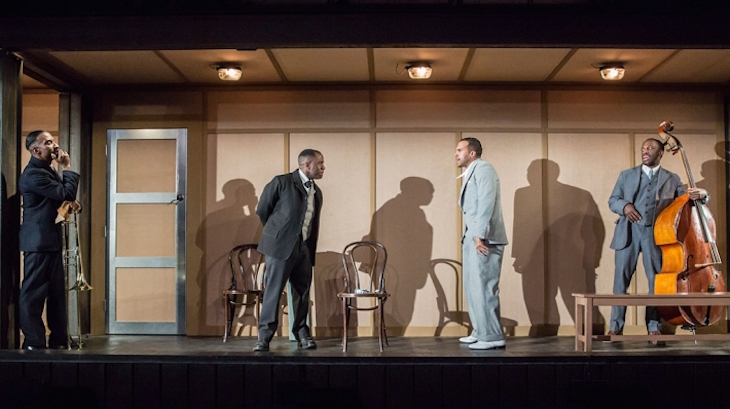
It’s Chicago, 1927. A quartet of four musicians meet in a studio for a recording session with Ma Rainey – the ‘Mother of the Blues’ – and, while they wait for the diva to arrive, the good humour of their banter thins to reveal underlying tensions.

The ingredients are simple: four talented men (and one woman) who are of use to white music bosses as long as their music produces cash dividends.

But the three older members of the quartet – bookish pianist Toledo, band leader Cutler and bassist Slow Drag – have all found ways of dealing with their situation as black men in the US.

Trumpeter Levee, however – hardly a boy at 32, but still the youngest of the four – is caught between rage at the situation and an ambition to have his own band and write his own material that sees him act with overt deferentiality toward the studio boss.

While the central theme here is an exploration of the African-American experience, it also does much more.

One of the interesting things here is how stories provide a defence.

Toledo, Cutler and Slow Drag tell stories that, to varying degrees, have an aura of folk tale or myth about them. Religion features, but not simply as comfort (it is the reason why Toledo’s wife left him, for instance) and often bound up with folktales.

When Cutler tells them a Faustian tale from his own home town, Toledo nods vociferously, noting that he’s heard the same thing, hundreds of times.

The stories reflect a shared experience and sense of community – beyond the purely historical, biographical and rational – and they appear central to the men’s sense of self and their ability to weather the indignities that are thrown at them.


Cutler, Toledo, Levee and Slow Drag
Even Toledo’s book-learned philosophy and history add to his defences.

But Levee, however, has no such stories and no such learning.

He joshes at the others until, challenged over his attitudes toward white people, he reveals how, as an eight-year-old child, he had seen his mother gang-raped by white men, and his father was subsequently hung and burned for daring to exact revenge.

There is no mythology here; nothing other than a raw, horrifying description of what a child witnessed; no shield against the weeping sore at the core of Levee’s being. He has no defence against his experiences.

Religion offers no comfort: when a row breaks out over his perceived blasphemy, we discover that his mother cried for divine help as she was raped, so he continues to challenge God to strike him down.

In all that he does, Levee pushes boundaries, as though deliberately daring those around him to respond negatively.

And when the levee eventually – and inevitably – breaks, it is with tragic, if unexpected, consequences.

This is a superb drama – a tragedy that operates on many levels – with dialogue that possesses a music of its own to counterpoint that blues that the characters are together to record.

And the National has – once again – given Wilson’s play the cast and production that it deserves.

Dominic Cooke’s direction never lets it sag. Ultz’s set is pared back and cleverly allows a sense of the liberating nature of the music (in a space that seems never to really end), the claustrophobic nature of the limits placed on black lives, and the social relationship between black and white men.

Title apart, Ma Rainey is not the central character here, but while she is on stage, she needs to exert a big, powerful influence – and Sharon D Clarke is marvelous in the role. Thank goodness too, that she gets one full song to show us what a fantastic voice she has.

Clint Dyer as Cutler, Lucian Msamati as Toledo, Giles Terera as Slow Drag and O-T Fagbenle as Levee all turn in top-notch performances – in terms both of their musicianship as well as acting.

You have until 18 May to catch this. It is very much worth the effort. 


Saturday, 25 July 2009

Desperate for a new life


The Container by Clare Bayley

The Young Vic, London

For five people, England represents hope: of safety and a new life.

For Fatima and her daughter Asha, they are trying to escape war and refugee camps in Somalia.

Jemal, a middle-aged businessman, is trying to get away from Afghanistan.

Ahmed, a Kurd who grew up and was educated in the UK, before being deported to Turkey after the government decided it was safe for Kurds, is trying to get back to his partner and child.

And teacher Mariam is fleeing Afghanistan after threats from the Taliban, who have already murdered her husband, a fellow teacher who dared to teach girls.

All of them are now together, locked into a shipping container as it makes its way west to the English Channel and a new life. And all of them have put their faith – and their hopes – in The Agent, a human traffiker.

Clare Bayley’s play, which premiered at the Edinburgh Festival in 2007, winning a Fringe First and the Amnesty International Freedom of Expression award, never descends to mawkishness or tries to score cheap, sentimental points.

The writing is straightforward and the characters utterly believable and flawed.

Many of those who will see the play at its run at the Young Vic will already be familiar with the sort of stories that her refugee characters tell, but two things stop The Container merely repeating what might be familiar.

Staging the play in a real shipping container, with pallets and packing cases to seat an audience of just 28, is an inspired approach. Once seated, the door is locked and the container descends into total darkness. The container itself vibrates slightly and sound effects add to the suggestion that we’re travelling along a road. It’s a very, very effective way of concentrating the mind on what people really put themselves through in order to gain safety and a better life.

Once the door has been locked and we’ve had a taste of the silence, the actors emerge from packing cases and boxes, and use small, hand-held torches to cast some illumination on proceedings.

The acting space is concomitantly tiny and the action as in-your-face as it’s possible to be. It is with great relief that vomiting, peeing and defecation are only represented by sound effects, but the ramifications of such bodily functions having to be carried out in such a space is brought home loud and clear.

What one is left with is the desperation: the bleakness of human existence that drives people to put themselves in such a situation, with such high risks. That people, damaged appallingly by horrendous experiences fight so hard to lift themselves out of those situations.

The performances are good, the direction tight and the plot never panders to easy answers.

A thought-provoking and very moving play.

Watch out for Bayley – she's got more work on the way and, if this is anything to go by, it will be worth seeing.

Friday, 1 May 2009

Plenty to consider as we wait for a reason


Waiting for Godot by Samuel Beckett
Theatre Royal Haymarket, London

Samuel Beckett’s play, written between 1948 and ’49, and premiered in Paris in 1953, is considered to be one of the most important plays of the 20th century.

Yet in 1956, the Irish Times critic, Vivian Mercer, famously described it as: “a play in which nothing happens, that yet keeps audiences glued to their seats. What’s more, since the second act is a subtly different reprise of the first, he has written a play in which nothing happens, twice.”

There’s possibly never been another theatrical work that is so open to interpretation; considerable effort has been expended in trying to explain what it’s ‘about’. For that reason, it’s worth starting at the very beginning, and considering what actually happens, before making an attempt to analyse or understand it.

The play opens on a bleak set, with a skeleton of a tree and a bench or large stone.

Vladimir and Estragon, two elderly men, arrive on stage. They are, apparently, waiting for someone called Godot, who they don’t really know and might not recognise easily. They spend the time while they wait in a mixture of philosophical and religious musing, dancing, joking around and contemplating suicide. They appear to be destitute – they’re sleeping rough and Vladimir gives Estragon food from his pockets that, presumably, he has pulled from the fields himself (they have soil on them); a carrot and some turnips.

Two more characters arrive – initially, Vladimir and Estragon think that one of them is Godot. But this is Pozzo, who appears to be well-to-do, and has the second, Lucky, under control by a rope attached to his neck. Lucky carries heavy bags and appears to be some sort of a slave to Pozzo.

Pozzo sits on a small stool, opens a picnic hamper, takes a drink from a bottle and eats some meat, before throwing away the bone. Estragon asks whether he can have the bone. Pozzo tells him that Lucky usually gets it, so he has to ask Lucky. Lucky, however, resolutely refuses to say anything, so Estragon takes that as assent and grabs the bone.

Vladimir and Estragon show sympathy for Lucky and ask why he never puts the bags down. Pozzo tells them that the man is attempting to persuade Pozzo not to sell him at a nearby fair.

In gratitude for being companionable, Pozzo asks if he can do anything for Vladimir and Estragon. The latter asks for money, but Pozzo offers to let them see Lucky dance. Upon order, he dances – a shambling effort. Then they tell him to think – and remove his hat to make him do this. He produces a lengthy, stream-of-consciousness soliloquy that makes no sense at all, and they can only stop him by jamming the hat back on his head.

Lucky and Pozzo leave. A young boy arrives to tell Vladimir and Estragon that Godot will not be coming that evening and they are to be there the next night, when he will come.

Act one closes.

The second act contains much of the same – although the formerly bare tree now has a few leaves on it. However, when Pozzo and Lucky turn up, Pozzo has turned blind. Even given this turn of events, Lucky has stayed with Pozzo and the two go off again, still with Lucky on a rope.

A boy arrives – not the same one as the previous night, he claims – and tells Vladimir and Estragon that Godot will not be coming tonight. They should return tomorrow.

The two consider suicide again, but the rope that they think of using – Estragon’s belt – breaks. They say they’ll get better rope tomorrow.

The end.

So, what does it all mean?

If you take it at face value – that it ‘means’ nothing more than what is described above, then it ‘means’ nothing. But that in itself is a very existentialist comment on life: that life ‘means’ nothing and is as absurd as what unfolds on the stage. The temptation to look for ‘meaning’ in the play is like the apparent human need to look for ‘meaning’ in life itself.

That seems to be the most stripped-back ‘meaning’ of the play.

There have been plenty of more complex interpretations – the Freudian one, the Jungian one, the “interpretation from compassion”, the political interpretation, the religious interpretation …

I first saw Waiting for Godot in 1991, in a production starring comedians Rik Mayall and Ade Edmondson. I have no memories of that production or the play itself. I can’t, therefore, even say whether I ‘got’ any of it at that point.

The production I saw last night, then, was completely fresh and it was a considerably different proposition – something that indicates to me personally a degree a personal development in the intervening years.

A number of things occurred to me while watching it and since.

I cannot escape the idea of this play having, in essence, existentialist themes – that’s partly at the stripped-back level I mentioned above, but also in further ways.

If this is a play onto which one places one’s own interpretations, influenced, in part at least, by one’s own subjective life experiences and beliefs, then that itself is existentialist – that life itself has no inherent meaning but that we place meaning on it.

But the play itself also seems to be ‘about’ that very point: life is a process of waiting for death – it is the one certainly we have, that we will all die. One of the few things that we can do that illustrates genuine freedom of choice is to chose when to die – to end our own lives. And Vladimir and Estragon consider exactly that, at the end of both acts, as they tire of the wait, of life.

This is not a depressing play though, and there are ideas about what can provide meaning in life. Vladimir and Estragon are, in many ways, like an elderly married couple. And their relationship forms the core of their own lives – they support each other, physically and emotionally. We might be alone in the universe from a strict existentialist point of view – but we don’t have to be alone. Relationships give our lives meaning.

Interpreting Lucky and Pozzo seems less obvious. But what we know suggests (to me at least) a sense of religious servitude – or of the self-delusional subjugation by people to a religious (or moral or anything else) mythology, by choice. Lucky is physically tied to his ‘master’ (who apparently owns him enough to consider selling him) by a rope. He does what he is told, no matter how menial or humiliating. He never puts the bags (that are full of sand – useless weight) down unless in order to perform a task for Pozzo or when ordered to dance.

When Vladimir and Estragon then remove his hat to let him think, he cannot produce anything coherent – it’s a sort of intellectual-sounding but meaningless garbage, which sends him into an increasingly crazed state. When they stop this by replacing his hat, Lucky collapses. He can only stand on his own again, when the bags have been returned to his hands.

He cannot operate without the meaningless, pointless baggage and the servitude that goes with it. Thinking sends him into a ‘mad’ state.

Godot, of course, never turns up. Is Godot God? A god that torments his creations by demanding things of them but always betrays them by promising to come and then doing so?

The two boys who deliver Godot’s messages to Vladimir and Estragon claim to be a goat herder and a sheep herder respectively. Both animals have symbolic meanings in Christian religious tradition – the goat being the devil and the sheep being Jesus, the lamb of God.

Early in the play, Vladimir talks of salvation and how only one of the four gospels says that one of the thieves crucified with Christ was saved. Vladimir and Estragon as the thieves? Godot as God? Pozzo as Godot? Lucky as the sacrificial lamb of God?

Whatever you conclude – and this is a hugely individual matter (which is rather existentialist in itself) – this is a staggeringly inventive, funny, absurd and challenging play. It seems to be a puzzle within a puzzle within a puzzle. Beckett himself gave out almost no clues and it will keep you thinking for ages.

And this new production, starring Patrick Stewart as Vladimir and Ian McKellen as Estragon, with Simon Callow as Pozzo and Ronald Pickup as Lucky, and directed by Sean Mathias, is superb.

McKellen is a wonderful natural clown, while Stewart has taken to such a performance style with aplomb. And it is a delight to see such great actors clearly relishing every moment.

Utterly fantastic stuff – I very much doubt that I’ll have forgotten this in 18 years.

Thursday, 16 April 2009

Bennett revival is a gem to enjoy


Enjoy by Alan Bennett
Geilgud Theatre, London

Alan Bennett is apparently known, by some, as ‘the teddy bear playwright’. Perhaps it’s a reference to the idea that Bennett, when talking, sounds a little like one imagines Winnie the Pooh would. Or Eeyore.

But such a nickname completely belies the darkness and prophetic qualities of this ‘national treasure’, and it perhaps no great surprise that the current revival of his 1980 play, Enjoy, has upset some who cling to the safe, cuddly idea of Bennett.

Set in Leeds, in one of the last back-to-backs, this is the story of Connie and Wilf, an elderly married couple.

She is suffering from Alzheimer's, barely able to remember anything for more than a minute or two, other than songs by Noel Gay and Ivor Novello. He can move little after a road accident, is obsessed with sex and desperate to be moved into a smart new council maisonette.

But then the council sends them a letter explaining that an ‘observer’ will be coming to visit them, to watch their ordinary lives and record their day-to-day existence before it is wiped out for ever.

Add into this mix the couple’s daughter and a mysterious, absent son, apparently gay, whom his father pretends has never existed, and you have a combustible mix.

The play not only looks at dysfunctional family relationships, including a marriage that, if it ever was based on love, has degenerated into mere habit and tetchy tolerance, but Bennett’s predictive powers are extraordinary.

Just a year into the Thatcher era, it predicts the destruction of communities – the destruction, indeed, of a class as it had existed. It raises the question of how we care for the elderly (and the vulnerable). Then it predicts the advent of the heritage industry, reality TV and the surveillance society, and the commoditisation of so much of life.

Sharp and bitter, Enjoy is both absolutely hilarious and painful, as the tragedy – and that is what it is – unfolds. It is deeply political, without ever mentioning politics.

David Troughton as Wilf is magnificent: bullying, bluff and frightened all at once. But Alison Steadman turns in a masterclasses as Connie – and absolutely fantastic performance to light up a really excellent and massively underestimated work by Bennett. This is not theatre for anyone who wants to curl up with a teddy bear for comfort.