Showing posts with label National Theatre. Show all posts

Sunday, 17 March 2024

Superb film of August Wilson's Ma Rainey – and not just because of Chadwick Boseman

After yesterday’s early evening football, there was still time for a film and, in this case, it was a re-watch of Ma Rainey’s Black Bottom.

I’ve seen August Wilson’s play three times – I reviewed the National Theatre’s 1989 production, then went to see it with The Other Half when it played briefly at the Hackney Empire (where the roof leaked onto us). Then we went to see it again in the National’s top-notch 2016 revival.

The release of George C Woolfe’s 2020 film – produced by Denzel Washington as part of his long-term project to bring all of Wilson’s plays to the screen – was overshadowed by news of the death of star Chadwick Boseman at just 43 from cancer, while the film was in post-production.

His performance as the tragic, traumatised trumpeter Levee in Ma’s four-piece band – at once full of contempt for the white men who only tolerate the black musicians because they bring money in, but also overly deferential to them because he wants his own band – is brilliant. Little wonder that he received a hat-load of posthumous awards and nominations.

In a way, though, Boseman’s tragically early passing dwarfed the rest of the cast. The Other Half and I streamed it early after it landed on Netflix, having linked up the TV to one of our phones because we were at the start of two months without the internet after a major blow-out. That was how much we wanted to see it – and see it early.

Yet seeing it again now, I can not only re-engage with the brilliance of Boseman, but also better appreciate Viola Davis’s powerhouse performance as Ma.

I’m also now familiar with Colman Domingo, who played Cutler so well, and can enjoy more fully Glynn Turman’s turn as Toledo.

The film landed barely six months after the murder of George Floyd, illustrating just how topical the themes of Wilson’s – and Woolfe’s film – remain.

An essential watch.


Tuesday, 12 December 2023

Bernarda Alba – a warning from Spanish patriarchy and fascism

Frederico Garcia Lorca completed The House of Bernarda Alba, his final play, in June 1936. On 16 August, he was arrested by the fascists and, two days later, murdered by a firing squad. One of those thought responsible, a distant relative, boasted that he had fired “two bullets into his arse for being a queer”.

The play was banned in Spain until 1963. That was partly because of what it suggested politically, about the nature of dictatorships and the inevitability of their ultimate failure, but also because the behaviour and language of the characters was regarded as shockingly immoral in a country that was still a fascist dictatorship.

Indeed, it was not until 1978 that the Spanish constitution gave men and women equality under the law, effectively ending the Franco regime’s system of guardianship for single women. In Francoist Spain, motherhood was the very definition of womanhood.

It’s not difficult to see why the play was considered ‘problematic’ in Spain then, and this latest production, a new adaptation by Alice Birch at the National Theatre in London until early January, reveals once again not only its power, but also reminds us that it is still completely topical.

The titular character has just become a widow and has stated that her five daughters will observe a years-long period of official mourning for their father. The exception, we learn, is the oldest daughter, Angustias, who is 39 and already engaged to local village hunk, Pepe El Romano.

The trouble is, while she doesn’t love him, she knows it’s her way out of this household – but two of her sisters do hanker after him and the youngest, Adela, is already having an affair with him.

As Poncio, Bernarda’s maid, tells Adela brutally: be patient – at such an age, Angustias is likely to die in childbirth and then Pepe will be free to marry her. However, Adela isn’t prepared to wait and moves forward with her rebellion.

Here is a work that, on the cusp of the Spanish Civil War and the triumph of Spanish fascism, railed against the country’s deeply patriarchal society – a society where the Catholic church would link arms with a fascist regime to promote and enforce exactly such patriarchal views.

Never mind these women having sexual needs and desires, one ‘crime’ in the play is having a white fan rather than a mourning black one.

While it was written just before the civil war, Lorca foresaw dictatorship; Bernarda is a dictator in her own home. She is quite prepared to openly and physically torture one of her own daughters for stealing Angustias’s photo of Pepe – yet persists in saying it was a ‘joke’ and refusing to accept that the daughter in question is actually in love/lust with Pepe too.

So much of the power of this work comes from the fact that there is no male voice heard. Pepe El Romano appears, but only ever silently. This is women policing each other according to patriarchal rules. Sisters telling on sisters; servants fanning the flames. There is, of course, a storm – a reckoning – coming. Or is it? Will what happens really change Bernarda and how she rules her daughters with a rod of iron? Lorca – and Birch – leave that open, though only just.

But ours is a time when author Margaret Atwood finds herself frequently reminding people that The Handmaid’s Tale was “not a manual!”

US states are banning abortion and making contraception access much more difficult. In Iran, people (predominantly but not exclusively women) are being murdered by the state because they will not cover their heads for a ‘morality’ law. In Afghanistan, the Taliban closes beauty salons.

In the US and UK there’s a pearl-clutching obsession with trans women (it’s never trans men, note) and whether they are ‘real women’ and/or a danger to (real) ‘women and children’.

In the UK, we can see an increasing influence from those with similarly conservative religious and socially political positions.

For example, in May this year, British Conservative Party MP Miriam Cates, a religious fundamentalist herself, claimed that the UK’s low birth rate is the most pressing policy issue of the generation and is caused in part by “cultural Marxism” – a far-right, antisemitic dog whistle if ever you wanted one.

She was addressing the National Conservatism conference. It was in London – though run by a US-based right-wing thinktank. Ms Cates frequently speaks out against trans people, was a congregant of an evangelical church that has carried out conversion ‘therapy’ (she denies knowledge of this) and has linked with a charity, The Christian Institute, that wants Section 28 back and a higher age of consent for homosexuals.

She is far from alone. Add in the likes of Danny Kruger MP (Tory), Kemi Badenoch MP (Tory secretary of state for business and trade), Rosie Duffield MP (Labour), Joanna Cherry MP (SNP and a lesbian) and House of Commons Alba party leader Neale Hanvey MP – himself gay – and you get an idea of where we are. And they are not alone.

A short while ago, over on X/Twitter, I found this in my notifications.

Presumably, either my views on sexuality and gender render me ‘male’ or some people (or AI) think that my avatar cannot possibly reflect someone who was ‘assigned female at birth’. A year ago, at the theatre for my last birthday, I was challenged by a woman (I assume) as to whether I was in the right queue for the toilets.

In other words, I wasn’t ‘womaning’ enough.

This is men – and women – policing how women look and behave. This is men – and women – enforcing patriarchal views. As Bernarda Alba does. Remember that I said this production is timely?

But back to the production itself. The first half in particular is simply stunning theatre, as the female cast range around a series of rooms in a set that never represents a home, but suggests a prison/convent. All the bedrooms are hung with crucifixes. A rifle hangs in the living/dining room, suggesting the tragedy to come, and the walls are not solid, affording no privacy to any of the inmates. Merle Hensel’s set is a claustrophobic wonder.

Rebecca Frecknall’s direction is excellent. It requires the audience to concentrate so hard to see and understand all the individual stories going on, overlapping, all at the same time, yet offers huge rewards for doing so.

Pepe El Romano (James McHugh) never speaks, but his arsenal includes dance to suggest the erotic as his mere presence – albeit beyond the locked gates of the Alba household – stirs all the daughters imprisoned inside.

And then there is Harriet Walter (left, with Rosalind Eleanzar as Angustias), whose casting essentially made me book for this, on my birthday, after just becoming, myself, a widow.

She is superb as the eponymous Bernarda. Steely, hypocritical, vicious and without a shred of humanity as she rules her household. Utterly bound up in ‘respedctability’.

Of the daughters, particular mention to Imogen Mackie Walker, who had to step in to play Adela the night I saw it. She was excellent. Plaudits also go to Rosalind Eleanzar as Angustias, Eileen Nicholas, as Maria Josefa – Bernarda’s dotty old mother, who her daughter tries to keep imprisoned in her room – and Thusitha Jayasundra as Poncia.

This really is a stunning adaptation and production of an iconic play that, almost a century after it was penned, remains – tragically – absolutely one for our times.


Tuesday, 30 May 2023

Recreating an historic Hamlet – with outstanding results


The Motive and the Cue

“Theatre is for thinking,” director Sir John Gielgud tells Richard Burton, as the latter prepares to take the stage as Hamlet on Broadway in 1964. And there is no shortage of that here, with Jack Thorne’s magnificent new play offering a feast of food for the mind.

Based on two accounts from actors who were involved in the production – Richard L Sterne’s John Geilgud directs Richard Burton in Hamlet: A journal of rehearsals, and William Redfield’s Letters from an Actor, the play takes its title from part of a speech by Hamlet in Act 2 scene 2:

“What’s Hecuba to him, or he to Hecuba, That he should weep for her? What would he do Had he the motive and the cue for passion That I have?”

It was a hugely successful production, but its gestation was troubled. There was no lack of respect from either for the other, but director and leading man struggled to work out what their individual visions were.

Gielgud was beset by fear that he was becoming irrelevant (he’d taken this job because it was the best offer) and was trying to do something ‘modern’, while Burton – now a global film star and celebrity after just marrying Elizabeth Taylor – was desperate to add ‘classical’ heft to his CV.

With an avaricious press camped outside the hotel where Burton and Taylor are staying, director and star fight, reconcile and fight again. Will they achieve what they both want – and how?

Gielgud’s great modern plan for the production was to stage it as though it were in the rehearsal room rather than before the footlights. Thorne’s script moves between shortish scenes, with surtitles telling the audience what day of rehearsals has been reached (there were 25).

Set designer Es Devlin uses black curtains to allow us to see into various sets behind, which change as one or more of the cast walk to the front of the stage to continue the play as the curtains close behind. If it sounds clunky, it isn’t. That, of course, is also down to the magnificent direction of Sam Mendes. The production moves smoothly and never lags.

If the central theme is about why we create art – and indeed, how – there is no shortage of other themes.

Father and sons, masculinity, ageing and sexuality to list a few.

On the latter, Gielgud at this point was 60. As a gay man, having lived his entire life with homosexuality being illegal, this adds a vulnerability, loneliness and a poignancy to him. In one scene, he takes Hugh, a sex worker, back to his hotel room, but cannot go through with any act and begins to talk.

When Hugh embraces Gielgud, the actor breaks down and sobs. It’s utterly heart-rending.

In essence, this is a two-hander with accompanying ensemble. All, of course, who are top quality. Special mentions to Allan Corduner as Hume Cronyn and Janie Dee as Eileen Herlie.

Taylor is played by Tuppence Middleton. She doesn’t have a vast amount to do, but brings light and sparkle, and also an important contrast to the two main protagonists, in seeming supremely confident and at ease in herself.

Johnny Flynn gives an excellent turn as Burton, moving fleetly from rage to fear, while there’s almost an impotence in his lack of knowing of what he himself wants.

But ultimately, this rests on the performance of Mark Gatiss as Gielgud – and it is an absolute masterclass. Not an imitation – though he fabulously captures the musical quality of his subject’s mellifluous delivery, and the quick-fire wit (and sharp bitchiness – though never used cruelly) too.

Finally, there is the ending. I give no spoilers, but is spine-tinglingly, eye-prickling stunning.

All in all, this really is outstanding – a love letter to theatre, and to Shakespeare.


• The Motive and the Cue is at the Lyttelton Theatre Until 15 July. It seem likely to transfer to the West End after that.

Friday, 10 November 2017

Follies is simply a bittersweet masterpiece

In the last 30 years, London’s West End has seen all too many musical follies and, in a previous life as a regular theatre reviewer, I’ve had the misfortune to see a few – Children of Eden and the execrable Robin, Prince of Sherwood spring all-too-rapidly to mind.

But 29 years ago, as a birthday present, I took my mother to the Shaftsbury Theatre to see the star-studded first London production of Stephen Sondheim’s Follies.

Diana Rigg, Julia McKenzie, Daniel Massey, Eartha Kitt, Lynda Baron, Pearl Carr and Teddy Johnson – I said it was a glittering array of talent.

This introduction to Sondheim catapulted him into my pantheon of household gods, where he has remained ever since.

In the years since, A Little Night Music introduced The Other Half to his work – and to the idea that the musical theatre might not be totally naff after all.

I’ve had the fortune to catch a rare production of Frogs in a south London public baths and seen Imelda Staunton in the West End production of Into the Woods. There was the utterly magnificent National Theatre production of Sweeney Todd as a Cottesloe chamber opera, with McKenzie once more and Alun Armstrong, and Staunton in the recent Gypsy.

But as the clock ticked down to my visit to the National Theatre’s revival of Follies, it is hard to describe the excitement that was mixed with slight trepidation at the fear that it might prove a disappointment.

Pared back to the original one-act version and with the overly optimistic 1987 ending ditched, it is better than ever.

James Goldman’s book has often been criticised as lacking much of a story. He continued revising it until his death and it’s noted that, of the relatively limited number of productions that there have been, no two are the same. For that 1987 London production, for instance, Sondheim wrote two replacement songs on the basis of the casting – Diana Rigg not being a dancer was the reason behind one of these.

Certainly there’s little story, but within the context of this work, that actually helps.

The hook on which Follies hangs is a party that is being thrown in a decrepit old Broadway theatre that’s about to be demolished. In the interwar years, it had played host to the Weismann Follies (based on the Ziegfeld Follies) and the guests on this final night are mainly former showgirls.

The two central former chorines, Sally and Phyllis, had been good friends, but with WWII they had drifted apart, marrying Buddy and Ben respectively – friends who had courted them when they were on stage.

But neither couple is happy, with Sally having spent years nursing a flame for Ben that threatens to consume her.

At the theatre once more, as the ghosts of their young selves mill around them, the tensions come to a head.

So, that’s the ‘plot’. In which case, how does the show as a whole  overcome such a slender storyline to be such a masterpiece?

Simply because, in removing any distraction of a more complex plot, it becomes a meditation on age, regret, missed opportunities, lost dreams, middle-aged cynicism and more.

And this is also why we’re drawn to the characters and why Follies demands such a top-notch cast.

Here, Dominic Cooke has given each present-day character a ghost – not just the central two couples – and it gives greater emphasis to this sense of being haunted by our pasts.

But of course the other thing that makes this such a masterpiece is the music. There are essentially two scores: the first features the numbers Sondheim wrote for the women to sing, reprising their glory days.

They are fabulous pastiches of various composers’ styles – pastiche, but never, ever parody – and Sondheim’s genius shines through in both music and lyrics. There are several showstoppers here.

Stella’s Who’s That Woman, with most of the other women, is one. Hattie’s Broadway Baby another and, of course, Carlotta’s I’m Still Here, given further poignancy in this production as the character starts singing it to various other party guests, almost as amusing anecdote, before they leave her and she is left to finish it alone, more brittle than ever.

But for me, the goosebumps really come as the elderly Heidi sings her Leharesque old hit, One More Kiss. Her voice quakes, but is then joined to the crystal clear coloratura of her younger self. It’s enough to make the eyes prick even thinking about it.

The second score is the book songs – classic Sondheim numbers such as Losing My Mind.

As the show moves to it’s finale, the differences between these two scores blur a little.

Follies, quite simply, leaves most other musical theatre mired in Earthbound mud as it soars above.

Cooke’s direction is superb, as is Vicki Mortimer’s design.

The cast is flawless. Staunton as Sally does, as always these days, hit the heights. But this is no solo piece. Janie Dee is a wonderfully acerbic Phyllis, Philip Quast is excellent as a man realising that his life is utterly lacking in any depth and Peter Forbes is every bit his equal as the confused and sad Buddy.

Alex Young, Zizi Strallen, Adam Rhys-Charles and Fred Haig all deserve praise as their respective ghosts.

It seems almost churlish not simply to reel off the rest of the cast. But particular standouts from the rest of what is, in so many ways, an ensemble, include Di Botcher as Hattie, Tracie Bennett as Carlotta and Dawn Hope as Stella.

And absolutely not forgetting operatic soprano Josephine Barstow – who has worked with the likes of Herbert von Karajan – as Heidi, with Alison Langer as her younger self.

The orchestra, under Nigel Lilley, is also excellent.

And if you want one final indicator of just how good this is – I’ve managed to get tickets to see it once again.

If you can’t make it to the theatre – it’s on until 3 January – then there is a live cinema screening next week, on 16 November; find your nearest venue here. I simply cannot recommend this enough.


Wednesday, 8 June 2016

The Threepenny Opera – get ready for Brecht on 'roids

It says something when critics are confused. And looking at some of the reviews of the National Theatre’s new production of The Threepenny Opera, a number of the critics out there are very confused.

For instance, it had been cleansed of all politics, suggested one review – which, were it true, would make it the most bowdlerised piece of Brecht ever produced.

It is also patently untrue and begs the question of what any such reviewer thinks is politics – let alone whether they actually know anything at all about one of theatre’s most iconic writers.

Brecht himself voiced the opinion that the British did his work no favours, treating it too reverentially and making it po-faced rather than fun.

The Other Half – a serious Brechtophile and a half – and I have been fortunate enough to see a number of productions that suggest Brits have learned how to do Brecht.

These included the 2009 National Theatre production of Mother Courage, with Fiona Shaw in the lead and songs reworked and played live by Duke Special, so we were expecting great things on our return to the Olivier for his most famous work.

A new adaptation by Simon Stephens has made textural changes – for instance, to more strongly reference bankers, which illustrates just how much this production is very conscious of its political heart.

Rufus Norris has enjoyed a mixed reception to the start of his tenure as artistic director at the National.

In a online comment after the Guardian review, one wit noted dryly that, in the style of its famous reviewer, Michael Billington, Norris’s latest outing had been given a three-star rating, meaning that it could be anything from crap to life changing.

So it was with the merest hint of trepidation that I entered the theatre last Friday evening. I don’t want to see Brecht treated like a religious text, and I’m far from being against adaptation and so on in principle, but would it really work?

Over the following three hours, there were moments when it felt as though I was closer to the soul of the Weimar cabaret scene than I have ever been before – even when listening to the songs of that era.

Brecht’s tale of London’s underworld, where the poor cannot afford ethics, is as resonant today as ever. Hypocrisy, the bread and circuses of pageantry, sex and violence and sexual violence, now with added gender play – it’s all here.

Roslie Craig as Polly and Rory Kinnear as Macheath
As too are beggars, disabled military veterans, crooked coppers and men whose minds have been damaged by war – appropriately, in Afghanistan.

While some changes have also been made to the song lyrics, Kurt Weill’s score is treated with due reverence and performed superbly by an eight-piece band, as it was originally. And this, of course, includes the iconic Mack the Knife.

It’s difficult to reconcile the doubts of some critics as to the quality of the singing – it was excellent throughout and Weill’s music has rarely sounded so downright, deep down sexy.

Indeed, many of the songs offer a very different feel to the general cynicism and decadence of the whole, giving characters the chance to reveal that they do dream and imagine something better, in sharp contrast to their physical, everyday lives.

But here’s the nub. In enjoying the dysfunctionality that is portrayed in front of us, we become complicit in the cruelty. It’s like Jeremy Kyle on speed.

Brecht has tied us in philosophical knots – with a piece of theatre that claims to eschew any moral.

Norris’s direction is spot on, giving us a performance of unrelenting energy and pace.

Vicki Mortimer’s design is wonderful – making the artifice and theatricality absolutely clear. Having characters enter and leave by tearing (or cutting) their way though paper flats is really effective – and the ruined mass of flats that creates Macheath’s den is so evocative of the decay all around (and also reminiscent of the set in GW Pabst’s 1931 film version).

The costumes evoke the Weimar period, with added Keystone cops and robbers.

The cast is uniformally excellent.

As Macheath, Rory Kinnear seems to be a physically calm presence in the midst of a whirlwind of action around him. But there’s always something sinister in that calm; a sense of latent violence – he brings to mind the brooding menace of the Mitchell brothers in EastEnders, but with knobs on; a thug with a soft underbelly.

But as Peachum, Nick Holder outdoes him in the nastiness stakes – perhaps most particularly when turned into a rotund Louise Brooks-alike in the second act; pinstripe suited and on black heels, threats and brutality his daily currency.

Nick Holder as Peachum and Peter de Jersey as 'Tiger' Brown 
Haydn Gwynne as Mrs Peachum is in wonderful form, while Rosalie Craig makes a marvelous Polly – apparently vulnerable and naïve, yet hard as nails when she needs to be.

Sharon Small is a super Jenny – her Surabaya Johnny is simply excellent, ranging from the poignant cry of a dreamer to the incandescent rage of the abused.

A special mention too, to Jamie Beddard as Matthais, one of Macheath’s four core gang members: casting a disabled actor in the role brings an extra dimension to the work’s sense of being about the disenfranchised and discarded of society, and Beddard’s performance adds a really ballsy note to proceedings.

It is great to see Elisabeth Hauptmann’s contribution as collaborator recognised – her German translation of John Gay’s Beggar’s Opera formed the basis for The Threepenny Opera.

This production might not be ‘life changing’ theatre – but it is an excellent, provocative, in-your-face, fuck-you evening’s entertainment that will live for a very, very long time in the memory.

I rather think Bert would have approved. The Other Half certainly hasn’t stopped singing since.

It’s in repertory until October. Find out more at www.nationaltheatre.org.uk.

Friday, 22 April 2016

Ma Rainey's Black Bottom: an American tragedy

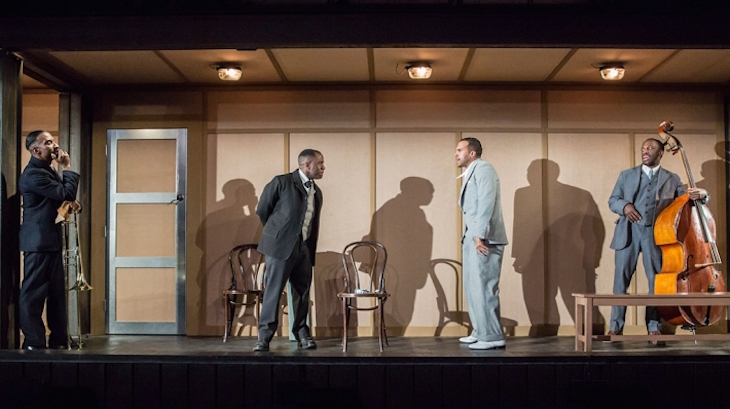
It was 27 years ago when the National Theatre last produced August Wilson’s breakthrough play, Ma Rainey’s Black Bottom, with Hugh Quarshie wearing tights trousers to strut his stuff on top of a table.
 
I saw it twice: the first time to review, and the second – under the leaking roof of the Hackney Empire, to growl quietly in appreciation at Mr Quarshie.

This new production offered a welcome chance to reappraise it.

It’s Chicago, 1927. A quartet of four musicians meet in a studio for a recording session with Ma Rainey – the ‘Mother of the Blues’ – and, while they wait for the diva to arrive, the good humour of their banter thins to reveal underlying tensions.

The ingredients are simple: four talented men (and one woman) who are of use to white music bosses as long as their music produces cash dividends.

But the three older members of the quartet – bookish pianist Toledo, band leader Cutler and bassist Slow Drag – have all found ways of dealing with their situation as black men in the US.

Trumpeter Levee, however – hardly a boy at 32, but still the youngest of the four – is caught between rage at the situation and an ambition to have his own band and write his own material that sees him act with overt deferentiality toward the studio boss.

While the central theme here is an exploration of the African-American experience, it also does much more.

One of the interesting things here is how stories provide a defence.

Toledo, Cutler and Slow Drag tell stories that, to varying degrees, have an aura of folk tale or myth about them. Religion features, but not simply as comfort (it is the reason why Toledo’s wife left him, for instance) and often bound up with folktales.

When Cutler tells them a Faustian tale from his own home town, Toledo nods vociferously, noting that he’s heard the same thing, hundreds of times.

The stories reflect a shared experience and sense of community – beyond the purely historical, biographical and rational – and they appear central to the men’s sense of self and their ability to weather the indignities that are thrown at them.


Cutler, Toledo, Levee and Slow Drag
Even Toledo’s book-learned philosophy and history add to his defences.

But Levee, however, has no such stories and no such learning.

He joshes at the others until, challenged over his attitudes toward white people, he reveals how, as an eight-year-old child, he had seen his mother gang-raped by white men, and his father was subsequently hung and burned for daring to exact revenge.

There is no mythology here; nothing other than a raw, horrifying description of what a child witnessed; no shield against the weeping sore at the core of Levee’s being. He has no defence against his experiences.

Religion offers no comfort: when a row breaks out over his perceived blasphemy, we discover that his mother cried for divine help as she was raped, so he continues to challenge God to strike him down.

In all that he does, Levee pushes boundaries, as though deliberately daring those around him to respond negatively.

And when the levee eventually – and inevitably – breaks, it is with tragic, if unexpected, consequences.

This is a superb drama – a tragedy that operates on many levels – with dialogue that possesses a music of its own to counterpoint that blues that the characters are together to record.

And the National has – once again – given Wilson’s play the cast and production that it deserves.

Dominic Cooke’s direction never lets it sag. Ultz’s set is pared back and cleverly allows a sense of the liberating nature of the music (in a space that seems never to really end), the claustrophobic nature of the limits placed on black lives, and the social relationship between black and white men.

Title apart, Ma Rainey is not the central character here, but while she is on stage, she needs to exert a big, powerful influence – and Sharon D Clarke is marvelous in the role. Thank goodness too, that she gets one full song to show us what a fantastic voice she has.

Clint Dyer as Cutler, Lucian Msamati as Toledo, Giles Terera as Slow Drag and O-T Fagbenle as Levee all turn in top-notch performances – in terms both of their musicianship as well as acting.

You have until 18 May to catch this. It is very much worth the effort.