Showing posts with label seafood. Show all posts

Tuesday, 27 June 2017

Brighton serves up two more enjoyable eateries

Beets with goat's cheese
If The Salt Room and Petit Pois were the runaway winners of the culinary side of last week’s working trip to Brighton, two more eateries also had things to recommend them.

Tuesday saw our team dinner, which often flounders on the food front – not least because such affairs are largely about the socialising.

This time, one of our number had booked for the Copper Clam on the seafront, another of the town’s new eateries.

Temporarily faced by hoardings as the refurbishment and redevelopment of the seafront continues, we were shown to a very nice upstairs room that had been set for our group.

Cod in a buttery, sweet sauce 
However, having spent all day in a darkened conference centre, being outside was absolutely key – not least in hot weather.

The staff dealt with this change from our booking with alacrity and good humour, and we sat down outside with our first drinks.

While imbibing a very pleasant rosé, we enjoyed whatever we’d pre-ordered on a very good deal.

In my case, it was a prawn cocktail to start, with serious prawns rather than the pink tiddlers sort you’d usually expect in this retro dish.

And no avocado in sight.

As only a slight aside, I used to like avocado – and I know how to de-stone one without giving myself an injury – but in recent years I’ve found them too sweet. Perhaps the decline in my liking has a direct relationship to how hip they have become?

Wine glass; chilled wine
Anyway, back to The Copper Clam.

Everyone had opted for sea bass to follow – and it is indicative of the quality of the kitchen, that over a dozen people could be served such a dish at the same time and without quality being compromised.

This was decent fish, well cooked – moist and tasty – and the right sort of portion for an evening where the socialising was the main thing (and hence the reason for no photos).

The staff are very friendly – and our waiter was particularly deft at spotting an empty win bottle that might need replacing.

Find out more at thecopperclam.com and on Twitter at ‪@TheCopperClam.

Sea bass and salad
Twenty four hours later, in need of a quieter experience, we decided to try the bistro at Hotel du Vin on Ship Street.

Revamped last autumn and pulling in appreciative noises, we got a table outside in the courtyard – a pleasantly peaceful environment that felt as though it were miles from the hubbub of the promenade that was, in fact, just a few metres away.

After enjoying a glass of Nyetimber – an interesting English fizz – it was time to see what the food was like.

First up for me was salt-baked beetroot with whipped goat’s cheese, sumac, Greek yogurt and Melba toast.

Cheesecake
Looking beautiful, it had plenty going for it. The beet was warm and tender, while the other ingredients lent various degrees of sharpness to the dish.

The Other Half had ordered soft-boiled duck egg with asparagus soldiers, which came on a wooden block that had clearly been designed for just such a dish, with once large dimple to hold the egg and a smaller one for the salt.

It was apparently very tasty – and for once, the slightly fussy way of serving it worked.

Most of the time, simple plates are more than adequate – even if that goes against the current fad for presentation demanding all sorts of ‘quirky alternatives to plates, which add absolutely nothing to the food.

Amaretto over ice
Next up for me was butter-poached cod with lyonnaise potatoes, smoked salmon and a hispi cabbage sauce – enough sauce, indeed, that it was served in a bowl.

A very sweet, rich dish, the cod was moist and flaked beautifully.

The Other Half opted for more sea bass – this time, with a panzanella salad and nasturtium pesto.

I finished with a lime cheesecake with meringue and dice of elderflower jelly, while The Other Half settled for ice cream.

The service was very pleasant, although we had quite a wait for dessert. But the setting made that bearable – and even allowed for a touch of dinnertime macro still life photography.

This is good food, well presented and served in a very pleasant setting.

Altogether, another welcome addition to a growing list of decent eateries in this south coast town.

To find out more, visit Hotel du Vin and Bistro.

Friday, 23 June 2017

The Salt Room ticks all the boxes again

Raw scallop starter
Extraordinary weather on the south coast ensured that dusk on Sunday evening was a beautiful sight to behold, with sky hues that were redolent of the Mediterranean, evolving through a palette that ranged from apricot to lilac.

And in such a situation, what could be better than a really good meal, enjoyed al fresco?

This was my fourth visit to The Salt Room in Brighton in the space of just over 12 months and The Other Half’s second.

I have, before each of those meals, had just the tiniest amount of trepidation. British dining is, in my experience, so often a matter of pot luck.

Over the years, we’ve paid not inconsiderable sums for food that has, if not inedible, been little more than fuel. Given serial disappointments, one is familiar with an inkling of fear that perfection simply cannot continue.

Teriyaki salmon
But this is The Salt Room and now, having eaten 12 courses there, I can report that it remains utterly flawless and a simply wonderful place to eat.

This time, I started with raw scallop, finely chopped and combined with elderflower and radish, and topped with lumpfish roe.

It was beautifully served on a shell, which sat on top of crushed ice to keep the fish at the perfect temperature.

I’ll say it again of this eatery: a single bite is enough to tell you two things – that the fish here is seriously fresh and that the kitchen really knows how to handle seafood.

Trout
In the case of the scallop, delicate tastes and a delicate texture made for an exemplary dish.

The Other Half very much enjoyed his teriyaki salmon, with wasabi, cucumber and lime.

He noted, as we dined, that suggestion from some that an expensive meal should induce guilt.

But as touched on above, you can spend less and, for instance, have a vast plate of pasta placed in front of you and not be able to come close to finishing it because it’s an insanely over the-top portion.

On weekdays, I lunch sometimes at a café near work where, frankly, any pasta dish is close to being half a packet of the pasta in question.

It’s not particularly expensive, but I can never eat it all – even though I always ask for a smaller portion.

Cod
The OH posited the point that, on such occasions, you even find yourself eating more than you really feel comfortable with – simply from guilt and not wanting to have to face staff asking what the matter is.

So which is worse – an expensive meal of quality that you eat every last crumb of, with relish? Or something that is far cheaper but you eat largely because you need to eat and you leave loads because theres far too much to start with and its not particularly special anyway?

Cherry Arctic roll
Portion size is a wide-spread problem in the UK. Thankfully, it’s not the case at The Salt Room, where I can comfortably eat a three-course meal.

The plates from our starters could have been licked clean by the time they were removed.

Next up, The Other Half enjoyed – very much – cod and chorizo with BBQ onions, samphire and lemon.

For me, it was sea trout, with crayfish dumplings, asparagus, BBQ tomato and basil.

Again – an utter delight, with perfectly-cooked fish and lovely flavours. Textures were light, while presentation was also up to the very high standards.

And two more plates were completely cleaned before being removed.

Last up, The Other Half had mango and vanilla parfait with lime curd, lime snow, passion fruit and macerated mango.

Parfait
I opted for a cherry and chocolate Arctic roll that was a confection of cherry ice cream, chocolate espuma and compressed cherries.

Do I have to tell you how much was left after we put down our spoons?

I didn’t think so.

The Salt Room is consistently producing excellent, seasonal food. The creations of head chef Dave Mothersill are inventive but never feel forced. Frankly, it was difficult to choose what to eat because there was so much to whet the appetite.

The service also remains superb: efficient, friendly, knowledgeable and enthusiastic.

My only question is when I’m back in town next!

To find out more and book, visit www.saltroom-restaurant.co.uk.

Monday, 19 August 2013

History and a load more art


Royal Chateau, Collioure
In a change of mood that could almost be seen as a case of morning after the night before, Saturday morning brought a spell of sustained and heavy rain to follow the fireworks and festivities.

Having taken the opportunity for a lie in, as the rain petered out, we decided then to amble around to Boramar for … well, pretty much anything that took our fancy.

By the time we sat down at one of the cafés overlooking the village’s central beach, the weather had not simply improved – it had turned into a glorious day.

A refreshing Coke later, we took the opportunity to make our way up to the chateau.

Vauban's work at Villefranche-de-Conflent
Part palace, part fort, the latter was begun in the first years of the 13th century by the Knights Templar and integrated into the royal castle in 1345.

Added to and changed over the following centuries, after the French finally annexed Roussillon in 1659, Vauban – his age’s number one artist when it came to military engineering – took it in hand.

Marshall of France to Louis XIV, he added substantially to its structure as well as upgrading Fort Saint-Elme, which watches over Collioure and Port Vendre from a nearby hill, while Fort Miradou, which stands at the back of the village’s Mouré quarter, also bears his hallmarks.

As I’ve said before, this part of the world is peppered with fortifications – a sign of its importance over centuries of tiffs between France and Spain as they fought to gain control of Catalan country.

You can pick out Vauban’s work quite easily: the chateau had thick walls added that also make it into a star fort – a form that made it harder for canon fire to do serious damage, while also allowing defenders to lay down overlapping fields of fire.

View across Port d'Avall
And then there are the classic Vauban sentry boxes, which I swear I’d recognise anywhere, having seen them not only in Collioure, but at Villefranche-de-Conflent too.

There, Vauban not only fortified the tiny town itself, but also built Fort Libéria on the hill above it to defend this crucial area in the Pyrénées, with the rivers Têt and Cady nearby and the plain not far away.

Anyway, back to Collioure.

We’ve been around the chateau before – and even attended a concert there – but it’s well worth a ramble around in it’s own right, plus there is usually an exhibition being staged. Or in this case, two exhibitions. So all that for €4 – you simply cannot go wrong.

One was made up of photographs of Dalí, who was born not far away, over the border, at Figueres.

Sculpture, Félix Valdelièvre
Now I don’t mind a spot of Surrealism, and some of his earlier work (The Persistence of Memory, Dream Caused by the Flight of a Bee Around a Pomegranate a Second Before Awakening etc) I actively like, while it also makes me wonder how much of an influence he was on the likes of Chris Foss and other sci-fi and fantasy artists.

This exhibition provides no revelations, but it does remind you – should it be needed – that Dalí’s main work was himself, and that his was an ego that could make Picasso seem like Uriah Heap.

And this without mentioning that Dalí’s politics were, to put it mildly, highly dubious, given his admiration for Franco.

‘Stark staring bonkers,” we kept muttering. But very, very clever too.

There was one actual Dalí work there – a piece that, frankly, looked like a Rorschach test, with title and signature daubed in the corner.

We all, to a greater or lesser degree do what Dalí did: we make decisions about how to present ourselves to the world. If we choose, for instance, to follow fashion, we are making one statement. But if we choose not to follow fashion, then it’s every bit as much a statement; a deliberate attempt to convey something; to say something to the world about who we are.

Dalí took that and commoditised it – more than any other artist, his own face is iconic.

If the ability to paint the wildest imaginings influenced some artists, how much did the artist as a work of art influence others, such as Tracey Emin, who has subsequently commoditised herself and others in her own career?

Sculpture, Félix Valdelièvre
After musing over the photos, we made our way further up through the chateau, past the bakery – a tiny little room with a double ‘oven’ that is, in effect, outside the main part of the building – and to the highest points of the chateau.

From there can be enjoyed magnificent vistas. And if you want a single reason for our continuing love affair with Collioure (and there are many) look at the sea at Port d’Avall.

Photographed on an iPhone and with no adjustments to the colour, that really is what it’s like.

Having wandered around Vauban’s walls, we made our way down to the chapel, to see the other exhibition.

This was a very different affair.

Félix Valdelièvre is a sculptor from the south of France, whose first exhibition was in 1999.

The works on show here were from his Volumes selection. And the more you look at them, the more intriguing they become.

Not only are the shapes themselves interesting – and many of them appear to defy gravity – but the manner in which he achieves and uses different textures is too.

Anchovies, Au Casot style
They seem to be primarily created from pieces of stone that are then sliced and polished or roughed up, to provide some of the contrasts, with contrasting stones and metals used sparingly to offer further contrasts.

In art speak, his website explains that he “puts the asymmetry in symmetry, the elevation in the straights, while recognising a taste for contradiction”.

Well, I found myself ‘seeing’ insect cocoons, torpedoes, sci-fi creations and strange armour. As I said, very interesting.

These were firmly non-figurative, but Valdelièvre’s work also includes more figurative pieces.

You can find out more here.

Suffice it to say that art can be found in many things. And later, when were headed to my beloved Au Casot for our first evening meal out of the holiday – and our first return visit to this restaurant – there was art on a plate too.

Squid, delightfully presented – superbly cooked
After enjoying an exquisite starter of two varieties of anchovy, with hard-boiled egg, roasted red peppers and black olives (pretty much a Collioure salad), it was on to baby squid with a persillade dressing.

Now go on – tell me that doesn’t look like art? It tasted like it too, because the chef at Au Casot keeps food simple, but knows how to top-quality, regional ingredients to absolute perfection.

Oh – and the coffee ice cream and apricot sorbet (my own special combo) that I had to finish was the highest quality too.

There’s no end to the art that’s available to enjoy here in Collioure.

Wednesday, 24 April 2013

From the beach to the wood


If Sunday had dawned in such good form that it felt as though spring were finally with us, Monday could have been mistaken for summer.

For the second day running, I was up early and down to breakfast pretty much as soon as it opened.

Well fed, I headed out into the sun and back to the charming railway station, passing me old friend Otto von Bismarck on the way.

At the station, I was tempted by a bottle of something declaring itself to be 'Fürst Bismarck Wellness Emotion". Given that the only product that I could think of that was called 'Fürst Bismarck' was vodka, this was intriguing.

It contained mineral water, with mango, trauben (grapes) and "Kräuter-geschmack" – 'a herbal taste'. And it was not unpleasant, although the presence of sugar and various additives means it wasn't really as healthy as it perhaps pretended.

And so to Travemünde. Just 30 minutes and 3€ stood between me and the beach.

That’s right – the beach.

After a month of scrutinising the forecasts in detail, I had packed a case that contained enough layers to keep me warm in the Arctic – and indeed there were patches of compacted snow that we passed on this journey to serve as a reminder of the only barely departed winter – but all I wanted was to cast off clothing and feel the sun on my skin.

A very old lighthouse.
The beach was blissfully quiet; strandkörbe standing quietly, waiting for visitors to arrive.

I rolled up my trousers, took off my Birkies – and stepped out onto cool, soft sand.

A slow wander later, I realised that a few of the strandkörbe were available for rent. I hired one, as the cloud cleared further and the sun climbed higher and the Baltic took on an ever more beautiful green-blue hue.

Forget the high culture – this was simply paradise.

Not that I did forget the culture. It took me a couple of hours to wind down enough to sit still for more than a few minutes, and eventually concentrate on a book. But I just about managed it.

The warmth on flesh was amazing. “On flesh”? It seemed to be worming its way straight to the bones, thawing me out all the way through.

Strandkörbe.
A few other people were around, but the biggest noise came from the gulls that shrieked and squawked as they dove at each other.

A little patch of heaven.

A family nearby stayed in bulky outerwear as they sat in their strandkorb and the small children played.

An older woman stripped off to her underwear.

An elderly man walked along the water’s edge in briefs, his stick in hand.

Bathing might not be without some risks to health – the area has plenty of old, decaying munitions on the sea bed.

I pulled my trousers up further and sat there in my Venice t-shirt, watching the ferries putter in and out, and the vast blue canopy above, and feeling the sun brush aside the winter inertia.

Travamünde is at the mouth of the river Trave and began life as a fortress built by the Duke of Saxony in the 12th century.

In 1329, it was bought by Lübeck for the princely sum of 1,060 Lübsche marks as a way of securing the sea entry to the city itself.

A seaside resort since 1802 and still Germany’s largest ferry port on the Baltic, it also has the oldest lighthouse on the German Baltic coast, dating from 1539.

It became a very fashionable resort, a German St Tropez, with the smart, belle époque casino overlooking the sea (now a smart spa and hotel), where gamblers included Dostoevsky, and a regatta that Kaiser Wilhelm II competed in.

For Thomas Mann, he declared it was "a paradise where I have undoubtedly spent the happiest days of my life".

Almost inevitably then, the town features in Buddenbrooks: first when Tony spends the summer there to escape an overly-enthusiastic suitor. And later, there’s a description of a family outing when they order vast amounts of fish and shellfish for a lunch.

I knew what was on the menu for my own lunch – well, approximately.

At something past 1pm, it was hunger that drove me from my strandkorb. That sea air had given me a real appetite.

The day was such that, when a few metres along the promenade I found a rather smart hotel, the Strandschlößchen, advertising lunch in the garden in front, it wasn't a difficult decision to make.

Time for the first al fresco meal of the year.

A very large sole.
With the sun beating down on my neck, sparrows jauntily hopping around and making a joyful noise, and yellow butterflies struggling to get over the clear, Perspex screen dividing this space from beyond, I took up a menu.

A recurring theme. My German is better than many other Brits, but it is far from being superb.

Surprise at my making even a basic effort was as nothing to the surprise when I insisted that a German menu would be fine (I do the same in France).

But food and menus is one way to easily improve your linguistic skills.

With the aid of my delightful waitress, I selected the sole – a whole specimen from the Baltic itself, which she swore was as perfect an example of local food as I could have found anywhere.

It came with a garnish of either bacon or shrimps. I opted for the latter.

It arrived with bread and a quark spread, a bowl of salad and a bowl of boiled potatoes with parsley.

Never mind that – the fish itself was huge!

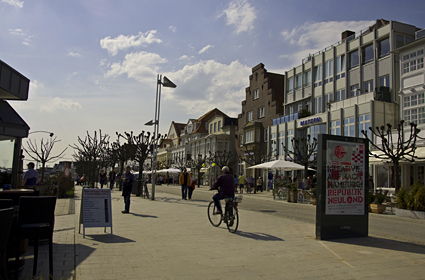
Travemünde.
And oh my, it was tasty. It was good. Let’s be honest – the ingredients of the salad were fresh only in grown in a polytunnel sort of sense, and essentially as tasteless. Given the winter, it’s hardly likely to be anything else, really.

But that fish was perfection.

I wandered after that, working off the food in the most gentle of fashions.

And after a short while, I found myself in Travemünde proper, the old town, where the pilots used to live.

The main drag, along the water, is very much a resort, although it seems to be primarily a resort for elderly visitors. The beach earlier had seen a few younger couples with very small children, but that was as young it got.

There are little streets in the town, with smaller houses and a smaller church than in Lübeck, but you can still catch a reflection of the city.

And then, since the forecast was for storms and I was wearing only sandals and not carrying a hat or brolly, I headed for the station.

I got slightly lost and ended up asking for directions from an elderly gentleman who seemed completely spooked by my question and toddled off at speed, himself asking another gentleman something a few paces on.

And after I too had asked the second man for directions, I found myself walking through a small wood with vast, skeletal trees soaring above, crows making a racket all around, their circular nests visible everywhere, and just a few hints that we were in April and not February.

The echoing sound of the birds was like nothing I have ever heard.

It was just the tiniest hint of the German woodland/forest and the power that it exercises over the German psyche. Andrew Graham-Dixon's series on German art is fascinating on this.

Into the woods.
We have nothing like it in the UK, having long ago either let our woods and forests be razed or enclosed.

Seeing large numbers of trees now seems very striking to me for the reason of that scarcity.

The fairy tale quality of it was not been hindered by the sight of that first elderly gentleman haring off up a path into the wood, looking so small beneath the towering trees.

I found myself following him most of the way, as though I were stalking him.

And then, back at the station, another old man came to peer over my shoulder as I bought my ticket, informing me that he had tickets for two to Lübeck and did I want to go with him? I politely declined.

It was almost certainly entirely innocent, but that is where, being a solo traveller, you have to exercise some particular care, I think.

Travemünde may be a slightly mixed-up place now, with a vast, rather ugly tower block dwarfing the nearby former casino, but it nonetheless made me want to do was explore the German Baltic coast more.

And to find more days like this one.

Later, having done a little run around the Altstadt to pick up a last couple of souvenirs, I sat outside a café near the Rathaus, listening to a busking violinist play the adagietto from Mahler’s fifth.

According to Rough Guides, Lübeck can seem “terrifyingly cultured”. Terrifyingly?

Nothing terrifying about it all – and hardly as unrelentingly high-brow as that comment might suggest. As if to prove that point, a few seconds after the adagietto had finished, a lad rode past on a bike blasting out something far less classical from speakers mounted behind his saddle.

But perception is nine tenths of the law, so to speak, and I was about to head for somewhere that nobody would dream of describing as “terrifyingly cultured”, even though culture is something that it has in abundance.

So, next up – Amsterdam. But first, all I had to do was get there.