Showing posts with label Anthony Worrall Thompson. Show all posts

Tuesday, 15 November 2011

The Christmas gifts you really don't need

It’s getting to that time of year when people start considering gifts – gifts to buy for others; gifts they’d like themselves.

And of course, this is when companies start bombarding us with ideas for just that.

Food gifts might not rate as highly in the UK as they do in France – strange, that – but foodies are not entirely neglected here.

But some of what is on offer could blow you away.

Currently featuring high in the kitchen gadget TV advert stakes is a Cuisinart soup maker, £140 from Amazon at the time of posting.

Now, before you all observe that:

a) all you need to make soup is a pan, a spoon, a knife and a chopping board – with an optional hand-held blender

or

b) I'm becoming a grumpy old woman, let’s look at what such a shiny new toy would give you.

And the perfect place to find out is the reviews section of Amazon.

There, one reviewer wrote: “We have had our soup maker for about 18 months now, and it tends not to get used much any more, in favour of a simple saucepan followed by blending.”

Okay. Why would that be, then?

“The maximum soup capacity of just 1.4L means that a big family only get small helpings.”

So it doesn’t give you enough size flexibility. Is that all?

“… and, why on earth, with such a good basic design, did they choose NOT to give it automatic intermittent stir? The manual stir means one has to remember to stir at intervals, or it can quickly burn – especially during the initial very hot period. That propensity to burn is the downside of a very effective heater used to fry up ingredients before moving on to liquid addition.”

So you don’t save any time, then, because you have to watch it and you have to stir it when it’s busy – exactly as you would with the conventional method.

But there’s more:

“We had to return the very first machine as the ‘spigot’ which is the drive spindle is some sort of plastic, and it lost its shape very quickly. We have been very careful with the replacement, to make sure we don't put too much drive up into the blender chamber. We do not use it for ice-crushing, for that reason.”

So it broke. And as a result, you don’t feel able to use it for one of it’s intended purposes.

“… If we had not had that experience, we would be giving a 3 or 4 star rating.

“Otherwise, it seems certainly well-made, heavy motor and well-thought-out. So, when the MkII comes out with intermittent stir and 2.5L capacity, we will possibly replace.”

So, to recap: in essence, it gives you next to nowt over and above the conventional method of making soup, takes up a lot more space, is less reliable (pans, knives and chopping boards rarely have a bit of plastic that loses shape) and costs well over a ton. And yet you claim you’d get a bigger one if such a thing existed?

It’s only the other day that I mention the ‘Breville Antony Worrall Thompson VTP099 Gourmet Pie Maker’, with a recommended retail price of £47.99.

Also available is the ‘Professional Cooks Gourmet 4 Slot Electric Pie Maker for a mere £26.

Come on – can anyone name me the “professional cooks” who would use a machine like this?

You can get similar machines for cupcakes, and others that promise to make ‘flapjacks, cake bars and breakfast cereal bars’. There are machines for waffles and canapés too.

Most of these take the form of a clunky piece of machinery that opens up like a book and has the halves of assorted moulds in each bit.

Although there is also a Russell Hobbs “cookie maker” that bucks the trend by looking, frankly, more like something you’d find on the shelves of your local ‘private shop’ and intended for male enhancement.

But how many of these do you get? How much storage space have you got?

To be honest, I’m reaching a point where I’m beginning to think that coffee machines are largely an OTT way of doing something that can be achieved just as simply, with far less expense, far less space taken in the kitchen and no bits of machinery to go wrong or get messed up by hard water with a simple cafetière!

Indeed, perhaps it’s heresy, but is ‘instant’ coffee really so much more ‘instant’ than cafetière?

Take a 200g jar of Douwe Egberts “pure smooth” instant – that’s £6.59. Douwe Egberts “cafetière blend twin pack” is £5.49 for two packs of 250g each.

But one thing is for certain: soup makers of the world unite – you have nothing to throw off but your gadgets!

And here's some I made earlier – the proper way.

A version of a River Café Italian rustic soup: peel and slice a couple of cloves of garlic.

Peel and chop a couple of medium potatoes into dice no bigger than 2cm.

Peel and dice a butternut squash.

Put all these in a pan.

Add a tin of plum tomatoes. Rinse out the juice from the tin with hot water and add this too, along with enough stock to cover.

Add a few crushed fennel seeds.

Grind some black pepper into it.

Cook gently for around 30 minutes and test that the potato is cooked through.

Remove from heat and mash – you want it to still have plenty of texture.

Serve with a drizzle of good virgin oil and, if you want, a dollop of marscarpone.

There. Soup. Made properly. How difficult is it?

Friday, 11 November 2011

The tao of pie

    Sing a song of sixpence a pocket full of rye,

    Four and twenty blackbirds baked in a pie.

    When the pie was opened the birds began to sing,

    Oh wasn’t that a dainty dish to set before the king?


Nursery rhymes are a fascinating subject in their own right – and this one might have been about Henry VIII and Anne Boleyn.

In that context, the description of the dish as “dainty” is sarcastic – it’s a wreck of a recipe. But it does tell us that a pie, of itself, would not be considered unsuitable for a monarch.

We don’t really think of savoury pie as a posh dish today – well, perhaps apart from game pie and that’s as much down to the remaining sentiments about game being posh/rich people’s food in England.

But if pie is, in general, the domain of all of us ordinary folk, then up north it takes on a deeper importance and in Lancashire, it’s pretty much a religion.

A few years ago, the Telegraph reported that after a discussion with a northern fan about the half-time pies at her beloved Norwich City, Delia Smith was encouraged to change the club’s supplier to Hollands Pies – from Lancashire. And when news emerged last summer that Hollands had been bought by a non-UK company, there was outrage locally.

Indeed, in recent weeks, I’ve been finding a Hollands meat and potato pie quite acceptable half-time fodder at Manchester City games.

As I mentioned the other week, I have fond memories of eating meat ‘n’ tatty pies – with black peas – at bonfire nights in when we lived in Mossley.

My mother used to buy little pork pies from a local baker in the town, Cakebread. She’d heat them through for tea and serve them with baked beans. The crusts were thick and peppery, and the meat densely packed but moist.

She made her own pork pies too: she’d spend an age trimming and chopping some pork until it was almost mince, then it would be mixed with dried onion that had been rehydrated in a white enamel mug with blue trim, plus grated potato, before being packed into pastry-lined enamel pie tins and topped with more shortcrust.

That, on the savoury pie front, was pretty much my mother’s repertoire. She would do a version of steak and kidney – but not in a pie, cooking the meats separately and serving them on a slice of piping hot pastry. That was Sunday dinner I particularly looked forward to.

If we had a steak and kidney pie (or chicken and mushroom, for that matter), it would be a mini Bird's Eye frozen one: she kept the little foil containers, watched them carefully and then found various uses for them – including as the receptacle for our ration of sweets and chocolate when she divvied this out a couple of times a week.

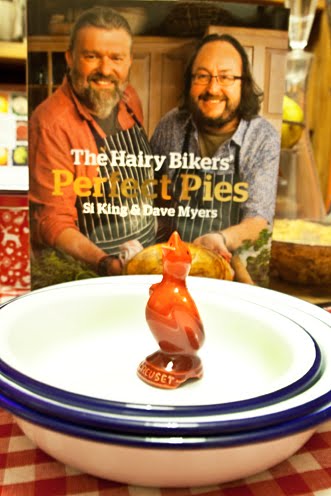
Just a couple of weeks ago, I spotted a new book by Si King and Dave Myers: The Hairy Bikers’ Perfect Pies: The ultimate pie bible from the kings of pies.

A flick through tempted me, but I left it on the shelf – and then, unable to put it out of my mind, ordered a copy less than two days later.

With the burgeoning sense of food nostalgia inspired initially by Nigel Slater, I had set my course for pie.

I also ordered a trio of old-fashioned pie dishes – three different sizes; all round and with wide rims; enamel with a blue stripe on the rim. And a pie bird – a nod to that nursery rhyme.

Like my Mason Cash mixing bowls, there is something hugely comforting in having such traditional equipment. And it's considerably cheaper than some other options.

For instance, in all honestly and without fear of overstating my culinary skills, I did not feel that I needed the Breville Antony Worrall Thompson VTP099 Gourmet Pie Maker (only £25.46 at Amazon, instead of the RRP of £47.99).

I don’t know what’s worse: that or Marco Pierre White trying to keep a straight face while telling us that Knorr stock (ingredients for the beef stock pots at £1.46 for four of 28g each: Water, Salt, Beef fat (5.0%), Yeast Extract, Vegetables in Varying Proportions (2,3%) (Carrot, Leek), Sugar, Flavourings (contains Milk and Mustard), Beef Extract (1.3%), Vegetable Fats and Oils, Thickeners (Xanthan Gum, Locust Bean Gum), Colour (Burnt Sugar Caramel), Herbs (Parsley, Lovage), Rosemary Extract, Apple Juice Concentrate, Carrot Juice Concentrate, Onion Juice Concentrate, Spices (Pepper, Paprika), Garlic) is every bit as good as the real stuff.

After the goodies arrived, I picked a midweek evening to make my pie debut. The plan was something involving chicken – based on the first recipe in the book, for a creamy chicken, ham and leek pie. Because it was midweek, I was preparing to cheat a tad, using ready-made pastry.

In the shop, I went to pick up a packet of Jus-Rol shortcrust (£2.80 for a kilo). Then I glanced at the ingredients: Wheat Flour, Vegetable Oil, Water, Salt, Lemon Juice, Preservative: Potassium Sorbate.

And I decided that I was damned if my first pie was going to be made with a pastry made with vegetable oil. And lemon juice.

Back in the kitchen, I rubbed together 350g plain flour and 100g each of butter and lard, before adding a large egg that had been whisked up with a tablespoon of chilled water.

It came together well, but fretting a little too much about not letting my warm paws heat it up to much, I probably didn’t press it together quite enough.

Defying convention, Myers and King suggest not putting the pastry into the fridge before rolling it – that makes it harder to roll – but doing that and lining the tin first. This works quite well.

In the meantime, I had skinned and boned four chicken thighs and added the meat to a pan in which I’d been gently cooking some sliced leeks in, in a little lard. Some chopped smoked streaky bacon joined it.

In another pan, I very gently heated some whole milk and a little stock for the sauce, with the chicken skin and bones in, along with the rind from the bacon.

In another pan, some butter was melted and some plain flour added and cooked through for a minute, before I started adding the milk/stock.

When that was a decent consistency – you need it quite thick – I popped the meat and leeks in, together with some chopped parsley and sage, then left it to cool down.

Pop the kettle on. Grab a biscuit. Put your feet up.

And then, after a while, you can decant the filling into the lined dish, roll out some more to make a lid, trim, crimp the edges and, if you want, decorate it.

I opted for a postmodern statement with the latter, cutting out the word ‘pie’ and sticking it on with the egg glaze. Just so nobody would be left in any doubt.

You need to have pre-heated the oven to 200˚C (180˚C fan). Myers and King recommend putting a baking tray in the oven to warm up thoroughly while it’s heating.

And then it’s the matter of a mere 35 minutes before you can remove it, slice it and eat.

I served this with mashed swede, since it needed something on the side, but I didn’t want to add more complex carbs, since there was already pastry involved.

The pastry didn’t look perfect and I hadn’t made it quite thick enough to withstand the serving process, but it was beautifully flakey. The filling was tasty enough to satisfy The Other Half, who tends to be underwhelmed by anything he considers ‘bland’.

One thing is certain. Pie is now firmly on the household agenda. And in keeping with my recent revelation that cooking something regularly helps you get to grips with the skills required, there’ll be another one very, very soon.