Showing posts with label Mossley. Show all posts

Thursday, 26 September 2013

Gary Owen put his arm around my shoulder


Gary Owen and me. Maine Road, 1979
I used to love this time of year – I mean, I don’t hate it now, but I used to really love it: perhaps more than any other. The end of August and the start of September brought with it the start of the football season and the start of the school.

Add to that that harvest was always my favourite time in the religious calendar (closet pagan that I obviously was).

But in terms of the new term, that was not because I was some sort of dreadful swot – I wasn’t – but in essence, because by the end of six weeks, I was simply lonely.

Mossley was wonderful in many, many ways, but when we moved there, fellow pupils at my new primary school had already had four years to establish friendships - many of which would already have been formed before they even started school - and when I went to Fairfield, I was the only one from that same primary school, it was two bus rides away and I lived nowhere near nobody anyone in my class.

And in footballing terms, for many years, close seasons were also a quiet time.

Manchester City, so often a laughing stock during a season, were rarely worth much gossip outside of it.

It has been part of the strange new world of winning football’s lottery that we’re now rarely out of the media, whether it’s genuine news about the club, speculation masquerading as news or just gossip.

The last of which brings to mind a very northern vision of gossip - and one that, in theory, I'm far too young to have: Norman Evans doing 'over the garden wall'.

Okay, so Les Dawson didn't invent it, but Evans, a comic right from the music hall tradition, should be way beyond my own memories. He is - but like many who grew up with parents who had lived through the war, the cultural memories were handed down just as much as the stories of, in my immediate family's case, the bombing of Liverpool and Plymouth.

I could mimic Evans before I eventually saw footage of him.

Mine, I think, was a generation caught between worlds: that of the pre-war, in which my parents grew up, and then the sixties and seventies, in which we grew up. A muddled collision of two very different worlds, split by such a short time historically, yet changed out of all recognition by the events that took place within that timeframe.

I offer a single, but very different cultural illustration.

City even invaded my art studies. Niall Quinn
Take Hollywood. Take The Maltese Falcon from 1941. And then take The Big Sleep from 1946. Just five years divide them, yet one remains modern and the other seems dated. They seems to be worlds apart.

My parents, like many others, I'm sure, struggled with these changes – certainly with the moral/ethical ones.

In many ways, I've long felt that I was brought up in a sort of time bubble: it was often really rather 1930s.

My father used to quite openly declare that he wanted a son, but that as a tomboy, I was the next best thing.

When it came to football, I discovered and adopted it all on my own and in spite of my earliest memories of the game, where my father was screaming at the TV set while England were playing (particularly against West Germany).

Rather perversely, although he had – and still essentially has – a very conservative attitude toward women, he seemed to welcome my interest, and bought me football cards and comics, albeit drawing the line at actually taking me to any matches.

My mother, herself every bit as much a traditionalist in terms of what a woman’s role should be – and arguably more so – remains a cricket and Rugby League fan. But somehow football was beyond that – not least as I tried to play at every possible opportunity.

For some years, I was only allowed to go and watch Mossley AFC – the realisation dawned years later that my father had his personal Stasi on duty wherever I went (or parishioners, as they’re sometimes known) and besides, Seal Park was only just behind our house.

In those lonely summer holidays, I’d spend hours bashing a ball against the garage door, lost in a world where I was scoring the winning goal in the FA Cup Final, until my distracted mother would come out and tell me to stop making such a noise.

Mind, come Wimbledon, I’d thrash a tennis ball against a wall and imagine victory in south London.

I was, in other words, sportily inclined, and also somewhat competitive.

For all the attempts to bring me up as a delicate and refined example of the female species, my genes seemed to scream something rather different.

Eventually, in 1979, I was permitted to go to A Real Match.

My parents had taken me to cricket at the real Old Trafford – I have seen Gary Sobers play – but much as I liked and still do like cricket, it made no odds to my blossoming love of the round-ball game, and I had continued to nag.

The Real Match in question was a rearranged fixture at the end of the 1979 season. In other words, it was one of the last opportunities for me to go to Maine Road before we were due to move away from the area.

In retrospect, I rather think this impending move featured in parental calculations.

Since it was rearranged, it took place in midweek. I went with Dorothy Edwards, whose own parents allowed her to go on a regular basis. My envy knew no bounds.

We got there early. My school tie was slightly pulled down – the very limits of rebellious behaviour for me at the time – and I had my school bag slung around me. The photographs make me look far younger (to my middle-aged eyes) than the 16 and a half that I actually was.

With Kaziu Deyna at Maine Road, 1979
I bought a few postcard photos of some of the team in the club shop (a portacabin) and then we went to wait outside the players’ carpark. There, I got several of the pictures autographed, and Dorothy took two photographs of me with players: Kazimierz Deyna and Gary Owen.

Deyna was the Polish World Cup captain at the time and a quality midfield player. Because of injury, he only made 38 appearances for City, scoring 12 goals. I saw two of them that night – even though we lost 3-2 to visitors Aston Villa.

Owen was one of our homegrown young stars. He was also the only player that I ever had a crush on – my footballing priorities were never about sex.

I look gauche as all hell on the pictures. In one sense, I hate them. But I also love them too, because in this very new world for Manchester City fans, they're evidence that I am not a bandwagon jumper.

More evidence can be found in a ring I still have – a Christmas present from Fairfield friends Susan Prince and, I think, Kay Grimshaw. It was a typical 1970s stainless still job, with an enamelled crest on top.

Some years ago, I was travelling north to a game and was offered a tenner for it by a fellow passenger. No way. Even if I was broke, that's a sentimental item I’d hate to be parted from.

It was also on a finger the day we won the title in May 2012. It was on my hand again last Sunday, when we handed out a serious thrashing to Manchester United that left me, once again, without much of a voice. Four goals = four screams = half a voice left.

Oh City, City, City: how can I explain my love for you? A love that has, over the years, been so often tested by the most dismal performances; by an unparalleled ability to grasp defeat from the jaws of victory; by off-pitch shenanigans; by farce masquerading as tragedy.

I recall a midweek League Cup game at Anfield when we lost 6-0, followed by a Saturday league match at Maine Road, just days later and also against Liverpool, when we lost 4-0.

“Alan Ball’s a football genius!” we sang at the then coach, who eventually emerged from the dug out to rather drily applaud.

And “We’ll score again, don’t know where, don’t know when, but I know we’ll score again some sunny day.”

Or at Bramall Lane for a fixture against Sheffield United, with the Blades fans chanting: “We hate Wednesday, we hate Wednesday,” to which our retort was: “We hate Saturday, we hate Saturday”.

Yet in May 1999, I came away from Wembley in the full and certain knowledge that that afternoon’s win against Gillingham in the Division II play-off final had been one of the greatest days in my life.

A word here, though, for the Gills fans, who were superb that day and well into a somewhat drunken evening.

And that’s without going over the story of 13 May 2012 when we won the title in extra time, in the kost dramatic fashion possible, and were crowned England’s champions for the first time in 44 years.

Another sketch. Tony Coton this time
In a nomadic life, City has, since I was around 13 or 14, remained a constant. Often a constant misery, a constant disappointment – but a constant nonetheless.

And these days, it is no longer quite like that.

On Sunday, I took the train to Manchester for the game against Salford United.

I was the first home game this season that I could get to.

And it was a wonder. If the 6-1 at The Swamp two years ago is already legend, this may well end up being even more so. Because while that certainly owed something to flukishness, with one of their side sent off with almost half the game to go, and many of our goals coming on the counter, this did not.

At 4-1, the scoreline might not have seemed as dramatic, but the performance was arguably much more so.

It was sandwiched between a Champions’ League away win in the Czech Republic (3-0) and a 5-0 drubbing of Wigan, who, only a few months ago, were much the better team on the day when they beat us 1-0 in the FA Cup Final at Wembley.

I’m no mathematician, but three games, 12 goals for and just one against is looking pretty good. The big, BIG test will come next week, when we face reigning champions Bayern München in the Champions’ League.

But hell – we’re IN the Champions’ League! And that is sort of match we all dreamed of for years.

We might have started the season in an mixed fashion, as new coach Manuel Pellegrini got his feet properly under the table and then faced some crucial injuries, but in the last week, we seem to have been on fire.

The Engineer is doing well: with Kompany and Nastasic back, central defence is solid, meaning that Yaya Touré can move further forward.

Indeed, Pellegrini’s decision to switch Yaya with Fernandinho, leaving the Brazilian further back, looked superb on Sunday.

Kolarov, who is unquestionably good in attack, even looked the part in defence at the weekend, and Clichy is now fit again.

Džeko is looking revitalised by a coach who, by all accounts, doesn’t work on the basis of hairdryers, grand funks, not talking to anyone or only talking to the press.

Oh, and before you think otherwise, I still love Roberto, but just understand that he had taken us as far as he could.

Football – I love you. Even though I wasn’t supposed to.

And City: one of the few constants in my life, I love you too. It may not be the case, but I do suspect that, if you cut me, I’d bleed blue.

And there’s very little that could better the catharsis of that day in May 2012. Or last Sunday.

Thursday, 17 January 2013

Eggs and Mrs David and snow


This morning, I cracked open an egg when making my breakfast omelette to find a double yolker.

To be fair, I had expected it, setting aside the egg in question until I was cooking something for which it would be better suited than being prepared to sit in an egg cup.

It was a vast thing, that egg – XL to start with – with an elongated shape, so that it was hardly the stuff of rocket science to guess that it would have two yolks.

In which case, I had a three-yolk omelette without breaking more than two eggs.

I follow the venerable Mrs David’s instructions on omelettes – well, to be more accurate, the instructions from someone else that she reproduces, crediting them and saying that she can do no better.

Reading and following those instructions was the point at which I finally learned to make an omelette – albeit further aided by investment in a proper heavy-duty, copper-coated omelette pan from across the Channel.

So you start by melting a good knob of butter and letting it just reach the foaming, might-be-about-to-start-turning-golden-at-any-minute stage, before you lob in your lightly beaten eggs: two plus one yolk, if you’re following many traditional recipes. Double yolkers excepted, I usually just use two: it’s quite enough for me.

From then on, it’s going to take about 40-45 seconds, as you raise the pan from on one side and then the other, gently lifting the egg mix to allow the uncooked, liquid egg to reach the base of the pan. But not much longer – you want it to still be silkily soft.

And then turn out carefully onto your plate, season and consume – although not with Mrs David’s glass of wine at that time of the day.

Actually, this morning’s omelette had a new seasoning: I wanted to use up some lumpfish ‘caviar’ and decided to garnish it with that, which added quite enough of a salty taste to the egg.

I remember seeing double yolks way back in the days when the family eggs came from one of the farmers that my father knew.

It’s funny how you forget such things, and only remember when something actually jumps up and slaps you across the metaphorical chops. When we started getting our eggs from Matthew was the point at which I remembered how good eggs can be.

And when I cracked the first double yolker from an egg I’d got from the same source – Black Rock hens, organic and free range, if you’re interested – it was as a case of: ‘oh gosh – I’d completely forgotten that such things occurred’.

But memories of eggs and farms also mean memories of snow for me, which is equally apt, given the UK weather forecast right now, and that I am due to be northbound for work tomorrow.

When we lived in Mossley – in the top half of that small mill town of 10,000, which was spread along the east-facing side of a Pennine hill, the valley and up into the opposite hill, we entirely expected to get cut off for a day or so once or twice a winter.

But one year – I cannot recall whether we were cut off at the time – the road up to a farm near Hartshead Pike was impassible for my father in his car. So I was sent, on foot, to collect the eggs.

I yomped up the road to opposite the parish church, before breaking away into a field and up a steep hill that was several inches deep in snow.

On the way back, I slipped, and ended up careering down the same slope some way on my backside.

When I got home, my mother (who, these days, is slightly embarrassed by this story) was only concerned about one thing – whether I’d broken any of the eggs! They were all intact, as it happened – just as I was. But I did feel a certain sense of being piqued at the priorities revealed.

Not that that was the only time that snow left me with a story to tell in those times.

I’d probably only been at Fairfield High School for Girls – some eight miles from Mossley, near the centre of Manchester – for a year or slightly more, when the white stuff had a big impact.

It was a Thursday – you’ll see later why I know this. There had been a trifling hint of snow at school. Only when I left for home at the usual time did it become an issue.

Indeed, it only became an issue well beyond Aston-under–Lyne, which was where I changed buses and, therefore, the halfway point of my daily journeys.

I was three quarters of the way home, then, near the old Ladysmith Barracks, when the bus stopped and the driver announced that he could go no further.

The reason was the snow, which had fallen heavily and drifted across the road that hugged the hill for a mile or so before dipping into top Mossley – near where I’d left the road to head for the farm and those eggs.

I was on my own.

Pulling the hood of my Air Force blue duffle coat up, I headed on up Mossley Road, the hill to my right, the fall away to Ashton Golf Club to my left, Hawkshead Pike ahead, and cars stranded in the deep drifting snow.

I reached a stranded bus and took a break inside, where I met a woman who took me – and a couple of other girls – under her wing.

We plodded on, taking a further break in another bus, before hitting the top of the town.

Almost the first buolding you hit coming from that direction is – or at least was – a pub. She took us all inside and the landlord gave us hot blackcurrant drinks.

From there, it was a short way home, albeit over icy roads.

I remember getting back, covered in the snow that was still falling thickly, and standing at the front door, ringing the bell, waiting to be let in.

When my mother opened it, the first thing she heard from this short, stocky yeti was whether Top of the Pops had started yet.

I had no watch; we had no mobile phones or tablets or computers. I had no clue as to the time. But that was why I know that it was a Thursday.

Thereafter, for my remaining time at Fairfield at least, the first hint of snow on the school fields would see the Mossley girls sent home straight away.

Nearly 40 years later, I remember that adventure with pleasure. I don’t think I was ever scared during it.

And perhaps it also explains why I never think of snow with anything other than relish.


Friday, 13 April 2012

Forgotten gardening exploits

Propped up on the sofa, nursing a sore throat and trying to fend off an incipient cold, I could look out at a garden that is both totally of me and totally surprising for the me that I see in my own mind.

It was a typically English April day; showers interspersed with bursts of sun; a cast of faint spring green over the whole scene.

What I could see directly was a potted box, leafing pyracantha; a pale green, iron table and chairs, pansies and violas, and an ornamental canal boat milk churn lying on its side.

Beyond, there's the carpark and then the old, characterful wall that borders the park, covered in ivy; in between, a young silver birch that soars high and sways in even the gentlest breeze, and in the park itself, a plane tree that always seems to be one of the last things into bloom every spring, but which is now visibly on the way.

And because the schools are still on holiday and there is therefore less traffic around then normal, there is a soundtrack of birdsong to accompany this very English vista.

But now you've got that picture in your mind's eye, I feel the need to explain about that churn. Some years ago, we had a brief phase of going canal boating. After a number of short trips, we decided to do a longer one - the Leicester Ring. We had two weeks - a tight schedule for that route, meaning no days without cruising.

The Other Half worked on the basis that it is a canal tradition that Other Halves do the "complex, technical stuff " - or driving the boat, to you and me - and the women do the hard physical graft, otherwise known as doing the locks.

I did over 100 locks that fortnight, including the full flight at Foxton and a particularly stubborn one in Leicester one evening in the pouring rain as I realised that my supposedly waterproof kagool was anything but.

The weather in general was far from great and I spent much of the time between locks sitting on my own in the cabin, reading a biography of RFK, teaching myself to play solitaire and listening to the radio.

The churn and a jug were bought as souvenirs of a trip that increasingly - as far as I was concerned, at any rate - became our last canal trip. They have been gathering dust on a shelf for the time since.

But back to the here and now.

A week or so ago, it dawned on me that although I had long thought that, if and when I got around to it, I'd be trying to create a sort of Mediterranean influenced garden.

But in this weather at least, it has the look of a rather dainty English garden. Okay, accepting that the rusted, iron cat planter is a touch of tweeness that is hardly Med styling (I was never going to get away with a gnome), I would have thought that the terracotta pots and the lemon tree and a lot of the herbs would have gone down that route.

Yet even with the lemon, it looks rather more Surrey than the south of France.

It will, in the coming months, get even more so. One of the things that will be added somewhere is forget me nots.

I had forgotten those delicate little flowers, but once seeing a packet of seeds, I was soaring away on a Proustian flight of gardening memories.

My father didn't do gardening. And nor did my mother. In retrospect, I don't know how our gardens ever stayed the right side of wilderness.

Although when we lived in Fulham, it didn't. With an old air raid shelled at the back, it was close to being a jungle.

I don't have strong memories of the garden in Bolton before that and certainly not of Tebay before that.

After London came Mossley and that's where my memories take far more concrete form.

The house was on the side of a hill, facing the Pennines. A long drive ran along one side; a steep haul up toward a battered old garage that was pretty much impassable in snow.

Next to the garage was a little shed. The shed - I can almost smell it now - rather unofficially became a little den for my sister and I.

I cannot remember how or even why, but I grew forget me nots in empty yogurt pots. I can't recall where I got them from - not seeds - but I have vague memories of my mother informing me that I wasn't to plant them out as they'd run riot and take over. But somehow, I grew those dainty, blue flowers in recycled plastic pots.

Then, after that memory had popped back into my mind, more crept out of the woodwork between my ears.

I remembered weeding that drive, which would otherwise get ridiculously overgrown. And I also cut the privet hedge that ran the full length of that drive. Sometimes, if memory serves, I'd mow the small lawn at the back of the house. What I certainly did do was neaten up the edges with a half moon-shaped tool with a t-shaped handle with rubber grips.

I can't remember if these were chores I was given - or whether I did them off my own bat and at least partly for pleasure. And I can't remember whether I ever got any financial recompense for my sweat.

But it was odd to recall that my currents efforts are not my first green fingered outings. And that's why forget me nots will eventually find a place in my own garden before very long.

Thursday, 15 December 2011

The Christmas memories come rolling back

On a forum elsewhere in the great ether, someone posted a thread about the 10 things at Christmas that take you straight back to your childhood.

In the last couple of years or so, I’ve been pushing at the door to the attic of memory to see what I can find from a past that is, in general, often really rather blurry.

Now in my own version of Proust, I’ve been specifically trying to dredge up food-related memories, and predictably, this set the cogs grinding away once more.

So here is a little selection of seasonal memories – some food related and others not – to perhaps whet your appetite and get your own memories going too.

❅ The arrival of the special double issue of theRadio Times was always something to be met with delight. Even in the days of just three channels, it heralded a lengthy and detailed study as I searched to find films that I loved and those that I'd never seen from Hollywood's golden era.

Just before Christmas itself, my mother and I would sit down and work through it more thoroughly, with a pen and paper to note down the things that the entire family would sit and watch together – because television was the centrepiece of family activity.

And after, like picking the final scraps of meat from the carcass, I’d raid it one final time, snipping out pictures and film details for a scrapbook.

❅ Turkey. I don't miss the big roast – but I do miss the sandwiches on Christmas night, when the far tastier dark meat would be packed between sliced white bread, seasoned well, and served with one of my mother's now cold stuffing balls on the side.

Most of these memories come from our time in Mossley – Christmas before then is rather vague, and even later Christmasses have only occasional concrete memories.

One of those was many years later, when my parents lived in Nottingham. It was one of the last years that the whole immediate family came together – after that, I finally found a little bit of courage to tell my parents I wouldn’t be joining them and would spend the holiday with The Other Half.

On this occasion, my mother was ill after Boxing Day and I suddenly had responsibility for feeding the family – and more to the point, for stripping the final meat from the turkey carcass, something I’d never done anything like before.

I haven’t a clue what I cooked. Perhaps that was a sort of revenge on my mother for never having bothered teach us anything in the kitchen beyond a few prep chores.

I also have vague memories of eating pheasant at Christmas in Mossley – when we'd be invited to a festive dinner by one of my father's parishoners: an elderly spinster who was, frankly, bonkers and, like more than one or two other female members of his congregations down the decades, saw her lay role in the church and her relationship with the minister as a very important part of her life.

You've seen those films where women fixate on the local priest? Well, I always had the sense that it was not far off with my father.

Memory is an odd thing. I do remember a moment from a Christmas a year or so earlier, in Reading, when we were all sat around watching telly. My father’s mother was with us.

Predictably, she was bored and didn’t want to watch whatever was on – so suddenly decided to start an entirely random conversation directed at my mother, asking her, entirely out of the blue: “Do you like tinned salmon?” before my father snapped at her to be quiet.

I suppose all of this is also why I could, quite frankly, live without a TV. Did many other families base so much of their family life around the box in the corner? Was it a particularly British thing? It seemed to have an almost sacred quality: my parents decided what we were watching – and so we all sat around and watched.

It may not have been the case, but I don’t remember there being a choice about whether to sit down and watch or not. There’s a bitter quality to the knowledge that I lost a lot of my youth just sitting there, watching things, without the bottle or the opportunity to go and do something else instead.

New Year’s Eve would be dominated by whatever end-of-year celebration was on, before my father would go outside with a piece of coal, ready to enter at the stroke of midnight.

❅ Carols. This is something I still associate particularly with school. Fairfield High School for Girls had been founded, in part, by the Moravian church, and was linked to the Moravian settlement next door. Each year, we’d have our school carol service in the church there, with Christingles, a traditional symbol of this Bohemian denomination.

Later, at Lancaster Girls’ Grammar School, the annual carol service would be held in the Priory. There’s been a church on the site from around 630AD, but the current one dates from a little later, with massive reconstruction work carried out in the early 15th century.

But such an environment always adds to the drama of an occasion – and our carol services benefitted too.

As a member of the school choirs at both schools, we'd have to sing the descant to carols – those for Hark the Herald and Come All Ye Faithful are still totally rooted in my mind.

I’d still be able to sing them today if it wasn’t that my voice has dropped over the years from a mezzo to nearer an alt: my wonderful music teacher, Noel McKee, who trained and then conducted us in those LGGS services, said I had an excellent, almost Russian middle register. I’ve never been entirely sure what that means, but it sounds good.

❅ After scouring the Radio Times there was always telly itself. From the utter boredom of the Queen’s speech, to the peerless pleasure of Morecambe & Wise. I still find the repeats hilarious – Eric was a comic genius. All he had to do was wiggle his glasses around.

The afternoon film once included the TV premiere of Oliver! – and it was love at first viewing.

Back at school, I went without lunch for a couple of weeks to save the money and buy a copy of the score, then sat down at the piano and taught myself to play using that score.

Many years later, when I was regularly penning theatre reviews, I used to write about the National Youth Theatre – indeed, I was the only hack who bothered, until Ed Wilson, the artistic director, scheduled Blitz! one year.

That had been one of composer Lionel Bart’s other shows – and suddenly, the media pack, realising that the man himself wasn’t actually dead, decided it was time to pay attention to the NYT.

Bart wasn’t doing an interviews – he might have been alive, but he was frail. But the following year, when the company revived Maggie May, Ed invited me along to the season launch, with a specific promise that he’d introduce me and that I should tell Bart the story of how I used Oliver! to learn the piano.

After that, Ed told me, I’d have him eating out of my hand and could do – informally – the interview he wasn’t going to give to anyone else. I stood there, almost gawping as he told me about going to the Maggie May after-premiere party with Judy Garland on his arm.

Remember I said I loved the golden age of Hollywood? Here I was, almost touching it.

It was Lionel Bart’s last interview.

Late on a Christmas night, there’d be a classic B&W film on BBC2. My introduction to Humphrey Bogart came in just such a fashion. I was considered old enough to stay up so late and it was The Big Sleep – still one of my favourite movies and, indeed, the subsequent inspiration for some of my O level art course work.

❅ Boredom. We’d get our presents (some of which we knew about, if we’d had the opportunity to sneak into my parents’ bedroom in the weeks preceding the day itself, and take a look on top of the wardrobe) and then have to leave them to go to church.

And then there’d be the wait for my father to actually remember he had a family – and a dinner – to come home to after he'd taken his second service of the day.

To be honest, I don’t know to what degree this actually happened every single year – but it certainly did happen some of the time, and I remember it clearly, not least for the tension of the wait, knowing that there'd be some level of row waiting when he eventually turned up.

❅ Decking the halls always reminds me of doing just that with my mother. It would often be as late as Christmas Eve and there’d be a film on.

I specifically remember Meet Me In Saint Louis being on one year while we were pegging cards to a thread before hanging it – a Judy Garland moment, note – and my father rolling in from somewhere and looking long and hard at the telly, before announcing: “It’s the Wizard of Oz”, to be met by considerable amusement.

It wasn’t bad for him really – after all, he’d clocked that it was Garland and then managed to remember the title of a film she really had appeared in.

❅ Finally, the booze. May parents would have a bottle of something like Blue Nun for Christmas dinner. My sister and I would have Woodpecker cider.

As a Cornish lad, brought up on scrumpy, my father considered it pop - and therefore entirely acceptable for his when we sat down to such a special lunch.

It was my tipple of choice for some years. At some point, my parents decided that, as a teenager, I needed a social life. So they sent me to the fortnightly disco for members’ children at the Conservative Club around the corner.

It was good fun, actually. I’d get enough money for a bottle of the aforementioned brew – but rapidly learned to change that situation by issuing staring-out challenges to random young males, with further cider as the prize.

I was rather good at it – but I don’t know what that says about me and my approach to the opposite sex. And indeed, I’m not sure I’m ready to explore that particular memory any further just yet!

Friday, 11 November 2011

The tao of pie

    Sing a song of sixpence a pocket full of rye,

    Four and twenty blackbirds baked in a pie.

    When the pie was opened the birds began to sing,

    Oh wasn’t that a dainty dish to set before the king?


Nursery rhymes are a fascinating subject in their own right – and this one might have been about Henry VIII and Anne Boleyn.

In that context, the description of the dish as “dainty” is sarcastic – it’s a wreck of a recipe. But it does tell us that a pie, of itself, would not be considered unsuitable for a monarch.

We don’t really think of savoury pie as a posh dish today – well, perhaps apart from game pie and that’s as much down to the remaining sentiments about game being posh/rich people’s food in England.

But if pie is, in general, the domain of all of us ordinary folk, then up north it takes on a deeper importance and in Lancashire, it’s pretty much a religion.

A few years ago, the Telegraph reported that after a discussion with a northern fan about the half-time pies at her beloved Norwich City, Delia Smith was encouraged to change the club’s supplier to Hollands Pies – from Lancashire. And when news emerged last summer that Hollands had been bought by a non-UK company, there was outrage locally.

Indeed, in recent weeks, I’ve been finding a Hollands meat and potato pie quite acceptable half-time fodder at Manchester City games.

As I mentioned the other week, I have fond memories of eating meat ‘n’ tatty pies – with black peas – at bonfire nights in when we lived in Mossley.

My mother used to buy little pork pies from a local baker in the town, Cakebread. She’d heat them through for tea and serve them with baked beans. The crusts were thick and peppery, and the meat densely packed but moist.

She made her own pork pies too: she’d spend an age trimming and chopping some pork until it was almost mince, then it would be mixed with dried onion that had been rehydrated in a white enamel mug with blue trim, plus grated potato, before being packed into pastry-lined enamel pie tins and topped with more shortcrust.

That, on the savoury pie front, was pretty much my mother’s repertoire. She would do a version of steak and kidney – but not in a pie, cooking the meats separately and serving them on a slice of piping hot pastry. That was Sunday dinner I particularly looked forward to.

If we had a steak and kidney pie (or chicken and mushroom, for that matter), it would be a mini Bird's Eye frozen one: she kept the little foil containers, watched them carefully and then found various uses for them – including as the receptacle for our ration of sweets and chocolate when she divvied this out a couple of times a week.

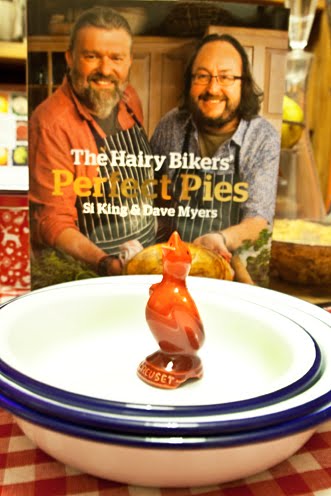
Just a couple of weeks ago, I spotted a new book by Si King and Dave Myers: The Hairy Bikers’ Perfect Pies: The ultimate pie bible from the kings of pies.

A flick through tempted me, but I left it on the shelf – and then, unable to put it out of my mind, ordered a copy less than two days later.

With the burgeoning sense of food nostalgia inspired initially by Nigel Slater, I had set my course for pie.

I also ordered a trio of old-fashioned pie dishes – three different sizes; all round and with wide rims; enamel with a blue stripe on the rim. And a pie bird – a nod to that nursery rhyme.

Like my Mason Cash mixing bowls, there is something hugely comforting in having such traditional equipment. And it's considerably cheaper than some other options.

For instance, in all honestly and without fear of overstating my culinary skills, I did not feel that I needed the Breville Antony Worrall Thompson VTP099 Gourmet Pie Maker (only £25.46 at Amazon, instead of the RRP of £47.99).

I don’t know what’s worse: that or Marco Pierre White trying to keep a straight face while telling us that Knorr stock (ingredients for the beef stock pots at £1.46 for four of 28g each: Water, Salt, Beef fat (5.0%), Yeast Extract, Vegetables in Varying Proportions (2,3%) (Carrot, Leek), Sugar, Flavourings (contains Milk and Mustard), Beef Extract (1.3%), Vegetable Fats and Oils, Thickeners (Xanthan Gum, Locust Bean Gum), Colour (Burnt Sugar Caramel), Herbs (Parsley, Lovage), Rosemary Extract, Apple Juice Concentrate, Carrot Juice Concentrate, Onion Juice Concentrate, Spices (Pepper, Paprika), Garlic) is every bit as good as the real stuff.

After the goodies arrived, I picked a midweek evening to make my pie debut. The plan was something involving chicken – based on the first recipe in the book, for a creamy chicken, ham and leek pie. Because it was midweek, I was preparing to cheat a tad, using ready-made pastry.

In the shop, I went to pick up a packet of Jus-Rol shortcrust (£2.80 for a kilo). Then I glanced at the ingredients: Wheat Flour, Vegetable Oil, Water, Salt, Lemon Juice, Preservative: Potassium Sorbate.

And I decided that I was damned if my first pie was going to be made with a pastry made with vegetable oil. And lemon juice.

Back in the kitchen, I rubbed together 350g plain flour and 100g each of butter and lard, before adding a large egg that had been whisked up with a tablespoon of chilled water.

It came together well, but fretting a little too much about not letting my warm paws heat it up to much, I probably didn’t press it together quite enough.

Defying convention, Myers and King suggest not putting the pastry into the fridge before rolling it – that makes it harder to roll – but doing that and lining the tin first. This works quite well.

In the meantime, I had skinned and boned four chicken thighs and added the meat to a pan in which I’d been gently cooking some sliced leeks in, in a little lard. Some chopped smoked streaky bacon joined it.

In another pan, I very gently heated some whole milk and a little stock for the sauce, with the chicken skin and bones in, along with the rind from the bacon.

In another pan, some butter was melted and some plain flour added and cooked through for a minute, before I started adding the milk/stock.

When that was a decent consistency – you need it quite thick – I popped the meat and leeks in, together with some chopped parsley and sage, then left it to cool down.

Pop the kettle on. Grab a biscuit. Put your feet up.

And then, after a while, you can decant the filling into the lined dish, roll out some more to make a lid, trim, crimp the edges and, if you want, decorate it.

I opted for a postmodern statement with the latter, cutting out the word ‘pie’ and sticking it on with the egg glaze. Just so nobody would be left in any doubt.

You need to have pre-heated the oven to 200˚C (180˚C fan). Myers and King recommend putting a baking tray in the oven to warm up thoroughly while it’s heating.

And then it’s the matter of a mere 35 minutes before you can remove it, slice it and eat.

I served this with mashed swede, since it needed something on the side, but I didn’t want to add more complex carbs, since there was already pastry involved.

The pastry didn’t look perfect and I hadn’t made it quite thick enough to withstand the serving process, but it was beautifully flakey. The filling was tasty enough to satisfy The Other Half, who tends to be underwhelmed by anything he considers ‘bland’.

One thing is certain. Pie is now firmly on the household agenda. And in keeping with my recent revelation that cooking something regularly helps you get to grips with the skills required, there’ll be another one very, very soon.

Thursday, 3 November 2011

Mary, the gift of lard and real roots food

I am one very lucky girl. One mention of my difficulties in procuring lard for my culinary shenanigans and a volunteer stepped forward.

Meet Mary, a hospital housekeeper from the Midlands, who brought me a second delivery of lard and dripping today.

Mary – you are an absolute diamond.

I think chips are on the cards – I haven’t made any since July – and this time I’m going to see what the results are like using dripping.

There is also the question of pies. Only yesterday, I noticed that the Hairy Bikers have a new book out all about pies, pies and nothing else but pies.

Since I seem to have dipped into a state of nosh nostalgia – thanks largely to Nigel Slater’s utterly delightful Eating for England – I have been drawn to pies.

Well, that and frequent trips to football matches where, after the hiccough of Manchester City’s legendary chicken balti pie, I have settled into a routine of eating a meat and potato pie at half time.

If I had an extra hand, I’d get a drink of Bovril too: the other day I caught a whiff of the stuff somewhere and I was instantly transported to a wintery, Pennine terrace where that beefy drink acted as half-time anti-freeze.

Slater talks of Marmite but not Bovril: for me, it's the the latter that has a Proustian quality – Proust, that is, given a football makeover.

Why on Earth would anyone consider memories of being so cold with such fondness? A certain innate masochism, perhaps? That might – until the last few years at any rate – explain my love affair with Manchester City.

But back to pies: with the nights crowding in, I want food likes pies. And I want to cook pies. Nothing fancy – but real big-flavoured comforting pies. With lard in the pastry.

It can’t be steak and kidney, since The Other Half doesn’t eat kidney, and even chicken and mushroom seems too fancy Dan for my present mood.

Meat and potato pie, then. It’s the season, I’m sure. I remember eating meat and potato pie, with black peas on the side, at bonfire nights near Mossley. Jacket potatoes too, baked in the fire. And parkin – real parkin.

Simple flavours. Food that was hot in the hands; warming against the cold and the night. The heat and the crackle of the fire; the pop and the fizz of fireworks blossoming in the velvet black above.

This drift into the joys of nostalgia and northern food took another, unexpected boost on Saturday. Shopping at Euston for fodder for the trek to Manchester, I was rendered nearly giddy with delight to find a pack of four small Eccles cakes. It was like coals to Newcastle: they’d been made just up the road from City’s stadium – just down the road from my old school.

I don’t recall having Eccles cakes in my childhood. This is a different nostalgia – something more collective and region based. This is roots food. This is food as something that is about who you are – who you think you are – who you want to be, where you come from.

And this, in so many ways, is what I think we have lost – to a degree at least. It's not that we shouldn't enjoy foods from other culinary cultures. I think, for instance, that Jamie Oliver makes an interesting point about this in his new book/series: that other foods have become our cuisine. Yes – to an extent.

The French have quite taken to couscous in recent years and it has become part of their national cuisine.

But I do think we'd done a bit of throwing the baby out with the bathwater in culinary terms. Don't mess around with a Yorkshire pudding, for instance – there's no need, because it's perfect to start with.

London isn't the only place in Britain – and as such, it isn't representative of the country as a whole – but it seems that the bulk of eateries in the places that I move on a daily basis don't serve any British food.

And there's nowt wrong with pie – any more than there's anything wrong with Yorkshire puddings or fish 'n' chips or many, many other dishes.

But let's not get too serious tonight. I need to try making some of those Eccles cakes too – and it occurs to me that lard might be helpful there as well.

Mary – thank you for the gift today (and for your previous delivery). I promise to use it well and appreciate it. And I promise too to write about at least some of what I cook with it.

Tuesday, 8 February 2011

Getting crabby about my cookery plans

Suddenly – and really rather strangely – I'm aware that while I’ve been thinking about food from my childhood, I have no memories of my mother cooking us fish. Yet I know that, in our time in Mossley at least, she visited the fish stall at the market, once a week or more, or sent my father there to get fish. But try as I might, I can recall none of her fish dishes.

I do remember – and with great love – fish ‘n’ chips from the chippy, which my father would occasionally go and buy and bring home for a Saturday lunch … with proper mushy peas, of course; there were also scraps (the left-over bits of batter) that you could buy for a penny or so a bag from chippies.

Later, I remember family trips to Blackpool and eating in restaurants where I’d almost always pick scampi.

Those things have stuck firmly in my memory – but not my mother’s fish dishes. And in being incapable of that memory, I’m also incapable of knowing exactly why that should be the case.

I do know that we never had any shellfish. Perhaps rather surprisingly under all the circumstances, I was quite prepared to try new things from early on in my adult life.

Well before the dawn of my ‘foodie period’, I’d eaten – and enjoyed – squid, mussels (before they seemed to have decided to disagree with me) and eel; foods that were really rather ‘exotic’.

At polytechnic in Leicester for a year, I discovered crab: you could buy it quite cheaply, ready cooked, from the market in the city centre.

I’d take it back to the halls and use a small hammer to break into the shell and liberate the meat. Then, as far as I can remember (because I long ago lost the un-illustrated Penguin cookery book that I got the recipe from), I’d warm it through with butter and some lemon juice and eat it on toast.

The book, incidentally, had been one of those great ideas of my mother’s: ‘I haven’t taught you anything much about cooking and I even stopped you doing cookery at school, so here’s a book of recipes now that you’ll have to cook for yourself’.

The hammer was my father’s idea of something practical that I should have. It’s still in the toolbox, if a tad bent.

Then today came reminders of crab: first Oliver Thring’s article in the Guardian and the associated piece about how to prepare and dress crab. Further recipes are apparently to follow.

Now my plans for the weekend have been blown right open: Never mind trashy retro food, crab has to be on the menu – particularly as The Other Half doesn’t really eat shellfish.

And to further complicate things, I then found this – which might be 'hard' by the standards of UKTVFood, but sounds relatively easy to me. And rather delicious. And if I'm going to buy a nice big crab, then it's going to do me more than one meal.

But there we are – at present!

And as if that were not making my foodie life complicated enough, my colleagues seem to have decided that I’m not doing enough to defend public services by making chocolate things to keep their spirits up!

Thank goodness there's marzipan in the house!

Sunday, 6 February 2011

Rhubarb, rhubarb, rhubarb

One of the joys of this time of year, when the nights might finally be lengthening out again, but the greyness of winter really starts to feel as though it’s dragging its heels, is the start of the rhubarb season.

It begins, of course, with the forced rhubarb: grown in dark sheds, where you can hear those tender, pink stems creaking in an effort to find the light.

In the UK, this also means rhubarb from the ‘Yorkshire Triangle’ around Wakefield, a name that suggests a certain sinister quality to a vegetable that has poisonous leaves, but whose stems can easily be put to all manner of culinary uses.

Actually, that’s one of the things that intrigues me: rhubarb is one of those foodstuffs that has been sectioned off neatly into puddings (well, crumble) and, err, that’s pretty much it.

For some years now, I’ve made Sarah Raven’s lovely rhubarb syllabub – but what else could you do with it? Is it limited to a few puddings or is it more versatile than that?

I love rhubarb. My mother used to make the obligatory crumbles – and she’d also stew batches to keep in the fridge and serve as a topping for cereal.

My sister was never as convinced. I liked the tartness: she’d sit and over-dramatically shiver if it wasn’t sweet enough for her taste. It was the same with gooseberries.

A few years ago, in possibly my first real moment of culinary creativity, I decided that chili would go wonderfully well with rhubarb. I’ve subsequently managed to rhubarb chili jelly – although far from brilliantly, since it gets all a bit complicated by the fact that chili apparently reduces the setting effectiveness of pectin. Experimentation has produced a decent taste – but not yet the right set.

A jelly will be a super condiment, like redcurrant or crabapple jellies, to serve with – well, to serve with pretty much the same things that you’d serve those with.

The fruitiness helps to cut through the richness of the meat: we use apple sauce that way with pork and mint sauce to balance the richness of lamb.

The French use raspberries with duck breast and even that cliché of a dish, duck à l’orange, is about using the citrus fruit to cut through the sweetness of the meat.

A book of Irish cooking on my shelf includes a recipe for herring with mackerel – but it uses the fruit as a stuffing and I’m hopeless at rolling up fish with a stuffing inside it.

The grain of an idea bnmkis present, though. I surfed a little, thinking of tuna. I’m afraid that I found this highly dubious image of someone’s idea, but while it didn’t inspire me, it didn’t completely put me off either.

On Friday, that grain developed into a full-blown experiment. After work, I bought salmon steaks. There were some rather tired stalks of rhubarb already at home.

Three stalks, cut into thumb-sized pieces, went into a pan with approximately a dessertspoon of caster sugar, a very little water, a few thin slices of a red chili and some redcurrants that were sitting in the fridge beginning to feel that they’d been forgotten.

Then it was left to simmer away – very, very gently.

Once it was cooked right down, it was mashed around a bit (primarily to better release the juice of the redcurrants) and then strained.

Adjust the sugar to taste. I also added a pinch of salt and a small glug of raspberry vinegar. Reduce a bit, then whisk in small pieces of beurre manié until you have something that’s the consistency of gravy.

Voila!

The technical idea was based on Rick Stein’s mushroom gravy for tuna, which I’ve been cooking for some years now, but this works very well with salmon. I’m sure it would work equally well with tuna, and probably duck.

But today, I made another small batch (no redcurrants or chili this time), to deploy somehow or other with the evening’s venison meatballs.

And then everything changed. Well, it’s the weekend, and things don’t always pan out the way you planned.

For various other reason, and after mulling over countless permutations of dishes with the aforementioned meatballs, I decided simply to concoct a pretty standard version. It was made up as I went along.

Meatballs: minced venison, complete with blood, into a bowl. A ‘cup’ of breadcrumbs – for some reason, this is the only US measurement I know that makes sense to me and which I use. Season. Mix by hand. Form into meatballs. Pop on plate, cover and chill. You really do not need to add an egg to meatballs – or burgers – to get them to hold.

When you’re ready, heat some butter in a big sauté pan. Brown the meatballs. Remove to a plate. If the butter’s remotely burnt, dump it, wipe the pan and add new butter.

Soften a diced onion and a diced carrot. Be patient – there are plenty of nice smells, so inhale and enjoy.

In the meantime, take a heaped dessertspoon of plain flour and whisk a little booze into it – just enough to make a smooth paste. Sherry would probably be an idea, but I only had Noilly Prat, so that had to do. Add a good, big squeeze of tomato purée. Whisk again.

Put the kettle on – yes, you can have a cuppa if you want, but that’s not what I was thinking about!

Pop some liquid beef stock concentrate into the flour-booze mix. Whisk again.

The onions and carrot should be soft by now. Pour a glug of your chosen/what’s-in-the-cupboard booze into the pan. Relish the smell while you deglaze: this is not some sort of sacrifice.

When some of the alcohol has boiled away (taste and decide whether that’s enough alcohol that’s evaporated or not!) and you’ve deglazed, add the flour mix and stir until it’s thick but even. Add the rhubarb mix and then as much boiling water as you need to reach a consistency you like.

Remember: you need little booze because the rhubarb mix is going to give you a big acidic fillip.

Pop the meatballs and any juices back into the pan. Add some peeled small potatoes. Taste – and adjust the seasoning if you think it needs it.

Put a lid on the pan, turn down the heat and leave for half an hour. The biggest question after this is how the potato is doing – potato always cooks more slowly in stock or sauce (George gave me that incredibly valuable piece of information some years ago – I’ve yet to see a book that mentions it).

So check your potatoes with a sharp knife. Taste again. And then decide whether it needs further cooking.

It is not, as they say, rocket science. The rhubarb might seem an odd idea, but it’s really no more ‘peculiar’ than those other fruit-meat/fish combos I mentioned earlier.

And it actually worked. It wasn’t remotely obviously that there was rhubarb in the dish, but there was pleasing tartness in the background – and indeed, that’s pretty much what wine would have added. Although I think the fruitiness just made it through, very subtly.

Why did it take me so long to understand this?

It occurs to me that perhaps some of us do need to go down an almost Heston route because we do not possess a history of knowing techniques. Perhaps, when we hit a certain age and if we haven’t learnt such things from standing next to our mother, watching, then even a small version of the Heston-like science becomes a vital way of learning?

But then again, that’s perhaps destroyed as an argument by my having picked some of these techniques up ¬– very recently – from one Raymond Blanc: hardly your backwoods Englishman!

But let’s get back to rhubarb, It's difficult to know why it became the word that actors supposedly use to each other when trying to look as though they were deep in conversation in the background of a shot or on stage.

Because whatever else you can say about rhubarb, it ain't bland.

And honestly, you really don't have to have it with custard.