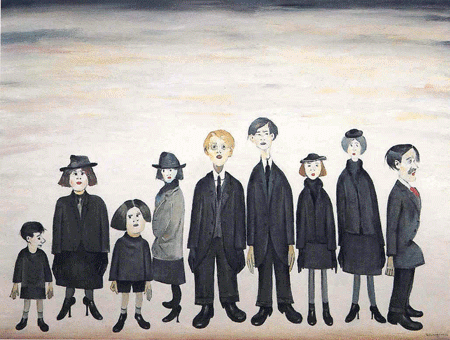
Showing posts with label LS Lowry. Show all posts

Sunday, 20 July 2014

Paris to Bow: an encounter with the East London Group


Bow Bridge, Walter Steggles
Paris might now be consigned to the past, but the return to England’s own bustling metropolis didn’t mean an end to viewing art.

With only a few days left before it closed, I finally made it down to the East End for an exhibition of work by the East London Group.

The Nunnery is so much in the East End that, never mind being within the sound of Bow bells, it’s almost directly opposite Bow Church itself.

This is, indeed, the very heart of Cockneydom.

Bryant & Mays, Oscroft
It’s odd how different it feels to Hackney – given that it’s not really very far away, but the same is true of many parts of London: it’s far from being a single, homogenised entity.

The Nunnery Gallery itself is situation in a former Carmelite nunnery that dates from 1850 and is now part of the Bow Arts Trust.

There’s an element of stepping back in time about the area – and this was an exhibition that emphasised that.

The East London Group was the brainchild of Yorkshire artist John Cooper, who taught at the Bow and Bromley Evening Institute from the mid-1920s.

Hackney Empire, Turpin
It was made up of two core groups – aspiring East Enders, plus some who, like Cooper himself, had trained at the Slade.

According to art historian David Buckman, Albert Turpin, for instance, was a “professional window cleaner, Anti-Fascist protestor and Labour mayor of Bethnal Green”.

Walter Sickert was involved, addressing classes and even showing with the group for a while.

There was a great deal of acclaim for the artists at the time, with a final group exhibition taking place in West End gallery the Lefevre in 1936, although works were also displayed collectively and individually elsewhere, including at the National Gallery and at Tate Britain.

Old Ford Road, Harold Steggles
But all this has been forgotten in the decades since WWII, although the work of dedicated people, including family members and Buckman, has been starting to turn that around.

One of the particular pleasures to be gained from exploring the work of the East London Group is the chance to look back in time to a very different London – although, as touched on above, they painted pictures of buildings and places that are still recognisable today.

The exhibits included a work by Harold Steggles, for instance, showing Grove Hall Park, which is still there – right behind the Nunnery.

Farringdon Road, Osbourne
There’s the instantly-recognisable Hackney Empire by Turpin, and his Salmon and Ball, which is an equally-recognisable corner of Bethnal Green.

Indeed, these two stood out in the exhibition as being rare examples of heavily-peopled works.

In most other cases, the streets are devoid of either traffic or people, which lends a haunting quality to the paintings.

The Arches, Mare Street, Turpin
There are occasional figures – walking away from the artist, with their back to us, or simply too distant to tell us anything.

But that only seems to add to the feeling, whether intended at the time or not, of the isolating nature of the city.

Grace Oscroft’s Bryant & Mays is a case in point: the bright palette used – seen among many of the artists – seems only to emphasise the lack of people and suggest a philosophically mixed view of the world they lived in: on the one hand, with industry offering a bright future, but on the other, it replacing humanity.

It’s inevitable that seeing many of these works, set as they are in working-class areas, one is reminded of Lowry, but that absence of people and that brightness of colour are two of the most obvious differences.

The Great Ventriloquist, Cooper
Sickert in particular urged the group to realism, but Walter Steggles’s Bow Bridge uses blues that almost take it into the realms of Impressionism.

A note helpfully points out that this is where the Bow flyover now starts. Imagining Bow Road with no traffic today is not easy.

This shouldn’t be read as suggesting a uniformity of approach, though.

Cecil Osbourne’s Farringdon Road (1929) – or the rooftops above it – goes down a very different route, with muted, dark tones that give it a very broody atmosphere.

But Harold Steggles’s Old Ford Road (c1932) is another bright but almost deserted world.

Perhaps surprise at this is because we mentally tend to view their world as a smog-filled monochrome. ‘But’, they seem to be saying to us, ‘there was plenty of colour. It wasn’t just unrelentingly grim’.

Kitchen Bedroom, Turpin
Cooper’s own The Great Ventriloquist – like many of the works, undated, but we known it was shown at the Lefevre in 1930 – shows clearly enough that the group were neither averse to painting people nor incapable of it, with Turpin’s Kitchen Bedroom (c1930) is another example of this.

Indeed, it’s possible to see in these two a passing of the baton: the realism of Cooper’s painting is tempered by a certain sentimentality in the image.

With Turpin’s domestic, working-class interior, there is none.

Harry Tate: The Freeman of Bethnal Green, Turpin
The teacher was being surpassed.

But it’s those deserted yet colourful scenes, such as Water Steggles’s tiny – just 15x20cm – Canvey Island (c1933), that stick in the mind.

And The Arches, Mare Street is another Turpin piece that, while colourful, has a deserted, mysterious air.

More than one of the artists were commissioned to provide artwork for the sort of travel posters that are now iconic, and the presence of two of these in the adjoining cafĂ© was a reminder of how that lack of people was not limited to the group’s activity: you recognise it in those suggestions for motoring out to see some old church.

No people: just the bricks and mortar. 

Canvey Island, Walter Steggles
The group painted parts of London other than the East End, and they painted parts of England other than London and parts of the world other than England.

They didn’t limit themselves to the urban, while there are still lives, interiors and portraits too – Turpin’s Harry Tate: The Freeman of Bethnal Green is a fascinating example – but it’s those deserted landscapes that stay with you.

It was a case of better late than never getting to this exhibition, but it was not something that was held in isolation, but as part of an ongoing campaign to revive knowledge of an interest in these artists. 

Travel poster, Walter Steggles
In that, it has already had success, with good crowds and a decent level of media coverage.

And if you want to know more, search out Buckman’s excellent 2012 book, From Bow to Biennale: Artists of the East London Group.

Online, there’s much more about Walter Steggles at www.wjsteggles.com, and about the group as a whole at www.eastlondongroup.com, while you can keep tabs with what’s going on – and see plenty of pictures – on Twitter @EastLondonGroup.


Friday, 14 February 2014

Laughing all the way to the bank

Valium, by Damien Hirst

People seem to have been getting into a grand old funk over Damien Hirst’s claim that he copies his children’s paintings and drawings.

Well, this was certainly the case at the Observer and at the Telegraph, in response to Hirst’s claim in an interview with the former.

At the Obs, the whinging was mostly about his being ‘a corporate whore’, while over at the Telegraph, comments concentrated on most of his own art resembling the contents of used nappies.

Don’t you just lurve reasoned debate?

As Will Gompertz explained at some length in What Are You Looking At? that no, your five-year-old could not have produced even the works of modern art that you find utterly incomprehensible.

You might think that a Mondrian, for instance, is simple or that Pollock simply dripped, but actually executing such a piece is a damned sight harder than many imagine.

Now to be quite clear, I’m not personally a fan of Hirst’s work, but he’s clever – not least in being able to exploit the market for whatever is deemed to be ‘hip’ and ‘trendy’ art among those who have more money than sense.

It was all encouraged in the halcyon days of the 1980s by the dear old Saatchis, who set out to prescribe what was cool – and, most importantly, to profit from it.

These are the same Saatchis who now routinely use Facebook to tell people that they can suggest new artists whose work would be worth investing in.

Buy them and the price will go up, of course, as they then become collectible. And the Saatchis will themselves make plenty of money from you taking their advice.

Oddly, none of the painters currently being touted by them seem to have chosen to represent a man appearing to throttle his wife.

But there’s an element of the emperor’s new clothes in all this: I’ve little doubt that, as he’s laughing all the way to the bank, Hirst is also laughing at those who pay millions for a piece that someone in his studio has produced to his instructions – based on something his children did, if we’re to believe his somewhat faux humility.

Indeed, never mind that fairytale – there’s always the classic modern art story of Marcel Duchamp and his urinal, a piece of ‘made’ art that was used entirely to extract the piss out of a group of self-appointed arbiters of what was and was not art – and in the process, itself became iconic and labelled ‘art’.

This is not a real Lowry
In the past, it would be the patron – often the church – who, in effect, made such decisions, but that has broadened out over the years, helped by, among other things, public galleries and exhibitions and also increasing numbers of people with disposable incomes and a desire to decorate their homes.

Mind, the likes of Hirst are not the only ones taking the proverbial out of people.

In a prime example of fools and cash being easily parted, the Facebook page for LS Lowry warned against a spate of fakes that are being sold on eBay.

They highlighted one in particular, which was secured with a bid of £670. Let’s allow for someone being a bit taken in by the background, but the figure? And just look at that face!

Beyond that, look at the signature – and it’s easy enough to Google the authentic signature. That’s not close.

Away from cyberspace, the Telegraph reported on 82-year-old Bill Harbord, a London man who has been selling fakes for years – although at rather lower prices.

It’s difficult to feel particularly sorry for anyone all those who have bought a picture from Mr Harbord. Honestly – be sensible: it’s really not very unlikely that you'll find a genuine Raoul Dufy painting for £250.

Actually, it’s tempting to laugh in much the same way you’ll possibly laugh at those who spend hundreds of thousands on a Damien Hirst because they’ve been told it’s good.

If you’re going to buy art by a well-known figure, make sure you know who you’re buying it from – a gallery will be a safer bet, for instance – and accustom yourself with the artist in question’s work, signature, any numbering system etc.

It’s not difficult – and it’s not rocket science.

If you do want to feel for someone, though, spare a thought for Martin Lang, who spent £100,000 on what he thought was an original Chagall.

Searching for authentification, it was sent to the Chagall Committee in Paris, which decided it was a fake and that it should thus be destroyed under French law.

Mr Lang wants it back – he’s still waiting to see if they’ll mark at as a forgery and send it back to him.


Sunday, 7 July 2013

Lowry – a painter for the world


Industrial Landscape, 1955
Laurence Stephen Lowry. Artist and rent collector. Born 1887. Died 1976. That’s the barest pencil outline of facts. But here is another: since his death, there has been not a single exhibition of his work in London.

As the very landscape of the north of England that he painted has been deleted from view, sanitised and landscaped and replaced, there has been a concomitant refusal from ‘The Establishment’ to consider his work seriously, as anything beyond the daubings of a naĂŻve and parochial painter who pictured something that it had no desire to see.

Such a statement is not Northern ‘chippiness’: my edition of the Oxford Companion to Art, first published in 1969 (my edition, 1988), edited by Harold Osborne (formerly of the Foreign Office and the Board of Trade) cannot bring itself, in more than 1,200 pages – including a specific essay on English art right into the 20th century – to once mention Lowry.

Elizabeth I, attributed to Nicholas Hilliard
Yet now, in the Tate Britain’s new exhibition, he is not simply restored to a position of importance within British art as a whole, but is finally acknowledged as an artist of global importance.

Uniquely, I had got hold of the catalogue early last week with the aim of reading up before actually visiting the exhibition.

So to begin with, a brief summary of some of the points made by the curators, TJ Clark and Anne M Wagner.

First, Lowry’s work was not provincial. As Clark explains in an essay, his industrial landscapes have a universality that extends far beyond the north of England. As countries such as China undergo their own industrial revolution, they will also be experiencing what Lowry sought to capture.

Clark posits the case that, if you want English parochial, then the modern London art scene is far nearer to that.

The catalogue makes quite clear, using Lowry’s own words, that he looked around him and saw that nobody else “had done it” – painted the industrial – and that he set out with a quite specific aim of ‘doing it’ himself. For that, as I mentioned in a 2010 article on this blog, he had to create his own visual language.

Lady with a Squirrel & Starling
As I also mentioned then, there is no sentiment in Lowry. Clark very nicely makes the point that what he managed was to combine, in effect, Engels and George Formby Snr: politics and the music hall. There is empathy here and there is humour, but all with a dispassionate perspective.

Clark also explores just why Lowry was so familiar with his landscape: while few others could have strolled around those areas in comfort (Baudelaire’s flâneur), the very nature of his work as a rent collector meant that he both could and did.

It allowed him to observe up close, but also with just the right amount of distance.

The exhibition also includes works by artists such as Utrillo, Pissarro, Seurat and Van Gogh – and, of course, Valette – dotted around, which help to give a very valuable context to Lowry’s work, and help you realise its connections with and links to wider art.

Actually, we had gained a further context from a wander around the general galleries before our time to enter the main exhibition came up.

Liverpool Quay at Midnight
And it seems fair to say that a great deal of British art has been really rather poor.

A portrait of Elizabeth I, attributed to Nicholas Hilliard (c1575), is a perfect example, with its impossible anatomy – just look at that left shoulder/arm. And in the same room, Hans Holbein’s exquisite Lady with a Squirrel and Starling (1527) shows just what could be done in northern Europe half a century earlier.

Elsewhere, there’s the gloomy palette of Gainsborough. Stubbs – yes, brilliant with horses but not so good with lions. Reynolds – almost grotesque tweeness and sentiment.

Two pieces by Joseph Wright of Derby stand out, as does the wonderful Liverpool Quay at Midnight (1887) by the fabulously-named Atkinson Grimshaw.

There are two Whistlers – excellent. And then some Pre-Raphelites, which, as I’ve said before, are excellently executed, but dreadfully mawkish and sentimental, and with a highly dubious attitude toward the representation of women.

And so to Lowry.

Beyond those connections to a wider art world, things that strike you when seeing such a body of work include his use of the vertical and horizontal in composing his pictures. And no matter how random Lowry’s crowds might, on the surface seem, their positioning is far from accidental and also helps draw the eye in the way the artist wanted.

This is never more the case than in the five vast industrial landscapes in the final room – never before seen together – which you can quite easily get lost in.

Going to the Match, 1924
And he does not go for the obvious compositionally: in Going to the Match from 1924, which shows crowds arriving for. Game at Bolton Wanderers’ old ground, Burnden Park, he chooses only to let the stadium be partially seen, ensuring that its context in an industrial landscape remains.

In Saturday Afternoon, from 1941, he does something similar. A football match is taking place, but it occupies a small space on the left of the canvas. The mill dominates, full centre.

In A Cricket Match of 1952, the game itself is loured over by a vast, dark mill. You may get some respite from industrial toil, but it’s never far away, seems to be the message.

But while it may have been grim up north, the people don’t simply give into the gloom and their situation. Pubs and betting are seen on Lowry’s canvases, along with religious and political meetings, processions and protests, funerals and fights – lives lived in great part on the glare of the street, since privacy was so limited.

Then there is the palette. Grey-white skies and a black that, on occasion, is every bit as rich and deep as that of Manet, the father of ‘modern’ art – the exhibition is called Lowry and the Painting of Modern Life quite deliberately.

Then muted blues and yellows that are occasionally allowed more vibrancy – VE Day is a case in point.

The Lake, 1937
But alongside the black and the grey-white, the dominant colour throughout is red: not just for the red bricks, but for a tie or a hat here and there, or piece of fencing, sometimes in isolation in a scene of dereliction, like a narrow gravestone askance.

Indeed, in The Lake (1937) and Gate Posts (1938) these occur in landscapes of ruin and pollution – scenes that suggest disaster. Lowry, the early environmentalist?

This is the other consequence of industrialisation – the one beyond Empire; the one that The Establishment does not want to have brought to mind.

It was also brought to mind, though, this despoiling of England, by Danny Boyle – a Lancastrian himself – in his 2012 Olympic opening ceremony.

St Augustine's Church, Pendlebury, 1924
Yet the palette can change too, when the subject demands. The pastel, The Lodging House (1921) has a depth of blueness that seems to very obviously invoke Valette, his one-time teacher.

And in the two seaside scenes exhibited, the colours different again – in Beach Scene, Lytham (1963), they fade to gentle pastels on the sails on the yachts at sea.

Yet again, the Welsh landscapes allow for more green, although it's hardly a vibrant one: here too, industry had taken its toll on the countryside.

The artist's observation is extraordinary, yet also almost ridiculously easy to miss.

View from the Window ...
In Coming from the Mill (1930), for example, in the right foreground, the horse that's having to be reined back as it tries to bolt with the cart behind it. A little detail, yet half hidden behind a low wall.

In other words, these works require more than a passing glance – and reward patience.

View from the Window of the Royal Technical College, a pencil on paper from 1924, reveals not only great skill, but also creative composition, as Lowry extended the vast chimney off the paper, as though it was endless.

From the same year, St Augustine's Church, Pendlebury has enormous depth: it seems to suggest religion louring over all, almost as much as the workplace, an idea that comes again with A Street Scene (St Simon’s Church) from 1928, which is almost monochrome, but for a few hints of red on clothing.

Junction Street, Stony Brow, Ancoats, Manchester, 1929
Junction Street, Stony Brow, Ancoats, Manchester, another pencil on paper from 1929, has not. Single figure in it, but the way it draws the eye is magnificent.

The line drawings reveal very clearly that Lowry was a superb draughtsman. He didn't paint “matchstalk men and matchstalk cats and dogs” because that was all that he could paint (and Brian & Michael should never be forgiven for such sentimental drivel, which Lowry himself would have hated), but as a deliberate part of the language he created.

His figures so often become ants in a vast, dour world, hurrying on with bent backs and heads down; their individuality lost in the brutalising nature of the industrial setting.

Self Portrait, 1966
And yet there is beauty here too; or if not beauty, then a certain majesty. For anyone who has lived in areas where the architecture of industry is still present, if reduced, Lowry’s paintings have an emotional resonance.

But perhaps we – and I use the word deliberately – can now let Lowry go, at least a little. He no longer needs quite the championing. He belongs to the world now – not just the industrialised north.

It would be difficult for the Osbornes of this world to leave him out of any future encyclopaedic work on art, even if they have been able to largely silence and delete from reality the brick and mortar of the landscape that he painted, for which they no longer have a use.

Lowry himself was a man of contradictions. Who isn’t? A Conservative, yet one who set out to portray the working class, he approved of the NHS: compare pre- and post-NHS paintings; A Northern Hospital from 1929 with the calm and noticeably brighter palate of Ancoats Hospital Outpatients Hall from 1952.

He also rejected a knighthood on the grounds that: “all my life I have felt most strongly against social distinction of any kind”: in fact, he holds the record for rejecting more honours than anyone else – five. Perhaps The Establishment’s issue has been, in part, resentment that he never wanted to become part of it?

Industrial Scene with a Monument, 1972
I do wonder whether the curators have missed one slight trick, though.

As mentioned in that previous post on Lowry, some of his non-industrial scenes convey a loneliness and an isolation that could also be seen as a symptom of ‘modern’ life.

Only in one of the final canvases of this exhibition, Industrial Scene with Monument from 1972, is it hinted at.

The monument recalls the Self Portrait from 1966, which had a similar ‘monument’ sticking up, in utter isolation, from the sea.

Here, in the last years of his life, Lowry seems to have added himself to his landscape; observing all from a position of isolation.

And here, in an exhibition for which Clark and Wagner, together with Helen Little from the Tate itself, should be massively applauded, Lowry has been able to take centre stage, finally, as one of the most important British artists of the 20th century.

Wednesday, 15 June 2011

Welcome to Manchester

Since quite a high percentage of the readers of this blog will be decamping to Manchester this coming week for work purposes, it seemed the ideal opportunity to offer up an entirely personal guide to that city.

Anyone coming will, when they get their conference guide, have details of more political outings and events in the city this coming week – so they're not getting repeated here.

First, let's clarify that Coronation Street is a fantasy. And you don’t have to go around saying ‘Ee by gum’ all the time – but if people – male or female – do call you 'love', don't worry: it's a regional term of endearment and not some sort of insult.

What must be stressed – and this is essential for first-time visitors – is that football is pretty much a religion in the city.

And there is only one football team that comes from Manchester: despite misleading names, the 'other' one comes from the Borough of Trafford in the city of Salford.

Now it's only a short time since the end of the season, so don’t be surprised if you find a few conference goers and staff getting together to party, in celebration of City’s FA Cup win. Indeed, after a bit of a drought on the football success front, please excuse us if we're still a bit giddy.

There are two sensible reasons to visit Salford: one is to go to the real Old Trafford, which is the home of Lancashire County Cricket Club, and the other is to visit the Lowry Centre, where you can enjoy its wonderful collection of works by LS Lowry.

If you get the chance, I heartily recommend the latter.

In terms of the former, it’ll probably be raining, so you won’t have the chance. There exists a general view that the reason that Lancs haven’t won cricket’s County Championship for many, many years is because of the rain levels in Salford. Which is also why a certain football ground in the vicinity is sometimes referred to as ‘The Swamp’.

In fact, the region doesn’t actually have the kind of high rainfall that it is notorious for. It has less precipitation, indeed, than Porto in Portugal (1,253.5mm per annum as opposed to Manchester’s 806.6mm), but of course you never hear things like that.

The rainfall was also one of the reasons for the thriving cotton industry, which was the source of the area's industrial wealth. And in spite of the regeneration – some of which is brilliant and some of which is less so – you can still find the architectural signs of that industrial heritage.

Stadium tours at the City of Manchester Stadium will be restarting this weekend after the Take That concerts. More details here.

If you have any spare time, then the Manchester Gallery is just a short stroll from the conference centre on Mosley Street. Entry is free and the works by Adolphe Valette, a French Impressionist who painted Manchester – and also tutored Lowry – are well worth a look, even if the Pre-Raphelites are worth dodging by anyone who dislikes the idea of utterly passive (and even dead) women being some artists' idea of beauty.

The wonderful Central Library is unfortunately closed for refurbishment until 2013. But behind it is Albert Square and Manchester’s town hall – a Victorian mock Gothic affair.

But don't let the picture of Mr Gladstone deceive you – it's not all 'grim up North'!

Manchester is also a party town that has a big reputation for producing bands. These have included the likes of the Fall, the Smiths, the Stone Roses, Joy Division, the Buzzcocks, the Verve, The Chemical Brothers, Oasis and Take That.

Brian and Michael do not count.

If, after a few days, you find yourself automatically adopting a Gallagher brothers swagger, do not worry. There is nothing wrong with this. Although it’s not recommended in high heels.

If you want big time party/clubbing information, then I’m afraid I'm not your woman. You’d be better to rely on the After Dark guide.

Although I will point out that Canal Street – the heart of the city's gay village – can be great fun. Churchills is gloriously loud and brash, pumping out retro disco sounds and staging such quality events as drag karaoke.

Just off Canal Street itself, on Richmond Street, Vanilla is run by the delightful Mary.

There’s music of course, but also absinthe – which may be welcome by the end of a week of political debate and grandstanding.

And I’m delighted to report that, even though the pool table is dinky, this is not a lesbian bar that believes in ‘non-competitive pool’. I was irrevocably scarred by finding such a thing in Amsterdam. How do you try to not pot the bleedin’ balls?

Just off Canal Street is Sackville Gardens, where there's the memorial to Alan Turing, the brilliant mathematician who, after contributing massively to the WWII effort, with his work on the Enigma code, was hounded to his death for his sexuality.

There are no shortage of shopping opportunities in Manchester, from the Arndale Centre – resurrected as a modern cathedral to consumerism after the IRA bombed the previous incarnation – to the likes of Harvey Nicks (they do a nice ploughman's, I'll say that).

Manchester has plenty of cinemas and theatres, with a varied fare.

The Royal Exchange is a great spot, not just for good theatre, but also because it’s an architecturally stunning old building, with a theatre in the round built inside. Currently on is Arthur Miller’s wonderful A View from the Bridge.

And now – because it would hardly be The Voluptuous Manifesto if we didn’t do this – there’s the small matter of food.

Tragically, the fish ‘n’ chippy that used to stand next to the bus station at Piccadilly is no more. And I don’t know of a good chippy in the central area. Which just seems so wrong to me.

But here are the few recommendations that I can make:

The Pizza Express in Piccadilly Gardens is a good one. I have a certain fondness for the ‘American Hot’, with pepperoni and jalapeno peppers, and a much-needed Peroni on the side.

China Buffet on Nicholas Street in Chinatown is a bargain, offering a cracking selection of dishes with an eat-as-much-as-you-can approach.

From Monday to Thursday, it’s £5.50 from 12am-5pm £5.50 and £8.95 from 5pm-11pm.

On Friday and Saturday, it’s £6.95 from 12am-5pm and £8.95 from 5pm-11pm. Sunday is £7.95 from 12am-11pm.

Booking isn't needed.

At the other end of the eating spectrum is Michael Caines @ Abode, which is just a few metres stroll down from Piccadilly Station.

It ain’t cheap, but it’s excellent and inventive food, as you’d expect of something linked to a Michelin-starred chef who’s worked with Raymond Blanc. The grazing menu is super.

Booking is pretty much essential. The number is 0161 247 7744.

Just as cheap doesn’t always mean poor, so expensive doesn’t always recommend something.

Personally, I’m not intending to eat at the Midland Hotel’s main restaurant, The French. It may have two rosettes, but the menu looks clichĂ©d, while the prices – judging on the basis of a Chateaubriand for two being a whopping £69.95 – are OTT, in my opinion. I’ve paid considerably less than £35 for excellent Chateaubriand in Paris (and sitting in the shadow of Napoleon's tomb), so I hope you’ll understand my scepticism.

On the other hand, the hotel’s Wyvern restaurant and bar, which is much more of a brasserie style, looks like it has a decent, modern menu and is far better priced. I'm likely to give it a whirl myself this trip.

For more details on both restaurants at the hotel, click here.

Now I haven't been yet, but the Manchester link in the Gaucho Argentinian steakhouse chain has been recommended. It’s apparently an excellent place to go with a few friends.

The staff are really knowledgeable about the meat and the restaurant does a special platter where a group can have a selection of different cuts cooked in the way that’s appropriate to the cut. Now that sounds like the very best sort of education.

It’s at 2a St Mary Street. Telephone 0161 833 4333 and booking is recommended.

Welcome to our city. Have a great conference and safe journeys to and from Manchester.