Showing posts with label Manchester. Show all posts

Wednesday, 5 March 2014

Never felt more like singin' the Blues


Vincent and the boys enjoy the win
Three days down the line and I’m still singin’ the Blues – the Blues in question being Manchester City, who triumphed in the League Cup final (or the Capital One Cup Final if you insist on the sponsored version) at Wembley on Sunday afternoon.

Yes, I know that it was ‘only’ Sunderland (which is massively unfair on them), but it was a match taken seriously by both teams and by both sets of fans and which, for those reasons alone, brought prestige back to a competition that, in recent years, has suffered because some clubs have treated it as a sideshow to the main events of the title and the FA Cup.

We last won it in 1976 – 2-1 against another North East team, Newcastle, with goals from Peter Barnes and a memorable overhead kick from Denis Tueart: I still have the press cuttings in a scrapbook.

That was a victory that marked the end of the good times, though, followed as it was by a silverware drought that lasted until the FA Cup final of 2011.

With last season’s FA Cup final defeat by Wigan all too fresh in the memory, the Black Cats’ goal on 10 minutes did nothing to soothe nerves.

It’s a good thing that I have short hair because otherwise I’d have been tearing it out for an hour.

‘No, no, no – not again! Please no!’

I arrived in good time and took my time wandering up Wembley Way, sampling the atmosphere. No silly jester hat this time – it was probably why we lost in May.

Superstition plays a role on such days: coffee in my ‘City ’til I die’ match day mug first thing in the morning is an established ritual.

Up in the gods to watch the gods
This time, with yet more rain promised and greyness already evident, I attired myself in navy cords, a hooded sweatshirt and a home shirt (Zabaleta on the back). This is not a particularly fetching look for anyone of my shape, but since I was determined to wear colours and since I’d already tried the shirt underneath a hooded sweatshirt look for the Barcelona game (which we lost) I wasn’t repeating that mistake.

Then for the City dog tags, the earring and the two rings – one of which, a 1970s enamel crest on a stainless steel band – was given to me as a Christmas present by friends at Fairfield High School for Girls, which just happens to be up the road from where the current stadium is.

That one has enormous sentimental value – I refused an offer of a tenner for it some years ago, when a tenner would have been very welcome – and only comes out for the really, really big games.

A baseball cap (Champions’ League) topped off the ensemble – as I said, no wearing that blue and white jester hat again – together with a Capital One Cup Final scarf that I’d picked up at the Etihad a couple of weeks ago, since it was cheaper than anything that the stalls on Wembley Way could offer.

The atmosphere was brilliant – none of the pessimism and doubt that City fans were feeling last May even before we made it into the stadium.

The only real question on people’s lips was whether Manuel Pellegrini was right to opt for Costel Pantilimon in goal rather than Joe Hart – a slightly odd thing to be asking when Roberto Mancini’s dropping of Pants on the morning of the Cup Final (and then sending one of the junior coaching staff to tell him) had almost certainly been one factor in what happened that day.

If you’re going to operate a squad – and with so many matches in so many competitions in a single season, you have to – then you don’t drop players when they’ve got you to a final.

Anyway, once inside the stadium, a pint of Tetleys was slowly imbibed while gazing outside.

At one point, a Virgin Pendolino sped past in the near distance, on its way north. It reminded me of all those trips I’d made in that direction, glancing to the right as we passed Wembley and uttering a silent prayer that I’d eventually get a chance to see City play there in a final for a proper trophy.

Mike Doyle with the League Cup in 1976
And here I was, on a third visit to the stadium in four years – the second for an actual final.

But however much this is a new incarnation of the Blues, the history remains.

In the fourth minute, in honour of former skipper Mike Doyle, who lifted that last League Cup in ’76, fans stood to applaud the man who died in 2011.

And nicely done by Wembley for putting up a picture of him on the big screens too.

Then, at the end, as I was leaving, people were taking it in turns to ring a very special bell outside.

Helen ‘The Bell’ Turner was a lifelong City fan who sold flowers outside Manchester Royal Infirmary, raised loads of money for charity, and carried a school bell with her to all games, where she rang it with a vengeance.

She stood behind the goal and would chat with ’keeper Joe Corrigan, giving him a sprig of heather before each match.

She was so much a part of the club that she ‘rang out’ the final game at Maine Road and, when she died in 2005, there was a minute’s silence for her.

And back on that League Cup Final day in 1976, memorable pictures attest to her joining the team on their lap of honour with the trophy.

Mike and Helen – just two indicators of how City has ‘no history’, according to some who resent our recent change in fortunes.

Anyway, back to the present – or the rather more recent past, as it is now.

Sunderland’s goal – well taken by Fabio Borini – came six minutes after that tribute, and I spent the following 60 minutes in hair-tearing mode, screaming at the team (and occasionally the ref) and frequently with palms pressed to brow in anguish.

Asa Hartford and Helen the Bell with the trophy in '76
Logic stated that, unlike last season’s FA Cup Final, the opposition had scored early and time was on our side, but logic and emotion are not necessarily the best of bedfellows.

Everything changed, though, inside two second-half minutes.

The Engineer claims not to have said much more at half time than ‘stay calm and patient’, but his charges came out a different team.

And 10 minutes into the second stanza, up stepped Yaya Touré to curl home a miracle shot (at my end of the pitch) from all of 30 yards out.

Then, just a minute later, Samir Nasri gave us the lead with another spectacular strike.

Not, of course, that it was ever going to be comfortable.

Moments of looking fragile at the back were only finally put to bed when Jesús Navas made it 3-1 on 90 minutes.

What a friend we have in Jesús.

Especially on a Sunday.

Now the celebrations could really begin.

Oh, the joy of seeing Vincent Kompany lift a pot at Wembley!

Most of the Sunderland fans stayed for the presentation and afterwards, as we were all slowly trooping out of the stadium, we applauded them and they applauded us.

They’re fantastic fans and helped create a really marvellous atmosphere: a credit to their club and their city.

Not that you’d have got that impression the night before from Tory MP Robert Halfon, who tweeted in disgust that they’d ‘taken over’ Covent Garden and turned it into a “cesspit”.

How dare those dreadful northern oiks come down to the Big Smoke to wreck your night out, eh Bobby?

The public-school educated politician has since apologised for calling Sunderland fans “scumbags”. He, however, remains a plonker.

I joined friends for a spot of post-match partying – although, in ridiculously middle-aged style, I was still home by 9.30pm.

It had been another day of sharp emotions: of dramatic highs and crazy lows.

But goodness: after all the years where what we mostly worried about was whether we could avoid relegation – and goodness, I shed a tear or two in those times – and where, more than once, we rescued defeat from the jaws of victory, how wonderful to be there, at Wembley, to see the Blues lift a serious trophy once again.

And on Wednesday night, I’m pleased to report that my voice has recovered.

Well ... almost.


Tuesday, 9 October 2012

Just to live up to my name!

A touch Bill Sykes, perhaps? Well, The Other Half did think it "spooky and Dickensian", and it isn't Nancy, that's for certain.

The new avatar was one of a series of projects undertaken on a remarkably busy day off.

There was shopping and washing first – both of which had been missed at the weekend because of a hop to Salford for a meeting, followed by attendance at Old Trafford to watch the Rugby League Super League Grand Final in the flesh for the first time.

Which was enjoyable enough in its own right: for those of you who don't know, Leeds Rhinos beat Warrington Wolves to retain the title.

It was an uncompromising affair – for goodness sake, Warrington's Paul Wood had a testicle ruptured by someone's knee early in the second half, but played on until the 57th minute. It was removed in hospital later that night.

Leeds deserved their victory: they had far more invention and variety, and the Wolves' ill discipline cost them dear, as well as their over-reliance on what legendary commentator Eddie Waring would have described as the "up and under".

I do want to add a comment on Hayley Westenra, the singer hired to lead the crowd in the pre-match singing of Jerusalem (well, there are still a few of those "dark, Satanic mills" nearby). But while she sounds much better on YouTube, her performance at The Swamp left me wondering what the fuss was about.

And Haley, love: if you're going to walk down a red carpet, don't wear fuschia – they clash dreadfully.

The trip's food was nothing to write home about, so I won't. Although I should say: Chiquito – nachos do not benefit from sitting in a puddle of liquid.

Anyway, back from The Dark Side (I had warned The Other Half as the tram had taken us from Piccadilly to Salford Quays), the remainder of Sunday was spent doing little, followed by a day of playing Occupy the Sofa yesterday, aided and abetted by the cats, as we hid away from a grim, grey day.

Today, fortunately, dawned bright and clear. And so, after nipping up to Broadway Market, it was a case of getting down to some autumn cleaning in the garden.

Over the last couple of weekends (preceding the one just gone, of course), we'd done damned well to do most of the garden clearing.

I'd pruned roses properly for the first time, together with the jasmine, which runs rampant. I'd trimmed and tidied, while The Other Half had nailed plastic strips against the base of the fence that runs along three sides of the garden, in the hope that this will prove a good snail defence mechanism.

He'd also used the same stuff to create deeper 'beds' around the base of the pyracantha, the jasmine, the rose and the bay tree.

Today, I emptied the pots that needed emptying (well, apart from the tomatoes, which will be done this weekend), took down the frames for the beans and cleared all the remains of the beans away.

And then, as if that wasn't enough, I took the riddle and cleared about two square metres of the rest of the bean bed of stones and other debris that I don't want to be around when I extend my planting next year. There's loads more to do, but it's not a task you rush at.

With all that done, it was time for a bit of long-planned photography.

On a technical level, it was the Canon 40D with a Sigma macro lens and a Manfrotto tripod. Matters were changed a tad by the discovery that my release cable doesn't fit this model – which tells you how often I use such an accessory.

Lighting was simply the lighting in the hall, plus a small lamp.

No make-up – except eyebrow pencil, because they're getting a little light.

Plain t-shirt, leather jacket, my most recently acquired hat, 20 minutes of attempts and half an hour of photoshopping (no airbrushing the face, though) and voila! The new avatar for all social media was ready to go.

Whether I caught something of the style or not, the influence was Irving Penn, the American photographer who died in 2009, and whose work formed an exhibition, a year later, at the National Portrait Gallery in London.

The idea of self portraiture is fascinating. I've not done many, but they do tend to surprise you in ways that seeing other people's pictures of you don't. There's an intimacy that is completely different.

Anyway, in this case, all that's missing is a cudgel, a dog and a burst of "strong men tremble when they hear it!" from a certain Dickensian musical.

Okay; maybe not.

* Click on the photo to see a larger version (if you want).


Friday, 24 June 2011

And the trophy goes to …

Since I’ve just got back from spending a week in Manchester, working at the UNISON local government and national delegate conferences, it seemed like a good idea to put together a brief list of my ‘bests’ for the past seven days.

Some are serious, some are silly and some are just downright fun – and they are all entirely personal.

So, let's get going!


Most gobsmacking story of the week

Bad stories abounded, but this was left until today and the debate on what’s happening to police staff. That’s the forensics officers, the call centre staff and many, many more civilian workers.

All of whom form a vital part of the police service as a whole.

But it seems that some senior police officers think that the best way to make the cuts that the government is demanding is to sack such staff – and then replace them with police officers who, for whatever reason, cannot do the ‘beat’ stuff anymore.

But it gets better, since these replacement staff are paid, on average, double the rate for the job that the sacked staff got.

Bonkers, bonkers and downright wrong.

Full story here


Costume of the week

Well, setting aside Julian’s Manchester City FA Cup winners socks, it has to be Maureen and her partner at the president’s ‘wild west’ social on Sunday.

Nobody, but nobody else had made even close to such an effort.

Neigh and thrice neigh!!!


Quote of the week

UNISON general secretary “Dave Prentis is not King Kong.

“We do not expect him to climb the Empire State Building and pluck planes out of the sky.

“Dave Prentis is our leader. Dave Prentis is our general and you are our captains.”

I keep trying to put this right out of my mind – but then find myself musing over who would be Dave’s Fay Wray …


Expression of the week


No further comment required – Julie’s face says it all.


Most moving moments of the week

Seeing Kenny and Anne. Both of then are dealing with cancer, but both of then are still concentrating their energies on what they believe – helping others to fight for fairness and justice.

Even if you don't agree with their respective politics, they are heroic human beings.

I wonder if I could be as brave as they are?


Meal of the week

No apologies – it was last Saturday’s visit to Michael Caines @ Abode.

Under executive chef Mark Rossi, this is not cheap, but offers really super food.

I took The Other Half this time and, after a complimentary baby leek terrine, I had almond crusted veal sweetbreads with
poached quail's eggs, gribiche sauce
 and a green bean salad.

The sweetbreads were a first for me – and were lovely. Light and with a slightly gamey taste.

To follow, wild brill with 
crab crushed new potatoes,
baby fennel and sauce vierge.

And for dessert, ‘Tasting of peach’, which meant a lovely dish with a
peach parfait, soup, a peach mousse, elderflower sorbet, glazed peach and roasted almond foam.

I am also delighted to report that, after heavily recommending it and insisting we went, The Other Half enjoyed his meal too.


Best service of the week

Even I make the mistake of forgetting sometimes just how friendly the north is – particularly when compared to London.

Service pretty much everywhere was with a smile and real warmth.

But my own award for service this past week goes to Raymond, the top-hatted doorman at the Midland Hotel, for always being helpful, but also going beyond the call of duty in presenting a down-to-Earth, humorous and warm face to a legendary hotel where one Mr Rolls and Mr Royce put pen to paper on founding a little company.

I rang the hotel a short while ago to thank them and commend him in particular, and was stunned to learn he’s only been in the job two weeks.

I hope the hotel’s management realises just what a gem they have.


Funniest moment

Our conference office was in the hotel and, while we were there, a small but perfectly formed group of ladies from Estée Lauder were also having a conference.

One morning, they were lining either side of a corridor as I walked through, chatting about something or other.

I wished them all a good day – and was tickled pink to see their faces.

Am I really that scary – or was it simply that I wasn’t wearing the right make up?


Best bit of the whole week

In a staggering coincidence, my beloved Manchester City were holding a charity do in the same hotel that we were staying in on Thursday night.

Now the players and coaching staff are still all on their hols, but the FA Cup was brought in to display at the event, and all the staff (including security) were brilliant about letting hotel residents who weren’t attending the event go and gawp at it and photograph it.

For those who don’t know, the FA Cup is the oldest domestic club competition in the football world. And every year, millions tune in around the globe to watch the final.

I was not the only one to get emotional and excited – and indeed, took pictures for a number of other people.

But as a happy coincidence, one of our conference photographers was walking past as I was whispering sweet nothings to this iconic piece of silverware – and took up my camera to picture me with it. So thanks to Steve.

To those who are not football fans – I know it sounds bonkers. But I’m still glowing with the pleasure of that, and I know I’m not alone.

Bloooo Mooon ... You saw me standing alone ...

Monday, 20 June 2011

Me and Bob Dylan and Manchester Day

It's not often that you get to pen such phrases – but Manchester's the sort of sophisticated place that allows me to link my name with that of Mr Zimmerman.

'And why's that?' I hear you ask.

Yesterday, after finishing work, I pottered out with the camera while the sun was shining above. One of my targets was only a few metres from the hotel – the former Free Trade Hall. I say 'former', because it was, a few years ago, converted into another hotel.

It was built on the site of St Peter's Fields, where in August 1819, cavalry charged into a crowd of 60,000–80,000 who had gathered at a meeting to demand reform of parliamentary representation. At least 11 people were killed and 400 injured in what became known as the Peterloo Massacre.

The Free Trade Hall was originally erected in order to mark the repeal of the Corn Laws. As an auditorium, it has played hosted to all manner of acts, from Kathleen Ferrier to the aforementioned Dylan to Pink Floyd to the Sex Pistols.

But back in the 1970s, when I was attending Fairfield High School for Girls, our annual speech day took place there and I, as a member of the choir, would be on stage.

Setting aside memories of the obsessional need, as young ladies, to keep our visible knees together at all times while sitting on the stage, I remember it as a fabulous place – vast and magnificent. It seems nothing more than an act of cultural vandalism to have destroyed everything of it except the facade.

I remember the acoustics as being good. I remember performing Windmills of Your Mind one year.

It doesn't seem inappropriate to muse on such a thing this week, as I listen to debates and pen stories about the human face of the government's austerity plans.

One of today's debates featured the small matter of meat inspectors who work for the Food Standards Agency. Many are being bullied and abused – not just by the big food producers, who want to cut corners in the drive for extra profit, but also by the FSA itself, over which the industry "holds too much sway", as one delegate put it. And these are not, I assure you, timorous types claiming such a thing.

So which is more important? The profits of big agriculture (and the big food retailers) or our health? And if the latter will have no negative impact (or risk of negative impact) on the former, then why the need for any abusive behaviour?

Do we really need to be reminded that BSE – or 'mad cow disease', as it was colloquially known – was a direct result of the food industry doing two things:

• feeding a vegetarian animal the flesh of other animals (sheep);

• asking the government of the day to let it reduce the temperature at which it could 'cook' said sheep remains in order to save costs.

The first was going right against evolution, biology and nature, whatever you want to call it. The second showed where priorities lay. Both were just begging for trouble.

We really shouldn't be having this sort of discussion at all, but the reality is that the government actually wants to get rid of any form of independent regulation – and replace it with self regulation. How many of us really trust that, given the interests involved?

Now just to be clear for anyone who's new to this blog: I am not opposed to profit. I believe in a mixed economy. And I don't think that everyone should be on the same wage.

But when profit is allowed to be the most important factor in a situation, you don't just get BSE, you get Southern Cross and you get Winterbourne View as well.

I find myself, frankly, not so much depressed by the approach of the current government, but by how effective has been the promotion of the idea of profit as the be all and end all of everything, which has been promoted – or not tackled – by successive governments, hand in hand with an entirely ideological belief that private is always better than public.

Fortunately, my mood was lifted by managing to catch the end of the second Manchester Day Parade, with community groups from across the city taking part. Colourful, vibrant, noisy and fun.

The picture at the top of this post is of two participants from the city's Chinese community, who had got together with a number of other groups to form one massive dance and music troupe.

And after showing our faces at one of the first socials of the week, we managed to find decent fodder in Gio, an Italian restaurant barely even a stone's throw away.

It was carpaccio beef with shaved Parmesan and rocket for me, followed by the sort of large prawns that require you to get your fingers messy, and than an indulgently big portion of ice cream – chocolate, vanilla, pistachio and strawberry.

And that was entirely enough to lift the spirits.

Saturday, 18 June 2011

More tripe about Manchester

So here we are, on the way 'oop North'.

In recent days, my mind has turned again to the Lancaster Footlights and a stage production that I saw them do (before I joined them) of Bill Tidy's wonderful strip cartoon, The Fosdyke Saga.

Set in Manchester, it tells of the trials and tribulations of tripe baron Josiah Fosdyke and his family, who are pitted in eternal battle against the dastardly Roger Ditchley.

Alan Plater, who wrote the script, is sadly no longer with us. He was a wonderful writer – particularly about the north of England – with a fabulous CV that, among the serious works such as A Very British Coup, includes the magnificent comedies, Beiderbecke Trilogy, Doggin' Around (please, somebody – release this on DVD!) and The Last of the Blonde Bombshells.

His works that are set in the north have a genuine warmth and self-deprecating quality. He was never mawkishly sentimental, but always had tremendous humanity.

The Fosdyke Saga is, since it's based on a cartoon, a little different, and takes the humour to more farcical extents. I remember it with massive pleasure and still have a copy of the script.

When the Footies did the play, the music – and there's plenty of it – was arranged by Noel McKee, my music teacher at the time. Later, I used one of the pieces from the play as an audition piece for college.

Noel, a Salford boy himself, spent the time to teach me the nuances of the accent, since my own northern tones, when I lapse from my practiced 'posh' into Northern, are actually those of Thameside, which is a little further to east of Manchester proper, edging onto the backbone of England, the Pennine chain.

I'm not sure the piece was fully appreciated by some of the stuffier interviewers – perhaps it lacked a classical touch? Although my other piece was a long speech by Paulina from Shakespeare's The Winter's Tale.

I've never actually eaten tripe – except in France, as andouillette, a tripe sausage, with a course mustard sauce. It was okay – I'd try it again, but I'm not falling over myself to eat tripe and onions, the classic way it used to be eaten in the north of England.

But here, with great a wave to the late, great Mr Plater – and to Noel, who died a couple of years ago, before I ever really got the chance to thank him really introducing me to classical music – is the poem he wrote for the The Fosdyke Saga and which formed half of my audition routine way back at the very beginning of the 1980s.

Sonnet to Manchester

    Leeds hath not anything to show more fair
    Thick as short planks be he who would pass by
    A cloud so noxious in intensity
    Manchester now doth like a string vest wear
    The dankness of the morning: surly folk,
    Pubs, pawnshops, doggy dirt and knackers' yards
    And drunken Irish navvies playing cards
    All dull and spluttering in the acrid smoke
    Never did muck more masochistic crown
    In chocking splendour, never to wash off.
    Never saw I a town so dirty brown,
    Canal so sluggish like a smoker's cough.
    Dear God, the very houses seem to frown
    And all that mighty heart says: Bugger off.

Wednesday, 15 June 2011

Welcome to Manchester

Since quite a high percentage of the readers of this blog will be decamping to Manchester this coming week for work purposes, it seemed the ideal opportunity to offer up an entirely personal guide to that city.

Anyone coming will, when they get their conference guide, have details of more political outings and events in the city this coming week – so they're not getting repeated here.

First, let's clarify that Coronation Street is a fantasy. And you don’t have to go around saying ‘Ee by gum’ all the time – but if people – male or female – do call you 'love', don't worry: it's a regional term of endearment and not some sort of insult.

What must be stressed – and this is essential for first-time visitors – is that football is pretty much a religion in the city.

And there is only one football team that comes from Manchester: despite misleading names, the 'other' one comes from the Borough of Trafford in the city of Salford.

Now it's only a short time since the end of the season, so don’t be surprised if you find a few conference goers and staff getting together to party, in celebration of City’s FA Cup win. Indeed, after a bit of a drought on the football success front, please excuse us if we're still a bit giddy.

There are two sensible reasons to visit Salford: one is to go to the real Old Trafford, which is the home of Lancashire County Cricket Club, and the other is to visit the Lowry Centre, where you can enjoy its wonderful collection of works by LS Lowry.

If you get the chance, I heartily recommend the latter.

In terms of the former, it’ll probably be raining, so you won’t have the chance. There exists a general view that the reason that Lancs haven’t won cricket’s County Championship for many, many years is because of the rain levels in Salford. Which is also why a certain football ground in the vicinity is sometimes referred to as ‘The Swamp’.

In fact, the region doesn’t actually have the kind of high rainfall that it is notorious for. It has less precipitation, indeed, than Porto in Portugal (1,253.5mm per annum as opposed to Manchester’s 806.6mm), but of course you never hear things like that.

The rainfall was also one of the reasons for the thriving cotton industry, which was the source of the area's industrial wealth. And in spite of the regeneration – some of which is brilliant and some of which is less so – you can still find the architectural signs of that industrial heritage.

Stadium tours at the City of Manchester Stadium will be restarting this weekend after the Take That concerts. More details here.

If you have any spare time, then the Manchester Gallery is just a short stroll from the conference centre on Mosley Street. Entry is free and the works by Adolphe Valette, a French Impressionist who painted Manchester – and also tutored Lowry – are well worth a look, even if the Pre-Raphelites are worth dodging by anyone who dislikes the idea of utterly passive (and even dead) women being some artists' idea of beauty.

The wonderful Central Library is unfortunately closed for refurbishment until 2013. But behind it is Albert Square and Manchester’s town hall – a Victorian mock Gothic affair.

But don't let the picture of Mr Gladstone deceive you – it's not all 'grim up North'!

Manchester is also a party town that has a big reputation for producing bands. These have included the likes of the Fall, the Smiths, the Stone Roses, Joy Division, the Buzzcocks, the Verve, The Chemical Brothers, Oasis and Take That.

Brian and Michael do not count.

If, after a few days, you find yourself automatically adopting a Gallagher brothers swagger, do not worry. There is nothing wrong with this. Although it’s not recommended in high heels.

If you want big time party/clubbing information, then I’m afraid I'm not your woman. You’d be better to rely on the After Dark guide.

Although I will point out that Canal Street – the heart of the city's gay village – can be great fun. Churchills is gloriously loud and brash, pumping out retro disco sounds and staging such quality events as drag karaoke.

Just off Canal Street itself, on Richmond Street, Vanilla is run by the delightful Mary.

There’s music of course, but also absinthe – which may be welcome by the end of a week of political debate and grandstanding.

And I’m delighted to report that, even though the pool table is dinky, this is not a lesbian bar that believes in ‘non-competitive pool’. I was irrevocably scarred by finding such a thing in Amsterdam. How do you try to not pot the bleedin’ balls?

Just off Canal Street is Sackville Gardens, where there's the memorial to Alan Turing, the brilliant mathematician who, after contributing massively to the WWII effort, with his work on the Enigma code, was hounded to his death for his sexuality.

There are no shortage of shopping opportunities in Manchester, from the Arndale Centre – resurrected as a modern cathedral to consumerism after the IRA bombed the previous incarnation – to the likes of Harvey Nicks (they do a nice ploughman's, I'll say that).

Manchester has plenty of cinemas and theatres, with a varied fare.

The Royal Exchange is a great spot, not just for good theatre, but also because it’s an architecturally stunning old building, with a theatre in the round built inside. Currently on is Arthur Miller’s wonderful A View from the Bridge.

And now – because it would hardly be The Voluptuous Manifesto if we didn’t do this – there’s the small matter of food.

Tragically, the fish ‘n’ chippy that used to stand next to the bus station at Piccadilly is no more. And I don’t know of a good chippy in the central area. Which just seems so wrong to me.

But here are the few recommendations that I can make:

The Pizza Express in Piccadilly Gardens is a good one. I have a certain fondness for the ‘American Hot’, with pepperoni and jalapeno peppers, and a much-needed Peroni on the side.

China Buffet on Nicholas Street in Chinatown is a bargain, offering a cracking selection of dishes with an eat-as-much-as-you-can approach.

From Monday to Thursday, it’s £5.50 from 12am-5pm £5.50 and £8.95 from 5pm-11pm.

On Friday and Saturday, it’s £6.95 from 12am-5pm and £8.95 from 5pm-11pm. Sunday is £7.95 from 12am-11pm.

Booking isn't needed.

At the other end of the eating spectrum is Michael Caines @ Abode, which is just a few metres stroll down from Piccadilly Station.

It ain’t cheap, but it’s excellent and inventive food, as you’d expect of something linked to a Michelin-starred chef who’s worked with Raymond Blanc. The grazing menu is super.

Booking is pretty much essential. The number is 0161 247 7744.

Just as cheap doesn’t always mean poor, so expensive doesn’t always recommend something.

Personally, I’m not intending to eat at the Midland Hotel’s main restaurant, The French. It may have two rosettes, but the menu looks clichéd, while the prices – judging on the basis of a Chateaubriand for two being a whopping £69.95 – are OTT, in my opinion. I’ve paid considerably less than £35 for excellent Chateaubriand in Paris (and sitting in the shadow of Napoleon's tomb), so I hope you’ll understand my scepticism.

On the other hand, the hotel’s Wyvern restaurant and bar, which is much more of a brasserie style, looks like it has a decent, modern menu and is far better priced. I'm likely to give it a whirl myself this trip.

For more details on both restaurants at the hotel, click here.

Now I haven't been yet, but the Manchester link in the Gaucho Argentinian steakhouse chain has been recommended. It’s apparently an excellent place to go with a few friends.

The staff are really knowledgeable about the meat and the restaurant does a special platter where a group can have a selection of different cuts cooked in the way that’s appropriate to the cut. Now that sounds like the very best sort of education.

It’s at 2a St Mary Street. Telephone 0161 833 4333 and booking is recommended.

Welcome to our city. Have a great conference and safe journeys to and from Manchester.

Tuesday, 5 October 2010

An ordinary Saturday night in Manchester

Saturday evening. After plodding around galleries and streets – the latter in preliminary search of photographic locations for a conference next June – I was knackered. Well, my feet certainly were. They’re rebelling against being shoved back into restrictive footwear after spending the overwhelming amount of the last five months in Birkenstocks or flip-flops.

So there I was, after a day spent thinking artistically. What to do for the evening? While I contemplated this – and gave my feet a break – I sat alongside the canal on Canal Street, outside Churchills, a diet Coke and ciggy at hand, watching the world go by.

For those who don’t know, Canal Street is at the heart of ‘The Village’ in Manchester; the centre of the city’s LGBT community and life.

Churchills is a spectacularly camp – it even hosts drag karaoke – and plays the sort of music that I enjoy (by way of an illustration, there was even Ute Lemper singing All That Jazz from Chicago on Saturday night).

There were Rugby League fans getting ready for that evening’s Grand Final, in noisy but robust good humour.

And then a large group of women arrived, in black t-shirts bearing the gold legend: ‘Lady Gail’s hen party Manchester’. They were, it became rapidly clear, from Liverpool. I hadn’t realised that there was that much hair bleach in the whole world.

Before long, having claimed three tables just along from where I was sitting, two of the more senior members of the troupe got up to perform their version of a robot dance. When one of them bent over, she couldn’t get up and had to be pulled back up by her belt.

Everywhere, onlookers were in hysterics. Men crowded to the window of Queer, next door, and joined in the laughter. I was nearly crying.

They flitted in and out of Churchills for the next hour or so, quaffing heaven alone knows how much vodka and Coke, and occasionally partaking of the services of the drag queen DJ inside, taking to the stage for a spot of karaoke – some of which could (unfortunately) be heard outside in the street.

One of the street performers, wearing vast green curlers in her blonde hair, borrowed my lighter and explained that they’d arrived at 11am in the morning and not stopped drinking since. Their hotel rooms for the night were well stocked with, err, plenty of vodka. I hate to think what their heads will have felt like the following morning.

As dark drew in, I pottered down to Vanilla, an all-girl bar nearby. I say “all-girl”, but men are allowed.

It’s run by Mary, a sort of lesbian version of the tough northern barmaid with a heart of gold.

It’s on two tiny floors, with a dinky pool table downstairs – and unlike at least one other such establishment I have visited (in Amsterdam), it is not non-competitive pool.

“Non-competitive pool?” repeated Mary back to me, the first time I visited and decided to check first in case it was some sort of universal thing. “Non-competitive pool!”

Reassured, I stuck around. It was on one visit last year that I had my first taste of absinthe in Vanilla. On a remarkably quiet early Saturday evening this time around, I was adopted by five teenagers as a mascot.

Given that I was, by some margin, the oldest person in the establishment, they were tactful enough to nickname me ‘Mother’ instead of a rather older female relative that I might actually have been old enough to have been to any of them.

It appeared that they needed advice on relationships and careers, wanted to discuss politics and general and the nature of feminism in particular.

And they did assure me that ‘you’re never too old’ and that I have ‘beautiful eyes’.

I admit having felt just a teensy weensy little bit like a dirty old (middle aged) woman receiving such flirty attention. And even though I have never been a cradle-snatcher, I admit that, as I knocked back a shot of some very brightly coloured liquid and winked at a rather pretty tomboy, I was really rather enjoying myself.

Nights in northern cities can be darned good fun!

Monday, 4 October 2010

Lapping up Lowry

Think of Manchester and there are a number of things that spring to mind. The rain, for one – although contrary to popular belief, the city doesn’t actually have the highest rainfall in the country.

You might also think of football, of Coronation Street, of the vibrant music scene, from the misery of The Smiths to the cocky swagger of Oasis to Northern Soul, or the rather grim industrial architecture that, while largely gone, still characterises this area of the country where cotton was once king.

There are still vast mills around the canal in Ancoats; mills like the ones that pepper the Pennine valleys; like the ones in Lower Mossley that I saw every day of my life there, with the grey hills louring over them.

Derelict buildings run alongside one side of Piccadilly, clinging stubbornly on in the face of the bland developments beyond that will have been designed to be obsolete in 30 years: I’ve stood on a platform at the station, waiting for a train in the chilling air and watching as the moon rises over them; buildings with decayed teeth for windows; eyeless, with plant life springing from corners like unruly tufts of hair on grotesque faces.

And then if you think of the Manchester of that landscape, it is no great leap to thinking of the paintings of LS Lowry.

I’ve loved Lowry’s paintings for years: the ‘naïve’ style, those “matchstalk men and matchstalk cats and dogs”. In the first flush of adulthood, large greeting card reproductions, framed in cheap plastic, adorned my first homes. But I had never actually seen the real McCoy.

So on this trip to Manchester, I was determined to rectify that with a visit to The Lowry, the arts centre that has been at the heart of the regeneration of the Salford Quays area of the city in the last decade.

Not only does Michael Wilford’s expressionist building house two theatres, it also holds the world’s biggest collection of work by Lowry at around 350 paints and drawings, with 100 on display.

It’s not very often that I’ve had the chance to see such a body of work by a single artist in one place and at one time. And there is a tremendous benefit to it.

Familiar with some of the most famous industrial landscapes, I had far less knowledge of Lowry’s other work. And being able to take the time to read the notes for each work, then step back and look again, has great rewards.

What I became particularly aware of was the ridiculousness of the assertion by disparaging members of the art establishment that Lowry’s work was, for instance, ‘sentimental’. It’s actually nothing of the sort – and that’s without even considering the painter’s own stated belief that there was no place for sentiment in art.

One of the most dominant themes in Lowry’s work is isolation: from buildings isolated in the middle of a landscape (both urban and rural) to something as expressionistic as the 1966 Self Portrait, which shows a single column standing up in the sea.

Then there are recurring motifs such as walls or fences where the gates are most frequently closed, blocking off the viewer from what is on the other side.

And then there are the dysfunctional relationships. One such picture shows a family group – possibly one that Lowry had encountered in his day job as a rent collector. The mother sits, with the father standing behind; they face in opposite directions. The children are arranged around them. There is no communication. This is the antithesis of Victorian sentimental ideas of family.

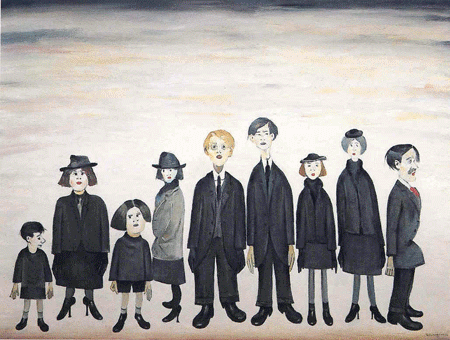
The Funeral Party from 1953 is a prime example, with the mourners lined up, not touching, not speaking. And at the end, one with his back to the others: Lowry claimed that this was because he was in disgrace for wearing boots and a red tie to the funeral (cue memories of Stanley Holloway reciting Brahn Boots: now that is sentimental!).

Reproduction doesn’t do many of the works any favours either. The Sea from 1963 really stunned me, but I’ve yet to see a reproduction that shows the strength of the contrast that gives it such power in reality.

Likewise, in Street Scene from 1935 (see the top of this post), the boldness of the colours – and particularly the blackness of the most distant terraces and the mill itself – are partly what draws you right into the picture.

But Lowry, while he initially trained with French Impressionist Pierre Adolphe Valette, was no Impressionist – although seeing some of Valette’s own works later, in the Manchester Art Gallery, you could see the influence of master on pupil. He was not a straightforward Expressionist either.

Indeed, Lowry belonged to no school but his own. He was at once a Victorian and a modern man: look at the paintings and you see a bridge between two such vastly changed worlds.

And of course, he painted the world of the working class – a world that ‘ordinary’ people recognised and appreciated.

The critical view was never completely one-sided, but it has certainly developed much more complexity in recent years. There are now those who suggest that, when the legacy of 20th-century British painting is fully assessed, Lowry will be viewed as more important than the likes of, say, David Hockney.

For Hockney has never created an entirely new visual language to express himself. And that is exactly what Lowry developed in order to depict his highly personal visions of a subject matter that few others touched.

I also took the time to have a look at Mister Sixties: Philip Townsend’s Portraits of a Decade, an exhibition of photographs, including portraits and street photography.

That and small amount of the Manchester Art Gallery that I explored (my feet were killing me by then) made it a wonderfully arty Saturday, with plenty to think about.

The Valette room was worth seeing on its own: it is remarkable to see an Impressionistic vision of Manchester. York Street Leading to Charles Street, from1913, is just one example: it could almost be Paris!

Impressionism can make the 'grim north' look almost romantic. And the Valette pencil study, Male Nude With a Cane, is different again and quite superb.

I could quite easily forget that the gallery also houses a collection of Pre-Raphelite works, which might well be one of my least favourite schools. Okay – beautifully crafted, but I dislike the subjects and particularly the portrayal of women, which could well be part of that Victorian fear of 'the fairer sex' and of female sexuality that reveals itself in a range of artistic works, including Bram Stoker's Dracula.

They seem to me to partly show women as a sort of Protestant, secular Madonna – they may be secular pictures, but they have a religiosity about them; a reverence for idealised women on pedestals.

Lowry was most definitely not sentimental!

And to cap the day off, at least the rain took a well-earned break, after falling heavily on Friday. It needed a break, before absolutely lashing down yesterday.

Tuesday, 3 March 2009

The best-behaved teenager in the world

Fairfield High School for Girls owed its existence to the next-door Moravian settlement in Droylsden – around seven or so miles nearer to Manchester proper than Mossley. And a veritable Arcady by comparison with the grimness of that Pennine setting.

The Moravian church is a Protestant denomination with roots in late 14th century Bohemia. It’s unobtrusive and doesn’t believe in evangelising – but music is an integral part of its traditions.

Ah yes; the music. The school choir used to be specially rehearsed for Christingle every Christmas, when we paraded into the church next to the school, each holding an orange (the world), wrapped around with a red ribbon (the blood of Jesus, given for our sins) and with a candle in the top (Jesus, the light of the world). Such an object is used in many denominations, but its origins are the 18th century German Moravian church. And there we would sing carols by candlelight, the choir performing the descants.

The church’s emblem is the lamb of God with a flag of victory, and it was the school badge too, worn on our blazers. The uniform comprised navy skirts with pale green shirts and ties of green, navy and white diagonal stripes.

I was sent there at the age of 11, having passed my 11+ exam (still the form of selection at the time in some areas of the country). My parents could have chosen to send me to a much nearer school, but Ashton Grammar admitted boys, while Fairfield was not merely single-sex – it also had that religious connection.

It was an outrageously vast building for little me – for the first few days, I couldn’t even find the toilets, and developed the ability to hold myself for a full school day.

No other girls from primary school were there, so I started from scratch. For a brief time, I hung around with a girl called Jayne. My mother enquired, one evening, what her father did. He was an ambulance driver, I replied. My mother, an inveterate snob, wrinkled her nose and advised caution, on the grounds that a Methodist clergyman’s daughter had a responsibility to pick suitable friends, given her father’s high calling. Even then, I was a tad bemused as to why anyone could find fault with ambulance drivers as a class.

After a couple of fairly uneventful years, my parents decided that I didn’t have a social life – and that one therefore had to be created for me. My father was a member of the local Conservative club, which was based just around the corner. Every couple of weeks on a Tuesday, they held a disco for members’ teenage children.

I was therefore sent, with enough change for a bottle of cider. My father, Cornwall born and scrumpy bred, regarded bottled cider as mere pop, thus I was allowed to consume it.

Of course, even then a single small bottle didn’t go far in an evening. My relationships with males of a similar age was not really up to much, but I managed to win regular staring-out contests, with the prize being another bottle.

And of course, I boogied, with a re-issue of Chubby Checker’s The Twist being a particular favourite, as I managed to really ‘get on down’.

I wasn’t allowed to join the local drama group, since they rehearsed on Sundays – the hypocrisy was staggering, since neither parent had any objection to cricket on a Sunday. But then again, perhaps it was more an objection to the suspect morality of the stage.

The school play was acceptable – just. I was already making a reputation for myself in ‘character’ roles.

But as my teens wore very sedately on, and my parents boasted to all and sundry that I was the least rebellious adolescent in history, my greatest freedom came when I babysat for a very respectable and upwardly mobile young couple who lived around the corner.

Those were wonderful Saturday nights. Not only did I get to pocket some cash, I could watch TV – but only if I wanted. And I could watch what I wanted: a revolutionary idea for someone whose Saturday nights had previously involved a formalised sitting-around-the-telly watching what Mater and Pater decreed. So many of my teenage Saturday nights were made up of Dixon of Dock Green, The Generation Game and All Creatures Great and Small.

I could play their records, too.

I could drink the cider they’d leave for me (a large bottle, in the fridge).

And I could read their books.

Ah. Their books. I don’t think for a moment that my parents knew what treasures that little bookshelf contained – or I simply would not have been allowed to pass beneath their portal.

The Joy of Sex and the entire Emmanuelle series are what I remember most. Actually, I remember the first two Emmanuelle books most – I don’t know how many times I read them, mind absolutely boggling. There I was, lying on the sofa, wanking over those masterpieces of smut, Simon and Garfunkel’s Bridge Over Troubled Water on the deck, and without any fear of having my privacy invaded.

Oh, the sheer blissful debauchery of it.

Not that masturbation was a new pleasure by then. I don’t know how I ‘discovered’ it, but the first time that I orgasmed, I lay in bed in a state of abject terror, convinced that I’d broken something and was going to be in almighty trouble the next morning.

When the dread day dawned, it brought forth no indication of any such catastrophe, and I soon found myself drawn back to that dirty habit.

It is a complete concidence, I should point out, and down to nothing other than genes, that I am extremely short sighted.

My first masturbatory fantasies, though, were not of local boys from the disco or even pop stars or football players.

They were of women. With tits. Lovely, big tits.

Every weekend, a paper was published in the area called the Saturday Pink. It contained all the sports results from the day, plus reports and articles. And all on pink paper. My father would send me down to the local newsagent to get our copy. What he conveniently ignored was the presence, on page three, of a glamour picture.

One of the models was called Gillian; she remained a regular in my fantasy life for years.

After the paper had been read and thoroughly digested, it was popped into a little woodshed to await collection by the local scouts for whatever they did with them (probably recycled the page three pictures). Occasionally, in a fit of daring, with youthful lechery as the motive and no other outlet, I’d creep down a clip out a picture. The fear of discovery was vast – privacy was difficulty, safe storage of such contraband even harder and my sister was a tell tale – and many were often destroyed quickly to avoid capture. But Gillian’s picture remained for some years, secretly squirreled away for private pleasure.

And there was always the school library. In what I now see was a wonderful subversion of learning and the religious ethos of the school, I actually managed to find masturbatory material in the library. And I don’t mean Chaucer.

I was hopeless at modern languages – perhaps influenced by my father’s anger that, having won the war (personally, you’d think, to listen to him) any English child should have to learn anything other then their mother tongue. French was bad. The announcement that we were starting German in our second year caused dinner table apoplexy. But in the library, for those rather better students, were kept copies of Paris Match.

And these could be guaranteed, in true French fashion, to include within their glossy pages pictures of topless women on French beaches. Or put another way – tits.

So I’d sit at the furthest table from the librarian’s desk, hidden by the high shelves and wedged as carefully as possible behind a desk, staring at pictures of bosoms, hand furtively inside my oh-so-very-unsexy navy knickers and biting my lip to stay mute.

The fear of discovery was always present, but it was an infinitely preferable way of spending a lunch hour than playing chase in the playground.

My mother later decided that I was the youngest spinster in town and dressed me in tweed twinsets (handed down from maiden great aunts), blouses with vast bows at the neck, and even a string of imitation pearls.

If only she’d know what lurked beneath the surface of her placid, respectable daughter, who she probably imagined was destined for life as a virginal singleton, making jam for the WI and attending church at every available opportunity.

C’est la vie, eh?

I’ll tell you one thing, though: if I’m birdwatching these days, it’s still the tits I look out for.

Monday, 2 March 2009

Amongst the 'dark satanic mills'

We moved around a lot when I was a child, leaving a merry little trail of schools in our wake.

But when I was about eight, we decamped to Manchester. Well, to be strictly accurate, we decamped to Mossley, which was eight miles beyond the city itself.

Our home was on a cul-de-sac on the edge of the Pennines and seemed, to fanciful youthful perceptions, to cling to the side of a hill, overlooking the valley below and glowering east toward the spine of England itself, and (say it quietly) Yorkshire beyond.

In the straggling towns below, old mills peppered the view, lowering over the scene, recalling Blake's Jerusalem and Lowry's industrial landscapes rolled into one.

Primary school was a dark stone building, single storey and arranged around a quadrangle that nobody ever entered, and which nestled below a hill. It was named for the Scottish missionary and explorer Dr David Livingstone ("I presume"), who apparently 'discovered' the Victoria Falls in southern Africa – something that must have come as rather a shock to the locals, who guided him to what they'd known as Mosi-oa-Tunya for years.

We were served school dinners in the main hall every day – mashed potato, garish yellow finnan haddock, cabbage boiled to grey and sago or semolina, into which a dollop of strawberry jam would be deposited: but on no account, for some reason or other, could the jam be stirred into the pudding. No whirly patterns if you please, girls and boys.

Grace was said before meals – the one occasion on which I was on the receiving end of corporal punishment from someone outside the family was when the headmaster administered a clip around the earhole for whispering during grace. Innocent of the charge, I was mortified.

PE took place in the same hall where, dressed in awful navy knickers with elasticated legs, we pranced around pretending to be trees or whatever else the radio told us to be. We sang there too, as the radio played folk songs on its schools programme.

In class, with Mrs Howard, Mrs Bottomley and Mr Coffee, we studied volcanoes, Romans in Britain, our times tables and reading. One teacher read us EB White's Charlotte's Web and Alan Garner's The Weirdstone of Brisingamen.

The schoolyard was divided around three sides of the school. One side was for girls, where they played incessant chase and skipped; one was for boys, where football was de rigueur, and the narrow strip at the front was where the twain could meet. Unfortunately, I rarely managed to get away with spending an entire playtime on the boys' side, although I was always rapidly picked for my silky footballing skills – the result of studiously watching Bobby Charlton giving a football school on TV in summer holidays, and then spending the rest of the day practising, thumping my ball against the garage door and driving my mother insane.

But playing football was not for girls in those days. So my love of soccer, born from no memorable influence when I was about six, had to find its outlet elsewhere.

Mossley's own team played at Seal Park – right behind our house. On Saturdays in the season, when they were playing at home, I'd wash my father's car, hands turning blue in the Pennine cold; finishing with chrome polish and Turtle Wax before I could gain enough of her majesty's legal tender to go to the afternoon match, purchase a programme and, in an act of cartharsis for this otherwise docile clergy child, yell myself daft at the referees – who always needed to visit an optician – and dirty visiting players. It's worth noting here that only opposition players were dirty – and the dirtiest team by far was Northwich Victoria, whom I recall to this day with remarkably resilient vindictive feelings, given the passage of the years.

I'd have a cup of soup (oxtail or tomato) at half time; it would be so hot that it would burn the roof of your mouth, but in those temperatures, you'd welcome the reminder that you were still alive.

On Monday evenings, if Mossley were playing at home, I'd be allowed to go around the corner to watch the first half through railings next to my headmaster's home.

Every June, we'd have to have the day off school for Whit Friday. In the morning, dressed smartly, we'd march on the 'walk of witness' with my father's church. All the churches came together for this: many with brass bands and all with banners, like those that trade unions had. The Catholics, of course, also carried their statues and crucifixes.

If the afternoon was fair, the community would descend on Seal Park for games. And then in the evening, it was the band contest.

There were many bands across the whole region, from Lancashire to Yorkshire. On that evening, each band would be packed into a hired coach to travel from town to town. At each stop, they'd get off and march to the area set aside for the contest, with someone walking in front holding a notice saying what band it was. Then they'd play their pieces and disappear to the next town and the next contest. If you've ever seen Brassed Off, you might remember this.

Mossley's contest was held in the playground of St Joseph's primary school. The bands marched from the George Lawton Hall to play. I remember seeing Grimethorpe Colliery, CWS Manchester, Fairey Engineering, Black Dyke Mills ... famous bands.

Not that I listened particularly closely at the time. Only later did the music take on a new meaning.

In July, there'd be the Wakes – the local annual holiday when, traditionally, the mills would close. A fair would come and set up in the little square opposite my father's church, which had the bus station on one side, facing the fish and chip shop that claimed to be the first chippy in the country.

There weren't many rides, but my sister and I would try the speedway, and then I'd win some piece of tat from the shooting arcade at which, for some inexplicable reason, I excelled.

This was Mossley and this was life in Mossley. Yet it wasn't Mossley itself that burrowed it's way into my very being. It was Manchester, looming on the horizon as I approached a move to secondary school. The city waited and the city called.


Saturday, 28 February 2009

Absinthe makes the heart grow fonder

Drunk by the very best of Parisian artistic society in the late 19th century, absinthe is a drink that has fascinated me for some time – well, at least since its revival in the last decade and it's unbanning in many European Union countries.

What is it? Why is it so awful that it was banned for years?

Those are the sort of questions that run through one's head.

Even the traditional preparation is about as Bohemian as it's possible to imagine.

Take a glass with a shot of absinthe, then place a special slotted spoon across the top, with a sugar cube on it. Drizzle ice-cold water on the sugar, so that it slowly dissolves into the absinthe, thus making a cloudy mixture as the herbs in the spirit are brought out. There's even a word for the cloudy look – louche, which rather adds to the mystique.

Well, there I was in Manchester, feeling not remotely grim up north and having discovered Vanilla, a most conducive lesbian bar just off the legendary Canal Street.

Having an evening to kill, I was attempting to look sophisticated by drinking G&Ts (apparently, my desire to have the Gordon's gin rather than the house standard was a sign of poshness) and trying to make myself generally agreeable to a very friendly crowd.

Now, lesbian bars and I have a history, which goes back to Amsterdam some years ago, when I visited Saarein. Delighted to see a pool table, I came instantly unstuck when it was made clear that hustling was out – this was uncompetitive pool. Which was a bit like suggesting I visit Manchester to watch City play uncompetitive football matches – although some might say that's been the reality for years.

I made an effort – which itself seemed oddly opposed to the idea of an uncompetitive game – but I readily confess to being utterly hopeless at not trying to win. Suffice it to say that I impressed nobody.

So, fast forward to Vanilla. The pool was competitive (but played in a perfectly well-mannered way) and the clientele and staff were open and friendly.

A few G&Ts down the road, I happened to notice a sign in the toilets, advertising 'flaming absinthe'. So I enquired. It materialised that the 'flaming' bit was off the menu, since it was well gone 9pm (I remain in the dark about this reasoning), but that I could have a shot of the stuff. I took the opportunity.

Canal Street may not quite be Montmartre, but it's quite Bohemian, in it's own fashion. The LGBT crowd are joined at weekends by hen parties and groups of straights, eager to enjoy the sights and get a fix of the party athmosphere.

The little plastic shot glass was full of la fée verte.

Here we go.

"Oh my God! Is that absinthe?" shrilled a girl next to me at the bar, sighting the glass. Another girl chipped in.

"I had some of that one night and I was so ill the next morning."

Now or never: I'm the daring one here.

A sip. Just a very small sip. 

Boy, has it got a kick. You know how whiskey has been called 'fire water'? Well this stuff makes whiskey feel like mere water.

A man behind me, thinking he wouldn't be outdone, ordered a shot too – and gulped it back in one. He was gasping, clutching at his throat for several moments after.

A sip. Just a small sip. I'm not a total fool.

Very aniseedy. You need the iced water and the spoon and the sugar to bring out the other flavours of fennel and grande wormwood. But very pleasant none the less.

Recent research has debunked the claims that absinthe is a powerful psychoactive drug – but it's still a powerful something. The warmth spread rapidly to my limbs, but my mind stayed clear (well, as clear as those G&Ts and an absinthe allowed).

I decided to melt into the night while I could still think about doing so.

Did it make the heart grow fonder? Well, it did nothing to quench my extreme horniness. But since my chances of pulling had decreased with the arrival of a very loud gang of straight women celebrating one of their number's 21st birthday, I popped into a nearby CloneZone and purchased a cheap and nicely proportioned dildo. It was enough to help make the rest of the evening, in a bland hotel room, very pleasant. And even appropriately louche.