Showing posts with label dumbing down. Show all posts

Thursday, 27 March 2014

That's not art - that's sick. Yes, it is

'Nexus Vomitus', Millie Brown
It seems that someone has finally worked out how to spew up onto paper and then call it Art.

Now admittedly, I hadn’t heard of Millie Brown until spotting a Guardian story online earlier this week, but since we’ve had piss and shit labelled as Art previously, plus assorted other bodily fluids, it was inevitable.

Brown, who has collaborated with Lady Gaga, gives performances where she drinks milk coloured with food additives – and then vomits it up onto paper to make ‘a rainbow’. Well, splodges of colour.

It was the sort of article that provoked a sizable response – not least for it having taken Brown’s claims that she makes Art quite so seriously.

On the other hand, responding to someone saying that it wasn’t ‘art’, another poster noted: “One of the values of art is to broaden the possibilities of thought – you seem to have skipped this altogether.”

Well, I can’t speak for the person that they responded to, but saying that this is, err, shit doesn’t mean that you’ve lost the ability to be broad-minded about art.

Refusing to make a critical judgment on something – while all the while condemning those who make a negative one – shows a lack of personal responsibility on an intellectual level. Nobody has to make a judgment, but if they choose not to, they shouldn’t condemn others who do and whine that it’s just because critics don’t ‘understand’ it.

What Brown does doesn’t ‘offend’ me, but it strikes me that this is yet another example of the infantilising impact of commercialisation, the cult of the celebrity, the Warhollian search for those 15 minutes and the dumbing-down of our culture as a whole.

To be fair, the quoted poster was not altogether alone: after all, this was the Guardian, where some people do tend rather to get off their dreadfully right-on lack of any discernment or taste: or relativism, as it’s known.

Brown’s oeuvre has been condemned as celebrating bulimia, which begs the question of what you’re supposed to be opened minded about if her performances are about that particular eating disorder: does the idea that it can create ‘rainbows’ make it somehow beautiful?

Perhaps the best that can be said about it is just how good it makes Jackson Pollock’s works look.

Brown – and others – seem set on provoking shock and sensation. One might say ‘good luck’ to her if the gullible give her money for it (although what such performances do to your health remains to be seen).

'Departure' by Max Beckmann, 1932-35 – 'degenerate'
But attempts to manufacture sensation in art seem particularly facile when considered alongside news of an exhibition currently on in New York.

The Neue Galerie near FifthAvenue is playing host to Degenerate Art, an exhibition of some of the works that featured in the Nazis’ infamous Entartete Kunst exhibition of 1937.


It’s been curated to include examples of the Nazi-acceptable art that were shown in an opposing exhibition, and which only serve to show just how good so much of what was considered ‘degenerate’ really was.

Yet however much senior Nazis officially abided by Hitler’s hatred of the modern, many took the opportunity to grab for themselves pieces of this art.

And the crowds throughout Nazi Germany gazed in their millions on that which had been declared degenerate, while pretty much leaving alone an exhibition of the Führer-sanctioned variety.

'The Four Elements' by Adolf Ziegler, 1937 – approved
It was art that, when you think of it in its historic context, reflected the extraordinary changes that were taking place in Western life in the early decades of the 20th century – psychoanalysis, the decline in religious belief, growth of technology, the increasing emancipation of women and the moves by increasing numbers beyond the narrow confines of the home, and so much more that had the power to unsettle.

Little wonder that it disturbed.

And indeed, the Nazi-sanctioned art was, in part, an attempt to hold back the tide of change.

Perhaps my response to Brown’s attempts to shock reveal only a jaded palate – although I think not.

It does all beg the old question of the role of art: is it simply to shock?

You can provoke without shocking – it does require a tad more subtlety, though.

British artist Dave White has a new exhibition on that actually manages to be modern, reflect rather more traditional artistic skill than Brown, and are actually worth looking at.

'Great White Shark II' by Dave White
His series of paintings of sharks and other creatures are in watercolour, but are a departure from what some might see as the conventionally ‘twee’ nature of that medium, as he himself points out.

He uses the paint in a very free way and allows dripping and splashing to add a feel of movement and energy to his works.

Yet these are completely figurative and the effect actually works intriguingly well by giving the paintings a sense of having been executed at incredible pace.

White is indicative of an artistic world well beyond installations in galleries that survive on a diet of shock; of painting that is both traditional but not.

He isn’t collaborating with Lady Gaga, but his work has much more to say, and does so in a way that provokes attention and thought more interestingly than a stream of vomited milk.


Saturday, 18 May 2013

Honey, we shrunk the brains


South Park takes on Honey Boo Boo and June
One of the cultural highlights of the past few weeks – nay, the past year – has been the arrival of a new digital TV channel from our cousins across The Pond.

And TLC, the channel formerly known as The Learning Channel, has chosen to announce its arrival in the UK with the highly educative Here Comes Honey Boo Boo.

This is a ‘reality’ TV show about a ‘redneck’ family where the mother pushes her seven-year-old daughter – the eponymous Honey Boo Boo – into child beauty pagents that she is never likely to win, and which is how the family was spotted in the first place, during another of TLC’s shows, Toddlers and Tiaras.

The family – parents and four girls – get to go to the Redneck Games, eat ‘sketti’ (spaghetti with a sauce of margarine and ketchup) and comment on life in general.

The audience, presumably, gets to feel superior, in much the same way it does over the ‘guests’ on Jeremy Kyle’s modern-day freak show or on that of Jerry Springer.

Actually, it’s difficult to know on whom the joke is this time. TV stardom has, for the family from rural Georgia, been enough to lift them far away from any impoverishment.

And the programme differs from other examples of reality TV in that they seem to be remarkably functional. The mother, June, has apparently set up trust funds for all her children, noting that such fame won’t last.

TLC – formerly known as The Learning Channel, remember – is also breaking Breaking Amish to UK screens.

This reality show is about a group of young Amish/Mennonite men and women who are taken to see the bright lights of New York, with much being made of whether, if they decide to go home, they’d be accepted back.

Lives lived out in front of cameras, for the entertainment of millions and the profit of a rather smaller number.

Now don’t get me wrong – the idea of giving young people from closed communities the chance to see the outside world isn’t one that I object to in principle.

What concerns me is the question (and let’s assume none of it – or only a small amount – is staged) that really quite dramatic personal experiences, with the potential to be life-changing to the extent that the young people in question might find themselves being ostracised by their families and communities, are being played out for entertainment.

And let's go back to the fact that nobody knows quite how much is 'real' and how much is staged and scripted. It's a blurring of lines that has the capacity to blur the critical senses. This is not the willing suspension of disbelief.

All this reminds me of HL Mencken’s famous quote about the apotheosis of democracy will see a moron elected to the White House – simply substitute culture. And then consider the impact of that on the former.

I’m not opposed to reality TV per se: it can be both educative and entertaining, without being exploitative – as illustrated by the BBC’s recent series, The Tube, about the working lives of some of the vast team that keeps London’s Underground running.

But that’s quite different from, say, Big Brother, when Jade Goody, a very vulnerable woman, according to a former teacher of hers I once met, became famous for being thick.

Later vilified for a racist comment on another version of the programme, she lived out the last days of her life in the public eye, turned almost into a martyr by her battle against cancer.

It all seems so vacuous and vapid and vicarious and vicious: and that is not a comment on Goody herself.

And it’s hard not to believe that such commoditisation of human lives devalues humanity in general.

But further, how much does the public vilification of Kyle’s guests – carefully chosen for their dysfunctionality, since that is what is ‘entertaining’ about them – contribute to the ease with which government and mainstream media demonise vast swathes of the population?

And politicians kowtow to this: from Barack Obama feeling obliged to mention being ‘endorsed’ by an infant would-be beauty queen, to David Cameron and Ed Miliband jumping on the bandwagon to condemn Hilary Mantel’s comments about the Duchess of Cambridge from a position that merely illustrated either their total ignorance of what she had written or their readiness to ignore the facts for the sake of being seen to make the ‘correct’ sound bite that would most please certainly elements of the press.

Honey Boo Boo and her family have been satirised already in South Park – from which no target is, rightly, considered exempt – but goodness, doesn’t it sometimes feel as though there’s a losing battle going on?

Nor is all this a snobbery about what ‘chavs’ watch or read. Consumption of gossip magazines and such programming is spread beyond any one social class, just as the consumption of junk food is.

And if junk food is bad for the physical health, what does junk culture do for the mental health?

For Honey Boo Boo, her parents and siblings, they seem to have been able to exploit the system as much as it has exploited them. And good luck to them in many ways for that.

But what will be the end result for those Amish/Mennonite young people – including the ones featured in a second series?

What about the Kyle guests, whose very dysfunctionality provokes enough Twitter traffic to trend, as viewers share their revulsion? It’s documented that they receive no real help to deal with the problems that allow the show to exist.

We’ve got a cult of easy celebrity, whereby fame is awarded not for actually having done anything or having any sort of talent, but simply for being prepared to act as outrageously as possible in front of a camera.

Geordie Shore, The Only Way is Essex, Made in Chelsea and Desperate Scousewives: moronic television made to moronise and desensitise the public, who appear to have enough of an appetite for it all that such dross keeps appearing.

Television that, when voting is concerned, garners more participation (even though it costs money) than some elections.

And if that doesn’t depress you, nothing will.

So where next in this drive to shock and titillate? Who knows?

But you can bet your bottom dollar that someone is mulling over a new approach even as I write and you read. And that, at its root, it will be about making money for a few with little regard for the larger cost.


Wednesday, 3 April 2013

The Mail, the convert and their attack on the poor


It had crossed my mind to write about food today – a couple of slight experiments on the culinary front.

But just when you don’t expect a story to crop up that you feel a need to comment on, up pops the Daily Mail with exactly that.

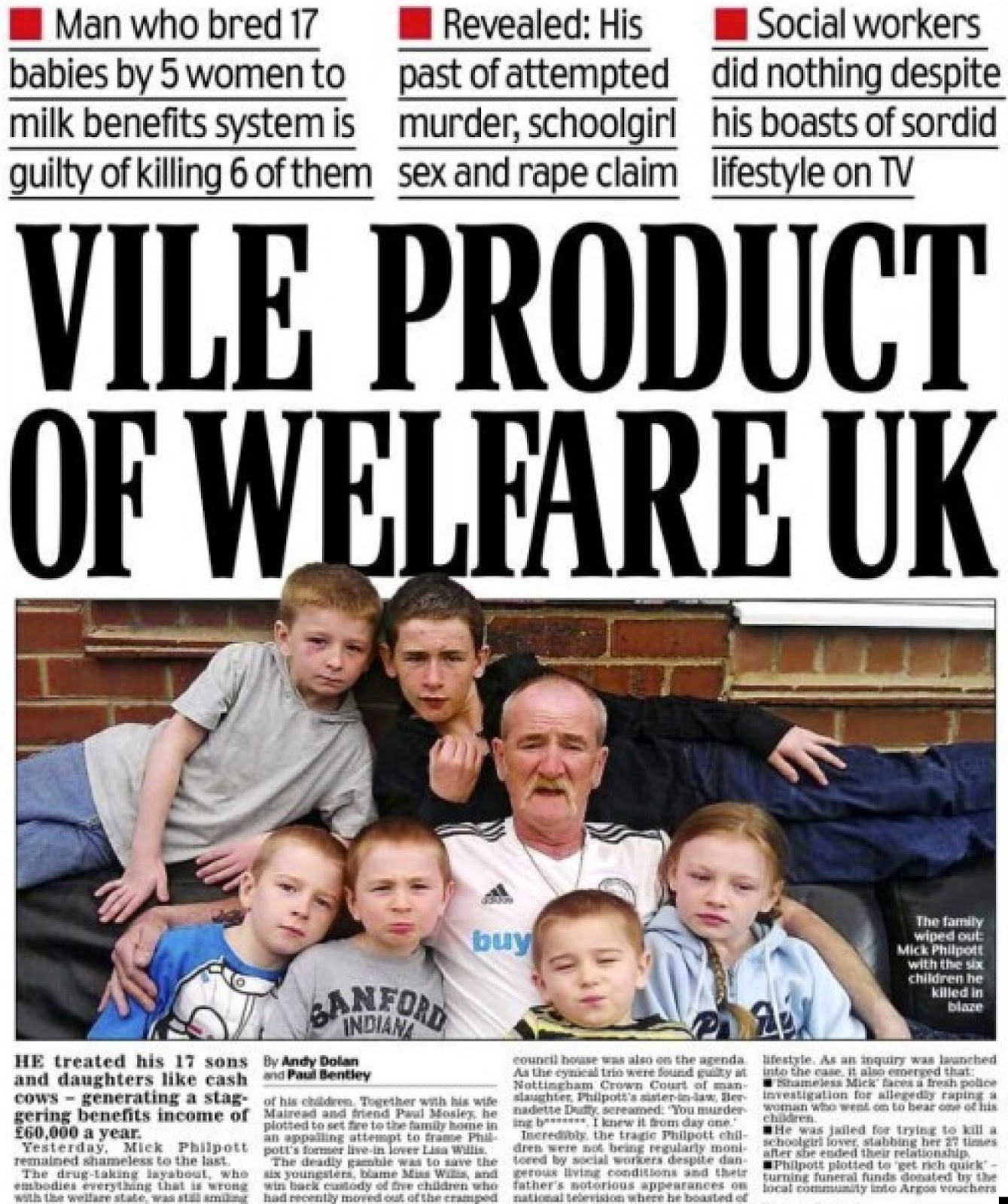
Yesterday, in Nottingham, three people were found guilty of the manslaughter of six children. Two of these people were Mick and Mairead Philpott, the parents of five of the children. Mairead was the mother of the sixth child from a previous relationship. The third guilty was a friend.

I can’t imagine that there will be much sympathy for the trio and that’s most certainly not the point of this post.

In this morning’s issue, the Mail’s headline trumpeted that Philpott was the “VILE PRODUCT OF WELFARE UK”.

Of course, the Mail never has been much cop at logic.

Or consistency.

A little digging finds that the same paper reported in very different fashion on the case of Hugh McFall, an indebted businessman who murdered his daughter and wife before killing himself in 2010.

It was reported pretty much straightforwardly as a tragedy – with his struggle with debt as a possible trigger.

“Troubled”, is the way the paper described millionaire Christopher Foster, who killed his wife, daughter, dogs and horses before killing himself and setting fire to his house in 2008.

Now only a complete idiot would suggest that Foster’s crime was a ‘product’ of his being millionaire or that McFall’s crime was a ‘product of business UK’.

Nobody would suggest that Harold Shipman was a mass murderer because he was a “product” of a medical training.

Nobody would say that Fred West was a rapist and killer because he was a “product” of the construction industry – or being an ice cream man; take your pick.

Nobody is likely to pretend that Dennis Nilsen became a murderer because he was a “product” of working in a job centre, or that Peter Sutcliffe became a killer because he was a “product” of long-distance lorry driving.

In the 1970s, Philpott was in the Army – perhaps he’s a ‘product of Army UK’? Indeed, he was in the Army when he attempted to kill his then girlfriend back in the 1970s.

Actually, what his having been in the Army illustrates is that he did work for a living at one point.

And before that, he was ultimately ‘a product of’ his parents, with contributions from a variety of institutions, including his school and possibly his local church.

And no – before anyone suggests it, I am not saying that Philpott and his crimes are a “product of the Army”, because that would be as ridiculous as any other such claims.

His crimes are a direct result of his being a controlling, violent, obnoxious piece of work – a psychopath, as one psychiatrist interviewed on the television about the case has put it.

And there is no evidence out there that the welfare state creates psychopaths, although if that diagnosis is anything like correct, it may provide an example of why Philpott doesn’t seem to have been particularly employable.

But that wouldn’t suit the agenda, would it?

The Sun wasn’t good today either, although it was a little more subtle.

The leader in its first edition ran: “We hope he never sees freedom.

“Likewise, let’s hope this is the last time the State unwittingly subsidises the manslaughter of children.”

In the second edition: “We hope he never sees freedom.

“And let’s hope this is the last time the State unwittingly subsidises a monster like Philpott.”

Where was Murdoch’s rag when “the State” was ‘subsidising’ the killing of innocent Iraqi civilians?

But even in the Sun’s more ‘subtle’ message, there is the suggestion there that the likes of Philpott only ever come from those on benefits.

But back to the Mail. The main ‘think piece’ of its coverage was penned by AN Wilson, a man who has gone all religious following his conversion to Catholicism, which makes it even more jawdroppingly dire.

Staggeringly, Wilson claims that: “... throughout this painful trial, as the evidence was so slowly and painstakingly heard, it was impossible not to think of it as a hateful parable of our times ... Those six children, burnt to a cinder for nothing, were, in a way, the children of those benevolent human beings who, all those years ago, created our state benefits system.”

That’s right: the deaths can all, ultimately, be placed at the doors of Wilson, Beveridge and Atlee, the founding fathers of the modern welfare state, which was a vast part of the post-war settlement.

You want vile? That’s vile.

Further, Wilson’s attitude is as far removed from what the Bible lists as the teachings of Christ on the poor that one wonders what Bible this convert has actually read during his devotions.

And then there is the small matter of whether he would extend his own logic to saying, for instance, that child abuser Jimmy Savile was ‘a product of the Catholic church’.

And this from a man who is regarded as some sort of intellectual.

He is a prime example of just why this country is in a mess. Nasty, vindictive individuals, so often from a privileged background themselves – Wilson went to Rugby – who demonise those less fortunate and are believed by large numbers of the knee-jerking gullible, who themselves like to think they're better than anyone else and have something close to an orgasm when anyone writes something that corresponds to their prejudices.

I’m reminded of the classic That Was The Week That Was sketch on class, with the Ronnies Barker and Corbett, and John Cleese. In other words, it’s all down to nasty snobbery.

But what does this say about a paper that decides to exploit the killing of six children to support the general attacks by this government on the poor, the disabled, unemployed – in short, anyone who is in receipt of any benefit?

What you also need to consider is that the Mail’s reports of the Philpott case contain plenty of prurient detail about sex.

In other words, the paper aims to scandalise and titillate in equal measure – and if it has to use the deaths of six children to do that, it will.

After all, this is the same publication that, on the one hand lectures about the sexualisation of children and, on the other, publishes pictures about young children on its website accompanied by text that sexualises them – referring to an eight-year old child as a “leggy beauty”, for example.

So, Wilson claims to be a Christian and takes his 30 pieces of silver from an utterly immoral rag to demonise the people that Christ apparently supported.

And perhaps the biggest obscenity of all is that so many people actually believe its vile copy, and all apparently without seeing it for what it is and without realising just how gullible they are in allowing it to profit from their worst instincts and prejudices.

And that, my friends, makes me despair.


* With thanks to The Media Blog for nods in directions on this. Well worth following at themediablog.co.uk and @The_MediaBlog.

Note: I have not provided any links to the Mail because, while it needs challenging, I have no wish to aid its profits. If you really need to verify what I have posted, you won't find it difficult to search for what you need.

Sunday, 31 March 2013

A wonderland of ideas


It could be read as a sign of the times that, when the news of the demise of Richard Griffiths broke a couple of days ago, the headlines read, over and again, that the “Harry Potter actor” had died.

It is highly doubtful that, no matter how lucrative were those films personally, Griffiths himself would have viewed them as his best or most important work.

That probably wouldn’t have been last year’s West End revival of Neil Simon’s bitter comedy, The Sunshine Boys, in which he starred to great effect opposite the bundle of combustible energy that is (Batman Returns actor!) Danny DeVito.

More likely, one might think, would be the cult classic Withnail and I, and both stage and film versions of Alan Bennett’s The History Boys, both of which have been seen by large audiences, not simply a certain, limited class of theatregoer.

Not, I hasten to note, that there is anything wrong with Harry Potter – books and films alike are thoroughly delightful.

To be fair, this is hardly new. When John Gielgud departed life’s stage in 2000, the Daily Star marked his passing with headline: ‘Butler in Arthur dies’.

But it was akin to reading that the West End production of John Logan’s new play, Peter and Alice, was really just a big Bond reunion, since the author had written Skyfall (amongst many big screen hits), and the stars were M and Q.

It could hardly have been further from 007.

In the introduction to the script, Logan writes that, “many years ago”, in a biography of Alice Liddell Hargreaves, the model for Lewis Carroll’s Alice, he’d read that: “On June 26 1932 Alice opened the Lewis Carroll exhibition at Bumpus, the London bookshop. Beside her was Peter [Llewellyn] Davies, the original Peter Pan.”

And that is where Logan begins, wondering what they might have said to each other.

Having inspired Rev Charles Dodgson (Carroll) and JM Barrie to pen their classic children’s tales, both went on to face tragedy in their adult lives.

Having lost both parents to cancer, Peter lost a brother and any remaining childhood innocence in the mud of Flanders, with another brother apparently ending his own life a few years later.

For Alice, her own lost boys were two of three sons dying on the Western Front.

From icons of childhood to pained adulthood.

Logan’s play explore the legacy of being the models for those icons; the pressures it might bring, unable to escape that.

For Alice, it’s a blessing; a distraction from the tragedy. For Peter, a dreadful reminder of innocence lost; of the pain of growing up.

When the shallow set of a dusty storeroom in a bookshop rises to reveal a vast version of a toy theatre, with proscenium arch decorated by illustrations from the two books, Alice and Peter are joined not only by Dodgson and Barrie, but also by the characters that they gave their names to, and Logan can embark on a journey of memory.

Challenged by their muses, we explore the two authors; possessive and both sad and bitter in unhappy adult lives.

The question of whether Dodgson had paedophilic inclinations is not a new one. Logan deals with it carefully – it cannot be ignored when seen through today’s sensibilities.

If one wishes to see it through the prism of pop culture, it could perhaps be suggested that Dodgson here is reminiscent of Michael Jackson – a desperately unhappy adult who spends time with children in order to claim or reclaim the joy of childhood.

However, he also has Alice ask Peter whether Barrie “molested” him or his four brothers.

And here we have one of Logan’s ideas. ‘No’, responds Peter. Not physically.

But how much can what these authors did, using children as unwitting templates for something from which they could never escape, a form of abuse?

It’s worth noting here that there are vastly differing views of Dodgson’s apparent fondness for photographing young girls, which is touched on in the play.

While just over 50% of his surviving photographic work is of young girls, 60% of his portfolio is missing or destroyed, so it’s not possible to say with certainty what the rest contained – and his sketches show a much more varied subject matter.

It has also been said that, at that time, child nudes were a popular and mainstream Victorian art form – part of the ‘Victorian child cult’ and even appearing on Christmas cards, so there is a danger of seeing Dodgson through 21st-century eyes.

What is equally interesting, though, is that at around the same time as he invented the stories of Alice, his diaries became full of the rather Calvinistic view of himself as a “vile and worthless” sinner, which may possibly be reflected in his desire for ‘innocent’ companionship.

Anyway, that’s one of the questions that Logan doesn’t pretend to be able to answer.

The performances are superb. Ben Wishaw as Peter is awkward and angular and painfully vulnerable and angry.

At first stiff and of stiff upper lip, Judi Dench’s Alice succumbs eventually to a heart-rending sob as she remembers her lost sons. But her ability to also convey the Alice of childhood without it ever seeming cloying or false is an indicator of just why she is such a superb actor.

To be honest, I don’t know what I expected of the play. I bought tickets because Dench is on a list of actors that I have told The Other Half he must see.

The play itself turns out to be a challenging, intelligent and fascinating piece.

But back to that dumbing down.

The obsessive need to popularise everything is an infantilisation of thought. It’s at the heart of what has happened to the country’s public discourse over the last few decades, which is a major reason why it matters.

While there can be genuine benefits if it means, for instance, that someone decides to go and see the play because of that Bond connection, it also brings with it a concomitant infantilisation of thought.

That saw senior theatre critic Michael Billington of the Guardian not only try out a rather patronising joke at the expense of those he imagines to be thus mired in the pop culture world – “Anyone hoping to see Q and M will find themselves constantly confronted by Q and A” – as though people really cannot differentiate between actors playing different roles, but then himself complained at the lack of easy gratification by asserting that Logan’s play neither offers any “revelations” nor “shocks or startles by its insights”, as though this were actually the latest installment in the Bond franchise and such things were the necessary intellectual equivalents of all the pyrotechnics and car chases.

For Billington, the performances are the pleasure: perhaps it was he who had turned up expecting merely to see “Q and M”.

The performances are very much a pleasure, but so is seeing question after question, theme after theme, idea after idea revealed, like the layers of an onion being peeled back. And all ready for the audience to take away with them and mull at greater length.

Peter and Alice might be short at just a single, 90-minute act, but is far from flimsy.

There is nothing wrong with popular culture – a cultural diet can include Carry On films as well as Shakespeare, but that doesn’t mean that we get all relativist about it, any more than trying to compare Abba and Beethoven.

It all seems to say: ‘we can’t do grown-up culture by itself any more: it’s too difficult.’ Or perhaps it’s simply that the easier something is, the more it sells.

In true chicken and egg fashion, it’s hard to know which came first – media reporting in this way or the public demanding it.

That production of The Sunshine Boys was met with some reviews that saw eyes rolled metaphorical at the physical contrast between the leads, decrying it as rather passé.

Well indeed. Simon’s piece is about a faded Vaudeville double act – so the physical contrast was precisely the sort of ‘obvious’ comic device that would have been around at the time.

The casting was done with this in mind – not as a pretence that, ‘oh, ha ha, we’ve thought of something new’.

The lack of understanding of something as simple as basic context was irritating and frustrating. It was an attempt at ‘clever’ reviewing without the understanding to be so.

At it seems to be part of a circle that include the ‘Harry Potter actor’ headlines, the desire for answers instead of the questions that provoke at least an effort at mental aerobics.

You never find yourself thinking like this in childhood.


Peter and Alice is on at the Noël Coward Theatre, St Martin’s Lane, London until 1 June. A limited number of tickets are available on the day for £10.

The script will be published shortly by Oberon Books.


Tuesday, 4 December 2012

Anyone fancy having a 'free press'?


Paul McMullan – a living, walking advert for regulation
Well, it didn’t take long. The weekend after the Leveson Inquiry reported, we had the fun and games of seeing Liberty director and Leveson advisor Shami Chakrabarti having to pen a rapid response to the confusion‚ in some of the press, over her stance on the report.

Now, setting aside the questions about who exactly elected Chakrabarti – and the organisation she heads – to the position that it appears to hold, one can’t help but wonder if the likes of the Mail on Sunday and the Independent (which lovely couple share a home these days) really couldn’t understand the nuances of her original response or were motivated by something else to actively misunderstand it.

But then again, lots of other people seem similarly incapable of understanding the issues surrounding Leveson.

For instance, there is lots of talk about threats to a ‘free press’. But what exactly does that mean?

Well, at it’s most simple, what people usually mean is something that can act in the general public interest by explaining things properly and uncovering corruption and lies etc, and holding politicians and so forth to account.

And it cannot be difficult for many to agree is a good idea.

But that is not, in general, what we have in the UK today.

Instead, what we have is a press that is, generally, owned by individuals for the sake of profit and their own agendas.

Now, for the sake of clarity: I have nothing whatsoever against profit – indeed, as a freelancer, I like it. Goodness – couldn’t I make a bit more myself?!

In terms of the press, though, there is the potential for conflict between the drive for profit and the general public interest ˆ not least where news isn’t considered sexy‚ enough to get readers and advertising.

Over the years, it’s meant, for instance, that some missing children are considered more worthy of space than others – usually because pictures of pretty, white girls make better front pages.

In other words, profit has been one of the drivers of the general dumbing-down of the UK press over the last 20-30 years, whereby we’ve arrived at a point where news‚ is dominated by who tweeted what, who slept with whom, and which celebrity fell out of what nightclub at 3am.

Now it may well be that that is what the great British public wants from its press – but let’s not pretend that, if that is the case, it’s what the concept of a ‘free press’ is really about.

Then there’s that agendas bit. Now again, let’s not be naïve.

All newspaper proprietors will have their own political views, and will want to disseminate them. And there’s nothing wrong with that.

But in the last decades, we’ve seen a serious crumbling of the once sacred wall that divided reporting and editorialisation as the British press has slumped toward a sort of Fox News approach, the kind of thing that Rupert Murdoch espouses as his answer to supposed elitism.

Even a once fine newspaper such as the Telegraph does it these days. In the past, you’d buy it for its quality of news coverage, even if you didn’t always agree with the editorial line, but the two were clearly defined.

And if conflating reporting and editorial isn’t bad enough, papers further dumb down matters by employing the likes of Jeremy Clarkson or Julie Bindel as columnists.

Okay – Clarkson can at least be funny, but he’s no more a philosopher, say, than Richard Littlejohn. Oh.

And Bindel’s continued contributions to the Guardian simply serve to allow hand-wringing liberals a bit of ‘acceptable’ bigotry.

Look across the Channel and it’s a different world. When the French were having their burqa debate, for instance, the public discussion was not drawn along strictly tribal political lines.

For instance, one of the commentators was a left-wing female philosopher who was in favour of a ban, but articulated her reasons in a nuanced way. Philosophically, in other words.

Similarly, if there is a strike in France, papers might not agree with that action, but there will be a pattern of all press – from across the political spectrum – actually analysing the reasons for industrial action, and discussing it in a way that at least examines the issues.

And French newspapers are refreshingly free of those 3am nightclub stories.

They are not, however, run by the state or as organs of the state – they are private companies. Which rather suggests that you don’t need to print a diet of salacious gossip or infantilised opinion in order to make money.

But fair enough: if you’re going to turn news into knee-jerkery and titilating entertainment because it sells, that’s your decision. Just don’t try to pretend that it’s about ‘free press’. It’s not.


Indeed, it was the late Sir Robin Day who once noted: “Only two newspapers tell the truth. The Financial Times, which tells the truth for the business community, and the Morning Star, which tells the truth for the workers”.

There is, of course, plenty of other hypocrisy in all this. Imagine if you will, editor Paul Dacre at the Mail suggesting that it would be a good idea for trade unions to regulate themselves. No?

But, as the late Frank Carson would have said: “There’s more”.

Many of those now shrilling the loudest about the idea of any form of meaningful (independent) regulation are, in effect, defending the intrusion into people’s private lives on the grounds of profit.

Because profit was the only motive for the stories about Max Mosely, for instance. The News of the World tried to confect a public interest argument – and failed.

The idea that, when someone is in the public eye, they are automatically demanding to be followed and photographed everywhere etc is a nonsense.

Some might – some do – but it’s hard to imagine it wouldn’t be a better world by ignoring such attention-seekers and not pandering to their demand for attention, let alone then deciding that anyone else remotely in the public eye (well, in the entertainment world, at any rate) is fair game.

And let’s note what should be obvious: making a film or writing a book is not one and the same as demanding to be followed and reported everywhere, any more than writing a column or editing a paper is also a demand for an end to one’s privacy.

So when some in the media wail about ‘a free press’, what they’re actually meaning is a press that is free to invade people’s privacy for no reason other that profit by publishing salacious stories.

What is odd about this is that it seems unlikely that the same people would also ever applaud or have applauded countries where the state invaded people’s privacy to the extent of persecuting them for what they wrote or said or read, whether for reasons of religious or political ideology.

Few would support such totalitarianism, but if not, why fall for a line that a ‘free press’ needs to invade people’s privacy for salacious entertainment that does not have the support of a genuine public interest argument?

That is one of the things highlighted by Leveson, together with other similarly irresponsible behaviour, in the name of sensation that, as Leveson himself said, has caused “havoc” in people’s lives.

One of the most tragic cases raised again at Leveson was that of murdered Glasgow schoolgirl Diane Watson, about whom a series of lies were published in two Scottish newspapers, plus Marie Claire magazine. Her brother later killed himself and was found clutching the articles about his sister.

The murder happened in 1991. One of the two papers, the Herald, only managed an apology in 2011, after Diane’s parents had appeared at the Leveson Inquiry. It was itself under different ownership by then.

The journalist who concocted stories about their daughter, claiming she was a bully and had, in effect, contributed to her own murder, claimed to have been shocked to have been personally mentioned at Leveson.

Perhaps if he had not taken a decision to invent stories to support his own agenda, that surprise wouldn’t have occurred.

There was the case of Mosely’s son, who suffered from depression and died of a drug overdose within a year of the News of the World story, which might or might not have pushed him over the edge.

Mosely himself has described how, when going to his son’s flat to deal with his remaining belongings, the place was subject of a press scrum. One wonders what public interest was served by that?

And then there’s the story of how News of the World hack Paul McMullan drove the mentally ill and drug-addicted daughter of the late Denholm Elliot to suicide by luring her into prostituting herself so he could take nude photographs of her for the paper and, in his own words, impress his new boss, Piers Morgan.

This is the same McMullan who has also claimed that the only people who want privacy are paedophiles – which quite splendid piece of utter fuckwittedness has the ring of Orwell’s 1984 about it.

And all this is without mentioning the links between elements of the press and the police in the case of the murder of Daniel Morgan.

It is without mentioning the complicity of swathes of the British press in the 20-plus year cover up of what happened at Hillsborough.

And so on.

None of these were accidents. They illustrate a culture that exists – a culture that is being defended by an assortment of individuals and groups.

It takes some contortions to pretend that any of this is remotely justifiable – or that the state of the British press is, in general, something to be proud of and something to defend.

Independent regulation works fine in places such as Finland and Denmark – the former is consistently number 1 in the International Press Freedom Index, even with (gasp) statutory underpinnings.

In the UK, independent regulation doesn’t seem to upset anybody when applied to, say, advertising.

It seems that the real problems people have with the thought of independent regulation are nothing to do with any concept of a ‘free press’, and everything to do with either reducing the ability to profit from the private lives of others – and a sort of fundamentalist small statism that has to pretend that none of the above problems and contradictions exist or need dealing with, in order to continue with it’s view that even an independent regulator would be state intervention and the end of life as we know it.

A free press? Yes – that would be most welcome.