Showing posts with label graphic novel. Show all posts

Monday, 1 April 2024

Robot Dreams is a an absolute charm

Dog is a lonely hound living on his own in a third-floor New York apartment in the 1980s. In the evenings, he plays Pong on his own. But one night, flicking through channels on TV while eating his usual meal of microwaved macaroni cheese for one, he spots an ad for a build-your-own-robot as a friend, and immediately orders one.

When he’s completed the build – hilariously watched by pigeons on his windowsill – and worked out how to activate his new buddy, their life together begins as they set out to explore the city.

Robot is fascinated and thrilled by everything, and passes on that zest for life to Dog. The pair roller-skate in Central Park, dance together, watch The Wizard of Oz together and, after Robot learns not to squeeze Dog’s paw too tightly, hold hands.

But on a trip to Long Beach at the end of summer, the pair are separated after too much enthusiastic play in the water from Robot. Try as he might, Dog can’t help his friend and, when he returns the following day with tools and manuals to do so, he finds that the beach is now locked until 1 June the following year.

How they cope without each other and learn to live again is the core of the film.

Do Androids Dream of Electric Sheep? Who knows. But Robot certainly dreams – not of sheep, but of finding his way back to Dog; dreams that are worked and re-worked from his time-limited experience of life. One in particular is gorgeous – he finds himself in The Wizard of Oz, surrounded by tap-dancing flowers doing a routine straight out of Busby Berkeley, as New York shimmers in green – seen like the city of Oz – on the horizon.

Between the Oz references, the trope of the gay love of musicals – here, Oz (don’t forget ‘friends of Dorothy’) and the Berkeleyesque routine – plus the holding hands, it’s little wonder that there is online speculation that this is a subtle and tender gay love story.

To be clear, there’s no mention of the gender of either Dog or Robot, but female characters in this anthropomorphic New York are pretty easy to spot. And the beach scenes clearly show Dog is male – watch out for a very funny swimming costume change gag.

Robot Dreams is Pablo Berger’s first animated feature and is based on Sara Varon’s comic of the same name. Entirely hand-drawn in 2D style, it has won plenty of plaudits – and rightly so. It’s a sweet, charming story, which depends on the visual, as there is no dialogue. It also references Isaac Asimov’s collection of short stories – and specific short story – of the same name. There’s a lot going on here. It’s not remotely a ‘kid’s movie’.

Don’t be misled by the animation being ‘old-fashioned’. It is fabulously done and gorgeous to watch – 1980s New York itself has been so lovingly created, while the cast of thousands has been given such wonderful attention to detail. There are couple of scenes where Dog is on a scooter with another character, riding into the countryside, where the trees coming over the horizon is simply stunningly done.

And while the comedy is gentle rather than LOLZ, it is certainly there. There’s a lovely scene about photo booths that will take those of us of a certain vintage back!

The ending is perhaps not what you’d expect, but shows a nice sophistication. The ’80s soundtrack is great.

Robot Dreams is a gentle, charming, really well-paced joy. My only personal surprise (disappointment?) as I came out of the cinema was that so many reviews have said: ‘Bring tissues – you will cry as well as laugh’, yet I didn’t.

Given how easily I blub at films (though I hate it when I feel my tear ducts are being deliberately tweaked), I walked home wondering if the absence of even a pricking meant it was not quite of the calibre so many have stated. Writing this, thinking back over the film itself, I have realised that it not bringing forth an instant deluge does not mean it’s not very good indeed.

I took lots of tissues to The Zone of Interest, expecting to find that would set me off, but it didn’t, yet it is one of the best (and most important) films I’ve seen thus far this year.

Robot Dreams is a wonderful film that I suspect is going to stay in my mind for a long time. And of course it’s gay!


Friday, 12 April 2019

A hell of a superhero romp

Boy, oh boy – the new Hellboy film has taken a critical panning. Before even reaching its first weekend, review aggregator Rotten Tomatoes had pelted it with an approval rating of just 12%, based on 97 reviews.

Surely it can’t be that bad?

Well, sure enough, it isn’t.

Let’s be clear – it isn’t Guillermo del Toro and isn’t Ron Perlman. The 2004 and 2008 films that the director and actor collaborated on are huge fun and the latter turned in a pair of iconic performances. I cant stop smiling at the scene in the second film where lovelorn Hellboy and Abe Sapien drunkenly sing along to Barry Manilow.

But lets also be clear – in a lot of ways, this screen reboot is actually closer to the look and feel of Mike Mignola’s original Hellboy comics – and I have loved those for years.

Here, we get the requisite origin reminder: demon baby Hellboy, summoned up by Rasputin for the Nazis in a last-ditch effort to win the war (and filmed by Leni Riefenstahl), but saved and adopted by Professor Trevor Bruttenholm, founder of The Bureau for Paranormal Research and Defense, a joint UK-US body.

The key plot here centres on an ancient sorceress, Nimue, The Blood Queen (Lady of the Lake), defeated centuries earlier by King Arthur, but now back with a vengeance and planning to wipe out humanity so that ‘monsters’ can live un-threatened in a new Eden.

No spoilers from me on the plot. But it is entirely in keeping with Mignola’s originals, which weave the modern with folklore and fairytale. Indeed, the comics were where I first learned of Baba Yaga (who crops up here too, in a seriously creepy piece of CGI work).

It’s violent – as are the comics – and indeed, the fight scenes capture the gravity-defying sense of action (and incredible composition) in Mignola’s original drawings (see left).

I’ve seen the film described as a bit all over the place, but I can’t see that. Perhaps not as tight as it could be, but it didn’t lag for me.

David Harbour as the eponymous hero seems to be feeling his way into the character: some early method mumbling doesn’t help, but by the second half of the film, when he’s getting sterling support from Sasha Lane as Alice Monaghan, a young woman with supernatural abilities, and Daniel Dae Kin as BPRD veteran Ben Daimio, he seems much more comfortable.

There’s sardonic humour, badass monsters and fight scenes aplenty, and a straight-up Mignola mash-up of folklore and mythology.

Ian McShane adds to all this as Bruttenholm, Hellboy’s daddy, while Milla Jovovich provides scary, sexy class as Nimue. 


It’s not perfect, but it’s also light years away from Marvel ands light years better than most of what DC has done in recent years. For me, as a long-time Hellboy fan, Neil Marshall’s film is a rollicking romp in the Hellboy universe and I hope we’ll see more.

After all – they can’t leave things just as the new team discovers Abe Sapien!


Tuesday, 10 January 2017

Further adventures in comic land

Atmospheric artwork from Andrew MacLean
The last part of 2016 saw plenty of action on the comic front – it’s become a serious pleasure to get regular deliveries of Forbidden Planet subscription packets through the post – and there’s been plenty to enjoy from what’s been inside.

Here’s a few notes on what I read and saw in that period.

Descender 3: Singularities by Jeff Lemire continues to be a cracking read, with this third collection playing with time to allow us to see events from different characters’ perspectives, and there’s enough meat here to keep the reader wondering what they’re not yet seeing, as the companion boy robot Tim finds himself being hunted by myriad forces – and the motives are not obvious yet.

And one of the things that Lemire achieves is to make the less sophisticated robots’ characters too, creating real pathos – light years away from the comedic approach of, say, C-3PO and R2-D2.

Panel from Descender 3
Dustin Nguyen’s art remains a real pleasure, his watercolours in a limited palette offering an unusual approach to sci-fi illustration, but one that works beautifully here, offering a soft-focus contrast to the story that nonetheless never jars.

Trees 2: Two Forests arrived a while back and takes us further into Warren Ellis’s apocalyptic tale, narrowing the field of vision to just the ‘trees’ – alien craft of some unexplained variety – in New York and the Orkney Isles, and with these, the central protagonists linked to them.

There’s a brooding darkness building here, with a sense of impending doom and even an incident in London that could be read as a pessimistic comment on the growing anti-immigrant sentiment that both contributed to Brexit and was boosted by it.

All this is helped by Jason Howard’s art, with strong images and a muted palette providing an excellent compliment to the words.

On a lighter note, I have also enjoyed a spot of Doctor Strange from Marvel – though not half as much as I enjoyed the film. Indeed, with TV watching and 2016’s cinema visits for the doctor and Deadpool, I’ve got really quite absorbed into the Marvel universe – albeit it cinematically rather than the version on paper.

"We are Groot" And the racoon's pretty cool too
Big screen trailers for spring’s Guardians of the Galaxy II looks so much fun that I caught up with the first one over Christmas – and loved it! It’s smashing entertainment.

Late as ever to such a party, I am however, now able to cry ‘We are Groot!’ with the best of them.

Then there’s the mere thought of autumn’s Thor: Ragnarok, which in promising to see Benedict Cumberbatch reprise Strange and Antony Hopkins Odin, looks set to ensure that this interest continues.

Christmas also saw me catching some Captain America for the first time – a bit straight-laced as a character, but when your support cast includes Samuel L Jackson as Nick Fury and, in Winter Soldier, Robert Redford as a senior SHIELD leader, plus the currently ubiquitous Toby Jones as a creepy, dead Nazi scientist (though not as creepy as his Jimmy Savile-alike villain Culverton Smith in last weekend’s Sherlock), then a bit of straight laciness can be coped with.

If Marvel have mastered the way to create universes from myriad characters, DC is floundering in its efforts to catch up, with last year’s Batman v Superman having been panned.

The only highlight was reputedly the brief first sight of Gal Gadot as Wonder Woman, set for her own individual movie release this summer.

Now I’ve loved Wonder Woman since the 1970s and the days of Lynda Carter, and it was one of the first things that I started reading as I dipped my toes back into the world of comics over the last few years, but DC’s 75th anniversary comic was a disappointing, disjointed mess.

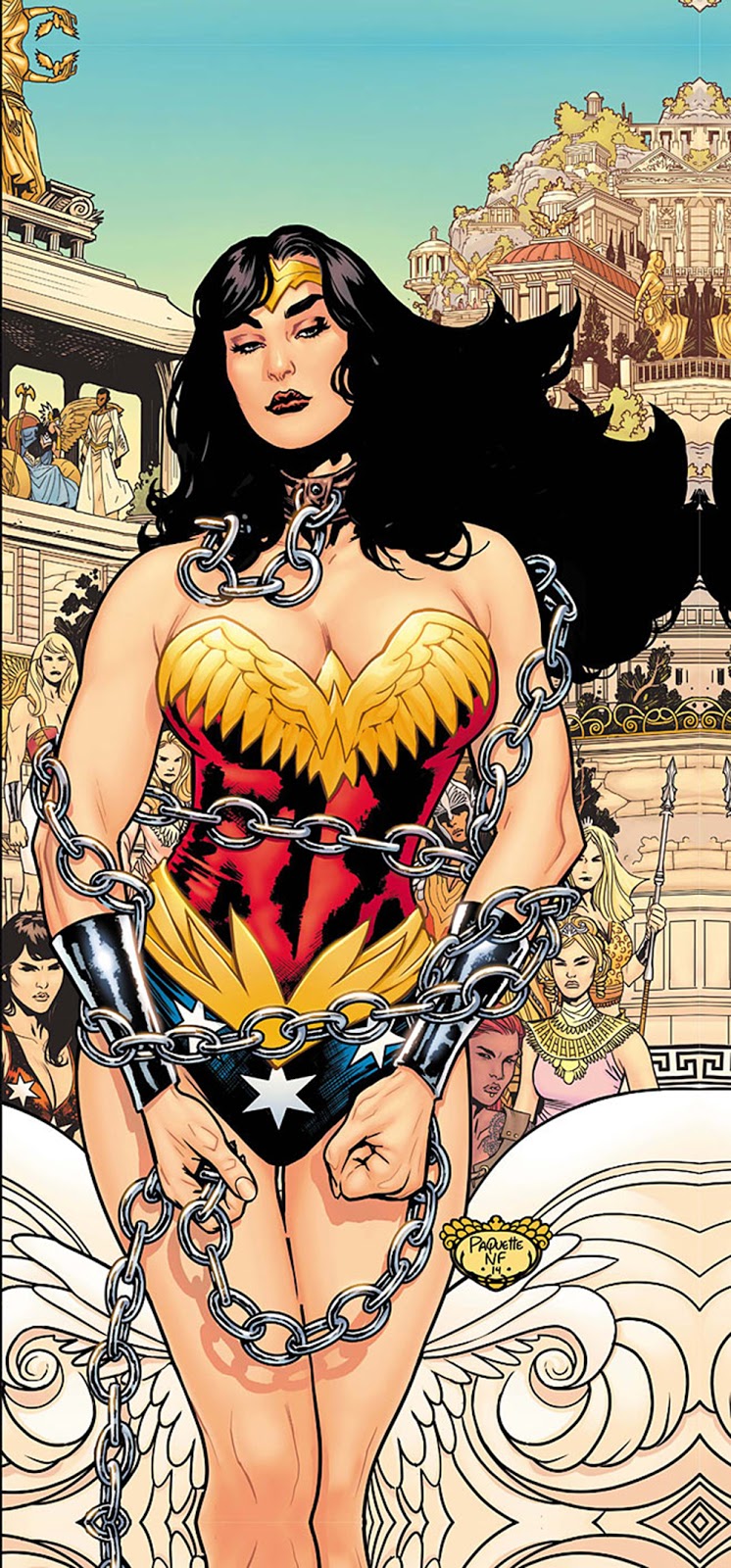
Much – MUCH – better was volume 1 of Grant Morrison’s Wonder Woman: Earth One from earlier in 2016, which provided a new but coherent take on the Amazon’s origin story.

Yanick Paquette’s art worked for me – but then again, I didn’t get in a tizzy about pictures of WW in chains. Well, not that sort of a tizzy.

I really don’t know whether I’ll watch this summer’s film: setting it in WWI as opposed to Wonder Woman’s conventional entry into human affairs in WWII suggests that the filmmakers have decided that, instead of understanding that conflict as six of one and half a dozen of the others, writ large across all the main actors involved, it’s going to leap in with a howlingly simplistic Goodies v Baddies approach.

We shall see.

Normal and the head of Agatha Blue Witch
Very differently, one of my personal discoveries of the year was Andrew MacLean’s Head Lopper.

Written and drawn by MacLean – and originally self-published before being picked up by Image – this is the tale of Viking warrior Norgal, who hunts down monsters with the help (though he doesn’t actually like it) of the severed head of Agatha Blue Witch, which he carries around in a bag.

Image threw the comic convention of monthly, 22-page issues out of the window for this, instead allowing MacLean to produce bigger issues on a quarterly basis.

And while the first trade is a lot heftier a volume than you’d usually expect, it doesn’t fail on the fun quota.

Completely different to Hellboy, it would nonetheless be impossible not to see a relationship between Mike Mignola’s seminal work and this.

There’s humour, violence, great atmosphere and a wonderful sense of the folkloric – yes, all things that you’ll find in Hellboy – along with a superbly stylised visual look, all of which effectively gets the Mignola nod of approval in a contribution from the man himself in the gallery at the back of this volume.

MacLean makes storytelling look simple and his art ticks incalculable numbers of boxes. The picture I’ve used here also illustrates MacLean’s fascinating use of foreshortening and perspective, which is a contributory aspect of the work.

There is not a single thing I don’t love about this.

Black Road comes with added ravens
Not very far behind in my personal appreciation stakes comes the first trade of Black Road, which also plunges readers into Viking terrain – but the mood and look could hardly be more different.

Magnus the Black is a man placed awkwardly somewhere between paganism and Christianity, as the church militant strives to conquer the Viking lands for Christ.

Hoping to perhaps ease the trauma of this momentous change for his fellow Norse men, Black finds himself caught up in the bloody politics of religious conquest – and has to turn detective when an official in his care is brutally murdered.

Brian Wood’s story has a satisfying complexity about it, but it’s the art by Dave McCaig and Garry Brown that really lifts this, with its evocation of the bleak, vast landscape of the north.

Having enjoyed the autumn release of the first trade, I’ve hit the subscribe button for the coming issues in this Image series, rather than wait for trade two.

Actually, that’s also an indicator that I’m getting sussed enough about the comics world that I spotted it before the new arc begins.

In the meantime, Skottie Young’s I Hate Fairyland is another comic that defies easy categorisation.

A bright, bubbly tot called Gertrude wishes to live in Fairyland – and then her wish comes true.

Gertrude is not as happy as Larry. Neither is Larry, to be fair
Unfortunately, 20 years later, she’s grown mentally but is physically still a child, trapped in a bubblegum world of sugary niceness.

A crazy new take on a sort of Dorothy longing for Kansas, Gertrude has become a sweary, psychopathic monster who wants to destroy everything and everyone as she tries to find an escape back to reality, accompanied by Larry, a cynical version of Jiminy Cricket.

Life is further complicated when the queen of Fairyland decides that the only way in which to deal with the chaos and violence is to have Gertrude herself killed.

Written and illustrated by Young, volume one was fun and the second trade is out now (if you look online at Forbidden Planet, it can currently be obtained with a very nice autographed postcard too).

It’s hard to know where Young can take this story – but fluff you (as our less-than-angelic Gertude so often puts it): it’s going to be fun finding out.

And finally, the autumn also saw my own first comic strip – okay, only three pages, but my words and my illustrations. It was published in a membership magazine that went to over a million people, but I've now put up a digital version, so you can catch it here. Enjoy!


Friday, 3 June 2016

By providence, a preacher worth watching

Preacher – the cast
It’s been pretty much gospel that Garth Ennis and Steve Dillon’s seminal comic series, Preacher, would never make it on screen.

Rambling across 75 issues from 1996 to 2000, the Vertigo-published story was apparently stuck in various layers of development hell for years, amid general feelings that it was ultimately impossible to film.

But fast forward a few years, when Evan Goldberg, Seth Rogen and Sam Catlin took up the challenge for AMC – and now we’re able to see the results.

In the UK, the pilot premiered as an Amazon Prime exclusive a fortnight ago. The first ordinary episode will air on 6 June, also on Amazon.

So far, we’ve had the chance to meet the three main protagonists: Jesse Custer, a small-town Texas preacher with a dodgy past who is struggling with his faith; Cassidy, an Irish vampire, and Tulip O’Hare, Jesse’s gun-toting ex.

Around the world, various clergy are exploding in front of their congregations in an unexplained manner – apparently, this includes leading Scientologist Tom Cruise, which may give you an idea of the humour on display.

But while Jesse prays for God to give him a sign of his existence, his body is invaded by something that gives him a strange, new power over people – although he has yet to realise this.

If it has moments that seem to channel Tarantino, it also has moments of surprising tenderness – not least in how Jesse treats the bullying sheriffs son, a young man whose attempted suicide by shooting himself in the mouth has failed, leaving him disfigured in such a way as to become known as Arseface.

The whole thing is dark, violent, funny, mixed-up and deeply un-PC stuff; part western, part road movie, part crime caper, part supernatural thriller, part horror story – but if you’ve ever read the comic, you’ll already know this.

And if you haven’t, then you’re in for a wild, genre-defying ride – and not one for those inclined to take offence easily.

It looks superb, with a wonderful sense of the vastness of the Texan landscape.

And the casting appears inspired. Dominic Cooper looks perfect as the eponymous cleric and nicely conveys the conflicts in the character.

Ruth Negga as Tulip is as feisty and takes-no-nonsense as you’d expect, but it has to be said, on this first outing at least, that Joseph Gilgun is going to steal the show as Cassidy.

It’s a fascinating point that none of this triumvirate of leading actors are from the US: Cooper and Gilgun are English; Negga is Ethiopian/Irish.

And that continues throughout the cast.

On the basis of the pilot, we’re in for a thoroughly entertaining time.

But the start of Preacher was not the only comic-related noteworthy moment of last week.

Arriving on my desk was a very nice hardback edition of the first four issues of Providence by Alan Moore and Jacen Burrows.

This short series of just 12 issues started last year. This first trade is a hardback, limited to just 6,666 copies.

Set in 1919 in the US, Moore returns to his exploration of Lovecraftian horror, intertwining it with elements of real history to create a layered story.

The central character here is Robert Black, a young man trying to make his way as a writer, first as a New York reporter and then with the aim of writing a Great American Novel about the occult ‘outsiders’ that he seeking out – as a metaphor for social outsiders in the country.

And central to this is Black’s own mixed status: at once, part of the privileged white establishment, he is also Jewish and gay, hiding both from most of those he encounters.

But for all that, he is also not immune to bigotry himself.

Some commentators have noted that Black is not particularly likeable. The real point is that he is a flawed and complex character – which is actually what you expect in something by Moore.

And this being a Moore work, it also defies it’s nature as a comic to include substantial amounts of text – both pages from Black’s diary and also from leaflets and books he collects.

Burrow’s art works well in conveying a sepia world that is never far from the strange and the dark.

All in all, a grown-up comic treat.

Sunday, 22 May 2016

Forget the snobbery: comics are no con

If you cant choose one, get the set
There’s little as irritating as snobbery – in oh so many walks of life.

Now to be absolutely fair, there’s also a form of reverse snobbery – or relativism, as it’s known – that asserts, for instance, that EastEnders is just as good as Shakespeare, NWA are genuinely the equal of Wagner, and Minions is as good a film as The Enigma of Kasper Hauser.

Now: time for the declaration.

I watch no soaps. I love Bill the Bard. I do listen to and enjoy some ‘popular’ music – but not NWA. I increasingly believe that Wagner wrote the most stunning music ever. I love Minions – AND I love The Enigma of Kasper Hauser.

Both are possible, without my remotely pretending that that means that the former is equal to the latter in critical terms.
 
I also like comics. And Thomas Mann. (And Günter Grass. And Gabriel García Márquez). 

That doesn’t mean a Superman story is the same as a Thomas Mann novella. But then again, what is? And indeed, few comics (well, certainly not the ones I read) are like a Superman story.

My introduction to comics as an adult came in 1990, when I was handed a copy of Alan Moore’s V for Vendetta to review, and had my mind well and truly blown.


There have been graphic novels on my shelves ever since.

Anyway, this weekend has been special: because yesterday morning, the first issue of William’s Gibson’s first ever comic slid through my letter box.

And Archangel is every bit as slyly engaging as you would expect from the founding father of cuberpunk.

For anyone who doesn’t know, Gibson is a superb and very grow-up sci-fi writer, whose dystopian novels gave rise to the label of ‘cyberpunk’. They’re literate and philosophically interesting.

So, what do we get from issue one of Archangel? Twenty pages in, I’m fully engaged. We have a tale of scientists from a dying 2016 Earth attempting to change history by sending people back to 1945.

I really want to know what happens next, complaining loudly upon reaching the end of the story after 20 pages. This is actually what you’d expect – and largely why the majority of my comic reading is done from trades (collections of several individual issues).

But then this is a comic Event.

Of course, as with Gibson’s novels, there’s far more subtlety involved than such bare phrases suggest. The characters are already clearly beyond mere symbols.

The art – by Butch Guice – is seriously good. Plus there’s a choice of covers for the first issue, just to increase the pleasure (and possible torture) for collectors.


A page of Jaques Tardi's work
And that’s all I can really tell you at this point. But beyond the opening of the actual story, the first issue has much to offer, with sketchbook pages of character development, as well as pages through the processes (both fascinating) and notes from Gibson himself.

That’s not, however, the end of this review. 

In recent weeks, my comic reading has also included the newly-published second volume of the trade of Descender by Jeff Lemire and Dustin Nguyen.

This is good stuff, taking us forward in a story about a sentient robot child, Tim, who is struggling to stay alive in a world where all androids have been outlawed and bounty hunters are constantly hunting for them.

It was pre-ordered for the simple reason that the first volume made me care about Tim, while Nguyen’s unusual (for a comic) art is also hugely appealing.


Also entered into the recently-read list is the first part of Jaques Tardi’s The Extraordinary Adventures of Adele Blanc-SecPterror Over Paris (which forms the basis of a Luc Besson film, in French with English subtitles, which is also worth watching).

Featuring the eponymous heroine – an archeologist and feisty creation of delightfully dubious morality – there are currently four stories available in English, so these are rare and great fun. 

Its always worth pointing out to any snobs that the French regard comic books as the ninth art. 

Trees, by Warren Ellis and Jason Howard is another trade first volume (the second is out this summer), and is a complex interweaving of different stories from across the world, a decade after vast, alien ‘trees’ suddenly arrived and ‘planted’ themselves across the Earth – and then did nothing.

Another fascinating story that gives few clues as to where it is going to go, Ellis’s character and plot development are strong and the art from Howard is equally memorable.


A page from Fables 2
Rather older is Fables, a long series by Bill Willingham, working with various artists.

The overarching story deals with characters from myth, folktale, fairytale and fantasy literature, who are driven from their home lands by the violent Adversary and become refugees in New York, staying hidden from humans and running their own society.

The second issue, Animal Farm, with art by Mark Buckingham, Steve Leiloha and Daniel Vozzo, largely takes place in the community’s out-of-town hideaway for those who cannot maintain a human form or otherwise pass unnoticed among humankind.

And yes, those familiar with George Orwell’s novel of the same name will find links between the plots and ideas.

With an approach that owes more to the darker origins of folk and fairytales than Disney, Willingham’s series is a good illustration of just how grown-up comics can be and would be a candidate for any list of best graphic novel reads.


Volume one of The Autumnlands, by Kurt Busiek and Benjamin Dewey, is another rollicking read: a brilliantly envisaged anthropomorphic world where magic is dying and the elite are trying to save their society.

Unfortunately for them, the secret efforts of a group of wizards to save the situation plunges them all – literally – into serious danger.

Another that’s rated ‘M’ for ‘mature’, Busiek’s story unfolds darkly and brutally. Dewey’s artwork is simply brilliant.

I have no personal axe to grind about comicbook superheroes – I’m rather fond of Wonder Woman – but if you believe that the worlds of Marvel and DC are the only ones in the comic universe, then think again. 

• Archangel issue 1 is out now from idwpublishing.com. 

Descender, Trees and The Autumnlands are all from imagecomics.com. 

The Extraordinary Adventures of Adele Blanc-Sec is published by Fantagraphics Books. 

Fables is available from vertigocomics.com.


Tuesday, 1 December 2015

Adventures in Tintin land

Small can be beautiful – although that seems to be all too easily forgotten when it comes to exhibitions.

In London at least, the recent trend seems to be that bigger is always and automatically better, with shows that can leave visitors utterly exhausted by the time they reach the end.

So it’s a shock to the system to visit Somerset House for the autumn/winter minibuster, Tintin: Hergé’s masterpiece, which occupies just three rooms.

The boyish reporter first appeared in a weekly cartoon strip in 1929 in Le Petit Vingtième, a newspaper supplement for children and youngsters.

But since that debut, Tintin and Snowy (Milous, in the original French) have become global icons, with more than 200 million copies of the famous 24 ‘albums’ sold in more than 70 languages.

Hergé – real name, Georges Remi (1907-1983) – made a signature of his ligne claire (clear line) style, and one of the primary treats of this exhibition is the opportunity to see some of his original drawings up close and personal.

There is a small selection of black and white pages on display, properly laid out as per the finished comic page, and without the lettering – done my a lettering artist until this century, when publishers started substituting digitally-produced text.

Not only are Hergé’s clean lines – executed in India ink – clear to see, but behind these, you can still pick out pencil guidelines, while there are also dabs of white gouache, which was used as a corrective.

There’s some brief biographical data on the artist – I particularly appreciated discovering that he was self taught – but this is not an exhibition where you’ll be overwhelmed by words.

What it does also mention is that comics are known as the ‘ninth art’ in the French-speaking world, which does not have anything like the snobbery attached to art that we do in the UK (of which more in a week or so).

Much of the pleasure comes from seeing how the rooms have been decked out with pictures from the books – like the walls of a mansion, decked in paintings. It’s like walking into one of Herge’s drawings.

In some cases, the curators have utilised the physical building itself – as with a picture of Snowy darting up a chimney from the hearth and with Tintin himself looking in at one of the windows.

And then, in a reminder of the architectural precision of Hergé’s work, there are a number of models, including Tintin and friends driving through a tickertape parade in New York, and his apartment – and who, looking around, won’t wish that these models were not behind glass but could be played with!

This may be a small exhibition, but it’s free – and if you don’t come out of it wearing a broad smile, then there’s probably something wrong with you.

It is, quite simply, a pleasure.

Tintin: Hergé’s masterpiece is on at Somerset House until 31 January