Showing posts with label jazz. Show all posts

Sunday, 17 March 2024

Superb film of August Wilson's Ma Rainey – and not just because of Chadwick Boseman

After yesterday’s early evening football, there was still time for a film and, in this case, it was a re-watch of Ma Rainey’s Black Bottom.

I’ve seen August Wilson’s play three times – I reviewed the National Theatre’s 1989 production, then went to see it with The Other Half when it played briefly at the Hackney Empire (where the roof leaked onto us). Then we went to see it again in the National’s top-notch 2016 revival.

The release of George C Woolfe’s 2020 film – produced by Denzel Washington as part of his long-term project to bring all of Wilson’s plays to the screen – was overshadowed by news of the death of star Chadwick Boseman at just 43 from cancer, while the film was in post-production.

His performance as the tragic, traumatised trumpeter Levee in Ma’s four-piece band – at once full of contempt for the white men who only tolerate the black musicians because they bring money in, but also overly deferential to them because he wants his own band – is brilliant. Little wonder that he received a hat-load of posthumous awards and nominations.

In a way, though, Boseman’s tragically early passing dwarfed the rest of the cast. The Other Half and I streamed it early after it landed on Netflix, having linked up the TV to one of our phones because we were at the start of two months without the internet after a major blow-out. That was how much we wanted to see it – and see it early.

Yet seeing it again now, I can not only re-engage with the brilliance of Boseman, but also better appreciate Viola Davis’s powerhouse performance as Ma.

I’m also now familiar with Colman Domingo, who played Cutler so well, and can enjoy more fully Glynn Turman’s turn as Toledo.

The film landed barely six months after the murder of George Floyd, illustrating just how topical the themes of Wilson’s – and Woolfe’s film – remain.

An essential watch.


Tuesday, 7 May 2019

A Man of Good Hope that ultimately conveys hope

A Man of Good Hope, which has just finished a run at the Royal Opera House’s new Linbury Theatre is an extraordinary work: at once exhilarating and uplifting, yet also a deeply serious piece about violence, war, colonialism, racism and xenophobia.

Adapted by the Isango Ensemble from a 2015 book of the same name by Jonny Sternberg, it tells the true story of Asad Abdullahi.

In 1991, when civil war came to Somalia’s capital, Mogadishu, two-thirds of the city's population fled. Among them was eight-year-old Asad, after his mother was murdered by a militia, and with his father somewhere in hiding. He was swept alone into the great wartime migration that scattered the Somali people throughout sub-Saharan Africa and the world.

Over the years, that migration takes Asad to South Africa, through refugee camps and into townships where xenophobia, hatred, resentment and violence reared their heads.

Somehow never losing his own humanity, Asad refused to give in: even when the odds seemed overwhelming, he continued to believe that, one day, he would be granted permission to go to settle in the global dreamland of the US of A.

Some reviews of A Man of Good Hope have suggested that it is a bit dodgy, since it’s an adaptation of a book by A White Man. Which rather misses the point that the Isango themselves are, y’know, black and African.

Indeed, if you want to compete in a competition for patronising white person of the year, you’d struggle to do it better than telling such a group that they’re ‘wrong’. Or that the premise of the US being a haven for refugees is ‘white saviour syndrome’. 

In the latter situation, the production makes absolutely sure you know, from very early on in the piece, that the belief in an America of no violence, no guns, wealth for all etc is a myth. When Asad and others continue to believe it, therefore, it is poignant because we know what a myth that is.

With a mini orchestra of eight marimbas, and a few upturned plastic bins, Isango has taken the story and turned it into an opera/musical: it’s not just national boundaries that are crossed here, but musical ones too, with styles from European classical to a wide variety of African styles.

It’s a serious, thought-provoking piece, yet somehow doesn’t leave one feeling depressed.
Siphosethus Hintsho (pictured above, bottom right) as the child Asad, rather steals the show – this is an exceptionally talented youngster – but Isango is an ensemble and there are no weak spots anywhere on stage. They all act, they all dance, they all sing, they all play instruments. And they all do it very, very well.


It’s difficult not to feel a Brechtian influence, but this is not westernised Africa: this is an African story – and a global one. And yes, given history, it is a predominantly South African way, with western influences. But ultimately, with an unmistakably authentic African voice.

Friday, 22 April 2016

Ma Rainey's Black Bottom: an American tragedy

It was 27 years ago when the National Theatre last produced August Wilson’s breakthrough play, Ma Rainey’s Black Bottom, with Hugh Quarshie wearing tights trousers to strut his stuff on top of a table.
 
I saw it twice: the first time to review, and the second – under the leaking roof of the Hackney Empire, to growl quietly in appreciation at Mr Quarshie.

This new production offered a welcome chance to reappraise it.

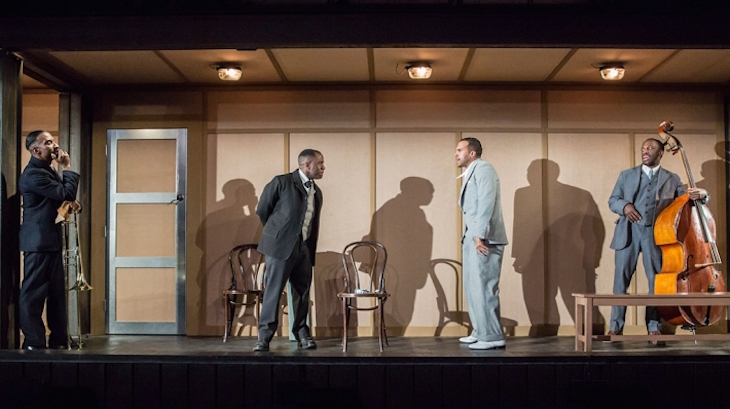
It’s Chicago, 1927. A quartet of four musicians meet in a studio for a recording session with Ma Rainey – the ‘Mother of the Blues’ – and, while they wait for the diva to arrive, the good humour of their banter thins to reveal underlying tensions.

The ingredients are simple: four talented men (and one woman) who are of use to white music bosses as long as their music produces cash dividends.

But the three older members of the quartet – bookish pianist Toledo, band leader Cutler and bassist Slow Drag – have all found ways of dealing with their situation as black men in the US.

Trumpeter Levee, however – hardly a boy at 32, but still the youngest of the four – is caught between rage at the situation and an ambition to have his own band and write his own material that sees him act with overt deferentiality toward the studio boss.

While the central theme here is an exploration of the African-American experience, it also does much more.

One of the interesting things here is how stories provide a defence.

Toledo, Cutler and Slow Drag tell stories that, to varying degrees, have an aura of folk tale or myth about them. Religion features, but not simply as comfort (it is the reason why Toledo’s wife left him, for instance) and often bound up with folktales.

When Cutler tells them a Faustian tale from his own home town, Toledo nods vociferously, noting that he’s heard the same thing, hundreds of times.

The stories reflect a shared experience and sense of community – beyond the purely historical, biographical and rational – and they appear central to the men’s sense of self and their ability to weather the indignities that are thrown at them.


Cutler, Toledo, Levee and Slow Drag
Even Toledo’s book-learned philosophy and history add to his defences.

But Levee, however, has no such stories and no such learning.

He joshes at the others until, challenged over his attitudes toward white people, he reveals how, as an eight-year-old child, he had seen his mother gang-raped by white men, and his father was subsequently hung and burned for daring to exact revenge.

There is no mythology here; nothing other than a raw, horrifying description of what a child witnessed; no shield against the weeping sore at the core of Levee’s being. He has no defence against his experiences.

Religion offers no comfort: when a row breaks out over his perceived blasphemy, we discover that his mother cried for divine help as she was raped, so he continues to challenge God to strike him down.

In all that he does, Levee pushes boundaries, as though deliberately daring those around him to respond negatively.

And when the levee eventually – and inevitably – breaks, it is with tragic, if unexpected, consequences.

This is a superb drama – a tragedy that operates on many levels – with dialogue that possesses a music of its own to counterpoint that blues that the characters are together to record.

And the National has – once again – given Wilson’s play the cast and production that it deserves.

Dominic Cooke’s direction never lets it sag. Ultz’s set is pared back and cleverly allows a sense of the liberating nature of the music (in a space that seems never to really end), the claustrophobic nature of the limits placed on black lives, and the social relationship between black and white men.

Title apart, Ma Rainey is not the central character here, but while she is on stage, she needs to exert a big, powerful influence – and Sharon D Clarke is marvelous in the role. Thank goodness too, that she gets one full song to show us what a fantastic voice she has.

Clint Dyer as Cutler, Lucian Msamati as Toledo, Giles Terera as Slow Drag and O-T Fagbenle as Levee all turn in top-notch performances – in terms both of their musicianship as well as acting.

You have until 18 May to catch this. It is very much worth the effort. 


Wednesday, 22 April 2009

Melly's Navy lark is a rum read


Rum, Bum and Concertina by George Melly

George Melly was one of that great tradition of English eccentrics – unconventional in so many ways, and worthy of national treasure status for that alone.

Rum, Bum and Concertina is the second volume of his memoirs, and with its title evoking the author's version of 'wine, women and song', it covers the years of his national service in the Navy, a service he joined because he thought that the bellbottom trousers that sailors wore were more becoming than other uniforms.

There isn't a huge amount of concertina here – but there's no shortage of rum and bum.

The book relates some of his many sexual experiences, from Melly's initially considering himself 100% gay to his first introduction to straight pleasures, thanks to the wife of a very liberally-minded couple (and her husband, who was entirely accepting and encouraging of the arrangement).

The book is peopled, as one would expect, with extraordinary characters – although it begins in the later stages of WWII, the world it portrays could hardly be further from that stiff upper-lipped ideal of Englishness, as conveyed by so many films both of the era itself and later.

And when the anarchist surrealist Naval rating started visiting London regularly, it was to a Bohemian world that included Fitzrovia, the corner of London where Bloomsbury meets Soho, which was thus christened by MP Tom Driberg, and where Melly encountered, amongst others, a drunken Dylan Thomas and England’s stately homo, Quentin Crisp.

And even the Navy, given the time, seems to have been remarkably tolerant of homosexuality, which going on these memoirs, seems to have been quite prevalent, even though it would be more than 20 years before decriminalisation.

The book also includes a fascinating explanation of the term: 'shake a leg'. Apparently, the Navy had, in earlier years, allowed women to spend the night on board. When the call went up in the morning to rise, any sailor with a woman in his hammock would be allowed an extra hour there. And to check this, the call would go up: 'Shake a leg!' At which any women present would pop a leg over the edge of the hammock, thus revealing the presence of a female of the species. Although this was rendered slightly more complicated when some sailors took to shaving their legs in an effort to gain their extra hour kip without requiring a female companion.

Jazz, of course, features. But mostly in terms of Melly reporting that he and some shipmate listened to some records. Only rarely are there hints of his future career, when he describes having given very rare (at the time) singing performances.

Huge fun – very funny – and as fascinating an evocation of an era as Scouse Mouse, the first volume, is of that period.