Showing posts with label urban. Show all posts

Tuesday, 28 April 2015

Discover London – before it's too late


Leadenhall Market
Some years ago, just as I was getting interested in photography, I took to going on Sunday morning photo safaris around London.

Some were to the more salubrious areas, some to where visitors mass and others still to streets and alleys that will not be likely to find themselves on the tourist trail.

Quite a few of these came as a result of an informal online photographic project: each week, the person organising it would set a place as a subject and those who wanted to participate would go, snap away and then share their efforts.

It was interesting to see how different people saw and approached the same subject, and it also provided an opportunity to discover parts of the city one might not otherwise ever come across.

I hadn’t thought about this for some time, but was reminded of it this morning by seeing #DiscoverLondon trending on Twitter.

‘Yes,’ I thought: ‘discover London before it’s too late.’

Falkirk Street, Hackney
There’s not been a time since I moved to London in 1988 that there hasn’t been construction work going on somewhere. But in recent years, in almost every direction, the skyline has become a forest of cranes as development and redevelopment have surged ahead.

Now I want to be clear that I have no aversion to modern architecture per se – I’ve enjoyed quite a few rambles with the camera amid the steel and glass, but what’s happening now is not the stuff of good or interesting new building.

Crypt window, Christ Church Spitalfields
This blog has previously touched on the boom in high-rise towers that are soaring above us. Some of them are interesting buildings. Some – and I am thinking particularly about the ‘Walkie Talkie’ – are simply hideous.

But even that is not the point. The gentrification of London – and it’s happening elsewhere too – is getting dangerously out of hand.

There’s a human cost to this: it’s a form of social ‘cleansing’ that has been discussed far and wide. The cost of housing long since became ridiculous – it’s now a question of
St George's Garden
needing to find over £400k for a home in the capital.

In September last year, it was reported that the average cost of a home in London was £515k. It’s £272k in the rest of Britain, which is hardly cheap.

Wages have not risen to the extent that most people can get a mortgage for three times their annual income that will buy them such a home. How mortgage lenders are, therefore, getting around this, I do not know, but it can hardly be sensible and sustainable.

Off Middlesex Street
There’s another aspect to the gentrification, though: it’s producing a city where character is disappearing as fast as the developers move in.

Denmark Street – our Tin Pan Alley – is earmarked for replacement with the anodyne. Norton Folgate, in the City, is under serious threat too. Soho is having its soul stripped out.

Many other areas are going the same way.

In Brixton just this last weekend, there was a demonstration against what’s happening there, with communities feeling that they’re being forced out by redevelopment and rising prices.

Change Alley
The situation is, however, complicated by
certain factors.

Broadway Market, just around the corner from me, has undergone a revolution in the last 12 years or so.

Moving into the area two decades ago, it was three quarters derelict, usually with hardly a soul around and not enough shops to buy the ingredients for a meaningful meal.

As illustrated previously, in a lengthy interview with one of the very few traders who had survived those desolate years, the growth of supermarkets had been a factor in that decay.


Pearly king at Covent Garden
A piece of local graffiti was memorable because it was accurate: “Broadway Market,” it declared: “not so much a sinking ship as a submarine.”

As the street started to revive, some locals complained. Yet apart from some dastardly dealings by local developer Roger Wratten by name rat by nature, it’s not been a case of losing much.

The street is always busy now – which also means it’s a bigger employer – is a darned sight more pleasant (even with the hipsters and more wheelie toys than Hamleys on a Saturday), and has enough of a range of independent shops that you can actually do most of your shopping there.

No, they’re not the same sort of shops, but since the majority of those who had abandoned the street for Tesco all those years ago had shown no sign of coming back, the shops are catering to a different, more middle-class market because that’s how they’ll survive as businesses.

Princelet Street
Those who complained that there shouldn’t have been any market on Saturdays, on the grounds of gentrification, never had any alternative plans to revitalise the street.

Similarly, you see something similar when dozens of people suddenly turn up to protest against a local pub shutting, having not bothered to give it any custom for years, if ever.

In other words, the issue is neither entirely straightforward nor bad per se.

But the problems don’t stop with regeneration. As has been seen across London, rising rents then further push the small independents out, to be replaced by franchises and chains.

Coronet Street
Think Leadenhall Market – a glorious building, tragically sanitised as hiked rents drove out the
likes of a fabulous fishmonger, a poulterer and a butcher.

Think Borough Market – revived to foodie heaven, but now becoming ever more a vastly over-priced stop on the tourist trail.

London is in danger of becoming simply a sort of theme park for those passing through.

So do #DiscoverLondon: look up above street level when you’re on foot: even Oxford Street is interesting when you gaze above the shop fronts. Look at the street art too – some of it can be fascinating and adds to some otherwise dour areas.

Postman's Park
Find out about some of the places where the photographs here were taken. Maybe even go and have a look at some of places they were taken in.

We have a fascinating city. So take a little time to discover beyond the bland and the corporate and the soulless.

And take any opportunity to look a little deeper, if you discover that an area is being scheduled for redevelopment.

Let’s all attempt to ensure that London – and all our cities and towns – are not rendered devoid
of any character by those who have no interest in them other than as money machines.

Look before it's all gone
And don’t forget that local businesses will only survive if we use them. Don’t go crying outside that pub or that butcher or that library when its shutters go up for the last time if you’ve never crossed the threshold in the past decade.

All photographs copyright.

• You can follow @londonerwalking, @SpitalfieldsT and @createstreets on Twitter to find out more about the city, its history, regeneration and development.


Tuesday, 25 February 2014

Save us from faux architecture


The Brunswick Centre
An elegant ramble into Bloomsbury yesterday evening for a tonsorial tidy up brought me alongside the Brunswick Centre – now fashionably rebranded as The Brunswick.

This icon of the concrete brutalist style was designed in the mid-1960s by Patrick Hodgkinson, based on studies by Leslie Martin, and was built between 1967 and 1972.

It differs from many brutalist buildings primarily in having been whitewashed, which gives it a slightly gentler appearance than, say, the National Theatre.

Back in the 1990s, I resided there for 18 months, so can say from experience that it is a perfectly decent place in which to live – the brutalism does not brutalise or oppress.

Gherkin reflections
I continue to appreciate its intriguing lines and forms: it’s expanse, seen against a blue sky (yes, rare I know) is bold and varied and not at all intimidating.

Indeed, if there’s any personal mystery for me, it’s why such a building still upsets some people so much.

Mind, that could take us right back to the National Theatre, which was designed by Sir Denys Lasdun and Peter Softley, and built between 1963 and 1976.

For all the criticisms of it – including the notorious denunciation of it being like a nuclear power station from that self-proclaimed guardian of our country’s architecture, Prince Charles – it found perhaps rather unexpected fans.

Of all people, that archetypal old pastoralist, Sir John Betjeman, wrote to Lasdun declaring that he “gasped with delight at the cube of your theatre in the pale blue sky and a glimpse of St Paul’s to the south of it. It is a lovely work and so good from so many angles ... it has that inevitable and finished look that great work does.”

Camden Town Hall
I have always liked the National – again, lines and angles: shapes that draw you in, that reflect light and absorb shadow to create yet further angles and planes.

These buildings seem to me, even now, to represent a bold and clea/n and optimistic future: I cannot see in them anything to depress.

What is depressing is Paternoster Square and its ilk: both desperately banal and simply desperate – the latter, in its weaning effort to placate the likes of Charlie Windsor and to somehow blend in with Wren’s magnificent cathedral next door.

Yet all it does it to conjure words such as ‘faux’ and ‘pastiche’, just as does Charles’s vanity town, Poundbury, which even includes pre-bricked-up windows designed into the new-old buildings.

Against Wren, they look all the poorer. I’d have given the space over to the likes of Richard Rodgers or Norman Foster and said: ‘go for it’. And then you might have got a world-class, iconic building.

Instead, it’s every bit as bad as those ghastly supermarkets that attempt to ape an old-fashioned look in their attempts to con people into believing that what is inside has some sort of culinary authenticity.

Kemble Tower
But the prime question remains: just why are so many people so apparently intimidated by buildings that divert from suburban convention?

None of this is to suggest that all modern buildings are brilliant, but it’s errant nonsense to suggest that they’re all bad.

And concrete brutalism is no different.

There’s a fair old amount of it around: the Barbican in London is but one more example – another immensely successful one, with its public spaces, water features and gardens giving it a sense of calm amid the wider City.

The Lloyd's Building
That wider City is a fascinating place to ramble if you’re remotely interested in architecture. In a small area, it possesses at once everything that is worst about British modern buildings and everything that is best.

In one tiny area, we have Norman Foster’s glorious ‘Gherkin’ – an elegant, spiraling tower – and his Willis Building, another monument to the power of glass and steel.

In the same area are Richard Rodgers’s Lloyd’s Building and now his new ‘Cheesegrater’, soaring into the sky above.

As architectural competitions go, this is really very good.

On the other hand, only a short distance away is the ghastly ‘Walkie-Talkie’ building and, just over the river, in an isolation that highlights its inappropriateness, the Shard, which now dominates every view over the area.

Willis Building (Lloyd's, to the right)
And for a different take, there is Broadgate, with more of those pretend columns and mock, mock invocations of classical styles.

Why the fear of the new?

The old and the new can coexist and compliment each other perfectly.

The British Museum – now graced with Foster’s magnificent inner court that surrounds and covers the original Reading Room, and soon to see an extension by Rodgera – is one such example.

The new UNISON building on Euston Road, which has sensitively incorporated the old Elizabeth Garrett Anderson Hospital for Women into a new structure, is another.

Architecture is ultimately about living and about our wider aspirations.

To desperately try to remain living in the past limits us all.

And to pretend that modern architecture, when done well, cannot hit the heights, is clearly the folly of rather limited minds.

• All photographs © Amanda Kendal

Monday, 3 June 2013

Community gardening in the car park

The potager develops,
If June isn't quite busting out all over, there still seems to be a marked difference over the last three days. It actually feels as though it could be spring. Or summer. Or just spring.

After the coldest spring for 50 years, it's actually hard to know. Or to be more precise, summery weather, so suddenly, is rather disorienting.

But yesterday was the first time that I was joined, in gardening, by other residents of our little block - something that spoke volumes for the change in the air (and, if you'll excuse a little self-congratulation) for my own dedication over the last few months.

Michael disappeared in his car and returned, some time later, with two bags of compost and some polystyrene trays of flowers: begonia and geraniums. And he then took plastic planters and a pot that have been waiting for an age, and filled them.

I took the rake and cleared a space just next to the potager and two of the planters and a pot now line the long edge.

Suddenly, it seems to look more beautiful than for years – if perhaps ever.

A brief bit of background.

This block was built - well, finished - 18 years ago this month. The Other Half and I moved in 18 years ago in July (with Mack and Mabel). We were both low-paid and were renting in the private sector - not being ripped off, but struggling none-the-less.

This was - is - a housing association, shared ownership block. It gave us the chance for a much better life in many way.

We had rather fancied one of the flats on the second floor, overlooking the park. But the moment we asked the housing association if they were okay with cats, they put us into a downstairs one. Until that moment, it hadn't even occurred to use to think that there would be (small) gardens.

There was no gate from the garden into the carpark in those days. It took us until November 2011 to remedy that, when we had the whole garden paved, getting rid of the excuse for a 'lawn' that we'd struggled with since moving in.

As only a slight aside, this is by far and away the longest I've lived in one place in my life and, a few years ago, I realised that it had ceased to be 'a place where I live', and become 'a home'.

But the gate was crucial. Before that, while we knew one or two of our fellow long-term neighbours, we would had to go out of the front door and then into a communal door and out of a rear communal door in order to get to the car park, where some of them socialised.

The block was built on a plot of land that had been a junk yard, with an old pub right on the corner. The up still stands, albeit cowboy-transformed into flats.

And for the first years, the housing association employed a decent gardening company to come and look after the car park area: not just keeping the paving weed free, but also taking care of the three flower beds in the area, two of them stubby fingers, dividing the allotted parking spaces, and one, a rather larger corner affair that partly serves to block off the communal bin area.

That changed a few years ago, when the association put the contract out to tender and got - surprise, surprise - a cheaper offer. Unfortunately, a cheaper offer also meant considerable less actual gardening.

And so, last year, when I had started gardening in pots on the patio, and then found myself desperate for more, my neighbours were so happy for me to dig out a little bit of that big bed in the car park.

And once it had started ...

When we were in France last August, Michael and Lisa simply ripped all the weeds and the dead, rusting bikes, and the dying bush out, so that I came back to what seemed like an enormous space.

We've talked about it ever since, but only this weekend has anyone other than me been out there, doing things.

I do rather like the idea of communal gardening - although it would be nice if the housing association recognised our contribution in terms of the service charge that we pay and which has been unchanged since those contractual changes.

This weekend, before Michael arrived with the flowers, I had weeded with the hoe as usual, thinned the turnips, added support to the broad beans and a third layer of string for the peas, and sown some lovage.

Anca, another of our neighbours - a wonderful artist who gave me a lovely picture for my birthday - loves lovage and has, over the last few years, nursed a single plant in a small pot near one of the communal entrances.

I had decided to find more, and eventually did so. It took me a while, but I found some Duchy Original seeds.

Now I doubt that either Anca or I are great royalists, but Prince Charles's brand is organic and of quality. And on the issue of organic, I find myself utterly in tandem with the old boy.

The communal gardening won't all be very romantic: we're already planning to weed the car park, given that the company being paid to do such things hasn't been seen in months - if this year.

There's a point at which this is annoying. We are being ripped off. W are, after all, still paying the same service charge, which is supposed to include the 'garden' areas.

Yet before I started digging out a tiny part of one flower bed last year, we were still being ripped off. The only difference is that now we've decided that, instead of waiting for some cheapskate company to do something, we'll do it ourselves.

And since I'm paying for it anyway, at least now I'm getting something for my money.

Besides which, if the communal gardening really takes off, then that's probably priceless.


Wednesday, 20 March 2013

Spring is here! (well, sort of)

The dwarf daffs have bucked the trend.
It might be difficult to believe, but today was the vernal equinox – the first day of spring.

No, I know: looking out of the window – in much of the east of the country at least – you wouldn’t be able to tell.

The sky is a blanket of grey-white cloud, putting an unrelenting dampener on everything.

As we head into evening, the birds that were at least twittering to each other under that cover have gone quiet, as the rain starts to fall again.

Someone said to me yesterday that it feels as though we’ve already had six months of winter. And it's impossible to disagree.

Temperatures are below what they should be and the gloom seems to be sticking around.

Peas, broad beans, a hint of runner & radish.
The bright spot on the horizon is that the vernal equinox is a tipping point. Since, from now on (for six months) the days will be longer than the nights in this hemisphere, the sun will – eventually – break through and temperatures will rise.

But for the moment, while some of the country is having better weather, many of us remain buried beneath that cloud.

And frankly, it feels as though we’re underneath a duvet where someone has farted.

Of our bulbs, the crocuses have been and gone – without the weather to enjoy them – and we now have dwarf daffs, which are managing a glorious display that, frankly, gives the bird to the weather.

From the perspective of the garden, this late, late spring would seem to be a big problem. Yet I do wonder if it’s actually a bit of a blessing too.

In only my second year of gardening – and arguably this is really only my first serious one – the weather is meaning that I can’t simply take what I read in a book, a magazine or a seed packet at face value.

In other words, I cannot be a book-learned gardener.

Perhaps the fact that I have all those seed cells sprouting new, delicate plants is simply beginner’s luck, but maybe not.

There is an extent to which I decided to start things off that way even though seed instructions suggested sowing straight outside last month.

In other words, I looked at the weather, looked at the packets – and then made up my own mind based on what I saw and felt was happening.

This, I think, may be a good sign for the future of my gardening. Perhaps I'm more in tune with something than I could have known 12 months ago when I started this project in such hesitating fashion?
It really doesn't look much like spring, does it?

What I do know is that it was a delightful ego rub to read Monty Don asserting, in My Roots, that real gardeners are those who sow from seed rather than buying a load of plants.

Mind, nature is more than capable of deflating ego. Slugs and snails are the perfect vehicles for that.

But I have strategies in mind and in place.

The potager is in a far better situation than it was last year.

With all the weeds and the dead and dying bush removed, there’s nowhere for slugs to hide during the day time. So the easiest option for the forthcoming months is to make sure that none get a foothold.

The potager, after carrots were sown at the weekend.
And a Dutch hoe makes attacking weeds before they can grow much really easy.

I also have copper ready to encircle any tender young plant. And will be getting copper tape to wind around any pot in which I intend to grow salad leaves, for instance.

There will be an odd ‘slug inn’ – a pot sunk into the ground and containing yeasty beer in which greedy slugs and snails will drown – but they’ll be set away from the plants I’m defending.

And there will, of course, be after-dark patrols, with torch and latex gloves to get rid of the little buggers.

I have learnt a thing or two already.

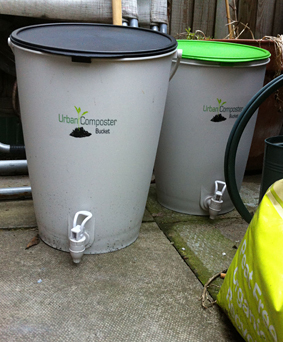
Urban compost buckets: perfect for small spaces.
And I will learn more.

But I have just this inkling – this tiny sense in myself – that maybe I do have green fingers; that maybe I have a greater connection with and sense of the soil than could have been expected.

In the meantime, I now have two 'urban compost' buckets that will allow me to create my own fertiliser and compost in a tight urban environment. It's another step up and solves the problem of space.

At breakfast in the canteen this morning, I was talking with someone who has an allotment. We hit a point where we burst into life discussing how wonderful it is to grow from seed and things germinate and develop.

Life-affirming; magical; magnificent; wondrous.

And even when we find ourselves, as now, battling the unseasonal elements, we can lift ourselves by knowing that, eventually, spring really will be with us.


Monday, 4 March 2013

A god in my garden


Late winter light and shade.
As the march toward spring continued, the forecast weekend sunshine arrived on cue, providing the perfect opportunity to spend quality time outside.

There was plenty to do, but the weather was such a convincing call to action that it felt effortlessly enjoyable.

Out of the breeze, the sun had real warmth, and with the brightness that dominated both days, it was intoxicating.

Saturday’s activities surrounded the potager; ground was prepped for sowing and plastic tracking, strenuously linked together, was laid down to provide a pathway between planting areas.

And then, in three spots, were sown peas (Meteor), broad beans (Witkiem Manita) and – probably wildly optimistically – some runner beans (Painted Lady). All are now covered with plastic bell cloches.

The runner beans shouldn’t really go in for a while, but as Monty Don said last year, if we’re going to get so much grey – and rain and god alone knows what else – then maybe we need to rethink some of the old formulas a bit. It’s certainly worth a try – not least as part of my learning process.

Stencil: Columbia Road.
Later, wigwams will be erected next to each group, and more seeds/plants added to (hopefully) ensure lengthy and generous cropping.

It was exhilarating: even the fact that I found myself wondering if I really had a clue what I was up to was joyful in its sense of unregimented experimentation and the attempt to do something so positive.

Over the weekend, various people commented on my progress. There was the father of one neighbour I don’t know who wished me luck, but then seemed fascinated to learn that the soil that he assumed was dismal should be home to countless worms.

Then there was Michael, the neighbour who had done so much to strip the weeds out of my patch once I’d started last year, and who is now so tickled and excited by the whole project that he’s decided to address me as Percy Chucker.

I feel faintly guilty at being so possessive of it – although Michael has a patch in the flower bed nearest his flat, which he also cleared last year, while Lisa is intending to make the most of the middle bed.

Everyone will be welcome to use the flower seeds that I seem to be accruing regularly as freebies.

Light and shade in Columbia Road.
And for Anca, who also wants to get stuck in, I’m going to get lovage seeds: she has just one small plant in a pot and relishes what it brings each year.

So this is not a one-sided relationship.

It’s funny really: of those of who know each other and speak regularly (about half the flats), we were all were peeved with the way that the housing association-employed garden contractors had let things get overgrown and out of hand, but we did nothing.

It was only my greedy desire to grow more that kick-started something last year.

Thus it was a group of us, one bright Sunday last year, that pulled down and cut away the climber that had covered much of the ivy on the carpark wall, had grown over the lights and was spreading out from the wall to the small tree that stands at the heart of the potager.

So as things warm up and the days stretch out like a cat on a warm hearth, it’s not difficult to imagine days when there will be gardening activity across all three little plots; gardening shared and enjoyed communally.

Choosing: Columbia Road Market.
On Sunday evening, Les delivered another 240 litres of organic, multi-use compost, which will help fill the space vacated by the rubble that is now heaping up against a wall beyond ‘my’ area.

This provided pleasant early-evening labour after work today and will be continued tomorrow. I’m hoping the area will be okay for sowing carrots and turnips by the weekend.

And how extraordinary to hear an early dusk chorus from the plane beyond the wall; so many different songs making me wish I knew each call.

But the patch also welcomed a new resident on Sunday afternoon, after an exploratory amble down Columbia Road produced a blackcurrant bush.

It’s not an easy fruit to buy fresh: something like 90% of the UK’s domestic blackcurrant crop goes straight to Ribena – an insult to a fruit that, used properly, whether as the base for a sorbet or a good jam, is gratifyingly grown up.

Which is why it’s the fruit bush I’d prioritised over any other – much as I love gooseberries and fantasise about making my own redcurrant jelly.

And of course, this is the time of year to plant fruit bushes, so the timing was perfect. Frankly, at £5.50, if it produces three punnets of fruit this year, it’ll have paid for itself already – and it looks lovely and healthy, with a mass of buds foretelling growth to come.

Otto exploring the potager.
According to a variety of sources, blackcurrant requires a deeper hole than you’d imagine; needs fertilising straight away (it got some organic seaweed food all over the root ball) and will need mulching in the next few weeks – so another trip to Hackney City Farm will be required, if only for a bag rather than a barrow of manure.

In the meantime, there was plenty more sowing to undertake – two more trays of 40 cells apiece, now nurturing two varieties of strawberry, four varieties of tomato, lettuce, more radishes and spring onions – and chard.

Chard? I’ve never even eaten it (to the best of my knowledge) but it was a free packet that was languishing at the bottom of the tin, so it seemed eminently sensible to use it.

My goodness: this is addictive!

But what pleasure and what a sense of something real as I rubbed compost between my fingers on Sunday, dying them black; and as I pressed seeds into the moist dark, a god in my garden, granting the opportunity for life to grow from what seems, on the surface, like shriveled death.