Tuesday, 24 January 2017

A heavenly dinner at The Salt Room

Mackerel, beetroot etc
In recent weeks, I’ve had a number of conversations with people who question what a ‘fine dining’ experience gives you other than a bigger hole in your wallet.

If you asked me that same question 15 years ago, I’d have been thinking along the same lines. But experience can be a great educator.

On Saturday night, working once more in Brighton, I headed for the Salt Room.

Having opened in February 2015, I’d first tried it, along with the Other Half, last June. When I was in the city again in October, I returned for a solo meal and after that, I never had any doubt that I’d be back as soon as possible.

If I’ve worked out one thing about what divides top-level dining from eating out lower down the scale, it’s that the really good experience is flawless throughout – however many courses you have.

Elsewhere, you might find that one or even two courses will be fine, but something else just won’t be up to the same level.

One of the things that I like about the menu at the Salt Room is that it’s proudly seasonal.

At the weekend, I began with a dish of mackerel, miso and beetroot in a variety of way, including pickled and as a ketchup.

Slip sole, turnip, nori butter, shrimps, celery, capers
The fish was cooked to perfection: griddled on the skin side until it was black, but with the flesh just done; flaking and moist.

One of the things that this sort of cooking makes you notice is just how fresh the fish was in the first place: you can taste the freshness – and the contrast with the crisped skin was sublime.

The use of Japanese flavour in miso was subtle and never threatened to overwhelm the delicate fish, while the beetroot provided an earthiness to the whole thing.

This was a joy to eat.

For a main course, I stuck with fish and opted for slip sole with diced turnip, nori butter, tiny shrimps, capers and celery.

Honestly, it really is no exaggeration to stress just how good this was. Again, the fish was clearly impeccably fresh and had been equally impeccably cooked.

It was a dish of extraordinary natural sweetness, tempered by the capers: very satisfying.

I didn’t bother with any side dishes (I’ve mentioned before that such a concept seems peculiarly British) – the portions were a perfect size for me.

One little guide to how good the food is at any restaurant is the issue of seasoning. There are salt and pepper pots on the tables at the Salt Room, but in three visits, I have never felt any remote temptation to pick either up.

Result
My waiter – Alfonso from Sicily; a knowledgeable charmer – thought that it was wrong to even offer customers the salt and pepper: some douse their food before even bothering to taste (something that Raymond Blanc described being appalled by in his book, A Taste of My Life).

It does beg the question of why you bother going to a good restaurant if you don’t start from a point of implicitly trusting the kitchen.

Another basis on which to recommend the Salt Room is that it has a far wider range of wines available by the glass than is often the case.

Here, Alfonso chatted with me about matching wine to my choices and gave me the chance to taste two wines before selecting. That’s really good service.

In the event, I enjoyed a Riesling Trimbach – but it was fascinating to have tried another possiblilty.

Being given time to sip my wine and contemplate the dessert menu in an unrushed gap between courses is, for me, vital.

So, what could I select to conclude such a meal?

It was an enticing dessert menu, but what stood out for me was rhubarb and custard: “custard tart, roasted rhubarb, rhubarb & Sauternes ice cream”.

Rhubarb and custard
It’s the start of the season for forced rhubarb, after all, and rhubarb is one of my favourite fruits, so selection was made easier.

A ‘custard’ of vanilla infused panna cotta, rich yet light at the same time, is served with rhubarb in a variety of ways – including a wonderful, wafer-thin crisp and ice cream – and a hint of crumble.

It was heavenly. There is nothing more that needs to be said.

If I have a liqueur after a meal, it’s usually a Disaronno, but Alfonso persuaded me to try something different – Frangelico, a hazelnut liqueur – and it was a very pleasant way to conclude a simply superb meal.

You do get what you pay for in food terms – certainly in the UK at present. In France, you can still find little bistros and brasseries that give you a memorable experience for little outlay.

But as I’ve seen, time and time again in recent years, dining out both for pleasure and particularly when away from home for work, that sort of middle tier of eatery in the UK is often far from cheap for food that is far from sensational.


I have no doubt that I’ll return to the Salt Room again.


Tuesday, 10 January 2017

Further adventures in comic land

Atmospheric artwork from Andrew MacLean
The last part of 2016 saw plenty of action on the comic front – it’s become a serious pleasure to get regular deliveries of Forbidden Planet subscription packets through the post – and there’s been plenty to enjoy from what’s been inside.

Here’s a few notes on what I read and saw in that period.

Descender 3: Singularities by Jeff Lemire continues to be a cracking read, with this third collection playing with time to allow us to see events from different characters’ perspectives, and there’s enough meat here to keep the reader wondering what they’re not yet seeing, as the companion boy robot Tim finds himself being hunted by myriad forces – and the motives are not obvious yet.

And one of the things that Lemire achieves is to make the less sophisticated robots’ characters too, creating real pathos – light years away from the comedic approach of, say, C-3PO and R2-D2.

Panel from Descender 3
Dustin Nguyen’s art remains a real pleasure, his watercolours in a limited palette offering an unusual approach to sci-fi illustration, but one that works beautifully here, offering a soft-focus contrast to the story that nonetheless never jars.

Trees 2: Two Forests arrived a while back and takes us further into Warren Ellis’s apocalyptic tale, narrowing the field of vision to just the ‘trees’ – alien craft of some unexplained variety – in New York and the Orkney Isles, and with these, the central protagonists linked to them.

There’s a brooding darkness building here, with a sense of impending doom and even an incident in London that could be read as a pessimistic comment on the growing anti-immigrant sentiment that both contributed to Brexit and was boosted by it.

All this is helped by Jason Howard’s art, with strong images and a muted palette providing an excellent compliment to the words.

On a lighter note, I have also enjoyed a spot of Doctor Strange from Marvel – though not half as much as I enjoyed the film. Indeed, with TV watching and 2016’s cinema visits for the doctor and Deadpool, I’ve got really quite absorbed into the Marvel universe – albeit it cinematically rather than the version on paper.

"We are Groot" And the racoon's pretty cool too
Big screen trailers for spring’s Guardians of the Galaxy II looks so much fun that I caught up with the first one over Christmas – and loved it! It’s smashing entertainment.

Late as ever to such a party, I am however, now able to cry ‘We are Groot!’ with the best of them.

Then there’s the mere thought of autumn’s Thor: Ragnarok, which in promising to see Benedict Cumberbatch reprise Strange and Antony Hopkins Odin, looks set to ensure that this interest continues.

Christmas also saw me catching some Captain America for the first time – a bit straight-laced as a character, but when your support cast includes Samuel L Jackson as Nick Fury and, in Winter Soldier, Robert Redford as a senior SHIELD leader, plus the currently ubiquitous Toby Jones as a creepy, dead Nazi scientist (though not as creepy as his Jimmy Savile-alike villain Culverton Smith in last weekend’s Sherlock), then a bit of straight laciness can be coped with.

If Marvel have mastered the way to create universes from myriad characters, DC is floundering in its efforts to catch up, with last year’s Batman v Superman having been panned.

The only highlight was reputedly the brief first sight of Gal Gadot as Wonder Woman, set for her own individual movie release this summer.

Now I’ve loved Wonder Woman since the 1970s and the days of Lynda Carter, and it was one of the first things that I started reading as I dipped my toes back into the world of comics over the last few years, but DC’s 75th anniversary comic was a disappointing, disjointed mess.

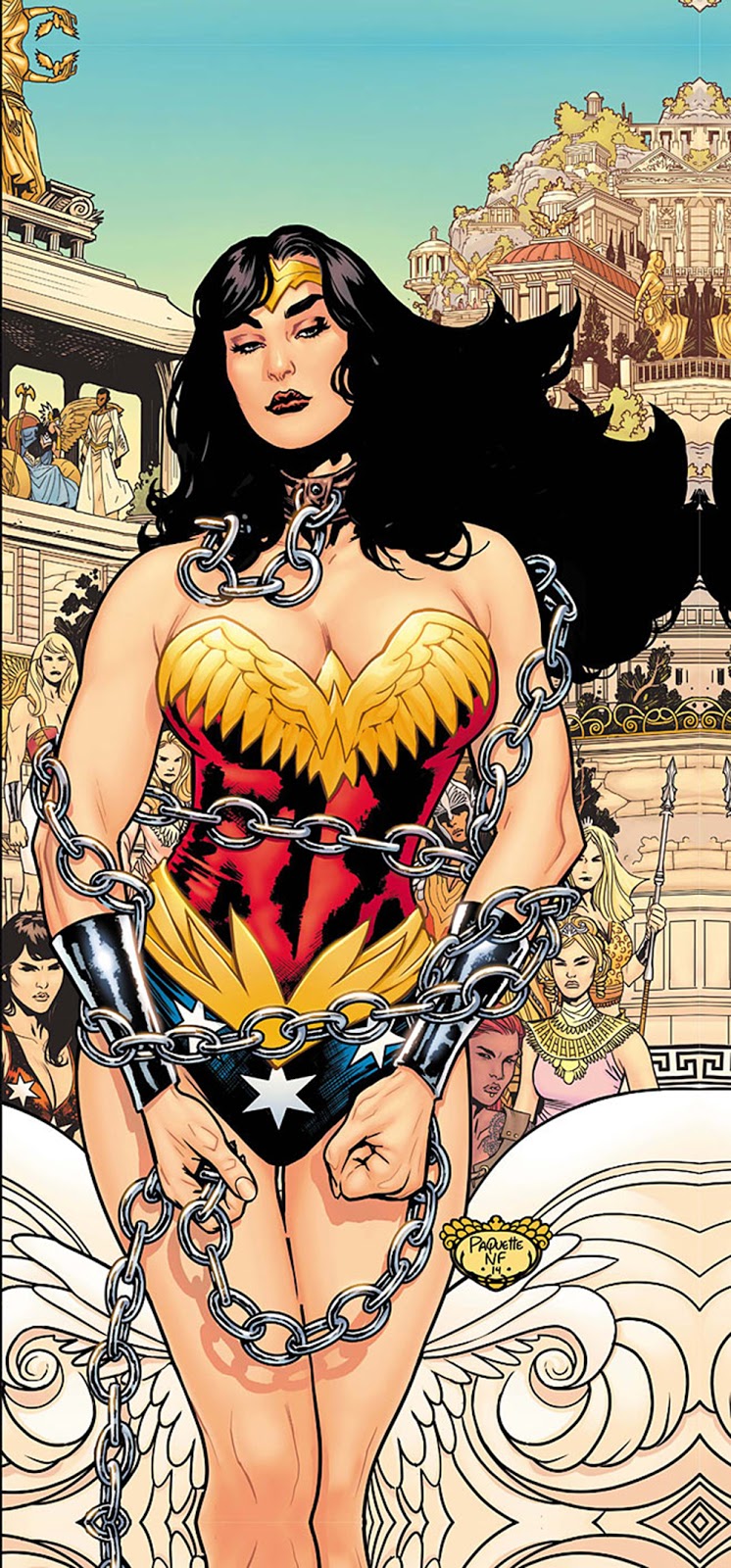
Much – MUCH – better was volume 1 of Grant Morrison’s Wonder Woman: Earth One from earlier in 2016, which provided a new but coherent take on the Amazon’s origin story.

Yanick Paquette’s art worked for me – but then again, I didn’t get in a tizzy about pictures of WW in chains. Well, not that sort of a tizzy.

I really don’t know whether I’ll watch this summer’s film: setting it in WWI as opposed to Wonder Woman’s conventional entry into human affairs in WWII suggests that the filmmakers have decided that, instead of understanding that conflict as six of one and half a dozen of the others, writ large across all the main actors involved, it’s going to leap in with a howlingly simplistic Goodies v Baddies approach.

We shall see.

Normal and the head of Agatha Blue Witch
Very differently, one of my personal discoveries of the year was Andrew MacLean’s Head Lopper.

Written and drawn by MacLean – and originally self-published before being picked up by Image – this is the tale of Viking warrior Norgal, who hunts down monsters with the help (though he doesn’t actually like it) of the severed head of Agatha Blue Witch, which he carries around in a bag.

Image threw the comic convention of monthly, 22-page issues out of the window for this, instead allowing MacLean to produce bigger issues on a quarterly basis.

And while the first trade is a lot heftier a volume than you’d usually expect, it doesn’t fail on the fun quota.

Completely different to Hellboy, it would nonetheless be impossible not to see a relationship between Mike Mignola’s seminal work and this.

There’s humour, violence, great atmosphere and a wonderful sense of the folkloric – yes, all things that you’ll find in Hellboy – along with a superbly stylised visual look, all of which effectively gets the Mignola nod of approval in a contribution from the man himself in the gallery at the back of this volume.

MacLean makes storytelling look simple and his art ticks incalculable numbers of boxes. The picture I’ve used here also illustrates MacLean’s fascinating use of foreshortening and perspective, which is a contributory aspect of the work.

There is not a single thing I don’t love about this.

Black Road comes with added ravens
Not very far behind in my personal appreciation stakes comes the first trade of Black Road, which also plunges readers into Viking terrain – but the mood and look could hardly be more different.

Magnus the Black is a man placed awkwardly somewhere between paganism and Christianity, as the church militant strives to conquer the Viking lands for Christ.

Hoping to perhaps ease the trauma of this momentous change for his fellow Norse men, Black finds himself caught up in the bloody politics of religious conquest – and has to turn detective when an official in his care is brutally murdered.

Brian Wood’s story has a satisfying complexity about it, but it’s the art by Dave McCaig and Garry Brown that really lifts this, with its evocation of the bleak, vast landscape of the north.

Having enjoyed the autumn release of the first trade, I’ve hit the subscribe button for the coming issues in this Image series, rather than wait for trade two.

Actually, that’s also an indicator that I’m getting sussed enough about the comics world that I spotted it before the new arc begins.

In the meantime, Skottie Young’s I Hate Fairyland is another comic that defies easy categorisation.

A bright, bubbly tot called Gertrude wishes to live in Fairyland – and then her wish comes true.

Gertrude is not as happy as Larry. Neither is Larry, to be fair
Unfortunately, 20 years later, she’s grown mentally but is physically still a child, trapped in a bubblegum world of sugary niceness.

A crazy new take on a sort of Dorothy longing for Kansas, Gertrude has become a sweary, psychopathic monster who wants to destroy everything and everyone as she tries to find an escape back to reality, accompanied by Larry, a cynical version of Jiminy Cricket.

Life is further complicated when the queen of Fairyland decides that the only way in which to deal with the chaos and violence is to have Gertrude herself killed.

Written and illustrated by Young, volume one was fun and the second trade is out now (if you look online at Forbidden Planet, it can currently be obtained with a very nice autographed postcard too).

It’s hard to know where Young can take this story – but fluff you (as our less-than-angelic Gertude so often puts it): it’s going to be fun finding out.

And finally, the autumn also saw my own first comic strip – okay, only three pages, but my words and my illustrations. It was published in a membership magazine that went to over a million people, but I've now put up a digital version, so you can catch it here. Enjoy!


Saturday, 31 December 2016

Robinson Crusoe meets Titanic, as Passengers intrigues

Part Robinson Crusoe meets Titanic in space (and yes, I know that Robinson Crusoe on Mars is a thing), director Mortden Tyldum’s Passengers is an intriguing film, even if it never hits any heights of supersonic excitement.

Written by Jon Spaihts, the luxurious starship Avalon is carrying 5,000 people to a new colony planet where they will begin a new life. They and the crew are in hibernation pods, as the trip takes 120 years.

But when one of these pods malfunctions, 90 years from journey’s end, mechanical engineer Jim (Chris Pratt) finds himself awake, with just a droid bartender for company.

And that doesn’t seem to be the only technical glitch. A year on, with the ship’s systems experience more and more problems, Jim is joined by Aurora (Jennifer Lawrence), with neither of them able to return to hibernation.

Here we get a touch of Titanic, with Aurora travelling first class and Jim in a subsidised – his skills are in demand – starship version of steerage.

But when a third person wakes as the malfunctions increase, that’s when the trouble really begins.

Lawrence and Pratt make a good and enjoyably watchable team here and the film carefully eschews any clunky stereotypes, allowing plenty of time to develop character and situation.

That’s almost as much a downfall as it is a benefit: this is a picture that can, on occasion, seem to drag, yet at the end, the viewer is left with themes that have been worked hard enough to intrigue, from the nature and affect of loneliness to the limits of AI-human interaction (and therefore the nature of humanity) and a sort of Dorothy-in-Oz question of what you really want from life.

Sumptuous to look at, the glossy, hi-tech, sleekly-designed appearance of the ship itself, together with its sheer size, adds to the sense of human isolation, along with a beautifully-realised idea of the vastness of space.

Michael Sheen as Arthur the android bartender and Laurence Fishburne as Gus, the third to wake, add nice cameos that help develop plot and the relationship between our central protagonists.

Some critics have complained about the ethics of a key element of the plot (I’m not giving that plot device away here), but the complaints seem a tad forced, since the question concerned is hardly played for over-simplicity and certainly far from ignored.

One hopes we’re not going to see sociological analyses of all forthcoming releases, from Assassin’s Creed (spoiler alert: likely to include some killings that are Not Very Nice) to Despicable Me 3 (is Gru really an appropriate parent for three small girls, once of whom is clearly from a different ethnic background to him?).

Tedious it may seem, but it seems boringly necessary to remember that Passengers is, after all, a piece of entertainment and certainly no more morally dubious than most other entertainments around if one starts playing such a game.


So, while it’s certainly no masterpiece, it is a pleasant and interesting enough way to spend a couple of hours.


Thursday, 29 December 2016

Reinventing Christmas folklore

Christmas Present
A few days ago, chatting over morning coffee and social media, The Other Half and I happened upon a mention of Père Fouettard, a Christmas character.

Thanks to the wonders of the internet and search engines, it didn’t take long to discover that Père Fouettard is a sort of counterpoint to Father Christmas in northern and eastern France, and in Flanders, and that he carries a whip with him to punish the naughty children.

This is not too far removed from Krampus, the half goat, half demon figure who can be found from Bavaria to northern Italy to Hungary and more, and who, through comics and more recently a film, has found his way into American and British minds.

It struck me how sanitised our own gift-bringing mythology is: at one time, a bad child in the UK might have been led to expect a lump of coal as a present, but we don’t seem to have the same child-snatching villain as Krampus or, indeed, Père Fouettard, who is sometimes equipped with a sack to take away naughty children, never mind whip them.

But then again, Victorian society was a weirdly mixed bag when it came to frightening children with morality tales, yet sanitising the likes of fairy tales.

The late 19th century was also the time when British personifications of Father Christmas morphed from the sort of Green Man version that owed a great deal to ancient myth and folklore – and is famously presented as the Ghost of Christmas Present in John Leech’s illustration for Charles Dickens’s Christmas Carol – to the red-cloaked old man we are so familiar with today.

Our discussion ranged across various other elements of Christmas folklore, including the vexed question of when Santa first needed elves.

Godey's Lady's Book
Elves were an established part of Germanic and Scandinavian folkloric traditions, but it was only in the US, where they’d made their way via migration, that they were incorporated into Christmas, with a first festive appearance in literature coming in 1850 in an unpublished book by Louisa May Alcott, called Christmas Elves.

Harper’s Weekly published a poem mentioning elves in 1857, but for the idea of the elves in the workshop, we can thank a 1873 edition of women’s magazine Godey’s Lady’s Book, with its cover illustration showing Santa surrounded by toys and elves and with the caption: "Here we have an idea of the preparations that are made to supply the young folks with toys at Christmas time”.

I’ve always rather thought of folklore as a process that has stopped, and that we preserve, as in amber, but it continues to grow, even if modern communication and entertainment methods have largely overtaken the oral tradition.

Star Wars has a sense of the mythological about it. And Christmas myth and folklore have not stood still in recent years either. Some reworkings and new versions are more successful than others.

In 1996, Terry Pratchett’s 20th Discworld novel introduced us to the Hogfather – with a two-part TV version following a decade later.

Josh Kirby's original cover artwork for Hogfather
Pratchett, of course, famously said that he’d occasionally been accused of penning ‘literature’ – and Hogfather is a good example of how his novels are so much more than simple ‘entertainments’.

Here, beyond the satire – and I’d suggest that Pratchett is one of the finest satirists the UK has ever produced – are questions and reflexions on the relationship between storytelling, myth and folklore and the human condition; on the fine balance between somehow believing (à la the willing suspension of disbelief we engage in at the cinema or theatre) and yet not allowing such beliefs to usurp science and reality.

The God Delusion didn’t hit bookshelves until three years after Hogfather, but re-reading it again this December, it was difficult not to see The Auditors as being akin to Richard Dawkins and others.

However, Hogfather is far from the only evocation of Christmas to add to the mythos and, indeed, to offer a sense of Christmas not being ‘just about the children’.

A Dan Mora cover for one issue of Klaus 
Klaus, written by top comic creator Grant Morrison and illustrated by Dan Mora (who has won an award already for his work on this), first appeared in seven parts, beginning at the end of 2015.

Now available as a trade – although when it’s a large-format, limited-edition hardback with gilded page edging, it’s hard to think of it as a ‘trade’ – this presents us with a far darker Santa origin story that draws on Norse myth and Siberian shamanism.

There are no elves here and nothing sanitised, but a brutal and beautiful tale that draws us back to Christmas as a festival marking the depths of winter.

It’s a really top work (the architectural aesthetic attracted me first, since it owes more than a little to the kind of Germany that we’ve experienced in the last couple of years), and left me with a meditative sense of something that was not new, but as old as the hills.

If you’re unfamiliar with Morrison’s work, just this work should illustrate why he’s so highly regarded.

Klaus is available now from BOOM! Studios, both in the limited edition mentioned above (it seems that Forbidden Planet still has copies) and in a non-limited edition. A one-off, single story comic has also just been released to follow up the first series/book.

I’ve also read Krampus! from writer Brian Joines and artist Dean Kotz (published by Image) and, while it’s an entertaining romp, it also serves to reiterate how good Klaus is.


So, folklore/mythology does not stand still, even in technological, cynical times such as ours. And thank goodness for that.