Showing posts with label natural world. Show all posts

Friday, 24 July 2015

Finding art in Rye and Hastings

Camber Sands by David Purdie
Perhaps it’s no coincidence that much of my own art takes as its starting point the built environment – after all, I live in a pretty extreme version of that and experience it on a daily basis.

But our trip to Rye was not limited by walls, and the outdoors and natural worlds that we found ourselves enjoying is clearly  an inspiration to plenty of artists working in the area.

That first walk down to Rye Harbour saw us, as mentioned before, take tea and cake at the Avocet Gallery and Tea Room.

The cake was delicious – and the art on display was appetising enough to have me smacking my lips at the range of high-quality works by local artists who had been inspired by the varied land and seascapes.

I came away with a delightful limited edition, signed and numbered print by Sue Scullard, an illustrator and artist whose woodcuts are simply incredible in their detail.

They’re also very small – which is particularly handy when you’re running out of available wall space in your own private gallery.

Out of a superb selection, I chose a print of a woodland scene – anyone who has been following this blog will know that I have a growing fascination with woods and forests, so it was a perfect picture.

The Edge of the Wood by Sue Scullard
But it wasn’t the only art that we saw – or that I picked up – although it was the most expensive, at £55 (plus what it’s costing to have it framed in plain oak, which seems an appropriate choice).

Find out more about the gallery – and they are constructing an online shop – at avocetgalleryandtea.co.uk.

Sue's own site can be found at suescullard.co.uk.

We had ambled up and down the High Street in Rye on the Friday evening, by which time all the shops were safely shut. But it had given us the opportunity to see what was around.

There was a general art gallery – and next door, a gallery belonging to photographer David Purdie.

A few doors down the street, another photographic gallery displayed works that had had colours so heavily saturated that John Hinde postcards would have natural by comparison.

It hurt my eyes every time we passed it over during the course of our stay.

But David Purdie’s gallery, on the other hand, drew me inside.

Red Hut by David Purdie
Making your work pay is not always easy for artists. In David’s case, his superb photographs are available in a number of ways, from signed prints, to posters to greetings cards.

It’s a long time since I bought any photography to display at home, but I was more than happy to spend under £20 to buy a specially-made frame that holds three of the greetings cards.

Like the print, it fits into a specific spot – indeed, on the wall in my little bit of study/studio space, thus adding additional inspiration.

And since the three photos I picked – groynes at Winchelsea Beach, an old fisherman’s hut next to Rye Harbour Nature Reserve, and dunes at Camber – are united by the sea, which I love so much, it was entirely apt.

It was amusing talking to David: he moved to the Rye area from London – not far where we’re based. After some years in the area, he finds it quiet – we’re desperate to get to somewhere where you can actually hear yourself think!

You can find out more about David’s work – there is an online shop, and he also runs photography workshops – at purdiegallery.co.uk. There’s also Twitter for keeping informed about the gallery – at @PurdieGallery.

Not that this was the end of the artistic aspect of the trip. On Monday, with the wind lashing in and a constant drizzle falling, we’d headed through the grey to Hastings.

Initial disappointment had given way to pleasure and interest when we’d discovered the fabulously-named Rock-A-Nore Road, a designation given it in 1859 and derived from a former building “lyinge to the Mayne Rock against the north”.

It borders The Stade – a Saxon term for ‘landing place’, where Europe’s biggest beach-launched fishing fleet is based and where you can find the incredible old net shops – black-tarred, tall, wooden buildings that used to be used to store the nets and other fishing tackle.

Misty Morning by Andrew Dennis
Later, wandering along one of the winding streets of the old town, we spotted a gallery with pictures in the window of the net huts.

This was the Old Gallery, and it largely serves as an outlet for work of self-taught local artist Andrew Dennis.

The Other Half spotted instantly why his pictures of the net shops would particularly appeal to me. Such was the way in which they caught my attention that I picked up another small print.

This is already on the wall – a simple, black frame picked up for next to nothing in Cowling and Wilcox last weekend does the job very well.

To find out more about Andrew’s work, visit theoldgalleryhastings.co.uk.

These were not the only artists’ work that we admired during the trip.

Pill Box, Rye Harbour by Brian Yale
The Rye Art Gallery was a revelation, with a small exhibition in one of the rooms upstairs, as well as the sale rooms downstairs.

My favourite work on display was the acrylic painting, Pill Box, Rye Harbour (2002/3) by Brian Yale.

Deceptively simple, it seems to me to contain the past and the future in the region’s familiar shingle landscape: humanity’s interventions in the landscape returning to that landscape as nature reasserts itself.

The gallery has a website under construction at ryeartgallery.co.uk.

So, while we’d headed to the coast with literature in our minds, we found far more art than expected – and this just gives you a hint of what can be found in the area.

Tuesday, 7 April 2015

We love to go a wandering

The way ahead
After a day’s rest for the feet, further studious study of the weather forecast revealed that Thursday and Friday were set to see precipitation of one sort or another.

That meant one thing: if we were to undertake another proper walk, it would have to be on Wednesday.

Helpfully, The Other Half – who had spent weeks studying online maps for precisely such ends – had just such a walk planned. So off we went, having this time remembered to take bottles of water with us but, unfortunately, no Kendal Mint Cake. I should have taken a slab to Bavaria on principle.

Our destination was another small Alpine lake, the Alatsee, and the start of the walk took us through the park at the back of summer palace of the bishops of Augsburg before we crossed a small, wooden bridge and climbed gently upwards onto a wooded ridge.

Germans, as I’ve mentioned before, care passionately about forests – it’s an essential part of the national psyche. Woods are so central a part of German life that, when it was discovered, in the 1980s, that the woods were dying from pollution, there was a united commitment to doing something.

Woodland delicacy
That the country is now a major producer of renewable energy is, in part, a result of that – and also an indicator that green politics is not seen as overtly as ‘left’ in the way it is elsewhere, not least in the UK.

For British townies in particular, we have, in general, long lost that sense of connection with nature.

But in Germany, no town or city is far removed from a wood or forest in which to spend time.

And these are maintained and looked after with great dedication, as are the footpaths that wend through them.

My mental musical theme for the week – with the exception of a burst of Wagner when at Neuschwanstein – was The Happy Wanderer.

Mein Vater war ein Wandersmann, to give it its original German title, was originally penned by Florenz Friedrich Sigismund (1788-1857), while the tune we’re familiar with was composed after WWII by Friederich-Wilhelm Möller.

Wood – smelling beautiful
A 1953 performance of the piece by the Obernkirchen children’s choir at the Llangollen International Musical Eisteddfod, broadcast on BBC radio, saw the song become an instant hit and staying in the singles chart (a top 12 at the time) for 26 non-consecutive weeks.

As we wandered through woodland, for a long while, with the sounds of the traffic of Füssen intermittently drifting upward to us, yet already in a different world, it drifted into my head again and even, quietly, from my lips: a song from childhood memory, suddenly taking on a new life.

Away from it all
We stopped to inspect tiny flowers alongside the path; to listen to the birds around us; to watch as a small deer sprung away through the trees, glancing back over its shoulder to check us out.

It wasn't a busy road
The process of maintaining the woods means that some trees are felled. Clearly there had been recent work done in this department, as we saw logs stacked neatly between pairs of standing trees.

Walking past one such stack – clearly very recently cut – the smell was astonishing. Forget those ghastly ‘air fresheners’ in cars and elsewhere: this is what trees smell of and it’s intoxicating.

Perfect for lunch
As we made our way, the road sounds drifted away entirely: the tranquillity was wonderful and eventually the tinkling of a beck made it’s way up to our ears.

Having discovered (the hard way) the result of the lack of contour lines on Google maps, we made a decision after some time to take a path down the side of the ridge to meet a road that then went on to the lake, rather than take what looked to be a harder path that would take us back up before coming down near the lake.

I say ‘road’, but I don’t recall a single vehicle passing us as we strolled along it, the metal points of our walking sticks now striking the tarmac surface.

Brilliant beer ....
The trees to our left eventually fell away, leaving us with views of Alpine pasture filling the space between the ridge we come along and the rather higher hill side opposite.

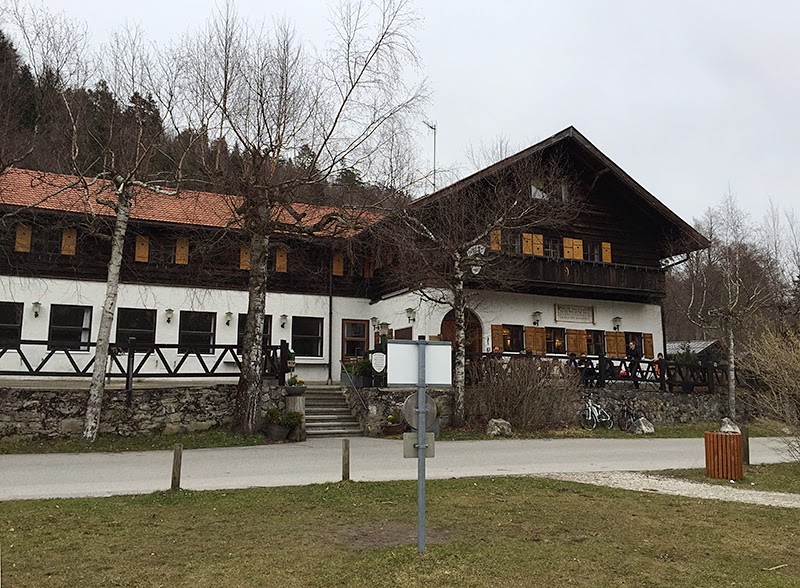
We made it to the lake for around 1pm – perfect, since the hotel there also has a restaurant and The Other Half had fully factored this into his plans.

With the temperature ludicrously mild, we sat outside the chalet-style building and ordered drinks while scanning the menu.

The beer was a caramel-coloured dunkel from the Aktienbrauerei – the oldest existing brewery in Kaufbeuren, first mentioned in 1308, a whopping 208 years before the Reinsheitsgebot – and was the best beer of the week, with an absolutely wonderful taste.

As we sipped, we could hear the sound of The Other Half’s schnitzel being beaten out in the nearby kitchen. Oh, this was going to be freshly cooked.

... and fabulous fodder
For myself, I had leapt at the opportunity to try spätzle for the first time. A sort of soft egg noodle from the south of Germany (and areas to the east), I knew it by legend alone.

It came as the bed on my (large) plate, dressed in melted butter and with a vast mound of gloriously crisp and wafer-thin fried onion rings atop a piece of absolutely superb beef that had been cooked to perfection: beautifully seared on the outside and melting to very pink the further in I got.

It was the perfect illustration of how good food doesn’t have to be haute cuisine. This was perfection.

Sated, we sat awhile, quietly taking in the view.

The Alatsee spread put in front of us, with a snow-capped
Austrian berg soaring beyond the wooded ridge that marked the border, and the wooded hills around the lake split in one place by a wedge of pasture.

The Alatsee
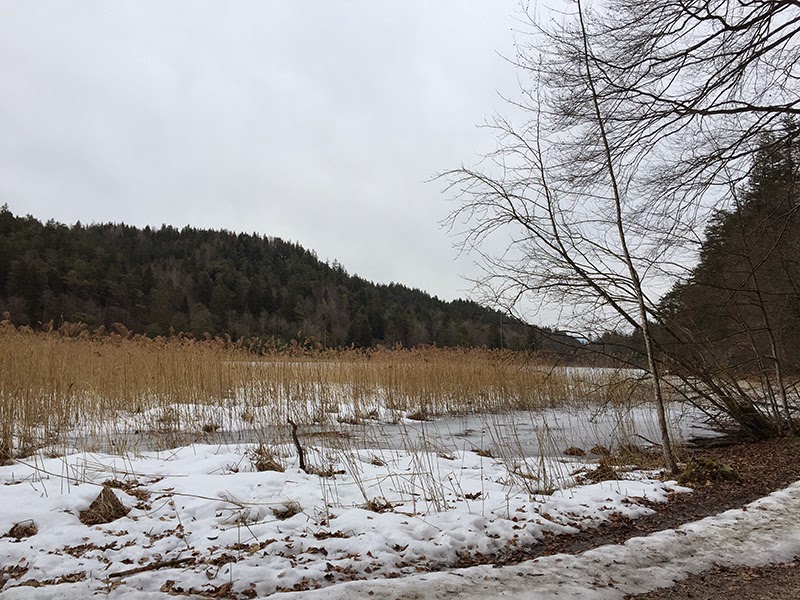
It was still largely iced over, although where the thaw had set in, the water was that rich malachite green again, and crystal clear at the edge, creating a perfect mirror to reflect its surroundings.

It’s apparently a meromictic lake – meaning that it has layers of water that do not mix, which in turn means that it can include within it radically different environments for organisms.

Snow ahead
Such bodies of water were only really named in the early 20th century. They may occur where the basin sides are unusually deep and steep compared to the lake’s surface, and where the lower layer of the water is highly saline and denser than the upper layers.

The Alatsee is 868m above sea level, with a surface area of 12 hectares and a maximum depth of 32.1m. There are such toxic organisms living in the lake that they’ve been blamed for a number of divers have died or disappeared in its waters.

And as if this were not enough, it’s one of the (many) spots that’s alleged to be hiding ‘Hitler’s gold’ – although Lake Toplitz in Austria beats it for plausibility, given that forged British banknotes were found by divers in chests, together with a printing press, in 1959.

You see – travel broadens the mind: or at least the knowledge base.

The Obersee
Eventually, we set off again. This time, the intention was to walk back along the valley floor on the opposite side, along the Faulenbach and passing the smaller Obersee and the positively diminutive Mittersee before reaching Füssen.

This route had been less exposed to the sun, meaning that snow several inches deep still lay in patches over the path. Those walking sticks were proving very handy.

There was evidence of winter tree fall from the steep, rocky ridge now to our right, and also where the local forestry management teams had come in and removed the section of a tree that had fallen across the path, leaving the rest where it lay.

Looking back from the Obsersee
Again, the sounds of trickling water and bird song were the dominant ones, leaving city natives to feel almost out of kilter at the absence of urban drone. It’s a long time since I spent so long away from the sounds of traffic.

The Obersee was almost completely iced over, with reeds rearing up to tell you that there was marshy land beneath the frozen white.

And so we continued toward the town; another satisfying walk under our belts – another day gazing at this extraordinary landscape and feeling awed by it. Happy wanderers indeed.


Sunday, 3 February 2013

A good healthy smell!

One of the residents of Hackney City Farm.
One minute it seemed that I was up to my eyeballs in the intricacies of work, on the busiest press day for some considerable time, and yet almost the next, it was a bright, sunny Saturday morning on Broadway Market, and I was sharing the crumbs of my breakfast sausage roll with a starling, who was hopping around below, metallic livery glistening in the light.

There were other things to revel in as the morning unfolded. Now I could just walk down the road toward Broadway Market, but I rarely do.

It’s much more interesting to cross that road and walk alongside the Regent Canal, at the back of an estate.

This isn’t a towpath side, and the bank is fenced off.

It’s a tip in many ways, but for all the careless trash that has been thrown in with the weeds, it’s also bursting with life. Squirrels are often visible, leaping from tree to tree. Yesterday, one was running around with what appeared to be a slice fruit loaf in its mouth, stopping every so often to have a proper munch.

Above, a great tit was on watch duty. Still higher up, smaller birds sang their songs.

And it’s a stretch where the changing of the seasons always seems so subtle yet obvious: from spring buds on trees that drape beyond the rusted railings to reddening leaves in the autumn. It always seems that I spot the changes here first.

How different it was this morning, as day came up to reveal a canopy of featureless grey.

But the week ahead not only beckons – things were required of today.

I toddled down to Columbia Road for the first time this year, pausing in Haggerston Park to admire more evidence of the turning of the year; pale green strings of bells, tinged pink in places.

Les was in his shop – so I was able to organise potting compost and, as he suggested, organic seaweed feed. He’ll bring those up later in the week.

But there was no joy on the subject of something to dig into the heavy, clayey soil at the back.

“What you really need,” he said, “is proper manure”, and went on to say that it was a pity I didn’t have access to a car, since nearby Hackney City Farm would probably give (or sell) me some.

Oh well. Wandering back along the market, I mused on whether I could get anything appropriate from Bradbury’s ironmonger at the top of Broadway Market.

But then, since my journey could easily take me past the city farm, I thought I’d pop in to enquire.

In the tiny shop, the ladies heard me out and suggested I look in the farmyard for someone called Stuart.

The yard itself was a bustle of hens clucking around, while one volunteer worked in a stall at the far end of the cobbles.

The smell – ah, the smell!

I remember that smell fondly from all the childhood visits to farms. It is, as my (honorary) Uncle John would say, “a good healthy smell!”

There were also signs everywhere, warning that it wasn’t a good idea to pet any of the cats you might see, since they’re working farm cats and can ‘get a bit grumpy’.

Stuart, as it happened, was busy in the kitchen; a vast man with a bandana around his head. After hearing me explain my mission, it also became clear that he was entirely the wrong person.

But he led me to an office where two women were on duty, with various of those grumpy, hard-working farm cats sleeping around the place in various spots.

It was a superbly productive conversation.

Later this week, I’ll pop down – it’s just a short walk through the park – and they’ll give me as much manure as I need. I get it free because, living so close by, I count as "community". And they'll lend me a wheelbarrow to bring it back too.

Now that’s going to be serious metropolitan sophistication!

But nothing could be better for what I want.

Fortunately, the weather looks decent over the coming week. Tomorrow and on Tuesday, in between trying to find a boiler engineer, waiting for my mini greenhouse to be delivered and making marmalade, I’m aiming to weed and sift the rest of my patch.

It’ll be backbreaking, but it has to be done. And once it is, then everything will get a bit easier.

Once the manure is dug in, it’ll get to rest for a couple of weeks. And then I should be able to start sowing directly into the bed.

In the meantime, I’m reading Felicity Lawrence’s Eat Your Heart Out: Why the food business is bad for the planet and your health.

I’ll go into more detail at a later date, but it doesn’t make for pleasant reading – even when you don’t actually eat vast amounts of processed food.

But it’s yet another swathe of information that makes me wish for a simpler life – and also convinces me of how worthwhile it is to grow as much of my own food as possible.

My little experiment in the car park is actually rather more than just a bit of messing around.

While it gives me pleasure in and of itself, and while the mere exercise of gardening is probably good for the health, the more I learn about the state of our food industry, the more I realise that it’s good for me in other ways.

Okay, let’s not go over the top with what I can achieve in such a small space, with limited time and very little knowledge or experience.

But if knowledge is power, then knowledge about food also gives an edge to such exploits: an edge that says that it isn’t just a bit of playing around.

The next few days should be busy and a bit testing and also fun.

The coming months will be fascinating.


Monday, 31 December 2012

Christmas is for cats


Loki (top) and Otto, with shiny paper and a few balls.
‘Christmas is really for the children,’ or so many people claim.

In which case, do cats count too?

It’s certainly been an eventful festive season for our little pride, starting when Loki got herself lost.

She’d successfully chased the considerably larger Reggie out of the carpark behind our flat, and was rather obviously feeling chuffed with herself.

But by the time I’d returned from the shops, The Other Half was back inside, the door was still open, but she was nowhere to be seen.

Cue much calling and rattling of food tins. No sign.

After about half an hour of hunting – and increasing panic – The Other Half went upstairs on a communal staircase and opened a window to peer out from above.

Next door to our small block is an old pub that’s been converted into flats. He thought he spotted her on the metal stairs leading to the upper floors.

He sped out one way and I went the other, food tin and fork in hand.

There she was, underneath the metal stairs, hiding in a corner, bravado gone, now just thoroughly frightened.

Eventually he coaxed her out and through the gate, picking her up and pushing her back into the carpark, where she ran past me as I beat a tattoo on the tin and called her.

Past me, indeed, into the garden, straight into the flat and absolutely straight to the food bowl, where she started to gobble food.

“She’s going to bring that all back up,” I mused to The Other Half a few minutes later, as she continued to empty the bowl. But remarkably, she didn’t. Presumably, being frightened and lost gets the appetite going.

She’d also managed to get mud all over her paws and belly, so we toweled as much off as possible. I was wondering if we’d have to experience the joys of bathing a cat, but fortunately she completed the job excellently all by herself.

And then it was a case of flopping next to The Other Half on the sofa and not moving for the rest of the day. And the day after that.

But Christmas Day brought with it reasons to be active again.

The cats have had a few balls to play with for some time – light, ping pong balls are perfect. But they lose them rapidly beneath the furniture and then demand we get them out again.

Solution? A Christmas present of a bag of 150 orange ping pong balls.

Which we emptied onto the wooden floor all at once, to enormous feline confusion. Confusion, however, that was followed by gleeful play.

Boudicca isn’t entirely convinced, but The Kittens – who arrived at Christmas three years ago, so aren’t really kittens any more – love them.

It’s a sort of combination of dribbling skills and pinball. Although Otto has added a format to the game that’s entirely of her own making.

Having worked out that she can carry a ball around, she picks one up (using her front paws to lift it to her mouth) and then carries it to the mat inside the door to the garden.

Then she puts it down and waits until it either rolls away, before she charges after it, or until she decides to bat it away, and then charge after it.

But then, after a while of pinging it around, it will be brought back to the mat to start again. In the last week or so, the mat has changed to a piece of shiny wrapping paper, which is near the mat.

Wrapping paper is obviously another seasonal pleasure, to be dived on (this year’s new wooden floor means you can pretty much surf on it), torn at – and made into little tents to hide in.

Not that this is Otto’s only version of a formalised game.

Having realised, last Christmas, that she particularly loves ribbon, I bought a spool so we can cut lengths off for play.

And the ribbons ended up on the bed, which has a blanket box at the end of it.

The game, as it has evolved, means that when I’m sitting in bed with a book, Otto will sit on the blanket box and wait.

I’m supposed to take the longest piece of red ribbon and flick it towards her and then draw it slowly up the bed.

Sometimes she pounces quickly – sometimes she waits. And waits.

But she always returns to the blanket box to start the next round.

Cats have habits – they’ll patrol exactly the same area in exactly the same way, for instance – but neither The Other Half nor I have ever seen anything quite like this. It’s fascinating.

Mind, she will also sit and watch television (or a computer) for longer than any cat I’ve known either.

Boudi continues to be the household’s big clumsy girl. Presumably because she was so young when we got her (six and a half weeks) and because she moved into a household with two elderly cats, her social skills are not what they might be.

She gets her verbal signals all confused, growling and hissing when she’s actually playing. It still bemuses The Kittens, although they generally seem to regard her behaviour in a sort of ‘oh, it’s just Boudi’ way. They’d probably shrug if they could.

Mind, that’s when they’re not teasing her – karma, Boudi, given how you baited Trickie when you were a tiny thing?

Trickie, our Battersea rescue cat, who had spent most of her life with an elderly man who clearly liked a very hot home; who thought that she wasn’t a cat, but a small, elderly and rather genteel lady in a fur coat.

Trickie, who was nearly about to set records for the longest stay at the home; who beat her ‘cabin’ door when she saw us coming, drooled over the top of it at us, and faked the cat test, which is supposed to reveal whether a cat can get along with other cats.

Trickie, who was so grateful to be rescued from Stalag Luft Battersea, and who was then twice attacked in our garden by some hulking stranger cat, who was chased off by Boudi, paws a-whir as she hurtled after it, claws glistening in the morning light.

All of them leave you with stories and memories.

Not that our anthropological observations this last couple of weeks have been limited to the cats.

When we finally managed to get out for a walk yesterday, we discovered that squirrels make nests. Okay, I knew that they nested in hollow bits of trees, but had never realised that they actually make nests in the branches too.

We were in the park and there were squirrels everywhere – including the fattest one either of us have ever seen; sitting beneath a tree and munching its way through a whole pile of nuts, beady eye keeping a watch on anyone who got too close.

But not far away, there were squirrels running up and down the naked trees, carrying leaves to a big nest.

Since there was another rather large squirrel watching, we surmised that there’s a spot of Sciuridae pregnancy in the air.

And with a scattering of pink blossom on a tree further on, and crocuses already well on the way in our own little garden, it would seem that the seasons are well and truly in chaos.

No wonder it hasn’t felt much like Christmas anywhere but completely hidden away from the outside world.


Sunday, 7 August 2011

All that nature allows

Swifts darted just above, so fast that in the early morning silence you could hear the flapping of their wings as a little 'wooosh' overhead.

A sparrow scratched in the gutter above and, when spotted, disappeared fast, its flapping wings audible.

We have a tiny terrace here; a tiny, precious space between high stone walls. A haven in the early morning, in the evening and at night.

There are balconies at the front of the house; big enough - just - to sit on and gaze at the foothills of the Pyrenees as they rise out of the Mediterranean, an old windmill on one early rise, Fort St Elme on the next one; vineyards and olive groves all around.

But the terrace offers something special.

I prop my iPad on a fag packet on the table and write, Gauloise between my fingers, glass of wine by my side, even as the stars wink awake in the eternal blue above.

Not far away, near the railway tracks that lead to and from Spain, cicadas hum in the dark.

I remember the first time I heard them; outside the hotel in Perpignan where we stayed on our first trip to France. And then last year, in Nîmes, in the shadow of a ruined Roman temple to Diana, as dusk fell and the swifts dashed around, hunting vast dragonflies in the fire of the sunset.

There was a lizard on one of the balconies the other day. It saw me coming and scooted over the edge. Huge crickets were drawn to the light in the kitchen the other night and hopped around high enough to feature on Record Breakers while The Other Half tried to get them out. Why are they attracted to the light in such a way?

The Collioure ducks are here as usual. I love ducks - on the water and on my plate (in case you were worried I was going to get too pastoral). Some years ago, when we did a canal trip in the UK, we discovered teenage ducks: they're the ones that come over to your boat in gangs at twilight, quacking madly, demanding food, and even tapping the hull with their beaks to make sure you don't try to pretend you haven't heard them.

You can hear Mother duck in the distance, calling them home, but they're a right bunch of dirty stop outs, and stay away until first light - probably having been to duck raves somewhere else.

In Collioure, they're always near the castle, at the end of the storm drain and where the commando training centre at Fort Miradou store their canoes and dinghies. In the last two years, late season duckings have been lost in sudden storms. Last year, we saw the mother going around in a distressed way for days, looking for her offspring.

Never believe that the French can't be sentimental about our animal and bird friends - it made the local newspaper.

This year, there's one late ducking. We check every day as we pass on the way to and from Le Petit Café for our post-beach sundowner, and urge the mother to look after it.

The beach is perfect therapy. There's warmth in my skin now: before long, it will permeate to the bone - and the red will hopefully turn to a tan.

I've worked out that most people who get wrinkled skin because of being in the sun started in their twenties and have totted up a good 30 years plus of damaging behaviour.

Since I didn't convert from the cult of paleness to sun worship until I was in my forties, I don't think I'll fret too much - and that's not to say that I do 't take precautions.

There is time and space to think. No: not just time and space - but quiet.

Even the beach seems civilised in the height of the season, and our neighbours are barely any noisier than us - and all considerably quieter than the people around us in London, where making as much noise as possible would seem to be a status statement.

The older I get - and the more I visit this part of the world - the more I recall the observation of a friend some years ago, who commented that, while the UK has the highest standard of living in Europe, it also has the lowest quality of life.

It is, I think, true - but very sad.

Commentators say that France is going the way we have done; that cooking is a dying art; that Le Big Mac is in the ascendency, even here.

I know it's easy to be all romantic when you're only visiting somewhere briefly, on holiday, but France - please prove them wrong. Keep the faith. Because someone needs to. And because when you have lost what you have, it is not easy to get it back.

Friday, 13 February 2009

It's all a question of dignity

I am now convinced that even inanimate matter has a life of it’s own.

The Queen B herself told me so this morning.

There she was, sitting on the bathroom shelf amid the pots and potions as I went about my ablutions, when the shelf rose up and tipped her off.

I know this, because cats do not fall off things all by themselves.

And if they do have such ‘an accident’, then the Great Commandment applies: ‘thou shalt not laugh at the cat’. Because the cat gets very, very huffy indeed if she sees you laughing at her.

She stared accusingly at the shelf – so I know it was the shelf’s fault. I bit my tongue.

Then she turned and, tail in the air, strutted out of the room, determined to show every ounce of her feline dignity.

A couple of hours later, my attention was drawn to a 2006 report from Newsweek, which says that scientists studying the behaviour of non-human animals, in the search for signs of self-awareness, have discovered that the famous mirror test might not be a reliable indicator.

This is the test whereby a mark is put on an animal and then they’re placed in front of a mirror to see if they notice that something is different about their appearance – to see if, for instance, they attempt to remove the mark. Elephants can’t ‘pass’ the test, apparently – although we know they’re intelligent. Yet some animals that do ‘pass’ are not expected to, because they don’t have the ‘right’ sort of brain.

Boudicca, our little Queen B, has never shown any indication of interest in her reflection. None of her predecessors did either. But they have all shared that sense of dignity that particularly reveals itself when cats fall (or not).

And if you have a finely tuned sense of personal dignity, then it would seem fair to suggest that that reveals a certain self-awareness. So, on an anecdotal basis, I suspect that the scientists are right: the mirror test is flawed.

Of course, reading this article the day after Charles Darwin’s 200th birthday, in the same year that also marks the 150th anniversary of the publication of On the Origin of Species, served as a useful reminder of just how anthropocentric we humans are, right down to the whole idea of our having dominion over the rest of life on this ball of rock we call home.

So it’s rather amusing to see that even the Vatican has finally got around to admitting that evolution happens. But that's so last century, boys.

Boudicca, who probably doesn’t realise this (although one can never be too sure with cats), is an everyday reminder to me that we are not the only sentient beings, and that we have a responsibility of care for the rest of the world around us, which we should never simply take for granted.

Although perhaps that’s just more anthropocentricity speaking? After all, I’m equally convinced that in any relationship with a cat, I’m not remotely the top dog, so to speak.