Showing posts with label fantasy. Show all posts

Monday, 29 June 2020

Literary joys in lockdown

Lockdown has been tough for everyone, but from a personal perspective, one of its few high notes thus far has been that I have been reading as though possessed.

The year had already started well on the book front: by mid-March, I’d read 10 titles. About a week later, when I started working from home because of COVID-19 – seven days ahead of the curve – I was about half way through what would be my eleventh book of the year.

Perhaps I should explain a little: for some anal reason or other, I like lists – and I keep ones of books I’ve read, films I’ve seen at the cinema and live performances of various sorts, together with a bit of a rating system.

Additionally, in as much as I ever make new year resolutions, reading more is a perpetual promise I make to myself.

Strangely enough, it’s also the only one of those lists that is thriving this year. Roughly a book a week until I went into lockdown. In the 15 weeks since, the total is 23.

That doesn’t include anything I haven’t finished – and there have been one or two: almost always when I’m struggling to get going again after something that has absolutely grabbed me and refused to let go until the last page.

Some of the books involved are very slender – not least because I started reading poetry quite seriously. But then again, more than one book has been well over 400 pages.

Indeed, the one that I was reading when I went into lockdown was one such example – Umberto Eco’s The Prague Cemetery.

Eco’s The Name of the Rose was the first literary novel I ever read voluntarily. It took me ages, but I loved it. I subsequently spent a long time getting through Foucault’s Pendulum.

Like those, The Prague Cemetery is about conspiracies: Eco is obsessed with them – and he is very good at showing you how they are created and how they grow.

There’s something unpleasant about the taste that The Prague Cemetery leaves in the mouth (albeit less so than after reading pretty much anything by Nabokov), given the nature of the anti-Semitic conspiracies that are created in this book. Almost all the characters really existed and what Eco has done is gloriously written and shines an unforgiving light on the conspiracy industry.

After that, Autumn and Winter, the first two volumes of Ali Smith’s seasons quartet. Written about a Britain in the wake of the 2016 referendum result, these are both are wonderful. Stunningly imaginative, they challenge the reader in unexpected and poetic ways. A joy to read and I look forward to the next two.

If you fancy something a bit more factual, then Hold on Edna! Is the story of the birth of the NHS, from the first baby born in it, Aneira Thomas – and I reviewed it here.

Lucy Foley’s The Hunting Party is a classic murder mystery in a closed room. I found it really quite irritating until I metaphorically slapped myself around the chops to remember that most of the characters in Agatha Christie are irritating too.

Foley has created a seriously tense story that will have you turning the pages madly to the end.

And now to Ransom Riggs and Miss Peregrine’s Home for Peculiar Children and its sequel, Hollow City.

These are wonderful works of fantasy; beautifully written, and illustrated by the most extraordinary vintage photographs, which both inspired the stories themselves and also give a really different feel to the books. I loved the first one – but the second is even better.

Wonderful stuff – and a perfect illustration that ‘children’s books’ can have plenty to reward adult reading.

On the fantasy front, it took me two goes at it, but I finally made my way through John Gardner’s novella, Grendel.

This entry into the Fantasy Masterworks selection is an alternate take on Beowulf and is short, but dense with ideas and images, and has a wonderful sense of the mythological that makes it very special indeed.

I mentioned poetry, and I’ve been reading a fair few slender volumes, so let me give particular mentions to Wendy Cope’s Serious Concerns, Daljit Nagra’s Look We Have Coming to Dover! and Margaret Atwood’s Morning in the Burned House.

In a melding of poetry and prose, I finally got around to reading the very short – but utterly stunning – Grief is the Thing with Feather by Max Porter. Do read – possibly after reading Ted Hughes’s crow poems first.

I’ve already mentioned Atwood, but if her poetry is good, her short story collection, Stone Mattress is, for me, even better. Frankly, it is the sort of dark gothic stuff that has lingered in the mind since.

It hasn’t all been ‘arty’: I’ve also finally read Stephen King’s one vampire novel, Salem’s Lot (and loved it.

But my bookish highlight of the last few weeks is absolutely a literary one.

For various reasons, I got around to James Baldwin and his semi-autobiographical first novel, Go Tell it on the Mountain.

It is stunning. I feel a link because, while not personally knowing the Pentecostalism of speaking in tongues, I have experienced other elements of the evangelistic Christianity that he describes.

But beyond that, Baldwin, in this gloriously written debut, seems to me to make the lived experience of those with a heritage of slavery to be immediate and understandable to all. I have never seen it, and felt an understanding of it, so clearly.

It is an incredible book and, if I had to recommend just one from this lockdown of reading, that would be it.

I’ve just ordered more Baldwin – so what more can I say?


Tuesday, 1 October 2019

The wonderful ... WONDERFUL Wizard of Oz

We didn’t go to the cinema a lot when I was child, but memory suggests that the most regular period for family film-going was from around about 1968-1971 when we lived in west London and would pop over the river to a cinema in Putney. It was during that period I saw Disney’s Snow White on re-release – and was terrified.

This was still the era of two-film programmes: Snow White was my first cinema trip and it was paired, if I remember correctly, with MGM’s Tom Thumb (Russ Tamblyn, Terry-Thomas, Peter Sellers et al).

It seems fairly safe to think that I saw The Wizard of Oz at around this time – 1969 would have marked the 30th anniversary of the film’s release and explain why it was back in cinemas.

Wizard of oz t captured my imagination then and has never stopped being an important part of my cultural life since – which includes being in two stage productions (as the Mayor of Munchkinland in a girls’ school production and later, as the Wicked Witch of the West, before you ask).

Last weekend, The Other Half and I went to our usual cinema to watch a single screening for the 80th anniversary.

I know the film so well that I can mouth along with the songs and a load of the lines, but seeing it on the big screen for the first time in ... gulps ... 50 years was a fascinating experience.

Being in a cinema makes you pay closer attention than if you’re watching at home, with all the distractions. Never before, then, had I really appreciated Harold Rosson’s cinematography – particularly in the opening sepia section of the film.

As times change and history moves on, you can view cultural works through a changing prism.

Today, Frank Morgan’s blustering conman wizard seems like a harbinger of politicians and political leaders for whom bluster and empty rhetoric is all they have.

Terry the cairn terrier – cast first and paid best of all her co-players – really is more than a set-dressing. Shes in is much of the film. Apparently, when she broke a paw during filming, she convalesced at Judy Garlands home – and Garland desperately tried to adopt her.

Margaret Hamilton’s Wicked Witch of the West remains scary – there is nothing to make her more ‘child friendly’ at any stage. There’s nothing to blunt the fact that, for instance, she is a torturer – not least in her psychological torture of Dorothy as the film builds to a climax.

And so to Dorothy and Garland’s iconic performance. Somewhere Over the Rainbow retains its magic – not least in her rendition.

She produced an extraordinary performance: there is nothing brattish about Dorothy: she’s a serious young girl – an orphan with (apparently) no friends of her own age; vulnerable at the same time as being self-reliant and with a simple yet strong sense of what’s right and what’s not.

There is an extent to which The Wizard of Oz is like Casablanca: there are many ways in which it shouldn’t work – or at least, not have travelled well down the decades.
The message of there being “no place like home” is twee and limiting. The film as a whole is arguably over long and, with the introductions of the Scarecrow, Tin Man and Cowardly Lion, repetitious.

And yet, and yet ...

At the cinema we went to, a new generation was seeing it on a big screen for the first time
Eight decades on, The Wizard of Oz defies so much and, in retaining its own magic, reveals for us again why cinema as a whole can be such a magical experience.

Saturday, 25 February 2017

A comic book return to the world of the Dark Crystal

After a long week, getting home on a Friday evening and finding two packets from Forbidden Planet waiting on the doormat was always going to start the weekend well; matters got even better on discovered that one of them contained the opening issue of a sequel to Jim Henson’s brilliant fantasy, The Dark Crystal.

A whole 35 years after that film – and oh, how old that makes me feel – Archaia Comics and Boom! Studio have just launched a highly-anticipated comic – The Power of the Dark Crystal, with a story by Simon Spurrier and art by Kelly and Nichole Matthews.

Set a century after the events of the film saw Jen and Kira restore the crystal and, with it, the world of Thra, this is based on a screenplay for an unfilmed sequel, and opens as a strange being arrives in a blaze of fire and on a desperate quest.

Scheduled for 12 issues, it’s beautifully illustrated – and the subscription cover by Sana Takeda is a gem, with more than a nod to Brian Froud’s wonderful concept work for Henson.

The first issue comfortably lives up to to expectation with nice pacing and intriguing suggestions of trouble brewing, as the ageing Gelflings are woken from slumber by the stranger’s arrival.

Elsewhere, as we start to turn the corner into spring, it seems a fitting moment to glance back and enjoy a glut of comics that all have have winter in their pages.

Klaus and the Witch of Winter, with a story by Grant Morrison and art by Dan Mora, is Boom!’s one-off winter special that sees a cruel witch awakened from ancient slumber by global warming, leaving it for Klaus to sort things out in time for Christmas and help a troubled child.

As with volume one of the trade (which I reviewed a while ago), it’s a cracking romp, excellently done, with the sort of emotional sophistication that marks it out as particularly classy.

Dark Horse has another seasonal offering in the Hellboy Winter Special, which gives us three short stories.

The Great Blizzard – story by Mike Mignola and Chris Roberson, with art by Christopher Mitten – doesn’t feature the titular hero, but is set in the 19th century and tells of a huge snow storm.

God Rest Ye Merry has a story by the same paring, with art by Paul Grist, and finds a stranger cropping up to help Hellboy and the BPRD tackle a Santa gone bad, while The Last Witch of Fairfield – story by Mignola and Scorr Allie; art by Sebastián Fiumara – sees Hellboy, Liz and Abe hunting for two missing children.

Okay, it doesnt involve any of Mignolas iconic artwork – but Hellboy has always been more than just that very stylised look – and the stories are all brief, but its fun nonetheless.

And talking of fun, Dynamite has a nice way of getting you to try a new comic: offering an opening issue for just 25c – so around the 25p mark over here.

Having enjoyed the Conan films and some of the books, plus Red Sonja, I decided to give the latters latest comic incarnation a try. Now on to the third issue, Amy Chu’s story, with art by Carlos Gomez, sees our heroine dumped from her Hyrkanian home into New York in a snow blown January 2017.

But for all the confusion caused by the modern world and the language, one thing remains a constant same for Sonja: Kulan Gath is still trouble and he knows she’s arrived in town.

You don’t look for great insights in a comic like this, but it is good fun.

If I dont mind a bit of sword and sorcery, I also rather like vampire stories. And since Dynamite was offering an identical cut-price introduction to lure you in is the first issue of a rebooted Vampirella, it would have been churlish not to give it a whirl.

The story is by Paul Cornell with art by Jimmy Broxton, and it is a cracking intro that leaves plenty to keep us wondering, even while getting things going quickly.

Who are the mysterious trio hunting for Vampirella’s tomb – and why are themselves being hunted?

Since I’m still feeling very experimental with the comics I’m trying, the 25c offer was too good to refuse. I didn’t particularly expect much, but so far, both have been a very pleasant surprise.

And with the real world offering so much to cause concern, pure escapist entertainment can feel like a life saver.

Tuesday, 21 February 2017

Katherine Arden's debut is a perfect Russian fairytale

The Bear and the Nightingale is Katherine Arden’s debut novel and, by the time you’ve turned the final page, you’re left with a deep hope that there will be more and that they will be every bit as good.

Texan Arden spent a year in school in France and, before beginning her degree in French and Russian literature at Middlebury College, Vermont, a year living and studying in Moscow. Since then, she’s spent further time working in France.

And all that experience is important because her book is essentially a Russian fairytale.

Set in a past where Russians still pay homage to the Khan; where Moscow is built of wood and where the new religion of Christianity still overlaps with the old – at least in the far reaches of the countryside – Arden’s tale begins with a family gathering around a vast oven for the telling of a story on a bitter winter’s night.

It is a story of winter; a story of the season anthropomorphised; a story of greed and fear and courage and love.

When the family sits back at its end, we begin to learn about them.

There is Marina – a strange woman and daughter of an equally strange and unknown bride of an Ivan in Moscow, who was married to minor noble Pyotr at her father’s behest.

They have had healthy children during a happy marriage, but then she becomes pregnant once more and, even though she’s weakened by a particularly hard winter, insists she that will give birth and that the child will be a daughter who will, in effect, continue her own philosophy.

Dying in childbirth, Pyotr is left to care for the new-born Yasya – helped by the rest of the family and Dunya, the elderly nursemaid.

But some years later, when he travels to Moscow with his sons to look for a new wife, an incident occurs that sees him travel home with a special pendant for Marina’s daughter and fear in his heart for the safety of the child.

Traditional fairy tales have little character development.

One of the things that Arden achieves here is to develop character far more than is traditional, yet to simultaneously give us something that never ceases to have the real and discernible sense of a fairy tale.

She gives the characters enough depth to satisfy contemporary readers – and to make us care – while at the same time never taking us too far from the recognisable types. Equally, this delves into philosophical realms that you can choose to pick up on or not (the nature of religion, for instance).

Arden knows her Russian folklore and it’s a knowledge that radiates throughout this book, yet never feels false or forced.

A tale of deep, deep winter, the landscape is conjured sublimely. And perhaps the most extraordinary aspect of the novel is actually the language. Somehow, Arden gives her tale a linguistic feeling of age – yet without ever a false note to make you squirm and feel that it is artificial or somehow wrong.

At least one review Ive seen suggests that this is, in part, magic realism. I disagree. And thats because it’s important to stress that what this certainly is IS fantasy/fairy tale – and on those terms, it is a work of literature and wonder and needs no such literary terms to justify’ it.

I will say no more than that Arden has written a wonderful, magical book, and that I can only hope that she will not be a one-hit wonder.


Tuesday, 10 January 2017

Further adventures in comic land

Atmospheric artwork from Andrew MacLean
The last part of 2016 saw plenty of action on the comic front – it’s become a serious pleasure to get regular deliveries of Forbidden Planet subscription packets through the post – and there’s been plenty to enjoy from what’s been inside.

Here’s a few notes on what I read and saw in that period.

Descender 3: Singularities by Jeff Lemire continues to be a cracking read, with this third collection playing with time to allow us to see events from different characters’ perspectives, and there’s enough meat here to keep the reader wondering what they’re not yet seeing, as the companion boy robot Tim finds himself being hunted by myriad forces – and the motives are not obvious yet.

And one of the things that Lemire achieves is to make the less sophisticated robots’ characters too, creating real pathos – light years away from the comedic approach of, say, C-3PO and R2-D2.

Panel from Descender 3
Dustin Nguyen’s art remains a real pleasure, his watercolours in a limited palette offering an unusual approach to sci-fi illustration, but one that works beautifully here, offering a soft-focus contrast to the story that nonetheless never jars.

Trees 2: Two Forests arrived a while back and takes us further into Warren Ellis’s apocalyptic tale, narrowing the field of vision to just the ‘trees’ – alien craft of some unexplained variety – in New York and the Orkney Isles, and with these, the central protagonists linked to them.

There’s a brooding darkness building here, with a sense of impending doom and even an incident in London that could be read as a pessimistic comment on the growing anti-immigrant sentiment that both contributed to Brexit and was boosted by it.

All this is helped by Jason Howard’s art, with strong images and a muted palette providing an excellent compliment to the words.

On a lighter note, I have also enjoyed a spot of Doctor Strange from Marvel – though not half as much as I enjoyed the film. Indeed, with TV watching and 2016’s cinema visits for the doctor and Deadpool, I’ve got really quite absorbed into the Marvel universe – albeit it cinematically rather than the version on paper.

"We are Groot" And the racoon's pretty cool too
Big screen trailers for spring’s Guardians of the Galaxy II looks so much fun that I caught up with the first one over Christmas – and loved it! It’s smashing entertainment.

Late as ever to such a party, I am however, now able to cry ‘We are Groot!’ with the best of them.

Then there’s the mere thought of autumn’s Thor: Ragnarok, which in promising to see Benedict Cumberbatch reprise Strange and Antony Hopkins Odin, looks set to ensure that this interest continues.

Christmas also saw me catching some Captain America for the first time – a bit straight-laced as a character, but when your support cast includes Samuel L Jackson as Nick Fury and, in Winter Soldier, Robert Redford as a senior SHIELD leader, plus the currently ubiquitous Toby Jones as a creepy, dead Nazi scientist (though not as creepy as his Jimmy Savile-alike villain Culverton Smith in last weekend’s Sherlock), then a bit of straight laciness can be coped with.

If Marvel have mastered the way to create universes from myriad characters, DC is floundering in its efforts to catch up, with last year’s Batman v Superman having been panned.

The only highlight was reputedly the brief first sight of Gal Gadot as Wonder Woman, set for her own individual movie release this summer.

Now I’ve loved Wonder Woman since the 1970s and the days of Lynda Carter, and it was one of the first things that I started reading as I dipped my toes back into the world of comics over the last few years, but DC’s 75th anniversary comic was a disappointing, disjointed mess.

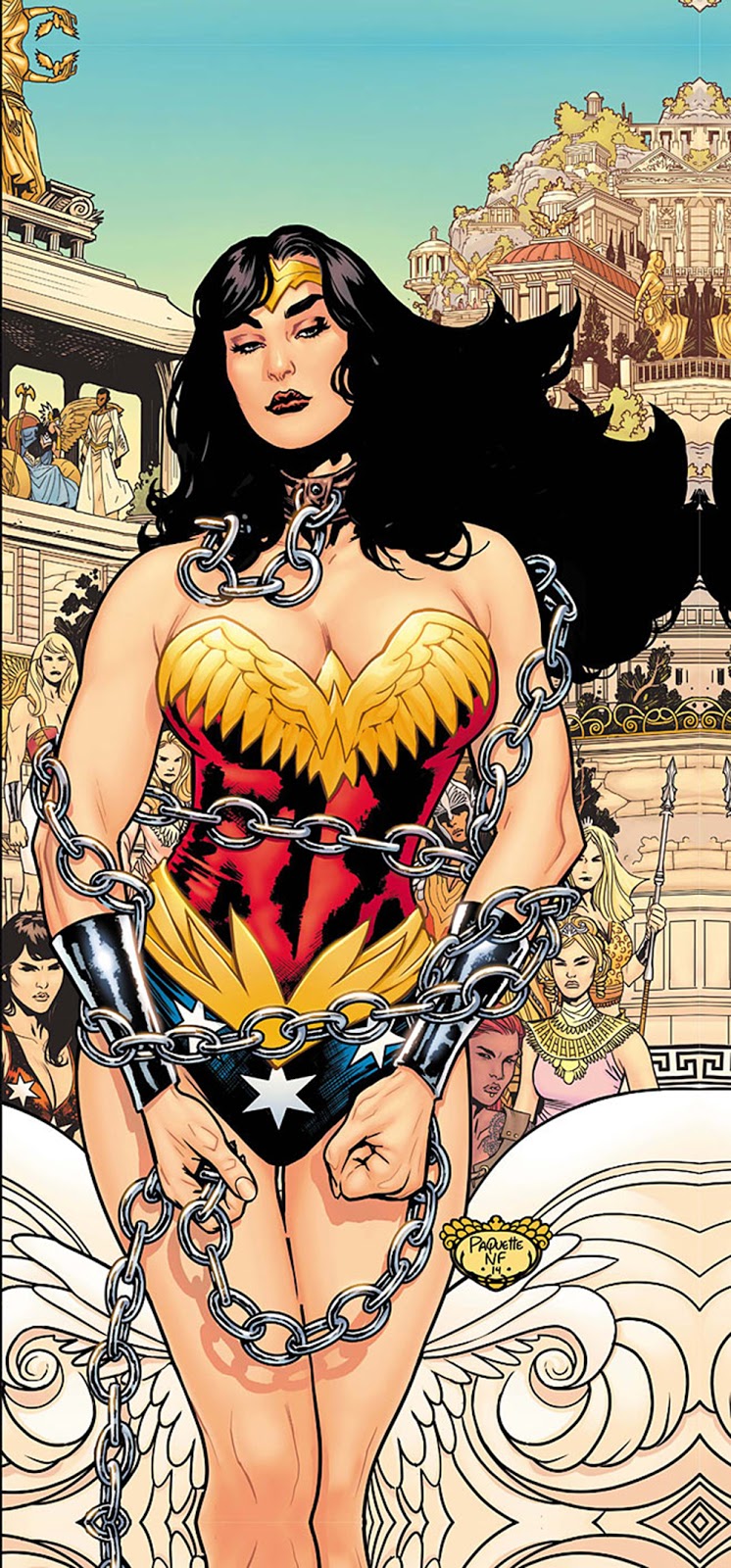
Much – MUCH – better was volume 1 of Grant Morrison’s Wonder Woman: Earth One from earlier in 2016, which provided a new but coherent take on the Amazon’s origin story.

Yanick Paquette’s art worked for me – but then again, I didn’t get in a tizzy about pictures of WW in chains. Well, not that sort of a tizzy.

I really don’t know whether I’ll watch this summer’s film: setting it in WWI as opposed to Wonder Woman’s conventional entry into human affairs in WWII suggests that the filmmakers have decided that, instead of understanding that conflict as six of one and half a dozen of the others, writ large across all the main actors involved, it’s going to leap in with a howlingly simplistic Goodies v Baddies approach.

We shall see.

Normal and the head of Agatha Blue Witch
Very differently, one of my personal discoveries of the year was Andrew MacLean’s Head Lopper.

Written and drawn by MacLean – and originally self-published before being picked up by Image – this is the tale of Viking warrior Norgal, who hunts down monsters with the help (though he doesn’t actually like it) of the severed head of Agatha Blue Witch, which he carries around in a bag.

Image threw the comic convention of monthly, 22-page issues out of the window for this, instead allowing MacLean to produce bigger issues on a quarterly basis.

And while the first trade is a lot heftier a volume than you’d usually expect, it doesn’t fail on the fun quota.

Completely different to Hellboy, it would nonetheless be impossible not to see a relationship between Mike Mignola’s seminal work and this.

There’s humour, violence, great atmosphere and a wonderful sense of the folkloric – yes, all things that you’ll find in Hellboy – along with a superbly stylised visual look, all of which effectively gets the Mignola nod of approval in a contribution from the man himself in the gallery at the back of this volume.

MacLean makes storytelling look simple and his art ticks incalculable numbers of boxes. The picture I’ve used here also illustrates MacLean’s fascinating use of foreshortening and perspective, which is a contributory aspect of the work.

There is not a single thing I don’t love about this.

Black Road comes with added ravens
Not very far behind in my personal appreciation stakes comes the first trade of Black Road, which also plunges readers into Viking terrain – but the mood and look could hardly be more different.

Magnus the Black is a man placed awkwardly somewhere between paganism and Christianity, as the church militant strives to conquer the Viking lands for Christ.

Hoping to perhaps ease the trauma of this momentous change for his fellow Norse men, Black finds himself caught up in the bloody politics of religious conquest – and has to turn detective when an official in his care is brutally murdered.

Brian Wood’s story has a satisfying complexity about it, but it’s the art by Dave McCaig and Garry Brown that really lifts this, with its evocation of the bleak, vast landscape of the north.

Having enjoyed the autumn release of the first trade, I’ve hit the subscribe button for the coming issues in this Image series, rather than wait for trade two.

Actually, that’s also an indicator that I’m getting sussed enough about the comics world that I spotted it before the new arc begins.

In the meantime, Skottie Young’s I Hate Fairyland is another comic that defies easy categorisation.

A bright, bubbly tot called Gertrude wishes to live in Fairyland – and then her wish comes true.

Gertrude is not as happy as Larry. Neither is Larry, to be fair
Unfortunately, 20 years later, she’s grown mentally but is physically still a child, trapped in a bubblegum world of sugary niceness.

A crazy new take on a sort of Dorothy longing for Kansas, Gertrude has become a sweary, psychopathic monster who wants to destroy everything and everyone as she tries to find an escape back to reality, accompanied by Larry, a cynical version of Jiminy Cricket.

Life is further complicated when the queen of Fairyland decides that the only way in which to deal with the chaos and violence is to have Gertrude herself killed.

Written and illustrated by Young, volume one was fun and the second trade is out now (if you look online at Forbidden Planet, it can currently be obtained with a very nice autographed postcard too).

It’s hard to know where Young can take this story – but fluff you (as our less-than-angelic Gertude so often puts it): it’s going to be fun finding out.

And finally, the autumn also saw my own first comic strip – okay, only three pages, but my words and my illustrations. It was published in a membership magazine that went to over a million people, but I've now put up a digital version, so you can catch it here. Enjoy!


Monday, 19 December 2016

When monsters help face life's brutality

There is little that is as infuriating as feeling that one is being manipulated into crying by a piece of entertainment.

Now of course, almost all entertainment seeks to manipulate the emotions, but some instances are rather more subtle than others.

And where the unsubtle can annoy, the subtle can have a cathartic effect.

With A Monster Calls, it’s very much a case of the latter.

Written by Patrick Ness and based on his own novel of the same name (which itself originated from an idea by Siobhan Dowd, who died from cancer before she could develop it), the film follows schoolboy Conor O’Malley as he faces the terminal illness of his mother.

His father is in the US with a new family, his grandmother is a cold, uptight figure and he’s being bullied at school.

But one night, an ancient Yew from a nearby churchyard roars into life as a monstrous tree, and challenges Connor to listen to three stories – told through beautiful animations – asserting that then Connor himself must tell a fourth but that it must be the truth.

An extraordinary screen representation of complex emotions, it bucks most current cinematic trends – not least in leaving some viewers wondering what age group it’s really ‘meant’ for, as though such stories can be filed away conveniently in boxes divided neatly along the lines of age.

To work, not only does this require an assured but delicate touch from director JA Bayona, but a top-notch cast too.

Signourney Weaver is excellent as the grandmother, while Tony Kebbell as the departed father adds to the sense of adults not knowing how to reach out to the boy.

If there’s a problem – and this risks being churlish – it’s that Felicity Jones as the dying mother can seem altogether too saintly in her suffering, although it’s to the film’s credit that the brutal progress of the cancer is portrayed utterly unflinchingly.

But boy and monster are at the heart of this.

Lewis MacDougall as Connor turns in a super performance of remarkable nuance and depth, while Liam Neeson lends a deep, primal power to the monster of the title.

A tale about truth and emotion, the power of stories and so much more, it could, all too easily, have lapsed into mawkish sentimentality, but it steers a clear path throughout to place before us a profoundly moving experience.

It opens across the UK on 1 January and should be widely seen. Just don’t forget the hankies.