Showing posts with label sci-fi. Show all posts

Thursday, 15 August 2024

Parallel – using sci-fi for a powerful take on grief

Described generally as a ‘science fiction thriller’, this year’s Parallel – a remake of the 2019 Chinese film Parallel Forest, and re-written by brothers Aldis and Edwin Hodge, together with Jonathon Keasey – is a seriously good film that seems to have picked up less attention than it should have when it appeared in UK cinemas earlier this year.

I was looking for something to watch this evening after work and noticed that it is currently available on Sky. My memory was jogged to remembering a trailer seen on cinema visits earlier this year. That trailer doesn't do it justice.


Vanessa is mourning the loss of her and her husband Alex’s son, Obi, who died a year previously in a car crash that was not the fault of either of them, though she seems confused over who was driving at the time.


They live in a very nice home, with Martel, Alex’s brother, effectively surrounded by forest and with a nearby lake and increasingly strange things start to happen. The men’s father had apparently thought the area ‘strange’, yet the film opens with only Vanessa seeming to experience such.


Although the couple have had counselling, she is withdrawing further and further from life. And then she finds herself facing herself in the forest, in a parallel universe.


It’s subtle and low-key for cinema sci-fi these days. In some ways very simply told, with no (discernible) special effects – and kudos to director Kourosh Ahari for that. But while it’s ‘sci-fi’, its core themes are loss, grief, and trauma, and they are very well and sensitively dealt with.


Very good cinematography from Pip White, and an equally good soundtrack from Josh Atchley and Denise Santos.


It is a three-hander, and the Hodge brothers play both the male roles (very well). But much here relies on Vanessa, and Danielle Deadwyler is excellent in the role, really catching the complexity of the emotional experience of loss, grief and guilt.


And the ending packs a surprising punch.


As I said – it's on Sky now and very much worth watching.

Saturday, 30 March 2024

A sweet look at ageing, loneliness, friendship and more

Milton Robinson is nearing 80, a widower living on his own, with an estranged son, and a daughter who, worried that her father is starting on a dementia pathway is naggin him to see a doctor.

One night, a UFO crash lands in his garden and a small alien appears. After his initial terror, Milton takes the nonverbal and apparently unthreatening alien inside and treats him as a guest.

He tries to tell the authorities, his daughter, a shop assistant and a local council meeting that he regularly attends, but all assume he’s imagining it. But then an acquaintance, Sandy, drops by and sees the alien, then names them Jules.

This is a really interesting and subtle point. All the characters assume – without any side – that the extra-terrestrial is male (they can pilot a spaceship, for instance), but we never find out, while Jules as a name is gender neutral.

Sandy warns Milton not to tell anyone else – before another acquaintance, Joyce, spots them and demands to be in on the action, though possibly from nefarious motives.

However, secret services monitoring knows that something has fallen to earth in the vicinity of the small town and the hunt is on.

Billed as a science fiction comedy-drama, it’s fairly slender in terms of the comedy aspect, but there is gentle humour. Watch out for the ET nods in Milton’s speeches to the local council and a running t-shirt gag later on.

Written by Gavin Steckler and directed by Marc Turtletaub, it is gentle and heart-warming, with themes of loneliness, friendship, kindness and family rifts played out sensitively, and over a pleasingly tight 87 minutes.

Jules themselves is very well done in terms of leaving plenty to the imagination throughout, with Jade Quon helping create and maintain the mystery around the character.

But it also relies on an excellent central trio. Ben Kingsley does a really lovely and delicate job with Milton, while Harriet Sansom Harris as Sandy and Jane Curtin as Joyce are also in very fine form.

Finally, Zöe Winters as Denise, Milton’s daughter, lends good support.

All in all, Jules was never going to set the cinematic world on fire, but it’s a sweet film, full of heart. Currently streaming on Sky Cinema, it’s well worth an hour and a half of your time.


Saturday, 21 September 2019

Ad Astra: cinema that reaches for the stars

In the near future, the Solar System is being hit by power surges from an unknown source, causing increasing damage and loss of life on Earth. Surviving one incident, astronaut Major Roy McBride is assigned a secret mission.

McBride’s father, H Clifford McBride, had long been thought dead, together with the Lima Project that he was commanding on the journey to Neptune to look for alien life.

But now Roy is told that the surges may be coming from the ship that carried that team – and that his father might still be alive. His mission is to travel to Mars, from where he will try to make contact and find out what is happening and what (if anything) can be done to stop the surges.

Inspired by Heart of Darkness, Ad Astra has inevitably drawn comments about its similarity to Francis Coppola’s 1979 epic, Apocalypse Now – hardly surprising, though, given the shared starting point of Joseph Conrad’s novel.

But written and directed by James Gray, this is light years from being some sort of a remake. 

It is a very different kind of space opera: there are few explosions and plenty of time – its excellently paced – to give us a sense of the infinite vastness of space and the almost choking awareness of our own smallness. 

 At once an intimate portrait of a parent-child relationship and also an existentialist meditation both on the meaning of our own, individual lives and also our world, there are myriad threads here. Gray’s targets include our insatiable desire to desecrate nature and and crass consumerism.

The first leg of Roy’s journey is to the Moon, via a commercial space flight. One wonders if Virgin Atlantic knew, when they (presumably) gave permission/paid to have their branding used at this point, that a scene would have flight crew charging rip-off prices for the additional comfort of a blanket and pillow.

While Gray doesn’t over-egg the idea, science is perceived as only offering humanity so much: it comes with dangers, while many of the answers lie within ourselves. Indeed, one can also see the nods here to another iconic Coppola film, in 2001: A Space Odyssey.

Ad Astra is the antithesis of macho adventure films, taking on ideas of emotional engagement, vulnerability and mental health. Indeed, the casting of Tommy Lee Jones and Donald Sutherland in the same film for the first time since they starred in Clint Eastwood’s 2000 astronaut romp, Space Cowboys, could be viewed as a comment that the time for such a view of masculinity is over.

On a rather less intellectual level, cult film junkies will spot a reference fo John Carpenter’s 1974 sci-fi comedy-drama, Dark Star.

Visually stunning, it’s hard not to imagine Hoyte van Hoytema’s name not being in the frame for cinematography gongs come award season, while Max Richter’s score is pitch perfect.

The performances are excellent: Brad Pitt is really at the top of his game as a the emotionally crippled son, all coiled control and desperate restraint, while Jones never goes into panto territory as his father. Sutherlands cameo is enjoyable.

If I have one regret it’s that we see so little of Ruth Negga. Her role as the director of the Mars base is small but important, and she gives it the heft required.


But that aside, Ad Astra is a really fine, grown-up film – and one that will stick in the mind for a very long time.


Monday, 7 August 2017

Valerian's visuals light up the screen

Valerian and the Planet of a Thousand Cities may not be quite up there with Luc Besson’s camp sci-fi classic, The Fifth Element, but it’s an enjoyable romp for the holiday season.

In part crowdfunded – helping make it both the most expensive European and independent film in cinematic history – it’s based on the iconic French sci-fi comic series, Valérian and Laureline, by Pierre Christin and Jean-Claude Mézières.

Valerian and Laureline are 28th-century special agents who have been sent to retrieve the last of a species of animal, known as a converter, from black market dealers.

But Valerian realises that the cute little creature – and an unknown race of aliens who are desperate to get their hands on it – have featured in an apocalyptic dream he had.

Back at a vast space station where millions of beings from across the universe live and work together, Valerian and Laureline are plunged into further danger when the converter is stolen and Commander Filitt tells them that part of this ‘planet of a thousand cities’ has become infected by an unknown force that is spreading.

Dane DeHaan and Cara Delevigne as the leads are perhaps not entirely convincing in terms of holding the film together – certainly at the beginning – but they grow into the roles and also have welcome help from Clive Owen as Filitt, Rihanna as Bubble, a shapeshifting alien chanteuse, and Sam Spruell as General Okto Bar.

Herbie Hancock, Ethan Hawke and perhaps particularly, Rutger Hauer, don’t really have enough screen time to make a great impact.

The plot is entertaining enough, with a nice ethical heart, but where the film unquestioningly wins is in its sumptuous, superb visuals.

There are all sorts of little references, as you’d expect from Besson: I’m not sure I’d be alone in seeing a subtle thread between the K-Tron robot warriors here, the battle droid army in George Lucas’s Star Wars: The Phantom Menace (1999), the Mondoshawans in The Fifth Element (1997) and Jacob Epstein’s Torso in Metal from The Rock Drill (1913-14).

Nor does it seem too farfetched to feel that in his central alien race, Besson has looked at what James Cameron did in Avatar – and then done it better.

And in the Doghan Daguis – a trio of devious, platypus-like characters – he seems to be saying that he can do irritating characters without going too far, as Lucas did with the legendarily awful Jar Jar Binks.


All in all, eminently watchable – and probably worth seeing more than once if only to play spot the reference and to enjoy the look of it all.

Saturday, 20 May 2017

Alien: Covenant – frustrating and fascinating

If ever a film was deserving of the description ‘mixed beast’ then Alien: Covenant is it.

Dissatisfying and satisfying in approximately similar amounts, it prompted me to consider ratings and what I’d give it, and I’d probably do three stars out of five.

On the cons side, it suffers from a number of things –- not least being the latest instalment in the Aliens franchise. Part one is an icon of the horror genre, with part two not far behind. Part three was dire, while the fourth instalment is as divisive as Marmite (I like it).

Then there was a long gap before Prometheus. Which was awful – a point not helped because it didn’t ‘feel’ as though it belonged to the same family as any of the films that had gone before.

In many ways, neither does this. It feels as though it belongs somewhere else – and that's not a bad thing.

It begins before Prometheus, with the perfect synthetic David being ‘awoken’ by his father/creator Peter Weyland, and then moves us fast forward a decade to the ship Covenant, which is on a long trip to set up a new colony, with 2,000-odd humans and a thousand embryos sleeping/stored until they arrive.

The crew too is asleep with only a synthetic, Walter, around to run routine operations with Mother, the ship’s computer, when a fluke of an accident sees the crew woken and the captain dead.

As they repair the ship, the crew comes across a human transmission – someone singing a John Denver song. When they discover that the signal is from a nearby planet that seems perfectly suited for human habitation, reluctant acting captain Oram overrides arguments that it’s all too good to be true, and sets them on course to investigate.

Down on the planet, Oram and a team find more than they bargained for  not least, David – ‘brother’ to Walter and last survivor of the Prometheus.

Frankly, the first chunk feels slow and is far from great – not helped by having a generally unmemorable crew. Compare that to the first film with it’s outstanding ensemble.

Katherine Waterson as Dany and Danny McBride as Tennessee are really the only two who make – are allowed to make – any impact.

Where the film starts coming into its own is when David and Walter meet – and it benefits hugely from two superb, intertwined performances by Michael Fassbender as both synthetics.

There are gory deaths aplenty as we are introduced to whole new flavours of aliens – someone has been playing god with genetics. And there are some very clever twists amid the horror – slipping on blood in an attempted escape is just one.

Some of the visuals are superb, but the script by John Logan and Dante Harper is flawed.

While there are enjoyable elements of philosophical questioning – the nature of gods/creators and the act of being creative; the question of artificial intelligence overtaking the human intelligence that creates it and more – having made a point of Oram having a religious faith, it then fails to explore this.

One is left only with the vague notion that perhaps Oram’s ignoring of reasoning in his desire to quickly find a paradise, is indicative of religious faith.

Perhaps much of this is director and producer Ridley Scott continuing to work through some of the same subjects that he has for years – see Blade Runner, for instance – with the added intensity of age.

The ending is genuinely creepy and the use of Entry of the Gods into Valhalla from Wagner’s Das Rheingold to bookend the film is actually very effective, not least because of the different ways it’s played: by solo piano initially and then in the full orchestral version – indicating a theme developed.


Flawed without doubt, it is a movie that nonetheless gets under the skin. But while the themes can be explored in other settings and contexts, please let’s make this a day for the Alien franchise.

Tuesday, 10 January 2017

Further adventures in comic land

Atmospheric artwork from Andrew MacLean
The last part of 2016 saw plenty of action on the comic front – it’s become a serious pleasure to get regular deliveries of Forbidden Planet subscription packets through the post – and there’s been plenty to enjoy from what’s been inside.

Here’s a few notes on what I read and saw in that period.

Descender 3: Singularities by Jeff Lemire continues to be a cracking read, with this third collection playing with time to allow us to see events from different characters’ perspectives, and there’s enough meat here to keep the reader wondering what they’re not yet seeing, as the companion boy robot Tim finds himself being hunted by myriad forces – and the motives are not obvious yet.

And one of the things that Lemire achieves is to make the less sophisticated robots’ characters too, creating real pathos – light years away from the comedic approach of, say, C-3PO and R2-D2.

Panel from Descender 3
Dustin Nguyen’s art remains a real pleasure, his watercolours in a limited palette offering an unusual approach to sci-fi illustration, but one that works beautifully here, offering a soft-focus contrast to the story that nonetheless never jars.

Trees 2: Two Forests arrived a while back and takes us further into Warren Ellis’s apocalyptic tale, narrowing the field of vision to just the ‘trees’ – alien craft of some unexplained variety – in New York and the Orkney Isles, and with these, the central protagonists linked to them.

There’s a brooding darkness building here, with a sense of impending doom and even an incident in London that could be read as a pessimistic comment on the growing anti-immigrant sentiment that both contributed to Brexit and was boosted by it.

All this is helped by Jason Howard’s art, with strong images and a muted palette providing an excellent compliment to the words.

On a lighter note, I have also enjoyed a spot of Doctor Strange from Marvel – though not half as much as I enjoyed the film. Indeed, with TV watching and 2016’s cinema visits for the doctor and Deadpool, I’ve got really quite absorbed into the Marvel universe – albeit it cinematically rather than the version on paper.

"We are Groot" And the racoon's pretty cool too
Big screen trailers for spring’s Guardians of the Galaxy II looks so much fun that I caught up with the first one over Christmas – and loved it! It’s smashing entertainment.

Late as ever to such a party, I am however, now able to cry ‘We are Groot!’ with the best of them.

Then there’s the mere thought of autumn’s Thor: Ragnarok, which in promising to see Benedict Cumberbatch reprise Strange and Antony Hopkins Odin, looks set to ensure that this interest continues.

Christmas also saw me catching some Captain America for the first time – a bit straight-laced as a character, but when your support cast includes Samuel L Jackson as Nick Fury and, in Winter Soldier, Robert Redford as a senior SHIELD leader, plus the currently ubiquitous Toby Jones as a creepy, dead Nazi scientist (though not as creepy as his Jimmy Savile-alike villain Culverton Smith in last weekend’s Sherlock), then a bit of straight laciness can be coped with.

If Marvel have mastered the way to create universes from myriad characters, DC is floundering in its efforts to catch up, with last year’s Batman v Superman having been panned.

The only highlight was reputedly the brief first sight of Gal Gadot as Wonder Woman, set for her own individual movie release this summer.

Now I’ve loved Wonder Woman since the 1970s and the days of Lynda Carter, and it was one of the first things that I started reading as I dipped my toes back into the world of comics over the last few years, but DC’s 75th anniversary comic was a disappointing, disjointed mess.

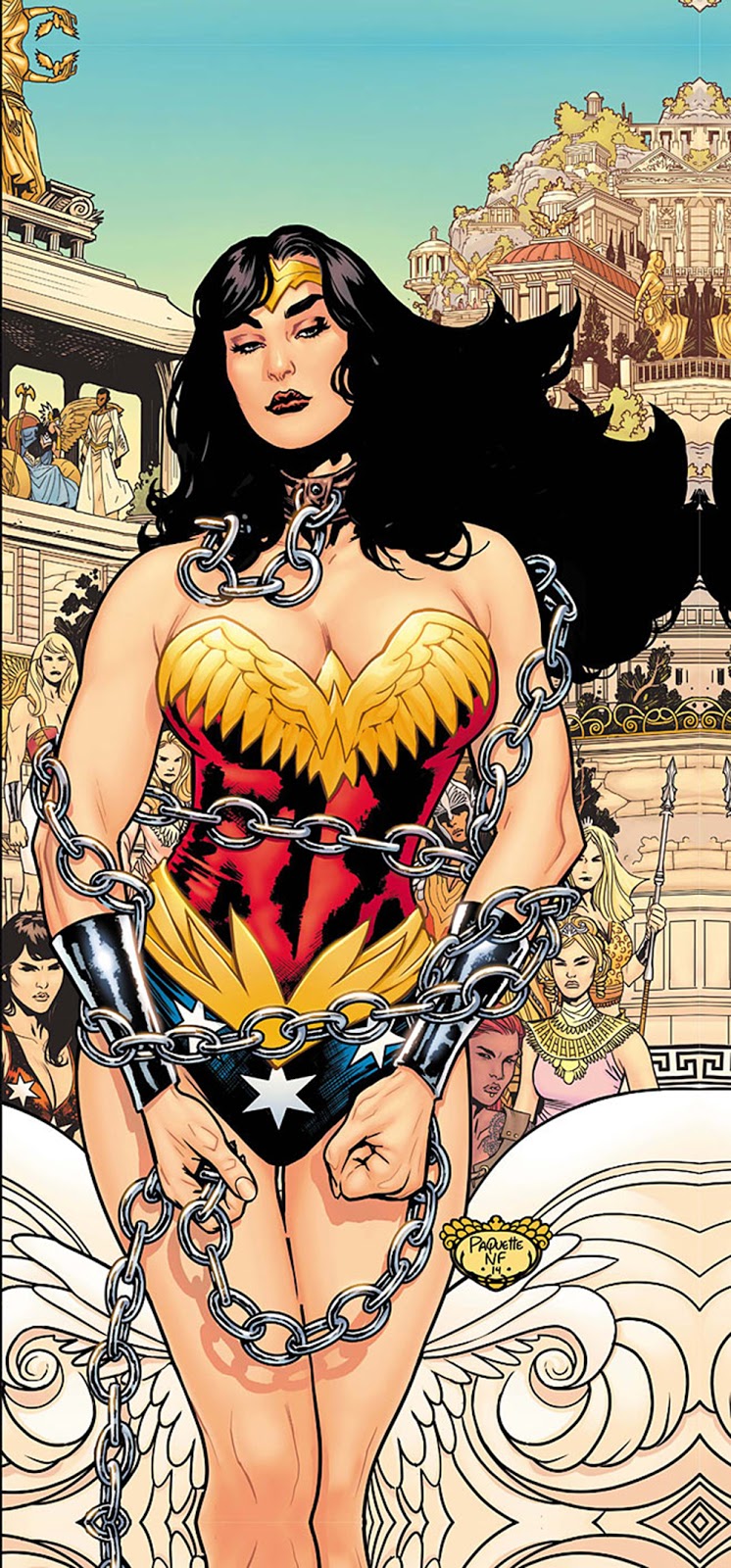
Much – MUCH – better was volume 1 of Grant Morrison’s Wonder Woman: Earth One from earlier in 2016, which provided a new but coherent take on the Amazon’s origin story.

Yanick Paquette’s art worked for me – but then again, I didn’t get in a tizzy about pictures of WW in chains. Well, not that sort of a tizzy.

I really don’t know whether I’ll watch this summer’s film: setting it in WWI as opposed to Wonder Woman’s conventional entry into human affairs in WWII suggests that the filmmakers have decided that, instead of understanding that conflict as six of one and half a dozen of the others, writ large across all the main actors involved, it’s going to leap in with a howlingly simplistic Goodies v Baddies approach.

We shall see.

Normal and the head of Agatha Blue Witch
Very differently, one of my personal discoveries of the year was Andrew MacLean’s Head Lopper.

Written and drawn by MacLean – and originally self-published before being picked up by Image – this is the tale of Viking warrior Norgal, who hunts down monsters with the help (though he doesn’t actually like it) of the severed head of Agatha Blue Witch, which he carries around in a bag.

Image threw the comic convention of monthly, 22-page issues out of the window for this, instead allowing MacLean to produce bigger issues on a quarterly basis.

And while the first trade is a lot heftier a volume than you’d usually expect, it doesn’t fail on the fun quota.

Completely different to Hellboy, it would nonetheless be impossible not to see a relationship between Mike Mignola’s seminal work and this.

There’s humour, violence, great atmosphere and a wonderful sense of the folkloric – yes, all things that you’ll find in Hellboy – along with a superbly stylised visual look, all of which effectively gets the Mignola nod of approval in a contribution from the man himself in the gallery at the back of this volume.

MacLean makes storytelling look simple and his art ticks incalculable numbers of boxes. The picture I’ve used here also illustrates MacLean’s fascinating use of foreshortening and perspective, which is a contributory aspect of the work.

There is not a single thing I don’t love about this.

Black Road comes with added ravens
Not very far behind in my personal appreciation stakes comes the first trade of Black Road, which also plunges readers into Viking terrain – but the mood and look could hardly be more different.

Magnus the Black is a man placed awkwardly somewhere between paganism and Christianity, as the church militant strives to conquer the Viking lands for Christ.

Hoping to perhaps ease the trauma of this momentous change for his fellow Norse men, Black finds himself caught up in the bloody politics of religious conquest – and has to turn detective when an official in his care is brutally murdered.

Brian Wood’s story has a satisfying complexity about it, but it’s the art by Dave McCaig and Garry Brown that really lifts this, with its evocation of the bleak, vast landscape of the north.

Having enjoyed the autumn release of the first trade, I’ve hit the subscribe button for the coming issues in this Image series, rather than wait for trade two.

Actually, that’s also an indicator that I’m getting sussed enough about the comics world that I spotted it before the new arc begins.

In the meantime, Skottie Young’s I Hate Fairyland is another comic that defies easy categorisation.

A bright, bubbly tot called Gertrude wishes to live in Fairyland – and then her wish comes true.

Gertrude is not as happy as Larry. Neither is Larry, to be fair
Unfortunately, 20 years later, she’s grown mentally but is physically still a child, trapped in a bubblegum world of sugary niceness.

A crazy new take on a sort of Dorothy longing for Kansas, Gertrude has become a sweary, psychopathic monster who wants to destroy everything and everyone as she tries to find an escape back to reality, accompanied by Larry, a cynical version of Jiminy Cricket.

Life is further complicated when the queen of Fairyland decides that the only way in which to deal with the chaos and violence is to have Gertrude herself killed.

Written and illustrated by Young, volume one was fun and the second trade is out now (if you look online at Forbidden Planet, it can currently be obtained with a very nice autographed postcard too).

It’s hard to know where Young can take this story – but fluff you (as our less-than-angelic Gertude so often puts it): it’s going to be fun finding out.

And finally, the autumn also saw my own first comic strip – okay, only three pages, but my words and my illustrations. It was published in a membership magazine that went to over a million people, but I've now put up a digital version, so you can catch it here. Enjoy!