Showing posts with label winter. Show all posts

Tuesday, 21 December 2021

A poem for the winter solstice


Winter Solstice


Welcome to the shortest day of the year

The heart of the long, dark winter of the soul

When you don’t feel whole,

When the bowl is empty and the bole is bare

And a bear roars up at the stars somewhere

In deepest memories

That arc through the blood

Reigniting fear

As the year burns out and the world spins on

And the purpose of light is forgotten in the night.


Amanda Kendal 21 December 2021


Photo: DreamyPixel

Saturday, 23 May 2020

Lockdown's creative surge continues

The lockdown brings with it plenty of difficulties, but there can also be opportunities – not least to think about things. 

I’ve already explained briefly here that for me, it has produced an entirely unexpected creative burst, as I have found myself writing poetry for the first time in decades.

In the last couple of days, remembering old family photographs uncovered when clearing my parents’ home two years ago this summer, I found that a couple of the pictures made me want to talk about them.

Or to put another way, I felt that I wanted to write about some of them, to build a picture in a different way. The photographs themselves will be included, because this is – hopefully – one thing complimenting another.


Before

Snow-dumped fells blur
Into snow-filled skies;
Drifts arc up from the road
Like a pitted bobsleigh track.
She stands in the middle distance,
To the bottom left.
Perspective,
deceptive,
has a black hedge tower over her,
Drawing the eye
and accidentally lending the shot
                        good composition.
The slide was colour but
Winter and time have leached that.

Blow it up and there is no trace
of a smile
in the smudge of a face.
Booted, with feet turned out
(Later, she’d say not to stand that way).
Stockings beneath a dress or skirt,
She relies for warmth on a big coat,
collar up
And hands hidden in gloves or overlong sleeves.  
Her hair is tucked away, queen-like, beneath a scarf.
Further off, two men in caps
            clear the road.
It was December ’62 and
The snow that had snowed
            would be followed by plenty more;
And, just a few days later,
            By me.


23 May 2020

Wednesday, 1 April 2015

Walking in a winter wonderland

Looking over the Lech to St Mang's 
Being English means, in part at least, developing an obsession with the weather. The Other Half and I had spent weeks before our Bavarian trip studiously watching the weather forecast for the area – not least in an effort to work out exactly what clothing would be required.

Overall, the outlook was not good, with precipitation of various sorts predicted for almost the entire week.

Looking back to Füssen
And it began exactly as forecast, with snow falling throughout Saturday night so that we awoke to a winter wonderland. A winter wonderland, it should be said, with knobs on.

And fairylights on the knobs.

Even in London, a little snow is transformative. In terrain such as this, it’s magical.

After breakfast, dressed in proper walking boots – mine, coincidentally, from Bavaria – and wrapped up against the cold, we set out.

A snowy stroll
The cloud was still low as we headed down the road. I was desperate to see Neuschwanstein and insisted we continued down a path the bordered a park, believing that, as soon as we reached a certain point, it would be there, soaring majestically out of the woods.

We never quite got that view, but we warmed instead to a walk that gave us the chance to enjoy the snow. And to see the slopes of the lower hills, with trees dressed in white – evergreens bowing under their thick garments; deciduous with a dusting that gave an illusion of mistiness – was just one of the pleasures.

Then there was the water of the River Lech as it wound its way toward the Forggensee – crystal clear and a wondrous, malachite green.

The Forggensee itself – the largest lake in the immediate vicinity and the fifth largest in Bavaria – is partly drained in the winter, which makes for an odd sight.

The clear, icy waters of the Lech
Created in 1954 when the Lech was damned for the first time to create the Lechsee further north, being able to drain it helps to reduce the risk of flooding during the spring snow melt, and provides a perfect setting for aquatic sports in the summer. It’s also a great source of pike, eel and trout.

And while we’re on the subject of such things, the Lech is a tributary of the Danube, flowing from lake Formarinsee in the Austrian Alps down past Füssen, before flowing through the Forggensee and on north to reach the Danube near Donauwörth.

The walk back was as pleasant and we continued under the main road bridge and round toward the side of the summer palace of the bishops of Augsburg before slipping back into the old town alongside St Mang’s Abbey.

The Benedictine abbey has stood there for centuries and is named for a hermit, Magnus of Füssen, who built and oratory and cell there and died on 6 September in a year nobody bothered to remember. The first proper documentary record shows that, while he was certainly not the first abbot, Gisilo held that position in 919.

The Heilig-Geist-Spitalkirche
But there were practical and political reasons for the founding of the monastery there too. Füssen lies on the medieval road that leads from Augsburg south and across the Alps to Italy – it’s the point where the Lech breaks out of the mountains, which is what gives it great strategic importance.

Thus both the bishops of Augsburg and the Holy Roman Emperors considered it to be of political interest.

But we’ll return to the abbey another day. In the meantime, as we enterted the old town, we came across the Heilig-Geist-Spitalkirche (Holy Ghost Hospital Church), which was built between 1748-49 by Franz Karl Fischer.

At this point, you might be thinking that that name reminds you of Spitalfields in east London – named because the land in that area belonged to St Mary Spital, a priory and hospital nearby.

Damn such linguistic connections, illustrating how we don’t live in clearly-defined national vacuums.


But back in Füssen, the tiny church’s rococo façade shows the trinity and assorted religious figures, including Johannes Nepomuk, the patron saint of rafters – rafts being an important craft used on the Lech when this was built.

The walk gave me a first opportunity to see if my photographic experiment was going to work.

Having finally been pretty much forced to upgrade my phone, instead of bringing the big camera, I’d decided to see if I could shoot the entire trip on a camera phone, albeit that the phone in question is an iPhone 6 plus, which I was just starting to realise has a very good camera.

Cake. And coffee
This is a phone camera that will do macros and panoramas and various other whizz-bang things, including video, which I was determined to try – and the first attempt can be seen above, giving you a brief look at the inside of the Heilig-Geist-Spitalkirche.

But after a stroll around the streets and a first sense of orientation – and a first chance to admire some of the painting on the buildings, including plenty of trompe-l’œil – given that it was still rather grey, we returned to the hotel and took coffee and cake in the Kurcafe, which was how our hotel had begun life, back in the late 19th century.

The cake involved chocolate. And creamy truffle.

Schweinebraten
And after that – and after a break to let thew cake and coffee settle – it was off to enjoy the sauna for the first time.

An early dinner followed in Himmelstube, the hotel’s Bavarian restaurant. For me, it was a first experience of a Schweinebraten, a roast pork dish; this one in Dunkelbiersoße – a dark beer gravy – with a substantial potato dumpling, a little side salad and some red cabbage, and with a glass of beer on the side.

And so, sated and warmed, and with the mind full of the winter landscape, we slept, with the weather forecast having told us that the following day would be the best of the week.

Fairytale castles awaited.

Monday, 8 April 2013

Tempestuous weather leaves gardening in a whirl


An anenome finally opens on the patio.
How many fingers can you cross? And is it possible that crossing some toes too will add to the effect?

The weather pepped up over the weekend. It wasn’t a heat wave, but there was enough warmth to give hope that my bones will feel warm sometime soon.

And enough warmth to make you very aware that the warming of the sun on you skin is very, very different to the warming of central heating.

Such an improvement was also just in time to be able to sit outside and appreciate the results of the bulb planing that we'd done last autumn.

The question, as always, is whether it lasts, but the forecasts are looking more optimistic, at least in terms of temperature.

Spot the healthy ones.
It had been a crazy week. Last Tuesday, I got home to find that the sudden sun that day had boiled most of my seedlings in their propagating trays. Most was gone – it remains to be seen whether any of the peas and broad beans recover. I’m holding out faint optimism for one or two at most.

At least there were two small pea plants – the smallest and poorest, it had seemed – that were outside the trays waiting for the extra coir pots needed for repotting, and thus didn’t suffer. They look so healthy by comparison now.

And then, just 48 hours after that, a blizzard hit. Oh, it didn't stick, but the snow was teeming down, swirling around in the wind, obliterating the nearby St Pancras and British Library.

All this while early mornings would, whether bright or gloomy, reveal frosted car roofs.

How on earth do you judge whether to try to harden off plants or open the propagator vents or do anything when the weather is so utterly all over the place?

Grazing sheep at Hackney City Farm.
It is a learning curve – and then some.

As young plants succumbed to massive stress and shock, the leaves of the broad beans turned from vibrant green to grey, and everything else wilted, it felt soul destroying, having judged so well until that moment.

But you have to get right back into the saddle, as they say after a throw, so on Saturday, with the sun at my back once more, I sat down and sowed two more full cell trays.

One was made up of salad vegetables – I’m going to leave radishes and spring onions until I’m back from my brief trip, and then sow them straight into pots – but included two varieties of lettuce, plus more chard.

The second tray was all tomatoes and chilies, of which there have been no sign in the earlier attempts.

Red leaves catching the sun near Columbia Road.
I read somewhere that the entire country is about five weeks behind usual growing times, so perhaps those first ones may yet geminate, while the new sowing should have a much better chance as the temperature seems to be stabilising.

Yesterday, a pleasurable wander down to Columbia Road allowed to to pick up some more fibre pots for potting on.

And alongside the one pea that I sowed to make a trio with the two healthy plants (a Kelvedon Wonder), I added three broad beans (Witkiem Manita) and three runner beans (St George).

All are sitting on trays – but are not in propagators. Let’s see what happens.

Primula on Columbia Road market.
Also yesterday, I added another row of carrots into the potager – there is no sign of anything pushing up from the first sowing, but as with the tomatoes, they may now appear.

And alongside this now sits a row of turnip seeds.

The revelation of the weekend – of the week, indeed – was the discovery of three tiny pea shoots in the potager, just pushing through and unbending to reach the light.

Sown five weeks ago, I was beginning to doubt that any of them would germinate, but it provides yet more evidence for just how tough and resilient plants can be.

They now have a wigwam erected around them – with space for several more plants – and are themselves encircled by strips of copper to (hopefully) help keep the slugs off as they grow bugger and juicier.

Joyfully able to revel in the weather, I also spent time clearing the space in the pot holding the vine, together with the hanging basket, and sowed substantial amounts of nasturtium.

Potager with added wigwam. And car. For context.
That will keep things ticking over for a few days, I think.

But with the forecast suggesting – finally – that temperatures are approaching a seasonal norm and, most importantly, not plunging below freezing almost every night, gardening matters might finally be looking up.

And the lesson of the lost beans and peas must be that, once leaves appear, open the vents.

As a wise man once put it: living is learning. And the same goes for gardening.


Wednesday, 20 March 2013

Spring is here! (well, sort of)

The dwarf daffs have bucked the trend.
It might be difficult to believe, but today was the vernal equinox – the first day of spring.

No, I know: looking out of the window – in much of the east of the country at least – you wouldn’t be able to tell.

The sky is a blanket of grey-white cloud, putting an unrelenting dampener on everything.

As we head into evening, the birds that were at least twittering to each other under that cover have gone quiet, as the rain starts to fall again.

Someone said to me yesterday that it feels as though we’ve already had six months of winter. And it's impossible to disagree.

Temperatures are below what they should be and the gloom seems to be sticking around.

Peas, broad beans, a hint of runner & radish.
The bright spot on the horizon is that the vernal equinox is a tipping point. Since, from now on (for six months) the days will be longer than the nights in this hemisphere, the sun will – eventually – break through and temperatures will rise.

But for the moment, while some of the country is having better weather, many of us remain buried beneath that cloud.

And frankly, it feels as though we’re underneath a duvet where someone has farted.

Of our bulbs, the crocuses have been and gone – without the weather to enjoy them – and we now have dwarf daffs, which are managing a glorious display that, frankly, gives the bird to the weather.

From the perspective of the garden, this late, late spring would seem to be a big problem. Yet I do wonder if it’s actually a bit of a blessing too.

In only my second year of gardening – and arguably this is really only my first serious one – the weather is meaning that I can’t simply take what I read in a book, a magazine or a seed packet at face value.

In other words, I cannot be a book-learned gardener.

Perhaps the fact that I have all those seed cells sprouting new, delicate plants is simply beginner’s luck, but maybe not.

There is an extent to which I decided to start things off that way even though seed instructions suggested sowing straight outside last month.

In other words, I looked at the weather, looked at the packets – and then made up my own mind based on what I saw and felt was happening.

This, I think, may be a good sign for the future of my gardening. Perhaps I'm more in tune with something than I could have known 12 months ago when I started this project in such hesitating fashion?
It really doesn't look much like spring, does it?

What I do know is that it was a delightful ego rub to read Monty Don asserting, in My Roots, that real gardeners are those who sow from seed rather than buying a load of plants.

Mind, nature is more than capable of deflating ego. Slugs and snails are the perfect vehicles for that.

But I have strategies in mind and in place.

The potager is in a far better situation than it was last year.

With all the weeds and the dead and dying bush removed, there’s nowhere for slugs to hide during the day time. So the easiest option for the forthcoming months is to make sure that none get a foothold.

The potager, after carrots were sown at the weekend.
And a Dutch hoe makes attacking weeds before they can grow much really easy.

I also have copper ready to encircle any tender young plant. And will be getting copper tape to wind around any pot in which I intend to grow salad leaves, for instance.

There will be an odd ‘slug inn’ – a pot sunk into the ground and containing yeasty beer in which greedy slugs and snails will drown – but they’ll be set away from the plants I’m defending.

And there will, of course, be after-dark patrols, with torch and latex gloves to get rid of the little buggers.

I have learnt a thing or two already.

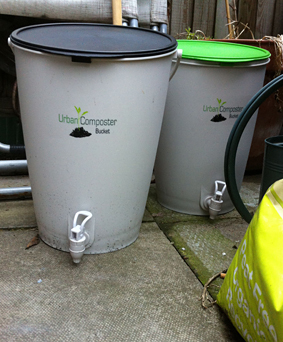
Urban compost buckets: perfect for small spaces.
And I will learn more.

But I have just this inkling – this tiny sense in myself – that maybe I do have green fingers; that maybe I have a greater connection with and sense of the soil than could have been expected.

In the meantime, I now have two 'urban compost' buckets that will allow me to create my own fertiliser and compost in a tight urban environment. It's another step up and solves the problem of space.

At breakfast in the canteen this morning, I was talking with someone who has an allotment. We hit a point where we burst into life discussing how wonderful it is to grow from seed and things germinate and develop.

Life-affirming; magical; magnificent; wondrous.

And even when we find ourselves, as now, battling the unseasonal elements, we can lift ourselves by knowing that, eventually, spring really will be with us.


Thursday, 17 January 2013

Eggs and Mrs David and snow


This morning, I cracked open an egg when making my breakfast omelette to find a double yolker.

To be fair, I had expected it, setting aside the egg in question until I was cooking something for which it would be better suited than being prepared to sit in an egg cup.

It was a vast thing, that egg – XL to start with – with an elongated shape, so that it was hardly the stuff of rocket science to guess that it would have two yolks.

In which case, I had a three-yolk omelette without breaking more than two eggs.

I follow the venerable Mrs David’s instructions on omelettes – well, to be more accurate, the instructions from someone else that she reproduces, crediting them and saying that she can do no better.

Reading and following those instructions was the point at which I finally learned to make an omelette – albeit further aided by investment in a proper heavy-duty, copper-coated omelette pan from across the Channel.

So you start by melting a good knob of butter and letting it just reach the foaming, might-be-about-to-start-turning-golden-at-any-minute stage, before you lob in your lightly beaten eggs: two plus one yolk, if you’re following many traditional recipes. Double yolkers excepted, I usually just use two: it’s quite enough for me.

From then on, it’s going to take about 40-45 seconds, as you raise the pan from on one side and then the other, gently lifting the egg mix to allow the uncooked, liquid egg to reach the base of the pan. But not much longer – you want it to still be silkily soft.

And then turn out carefully onto your plate, season and consume – although not with Mrs David’s glass of wine at that time of the day.

Actually, this morning’s omelette had a new seasoning: I wanted to use up some lumpfish ‘caviar’ and decided to garnish it with that, which added quite enough of a salty taste to the egg.

I remember seeing double yolks way back in the days when the family eggs came from one of the farmers that my father knew.

It’s funny how you forget such things, and only remember when something actually jumps up and slaps you across the metaphorical chops. When we started getting our eggs from Matthew was the point at which I remembered how good eggs can be.

And when I cracked the first double yolker from an egg I’d got from the same source – Black Rock hens, organic and free range, if you’re interested – it was as a case of: ‘oh gosh – I’d completely forgotten that such things occurred’.

But memories of eggs and farms also mean memories of snow for me, which is equally apt, given the UK weather forecast right now, and that I am due to be northbound for work tomorrow.

When we lived in Mossley – in the top half of that small mill town of 10,000, which was spread along the east-facing side of a Pennine hill, the valley and up into the opposite hill, we entirely expected to get cut off for a day or so once or twice a winter.

But one year – I cannot recall whether we were cut off at the time – the road up to a farm near Hartshead Pike was impassible for my father in his car. So I was sent, on foot, to collect the eggs.

I yomped up the road to opposite the parish church, before breaking away into a field and up a steep hill that was several inches deep in snow.

On the way back, I slipped, and ended up careering down the same slope some way on my backside.

When I got home, my mother (who, these days, is slightly embarrassed by this story) was only concerned about one thing – whether I’d broken any of the eggs! They were all intact, as it happened – just as I was. But I did feel a certain sense of being piqued at the priorities revealed.

Not that that was the only time that snow left me with a story to tell in those times.

I’d probably only been at Fairfield High School for Girls – some eight miles from Mossley, near the centre of Manchester – for a year or slightly more, when the white stuff had a big impact.

It was a Thursday – you’ll see later why I know this. There had been a trifling hint of snow at school. Only when I left for home at the usual time did it become an issue.

Indeed, it only became an issue well beyond Aston-under–Lyne, which was where I changed buses and, therefore, the halfway point of my daily journeys.

I was three quarters of the way home, then, near the old Ladysmith Barracks, when the bus stopped and the driver announced that he could go no further.

The reason was the snow, which had fallen heavily and drifted across the road that hugged the hill for a mile or so before dipping into top Mossley – near where I’d left the road to head for the farm and those eggs.

I was on my own.

Pulling the hood of my Air Force blue duffle coat up, I headed on up Mossley Road, the hill to my right, the fall away to Ashton Golf Club to my left, Hawkshead Pike ahead, and cars stranded in the deep drifting snow.

I reached a stranded bus and took a break inside, where I met a woman who took me – and a couple of other girls – under her wing.

We plodded on, taking a further break in another bus, before hitting the top of the town.

Almost the first buolding you hit coming from that direction is – or at least was – a pub. She took us all inside and the landlord gave us hot blackcurrant drinks.

From there, it was a short way home, albeit over icy roads.

I remember getting back, covered in the snow that was still falling thickly, and standing at the front door, ringing the bell, waiting to be let in.

When my mother opened it, the first thing she heard from this short, stocky yeti was whether Top of the Pops had started yet.

I had no watch; we had no mobile phones or tablets or computers. I had no clue as to the time. But that was why I know that it was a Thursday.

Thereafter, for my remaining time at Fairfield at least, the first hint of snow on the school fields would see the Mossley girls sent home straight away.

Nearly 40 years later, I remember that adventure with pleasure. I don’t think I was ever scared during it.

And perhaps it also explains why I never think of snow with anything other than relish.