Thursday, 29 February 2024

Death in Venice – a fine adaptation of Mann's novella

It’s the last day of February – and therefore the last day of LGBT+ History Month – so to conclude my thematic viewing on that basis, a repeat watch of Luchino Visconti’s 1971 adaptation of Death in Venice.

Gustav von Aschenbach is a German composer in the early 20th century. Suffering ill health, grief and a crisis in his work, he journeys to Venice to recover. At his hotel, he sees a beautiful young boy, Tadzio, and becomes utterly besotted. While never making verbal or physical contact, Aschenbach follows the boy and his family around, his own personal crises increasing rapidly, while at the same time, La Serenissima faces an increasing health problem.

The film is an adaptation of Thomas Mann’s 1912 novella, which I first read in 2001. A German friend had introduced me to Mann, recommending Buddenbrooks. Having read – and been captivated by that – I looked for more.

I knew the title of Death in Venice – but nothing more. I bought it, read the short stories that fill out most volumes and then the novella itself – albeit slowly. I was utterly blown away by the novella. Having spent the decades since my very late teens believing that Lord of the Rings was the greatest thing ever written, such a faith was utterly and irrevocably changed.

I have long attempted to write myself and, at that point, was doing so quite regularly. But I was stopped in my tracks by Death in Venice. My gods – you could do something like this in a ‘story’? The words wouldn’t come. It was some considerable time before I could even attempt fiction again.

Indeed, the Late OH and I were visiting friends on the west Irish coast, at the beginning of this century. We were walking by the sea, and I noticed that the wind was sending a fine spray of sand hovering horizontally above the beach itself – as if it were a sandy magic carpet. Desperate to describe to myself – and thereby understand – what I was seeing, suddenly the words started tumbling out of me again.

In 2010, the Late OH and I had done A Very Big Once-in-a-Lifetime Trip for his fifteeth: the Orient Express to Venice. I took a certain book by one Agatha Christie with me. When we visited again, in early 2017, I took the Mann, and sat reading it briefly on the beach in front of the hotel – Grand Hotel des Bains – in the film. It’s also the hotel in the novella, where Mann was staying when he was inspired to write it.

When my own fifteeth approached, it was a question of what I’d do. I decided that I wanted a brief trip abroad on my own, having never done so previously, for all sorts of reasons; fear and lack of money being primary.

I thought of cooking classes in Sicily and art schools in France. And found myself ultimately terrified. And then I reached a conclusion: Lübeck, where Mann himself had hailed from and where Günter Grass, another German literary laureate and personal hero, lived. And also, because the language beyond English that I know best is German, having been studying it in an – often random way – for a couple of decades now.

I recall sitting with a coffee, outside a cafe in old medieval Lübeck, blanket dove my knees (it was 'Baltic' cold!) and listening to a superb violinist play the adagiettio from Mahler's fifth symphony, an iconic piece of music that has becomes the film's theme.

That trip was a rite of passage – better late than never, I guess. But that’s an indicator of what Mann and his work means to me.

On my sixtieth birthday, in December 2022, The Late OH gave me a signed, English-language edition of three short stories by Mann. It meant – and means – so much.

I feel as though I’m going through another explosion of personal growth right now – akin with the language experience in Ireland. Watching Victim a couple of nights ago, and Death in Venice tonight, I seem to be seeing and reading more in films than I did previously. There are words in my head that would not have been in my useable vocabulary previously. Yet they’re there now. And a different way of seeing and reading is also there.

But enough of me. To the film itself. It is beautiful to watch – Pasqualino De Santis’s cinematography is wonderful. It frequently looks like an Impressionist painting. By the way, if you wonder if the green of the lagoon is accurate – yes, it is.

There are issues about how Björn Andrésen, who plays Tadzio, feels in retrospect about the film – to be clear, he has spoken of great discomfort etc, but never of any physical abuse from anyone involved in the making of it.

The film is not as subtle as Mann’s novella, but it is still a thing of great beauty – and a contemplation of beauty, and the debilitating sense of guilt about who you are at your most intrinsic level.

And then there is Dirk Bogarde as von Aschenbach. There is so little dialogue in the film as a whole, but Bogarde does so much with his facial expressions, including on some very, very long shots. It is a superb performance. And it is a superb film.


Tuesday, 27 February 2024

Victim: Dirk Bogarde helps the UK turn a corner on LGBT+ rights

This evening wasn’t the first time I’ve watched Basil Dearden’s 1961 noirish suspense film Victim, but there was so much more that I ‘saw’ and appreciated on a second viewing.

Melville Farr is a successful London barrister, married – apparently happily – to Laura. But he is drawn into a scandal when Jack ‘Boy’ Barrett, a young man he had had a secret romantic relationship with (not consummated) is arrested for stealing from his employer and hangs himself in a police cell rather than risk naming Farr under interrogation.

It emerges that Barrett was one of the victims of a gang of blackmailers targeting gay men – the reason for the thefts.

Yet ironically, when he’d tried to contact Farr for help, the barrister had refused his calls, assuming that they were attempts at blackmail.

When Farr learns of Barrett’s suicide, he decides that, whatever the personal cost – and there will be a large one – he will ensure justice is served on the blackmailers.

As with any form of culture, film has the power to change minds and inform debate, but with a wider reach than, say, theatre, its potential power is increased.

The influence of Victim can hardly be overstated.

It was written by Janet Green and John McCormick, after the former had read the 1957 Wolfenden Report, which had recommended that “homosexual behaviour between consenting adults in private should no longer be a criminal offence”.

Green already had ‘form’ for screenplays about social issues: the 1959 film Sapphire dealt with racism in London toward West Indian immigrants. She’d also penned the excellent 1950 thriller (which sadly seems to have been almost forgotten) The Clouded Yellow, starring Trevor Howard and Jean Simmons.

Victim, however, was of a different order – explicitly proselytising against the law, not least on the basis that, as Wolfenden had stated, the law as it stood was a “blackmailer’s charter”. It was to be hugely influential in changing attitudes so that homosexuality was decriminalised in 1967.

The film faced problems with censors in the UK and US. Yet it is not remotely voyeuristic or sensationalistic. It is, however, clearly sympathetic to its gay characters – and it is equally important in another context, in that they come from more than one social class and transverse that in their relationships.

Sylvia Syms turns in a really fine performance as Laura. In an indication of how difficult the subject was, the role had been turned down by a number of actors. But Syms had worked on stage with John Gielgud – an experience that had enlightened her about the impact of the law at that time – while she had also known a family friend who had ended their own life after being accused of being gay.

Peter McEnery gives a great turn as the vulnerable ‘Boy’ Barrett. As does Denis Price as the – closeted bisexual? – theatre star Calloway.

But this ultimately belongs to Dirk Bogarde as Farr. Gay himself – but never out – he apparently leapt at the chance, after several other stars had turned the role down (including James Mason and Stewart Granger). It transformed him from a matinée idol who had played romantic, comedy and action leads, to an art-house, European and intellectual film star.

It is a searing performance. If you have only ever seen Bogarde in one of the Doctor films, alongside the likes of James Robertson Justice and Leslie Phillips, then this will be a revelation.

While remaining silent about his own personal life, it was not the only gay role Bogarde played. In Luchino Visconti‘s 1971 adaptation of Thomas Mann’s novella, Death in Venice, he held centre stage again as the gay Gustav von Aschenbach.

Victim is not only a genuinely good film – it is also a very socially significant film. If you haven’t already, check it out.


Sunday, 25 February 2024

A film about religious difference transcends religion

It’s early 2005 and Jorge Bergoglio, the archbishop of Buenos Aires, travels to the Vatican after the death of Pope John Paul II in order to elect a new pope. Joseph Ratzinger – arch-Catholic conservative and inheritor of the mantle of grand inquisitor – is elected.

He treats Bergoglio with disdain, but the religiously liberal – and certainly sharing many of the core ideas of liberation theology – Argentine is the only real challenger to the Bavarian’s ascent.

Some years later, Bergoglio travels to Rome to ask permission to resign as an archbishop and return to being a parish priest.

He is astonished to find that he had booked his flight before receiving a letter from Ratzinger – now Pope Benedict XVI – calling him to the Vatican.

They meet at the pope’s summer residence, the luxurious Palace of Castel Gandolfo, where they engage in theological debate, with Benedict tetchily disagreeing with every point that Bergoglio makes.

Yet in the evening, after dinner – which Benedict always takes alone – a thaw begins as they move away from the theological and into a more personal socialisation.

However, scandal – financial and in terms off sex abuse – has been hovering over the church. And the next day, after Benedict is called back to Rome as matters worsen, Bergoglio is told to meet him there the following morning.

The Two Popes is a 2019 film, written by Anthony McCarten, adapted from his own play, The Pope.

It’s been argued that it’s easy to see its theatrical origins, but Fernando Meirelles’s direction and Céasar Charlone’s cinematography ensure that it doesn’t feel static or stagebound.

Having come from a very conservatively religious background myself (albeit from a different Christian denomination), and having gone through a fundamentalist, evangelical religious period in my teens (embarrassingly, I tried to ‘convert’ fellow pupils in the lunch break), I don’t think this will upset anyone of faith, unless they are particularly unyielding in terms of a single perspective or interpretation.

Equally, I came to it today as someone who no longer has a faith and whose background was very much anti-Catholic – though my clergyman father loved nothing better than sharing whiskey with the local priest in our time in a Pennine mill town, a relationship that was far more friendly to him than any with an Anglican cleric.

It feels apt to say here that my own journey was slow. I drifted first from evangelical fervour to fairly high Anglicanism (I liked the theatre of it).

A few years further on, travelling on a train within the outer reaches of London and sporting badges on my jacket representing the Communist Party of Britain, a Christian fish symbol (ichthys) and a green star, I was challenged by another passenger as to what that all meant. I replied that I thought of myself as a “green, Christian communist”. So yes, I know what ‘liberation theology’ means.

He had an unopened can of beer and gave it to me, getting off at the next station.

Some years later, filling out the census, I realised, with a certain amount of surprise, that I had no faith left. Under no pressure, it had dissipated. Like the smoke from the extinguished candles in this film.

A period of Dawkinesque detestation of organised religion followed, but thankfully that too dissipated quickly. Now, I can happily visit churches (not – yet – a mosque, synagogue or temple) and always do so quietly and with respect. Apart from anything else, I actually take off the inevitable hat I will be wearing.

Though isn’t that strange? When my mother married my father, women going to church would be expected to wear a hat – and keep it on (an echo of the ‘modesty’ expected in the more conservative realms of Christianity’s fellow Abrahamic faiths, Judaism and Islam). Yet I always take mine off in a church – whether in the UK or abroad. It’s a very basic sign of respect for me.

As the protagonists of this film discuss, ‘times change’.

This is essentially an intellectual/theological two-hander conversation – and it’s really engaging as that. The time doesn’t feel strained.

Anthony Hopkins as Ratzinger/Benedict – as with so much work he has done late in his career – is nuanced and fantastic. There is also massive credit to be paid to Juan Minujín, who plays Bergoglio in earlier years.

However, Jonathon Pryce as Bergoglio (later, Pope Francis) arguably gives the finest film performance of his career. The pain, the guilt (over his own actions during the time of the Argentinian military junta) are clearly covered – and are very, very moving.

This really is an excellent film. Available on Netflix, it is very much worth a watch.


Saturday, 24 February 2024

Zone of Interest: A haunting look at casual barbarism

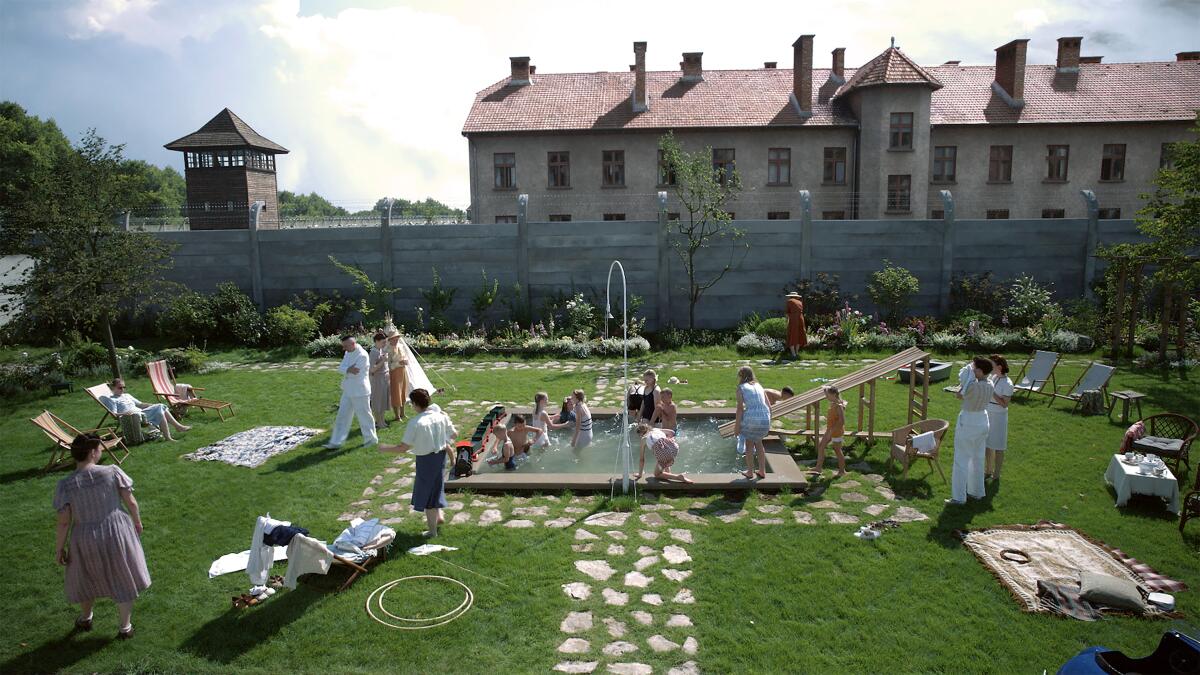
Jonathon Glazer’s acclaimed film, The Zone of Interest, is about the commandant of Auschwitz, Rudolf Höss, who lives right next door to the camp, where he and his wife Hedwig have built an idyllic family life.

Based loosely on Martin Amis’s novel of the same name, it creates an incredibly effective picture of the casual barbarism. On Höss’s birthday, for instance, he holds a meeting with engineers to discuss plans for more effective crematoria at the camp, before being toasted by his fellow officers and enjoying cake with his family later that day.


Hedwig is more than happy to receive clothes taken from camp inmates. We see her try on a fur coat and, finding a lipstick in one pocket, try that too.


Her visiting mother muses, almost jokingly, whether a Jewish woman she knew, and whose book events she attended, had been sent to Auschwitz. And in a throw-away comment, she notes that she was out-bid for the woman’s curtains in a street sale.


It is the normalisation of the dehumanisation that’s vital for genocide.


Repeatedly, the camera tracks a figure down one length of the vast garden, alongside the wall of the camp, with its buildings, chimneys and guard towers rising above.


Hedwig happily takes her youngest child around the magnificent garden, introducing her to flowers, while in the distance, we hear the sounds of the camp.


Glazer didn’t want to show the inside of Auschwitz – and he doesn’t have to for the film to convey a real sense of horror.


Sound designer Johnnie Burn put together a 600-page document in order to understand the camp layout and witness statements, together with a sound library that included the sounds of crematoria, machinery, historically correct gunfire, cries of pain and trains.


It is a soundscape that means however perfect the Höss family’s life looks, the viewer can never see it without being reminded that it happened within earshot of industrial mass murder – and that they all choose to ignore this.


And then there are the two central performances. Christian Friedel as Höss is so utterly engrossed in work that it is a mission – no matter the horrific reality of it, and Friedel portrays him as cold when on that mission, yet a dedicated and loving father. Sandra Hüller as his wife is also superb – little wonder that she has picked up a raft of award nominations – as a woman who is happy to bring up her children in such proximity to mass murder.


Łukasz Żal’s cinematography is deceptively simple – almost ‘flat’. Yet the look works incredibly well.


Glazer – who also wrote the film – has received nominations too. The film itself has already picked up awards, including the unique double of best British film and best film not in the English language at the recent Baftas.


Burn, together with Tarn Willers, have also been rewarded for the sound.


It is in many ways a very calm film, but most certainly not a comfortable one. It is, without doubt, an extraordinary piece of filmmaking that will not be easy to forget.


Friday, 23 February 2024

Orlando – throughly entertaining queerness

It was time for another spot of film catch-up this evening – and back to an effort at being thematic for LGBT+ History Month – with a first viewing of Sally Potter’s 1992 adaptation of Orlando, Virginia Woolf’s 1928 novel of the same name.

The film opens in 1600, with aristocratic youth Orlando pondering over his loneliness and his desire to write poetry. When his family is visited by Elizabeth I, the aged monarch takes to him, making him her “mascot” and granting him property and money. There’s one condition: Do not fade. Do not wither. Do not grow old”, she orders.

In the novel, there is no explanation of how Orlando becomes immortal, but Potter added this to the film to suggest how this occurs, feeling that a cinema audience would need at least a hint.\

As part of the wider court of James I, he becomes utterly besotted with Sasha, a beautiful Cossack, who is visiting with her father. But when she dumps him, he’s left to muse on the “treachery” of women.

Time passes and, in the 18th century, the eternally unchanging Orlando – nobody ever comments on this, ‘because it’s England’ – is appointed ambassador to the Ottoman Empire. There he enjoys a brotherly friendship with the Khan, before participating in a battle.

Shocked at seeing his first violent death, he flees and falls into a deep sleep for seven days. On waking, he discovers that he has become a she. Heading back to England, Orlando is stripped of her home on the basis of being a woman – and thus effectively “legally dead”.

Somehow, she continues living there until the time of Victoria, where she has an accidental meeting with Shelmerdine, an American revolutionary, with whom she enjoys a passionate fling, before he departs for home. She refuses to join him – and muses on the “treachery” of men – before her life takes her into the 20th century, through the mud of Flanders and beyond, to 1990s London, where she has a young daughter.

It's not a devastating script, but there is wit – not least in the wonderful to-camera shots of Tilda Swinton as Orlando, where Potter has her break the fourth wall.

It is beautifully shot – cinematography was by Alexsei Rodionov – and beyond Swinton’s fabulous performance, which really grounds the film, it has a wonderful ensemble cast.

Billy Zane posts a nice turn as Shelmerdine, but one of the real joys here is Quentin Crisp as Elizabeth I – “the Queen of Queens”, according to Potter – which also adds to the queerness of the whole thing.

Then there’s Jimmy Sommerville, Kathryn Hunter, Simon Russell Beale and Toby Jones among many other familiar faces, while John Wood provides a delightful cameo as a bumptious, elderly archduke who falls for Orlando.

Potter’s direction moves things at a nice pace – easy to expect an epic, given the century-spanning scale of the story – but it’s just 93 minutes. She also wrote the screenplay and the music (the latter, along with David Motion and, for one song, Sommerville).

It’s thoroughly entertaining – and with the added spice of the gender politics, not least in terms of the differing attitudes toward men and women throughout history.

And as Vogue put it in 2020: Nearly three decades later, Sally Potter's Orlando is more topical than ever.

Thursday, 22 February 2024

My Neighbour Totoro – taking joyful to the extreme

Back in mid-autumn, as I was coming out of the initial dark phase of my partner of 34-plus years having died, I started rather frenetically booking cultural events. The quoted reviews on the trailer for the return of the RSC production of My Neighbour Totoro at the Barbican particularly caught my eye. One, from The Stage, declared that it was a “huge healing hug of a show”.

Got me right there. I had no knowledge of Studio Ghibli or any of its films, but a “healing hug” sounded like a bloody good idea! I bought a ticket.

I mentioned this to my niece who, while envious of the theatre ticket, told me in no uncertain terms to ‘see the film first’.

Then, as we neared Christmas, I saw cinema trailers for a new Studio Ghibli film, The Boy and the Heron. It looked worth watching – so I made it the centre of my Boxing Day. And was blown away.

I subsequently ordered Tortoro and Spirited Away on discs – better than streaming, not least given the home cinema set-up I have.

Spirited Away was the centrepiece of my New Year’s Day – and I loved it.

And so I came to watching Totoro this evening, as my theatre date with the Japanese troll is on Monday.

Wow – just wow.

It’s set in 1950s Japan, where kind university professor Tatsuo Kusakabe and his daughters Satsuki and Mei (10 and four years old, respectively) move into an old house in a rural environment, close to a hospital where their mother is recovering from a long-term illness.

The children start seeing – and interacting with – varied sprites and supernatural beings, including Totoro, a giant (fluffy) troll.

There are familiar themes from the Ghibli films I’ve previously seen: children finding themselves in new environments after a move; lonely, disoriented and distressed by family loss; nature, adventures that lead to supernatural encounters.

It is a short film (blessings be upon the studio!) but absolutely gorgeous and utterly joyful! By the end, I had tears streaming down my face while also wearing a Cheshire cat (like the cat bus) grin.

Directed and co-written by Hayao Miyazaki, it is an absolute joy. Wondrous.

Friday, 16 February 2024

Prussianism meets lesbianism in 1931 school drama

In Mädchen in Uniform, the apparently difficult Manuela von Meinhardis (‘you’re big for 14’ – ‘I’m 14 and a half’), whose mother died when she was young and whose father serves in the Prussian military, is enrolled by her aunt at an all-girls boarding school headed by strict disciplinarian Fräulein von Nordeck zur Nidden.

An emotional child, she is drawn to teacher Fräulein von Bernburg, who has a considerably kinder attitude toward the girls than the head and the rest of the teaching staff.


But while most of the girls have a crush on the teacher, for Manuela it becomes more serious, with hints too of the same from Fräulein von Bernburg.


While this is a film from Germany’s extraordinary Weimar era, you probably won’t guess at how it works itself out.


Written by Christa Winsloe (with FD Andam and based on Winsloe’s own play, Gestern und heute – Yesterday and Today), it’s set firmly at the start of the 20th century.


The themes are clear – from the head’s austere version of “Prussianism”, insisting that even if the school is struggling financially and the girls go hungry as a result, “poverty is not a sin; poverty enobles”; that the girls come from military and aristocratic stock and will, ‘God willing’, become mothers to more Prussian soldiers.


“Discipline and order” are paramount here.


None of this is far-fetched. I went to the state Lancaster Girls’ Grammar School in the late 1970s and into the 1980s – and the head in this film reminds me absolutely of our head then, Miss Owen (albeit the film version is infinitely thinner) with her deputy, Mrs Rigby, reminiscent of Fräulein von Kesten, a smarmy adjutant.


It is a remarkable film that I ‘discovered’ via a BFI list of 30 best LGBT+ films.


Directed by Leontine Sagan – her first film – and with an all-female cast, it’s astonishingly filmed, remarkably naturalistic – yet with nods to the visual look of German Expressionism – and wonderfully acted. The stand-out performances are from Hertha Thiele as Manuela, Dorothea Wieck as Fräulein von Bernburg and Emilia Unda as the headmistress.


A really powerful lesbian film for LGBT+ History Month.