Showing posts with label Berlin. Show all posts

Monday, 26 February 2018

Who is really the bird brain?

It was nine years ago when I first looked at a bird with anything more than passing interest.

It wasn’t that I didn’t like our feathered friends – rather that I hadn’t really expended enough mental energy to regard them as anything other than feather brained.

But in 2009, The Other Half and I were in Berlin and decided to take in the city’s zoo. In the event, our visit was cut short by a storm, but we were impressed enough that we returned before our week was out.

Aviaries are the sort of places I would previously have skipped, but with a quality camera around my neck, what stopped me in my tracks was a king vulture.

A family nearby was trying to attract its attention through the fence, but it maintained a regal sense of aloofness – ignoring them completely and opting instead to stare me down. That bird had attitude. And I got great pictures.

Since then, I have looked out for birds – and always make a beeline for any vultures. Ive have even been able to identify one in the wild, flying above a Pyrenean town – a lammergeier.

Anyway, fast forward to last autumn and a lunchtime browse in the shop at the near-to-work British Library. Such visits have to be strictly rationed, since it’s well nigh impossible to walk out without having added to our own already creaking shelves.

On this occasion, I picked up a 2017 paperback version of The Genius of Birds.

By this stage, it was some time after my ‘ravens rock’ thing had first blossomed, but the initial enticement to Jennifer Ackerman’s book was a rapid flick through the index to see if ravens merited a mention.

Standing in the shop reading a brief section on how researchers had been on the receiving end of a pair of ravens using weapons against them (dug-up stones) was all it took. I bought the book.

A few weeks ago, waiting for something else to arrive, I plucked it down from the shelf and started to read. Nothing had suggested just how compulsive I’d find it.

Every time I visit the hospital my father now frequents regularly, I talk to the crows that rule the roost on the recreation ground opposite – we know each other well – so it delights me that corvids rate very highly in the avian intelligence stakes.

The early part of the book includes fascinating information about the tool use of New Caledonian crows, the Einsteins of the bird world, but other corvids feature too.

However, there was a whole world of bird brains to discover.

The chickadee, for instance, with it’s astonishingly varied call that can be used to warn its community of a nearby predator and even how threatening that predator is.

We can read about the architectural and aesthetic works of bowerbirds and learn about the astonishing capacity that pigeons have for navigation. It’ll never be so easy to simply dismiss them as ‘rats with wings’ after reading this.

King vulture with attitude, Berlin 2009
In a German experiment, it was found that homing pigeons that were allowed to fly around outside their loft and get to know its surrounds, and then participate in races of up to 175 miles, had hippocampi that were 10% larger than homing pigeons that had not been allowed outside a spacious loft/aviary.

Here, Ackerman adds a fascinating note on research done with humans, showing that experienced black cab drivers in London have more “grey matter” in the rear of their hippocampus than bus drivers or new cabbies.
Which begs the question of whether navigational tech such as GPS is damaging to human intelligence.

The author is always careful not to over-egg any puddings by anthropomorphising avian intelligence, but that works both ways, as she urges us not to consider ‘intelligence’ only in human terms, even where intelligence does not easily correspond with the human understanding of the word.

And at the end of a book that constantly makes you go ‘wow’, Ackerman brings everything together within the context of climate change and what that might mean for birds.

This is popular science, but don’t let that suggest that it’s sloppy. There’s plenty of science here and that can take some serious reading attention. But from start to finish, it’s also an absolute joy. I’ll never again consider birds to be rather boring.

• The Genius of Birds by Jennifer Ackerman is published by Corsair and available in a variety of formats.


Tuesday, 20 May 2014

Sophisticated dining – including some wurst


Delicate couscous and feta
If Germany provided plenty of hearty, down-to-earth dining experiences, it also provided two really top-notch fine-dining experiences.

But while the food was excellent, perhaps the most interesting aspect of those meals was that they illustrated that German culinary tradition, far from being something to sniff at, is well worth looking at.

For the first couple of days, adjusting to later starts, larger-than-usual breakfasts and then larger-than-usual lunches meant that we were not in the mood to try either of the hotel’s two restaurants.

Belle Epoque is the flashiest of the two, with Michelin-starred food that, as the name implies, has its roots in what Michel Roux Jr would call “The Classics” – or a certain type of French cuisine and approach – and which is open to non-residents.

There's no escaping Thomas Mann
Downstairs, and also used for breakfast, lunch and afternoon tea, is Holstein, the hotel restaurant for residents. And as that name suggests, it has a rather more local ethos.

During last year’s solo trip to Lübeck, one of the highlights – one of the core things I’d set out to do, indeed – was dinner at Schiffergesellschaft.

The centuries-old seaman’s guild is housed in a 1553 building that still serves as a restaurant.

There, I’d tried the iconic labskaus, a seaman’s dish of pickled or corned beef, the meat mixed with onion and beetroot, and traditionally served with a fried egg on top and a plate of good old matjes herrings on the side.

A superb spargel soup
Schiffergesellschaft gets a mention in Thomas Mann’s Buddenbrooks, and I was delighted to find that the Holstein has a large, black and white photograph on the wall of the man himself, taken outside the hotel in 1953.

But then the author considered Travemünde as something close to a paradise.

It too features in Mann’s first great novel, and even if worthy Lübeckers were mightly offended by his 1901 literary debut, there is plenty to suggest that their modern-day descendants appreciate the added value it lends the area – there is even a Buddenbrooks restaurant in a hotel just a couple of hundred metres from where we stayed.

But back to the pickled beef.

The first thing on the Holstein menu that caught my eye – a couple of days before we were first ready to dine there – was a labskaus.

How would an essentially modern and smart restaurant tackle such a dish?

Labskaus, deconstructed
I kept that question in mind until the first evening on which we’d actually left enough space for a three-course meal.

Before we get to that, let’s start by saying that, we waited, we were served with a selection of very nice breads, plus quark (a sort of German yogurt) and a lightly spiced relish, plus butter, and then with a small plate that was less an amuse bouche and more an hors d’oeuvres, involving very delicately prepared couscous and crumbled feta that was, if not very Germanic, then certainly very pleasant.

And of course, since The Other Half doesn't like cheese, I got his feta too.

But as a first course proper, both of us opted for the spargel soup.

The asparagus season enjoys cult status in Germany.

Known by a variety of nicknames, from ‘Königsgemüse’ (king’s vegetable) to ‘Frühlingswonne’ (springtime delight) and ‘Zartes Elfenbein’ (soft ivory), restaurants across the country add special asparagus menus, while little stalls set up on the streets to sell this seasonal glory.

While Germans prefer the white asparagus, the green that we’re more familiar with is not neglected.

Matjes herring on onion
Back in 2009, when we were in Berlin in early June, we ordered spargel soup at the iconic Lutter & Wegner, but were disappointed with the overly salty result, which suggested that it had been hanging around for some time.

This time around, the result was quite simply superb, with a creamy base, slivers of perfectly cooked white asparagus, drops of delightful tarragon oil and a few croutons for added texture.

Next up for me at least was the labskaus – which turned out to be deconstructed.

There’s always a danger with this approach that it can look good but not actually achieve anything much for the palate.

Here, it proved a very enjoyable exercise in appreciating the tastes and textures of a mixed dish – I bet those sailors never thought their dish would assume the level of haute cuisine.


Wonderful blutwurst
The meat, combined with some beetroot, came in quenelles, with the fried egg replaced by a breaded quails egg atop onion and herbs, a roasted beet purée, homemade potato crisps, matjes and shredded gherkin.

I opted for the almost inevitable ice cream after – but was too stuffed to make much headway with that.

The Other Half, having opted for a rhubarb crumble after a beef dish, reported himself more than satisfied.

Our final night saw us decamp to Holstein yet again and this time, the hors d’oeuvres was an incredibly delicate matjes herring on top a sweet and gentle onion, very finely chopped, a hint of bitter herbs and a little tomato.

Zander, with beetroot and potatoes
Lovely – and ensured The Other Half didn’t leave the country without at least a taste of herring.

Again, we both opted for the same main course – blutwurst (black pudding).

Gloriously moist and tasty, it was complimented by a bitter salad and quince two ways – as small triangles of jelly and as a rather larger wedge of mousse.

A real joy, this.

For a main course, the Other Half opted for zander, a German fish that is often translated, rather meaninglessly, as ‘pike-perch’, which are two altogether different fishes.

But then there is no British alternative, although it was introduced to the Fens some time ago and is considered a pest – can I try to get rid of it by culinary methods, then?

While he enjoyed that, I dined on lachs (salmon), with new potatoes and white and green spargel, which was very nice if not earth-shattering.

For dessert, however, I picked apple three ways – a slice of feather-light strudel, a sorbet and calvados-infused brunoise on a crisp, all made with Holstein cox. Absolutely gorgeous.


Apple, three ways
On the matter of wines, we drank a German red with the first meal at Holstein: that was a first, and very nice it was too.

For the second meal, we opted for a white – a Grauburgunder: a 2012 Kabinet, trocken, Weingut Bimmerle from Baden, which was also extremely nice.

We left thinking that that was food we’d be more than happy to eat again.

What Holstein perfectly illustrates is that German cuisine is very far from being sausage and pickled cabbage.

It can be hearty and simple and comforting, but done like this, it can also be as sophisticated as anything that most of us are likely to eat anywhere.


Wednesday, 29 January 2014

When similes go bad


There should be a law about similes. Or at least the over use of them in novels.

A couple of days ago, I gave up reading March Violets by Philip Kerr, as I was on the verge of throwing it at something.

Described variously as “brilliantly innovative” (Salman Rushdie in the Independent on Sunday) and as having “echoes of Raymond Chandler but [being] better on his vivid and well-researched detail than the master” (Evening Standard), it’s the first of what constitutes the Berlin Noir trilogy, with further installments published later.

Set in 1936 in the German capital, it features private detective Bernie Gunther, a former policeman.

It’s a great idea, but what the Standard describes as “well-researched detail” is, in fact, laid on with a trowel – not least when it comes to the aforementioned similes.

Here’s an early example:

“From her coat pocket she produced a small lace handerchief which seemed as improbable in her large, peasant hands as an antimacassar in those of Max Schmelling, the boxer ...”

Now, if you have to explain a simile to the reader, perhaps you shouldn’t bother in the first place.

It was with some relief that, a few pages later, Kerr didn’t feel the need to similarly explain who Horst Wessel was.

The comparisons with Chandler do Kerr no favours either.

If that “well-researched detail” is better, then it’s worth noting that Chandler was not writing anything that claimed to be a work of historical fiction, so such a comparison is unfair.

And while Kerr clearly is a clever writer, the cynicism of his protagonist comes across as forced and too clever by half.

In Chandler’s deft hands, Philip Marlowe’s world-weary persona never seems over the top, and is subtly leavened by, for instance, his observation of the nature of the novels’ California setting – passing mentions of the colour and scent of jacaranda, for example.

In other words, there are sensibilities beneath Marlowe’s hard-boiled exterior.

If you’re going to do ‘clever’ and make historical and cultural references, there are other authors doing it far better.

Kim Newman’s Anno Dracula novels are riddled with references, historical and cultural, but he doesn’t feel a need to signpost them. You either spot them or you don’t – and part of the pleasure in reading the books is in seeing what you do spot.

And the same can be said of Alan Moore’s The League of Extraordinary Gentlemen (not the film).

One of the things that this illustrates is just how subjective book reviewing is.

A review in the Guardian for Mortal Mischief, the first of Frank Tallis’s Liebermann Papers series, finds it to contain “too much history”.

As someone who’s about half way through that book right now, it seems that there’s enough to give and sense of authenticity and atmosphere, but nothing that leaves you feeling that the author is being overly clever or that gets in the way of the story itself.

Choosing to set his novels in fin-de-siècle Vienna, it allows him to explore some of the massive changes that were occurring at the time – not least in making his central protagonist, Max Liebermann, a young doctor who is acquainted with one Sigmund Freud, and who uses the new science of psychology in his contributions to criminal investigations.

Oh – and since it’s set in the Austrian capital, there’s cake. And lots of it.

One of Kerr’s other problems is that of writing a novel set not just in a different time, with historic events at its heart, but also in a different place.

I can think of a host of 1930s novels about Berlin to recommend instead of this if you want to get the atmosphere – Berlin Alexanderplatz by Alfred Döblin, for instance, or Fabian (now republished in a restored, uncensored version, as Going to the Dogs: The Story of a Moralist) from Emil and the Detectives author Erich Kästner.

And there’s always Christopher Isherwood, who was actually there at the time – and yes, almost inevitably, Kerr uses a metaphor about “Kit Kat” girls.

Of course, the different attitudes toward the historic backgrounds of both books could simply be a reflection of the fact that one of those periods continues to obsess British readers and the other does not.

Run a search for ‘Nazis’ in books on Amazon, and it produces 16,330 results – not all of which will entirely fit the bill, but it gives you an idea.

Run a similar search for fin-de-siècle Vienna, and you get 1,279 results – and that too includes things like tourist guides to the city in the very much here and now.

It is, of course, entirely possible to pen a novel set against historic events in a country and culture that’s different from your own – Martin Cruz Smith is evidence of that.

If he set himself an almost impossible standard with Gorky Park, the first Arkady Renko thriller, the second and thirds one, Polar Star and Red Square respectively, are still a very good outing and in the latter particularly, historic events present a backdrop to the story.

The thing is with Smith, he’s good enough to weave fiction and fact together seamlessly and without ever seeming to be over-egging the pudding.

You don’t sit there, turning pages and thing: ‘My god, how clever is this writer?’ Instead, you simply wonder how it’s all going to turn out – and you keep turning the pages.

It might be that the stereotype of the melancholic Russian, steeped in vodka, is just that – a stereotype – but stereotypes also exist for a reason.

And here too, Smith gives his Renko books a great sense of empathy and atmosphere.

Still, as all this just goes to show, literature – even for professional reviewers; and that’s a role I’ve played – is more subjective than objective, particularly where fiction’s concerned.

It’s also always useful to be reminded of what quality is by seeing what it isn’t. And if Berlin Noir did nothing else, the obvious comparison with Chandler made me realise, yet again, what an absolute poet that man was.

Wednesday, 2 December 2009

Calendar girl

It's Craft Day in the office. I'm tempted to say to you: 'don't ask', because it's all really rather bonkers and I do have quite a bit of work to think about first before this little team building exercise.

But Craft Day it is, as initiated by our new editor. She, indeed, has arrived at work in a very nice wool dress that she apparently knitted for herself last winter.

I had been intending to bake some Lebkuchen or a Stollen to bring in, but what with Monday night's table-moving saga and then an unexpected bar shift last night, the opportunity has not been forthcoming.

It remains to be seen what I'll do. I have a delivery of 2010 calendars due – so perhaps showing one of those around the office will suffice.

It was a year ago, after a colleague had had calendars produced from her family snapshots, that I decided to give it a whirl.

The resulting calendar had no family snaps in it, but was a selection of pictures I'd taken over the previous two years. I tried to be a bit arty and, not only were the pictures seasonal, they alternated between monochrome and colour. On a few of the pages, I used selections of three related pictures.

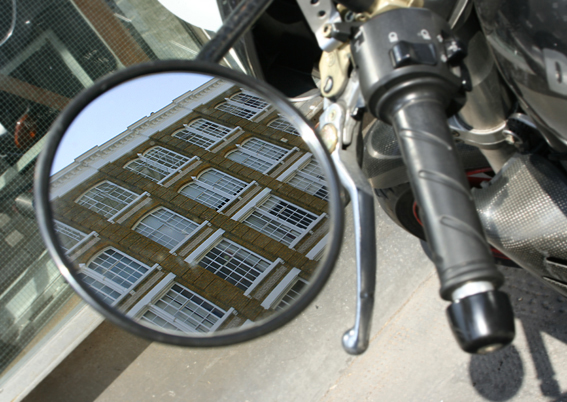
Just recently, my Mother announced that she didn't 'understand' one of these. It was a shot of some old London buildings, pictured as a reflection in a motorcycle mirror.

Curtain Road

It was one of my early shots and took a certain amount of effort in capturing the reflection without seeing me and my camera included in it.

It would seem that my Mother cannot cope with anything other than the most obviously chocolate boxy. So to an extent I have given in and tried to make sure that this year's calendar is as straightforward to 'read' as possible.

I still have an idea of what will happen when she looks through it.

'No, Mother: there is nothing here that you won't 'understand'.

'Yes, Mother. That is a picture of door with a great big door knocker and a tiny grille on it.

'Why did I photograph a door, Mother? Because it was an interesting door, Mother.

'Look, just turn to the next month: that's a church, Mother. Nice and easy on the eye.'

Not that such a subject doesn't have entirely it's own risks.

When we first visited Berlin in 2002, I sent my parents a postcard of the Berliner Dom. Once back at home, I was on the phone to them when my mother told me off for sending a picture of a Catholic church.

'Mother: it's a Lutheran cathedral.'

Pause.

'Oh.'

There's a new photograph of that in the 2010 calendar too. But I expect no repeat of the previous comment.

There really are times when I feel a sense of awe at the ability of some people – and my parents in particular – to complicate life by demanding a naive level of simplicity in certain things.

Tuesday, 9 June 2009

The taste of Berlin

As I posted before we left for Berlin, I was “looking forward to enjoying a cuisine that is often overlooked when people discuss European food.” And sure enough, I managed to taste vast amounts of it.

Maximillians and Gendarmerie were both so good that we visited twice.

In the case of the former, our second visit saw me opt for a lighter meal, of Brotzeit – a platter of cold meats and sausages, with raddishes, pickles, excellent bread and cheese. I actually thought that there were two sorts of cheese on the board that it was all served on – one cubed and a second grated. I was wrong though: it was grated horseradish, as I found out when I forked a generous load into my mouth.

I took considerably greater care with the next mouthful of it – powerful stuff.

Our return to Gendarmerie on our final night in the city produced another excellent meal, sitting inside this time after torrential rain during the day.

I ordered the spargel with hollandaise – the waiter who delivered it questioned whether that was what I’d really ordered and not meant to order it with, say, a schnitzel. I had to reply that I don’t have a very Germanic appetite, so yes, it was just the spargel and sauce. Well, plus some new potatoes. Which were lovely anyway.

I followed that with a dish of calve’s cheek – having heard cheek meat recommended by assorted TV chefs and not having had the chance to taste it. It was really tender meat, very tasty, and was served with an intriguing snail ragout, puréed potato and spinach. An interesting and tasty dish.

The break between courses worked well again and I opted once more for the chocolate torte. Really good stuff.

We also lunched at KaDeWe on the legendary sixth floor – a fabulous food hall, which includes a number of mini eating areas: kitchens with benches or stools around them, serving a range of freshly-cooked food.

I had excellent matjes herrings, served on a bed of sour cream and sliced onion (very refreshing) and with a mass of pan fried, sliced potatoes.

One wasn't really supposed to take photographs inside, but I managed to sneak one.

We also had wurst at a biergarten in Tiergarten, the city’s vast park. It was served in the cooking water, in bowls, was as light as a feather and went down fabulously with a pretzel, two sorts of mustard and good beer.

Then there was currywurst at Berliner Republik on the Friday evening, surrounded by Werder Bremen and Bayer Leverkusen fans arriving in town for the German cup final the following day. Plenty of tales exist about how this particular Berlin speciality was created – most via accidents – but it was a very light curry sauce, tangy and rather tomatoey.

The culinary disappointment of the week was Lutter & Wegner. A very old and well-known restaurant, we expected great things. The spargel soup was an intense flavour, but rather salty (suggesting it had been hanging around for some time) and there was far too much of it.

Unlike Gendarmerie, we were rushed between courses. I thus fail to agree with the Time Out guide that the service is excellent: efficient, yes. But too rushed.

Having quaffed my soup, I moved onto Himmel und Erde.

Now, this was being offered as a speciality of a smart restaurant. And I was thrilled that, even after being handed an English-language restaurant, I knew what this was and could order it in German. As a German friend tells me, it’s winter food for manual workers. But I was falling over myself to try such a traditional dish.

A long, single black pudding, halved lengthways, served with apple and pureed potatoes, it was tasty – but sat incredibly heavily. As did the red wine. I thought I was going to be ill.

The Other Half, who had chosen the same main course, also felt ‘heavy’ for about the same length of time after. We left without finishing the wine – and certainly without even considering a dessert.

In Potsdam, there was a very nice piece of grilled salmon, with spargel and potatoes, followed by a slice of Black Forest Gateaux.

The zoo supplied a decent, slightly spaced wurst on our first visit (chips rather hard and chilled given so few customers that day) and, on the second, a very decent frikadellen. On that second visit, cheeky Berlin sparrows came and grabbed food from our plates and fingers.

And a rather smart restaurant on Charlottenstraße served up a very pleasant lunchtime dish of Nürnberger Rostbratwurst, served with excellent sauerkraut and potatoes, as we sat outside, watching the rain from beneath a canopy, a stone's throw from Gendarmenmarkt.

I enjoyed a few glasses of Berliner Weiße mit rot (white beer flavoured with raspberry syrup), which were very refreshing. But after getting over the novelty, I stuck with more traditional beers for the rest of the trip.

But without doubt, the culinary part of the trip was a roaring success.

Monday, 8 June 2009

Animal crackers

Vague thoughts had crossed my mind before heading off to Berlin that we might potter along to the city’s zoo (the one in the west, that is) at some point – not least so that one could say that one had said ‘hello’ to Knut, the world famous polar bear who is now two years old.

It was Tuesday and the weather forecast was not brilliant. We’d made the most of the morning with a boat trip on the Spree, before ducking into a café-bar, Berliner Republik, to escape the inevitable shower.

Musing over the rest of the afternoon ahead, The Other Half suggested the Zoologischer Garten. On first consideration, time in the open on a day of inclement weather didn’t appeal massively. But then the reasoning occurred that such weather might reduce the number of coach parties wandering around the place. So off we set from Friedrichstraße Bahnhof.

With the largest number of species in the world, it also offered a chance to photograph some exotic animals – something I’d never tried before.

Well, it was certainly quiet. We saw some elephants waiting to get into their ‘house’. And then a lovely sight of two young giraffes and two adults.

The big cats all seemed to be inside too: as we ambled into their quarters, a male lion was roaring, sending goosebumps up and down the spine. The cats themselves are magnificent – and a particularly insouciant leopard posed very nicely for a shot.

The carnivore house also houses the meerkats and the dwarf mongooses, which seem to be a competition in who could out-cute who. The meerkats do all the things you’ve seen on documentaries – including having one standing guard even though there’s no predatory threat.

And the mongooses spend a lot energy trying to all curl around a single branch together to sleep.

That produced technical issues – getting close enough to the glass to avoid it messing up pictures. But the results were very pleasing.

Our fellow apes were suitably ape-like and didn’t engage me anywhere near as much as I’d expected, some of the monkeys were far more fun – one little one dropped a rope while we were watching. Deeply distressed by this, it was comforted by a fellow monkey. It's difficult not to anthropomorphisise at such moments

And then there was a panda. Who was asleep. As pandas are most likely to be.

We grabbed a lunch from the café, where the food had been sitting beneath lamps for some time, given the lack of crowds, then hit the trail again, catching the pacing brown bear and finally, Knut. Who was lying down and doing not a lot, until he hauled himself up and ambled into his own indoor quarters.

It was the right idea. A few moments later, it started to rain. I managed to get under cover long enough to get my camera into it’s nice, waterproof bag, but got absolutely drenched as we headed back, as quickly as possible to the Elephant Gate.

It didn’t take much to decide to visit again. And we spent the best part of the Saturday there, in better weather and with bigger crowds.

The photography was challenging, fun and very rewarding.

But what made these visits so enjoyable was seeing the animals up close, in some cases, interacting.

Cats, for instance: it doesn’t matter how big they are, I now realise that they all eat grass, all patrol and all like to sleep on shelves. Which brought to mind the sight of The Queen Bee dozing on a bookshelf. Although I won’t be telling her that she’s got a lot in common with lions and leopards – she’s got more than enough grand ideas as it is.

Amazingly, on the Saturday, Bau Bau the panda was awake, while taking an extra lens with me enable me to get some corking shots of some of the birds, including while being eyeballed by a bloody big king vulture, which seemed to be echoing Robert de Niro and asking: "You looking at me?".

Berlin is doing valuable work in terms of conservation, but what seeing so many animals in the flesh, as opposed to via the TV screen, does is to usefully remind you of just how beautiful – and awesome – the rest of the this planets inhabitants are, and how much they need protecting.

I last saw a zoo – a tiny, private one – in KwaZulu Natal about 11 years ago (run by a certain famous circus family) and it was dreadful – very, very upsetting, with cages that were far, far too small for big cats and neurotic apes that were alone and with sod all to distract them.

Berlin is what zoos can be. And I won’t be waiting as long to pay a call to a zoo again.

Friday, 5 June 2009

Of Wagner and some rather good dumplings

This is turning into a funny old year for finally doing musical things that I've dreamed of for around three decades.

In April, it was finally getting to see Ultravox live – and last week, it was seeing the Berlin Philharmonic Orchestra. Indeed, not just seeing them, but seeing them in the Philharmonie, their own home concert hall.

I'd first become aware of the Berlin Phil back at the end of the 1970s, when I was studying music 'O' level at school, and that awareness developed when I started 'A' level studies.

My mother, delighted that I was listening to something other than 'pop', started buying me records at Christmas and birthday. Given the wide world of choice that is available in the classical music world, I had rapidly developed a mantra for her to remember: Deutsche Grammophon, Berlin Philharmonic, Herbert von Karajan: simple.

I have an absolutely specific memory from the time: we had started 'A' levels and were being introduced to one of our set works, Debussy's Prélude à l'après-midi d'un faune. It was a recording by ... well, you can guess. The piece has remained one of my favourites, but as I sat in the tiny attic classroom, listening to this extraordinary music for the first time, I was transported to a pastoral paradise; a world of willows trailing their fronds into gently flowing water, of dappling sunlight and, of course, of a flute-playing faun. It was the most sensual music that I'd ever heard.

So when we booked our trip to Berlin, I leapt at the opportunity to see if it was possible to attend a concert.

If memory serves, they were performing three concerts in the city last week, but choice had been diminished by demand (including for a performance of Debussy's La Mer) so I simply grabbed what I could.

That was to be for the world premiere of a new piece for wind quintet and orchestra by German composer Siegfried Matthus, plus highlights of acts two and three of Wagner's Götterdämmerung to round out a complete programme.

Quick research told me little about Matthus, but I managed to find a recording of his Symphony No2 and Concerto for Violincello and orchestra to offer a taste of what we were getting ourselves into.

Gulp. This was very modern – at least, very atonal.

Now we're not averse to modern serious music, so we simply waited for the night itself.

It was a windy walk to the Philharmonie. We made sure we were in plenty of time. After taking a few snaps of Hans Scharoun's building, I collected my tickets. For pretty much the whole week I'd been in a calm glow – enjoying so much of the trip, but not being overly excitable about anything. At this point, as I came close to actually kissing my ticket, the realisation of just how much it meant started to dawn.

We raided the shop – a number of recordings to add to the collection – and then slowly headed to our seats upstairs. Up a lot of stairs, to be accurate.

As we waited in the remarkable auditorium, famous for its accoustics, my mind drifted back to those school music lessons. At 'A' level there had been just six of us. I wondered if any of the others had continued to listen to – or even play – music. And as the orchestra drifted in, I found myself thinking of Noel McKee, our wonderful teacher, and thinking that he'd be very proud, in his ever so slightly pretend-grumpy way, that at least one of his pupils had made it to where I was sitting.

The Matthus piece was first up. With a substantial orchestra plus the quintet, we were surprised when Sir Simon Rattle took his place at a set of kettle drums next to his conducting podium – and started the performance on these slightly off-tune instruments, before turning to step into his normal position (he returned to the drums to conclude the work too).

The piece was fascinating. It gave us reminders of the Classical, of the pastoral/Romantic and of the 20th century, with percussive sections that owed a great deal to jazz. And all linked by a scuttling theme.

Far more obviously melodic than expected, it seemed to be telling the listener that nothing is new – and that we can never fully escape all previous forms: that history, if you will, is always with us; that everything is a circle. And the idea of a musical past woven into a musical present seemed to perfectly reflect this city of history on every corner too.

This being a world premiere, we were treated to that most unusual sight at a 'classical' concert – the composer, who took his place alongside Rattle at the end for our plaudits.

A fascinating and enjoyable work, I'm hoping it'll be released on disc – not least because I want to actually listen to it carefully again.

And Rattle is an intriguing conductor to watch – his style is almost as bubbly as his distinctive hair; he can hardly stand still. And yet, like all the best conductors – and after eight years in Berlin, Rattle's showing he's no mug at this game – he exudes authority. It's something that I find fascinating. Von Karajan almost always conducted with his eyes closed, sometimes barely moving. Yet he exerted complete control over the musicians (not without a few highly-strung souls amongst them either). On one occasion at a rehearsal, a brass player apparently made a slight mistake. All Von K did was open an eye to look briefly in his direction. The man later recorded that he felt compelled not to make the same error again.

After a break – always interesting to watch the stage hands change things around for different orchestrations – Rattle let the orchestra rip. If anyone was in any doubt that this was going to be full-blown (some would say overblown) 19th century German romanticism, then the presence of an amazing four harps on stage, plus around 45 violins (according to The Other Half, who counted them) should have acted as a warning. It's no wonder Wagner needed to build his own opera house. Although, to be fair, he was hardly the only composer of the period who scored for big bands – Mahler and Richard Strauss were not very far behind.

Now I appreciate that Wagner is an acquired taste, but whilst I'm still not hugely up on the singing bits, the straight orchestral stuff can send me into ecstasy. With added goosebumps. It's music that has a G factor, forceing you back into your seat, holding you there and demanding you pay attention.

And when a clear, piercing brass theme emerged above the quivering strings in the funeral march, I was almost reduced to total mush.

As we left the auditorium, The Other Half asked how I was. "I'm going to try to start breathing again," was all I could muster, as I attempted to make my insides relax.

We walked in silence from the Philharmonie toward Potsdamer Platz. Food was required. Amid the neon and steel and glass, Weinhaus Huth stands as the one remaining pre-war building, but Diekmann, the highly-lauded restaurant there, was accepting no new customers that night.

We found a large, modern venue still serving and settled down with beers (a dark Franzikaner for me – oh joy), trying to order our thoughts, having ordered the food.

Although assorted guides to the city berate the area for its lack of quality eating places (apart from Diekmann), I very much enjoyed a dish of Königsberger Klopse – veal meatballs, served with a traditional caper sauce, plus a gem lettuce salad and, of course, potatoes. The meatballs, I'm delighted to say, were light as a feather and very tasty.

It really was not a bad way to conclude a night I'd waited 30 years for. And are the Berlin Phil really good? Oh yes – very!

Wednesday, 3 June 2009

History around every corner

If you want to avoid history, then you’d probably be best advised to avoid Berlin, because you really can’t keep away from it there.

It’s not just the obvious, the large scale. Here a street named after a student leader in 1968, there a tiny brass plaque in the cobbled pavement to a woman who was deported to a concentration camp from that spot.

I wanted to do history – well, some history. A trip out to Potsdam and Sanssoucci had been identified as a must, giving me a lovely big dose of old Prussia as we strolled around the gardens, formal and less formal, that surrounded Frederick the Great’s getaway palace.

There too was the grave where he was finally interred, in accordance with his wishes, at night and without ceremony, next to the graves of his beloved dogs.

It was a Monday and the palaces themselves were closed. Whilst that meant not being able to wander in the halls where the king had entertained guests with his flute playing and conversed with Voltaire, it had the advantage of meaning a greatly reduced tourist presence that day, thus enabling many moments of solitude, where the only sounds were bird song, a gentle breeze in the trees and the occasional buzz of insects. It was beautifully soothing.

Not quite everything was shut – the shop remained open, so I didn’t have to miss out on the appropriate fridge magnets, postcards and a lighter. The Other Half has long been tolerant of what he describes as my being a "romantic Prussian" – his reward was being photographed next to a T34 tank at the Soviet War Memorial in Tiergarten later in the week (his kind of history).

But even as one approaches Potsdam on the train – a lovely journey through wooded countryside much of the way – more recent history imposes itself. When the train stops at Wannsee, for instance, and you see the name on the platform sign, it is impossible not to make the historic connection. And then, of course, Potsdam itself hosted the allies’ post-war conference to decide the fate of Germany.

A short walk down the road from our hotel in one direction was the Jüdisches Museum, with architect Daniel Libeskind’s shattered Star of David providing a disorienting and claustrophobic experience next to the old Kollegienhaus, where the main part of the museum is housed.

In the other direction had stood Checkpoint Charlie, where people could pass through substantial checks from the US to the Soviet sector. Now, with the original checkpoint in a museum, a copy has been built and bus loads of tourists queue to have their pictures taken in front of it, with models dressed in the uniforms of the four occupying powers.

With spectacular irony, on street corners in all the major tourist areas, trestle tables are loaded with reproduction Soviet and DDR military memorabilia – hats in particular: communist iconography made for profit.

And on Marx-Engels-Forum, the knees on the seated statue of Marx are polished to a shine by the endless bottoms seated there for holiday snaps.

Later in the week, as we walked from the hotel to the Philharmonie to see the Berlin Philharmonic Orchestra, we found ourselves on the street where the last remaining stretch of the Berlin Wall stands. If every souvenir shop that sells what they purport to be real fragments of the real wall is telling the truth, then that wall must have stretched to the moon and back – never mind across a city.

There are holes in the remaining stretch, with bared wire visible like prison bars, and gouges where the surface of the concrete has been stripped away, as though by clawing hands. It is ugly and obscene, and something keeps you mute as you hurry past.

The next day, I discovered from my Time Out guide to the city that the building site on the other side of that stretch of wall is where the Gestapo headquarters were. A temporary exhibition of photographs from the first half of the 20th century stands on the site while an exhibition and memorial centre is built. The pictures displayed are the only place where it is apparently legal to show the swastika, an otherwise banned symbol.

I’m never comfortable amid such history – but then again, it should disturb. In Amsterdam, next to the Westerkerk, stands a small statue of Anne Frank. On many occasions, I’ve seen people having their photographs taken, smiling, next to it. Which disquiets me.

In the UK, we’re comfortably removed by distance from most of our historic dodgy deeds. There are some memorials to the victims of the trans-Atlantic slave trade, but none that I know of to the victims of the British concentration camps in South Africa in the first years of the 20th century or in Kenya in the 1950s, for instance.

And Churchill and Bomber Harris even have statues to celebrate them – conveniently ignoring, amongst other things, their roles in the 1919 gassing and carpet bombing of the Kurds in northern Messopotamia (as it was then) or in the firebombing of Dresden in 1945 (which incident itself still divides opinion as to whether it was proportionate: even Churchill tried to distance himself from it).

The immediacy of such history prompts one to query one’s own relationship to it – and one’s own response. And in some cases in particular, there is a sense that one has to have a socially-approved ‘correct’ response. If you don’t, have you ‘failed’?

Not all Berlin’s recent history is so disquieting, thankfully. It was with great delight that I found a collection of 21 original pen and ink erotic sketches from 1925. Together with a bowler hat purchased from the same market, I could quite happily create a Cabaret mood.

Tuesday, 2 June 2009

Putting the 'fine' into fine dining

I admit that I didn't fly out to Berlin with any expectation that I was probably about to enjoy my finest fine-dine experience to date.

We'd walked past Gendarmerie on the eve of our arrival in the city and made a mental note. On the Sunday evening, we decided to give it a whirl – and fortunately, even without a reservation, we got a table outside.

The staff were excellent – very friendly and not in the least bit rushed. Indeed, dinner took us almost three hours with welcome breaks between courses.

I started with a terrine of black pudding and goose liver (foie gras, in essence), topped with a layer of tart, fruity jelly.

It was served with an apple chutney, spiced with a hint of cinnamon, and a small herb salad, with a slice of toasted brioche that was so light it almost fell apart.

Not only did this look stunning, it was fabulously well balanced, from the sweetness of the meat, through the less-sweet apple to the bitter herbs. It had texture, colour and, most of all, it had taste. Wonderful: I was close to orgasmic over it.

I'd had a glass of Champagne when we sat down, and being slightly better versed in the wine department, had selected a 2007 Dr Loosen Riseling. Which was jolly good too. I didn't really feel tempted to ask about the 1945 Rothschild that was listed – price on enquiry.

And so to the main course. The Other Half, having enjoyed a chervil soup, had lamb. I opted for a piece of cod, grilled, and served on a bed of puréed potato, with a halved fennel, a little tomato and a very light, frothy sauce, that never threatened to swamp the fish.

The cod itself was excellent – tasty and moist. And it struck me how much the tomato (hidden initially when the dish arrived) just added a little welcome sharpness to the dish – it wasn't simply there as some sort of afterthought or design point.

At this point in a restaurant meal (apart from in Barcelona or Collioure, where meal structure is perfectly suited to me), I'd usually have had to leave some of the main course, and wouldn't have a cat in proverbial hell's chance of being able to manage a dessert. However, I'd comfortably managed every crumb of what had been placed before me thus far and, when I saw desserts being carried to a nearby table, my mind was made up.

I opted for a chocolate torte that, despite the assertions of the menu, didn't arrive with a biscuit of Proustian fame, but a portion of utterly gorgeous strawberries. I wasn't complaining.

And the torte itself was perfection – rich and moist and utterly gorgeous. Our waiter, having told me that they didn't do dessert wines by the glass, suggested a glass of another Riesling – it turned out to be quite different – a grassy, light taste that complimented the dessert perfectly.

This was a first visit to a serious, chef-led restaurant. And it didn't disappoint.

Chef Axel Burmeister already has form – not least at the Esplanade in Berlin. And it's difficult to imagine him not making a hit of Gendarmerie, which had only opened its doors for the first time around three weeks before our visit.

Perhaps the biggest compliment that I can pay is that, after our most expensive meal ever, we decided to book again for our final night. And we weren't disappointed then either.