Showing posts with label racism. Show all posts

Wednesday, 1 January 2025

Inspiring call for LGBTQI people to be authentic

Admittedly I started it in December, but New Year’s Day found me with the mental space to read 230 of its 287 pages, so filing this as the first read of the year really does count.

Life as a Unicorn – Amrou Al-Khadi’s memoir, first published in 2019, is the story of a non-binary, gay, British-Iraqi writer, actor, drag artist and filmmaker, and their struggles to find a way to live as their authentic self.


While their parents are not fundamentalist Muslims – in the sense that (much, if not all) Western media likes to portray Muslims – they still inherited a belief from quite early in their childhood that their queerness was going to send them to a fiery hell.


And what signs they gave off in terms of that queerness, their parents policed heavily.


Indeed, there are elements of this where Amrou’s story is like reading that of any dissenter in a dictatorial society, where they are being observed and reported at every turn.


How they eventually come through this is inspirational and deeply moving.


As a white, essentially middle-class English person, I clearly cannot appreciate the racist elements of Amrou’s experience, but there’s a huge amount from the homophobic aspects of their story that I felt that I could relate to (I was blubbing at the end) and also to the religious aspects, given my background.


For those who don’t already now, my father was an ordained, evangelical Methodist clergyman, who was homophobic, Islamophobic, racist, antisemitic, misogynistic … and just about every other kind of phobia that suited a white, English exceptionalist, cis, straight, male Christian (even though he’d come from an essentially Cornish peasant background).


I have thought for some time that, if I had ever come out to my parents, I would have been exposed to some form of conversion therapy. Indeed, I arguably was – being taken, in my early teens, to four evangelical ‘crusade’ meetings within a couple of weeks, with the explicit intention of being ‘converted’ – ‘born again’. And of course, it happened. The emotional blackmail of it was too much to eventually resist.


Life as a Unicorn is ultimately a wonderfully uplifting read about how to live as your own, authentic self. The section about marine life is staggeringly informative – I learned so much!


Al-Khadi is also absolutely spot on about the patriarchy, throughout the world and across cultures. It’s not just misogynistic, but also homophobic and transphobic. It’s no coincidence that we see the far right in Britain and the US, from Badenoch to Trump, engaging in ‘culture wars’ and taking particular aim at trans people and drag culture.

Sunday, 31 March 2024

American Fiction: A funny satire on literary ghettos and dysfunctional families

Thelonious ‘Monk’ Ellison is a black Los Angeles-based professor and writer of acclaimed literary novels that sell poorly. Uptight and abrasive, his college decides he needs to take some enforced leave and spend time at a literary festival and with his family in Boston.

After presenting a poorly-attended seminar at the festival, Monk is horrified to find a packed event for a talk with fellow black author, Sintara Golden, whose bestselling novel, We's Lives in Da Ghetto, is full of tropes about the lives of black people – what he later describes to her as “black trauma porn”.

Sitting down to pen a satire on this kind of novel, My Pafology, Monk sends it to a publisher in contempt – and is stunned to be offered a huge advance. But with his elderly mother failing with Alzheimer’s, he has to take responsibility for finding a care home for her and, although the family is apparently well-off, that cash will be very welcome.

But when the book becomes a best seller – published under an alias, by a supposed fugitive on the run – and Monk gets a film deal, he has some heavy ethical decisions to make.

It’s a funny film, which has a benefit of not being hectoring in tone and also not being simplified in terms of themes. 

When Monk challenges Sintara over her own book, she has no time for his moralising, effectively shrugging and saying it’s “what the market wants”.

There are also attitudes within Monk’s own family life that send a message that they’re not without intolerances or problems or a lack of understanding. Having been raised in a middle-class, well-off home that produced three professional siblings, he seems to have little or no comprehension of the reality of some black lives for those much lower down the economic and social ladder.

His mother is homophobic and his late father would have probably disowned Monk’s brother, who has come out as gay after being in a straight marriage for some years. Indeed, all three siblings are recently divorced (a slightly odd note to presumably excuse why their professional incomes won’t cover mum’s care costs).

And then there is the central question of how Monk deals with his success coming as his ‘joke’ backfires and makes him into what he despises.

Director Cord Jefferson also adapted the screenplay from Percival Everett’s novel, Erasure, the latter earning him this year’s adapted screenplay Academy Award.

Making it as a comedy about a literary ghetto – and combining it with a story of a dysfunctional family – avoids it seeming too ‘preachy’.

Laura Karpman’s jazz-filled score deservedly won her a first Oscar nomination.

But it’s the performances that really make this film. Jeffrey Wright as Monk is superb in a roles that needs him to be many things – brusque to the point of rudeness, highly intelligent (except in emotional terms), yet also vulnerable in many ways.

Sterling K Brown as Cliff, Monk’s brother, Leslie Uggams as his mother, Erika Alexander as his girlfriend and Adam Brody as the film director and provide excellent support.

Worth watching and currently streaming on Amazon Prime.


Sunday, 17 March 2024

Superb film of August Wilson's Ma Rainey – and not just because of Chadwick Boseman

After yesterday’s early evening football, there was still time for a film and, in this case, it was a re-watch of Ma Rainey’s Black Bottom.

I’ve seen August Wilson’s play three times – I reviewed the National Theatre’s 1989 production, then went to see it with The Other Half when it played briefly at the Hackney Empire (where the roof leaked onto us). Then we went to see it again in the National’s top-notch 2016 revival.

The release of George C Woolfe’s 2020 film – produced by Denzel Washington as part of his long-term project to bring all of Wilson’s plays to the screen – was overshadowed by news of the death of star Chadwick Boseman at just 43 from cancer, while the film was in post-production.

His performance as the tragic, traumatised trumpeter Levee in Ma’s four-piece band – at once full of contempt for the white men who only tolerate the black musicians because they bring money in, but also overly deferential to them because he wants his own band – is brilliant. Little wonder that he received a hat-load of posthumous awards and nominations.

In a way, though, Boseman’s tragically early passing dwarfed the rest of the cast. The Other Half and I streamed it early after it landed on Netflix, having linked up the TV to one of our phones because we were at the start of two months without the internet after a major blow-out. That was how much we wanted to see it – and see it early.

Yet seeing it again now, I can not only re-engage with the brilliance of Boseman, but also better appreciate Viola Davis’s powerhouse performance as Ma.

I’m also now familiar with Colman Domingo, who played Cutler so well, and can enjoy more fully Glynn Turman’s turn as Toledo.

The film landed barely six months after the murder of George Floyd, illustrating just how topical the themes of Wilson’s – and Woolfe’s film – remain.

An essential watch.


Friday, 15 March 2024

Joyous take-down of racism and fat-shaming

More catch-up film. This time, John Waters’s 1988 comedy, Hairspray. As with Studio Ghibli, I find myself wondering how on earth have I have missed this previously?

But on the other hand, what a joy to discover such pieces now!

The plot is simple – teenage Tracy Turnblad is a brilliant dancer who dreams of being on The Corny Collins show, a dance off. On the way to realising her dream, she fights racism and, given that she is chubby, fat-shaming.

But there’s plenty of racist opposition to her ideas, from individuals and institutions. And Tracy has a job on to win.

It’s a joy. Wonderfully camp, and with the positive messages mentioned above – plus a wonderful cast. Rickie Lake is marvellous as Tracey. Then there is Divine as her mother, Jerry Stiller as her father and Debbie Harry as the mother of her fiercest – and most bitchy – opponent.

One question, though: how do you make a ‘musical’ of this, given the music that’s already an integral part of this original version?

Wednesday, 17 January 2024

Femme is a serious take on the effects of self hatred

Currently on various streaming services – certainly Curzon Home, and with a limited Curzon cinema release to come – I learned about Femme because one of the directors, Sam H Freeman (Ng Choon Ping is the other), takes coffee at my local Haggerston Park kiosk, where I delight in discussing film (among other things), with the wonderful staff, one of whom told me about it.

I have just caught up with it – and it is well worth seeing.

Briefly, drag artist Joel is assaulted and finds his confidence and life shattered. But later, at a gay sauna, he sees his chief assailant – who doesn’t recognise him out of drag – and decides to get revenge on his deeply closeted attacker.

Grainy, grimy and not an easy watch, it is really well made and superbly acted – not least by Nathan Lloyd Stewart-Jarrett as Joel and George MacKay as Preston, his assailant and later lover.

There is a particularly wonderful scene where Joel secures an incredible psychological win against Preston’s homophobic, thuggish mates: with a console in his hands and Street Fighter on the screen, playing as a female fighting character – which is initially laughed at – he simply destroys all opposition in a format that they respect.

A really strong film about gay life – and about the struggle to come out of the closet in a world where it is not always remotely easy, not least in class terms – with an undercurrent of racism present too.

Saturday, 18 January 2020

Jojo Rabbit – savaging propaganda and bigotry

Have you ever noticed how, at the cinema when the certificate is shown on screen, it will include keywords about the film’s content: ‘moderate violence’ or ‘mild swearing,’ it will tell you, for instance.

It’s difficult to know why this happens, since people have already made the decision to shell out their hard-earned and take their seat.

Does anyone ever leave on seeing this ‘guidance’?

Before Jojo Rabbit, the first word that pops up with the certificate – and which I’ve not personally noticed before – is “discrimination”. Which is amazing really, given that this is a film about the Nazis, propaganda and bigotry.

As the opening titles make clear, it’s “an anti-hate satire”.

But if you survive such a warning, then Johannes ‘Jojo’ Betzler is a 10-year-old boy living with his mother in Nazi Germany in the latter stages of the second world war.

Jojo has fallen hook, line and sinker for all the nationalism and bigotry with which he’s been pumped by the system – in spite of his mother clearly not agreeing with any of it. But his invisible friend, a childish Hitler, eggs him on.

A member of the Hitler Youth, he earns the sobriquet Jojo Rabbit after he finds himself unable to kill a rabbit as ordered at a youth camp.

But then Jojo finds out that his mother has been hiding a Jewish girl in their home – and slowly he finds that the propaganda he’s been fed is being challenged.

Taika Waititi had wanted to bring the story, based on Christine Leunens’s novel, Caging Skies, to the screen for years. Now he’s done it and the wait has been worthwhile.

In spite of having written the screenplay, directed and co-produced it – and played Hitler – Waititi (whose maternal grandfather is of Russian-Jewish heritage) never lets himself get in the way.

It’s frequently very, very funny, but never loses sight of the main aims: to throw a spotlight on the utter crassness of intolerance, the real dangers of nationalism, fake news and propaganda – and the impact of all these on children.

A little aside here.

A German friend, himself born in 1946, once told me how, in 1945, a 16-year-old cousin was on the front line to defend his home town against the allies.

Fully indoctrinated, he waited in a trench, his gun sights trained on the advancing US forces. Then he realised that a young American soldier was looking down his own sights at him.

Clarity cut through the propaganda and he realised that, just as he did, the American probably only wanted to go home to his mother. The teenage German threw down his weapon and threw up his hands.

Tragically, many more boys – and girls – did not reach such a conclusion. And perhaps it needs noting that a 16-year-old in 1945 had been just four when Hitler had come to power.

It was an anecdote that I remembered forcefully when watching Waititi’s film. Today, we’d know that what happened to my friend’s cousin and what happens to Jojo and his friends is ‘grooming’.

There are plenty of laughs, but it’s never at the expense of the humane message and indeed, I suggest taking tissues, because there are a couple of real couple of kicks to the gut that bring home the importance of the message.

It’s an excellent cast. Scarlett Johansson is a revelation as Jojo’s mother. Thomasin McKenzie as Jewish teenager Elsa is vulnerable yet strong – and (importantly) never plays the character as a ‘victim’.

Sam Rockwell gives a very nice performance as Wehrmacht officer Captain Klenzendorf, who has been ‘demoted’ to running Hitler Youth camps after losing an eye in the war.

Stephen Merchant has a cameo as a suitably sinister comic book Gestapo officer, while Rebel Wilson turns in a similarly fine cameo as Fräulein Rahm, a Hitler Youth camp instructor who spouts the most ridiculously extreme anti-Semitic propaganda.

Waititi’s own turn as Hitler is also very good – as is that of Archie Yates as Jojo’s friend Yorkie.

But to a large extent, the film rests on the 12-year-old shoulders of Roman Griffin Davis as Jojo himself – and it is a remarkable performance of enormous nuance.

And just a brief mention for the incredibly clever weaving in of pop culture references – keep your eyes peeled – which are not gratuitous but add to the whole.

Waititi has done something remarkable with Jojo Rabbit: in so many ways, you tell yourself it shouldn’t work. But in its irreverence and it’s sense of fun, it is perhaps one of the most deeply serious movies of our times and its message could hardly be more important.

Superbly entertaining – and with a deeply significant message.

Friday, 23 January 2015

Insulting gods – it's 'punching up'


Never mind the politicians: this was the people in Paris
The murders in Paris just over a fortnight ago have already illustrated a number of things – one of which was how the presence of 40 global leaders on the city’s massive march a few days after the killings merely served to highlight a great deal of hypocrisy over freedom of speech from a substantial number of them.

Indeed, the sycophantic sounds heard from many of the same politicians in the wake of the death of Saudi Arabia’s King Abdullah – the monarch of a country that routinely beheads people in public and flogs others for the ‘crime’ of expressing non-violent opinion – was, to put it politely, nauseating.

But setting this issue aside for the sake of today’s post, one of the most extraordinary things that has happened in the aftermath of the attack on satirical magazine Charlie Hebdo has been the attitude among some on the political left in the UK of criticising that publication as racist, Islamophobic and a clear case of ‘white men punching down’.

Now I’m going to assume that the last piece of jargon is understandable to all – although obviously, if you’re white and male, you cannot comment on it. Given that I’m female, I have more points than you and therefore will comment.

Various writers have attempted to correct these assertions, using something as unfashionable as facts.

The facts in question include pointing out that the magazine satirises all religions – and also (on a particularly regular basis) the French far right and its anti-immigrant stance, while also calling an amnesty for all illegal immigrants. On a slightly different tack, the same magazine published articles by economist Bernard Maris (one of the victims) opposing austerity and damning of the way in which Greece has been treated.

But still the shrill little cries about it being racist persist.

It appears that you (well, not if you’re white and male, obviously) must never, ever insult someone’s religion – or at least not if that religion is Islam, which is the religion of choice (or not) for a great many people in the world, of whom many exist in poverty.

But what are the ‘insults’?

The problem is of publishing pictures of ‘the prophet’ – Muhammed – and the problem is twofold.

Nowhere in the Qu’ran is there anything forbidding images of Muhammed or Allah, but these occur in the hadith – a record of sayings and actions of Muhammed and his companions, which was written over the years after his death.

The key idea here is that, since Muhammed was a man and not god, portraying him may lead to worship of Muhammed rather than of Allah.

So at its core, it’s about idolatry, in other words.

Islam is far from being alone in a fear of idolatry. Judaism shares the same fear, up to and including any representations of Yahweh.

In Christianity, the early church was also aniconist, as was the 8th century Byzantine church, while the likes of Calvin and Luther proscribed images in churches after the Protestant Reformation. To varying degrees, this continues today in some sects.

And the bar on images of Muhammed and Allah also extends to Moses and Christ, both of whom are revered as prophets in Islam. This is a large part of why the film Exodus: Gods and Kings has been banned in Morocco and Egypt (apart from the ‘historical inaccuracies’, but let’s not go there).

Aniconism in Islam, though, is nowhere near universal. Sunni Muslims are considerably more likely to believe it than Shias. Shia Islamic tradition is far less strict and there were, for instance, images of the prophet produced in 7th century Persia.

On Islamic representations of the prophet, Omid Safi, a religious studies professor at Duke University, told CNN: “We have had visual depictions of the prophet in the form of miniatures and pictures in the Iranian context, the Turkish context, the central Asian context. The one significant context where depictions of the prophet have not been image-related has been in the Arab context”.

This tallies with the spread of Wahhabism, a particularly austere and fundamentalist version of Islam that arose from the Middle Eastern deserts, which has been actively spread by the likes of Saudi Arabia for years and which provides the theological basis for the likes of Islamic State (IS).

But if idolatry is a fear, how does a cartoon – let alone a satirical one – encourage that? Is someone really likely to worship Muhammed rather than Allah on the basis of any cartoon?

There is no obvious connection – although perversely, the murders have now made the post-massacre Charlie Hebdo cover an icon in its own right, complete with its portrayal of the prophet.

And as Hussein Rashid, a professor of Islamic studies at Hofstra University in New York, told CNN, there’s a “bitter irony” in violent attacks against portrayals of the prophet, since they become, in effect, a “kind of reverse idol-worship, revering – and killing for – the absence of an image”.

So the murders have created one of the things that were feared in the first place.

The second theological response is that picturing the Prophet is a direct insult to Allah.

This is the point at which many will have real difficulty. How do you insult something that doesn’t exist? Or, if such a god does exist, then isn’t he big enough and powerful enough to take issue with any mere mortal who does ‘insult’ him?

Besides, how do you insult a god? And why would a god be so thin-skinned anyway?

Mind, if that’s what the Charlie Hebdo cartoonists were doing, I think it counts as the ultimate ‘punching up’.

But there is a further matter of context. Take a Charlie Hebdo cartoon of the prophet about to be beheaded by someone dressed as we’re used to seeing IS insurgents attired. The word bubble has him complaining that he is the prophet.

It’s pretty clear that what’s being suggested here is that the likes of IS are the ones doing damage to Islam – in terms both of reputation and, indeed, in the murder of so very many other Muslims across Syria, Iraq, Pakistan, Nigeria and so on.

Let’s ignore the nonsense accusations of racism, which start from a position of ignoring the fact that Islam is no more a race than Christianity.

And as for the faux empathy with ‘poor Muslims’ – a particularly patronising bit of Western, liberal guilt – would the same people condemn Charlie Hebdo cartoons satirising the Pope, given that many millions of Catholics live in abject poverty and squalor, even as the current Pope is telling them that no, they still shouldn’t use contraception, but not to ‘breed like rabbits’?

Have they forgotten (if ever they knew) that, while religion might well be the “sigh of an oppressed creature”, it is also “the opium of the people” – in other words, part of the problem.

The people who are now getting upset about the post-murders Charlie Hebdo cover are being whipped up by powerful religious leaders with their own agendas – and those agendas have nothing to do with promoting equality, education, opportunity or pretty much anything else that is in contradiction to their power and to the version of their religion that they use to control people.

Indeed, so successful is that winding up, that people have burned down churches in an entirely different country in protest at a cartoon – a country that hasn’t got enough of it’s own troubles with Islamic terrorists in the shape of Boko Haram, who think nothing of mass murder, mass kidnapping etc.

Priorities, eh?

'Weapons of Choice'
But then again, protests against the post-massacre cover are now also being whipped up in Pakistan, the site of December’s Peshawar school attack, when the Taliban – precisely the sort of fundamentalist goons who get het up about cartoons – massacred 141 people, of whom 132 were children, not because of Western imperialism, but precisely because they want to keep people uneducated.

It’s impossible not to remember Luther’s description of reason as the devil’s whore, as I point out what should by now be bleedin’ obvious: that pissing off shit-stirring clerics and religious leaders, who have power and use it negatively to keep people in an oppressed state, is punching up – not down.

Incidentally, the phrase the “opium of the people” was not new when Marx wrote it in the 1840s. In 1797, in his novel Juliette, Marquis de Sade has his eponymous character tell the king that ignorance is “This opium you feed your people, so that, drugged, they do not feel their hurts, inflicted by you”.

Sade spent a great deal of his adult life in prison. His repeated ‘crime’? That’s right: offending religious sensibilities – and his relatives were among those who were desperate to get him imprisoned.

And so we return to the question of offence. Who gets to decide what is allowed and what is not?

Freedom of speech must have limits, surely?

Well there’s an old philosophical point that you cannot just get to yell ‘fire!’ in a crowded building for the sake of it. The reasons should be obvious.

Many cartoons are grotesque – see the work of Ralph Steadman or Steve Bell. Should we ban them because of that? Only last year, the Times was forced to grovel an apology for a scathing Steadman cartoon on the state of Israel’s assault on Gaza.

I’d suggest that it was a pity they didn’t have more balls in the face of the ‘offence’ taken by some.

There have been examples of cartoons by Muslims that are downright objectionable in their portrayals of Jewish people. Is this ‘punching up’, on the basis that those drawing them are probably ‘brown’ and those being drawn probably white?

But at what stage do we say that someone’s offense is reason to bar something? If so, who gets to choose?

Unless something is a direct incitement to violence against a particular group – and we have laws for that – then why ban anything?

Should we ban Bell’s portrayals of politicians if their party’s followers feel offended by them? Or only if he is unpleasant about something or someone we like?

Subjectivity should never be a basis for law or for banning anything or restricting free speech. And once we start down that path, there is no logical – or reasonable – reason to not ban anything and, ultimately, everything.

And don’t forget how glorious mockery can be too – for instance, in the wonderful Twitter reaction to Fox News’s uncritical allowing of a so-called extremism ‘expert’ to say that Birmingham was 100% Muslim and a no-go area for any non-Muslim?

Although given the ownership of Fox, that would probably also count as ‘punching up’.

But Twitter has also been on fire when countering factually incorrect and racist content from the likes of the EDL.

However, the EDL is not a sort of group that attracts powerful, middle-class people, but many who feel powerless and economically disenfranchised, and who look for scapegoats to why they’re not doing well. It’s classic kick-the-cat syndrome, and it’s also as old as the hills (hence the tragic rise in anti-Semitism and other forms of prejudice).

Does ridiculing EDL then, become ‘punching up’ because they’re racists and Islamophobes (and often sexists and homophobes too) or ‘punching down’ because of their lack (perceived or otherwise) of opportunity in a de-industrialised society that has never replaced all the skilled, manual jobs that formerly paid a decent and dignified wage?

We can – or at least should – be able to condemn the racism and see what feeds that at the same time.

Just as we should be able to empathise with the lives of the millions of Muslims who are living in poverty, in brutal dictatorships or theocracies – many being slaughtered or driven from their homes by Islamic fundamentalists – without pretending that religion is not a tool used by oppressors to maintain oppression, and without adopting an attitude that the ‘problem’ is cartoons that ‘offend’ on the most spurious of grounds.

And we should be very wary of patronising certain groups by suggesting that their religious sensibilities deserve special consideration.

If we go down that route, what would the opinion be about Lillian Ladele, the Islington registrar who objected to the mere idea of performing a civil partnership ceremony for lesbian or gay couple – on the basis that it ‘offended’ her religious sensibilities?

Her employer – Islaington Council – disciplined and threatened to dismiss her. She claimed it was discrimination.

Eventually, some appeals and counter-appeals later, she lost her case on the grounds that, in essence, she wanted to be discriminated for on the basis of her religious sensibilities: she wanted different treatment from her colleagues, because of what she chose to believe.

Indeed, given that Ms Ladele had had a child out of wedlock it could be taken as her being a tad choosy about which bits of theology she chose to consider important and those she chose to ignore (always a problem with all religions).

Which leaves one thinking she might just have been a bigot.

So, were the unions involved and later, the assorted tribunals/courts, wrong?

Should she have been allowed special treatment because of what she chose to believe and how she chose to interpret her religion?

To apply the same stance as that of some on Charlie Hebdo, then she should have been treated differently because, well, you know, she’s black and, you know, many of ‘them’ are religious and obviously we can’t say anything ‘offensive’ about that.

See what I mean about patronising?

To conclude this particular post, some on the left might perhaps benefit from learning what happened to secular opponents of the Shah in Iran after the Iranian Revolution of 1979, when their use to the theocrats had ceased.

• Note: no divinities have been insulted in the making of this post. I tweeted and re-tweeted a number of Charlie Hebdo cartoons in the immediate wake of the murders, but using some here as illustrations had the potential to get in the way of the argument.

• A further post is in development looking at the causes of Islamic extremism.

Friday, 23 May 2014

Singing the Blues (again) and why FFP has nothing to do with fairness


The god that is Vincent lifts the trophy
The domestic football season is almost over, but oh my goodness, what a season it’s been!

More open than any for years, with three teams in with a chance of claiming the Premier League title until only a matter of days before the concluding round of matches.

As a City fan of 40 years (this year!) and counting – I am, of course, utterly delighted: not just with a second title in two years, but a first ever double, having lifted the League Cup in March.

And I got to be there on both occasions and I screamed myself daft – great catharsis – and I’m still feeling the sheer joy. Hey – that’s football for you.

Fortunately too, for health reasons, the final day of the season wasn’t as nerve-shreddingly tense as 2012.

The season was not just about City, though.

Goodness – how I wish I was a betting person and had thought to put money on a Madrid derby for the Champion’s League final.

And no look back at the domestic season would be complete without recognition of David Moyes’s achievement in finally getting Everton above Manchester United in the table.

 Chris Hughton
It was also good to see Arsenal win the FA Cup – not because I have any sort of issue with Hull or Steve Bruce (in my days as a pro sports hackette, I interviewed him, and he’s a decent bloke), but because it helped stuff some of his words back down José Mourinho’s over-sized gob.

Banter is one thing – the utter lack of respect he shows on a regular basis is quite another. And as for his “19th century football”, I’m no fan of Allardici’s style, but Chelsea can hardly claim to be an unrelenting a joy on the eye.

On the subject of respect and talking to managers, I would like to take this opportunity to apologise to all those I seem to have jinxed this term by taking their pictures.

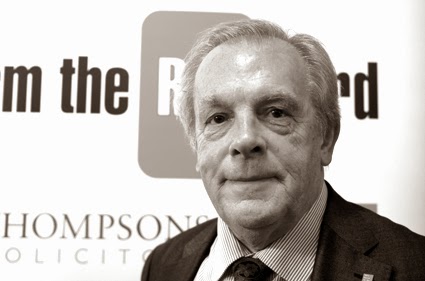
After photographing an event at Westminster for Show Racism the Red Card early last December, Steve Lomas and Chris Hughton have lost their jobs, while Alan Pardew seemed to go into meltdown a short while later.

West Ham fans may – or may not – be interested to know that I also photographed Sam Allardyce.

I should add that, as far as that evening was concerned, all were completely charming, as were all the people I came into contact with.

Ashton-under-Lyne's very own Gordon Taylor
And a special mention for PFA boss Gordon Taylor. Back when I was a sports ed, he’d give me the time of the day and would take my calls, yet I’d never met him face to face. It was a pleasure.

Of course the season also ended with news of UEFA’s sanctions against those European clubs judged to have fallen foul of the new financial fair play (FFP) rules.

The two biggest clubs affected were City and Paris St-Germain – champions in their respective countries for this term just gone.

Now it is, I should point out, entirely coincidental that both clubs are currently owned by swarthy Middle Eastern types. After all, UEFA has frequently illustrated just how seriously it treats racism rearing its ugly head anywhere near the beautiful game.

Steve Lomas, Sir Trevor Brooking and Sam Allardyce
After all: that was about money. Or more importantly, about not upsetting big business when it sponsors the game.
Now the thing about FFP, in theory at least, is that it’s supposed to avoid any more cases of clubs living so far beyond their means that they go bust as a result.
Which is a perfectly laudable aim.
However, neither City nor PSG are living above their means.
You can object all you like to those clubs being owned by foreigners, to those foreigners being Middle Eastern, to owners being richer than Croesus, to the state of football in general or to the moon being made out of cheese, but it doesn’t change the simple fact that the owners of those clubs are wealthy enough that they’re not likely to go broke any time soon, no matter how much they spend, and certainly not as long as the oil is flowing.
Rachel Yankey
Indeed, in City’s case, the entire Etihad Campus project is seeing a massive regeneration of an area of Manchester that has been derelict since the massive deindustrialisation of the 1980s – and not just with facilities for the club, but also for local people, including housing.

And – hardly unimportant – a shed-load of new jobs, with a commitment that close to 100% will go to local people.

All that's without mentioning that it represents a long-term, sustainable model for the club, by creating a world-class academy along the lines of that at Barcelona.
None of this suggests that Sheikh Mansour is about to pull the plug and run away, leaving the club to die because he’s got bored.
The problem with FFP – and casting aside cynicism for a moment, let’s just say that it really was meant to stop another Portsmouth – what it actually does is go a long way to closing the door between an existing European elite and those who might aspire to join it.
It’s a little like the UK and US rabbiting on about protectionist policies – after using the very same approach to initially build their own economies.
Alan Pardew surprises SRTRC’s own Ged Grebby
In terms of domestic UK football, there is not a single winner of the English title for a considerable length of time that has not had to buy players.

If you want to talk of ‘buying titles’, then Blackburn and Jack Walker are a perfect example.

Manchester United and Chelsea have spent considerable sums – as have Liverpool – including on wages (infographic here that might surprise you).

After the ‘golden generation’ of Fergie’s Fledglings, United have frequently brought new talent to the club – and broken the British transfer record in so doing.

And then there’s the idea that Arsenal don’t spend money – that they ‘do it right’ – a rather romantic perception that is actually rubbished by looking at the facts.

Having won the title in 1988-89 and 1990-91 under George Graham, the Gunners then endured a bit of a drought.

Arsène Wenger took over the managerial hot seat in 1996 after the 14-month reign of Bruce Rioch had been followed by the brief caretakerships of Stewart Houston and Pat Rice.

Speaker John Bercow, Rachel Yankey and Gordon Taylor
The previous year, under Rioch, the club had made the marquee signing of Denis Bergkamp for £7.5m. The following year, Patrick Vieira was brought in for £3.5m, and in 1997, Emmanuel Petit joined for £2.5m and Marc Overmars for £5.5.

Adjusting for inflation, that’s £12,581,338.70 for Bergkamp, £5,733,350.00 for Vieira, £3,972,000.00 for Petit and £8,738,400.00 for Overmars.

In 1995, the English record transfer fee was £7m – paid by Manchester United to Newcastle for Andy Cole – until that Bergkamp deal.

Arsenal went on to win the title in 1997-98, 2001-02 and 2003-04. They continued to be both a buying and a selling club in that period, including, in 1999, spending a new club record of £11m to bring Thierry Henry to north London from Juve.


It doesn’t, for instance, mention the £42m deal that brought Mesut Özil to Arsenal last summer – not least because the British record has been smashed out of sight by the fees paid to English clubs by Real for, first, Ronaldo and then Gareth Bale.

By 2000, Barça were willing to stump up £32m for Overmars and Petit combined, a week after Luis Figo had left the club for Real for £37.2m. At the time, other top fees in global terms were Hernan Crespo – Parma to Lazio for £36m – and Christian Vieri – £31m to move to  Inter from Lazio.

Those figures also illustrate just where the market was pushing up transfer fees most.

Now none of this is intended as a ‘dig’ at any club.

But it shows quite clearly that the reality is that no club that challenges for domestic titles in the UK – let alone wishes to challenge in European competition – is likely to do so without substantial spending.

It also illustrates one reason why Arsenal have failed to win another title for some years.

If one really wanted to look at financial issues, perhaps one should ask why UEFA has managed not a whisper as a club such as Manchester United was bought in a way that places it in greater risk.

One could, if one were so inclined, consider the role of agents in creating transfer inflation.

My solution to that would – in UK terms at least – to have PFA-appointed reps available to help any player needing help with any form of contract negotiations.

It would go a long way to cutting out the culture of agents shit stirring to make money for themselves off the back of the talents of any players in their stables.

But since that seems unlikely to happen in the near future, remember this: spending money that you have is worth a £50m fine.

Abusing young, black players because of the colour of their skins comes in at £8,270.