Showing posts with label Pride. Show all posts

Saturday, 25 May 2024

Beryl Cook/Tom of Finland: a stimulating exhibition

It might seem a strange idea to stage an exhibition of works by both Beryl Cook (1926-2008) and Touko Laaksonen, who was better known as Tom of Finland (1920-1991), but that’s what Studio Voltaire in Clapham has done. And it works a treat.

It’s a concise selection, but carefully chosen and with curator’s notes that avoid the pretentious and actually provide good context.

Cook is famous for her paintings of voluptuous women, predominantly working class. They’re often skimpily attired and seen with very high heels, drinks and/or fags in hand. Importantly, there is no sign of them being ashamed of their bodies – and they have the temerity to be having fun.

Victoria Wood described Cook’s paintings as being “like Rubens with jokes”.

She was self-taught and, entirely predictably, like LS Lowry, the British art establishment was sniffy. Even when she died, obituaries referred to her saucy seaside postcard as ‘naïve’. But she was – and continues to be – incredibly popular, while some major galleries now display paintings by her.

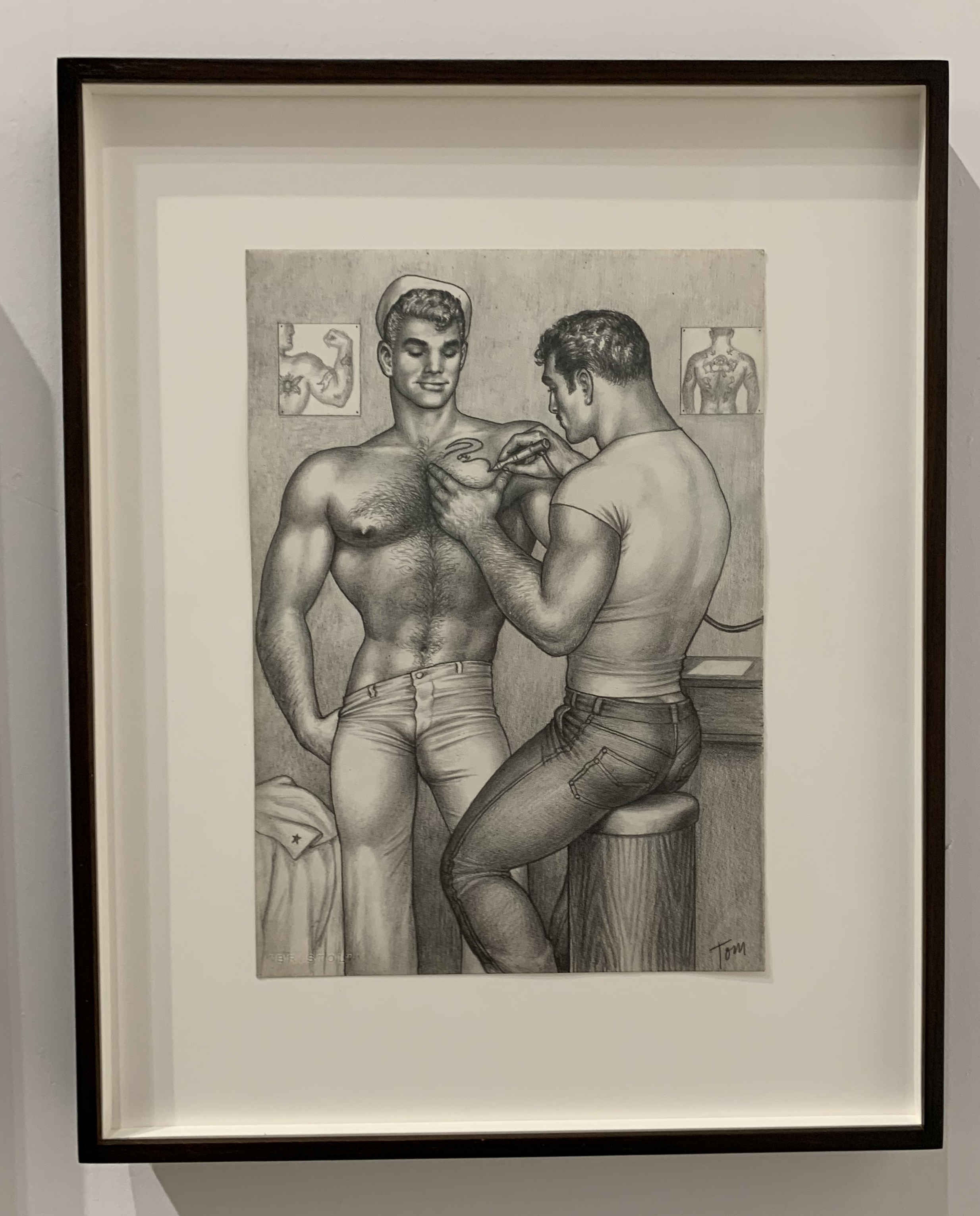
Tom’s works are more overtly and explicitly sexual. He took his name for the sake of anonymity, when by the late 1950s, he was an illustrator for US magazine Physique Pictorial, which portrayed muscled men in homoerotic activities that would just scrape past the censor.

Looking at his works of extremely muscled and well-hung hunks now, it’s easy to think of them as reflecting tropes of gay culture: the cowboy, the sailor, the leather man. All very Village People. But then that’s because Tom helped create such an incredibly influential aesthetic.

Like Cook, his figures are predominantly working class. The hyper-masculine nature of them was a direct challenge to the idea that gay men were effeminate. They are also clearly happy in their own bodies – and they’re having fun.

The styles of both artists are very different. But they’re instantly recognisable, beautifully executed and absolutely suit their subjects.

Of the works on display, there are several standouts. Cook’s 1976 painting The Lockyer Tavern (pictured at the top of this review), shows women drinking in a Plymouth gay pub – the artist was very much an ally – is iconic.

Personal Services
There’s also Personal Services from 1987, inspired by the life of famous madame and dominatrix, Cynthia Payne. It was used as a poster for the Terry Jones film about Payne, of the same title.

Ladies Night (Ivor Dickie) from 1981 portrays women surrounding a male pole dancer/stripper and laughing and straining to see as he pulls down his thong.

There’s also a display of some of the photos she took to help her work, which is illuminating.

Much of Tom’s work was graphite on paper – and untitled. I have selected three to include here, all of which showcase his skill and the points I’ve made above, but all of which are (just about!) ‘safe’ to see.

Studio Voltaire is a small exhibition space and this is a small exhibition. But that doesn’t mean it doesn’t offer an experience that breaks away from mainstream exhibitions to represent and celebrate communities and groups in a way that is really welcome and thoroughly life-affirming.

Ladies Night (Ivor Dickie)


Beryl Cook/Tom of Finland is at Studio Voltaire until 25 August.

It includes explicit artistic representations of gay sex.


Friday, 9 June 2023

Camping it up with a fascinating new history


Paul Baker’s latest foray into LGBT+ history, following histories of Polari and Section 28, takes a look at Camp! The story of the attitude that conquered the world – and it is both an extremely educative and entertaining read.

As with those two previous books, Baker’s approach is well-researched historically, but also includes autobiographical elements and observations, with a nice side of cheek. Also as previously, this recipe works very well.


The first chapter examines the origins of camp as we know it – in particular, its relationship to Louis IX in France.


I also had no idea about the origins of the cakewalk and the black balls, and therefore, voguing. Baker covers both these in good fashion. 


I’ve seen the Jimmy Cagney film Yankee Doodle Dandy (1942 a number of times, but I hadn’t a clue that the lyrics of the eponymous song were originally written in 1755 as a British pop at ragged Americans, who then turned it around.


Take these lyrics:


“Yankee Doodle went to London,

Riding on a pony,

Stuck a feather in his cap,

And called it macaroni.”


Had I ever considered what the pasta reference was actually about? No. But in fact, it was a nickname – and a pejorative one – for young British men who did the Grand Tour and returned with the fashion affectations of, in particular, Italy. Maybe not ‘gay’, but certainly you can see the link to ‘camp’ – and to gay. Fascinating.


Taking a leaf out of Baker’s own book, so to speak, there was masses here (particularly in the earlier chapters) that I recognised as tastes from my own earlier years. Agnes Moorehead in Bewitched gets a mention – my absolute favourite character in a show I adored as a child!


Paul Lynde was also in Bewitched, but for me, was most memorable and most deliciously enjoyable for his voiceover work on The Perils of Penelope Pitstop (camp in every way imaginable).


There are explorations of upper-class British (English) camp – the Mitfords in particular, plus the reach of non-aristo Noël Coward – together with a fascinating introduction to the black cakewalks and balls where voguing was created.


But while camp is easy to take as an unserious attitude, Baker illustrates that it is often a way of defiance. And how much more defiant than those at the Stonewall Riots who faced down the police down with a chorus line, singing a revised version of Ta-ra-ra Boom-de-ay, which, while details are not set in concrete, certainly involved black drag queens.


There’s a personal educational tip on that note – it also made me realise also why a version of Ta-ra-ra Boom-de-ay is used, in the way it is, in the film, The Adventures of Priscilla, Queen of the Desert.


Of course there are things that are missing here – as Baker acknowledges early on: everyone will have different camp (and campy – ie *knowingly* being camp) faves, but this a really good look at a cultural phenomenon. 


Paul Baker’s Camp! Is out now, published by Footnote Press


There are still tickets for an event with the author next week in central London – Bloomsbury, Queerness and Camp. Perfect for Pride Month.


Monday, 15 July 2019

Walks of witness, steps free of shame

Placard protesting against the homophobic laws of the
Sultan of Brunei, Hassanal Bolkiah, who, in true
Freudian style, has ‘anal’ as part of his name
Last Friday was Whit Friday – a day that means little throughout most of the UK but which, in parts of the North West of England, has great cultural significance.

In the morning, members of local Christian churches march through their town in a walk of witness, usually with banners for each church (think a religious version of trade union banners) and sometimes with a brass band from, say, a local school.

In the afternoon – in Mossley at least – there’d be games at the local football ground. In the evening, there’d be the band contests, where brass bands would travel from town to town, à la Brassed Off, competing in each contest before travelling to the next one.

For eight years, when my family lived in the Tameside region, I would have the day off school. I’d march with my father’s church, enjoy the games and then hang around outside the church itself while the bands marched in and out of St Joseph’s school yard to perform.

Eight years was the longest we spent anywhere when I was growing up: the sound of brass bands is woven into my being.

Yours Truly
My last Whit walk was 40 years years ago on Friday 8 June, 1979.

This year, on 6 June, I took part in what was, in many ways, another walk of witness and my first such one: London Pride.

I’d thought about going to Pride before – only as a member of the crowd, mind – but then somehow just never got around to it.

With the benefit of hindsight, I think that I was afraid of being outed to the only two people I was in contact with whom I wasn’t out – my parents. My father had, back in those Mossley days, carefully nurtured an awareness in me that people who knew him would see me doing things and report.

Trafalgar Square
It happened at least once that I can specifically remember now, about something ridiculously innocuous, but it was an idea that lingered. I don’t think that such things leave you easily, even if you cease to be consciously aware of them.

I never told Mother and Dad that I was bisexual: by the time I’d come out to myself, I wondered what the point would be: wouldn’t it just risk seriously upsetting them, given their attitudes toward sexuality – and sin?

A few days before this year’s Pride, a work email newsletter arrived in my inbox, announcing that there were spare places with our organisation’s contingent for the parade itself. I took the opportunity. It seemed an apt moment too, as I work through some of the things that have risen to the surface in the tumult of dealing with both parents’ deaths since 2017, plus my own cancer diagnosis last year.

The day of Pride, I got to Portland Place in good time, but realising that, in olive linen trousers, walking shoes and a branded UNISON t-shirt, I was woefully underdressed. So I picked up a little rainbow clip-on bow tie. I was still underdressed, but not quite as much so.

Steampunky Gothy greetings
The atmosphere was almost overwhelming. As an old friend noted to me later on Facebook, you feel surrounded by warmth and good feelings. I have never experienced anything like it. It was extraordinary to have people reach out from the massive crowd (an estimated 1.5 million on the streets of London) to high five as they wished you the best.

There was plenty of outré behaviour and attire – and I like that: I adore the transgressive nature of drag, for instance.

And off course, it was less than a week into my One Million Steps Challenge, so perfectly suited.

Perfectly suited too, for being not simply a utilitarian walk.

Some ask why Pride is needed these days. Well, when you hear and read of rising homophobic and transphobic attacks, you realise why.

When you read of the protests against the No Outsiders programme being taught in Birmingham schools, you understand why Pride is necessary.

Indeed, just today, it’s been reported that the government has been accused of being “too slow” to tackle the issue – and support the school: accused by the woman tasked with tackling extremism.

‘God is love’
But now, it seems that the protests by some Muslim parents, on the grounds of their religious beliefs, against teaching children that all people are equal, are encouraging others.

According to this report, a group called Catholic Family Voice has been set up near Glasgow by a woman who describes herself as “excited” by what’s been happening in Birmingham. Another woman has been individually leafleting schools on the issue, ”aiming to disrupt, essentially,” while the founder of The Values Foundation makes it clear that she doesn’t ‘value’ equality.

“There’s no way that people of faith will teach it’s OK to be gay,” she said. “They won’t because the Bible tells us it isn’t OK to be gay.”

Yes. And the Bible tells us that we should do an awful lot of things that these people would not remotely suggest were appropriate these days.

It’s also worth noting at this juncture, that plenty of people of faith have no problem with the spectrum of sexuality, just as plenty of people of faith acknowledge that evolution is real.

But that’s as maybe. The point here is simple: it might seem that LGBT+ people have equality – in law, at least. But while they continue to be attacked, simply for being who they are and loving who they love, then the struggle is far from over.

I‘ll go with this
In many ways, in terms of a practical, day-to-day level, it’s not been particularly difficult for me: despite being out to people in my daily life, I’ve been in a relationship with a straight, male Other Half for 30 years (he knew before I recognised it myself), so people comfortably make assumptions and frankly, I’ve no interest in making my sexuality the subject of every first conversation with someone.

But almost four decades to the day since I last took a walk of witness – and now, not because I had no choice, but because I wanted to – I walked again.

In times like these, with the rise of the far-right revealing again the attitudes that gave rise to the pink triangle – the symbol stitched onto the concentration camp uniforms of LGBT+ inmates in Nazi Germany – witness is vital.

This year is also the 50th anniversary of Stonewall, with all that began. Our history is important.

So too is showing solidarity with those still being persecuted and even being killed: four LGBT refugees from Syria had finally arrived in the UK a couple of days before Pride. Finally, they could experience what it means to be out.

And it is also vital to say, as MP Angela Eagle recently did in a speech about the Birmingham schools protests: “We aren’t getting back in the closet”.