Showing posts with label class. Show all posts

Saturday, 25 May 2024

Beryl Cook/Tom of Finland: a stimulating exhibition

It might seem a strange idea to stage an exhibition of works by both Beryl Cook (1926-2008) and Touko Laaksonen, who was better known as Tom of Finland (1920-1991), but that’s what Studio Voltaire in Clapham has done. And it works a treat.

It’s a concise selection, but carefully chosen and with curator’s notes that avoid the pretentious and actually provide good context.

Cook is famous for her paintings of voluptuous women, predominantly working class. They’re often skimpily attired and seen with very high heels, drinks and/or fags in hand. Importantly, there is no sign of them being ashamed of their bodies – and they have the temerity to be having fun.

Victoria Wood described Cook’s paintings as being “like Rubens with jokes”.

She was self-taught and, entirely predictably, like LS Lowry, the British art establishment was sniffy. Even when she died, obituaries referred to her saucy seaside postcard as ‘naïve’. But she was – and continues to be – incredibly popular, while some major galleries now display paintings by her.

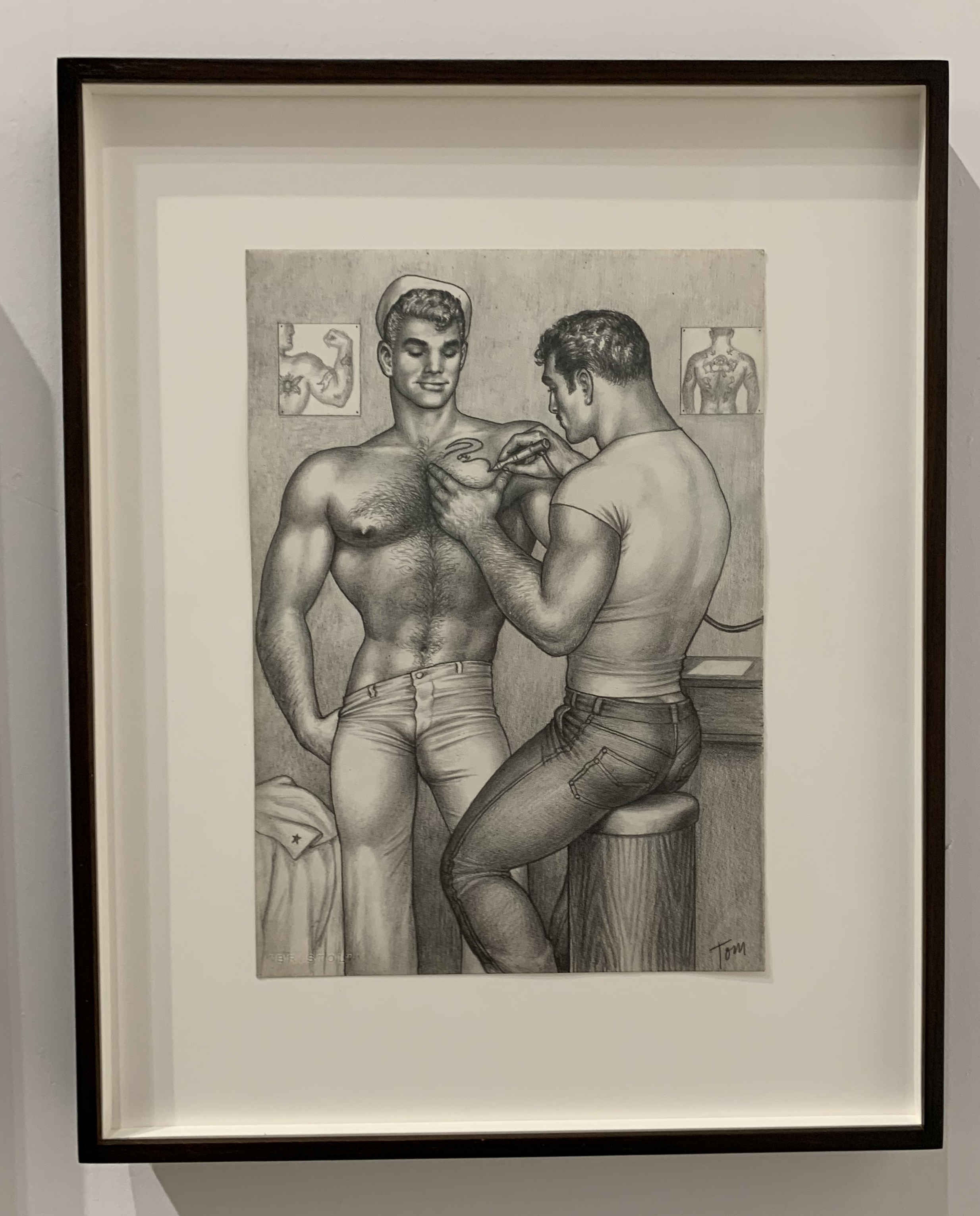
Tom’s works are more overtly and explicitly sexual. He took his name for the sake of anonymity, when by the late 1950s, he was an illustrator for US magazine Physique Pictorial, which portrayed muscled men in homoerotic activities that would just scrape past the censor.

Looking at his works of extremely muscled and well-hung hunks now, it’s easy to think of them as reflecting tropes of gay culture: the cowboy, the sailor, the leather man. All very Village People. But then that’s because Tom helped create such an incredibly influential aesthetic.

Like Cook, his figures are predominantly working class. The hyper-masculine nature of them was a direct challenge to the idea that gay men were effeminate. They are also clearly happy in their own bodies – and they’re having fun.

The styles of both artists are very different. But they’re instantly recognisable, beautifully executed and absolutely suit their subjects.

Of the works on display, there are several standouts. Cook’s 1976 painting The Lockyer Tavern (pictured at the top of this review), shows women drinking in a Plymouth gay pub – the artist was very much an ally – is iconic.

Personal Services
There’s also Personal Services from 1987, inspired by the life of famous madame and dominatrix, Cynthia Payne. It was used as a poster for the Terry Jones film about Payne, of the same title.

Ladies Night (Ivor Dickie) from 1981 portrays women surrounding a male pole dancer/stripper and laughing and straining to see as he pulls down his thong.

There’s also a display of some of the photos she took to help her work, which is illuminating.

Much of Tom’s work was graphite on paper – and untitled. I have selected three to include here, all of which showcase his skill and the points I’ve made above, but all of which are (just about!) ‘safe’ to see.

Studio Voltaire is a small exhibition space and this is a small exhibition. But that doesn’t mean it doesn’t offer an experience that breaks away from mainstream exhibitions to represent and celebrate communities and groups in a way that is really welcome and thoroughly life-affirming.

Ladies Night (Ivor Dickie)


Beryl Cook/Tom of Finland is at Studio Voltaire until 25 August.

It includes explicit artistic representations of gay sex.


Thursday, 27 October 2022

Taking a sledgehammer to the uber rich

Triangle of Sadness
many not exactly be up there with Brecht in terms of being a subtle approach to class, but Swedish film maker Ruben Östlund’s English-language debut – a satirical black comedy about the excesses of the uber, uber rich – premiered at this year’s Cannes Film Festival in May, winning an eight-minute standing ovation and the Palme d’Or.

But then again, this is an unsubtle age (was there ever anything else?). There is nothing nuanced about the likes of Elon Musk, Jeff Bezos, Russian oligarchs or Instragram ‘influencers’, so perhaps a sledgehammer approach is the only possible one.


Set in three distinct ‘acts’, the film opens as group of young male models are being put through their paces at an audition. One of them, Carl, had been at the centre of a major, successful campaign a few years earlier, but has had nothing much since.


After watching his more successful girlfriend Yaya on the catwalk at a fashion show – she’s also a big Instagram influencer – the two dine in a posh restaurant, where a row breaks out over gender roles and equality, and who pays for the dinner.


Fast forward to act two, which takes place on a luxury yacht – the sort that needs armed guards on patrol and where a helicopter drops off a special delivery of Nutella to meet the whim of one of the guests. Carl and Yaya are there because of the latter’s status as an influencer.


The upper deck crew (mostly white) are preparing for their next cruise, being drilled by chief of staff Paula, who tells them that they must obey every demand of their guests, however cracked these might seem.


Below stairs (so to speak), the (mostly black) cleaners, engineers and kitchen staff are also prepping.


Then we meet some of the guests, including Dimitry, a Russian who has made a fortune “selling shit” (manure) and his wife Vera; elderly English couple Clementine and Winston (I said it wasn’t subtle) who made their dosh by selling arms to protect “democracies” and bemoan UN bans on landmines; Jarmo, a lonely tech millionaire; and Therese (and husband), who can only speak a single sentence in German – “in den Wolken” (“in the clouds”) – following a stroke.


The captain, meanwhile – American Marxist Thomas Smith – is nowhere to be seen, locked in his cabin with a shed load of booze. After a few days at sea, he is finally coaxed out to attend the captain’s dinner.


Unfortunately, this coincides with a very bad storm.


Act three takes us to a deserted island, where a small number of survivors have washed up. Several of the guests have made it, together with ship’s mechanic Nelson and toilet manager Abigail.


At which point, the question arises of just who among them knows how to ensure that they can survive, to build a fire or find food? And, therefore, who should be the leader among them?


At a whopping 149 minutes, it’s overlong. It doesn’t particularly lag, but it’s impossible not to feel that it couldn’t have been pruned some more. The storm section alone, which provides some brutally funny moments – yes, the rich really do vomit and shit like we mere mortals – lasts 15 minutes.


And while also funny, a scene where, in the middle of that storm, the captain and Dimitry sit locked in the former’s cabin, drunkenly trading quotes about capitalism versus Marxism/communism over the ship’s public address system, probably over-eggs the pudding.


The opening fashion industry sequences are very funny in their mocking of the ridiculousness of that world. The island scenes have some good takes on masculinity, power relationships, class, race and more.


By and large Östlund’s script and direction work. None of the characters are wholly ‘bad’, although all the privileged lack a self-awareness of their relationships with the rest of the world.


And the ending is smart, effectively forcing the viewer to make their own moral decisions.


It’s a really good ensemble cast, including Harris Dickinson as the comically naïve Carl and Charlbi Dean as Yaya – tragically her last role, before she died suddenly in August.


Woody Harrelson gives a fine short turn as the captain, while Zlatko Burić as Dimitry, Iris Berben as Therese, Viki Berlin as Paula, Oliver Ford Davis as Winston and Henrik Dorsin as Jarmo also provide in good performances.


But arguably the best of the lot comes from Dolly de Leon as Abigail. We don’t see her until the third act – unless we simply not been aware of her presence, given her lowly position? How apt a point that would be. But from then on, so much turns and rests on her.


All in all, Triangle of Sadness is an enjoyable exercise in punching up at extreme privilege. And it doesn’t lose anything in taking such a Rottweiler approach to its theme either.


• Triangle of Sadness opens in the UK tomorrow, 28 October, and is screening largely at independent cinemas.

Thursday, 4 April 2013

If cleanliness is next to godliness ...

My friend Mary.
If cleanliness really is next to godliness, you could be excused for imagining that cleaners would be considered as valuable members of society.

Yet within our society, this is so far from the case that one could be forgiven for imagining that cleanliness actually isn't remotely important.

Cleaners are treated as something like the lowest of the low.

So even the John Lewis Partnership, which is, in so many ways, an exemplary employer, refuses to pay its cleaning staff the Living Wage.

It's as though cleaners are charity cases – as though, if nobody cleaned anything, it would go unnoticed.

John Lewis would continue to open all its stores and no customer would ever resent the lack of cleanliness and, thusly, stay away.

No restaurant would see a slip in trade if cleanliness slipped.

And as for hospitals ...

Well, we actually know the answers to that: when so-called 'soft services' were privatised, the numbers of hospital cleaners was halved – and the rate of infections like c-diff and MRSA leapt.

For a little amusement yesterday, I took the brief version of the new the 'what class are you?' test.

It seems that I am 'established middle class'. Well, on a social definition of class, of course I'm middle class. And do I have a problem with that? No. Not in the least.

But equally, I have no private income and have to 'sell the labour of my hand or brain' (to borrow from old Charlie Marx) in order to ensure that I keep a roof over my head and food in my belly. So in that sense – the political-economic – I am working class.

But oh God – how obsessed are we Brits with the social definitions!

Back to the test. If you're going to conflate the political-economic definition with the social version, then the section on cultural capital at least makes some sense.

However, I find the section on social capital deeply annoying.

What? You lose 'social capital' if you know a cleaner socially? This is based on nothing other than pure snobbery.

I do know a cleaner or two socially. I'm not going to claim to be 'proud' to, because that would be really rather patronising. I mean – 'look at me: I know a cleaner'. How naff would that be? Really?

I know some road sweepers too – and a window cleaner and a few removal men ... all socially.

I also know a teacher socially. And a lawyer or two. And an accountant. Or two (they're not half as boring as they're made out to be).

I know an artist.

And a musician. And a record producer.

And people who run their own businesses.

I know a few other people in the media (strange that).

Why on Earth do we bother with such divisions? Would it not be better to celebrate what unites us all rather than what divides us?

Class exists, essentially, on two levels.

One is an old-fashioned – and still entirely rational – Marxist definition of the relations of people with capital. The political-economic, in other words – as mentioned above.

The other is the social – the A, B, Cs, also as suggested above. It's the world of the 'keeping up with the Joneses' and of 'aspirationalism' and of 'scroungers' and 'skivers' and 'strivers'.

It's not difficult to see why this is also the world where plain, old-fashioned snobbery comes into play.

I like to think – and I hope it's true – that from a personal perspective, the fact that I have a wide range of social acquaintances is because I actually take people for who they are, and not on the basis of some label or other.

And equally, that is why, if I come out in support of a proper living wage for cleaners, for instance, it has nothing to do with 'envy', and everything to do with concepts of 'fairness' and ultimately, being a decent human being.

Gawd – why does it all sometimes feel like rocket science?

Monday, 15 October 2012

We're all plebs and scumbags now


'Oooo, those plebs make my blood boil.'
‘In vino veritas’, goes the (very) old saying: or to translate from the Latin, ‘in wine there is truth’.

It’s been suggested that Andrew Mitchell MP, Conservative MP for Sutton Coldfield and the government chief whip, had been imbibing himself before his recent spat with a policewoman at the gates of Downing Street.

After being told that he could not exit the street through the main gates, he launched into a stream of invective.

But if being a bit sweary and ranty were that not enough, Mitchell’s biggest mistake came in telling the police that it was “best you learn your fucking place” and then (although he continues to deny this – in other words, he’s saying the police are liars) that he called them “fucking plebs”.

‘In vino veritas’, perhaps?

Was this the mask down; the true feelings revealed?

Mitchell is hardly outside the government’s little coterie of public school boys, having himself been educated at Rugby, where he gained the nickname ‘Thrasher’ for his love of stern discipline.

Whether he did use ‘plebs’ or not, his other comments suggest a sense of his own superiority – and others’ inferiority.

The good old British class system is alive and kicking, it seems. Or if not kicking, at least swearing a bit.

Not that Mitchell is alone in being caught with the mask askew.

For at the weekend, on hearing that anti-hacking campaigners were lobbying the prime minister, Rupert Murdoch availabled himself of the opportunity afforded by Twitter to let his 340,000-plus followers know his thoughts on the matter:

“Told UK's Cameron receiving scumbag celebrities pushing for even more privacy laws. Trust the toffs! Transparency under attack. Bad.”

That’s quite some way from his declaration, when sitting in front of a committee of MPs in Parliament to examine the issue of hacking, that it was “the humblest day of my life”.

He tried to backpedal on Twitter, claiming he hadn’t meant it about people like Charlotte Church, but then poured further oil on the flames with another tweet, attempting to link the case of Jimmy Savile to that of hacking.

“Likes of Saville [sic] further protected if we don't fight Cameron, dodgy celebrities in UK. Could not happen in US.”

There’s a certain irony to this – Murdoch and his varied businesses make a very great deal of money out of these people he appears to view as “scumbags” and “dodgy”.

And it is, of course, so reassuring to realise that hacking and invasions of privacy for nothing other than salacious stories are really the sort of things that help uncover abusers.

In which case, it’s such a shame Murdoch’s minions didn’t actually use such methods to garner stories of an actual public interest.

It seems that some of the people in positions of power in this world don’t think much of either those they are either in power to help govern – or those who make them millions.

Not that this should come as any major shock. Look at the behaviour of the banks and big finance – they gambled and lost, and now it’s ordinary people who are paying the price. And do they show any sense of remorse? No.

They just keep paying themselves the same big bonuses and keep denying that continuing relevations of corruption and wrongdoing suggest that anything might actually need to be done.

Or of the supermarkets, which put the single issue of profit over the health, wellbeing and choice of their customers, the nation as a whole, the environment and their producers.

Or the big pharmaceutical industry, which does the same with patients the world over, as Ben Goldacre’s new book, Big Pharma, reveals in shocking detail.

It seems that, when our government tells us that "we're all in this together", what they really mean is that most of us are – but not them. Or their friends.

After all, is there a reason that they seem remarkably reluctant to tackle the issue of corporate tax evasion, while David Cameron himself can stand up and condemn an individual for using a scheme to avoid paying much tax.

Indeed, Murdoch's Times has been pursing the latter line with relish in recent weeks. But the former? Forget it.

So, hide away in despair? Or try to find ways to spread the word and grasp any chance to change things?

Can they even be changed?

Perhaps old Charlie Marx wasn’t so wrong in some of his analysis after all.

Friday, 28 September 2012

We know what you did 23 years ago


It seems quite extraordinary, but just a couple of weeks after the facts about the Hillsborough disaster were released, a new one has emerged.

There were not 96 victims, as previously believed, but 97.

That previously unrecognised victim was Kelvin MacKenzie.

Yes: that Kelvin MacKenzie.

The same person who, as editor of the Sun at the time, made the decision to plaster the headline ‘THE TRUTH’ over reporter Harry Arnold’s story about what he had been told had occurred.

Arnold says that the story did not assert that it was the unquestionable truth, and he queried the headline with MacKenzie, who just went ahead anyway.

However, the fault for this now appears to lie entirely with the South Yorkshire Police, who fed the claims about Liverpool fans at Hillsborough to a Sheffield news agency, supported by the claims of an MP who wasn’t there, but also now says that he totally believed what the police told him, and was subsequently knighted – presumably not for services to the truth.

It seems that, if the stories hadn’t come from police, MacKenzie would not have felt so sure of their absolute veracity that he would have written that headline.

Now, therefore, he wants an apology from the force in question, for all the years of vilification he has suffered.

Poor lamb.

This is the same MacKenzie who did once apologise – and then recanted. His latest apology therefore means little – and is being taken in precisely that manner.

This is also the same MacKenzie who will be perfectly well aware that the Taylor Report showed up the lies for what they were ages ago – yet he did nothing then.

The first rule of journalism is that you make some effort to check what you’re printing – not least if the stories are as extreme as those that the Sun published about Liverpool fans.

I’m not a Liverpool fan. I wasn’t at that match, but I was watching it on television that day, and I remember the horror as events began to unfold.

Back at work after the weekend, the first person I met was a fellow football supporter – Crystal Palace in her case. We hugged and exchanged the view that was widespread among fans then and remains so now: ‘there but for the grace of god go I’.

There were reasons that Hillsborough happened. There was hooliganism that had attached itself to the sport. But suggestions that the sport was saturated in violence of the threat of it, are nonsense.

However, it suited the political agenda of time – don’t forget that the government, desperate to assault civil liberties in general, wanted to use the reputation of football fans as an excuse to foist ID cards on them, as guinea pigs for the rest of the population.

The Sun, under Rupert Murdoch (who has been strangely silent on the subject of Hillsborough), had relished the opportunity to batter working people – not least those from rebellious Liverpool, where the government was talking of planning a ‘managed decline’ after its own policies had destroyed the city’s major industry.

The paper supported the police utterly – including that same South Yorkshire Police force, which had been allowed to act with impunity at Orgreave.

MacKenzie was entirely happy to be part of the process of the demonisation of working-class people who didn’t tug their forelocks dutifully as the government of the day laid waste to the country’s industrial base.

As an editor, he and he alone made the decision to write and publish the headline that has seen him ‘vilified’.

As a journalist, he had the responsibility to check sources – and to act in a responsible manner.

This is not to remotely excuse what some members of the South Yorkshire Police did, but MacKenzie cannot shed his own responsibility for his own professional decisions.

Whatever his reasoning or his motive at the time, he made a personal decision to all of these responsibilities.

And now, if he had a shred of human decency, MacKenzie would just crawl back under his stone and shut up.

Monday, 23 April 2012

St George's Day and Englishness: a few thoughts


In case you hadn’t noticed, it’s 23 April. Which means it’s Bill Shakespeare’s birthday – and St George’s Day too.

In the case of the latter, that means celebrations of some sort for the people of many countries, since he is the patron saint of more than one nation – and plenty of other things besides, including archers and sufferers of syphilis.

But national days have little to do with the historic reality behind the saint in question.

In this case, there seems to be some confusion as to where he even came from, although there is support for his having been a Roman soldier from Syria Palæstina.

The Catholic Encyclopedia is of the opinion that, while there seems to be no ground for doubting the historical existence of St George, that doesn’t mean that we should believe some of the more fanciful tales.

Which conclusion struck me as showing a certain lack of self awareness.

But the mythical nature of St George seems rather apt in many ways.

You could start with the very nature of nationalism: anyone who really thinks that the country they hail from is better than any other is daft – just as daft as anyone thinking the reverse.

My parents were very much in the camp of thinking that England was absolutely finer than absolutely anywhere else on planet Earth. ‘God is an Englishman’, they commented more than once – presumably, given their devoutly held religious beliefs, without entirely meaning it.

So convinced of this innate superiority are they that they have been rendered incapable of actually seeing the satire in things such as Flanders and Swann’s Song of Patriotic Prejudice – or even some of what WS Gilbert wrote – and treat such songs with utterly gleeful relish.

Which rather means that the joke is on them – even if they can’t understand this.

My mother used to comment loudly – and god, how embarrassing it would be – when people left the cinema before the national anthem was played. We obviously had to wait – and stand for it.

Yet in spite of growing up in such an atmosphere, I could never understand what it was I was actually supposed to feel.

I mean – why be ‘proud’ of where you’re from? Why would you take pride in something over which you have had not an iota of control or influence?

It’s as daft as being ashamed of where one comes from.

They really are the two sides of a single coin.

It took me years to work out what my own Englishness meant – and it has much in common with that Flanders and Swann or Gilbertian strand of disguised satire.

Like much English humour, they seemed to be either of the Establishment or at least rather tame, yet the reality was more complex.

They were observers, sitting slightly apart and recording the quirks of the English, often with a slightly surreal edge.

The same could be said of a vast number of talents, from Joyce Grenfell to Eddie Izzard and Alan Bennett to Victoria Wood.

Equally, I doubt my mother, for all her liking Shakespeare, is aware of many aspects of the Bard’s writing.

Take A Midsummer Night’s Dream, for instance. It’s long struck me as more than a tad amusing that it’s the first Shakespeare play that children are introduced to.

It’s about sex. An Elizabethan audience would have understood that Puck transforms Bottom into an ass because the ass has a whopping big penis. That’s what it is that attracts Titania when she sees him.

But there are plenty of other myths about England and Englishness.

The likes of John Betjeman and JRR Tolkien both helped popularise a particular mythology during the 20th century.

For both of them, England was the countryside: not the dramatic, romantic scenery of the Lake District, for instance, but something far gentler: rolling downs and pretty woods.

You see this chocolate box idea in much of Betjeman’s poetry. And it’s no coincidence that Tolkien labeled the part of Middle Earth that was under threat and needed defending as The Shire.

There was no place for industry or the inner cities – and they both pretty much wrote them out of their visions of what constituted an ideal England.

You could also mention St Mary Meade, home of Miss Jane Marple. But since Agatha Christie’s sharp-minded old lady was always solving murders rather than sitting in the garden, drinking tea from a bone china cup and doing the Times crossword, it was hardly an idyll – however far geographically from the encroaching obscenity of modern, urban life.

On the other hand, Hercule Poirot most definitely disliked the countryside – although perhaps that’s because he was furrin?

It’s an England that did – or does – most certainly exist, and it has a powerful hold on the collective imagination of many; perhaps particularly those of ‘a certain age’ and a certain social background.

In a speech to the Conservative Group for Europe, on (note the date) 22 April 1993, the then Prime Minister John Major said: “Fifty years on from now, Britain will still be the country of long shadows on cricket grounds, warm beer, invincible green suburbs, dog lovers and pools fillers and, as George Orwell said: ‘Old maids bicycling to holy communion through the morning mist’ and, if we get our way, Shakespeare will still be read even in school.”

It’s quite obvious that a lot of this is connected to class.

Grubby, grimy, dirty industry was what the hoi polloi in the cities and grim, industrial northern towns did.

The middle classes built “invincible” suburbia to live as far as possible from the inner city, if they couldn’t avoid working there.

Only very recently has this trend started changing: now, living in the city so trendy that the rising cost of even old council flats is driving out the people who once were the only residents.

There is a truth to the vision of Betjeman and Tolkien et al, and there is something quite intoxicating about the picture that Major conjured up.

But it is only one part of that truth; only one part of what constitutes England – and a smallish part at that.

When I travel to Bournemouth later this year for work, I’ll enjoy some of the sort of scenery that Betjeman eulogised. But my own Englishness also incorporates the landscapes of Lowry – and there, in a nutshell, may be the reason that he was so shamefully treated by the country’s art Establishment: he recorded a world that they didn’t want to see; that did not conform to ideas of what was ‘nice’ and acceptable: that could not be Art.

Betjeman was a snob. Oh, he’s an enjoyable snob to read – his use of rhyme and rhythm makes his work readily accessible – but there is poetry in the industrial and in the north too: witness the work of the sublime Alan Plater and, as mentioned earlier, Bennett.

And of course, that doesn't even touch on just what those grubby working types actually contributed to the country, which such snobs so conveniently forget.

But going back to English humour, perhaps at our best, there’s a determination to prick pomposity.

Think of Will Hay, playing a double agent and being allowed to make repeated v signs to a picture of Hitler in 1942’s The Goose Steps Out as he ‘educates’ would-be spies about English ways of showing respect.

But it's equally part of the greater picture that Hay's screen persona was that of a buffoon. He was hardly some heroic figure. And indeed, you see the same thing repeated in English culture, from George Formby to Norman Wisdom.

That example came to mind again last week, when English Defence League founder Tommy Robinson responded to a picture of the Taj Mahal on the Twitter homepage with the following: “welcome to twitter homepage has a picture of a mosque. what a joke #creepingsharia”.

Major wasn’t entirely wrong when he also said: “Only in Britain could it be thought a defect to be ‘too clever by half’. The probability is that too many people are too stupid by three-quarters”.

But quite apart from pointing out that the Taj Mahal is not a mosque, the Twittersphere had enormous fun taking Robinson’s hashtag and sending it up mercilessly.

To give a flavour, tweets included: “My nan goes to Mecca bingo. Coincidence? #CreepingSharia” by Robbie Gibbo.

It was the perfect riposte. And it was deliciously English.

It is the same approach that produces Private Eye.

Although the downside of this is that, in general, we also notoriously distrust intellectualism. Public discourse suffers as a result – little wonder we therefore have political (and other) ‘elites’ and that we canonise the thick.

See Jade Goody – a troubled individual, exploited by the media and a voyeuristic public, who became a celebrity for her stupidity, before being vilified for the same thing and then hailed as a saint as she died in the public glare, desperate that the financial benefit that that would bring would benefit her children.

England at its best; England at its worst.

But you can’t have everything.

On a rather more down-to-earth level, I’m afraid today’s food hasn’t been particularly English – with The Other Half away, I’m on an Italian kick involving seafood and cheese and dishes he would not want to eat.

But it could hardly have been more English on Saturday evening – well, British – with English lamb chops, English asparagus and Jersey Royals from, err, Jersey.

However, that’s not to say there wasn’t a little something to do to mark today.

Just over a week ago, while wandering along Columbia Road, we were both handed what appeared to be a rather knobbly, red business card.

In fact, it turned out to be an invitation from the mayor of London to a St George’s Day festival this weekend just gone.

But the little cards themselves could be soaked overnight in water and then planted in soil, since they contained seeds for English wild flowers.

Which was an entirely nice idea – and I therefore saved them to soak and planted them late this afternoon.

And that’s exactly what I did.

Dressed in jogging pants, a football shirt and a tweed cap (made in the UK), with a mug of Earl Gray on the side, while another April shower pit-pattered down and, between the steady growl of the city’s traffic, bird song filled the air, I sowed a little bit of one England in a little corner of another England.

Friday, 9 July 2010

That's me, sweating like a pig

There I was, sitting in the garden, under a steaming sun, with sweat absolutely pouring out of me. And it struck me: "Ladies do not sweat: they glow or at worst, perspire".

I was doubtless glowing, but evidently not from anything as ladylike as 'perspiring'. No, this was sweat.

That was a quote of my mother's. She seemed to have an obsession about how 'ladies' behaved; about ideas of what constituted 'ladylike' behaviour. I say "seemed", because I'm too old now to be subjected to it any more – if indeed she still maintains the obsession.

My mother was always obsessed with such appearances. She was – again, I'm not subjected to it any more, so she may have changed – but she was a dreadful snob. And it wasn't a snobbery based on any achievements – real or otherwise – but purely on her own sense of her station in life.

Her father had started off as an office boy, but had worked himself up to be the boss of a steel company. Her mother had been a teacher. But her mother was a snob too and she inherited that sense of class: once they'd risen to something that they could perceive to be middle class, then they were going to prove just how middle class they really were.

When I went to Fairfield – the only child from my town, that year, to go to that school – one of the first things she asked me about a new friend was what her father did for a living. He was an ambulance driver. That drew forth a warning about my responsibility to my father to have appropriate acquaintances.

She never seemed to have seen the irony of such comments – that my father came from a tiny backwater in Cornwall, the son of a roadmender and a barmaid, who'd had to have elocution lessons so that any congregation outside of the south west could understand him. He was exactly the sort of person that she now considered as inappropriate as a parent of a friend.

You'd have thought that, if she was so concerned about class and her social station, she'd have got herself hitched to a Church of England vicar with the ambition and opportunity to gain a bishopric. Instead of which, she pinned her hopes on a rebellious Methodist, who could never keep the church hierarchy happy, and whose financial dealings left us perennially short of cash.

Not that my mother's comments about my new schoolfriend was the only time that I can remember her on such a theme. She once famously informed my sister and I that we could not behave as 'normal' children did, since as the minister's daughters, we were looked to by other children and their parents to set an example.

Which, now I think about it, is close to vomit-inducing. I concluded, a rather long time ago, that we were as much accessories to my father's work as we were children.

If my father himself didn't have the same class snobbery, he certainly viewed his family as subservient to his work – his 'calling', once should say. And very much in the accessory mold – what we said and did reflected on him, he made quite sure we knew.

I got into huge trouble once, when he carted me off to some church to give my 'testimony' – a little speech about how I'd accepted Christ into my life etc etc. I was in my early to mid teens, I suppose. My parents had apparently been delighted when I'd been 'born again' at pretty much the last of a lengthy series of evangelical rallies in the area. But his delight was nothing when my little oration contained – completely unconsciously – words that apparently showed him in a bad light as a preacher. I was on the receiving end of a remarkably un-Christian tongue lashing over that little episode.

Sometimes, looking back, I think it was like being brought up in the 1920s or '30s. It certainly bore little relation to the 1960s and '70s. That and then the cotton wool.

It's rather amusing to think how – eventually at least – it was all to no avail. Ultimately, they lost.

Anyway, decent weather is forecast for the coming weekend. So I shall enjoy sitting outside, nose in a book. And having a damned good sweat again.