Showing posts with label art. exhibition. Show all posts

Saturday, 25 May 2024

Beryl Cook/Tom of Finland: a stimulating exhibition

It might seem a strange idea to stage an exhibition of works by both Beryl Cook (1926-2008) and Touko Laaksonen, who was better known as Tom of Finland (1920-1991), but that’s what Studio Voltaire in Clapham has done. And it works a treat.

It’s a concise selection, but carefully chosen and with curator’s notes that avoid the pretentious and actually provide good context.

Cook is famous for her paintings of voluptuous women, predominantly working class. They’re often skimpily attired and seen with very high heels, drinks and/or fags in hand. Importantly, there is no sign of them being ashamed of their bodies – and they have the temerity to be having fun.

Victoria Wood described Cook’s paintings as being “like Rubens with jokes”.

She was self-taught and, entirely predictably, like LS Lowry, the British art establishment was sniffy. Even when she died, obituaries referred to her saucy seaside postcard as ‘naïve’. But she was – and continues to be – incredibly popular, while some major galleries now display paintings by her.
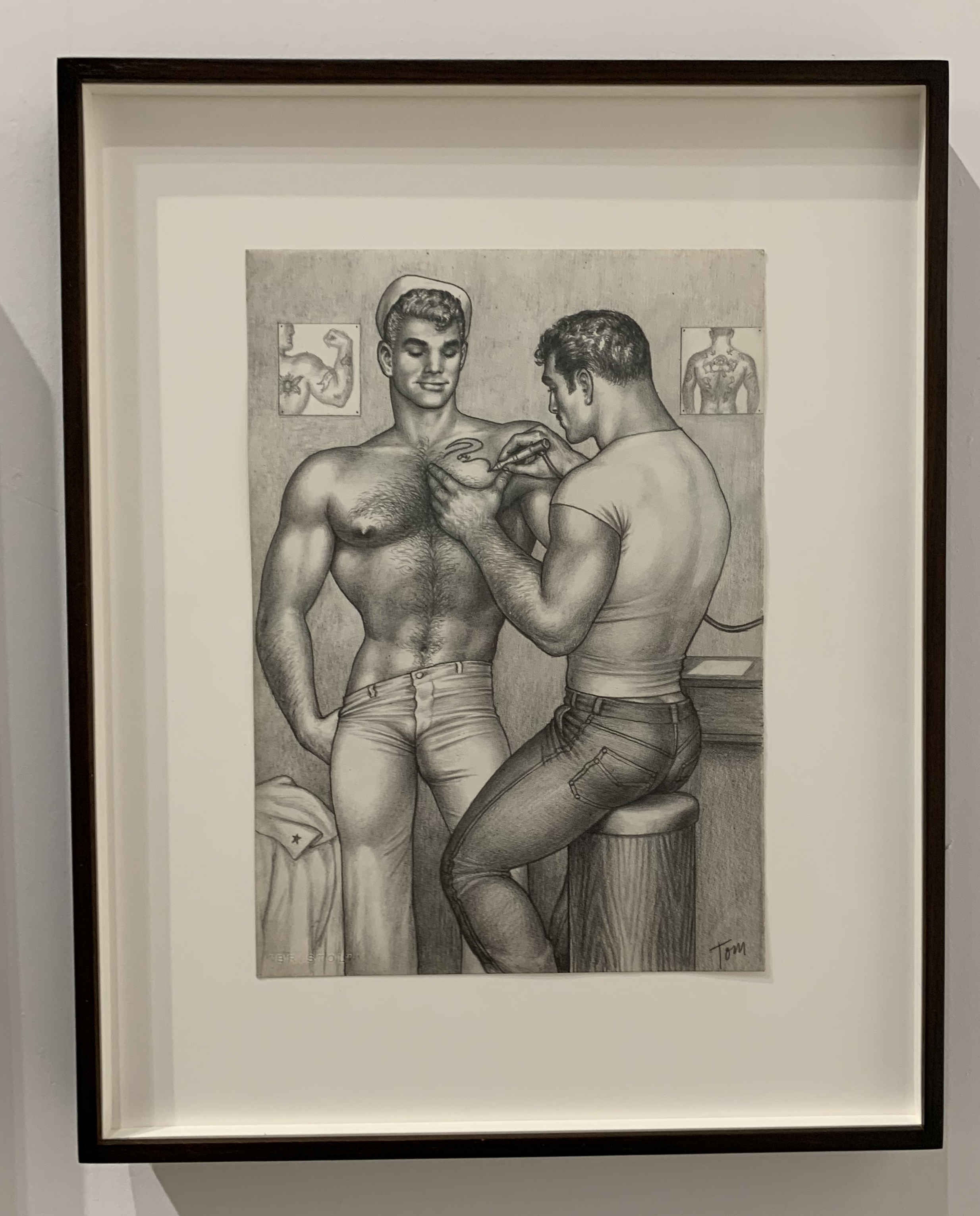
Tom’s works are more overtly and explicitly sexual. He took his name for the sake of anonymity, when by the late 1950s, he was an illustrator for US magazine Physique Pictorial, which portrayed muscled men in homoerotic activities that would just scrape past the censor.

Looking at his works of extremely muscled and well-hung hunks now, it’s easy to think of them as reflecting tropes of gay culture: the cowboy, the sailor, the leather man. All very Village People. But then that’s because Tom helped create such an incredibly influential aesthetic.

Like Cook, his figures are predominantly working class. The hyper-masculine nature of them was a direct challenge to the idea that gay men were effeminate. They are also clearly happy in their own bodies – and they’re having fun.

The styles of both artists are very different. But they’re instantly recognisable, beautifully executed and absolutely suit their subjects.

Of the works on display, there are several standouts. Cook’s 1976 painting The Lockyer Tavern (pictured at the top of this review), shows women drinking in a Plymouth gay pub – the artist was very much an ally – is iconic.

Personal Services
There’s also Personal Services from 1987, inspired by the life of famous madame and dominatrix, Cynthia Payne. It was used as a poster for the Terry Jones film about Payne, of the same title.

Ladies Night (Ivor Dickie) from 1981 portrays women surrounding a male pole dancer/stripper and laughing and straining to see as he pulls down his thong.

There’s also a display of some of the photos she took to help her work, which is illuminating.

Much of Tom’s work was graphite on paper – and untitled. I have selected three to include here, all of which showcase his skill and the points I’ve made above, but all of which are (just about!) ‘safe’ to see.

Studio Voltaire is a small exhibition space and this is a small exhibition. But that doesn’t mean it doesn’t offer an experience that breaks away from mainstream exhibitions to represent and celebrate communities and groups in a way that is really welcome and thoroughly life-affirming.

Ladies Night (Ivor Dickie)


Beryl Cook/Tom of Finland is at Studio Voltaire until 25 August.

It includes explicit artistic representations of gay sex.


Saturday, 20 July 2019

Haring exhibition shows what 'pop art' can be

Untitled (Apartheid) 1984
It’s not uncommon to visit an exhibition and find something that you didn’t expect. More rarely, though, is visiting an exhibition that goes way beyond the unexpected and offers something revelatory.

The Keith Haring exhibition, which opened last month at Tate Liverpool, is in the latter category.

Knowing I would be in Liverpool for a week for work, I’d done my usual and checked what was on art wise in the city.

There was an exhibition of Charles Rennie MacIntosh at the Walker (on until 26 August), but it’s a push to get the time, during a particularly intense working week, to get that ‘far’ from the conference centre.

Mickey Mouse eyes
However, the Haring exhibition was scheduled to have just opened at the Tate, which is only a short walk away from where I would be working, so it was a simple matter of remembering to pack my Tate membership card.

I was familiar with Haring’s simple figures – pop art’s answer to Lowry’s stick figures. In the 1980s, you couldn’t miss them – they were ubiquitous.

But context can make all the difference.

Here, we see works from the very beginning of Haring’s all-too-short career: the early Mickey Mouse cartoon eyes and examples of the drawings that Haring, with a deep belief in art being for everyone, executed on paper stuck up in New York Metro stations.

On a personal note – God, I remember drawing those eyes myself. Since, I’ve remembered how I drew and then drew again Mickey Mouse and more off the Disney icons.

But setting such personal memories aside, these are interesting enough and show his style evolving, but what really starts to resonate is later works.

Silence = Death
Haring rarely titled his works, so the only guideline to what he wanted to say is mostly on the surface he worked on – and his ‘canvases’ ranged from the yellow hood of a New York taxi to squares of tarpaulin.

While I knew that Haring had died of AIDS-related causes – and had, late in his life, campaigned around HIV/AIDS – I had not been aware that his political awareness had begun far earlier and went far beyond that.

Perhaps the best example of the HIV/AIDS works is 1989’s Silence = Death, a moving combination of the pink triangle and the idea of ‘hear no evil, see no evil, speak no evil’.

But in terms of wider political awareness, there are works here that specifically speak out against apartheid in South Africa, while others examine the links between money and war.

An A5 page of my studies from The Matrix
Even more fascinating – and complex – are Haring’s works exploring new technologies. Intrigued by the possibilities offered by growing computerisation, the artist was also aware that there could be downsides.

It’s been suggested that Haring’s line can be compared to Picasso’s, but in its effortless, it reminds me more of Matisse – and indeed, many of the later works have a decorative quality, created out of densely-packed glyphs, that is pure Matisse too.

And as glyphs, they also have a sense of continuing a form of human expression that is millennia old.

The vast (and unusually titled) The Matrix, from 1983, seems at first almost abstract: it needs attention to understand anything it, so densely is it packed with ideas.

A day after my visit I returned in a lunch break, complete with sketchbook and pens. Trying to replicate some of the figures is a great way to more fully appreciate the sureness of Haring’s line.

Untitled, 1983
But back to the complexity of technology. Could aliens save us – or slaughter us? Will technology enslave us? Will we end up fucking computers or being fucked by them?

Things here are not necessarily as obvious as they seem. The last works displayed are Boschian in their nightmare view.

Equally interesting are works such as No Sin ... run off on printers, yet interestingly designed and with an eye to mass communication of an idea. 


This is the first exhibition of Haring’s work in the UK.

It’s a revelatory experience: work that built upon pop culture and pop art – Haring might have been the successor to Warhol and Lichtenstein, but he was far more grounded in the community in which he lived and worked, and in political struggle, while he also believed in art for all.

Untitled, 1984 –  no doubt a Boschian hell, though
While I have seen little Warhol and only a small Lichtenstein exhibition (ironically, at Tate Liverpool a year or so ago), I would suggest that Haring was streets above both of them.

In his work, there are what now seem prophetic questions about the nature of technology.

While the last stage of his career was bound up with his own struggle with HIV/AIDS, there is no self-pity and no mawkishness anywhere, but a boisterous sense of joy that is present in every line he executed.

In his work, Haring often dealt with death and the means – or potential means of it. Yet ultimately, this is a life-affirming journey: his work bows to nobody and no god. It is out, it is not ashamed and it is most avowedly concerned with equality for all

It is on until November and is well worth a visit.

Keith Haring is on at Tate Liverpool until 10 November. Find out more here.