Thursday, 30 May 2024

Evenings and Weekends: A brilliant debut novel about queer life from Oisín McKenna

London; 2019. As a beached whale lies beside the Thames, a sweltering summer is leaving the city’s residents with a sense that something – whatever that is – is going to happen, and when it does, it will be as explosive as a thunderstorm.

For Maggie, it’s about being pregnant and broke, and facing the prospect of returning to the hometown just beyond the city that she had fought so hard to escape; this time, with her partner Ed, who has his own demons.

Then there’s Phil, Maggie’s best friend, who is struggling to make sense of his own life as a gay man. His brother Callum is about to be married, but there are problems on that front too.

Oisín McKenna’s debut novel, Evenings and Weekends, begins on a Friday afternoon as the weekend approaches. Apart from a short coda, it essentially concludes at the end of that weekend. But don’t let that give you the impression that the 352 pages are in any way slow.

It’s a beautifully paced exploration of characters who are by no means unflawed, but feel completely authentic, as they try to work their way through particularly intense periods of their lives.

The central characters are all from working-class backgrounds and McKenna is excellent at weaving this into other aspects of their experiences – particularly in terms of sexuality and gender, but with ethnicity featuring too, via a strong backstory.

McKenna is a spoken-word artist, and this comes through in the musicality and rhythm of the language in the book, which is not only very effective, but joyful.

A gritty work, it’s sexually explicit in places, but always empathic, while never pretending that every relationship doesn’t have its difficult elements.

It’s also a love letter to London – particularly the east of the city – almost a walking tour of the Hackney I live in, really capturing, in detail, many places I know, together with introducing me to ones I will now check out!

The book came out early this month, but it’s taken me a while to feel that I’ve processed my thoughts together coherently enough to review it. It made me think of Virginia Woolf’s Mrs Dalloway – particularly in terms of the timeframe of the story.

The book was recommended to me just before publication, by a friend who’s a friend of the author. I’ve been struggling with reading in recent months but am glad that I didn’t put off getting a copy. Indeed, I read it over three days – which in present circumstances, is a minor miracle.

Ultimately, I think that Oisín McKenna has given us a queer novel that it is not only brilliant, but links back to that iconic work by Woolf. The key difference here being its exploration of working as opposed to upper class, plus sexuality and gender, yet all within a similarly limited timeframe. And of course, the Bloomsbury Set, of which Woolf was a central figure, was sexually and gender diverse.

I cannot recommend this enough.

Saturday, 25 May 2024

Beryl Cook/Tom of Finland: a stimulating exhibition

It might seem a strange idea to stage an exhibition of works by both Beryl Cook (1926-2008) and Touko Laaksonen, who was better known as Tom of Finland (1920-1991), but that’s what Studio Voltaire in Clapham has done. And it works a treat.

It’s a concise selection, but carefully chosen and with curator’s notes that avoid the pretentious and actually provide good context.

Cook is famous for her paintings of voluptuous women, predominantly working class. They’re often skimpily attired and seen with very high heels, drinks and/or fags in hand. Importantly, there is no sign of them being ashamed of their bodies – and they have the temerity to be having fun.

Victoria Wood described Cook’s paintings as being “like Rubens with jokes”.

She was self-taught and, entirely predictably, like LS Lowry, the British art establishment was sniffy. Even when she died, obituaries referred to her saucy seaside postcard as ‘naïve’. But she was – and continues to be – incredibly popular, while some major galleries now display paintings by her.

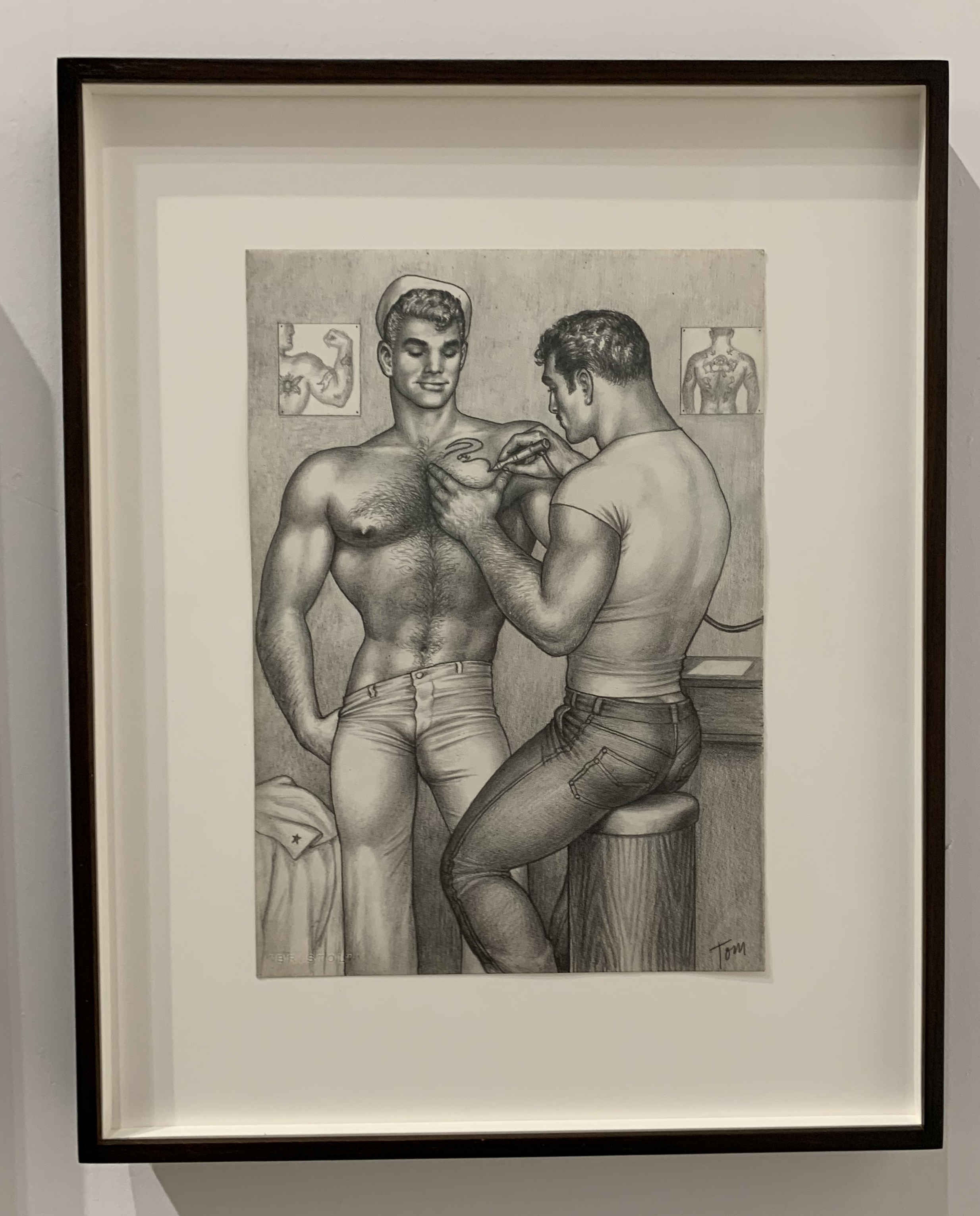
Tom’s works are more overtly and explicitly sexual. He took his name for the sake of anonymity, when by the late 1950s, he was an illustrator for US magazine Physique Pictorial, which portrayed muscled men in homoerotic activities that would just scrape past the censor.

Looking at his works of extremely muscled and well-hung hunks now, it’s easy to think of them as reflecting tropes of gay culture: the cowboy, the sailor, the leather man. All very Village People. But then that’s because Tom helped create such an incredibly influential aesthetic.

Like Cook, his figures are predominantly working class. The hyper-masculine nature of them was a direct challenge to the idea that gay men were effeminate. They are also clearly happy in their own bodies – and they’re having fun.

The styles of both artists are very different. But they’re instantly recognisable, beautifully executed and absolutely suit their subjects.

Of the works on display, there are several standouts. Cook’s 1976 painting The Lockyer Tavern (pictured at the top of this review), shows women drinking in a Plymouth gay pub – the artist was very much an ally – is iconic.

Personal Services
There’s also Personal Services from 1987, inspired by the life of famous madame and dominatrix, Cynthia Payne. It was used as a poster for the Terry Jones film about Payne, of the same title.

Ladies Night (Ivor Dickie) from 1981 portrays women surrounding a male pole dancer/stripper and laughing and straining to see as he pulls down his thong.

There’s also a display of some of the photos she took to help her work, which is illuminating.

Much of Tom’s work was graphite on paper – and untitled. I have selected three to include here, all of which showcase his skill and the points I’ve made above, but all of which are (just about!) ‘safe’ to see.

Studio Voltaire is a small exhibition space and this is a small exhibition. But that doesn’t mean it doesn’t offer an experience that breaks away from mainstream exhibitions to represent and celebrate communities and groups in a way that is really welcome and thoroughly life-affirming.

Ladies Night (Ivor Dickie)


Beryl Cook/Tom of Finland is at Studio Voltaire until 25 August.

It includes explicit artistic representations of gay sex.


Saturday, 18 May 2024

Love Lies Bleeding: A taut, sexy thriller

It’s 1989 in a small town in America: Louise ‘Lou’ Langston is the manager of a gym, where she spends an inordinate amount of time unblocking toilets and has a sideline in dealing steroids. But change is in the air when Jackie Cleaver hitches into town on her way to a bodybuilding contest in Las Vegas, and walks into the gym to keep up her training regime.

Lou is instantly smitten. After she rescues Jackie from a homophobic incident outside the gym, she takes her back to her own home. Since Jackie plans on staying until it’s almost time for the competition, she takes a job at a local gun range, not knowing that it’s owned by Lou’s father, Lou Langston Snr, who also runs a violent criminal enterprise.

Also employed at the range is JJ, the husband of Lou’s sister, Beth, who is violently abusive to his wife. After another violent episode, things get out of hand, with huge ramifications for Lou and Jackie.

Directed by Rose Glass from a screenplay that she co-wrote with Weronika Tofilska, Love Lies Bleeding taut, sexy thriller, with themes of domestic abuse, homophobia, misogyny and revenge.

It also riffs brilliantly on tropes of lesbian lives. Here, it’s Lou – while physically much smaller than the big and muscled Jackie – that’s the butch and Jackie the femme.

If all that were not enough to recommend it, Kristen Stewart turns in a superb performance of real subtlety as Lou.

Katy O’Brian – who’s also a martial artist – is very good as Jackie, her first major screen role.

The rest of the central cast is also very good: Ed Harris doing a fine job as the creepy Lou Snr; Anna Baryshnikov as a ditzy – but dangerous – lesbian who wants Lou for herself; Jena Malone as Beth and Dave Franco as JJ.

Ben Fordesman’s cinematography conveys a sense of brooding – and also one of the vastness that surrounds the characters, suggesting a lostness in the universe. Music by Clint Mansell also adds to the tension.

Having done some bodybuilding in my time – and having once been to watch a competition – the way the gym and contest scenes are handled is excellent.

The scenes at the gun range also provide a commentary on the relationship between Americans and their guns.

All in all, a really excellent film.

Saturday, 27 April 2024

Brilliant: Salman Rushdie on The Wizard of Oz

“There’s no place home; there’s no place like home.” It’s an iconic line – and sentiment – from The Wizard of Oz, and certainly from the classic 1939 film version. But what does it actually mean?

Back in 1992, the British Film Institute launched the first four in an ongoing series of slender volumes about specific films – BFI Film Classics. That initial quartet were Double IndemnityWent the Day WellStagecoach … and The Wizard of Oz.


The last of those was penned by Salman Rushdie, with an updated edition published in 2012.


Since starting a deep(er) dive into film than at any stage previously in my life, I have been getting some of these and reading them. Well … in the first case, trying to read. That was Michael Atkinson’s monograph on Blue Velvet, which I gave up on, not least because – in my opinion – it’s appallingly badly written.


The next one was by Dirk Bogarde biographer extraordinaire John Coldstream, on that star’s career-changing and social-challenging film Victim, which was eminently readable and informative.


And so to Rushdie’s contribution. Rolling in at 69 pages – without a few more including the full film credits, which all the books have – it is very, very good indeed and packed with philosophical insights in two sections. First, in an essay about the film and second, in a short story, which is effectively a very clever, and funny futuristic fantasy tale/satire about an auction for the ruby slippers. Both are centred on the concept of home.


If there is “no place like home”, what does that actually mean?


The essay starts with fascinating autobiographical insights, including some making links between the film and the cinema of India, where Rushdie grew up, and how it influenced him from early in his life.


He is detailed. He notes, for instance, a mention in the later stages of the film by the Wicked Witch of the West of “an insect” that she has sent on to take on our heroes. But there’s nothing else about that in the film.


As he points out, it relates to a cut musical number, The Jitter Bug. Bad editing! Though you can find grainy footage of said cut number here.


Now here I am going to go off piste a tad. I know that song.


I had loved The Wizard of Oz since being taken to the cinema to see a re-release of it as a child.


In the mid 1970s, at Fairfield High School for Girls, I played the Munchkin mayor in a school production.


Then, in late 1981, a couple of years after my family had moved to Lancaster, I was encouraged by Noel McKee, my wonderful music teacher at Lancaster Girls’ Grammar School, to audition for the annual Lancaster Footlights’ Christmas show – that year, to be The Wizard of Oz. So, with blesséd parental permission (it was the first time for a non-school production), I went along, prepared to audition for Gloria (she doesn’t appear in the film, but gets to sing Evening Star in the stage version – perfect for a mezzo like me).


I was 18, going on 19.


But something unexpected happened. While at packed auditions, I was asked if I’d read in the Wicked Witch of the West’s lines in an exchange with the Good Witch of the North, for auditions for the latter part. With no pressure on me – I wasn’t auditioning, after all – I thoroughly enjoyed doing full panto cackles and ‘witchy’ voice.


I landed the role (pictured left, centre) – without even trying for it! The Christmas production was always staged for a week, with the Saturday having a matinee as well as an evening production (often punctuated by dinner at Pizza Margherita on nearby Moor Lane). It was an utter joy.


I remember descending the steps from the stage to the stalls, in full costume and green face paint, with children backing up into their seats as I did so.


Weeks later, I was in Lancaster’s department store with my mother, when a young lad came up to and said, in awe: “You’re the witch!”. I played along, hissing back at him: “Tell nobody!” His mother, just behind, was at first embarrassed and then tickled pink. The power of theatre. The power of The Wizard of Oz.


So that’s my personal connection. Now, back to Rushdie’s own monograph.


He gets pissed off at the sentimentalised ending: why would Dorothy need to flee home only to be told, at the end, that the lesson is that she should never have wanted to. Is that really the only concept of home – that is limited to where you initially come from?


Contextually, bear in mind that, for Rushdie himself, this was written after the fatwa against the author for writing the Satanic Verses (published in 1988) was announced in early 1989 – effectively driving him away from ‘home’.


A number of things occurred to me.


First, Rushdie shows, in many ways, that The Wizard of Oz is a rebellion against simplistic ideas of ‘home’. Dorothy flees home to protect what is most important to her – Toto. It occurs to me, what happens to Toto when she returns? Is Miss Gulch still there to demand his death? If so, what are her values?


Rushdie points out that, in the series of books by Frank L Baum, Oz eventually becomes home – not just to Dorothy, but also to Aunt Em and Uncle Henry.


I did some checking: is this less a British/US understanding of ‘home’ and more a German one? ‘Heimat’ is one of those German words that holds within it layers of meaning. At its very simplest, it could be said to mean that home is ‘wherever you hang your hat’. Not ‘where you originate from geographically or in any other way’.

And then look at Baum’s name – and yes, he did have German heritage: ‘Baum’ is ‘tree’ in German.


To go further on the subject of home: given that ‘the friends of Dorothy’ is a euphemism for gay men, can we also, at this time, see that ‘home’ can refer to any community of which we choose/feel ourselves to be a part? Again, a sort of riff on heimat.


And finally, after re-watching the film, it struck me that the move from monochrome to colour is like a move from binary to non-binary. Indeed, the land of Oz is a vastly more diverse place than Kansas. Further, the Cowardly Lion is effeminate, though we learn that he is also not a coward.


Of the central four characters, Dorothy is the least camp, while many of the Munchkins are quite androgynous.


There are few books – let alone ones with so few pages – that can set readers thinking like this, but this is superb. And of course, it’s also superbly written.


Sunday, 14 April 2024

Evil Does Not Exist – or perhaps it does, in Hamaguchi's enigmatic eco-parable

Single father Takumi – we’re led to believe he’s a widower – lives with his eight-year-old daughter Hana in the peaceful village of Mizubiki, not far from Tokyo. Takumi is an odd-job man, who primarily acts as a woodcutter, and as the collector of water from a pristine stream for a local restaurant to cook its noodles in. He also spends time teaching Hana about the environment – how to identify trees, plants and animal tracks.

But his life – and those of the rest of his community – is suddenly disrupted when a Tokyo company plans to create a glamping site in the area, for Tokyoites to chill.


The company is racing against time to get construction started, so that it can claim a post-pandemic financial grant, and it sends two members of a talent agency that has branched out into PR to go and address a meeting in the village and smooth the way and be able to claim, in a totally perfunctory way, that it has undertaken a consultation.


But the villagers are not impressed. Top of their list of concerns is that the planned sceptic tank is not remotely adequate and will, given where it is to be sited, pollute the water for the village itself and for villages further downstream.


The two company apologists are taken aback both by the level of objection to the scheme and the sophistication of those objections, but essentially deflect the questions.


However, we learn that, while their direct bosses fit the bill of rapacious capitalism, they are both deeply discomfited by it – and their roles within it. But when they head back to Mizubiki, ostensibly to offer Takumi the job of caretaker at the glamping site, events take a series of unexpected turns.


Writer and director Ryusuke Hamaguchi has produced an absorbing, meditative film that both engages and, ultimately, confuses. The ending is an enigma squared and then squared again.


The lengthy opening has the camera looking upward toward the trees as it moves through a winter woodland. Yoshio Kitagawa’s cinematography is superb: wonderful, lingering shots of nature are beautiful and make clear what we are (ultimately) looking at, while Eiko Ishibashi's score adds to the sense of something haunting.


After this opening, the film focuses on Takumi’s work and routine. In many ways, this is reminiscent of the first part of Wim Wenders’s Perfect Days. There is something almost hypnotic about it.


It’s a slow film, but that is not bad, because it has meditative qualities. The cast is excellent. Hitoshi Omika as Takumi manages to combine gentle and dark. Ryo Nishikawa as Hana gives a remarkable performance.


Ryuji Kosaka as Takahashi and Ayaka Shibutani as Mayuzumi the corporate employees, are very good.


Hamaguchi does not provide easy solutions. But this is an eco-parable that will live long in the mind – whatever the ending means and however you personally interpret it.


Saturday, 6 April 2024

Just who is the Monster?

Saori Mugino is a widow, raising her young son Minato and working in a laundry in a small city in the Nagarno region of contemporary Japan. When the boy starts behaving oddly – and returns home from school one day with an injury – she grills him until he says that his new teacher, Mr Hori, had inflicted it.

Saori goes to the school, demanding action against the teacher, but only receives overly deferential apologies, particularly from the principal, who herself seems oddly distant.

But when Hori himself claims that Minato is bullying sensitive classmate Yori, she becomes ever more determined to get at the truth and the situation escalates.

Written by Yuji Sakamoto and directed by Hirokazu Kore-eda, the story is told three times. First from Saori’s perspective, then from Hori’s and finally, from that of the two boys.

It is subtle, affecting and very sensitive. Kore-eda himself has denied that it’s an example of the Rashomon effect – storytelling centred on the unreliability of witnesses – and certainly it’s more of a jigsaw than an enigma.

There are manifold themes here: respect, acceptance – not least of self-acceptance – bullying, grief and loss, the concept of rebirth in Japanese Buddhism, and the problems that can be caused by overly strict structures.

Kore-eda’s direction is excellent – not least of his child actors. He coaxes an extraordinary performance in particular from Soya Kurokawa as Minato, who won the best newcomer at Japan’s Blue Ribbon Awards, as well as from Hinata Hiiragi as Yori.

Sakura Ando as Saori, Eita Nagayama as Hori and Yuko Tanaka as the school principal also produce fine turns.

The film includes the last music for film written by legendary composer Ryuichi Sakamoto – delicate piano pieces that add to the poignant atmosphere.

Monster’s world premiere was at Cannes last year, where it competed in the Palme d’Or. It won the Queer Palm and the award for best screenplay. It’s not difficult to see why. It is a very special film.

Monday, 1 April 2024

Robot Dreams is a an absolute charm

Dog is a lonely hound living on his own in a third-floor New York apartment in the 1980s. In the evenings, he plays Pong on his own. But one night, flicking through channels on TV while eating his usual meal of microwaved macaroni cheese for one, he spots an ad for a build-your-own-robot as a friend, and immediately orders one.

When he’s completed the build – hilariously watched by pigeons on his windowsill – and worked out how to activate his new buddy, their life together begins as they set out to explore the city.

Robot is fascinated and thrilled by everything, and passes on that zest for life to Dog. The pair roller-skate in Central Park, dance together, watch The Wizard of Oz together and, after Robot learns not to squeeze Dog’s paw too tightly, hold hands.

But on a trip to Long Beach at the end of summer, the pair are separated after too much enthusiastic play in the water from Robot. Try as he might, Dog can’t help his friend and, when he returns the following day with tools and manuals to do so, he finds that the beach is now locked until 1 June the following year.

How they cope without each other and learn to live again is the core of the film.

Do Androids Dream of Electric Sheep? Who knows. But Robot certainly dreams – not of sheep, but of finding his way back to Dog; dreams that are worked and re-worked from his time-limited experience of life. One in particular is gorgeous – he finds himself in The Wizard of Oz, surrounded by tap-dancing flowers doing a routine straight out of Busby Berkeley, as New York shimmers in green – seen like the city of Oz – on the horizon.

Between the Oz references, the trope of the gay love of musicals – here, Oz (don’t forget ‘friends of Dorothy’) and the Berkeleyesque routine – plus the holding hands, it’s little wonder that there is online speculation that this is a subtle and tender gay love story.

To be clear, there’s no mention of the gender of either Dog or Robot, but female characters in this anthropomorphic New York are pretty easy to spot. And the beach scenes clearly show Dog is male – watch out for a very funny swimming costume change gag.

Robot Dreams is Pablo Berger’s first animated feature and is based on Sara Varon’s comic of the same name. Entirely hand-drawn in 2D style, it has won plenty of plaudits – and rightly so. It’s a sweet, charming story, which depends on the visual, as there is no dialogue. It also references Isaac Asimov’s collection of short stories – and specific short story – of the same name. There’s a lot going on here. It’s not remotely a ‘kid’s movie’.

Don’t be misled by the animation being ‘old-fashioned’. It is fabulously done and gorgeous to watch – 1980s New York itself has been so lovingly created, while the cast of thousands has been given such wonderful attention to detail. There are couple of scenes where Dog is on a scooter with another character, riding into the countryside, where the trees coming over the horizon is simply stunningly done.

And while the comedy is gentle rather than LOLZ, it is certainly there. There’s a lovely scene about photo booths that will take those of us of a certain vintage back!

The ending is perhaps not what you’d expect, but shows a nice sophistication. The ’80s soundtrack is great.

Robot Dreams is a gentle, charming, really well-paced joy. My only personal surprise (disappointment?) as I came out of the cinema was that so many reviews have said: ‘Bring tissues – you will cry as well as laugh’, yet I didn’t.

Given how easily I blub at films (though I hate it when I feel my tear ducts are being deliberately tweaked), I walked home wondering if the absence of even a pricking meant it was not quite of the calibre so many have stated. Writing this, thinking back over the film itself, I have realised that it not bringing forth an instant deluge does not mean it’s not very good indeed.

I took lots of tissues to The Zone of Interest, expecting to find that would set me off, but it didn’t, yet it is one of the best (and most important) films I’ve seen thus far this year.

Robot Dreams is a wonderful film that I suspect is going to stay in my mind for a long time. And of course it’s gay!