Showing posts with label Lib-Dems. Show all posts

Tuesday, 14 October 2014

Adding to the UK’s democratic deficit

Douglas Carswell: the first MP from outside the 'Big 3'
What might politely be referred top as the UKIP ‘issue’ has been discussed on this blog before, but after last week’s momentous event, it demands attention once more.

Douglas Carswell was elected as Conservative MP for Clacton in 2010. This August just gone, he defected to UKIP, sparking a by-election, in which he was last week duly returned to Parliament – as a UKIP MP for the constituency of Clacton.

Most importantly, this made him the party’s first MP – such a staggering event that, in the days since, UKIP leader Nigel Farage has been invited to participate in next spring’s pre-election debates between the leaders of the main parties, the Conservatives, Labour and the Lib-Dems.

And all because no other party has ever achieved anything like this: no other party has ever broken through that established trio to gain even a single, solitary seat in the House of Commons.

UKIP’s win last week changes the make-up of the House of Commons out of all recognition, as revealed by this up-to-date (and obviously very brief) list with four entries in it:

Party                              MPs
Conservative                         303
Labour                                  257
Liberal Democrat                    56
Democratic Unionist                8
Scottish National                    6
Sinn Féin                               5
Independent                          3
Plaid Cymru                            3
SDLP                                    3
Alliance                                 1
Green                                   1
Respect                                1
Speaker                                1
UKIP                                     1
Vacant                                  1
Total number of seats            650

The DUP's Ian Paisley Jnr – MP
It’s hard to work out what all the excitement is about. Or, more to the point, if UKIP has produced such a revolutionary result that it deserves its place in pre-election debates, then what about other parties that also have one MP or more?

In the media Establishment’s excitement, it is blatantly favouring one ‘alternative’ party over any and all others.

There is absolutely no logical reason why UKIP should be included in pre-election debates, over and above any other party. If UKIP gets on to the debates, so should all the others.

Anything else has nothing to do with democracy and everything to do with a media Establishment that is delighted to promote one particular party and its ideology.

Once again, we see that the bulk of the mainstream UK media is not remotely interested in being part of what could be considered an honourable Fourth Estate, but simply in pushing the personal ideologies of proprietors and editors.

Sinn Féin's Michelle Gildernew – MP
Some observers are particularly upset with the BBC’s attitude in all this, harking back to some time that never existed.

The BBC may be wonderful in many, many ways, but on politics, it has always been a supporter of the status quo, from the General Strike of 1926 on, when director general Lord Reith made it clear that his idea of ‘impartiality’ in terms of newscoverage by the new broadcaster would not ‘offend’ the Establishment.

If we were really talking about the will of the people – and as discussed previously, the rise of UKIP is reflective of one reaction to a widespread disenchantment with mainstream politics in the UK – then based on the change-everything criteria of UKIP having won a single Parliamentary seat, all alternative voices should be heard.

But of course UKIP has councillors and MEPs too.

Yes: and so do other parties in that list.

The Green Party's Caroline Lucas – MP
If ever you wanted an illustration of the bias in much of the UK’s mainstream media, and of the agenda of its owners, then look no further.

The manner in which it has promoted UKIP – and ignored other alternative parties – would make Reiths version of impartiality look like the real deal.

And good luck to the Green Party, which is considering taking legal action – if it can raise the funds – to challenge this blatant bias.


Perhaps the other parties being disenfranchised in terms of TV election coverage could join them in that endeavor. Now that might be some sort of victory for British democracy.

change.org petition to include the Green Party in any such widened debate (you can add a note that all parties should be included)

Wednesday, 30 April 2014

Kipper baiting still leaves the mainstream in a fishy state

Taking the proverbial is not difficult
Nobody should be surprised at the likelihood of a substantial vote for UKIP in the forthcoming local and European elections.

And although it’s come close to being a national sport for people and media from across the political spectrum, it seems facile to invest too much time in pointing out the more ludicrous comments and opinions that have come from ’Kippers, as supporters themselves have become known.

They have loons in their midst, but they aren’t going to poll more than a handful of votes because everyone who votes for them believes that Lenny Henry should ‘go to a black country’ or because they want to ‘hate those dastardly gays just like you can hate a cup of Earl Grey’.

The rise of UKIP – just like the rise of assorted unsavoury parties across the continent – is symptomatic of a general disillusion with mainstream politics, further revealed in the UK by increased use of ‘ConLibLab’ to describe those parties.

What that reveals is a belief that there’s so little distance between the three main parties that you could barely slip a cigarette paper between them.

In other words, there’s little meaningful choice.

And so we have a party that claims to speak straightforwardly, and promises to lift up Britain once more by stopping (most) immigration and hauling the country out of the European Union.

The main reasons for the UKIP leadership wanting us out of the EU don’t really matter to those for whom all this country’s real or perceived ills are down to Brussels.

However, the UKIP leadership wants to be able to reduce – or cut altogether – employment rights, from paid annual leave to sick pay to maternity leave.

It’s debatable whether they really do think that these are what is holding the country back or whether those of them who are employers simply want to be able to reduce their own labour costs.

Such an approach, together with a commitment to reducing the state still further, is entirely reminiscent of free-market fundamentalists in the US and indeed, a great deal of the language to be found on forums in the UK is borrowed from them.

But on UKIP’s part, it hardly seems ‘patriotic’ to want to butcher the rights of the same British workers that they like to pretend they’re on the side of, does it?

The EU as a political entity is fraught with problem – not least legislation that, in effect, enshrines neo-liberalism, irrespective of the democratic wishes of individual electorates.

But then it’s not neo-liberalism that offends UKIP – the party’s leadership wants to plunge ever further down the marketisation path, to scrap vastly more public services than current Chancellor George Osborne, and sack as many public service workers as possible.

But such pesky facts are not getting a very wide outing – and there’s a reason for that. They’re not necessarily obvious vote winners, while there’s a fair few other politicians in the mainstream parties, and more than one media proprietor, who would be in almost total agreement.

How have we reached this state?

The spin – and the perception of spin – from all the mainstream parties has been contributory, as has a perception that none of those same parties really cares about Joe and Joanne Public.

Election at Eatanswill (Pickwick), 1836, Phiz
A generation and a half has seen both Conservative and Labour parties change from what the majority of their followers – certainly the older ones – would consider those parties to be.

The Lib Dems earned themselves an increase in votes at the 2010 general election, primarily because people saw, in their commitment to electoral reform, a possible way to give a kick in the pants the system, but they had counted without the fact that Nick Clegg and many of his MPs proved to be interested only in an illusion of power.

The Conservative Party has become the out-and-out supporter of marketisation and big business: that is now its prime constituency, other than on election days.

Look back at it’s actions in office over the last four years and you will see this borne out time and again, from the privatisation of the NHS to the so-called lobbying bill, which has been used not to do what was intended, but instead to gag a whole range of groups from commenting on politics in the run-up to the 2015 general election.

Having, in opposition, rightly opposed assorted attacks on civil liberties and privacy, one talk from GCHQ has convinced it to champion mass invasions into private communications, while also using the porn panic to introduce censorship by the back door.

Labour, on the other hand, seems like the proverbial headless chicken.

Its leadership seems unaware that there is any alternative to neo-liberal marketisation, however much it might make a few noises about the problems of a low-wage economy.


Indeed, it seems to be as wedded to such approaches as the Conservatives, but with just an iota of embarrassment at such a betrayal of the party’s own history and its traditional followers and a belief that a tiny bit of tinkering around the edges will ease any problems.

The steady drip drip of stories about the venality and greed and absolute lack of ethics on the part of politicians has also had an unsurprising impact on public trust, who generally seem to harbour the illusion that it was not always thus.

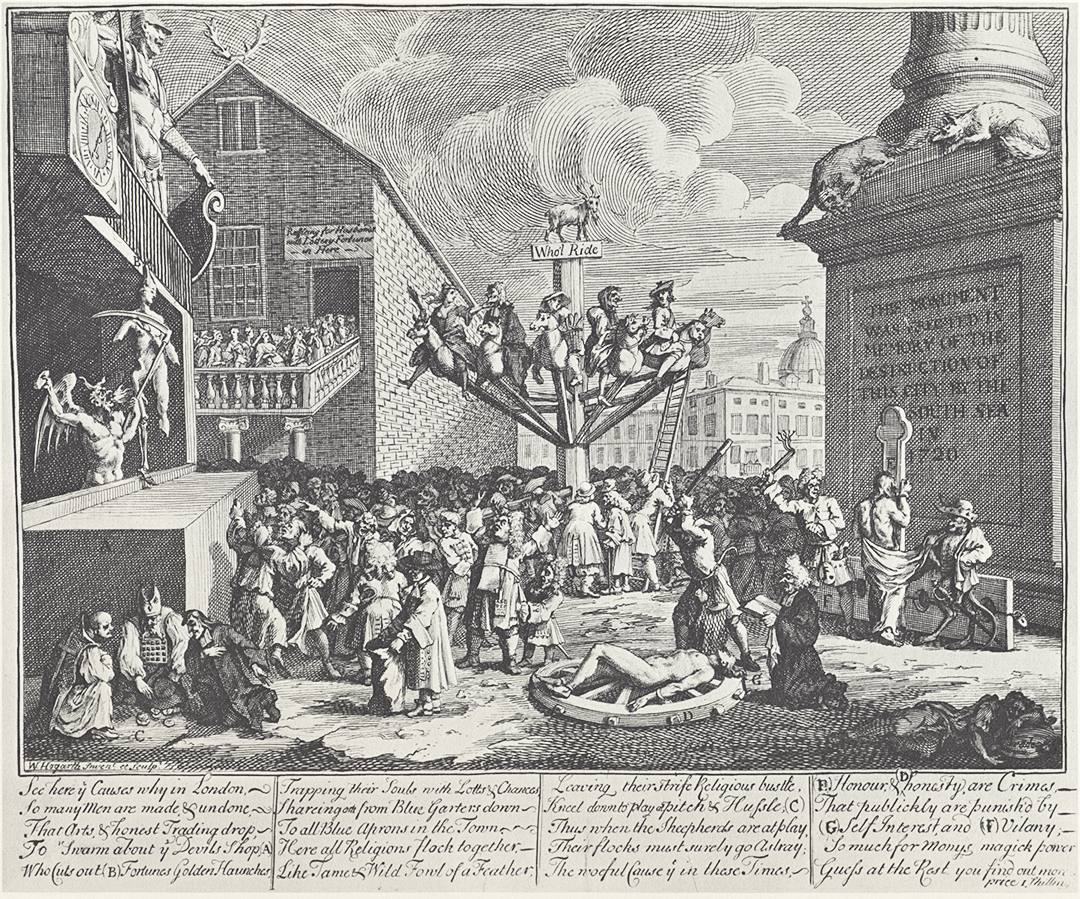
Take a look at Hogarth and read Dickens’s Pickwick Papers if you believe that politicians behaving badly is new.

The South Sea Scheme (c1721), Hogarth's 'casino economy'
But it’s all well and good condemning any or all the above, if people themselves do not get involved and take responsibility.

The minimum that can be done is to use your vote – preferably after paying at least a few minutes examining what all the candidates you can vote for are promising and/or claiming to have done.

It takes perhaps a little more effort not simply to believe everything that you read in your newspaper of choice, but to look beyond a simplistic headline and story that confirms any personal opinions, and explore an issue in different media.

It takes yet greater effort to get involved in local politics – which doesn’t mean any of those mainstream political parties or even any smaller parties, but can involve community groups, for instance, or local campaigns.

It’s simple: an investment of time is required to educate ourselves and be involved politically – the things that offer us the possibility of having an influence and even of changing something.

But when the electorate becomes disenchanted to the extent that few even bother to vote outside general elections – although millions spend the money to vote for a contestant on Britain’s Got Strictly X Factor Talent – then perhaps the point that needs to be made is that we get the politicians that we deserve.


It’s easy to simply accuse those saying they’ll vote for UKIP of racism for worrying about immigration.

Far easier, indeed, than it is to try to get across the real reasons why, among other things, incomes for the majority have been declining for 30-plus years, the cost of housing has increased to such an extent, job security has disappeared and nothing comparable has replaced all the decently-paid, skilled manual jobs that formed a major strand of the national economy until de-industrialisation was commenced for ideological reasons in the 1980s – let alone to attempt to posit real alternatives.

And viewed from that perspective, taking the piss out of UKIP smacks of political onanism rather than a meaningful consideration of what has allowed that party to grow and how the situation can be changed.