Showing posts with label Vincent van Gogh. Show all posts

Wednesday, 15 October 2014

Would you trust G4S with a van Gogh?

Who wants to trust G4S with this?
It’s amazing what constitutes ‘public services’. We might be used to thinking in terms of the likes of emptying the bins and education and health care, but many more things that we take for granted come under that label too.

And many of them are increasingly under threat.

But amid the ongoing, ideological rush to sell off anything and everything – even at a cut price, as the Royal Mail debacle showed – it’s easy to forget that our culture is a public service, and it’s also under threat.

Libraries have been facing cuts for years, with politicians revealing an utter lack of understanding about the service by suggesting that volunteers could run them.

When I was doing my ’O and ’A levels at girls grammar schools in the 1970s and into the ’80s, becoming a librarian was something that was considered a good career, requiring a proper degree.

When did that morph into, ‘oh, some local volunteer can do it’?

Now that’s not an attack on volunteers, but it begs – or should beg – the question of when and how running a library ceased to need the level of education, training and skills that it did previously.

Is the writing on the wall for quality of visitor experience?
Inevitably, such an approach doesn’t simply deskill, but in doing so, it reduces the actual service. And that illustrates how little the service is understood and valued in the first place.

Now, it seems, plans are well under way to privatise visitor services – including security – at London’s National Gallery.

The gallery – just one of many such institutions that helps draw millions of tourists to the capital every year – points out that funding from government is falling, and that it needs to increase retail and commercial activities, including opening for some groups outside normal hours.

Even accepting all that, it’s difficult to see how privatisation will help – all it does is involve a private company that needs to make a profit. And one of the first things to happen when that’s the case is that wages are hit.

Claims that terms and conditions will be protected are meaningless, as has been illustrated in Doncaster, where venture capital company-owned Care UK made the right noises before taking over a contract for the care of vulnerable people with learning disabilities – and then, when the ink was barely dry on the contract, decided to slash the pay of the people who do the actual work of caring, start employing any new staff on minimum wage and deskill the workforce by, among other things, ordering staff to stop dealing with medical or violent situations and call 999 instead.

In other words, the profit is privatised and the debt socialised.

Should gallery staff know about the exhibits?
And then, of course, there’s the issue of slashed pay leading to more people needing in-work benefits – so the taxpayer is forking out to subsidise the profits of the private company.

The deskilling of the Doncaster workforce will be replicated at the National Gallery, as the Ministry of Curiosity blog, an “insider’s guide to London’s museum-centric life” explains that a lower-paid workforce will mean, “for the gallery and public, a transient workforce with less knowledge and expertise”.

The blog also makes a very interesting link between the recent decision to allowphotography in the gallery and the plans for privatisation.


The nation's favourite painting – left to the nation by Turner
The idea of putting security for some of the world’s greatest art treasures in the hands of the likes of G4S should be enough to horrify any sentient being.

What could possibly go wrong?

After all, the likes of G4S, Serco and others have great form on all manner of things, from security itself, to proving incapable of organising a piss-up in a brewery (or the 2012 Olympics, as they were known), to overcharging and false charging for services provided (or not).

But in this case, the atmosphere has been sullied further by union reps being hit witha gagging clause by the gallery – even though named reps were quoted in the press during disputes at the gallery in 2010 and 2012, with no apparent problem.

Of course, this isn’t the only bit of the “family silver” that is being primed for sell-off – the country’s entire road network couldbe threatened too.

And the National Gallery it’s far from being an isolated case of how our culture is being dumbed-down, devalued and sold off.

In Manchester, for example, funding has been cut to the People’s History Museum – the only museum in the country dedicated to the history of ordinary, working people.
Profit fodder?

On a more general basis, moving further and further toward a low-wage economy is neither good nor sustainable for the economy, as shown by recent figures from the Office for Budget Responsibility, which revealed that, in spite of record levels of employment, tax revenues are down, and theneed for in-work benefits (including housing benefit) is up.

There may come a point when museums and galleries have to look at charging for entry – again.

But our history and our culture should not be seen as commodities, existing for the financial of the few, but unavailable to the many.

Plans to privatise huge numbers of jobs at the National Gallery are, at best, short sighted.

At their worst, its yet more evidence of an ideologically-based knowledge of the price of everything – and the value of nothing.

• 38 Degrees currently has two petitions running related to this topic:


Friday, 31 January 2014

A school of art you won't have heard of – and some artists you might have


The Red Baron, Barry Blend (2005)
Sometimes, little mysteries solve themselves when you’re least expecting it.

Last summer, when I interviewed artist Barry Blend in Collioure, he said of his own work: “There is a word for it actually; they have a word for it in French ... but I’ve forgotten it.”

Well, I thought about it, but didn’t get very far in trying to find that word.

And then, in October, while watching an online BBC video report of an exhibition of van Gogh’s Paris periodI came across a school that I hadn’t heard of before: cloisonnism.

It’s easy enough to have missed. Neither the Oxford Companion to Art nor Art: The definitive guide from Dorling Kindersley make mention of it in their indexes.

A piece of cloisonné jewellery
So a certain amount of internet trawling was required.

The information fished up revealed that it’s generally described as a style of Expressionism that uses blocks of bold and largely flat colours that are divided by dark contours – an echo of the jewellery technique of cloisonné, where wires are soldered into place to make a design, the spaces are filled with powdered glass (vitreous enamel) and then the whole is fired.

The term was coined by critic Édouard Dujardin in 1888, during the Salon des Indépendents, and it remains associated with the likes of Gauguin – The Yellow Christ (1889) seems to be regarded as an iconic example.

Many of the painters who used the style described their works as Synthetism.

And most sources also seem to suggest that the school was pretty much finished by about 1903.

But there are plenty of later works that suggest that it didn’t die out at all.

Picasso’s Pitcher and Bowl of Fruit (1931, oil on canvas) very much fits the definition – and who is anyone to argue with Pablo?

Yellow Christ, Gauguin
There are all sorts of cross-overs too: it’s easy, for instance, to see why Roy Lichtenstein might be included in a discussion of cloisonnism – which as much as anything, illustrates how open a term ‘pop art’ is and, indeed, how many art styles overlap with others.

There are plenty of recent works that fit the core description.

Anita Klein’s Willow (2010, silkscreen with woodblock) is one example.

Julian Opie’s Imagine You Are Driving (fast)
Olivier/helmet (Lambda print on photographic paper) is another – as are, of course, his own iconic Blur portraits, and Opie has also created quite different and equally modern works that absolutely scream of being cloisonnism by the simple fact of being stained glass.

Of these two, one could say that the Klein seems to hark back to Gauguin – if from a different period in his career – while Opie’s work looks much more like Lichtenstein.

Pitcher and Fruit, Picasso
But we don’t have to stick with the straightforwardly figurative. Take a look at Richard Woods’s woodcut, Remnant No1 (around the fireplace) from 2013. 

This is all rather intriguing on a personal level: I’ve long thought – felt, would probably be more accurate – that I didn’t ‘do’ colour.

I struggled in art at school whenever anything other than drawing was required.

In my memory, I only ‘discovered’ colour when I first saw some van Gogh in the National Gallery when I was about 19.

But it’s equally the case that I always liked cloisonné and other forms of enamel jewellery, not least because of the sheer vividness of colour.

Willow, Anita Klein
However, that’s a slight diversion.

Let’s go back to the original context of this article. It’s clear that Barry Blend’s work most definitely fits the core description of cloisonnism.

His work also fits other labels too – see my comments above about the flexibility of many schools, while I’ve noted previously that pop art, cartoon and stained glass could all be terms that would be applicable to his work.

When in Collioure last August, I gave into temptation (not difficult) and bought another one of Barry’s paintings. The Other Half, knowing my Prussophilia, was understanding.

The Red Baron touched down safely in Hackney, just down the road from Barry’s childhood home in Clapton, in September and now hangs above my workspace, where I spend a fair old amount of time just looking at and enjoying it.

Barry has a fascination for aircraft and, indeed, has also painted a larger version of the same subject, which he currently keeps in his own home.

Imagine You Are Driving (fast) Olivier/helmet, Julian Opie
But like his other paintings, the brushwork is just one fascinating aspect of his work.

Something else also struck me during the autumn.

Reading Hilary Spurling’s really excellent Matisse the Life, she makes the following observation:

“Discussing luminosity long afterwards with his son-in-law, he [Matisse] said that a picture should have the power to generate light.”

Remnant No1 (around the fireplace), Richard Woods
Of The Conversation (1908-12), Matisse’s Russian champion, “Shchukin, who first saw the painting at Issy in July, wrote that it glowed in his memory like a Byzantine enamel”.

Enamel, cloisonnism and light. There are more than a few links here.

Barry’s paintings have the same quality: they add light to a room.

September’s interview revealed Barry’s connections to a Collioure past that has now gone, linking his work with many artists who have gone before – although I’ll maintain that, if you look at other representations of the village by artists operating now, there’s nothing else remotely like his work.

But if Barry’s work has links with the past, it doesn’t dwell in the past: he creates new, vibrant images that draw on many schools, but are entirely of themselves and of him and how he sees and remembers.

Whaam! Roy Lichtenstein
And nobody should ever be suckered by their apparent simplicity. Personally, I never cease to get enormous pleasure from looking at them.

They’re far more sophisticated than one might initially think, but then that is half the reason why they’re so good.

So there we have it: a little mystery solved and, in the solving of it, a lovely array of new knowledge opened up about a school that I imagine few of us had ever heard of before.

Monday, 28 October 2013

Finally 'getting' the modern


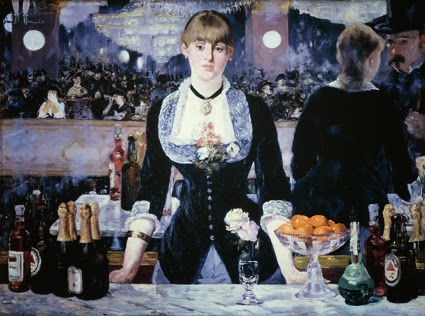
Bar at the Folies-Bergere, Manet
At the end of a production period, when you’ve safely tucked up the publication in bed, a little relaxation is always in order.

And what could be better than the opportunity to gaze at some top-notch art for an hour or so?

That was the situation by mid-afternoon on Friday and, with dinner at Joe Allen and theatre to follow, I had a nice little gap in my calendar.

And given that I’d later be heading to the Aldwych/Strand, the best possible solution presented itself in a first ever visit to the Courtauld Gallery.

Based in the part of Somerset House that was originally designed for the Royal Academy, which itself was founded 1768, it houses the art collection of the Courtauld Institute of Art, a self-governing college of the University of London that was founded in 1932.

Autumn Effect at Argenteuil, Monet
It has a small, but renownedly fine collection and, for some reason or other, I’d never visited.

First up was the medieval room, which was devoid of any other human life when I entered, and fabulously quiet.

But just as a started gazing in wonder into a cabinet of remarkable carvings, the door was shoved open and in burst a group of Russian tourists, cameras and phones ready to snap anything and everything – and woe betide anyone who was in their way.

Bang went my chance of seeing anything properly, as I was shoved out of the way from two sides (there was at least one brief apology), by phone-toting visitors determined simply to snap, snap and snap again. They were not, I hasten to add, youngsters.

Adam and Eve, Cranach the Elder
I retired quickly to the first of the upstairs galleries, only to find them catch up with me almost instantly.

Again, the same pattern.

Having spent a few minutes looking at Peter Bruegel the Elder’s Landscape with the Flight into Egypt (1563), which I realised that I remembered from school, I approached Lucas Cranach the Elder’s Adam and Eve (1526), only for a group to surround it with no interest in anything other than having a picture taken beside it, making funny signs with hands near Adam’s groin.

Quickly on then, through the rooms with the Gainsbroughs and the Rubens, into the smaller, square Cézanne Room, where I plonked myself firmly on the square bench in the middle and stayed put to wait them out.

Art’s for everyone, and all that – and I’d love more people to see stuff like this and enjoy it, but what the hell is the point of visiting a gallery or museum and behaving like this?

Montagne Sainte-Victoire, Cézanne
What do you get from it – and it had better be pretty damned special if you’re going to make such a negative impact on other visitors.

While doing that ‘waiting out’, I set myself to concentrate on the painter’s Montagne Sainte-Victoire from around 1887, sketching a very rough outline of it with a pen on the lined page of a notebook in an effort to better understand the composition. Which actually does work.

The gallery’s Cézanne collection alone is worth the (£6) admission, and covers a wide period in his productive life, up to a very late landscape, Route Tournante, from 1904, which looks unfinished as well as quite abstract, and also includes the wonderful Man with a Pipe from 1896.

Nevermore, Gauguin
Looking at these, I found it much easier to start to understand the difference between Impressionism and post-Impressionism: it starts to make sense.

There was no shortage of treats in just three rooms, including some Renoir and Degas, with Monet’s beautiful Autumn Effect at Argenteuil (1873), plus Manet’s vivid explosion of colour, Banks of the Seine at Argenteuil (1874) and the iconic A Bar at the Folies-Bergere (1881-82) being stand outs, along with a sculpture by Rodin, van Gogh’s disturbing Self Portrait with a Bandaged Ear (1889) and the lovely Peach Trees in Blossom from the same year.

Self-portrait with a Bandaged Ear, van Gogh
But for me, one of the most important ‘new’ experiences was seeing two of Gauguin’s Tahitian paintings in the ‘flesh’. The colour palate really reminded me of Survage’s Collioure pictures, and they also have a sense of mystery about them that adds to the fascination.

I don’t know why – now – but I’d long assumed that they were quite exploitative, but when you see them, you also see the dignity of the women in them. I was wrong on that score, most defininately.

There’s also a realism combined with a decorative element that makes a particularly interesting contrast with The Haystacks, which the artist painted in Brittany in 1889, which has a palate that seems closer to van Gogh than what we perhaps most obviously think of Gauguin.

Upstairs, though, came an unexpected treat.

As I walked into a room of 20th century art and turned back to look what was hung on the left of the door, it was to see André Derain’s Fishermen at Collioure, painted in 1905, in that summer that, in effect, saw the beginning of Fauvism.

The Red Beach, Matisse
And on the other side of the same door, The Red Beach by Matisse, also from 1905, and quite recognisably of Port D’Avall.

After all the hunting for work in London by Matisse, finally here was not just ‘any old work’, but something that I could comprehend and appreciate on a specific and quite personal level.

I was thrilled almost to the point of tears – and telling innocent bystanders: Ive sat on that beach, I ave.

Other exhibits that made an impact also include some Kandinsky, some Kirchner and a room of Walter Sickert (a revelation) and Modigliani’s rather wonderful Female Nude Sitting from 1916.

Slowly I seem to ‘get’ modern art. Or actually, not so much slowly, but all in a relatively short burst, after having spent decades – including my time studying art formally at school – not doing so.

It’s really rather enjoyable.

Sunday, 29 September 2013

The shock of the modern


Wheatfield and Cypresses; van Gogh
Art is addictive. After nine months in which I’ve probably visited more galleries and exhibitions than in any comparable period in my life, I now want the occasional dose.

On Friday evening, with three and a half hours between the end of my working day and the beginning of the play I had a ticket for that evening, I headed down to the National Gallery in Trafalgar Square for a top up.

It’s huge gallery; so labyrinthine that a map is vital. The first time I visited was right at the beginning of the 1980s.

I was studying for an art ‘A’ level at the time, and I made a point of going to see Jan van Eyck’s Arnolfini Portrait, which had already become my favourite painting after studying it in class. Painted in 1434, the detail staggered me, together with the ‘joke’ of the artist reflecting himself in the mirror on the wall behind the couple.

It wasn’t that I only liked old pictures – I loved the sheer photographic gloss and perfection of photorealisim and hyperrealism – so for me, that picture was a 15th-century example of something as close to that as it was possible to be.

Sunflowers; van Gogh
Amazingly, there were so few visitors that day that I could actually get really close to it – close enough to marvel at the detail.

But elsewhere, there was a revelatory moment lying in wait. The Impressionists at their most chocolate boxy were always going to delight me, but what really took my breath away was van Gogh’s Sunflowers from 1888.

I didn’t like modern art. I simply couldn’t see – couldn’t ‘get’ – anything that was beyond the clearly and obviously figurative.

It’s probably hardly surprising then, that while I could draw impeccably, I had the devil’s own job of being able to take a drawing an develop it beyond the obvious and photographic.

And I’d thought little of the likes of van Gogh. But that day, I suddenly got a least a little bit of the sense of the texture and the colour.

I’ve loved the artist’s work since.

A few years ago, I did an Open University humanities foundation course. One of the sections concerned art, and included a documentary about a Jackson Pollock painting.

Girl on a Divan; Morisot
It used computers to strip away each layer of pain, illustrating that there was a balance to the work – that it wasn’t just random drizzles, and that each layer added something without which the final piece would not work.

It was a step forward in ‘getting’ modern art – at least the non-figurative variety.

Then, this summer, something struck me.

Memory had long suggested that we didn’t really study any modern art at school. But memory had been playing tricks.

Because I started to recall that, however such it was that I had forgotten that part of the course, the reality was that I had studied the Fauves – which presumably means Matisse. I remembered suddenly that I knew the word and had known it for decades, because and I had first heard it at school.

How extraordinary the human mind is.

I’m currently reading Matisse: The Life by Hilary Spurling – not least because that, when he gained the burst of energy or inspiration that, in effect, led to the creation of Fauvism, he was in Collioure.

Bathers at Asinères; Seurat
Looking at reproductions of some of the paintings – in particular, at Open Window, Collioure from 1905, and it was with a dawning of what he had been doing. Because now I saw the light and recognised it.

And then I started to see colour as I hadn’t before – to look at it for its own sake, if you will.

Maybe that’s the key: Like Matisse himself, in a way, I needed the revelation of the south.

Anyway, with the time to spend on Friday evening, I headed to the gallery, armed with the knowledge, gained from a search of the website, that it has one Matisse – Portrait of Greta Moll, which was painted in 1908.

However, in my enthusiasm, I’d missed the little link for ‘key facts’, which also revealed that it is “not on display”, and therefore spent some time trailing from room to room, double checking whether I’d somehow missed it.

Still Life with Mangoes; Gauguin
However, it was never intended as a visit for just a single picture, but one in which to return to the most modern works on display.

Speeding past the Canalettos and the Hogarths, I found myself in a large room with the Turners – something else I’d not given much consideration to in the past.

This time, I stopped and looked. And started to wonder why on Earth I’d always preferred Constable. You can see why the likes of Matisse felt they owned something to the former: they don’t appear to have found anything from the latter.

And then the Monets and the Manets. I’d had a substantial (if brief) dose of Manet at Easter, so appreciated them differently, and there was also a Berthe Morisot, Girl on a Divan, from 1885.

Hillside in Provence; Cézanne
Seurat’s Bathers at Asnières, dated 1884, is one of the gallery’s most famous canvases.

It wasn’t actually a pointillist painting, since the artist hadn’t created that style when he painted this, but he did incorporate some dots into the picture.

I’d seen it previously, but never realised just what a luminous quality it has.

Paul Gauguin’s Still Life with Mangoes from 1891-96 was seemed to radiate with the same lessons about colour that I’m learning from Spurling’s book.

Of the Cézannes on display, Hillside in Provence (1890-92) is beautiful in it’s light and colour.

And again, looking at it anew, I could start to appreciate the breaking down of the painting style and the capturing of something different from the merely ‘photographic’.

Les Grandes Baigneuses (1894-1905) is a very different canvas, with the artist setting out to reinterpret he sort of nude in landscape that had been painted by Titian and many more.

Les Grandes Baigneuses; Cézanne
The gallery had acquired in 1964, but I don’t remember seeing it before, and it’s so striking – in terms of colour and composition: look how the eye is drawn.

You can also quite clearly see the link to Matisse here, in both the simple way in which the figures are conveyed and the use of colour.

And then there were the van Goghs – and what turned out to be two very special treats.

First, Two Crabs (1889) is on loan from a private collection – exactly the sort of reason to visit nearby galleries on a regular basis so that you catch such gems.

The colour is sumptuous, while the varied brush strokes used to convey the textures are fascinating.

And then, A Wheatfield with Cypresses from 1889.

Two Crabs; van Gogh
Now this has been on display for a long time – and I’ve seen it more than once before. But somehow, on Friday, the colours seemed to take on a new intensity and vibrance.

Sometimes, a painting is so famous that you possibly don’t even really see it in all its glory because you can’t see beyond its reputation.

And suddenly, this had a 'wow' factor about it, with its swirling, curvaceous quality, and its wonderful hues.

The moral of the story is that you can never stop learning or seeing anew.

There might also be a second moral – the chance to repeat the old saw that travel broadens the mind, not least when it comes to appreciating art.