Showing posts with label dessert. Show all posts

Tuesday, 3 February 2015

A culinary masterclass from a master chef

Sweetbread, almond, pear
Back in December, a whole fortnight before Christmas, we ended up at the Gilbert Scott for my birthday meal, after a salutary lesson in just how far in advance you need to book for certain restaurants.

Not, I hasten to add, that The Gilbert Scott is in any way a culinary let down.

But within a few days, I’d suggested to The Other Half that we try to book well advance for his birthday, which fell this weekend just gone.

It paid off – thanks to very helpful staff – and we found ourselves with a reservation for lunch at Marcus, Marcus Wareing’s eponymous eatery at the Berkley Hotel in Knightsbridge.

Having quaffed a late-but-light breakfast of scrambled eggs on toast – as much to get the systems going as anything – we dressed and headed out into Saturday’s gloom.

To begin with, the bus was slow. Then, after getting to King’s Cross, the tannoy blared out the news that a signal failure had stalled all Piccadilly line trains – just as we’d found our way to the platform.

I’ll just say at this point: King’s Cross was always bad, but it now simply seems bigger and more crowded than ever, even if shiner and newer. It’s a nightmare to navigate around.

We thought about hopping onto the nearby Victoria line and changing – only to see that there are no stations where you can change to the Piccadilly.

We’d given ourselves more than enough time – more than recommended by Transport for London – but with less than half an hour left before we were due to take our seats, we hopped a cab and I rang the restaurant to let them know we would be a little late – which didn’t worry them in the least.

Eventually, we made it across London just 15 minutes beyond our appointed time, but nonetheless feeling slightly harried.

Anjou pigeon, celeriac, bean, blackberry
Moving through the tea room and into the restaurant provided almost instant tension relief.

At a comfortable spacious table, we started to unwind with the menus, a welcome glass of fizz and small, doughy balls with a Parmesan salty kick inside that really lengthened the taste experience.

Marcus is one of those establishments that uses very simple menu descriptions, but frankly, I don’t know why some people find it disconcerting: for me, it’s a nice way to highlight the key flavours and ingredients.

So, while The Other Half started with “sea bass, sweet potato, saffron, sorrel”, I opted for “veal sweetbread, almond, pear”.

Sweetbread is one of those hugely misunderstood cuts: yes, it can be testicles, but it can also be several other things – not least, thymus.

These were blissfully sweet and tender, with a texture that was not unreminiscent of foie gras, and with a gloriously caramelized top providing a wonderful contrast.

The pear came in at least two ways: two segments that, our waiter explained, had been given the sous vide treatment, which firmed them up at the same time as keeping them juicy. The cut edges had a filigree of black on it – a little like charcoal, I thought.

And indeed, that would work perfectly, given the wine I had.

We’d decided to rely on the sommelier for recommendations, and for this course, mine was a French white – Chardonnay Vieilles vignes’, Seguela, Côtes Catalanes, 2013 – with a distinctly burnt toast taste that worked really well as a compliment to the sweetness of the meat and the pear.

There was also a pear crisp that was wafer thin and simply melted in the mouth, plus slivered almonds and a purée to add further textures.

It was divine.

For a main, The Other Half picked “venison, chestnut, cranberry, black pudding”, while I took on “Anjou pigeon, celeriac, bean, blackberry”.

Again, two very happy diners.

The pigeon was wonderful: superbly cooked, with a single leg roasted to the point of being sticky with it’s own juices, and served in a tiny bowl of bread sauce and with a water bowl alongside. There’s something almost divinely nefarious about sitting in a two-Michelin-starred restaurant and eating with your fingers.

Rhubarb, custard, thyme, ginger
The blackberries, I suspect, had also been in the sous vide for the same reason as the pear – intensified flavor and firmness – while the celeriac came in both tiny, sautéed dice and little roundels. The beans added yet more texture.

Wine this time was an earthy red – a Châteauneuf-du-Pape, Clos des Brusquieres’ from the Rhône, 2010.

And then, of course, dessert.

Both of us, having seen Wareing himself present Masterchef: The Professionals late last year, were aware of his love for the dishes his grandmother cooked in his native Lancashire.

So on seeing a listing for “rhubarb, custard, thyme, ginger,” neither of us bothered with a second thought, given that the Yorkshire Triangle’s forced rhubarb season is just underway.

Not, of course, that this was any old rhubarb and custard.

The custard came as feather-light set discs, flavoured with vanilla and thyme.

With that, there was a sticky rhubarb smear, a quenelle of rhubarb ice cream, pieces of rhubarb (probably from the sous vide, because it was ‘cooked’ yet firm) with dots of foam and thyme, ribbons of stewed rhubarb and strings of ginger.

With the restaurant out of banyuls, I tried a digestif from Spain: a Moscatel Dorado, Bodegas César Florido, Jerez, which was full of prune sweetness and sunshine.

There were Tahiti vanilla and milk chocolate truffles and banana ganache with yuzu gel squares to complete the meal.

We that, we headed home, both sated and soothed.

People sometimes question whether fine dining is worth the lay out.

Truffles and ganache
I know I’ve said it before, but yes, it really does.

This was flawless cooking; not a single false note. Superb ingredients, with flavours that were robust yet combined with great subtlety, and all presented quite beautifully.

Having the wine selected for you by an expert really adds to the experience: when matched like this, it becomes even more an integral part of the meal than if you simply selected a single bottle to cover all courses.

Service was exemplary – friendly yet formal at the same time: the perfect way to illustrate this was that the junior sommelier happily agreed to give me a list of the wines we’d had, and did so in a beautifully hand-written list before we left.

And in the interests of completeness, the setting combines comfort and elegance.

This was a wonderful meal – and a perfect way to spend an afternoon.


Monday, 23 December 2013

Little pots of silky lusciousness


Little ramekins of loveliness
As with pretty much anything else in life, if you stick with something, you will learn.

One of my earliest cookery books was Gordon Ramsey’s Passion for Flavour.

Having started cooking, I’d finally picked up his little book of pasta sauces that had come with two pasta bowls and some herbs in a Christmas gift from The Other Half.

Having nearly dazzled myself by managing a velouté sauce, I’d reached for the stars with far more complex dishes in a full book.

It gave us, without too much pain, venison with a chocolate sauce, and crème brûlée with roasted rhubarb.

Well, I say without “too much pain”, but the latter might have involved beginner’s luck, because when I tried it subsequently, the times when I produced something akin to scrambled eggs rather outnumbered the times I managed a silky custard.

At the weekend, however, I needed a recipe for a set custard, since I was making créme Catalan to finish a Catalan meal – Boles de Picolat – as the main, with olives, an anchovy paste (from Collioure), bread and a homemade tapenade to begin.

Créme Catalan is a close relative of the crème brûlée, but is flavoured with orange and has slightly softer texture than the more familiar French version.

Given that the basis is set custard, I decided to return – carefully – to Ramsey’s recipe. And there, I noticed something.

“When the cream mixture starts to boil and rise ...” says the recipe.

It struck me that this is the root of the problem: if the milk/cream is that hot, it’s more likely to scramble to egg mix.

I decided to try it slightly differently.

The milk and cream were heated, but not to boiling point, before being drizzled onto the egg yolk and caster sugar mix and stirred gently in.

Everything was then returned to a clean pan and heated through gently until it started to thicken a little, when the strained juice of a mandarin was added and the mixture was decanted into ramekins.

These were popped in a roasting tin with a little water, and baked in a low oven for around 40 minutes.

After that, they were chilled and went into the fridge over night.

Cometh the hour, however, my blowtorch had run out of fuel and the can I’d bought earlier in the day didn’t have the right fitment, so the only option was the grill.

Using caster sugar instead of anything heavier, I eventually got the tops caramelised – with the added benefit that the heat of the grill had gently softened and warmed the custard, which was very pleasant.

They were silky smooth, with a nice hint of citrus – no hint of scrambled egg.

The lesson, it seems, is not always to fret about cooking to the letter of a recipe, but learning to trust your own instincts and also your own understanding of what is going on.

The ramekins were served, incidentally, with a garnish of redcurrants and physalis – the latter of which was absolutely made for such a purpose.

Such lessons are handy – and today has seen a similar situation as I made a mandarin sorbet. Recipes seemed to have vast amounts of sugar, but I didn’t worry too much about reducing it – or at least the ratio of sugar to juice.

Around a dozen fruits were juiced and sieved, with a generous squeeze of lemon juice added.

To that was added a syrup of 250ml water and around 210 caster sugar that had been allowed to cool after the sugar had all dissolved.

This was then decanted into a box and popped in the freezer.

Take a fork to mix it thoroughly once an hour for about three hours, and then simply allow it to freeze completely.

So easy – and a perfect palate refresher.

And with that, the pre-Christmas prep moves into a new gear.

Sunday, 24 February 2013

Comfort essential as winter returns


After the joyous hints of spring last weekend, the days since have descended further and further into grey chilliness, and the weekend dawned not only with a numbingly cold wind, but with a trickle of snow that, while it was never going to stick, seemed set on reminding us that winter is not gone yet.

Broadway Market was no warmer and by the time I turned the key in the door, four bags bursting with food, my hands were frozen, in spite of the gloves.

It was a day for comfort food – and what could be more comforting than belly pork?

It’s not a cut I’ve cooked often, and to be honest, I couldn’t think in what book on the shelf I’d find a recipe, so after deciding that this would be perfect, I hit the internet.

To be specific, I searched for the following words: ‘Belly pork Nigel Slater’, because such a search will frequently throw up quality results.

Indeed, one of the first things that came up was an Observer column by Slater with five different recipes for my desired cut.

And there, indeed, was the one that sounded perfect.

This is precisely why I spend time writing out menus and planning a shopping list instead of simply ‘going to market’. In this case, it meant that I could ask Matthew to bone me around a kilo of pork belly, and score the skin.

That done, it was relatively easy to stuff it with a mixture of sausage meat, chopped apple (a Cox for sharpness) and some small sage leaves – Slater says leaving them whole infuses the stuffing without taking it over.

My tying up is far from perfect, but sticking with four shorter pieces of sting instead of attempting to mimic the pros with one lengthy one ensured that it held together for the cooking. Which is, after all, the main point.

Once the skin has been seasoned, you’re ready to go.

The oven was heated to 180˚C (fan) and a little lard melted in the roasting tin.

The pork then got 20 minutes before the temperature was reduced to 170˚C (fan) and it was left for a further 40-50 minutes – you can check that the juices are clear.

In the event, my fan oven never being predictable but often seeming slow, it had five minutes or so beyond that latter point.

Surprisingly, it had produced relatively little fat – Slater says to expect quite a lot. But this isn’t a problem. There was no shortage of meaty goodness left once the meat itself had been moved to a warm place to rest.

On the hob, it was given a good glug of cider and the bits were scraped off the tin and reduced to provide a tasty gravy.

Served with small pillows of mash and rather larger heaps of cavolo nero, this was very tasty and very comforting indeed.

Now I’m not much on desserts, but somehow the weather was demanding afters, so I’d decided to try something that I’d only attempted once before, and that with inedible results: a rice pudding.

By way of explanation, that attempt had been from a Michel Roux recipe, whereby the individual puddings – cardamom-scented – were baked in the oven.

Rice pudding is not high on the menu of my childhood memories: certainly not at home, anyway.

It was one of those school dinner desserts of folkloric magnitude, along with sago and semolina, all of which came served with a dollop of red jam, which was most definitely not to be swirled in too much lest the observing teachers tick you off.

In Slater’s Real Fast Puddings, there is a recipe for a 20-minute version. It looked easy and ideal.

I had pudding rice in from last year’s ill-starred effort, plus vanilla essence, and simply made sure I bought quality milk and cream.

The milk, cream, vanilla, rice and a little water all go into a heavy-based pan and are brought to the boil.

The heat is turned down so that the mix is, as Slater describes it, bubbling gently, just as you’d do with a risotto.

After 20 minutes or so, when the rice is cooked but still has some texture, add a small amount of butter and then some caster sugar.

Once the sugar has melted, you’re ready to go.

It was, in this case, served with a small dollop of raspberry jam – the French sort, with no added sugar and plenty of real fruity taste and and a touch of tartness.

And after all these years, I could finally see what the fuss is about.

It's also worth adding that the whole meal was a testament to the qualities of traditional British food – to forget that quality is our loss.

In the preceding days, as the temperature had dropped, I’d ‘discovered’ the Slater pudding book while looking for crumble recipes.

If ever you wanted a quick illustration of just how variable much in the culinary world can be, then crumble is it.

In her Complete Cookery Course, St Delia of Norwich, on whom I swear for basics, sets down a crumble topping thus: for four portions, 225g flour, 75g butter and 75-110g sugar, depending on taste.

And this is what I have used for some years (with the minimum sugar), on the rare occasions I make a crumble.

Yet the venerable Mr Slater gives it as 175g flour, 175g butter and 100g caster sugar (also for four).

And a spot of internet research produces further variations on the proportions of these core ingredients – without getting into the addition of oats or ground almonds or whatever.

We stay as straightforward as possible here – I have an Other Half to feed. But Delia’s version seems a tad floury to my mind, which was why I was looking elsewhere.

I decided to try Slater’s version. Well, until I’d tried to be clever by measuring flour and sugar into the scales at the same time, only to realise that I’d tipped in equal proportions of both.

It didn’t seem like a good idea to consider trying to separate the two – and I’m loathe to waste perfectly good ingredients – so after a facepalm moment, I shrugged, decided that it wasn’t going to make a staggering amount of difference, and weighed out the same amount of butter.

For just the two of us, it would be a ridiculously small amount to mix, but it keeps perfectly well, in a cling film-covered bowl in the fridge, so you can use it over a few days.

First time out, I used rhubarb with some thinly-sliced stem ginger, an experiment that didn’t entirely work. The taste combination is fine, but good ground ginger would be better.

And with rhubarb in particular, you really do only need a very small amount of water to start the process.

That’s less the case with apple – which featured the following day. A nicely-sized Bramley cooked with a little brown sugar, water and ground ginger until caramelisation was nearing.

It was still good a chunky when decanted into the small dishes I use to make individual crumbles, but perfectly cooked by the time it was served, with a dollop of clotted cream.

For the actual cooking, Slater’s suggested 170˚C (fan), rising to 180˚C over half an hour, works well and aids crunchiness and the pleasure of having the fruit bubble to the surface, volcano-like, by the time it’s ready to serve.

And so to the topping. Well, in the event, it worked just fine: indeed, it avoided the flouriness that I wasn’t entirely happy with in Delia’s version.

I will try Slater’s proportions, but the entire episode was a perfect illustration of how an absence of basic knowledge can lead us to treat recipes as having a godlike status that brooks no alteration or adjustment, when that’s precisely (so to speak) the sort of freedom that time in the kitchen should involve.


Friday, 28 December 2012

Festive food lessons


Channelling Michel; Roux Jr.
A few days before Christmas, BBC online ran a magazine article with a headline that described sprouts as a “controversial vegetable”.

Now I’m well aware that not everybody actively likes sprouts, but in what possible way are they “controversial”?

I mean, gay marriage is ‘controversial’, but is someone really standing up and saying that sprouts (or a lack thereof) would mean the end of civilisation as we know it?

Personally, I love ’em.

The Other Half was not enamoured – until, in fact, late last year, when I discovered Joël Robuchon’s way to cook them, in a book, coincidentally, that had been a Christmas present from The Other Half himself a year previously.

Prep your sprouts as usual – although there’s no need to do a cross cut on the end of the stalk: it makes no difference – and then soak them in cold water, with a glug of vinegar, for two minutes. Drain and rinse, and blanch for a minute in boiling, salted water.

Stop the cooking process by plunging them in iced water, and then cook in fresh boiling, salted water for 20 minutes, gently, so that the water is just bubbling, but not harshly enough to break up the little “cabbages”, as the great chef himself describes them.

Now you have a choice: you can either drain and serve straight away, or you can decant them into a new bowl of iced water to be dried carefully later, and then finished in butter.

Bread rolls, straight from the oven.
Robuchon says that this process is good for the digestion – well, it certainly seems to reduce the fart factor – but you can see why it would be useful in a restaurant situation too, allowing most prep to be done, with only a tiny amount of cooking to finish.

And of course you can add chestnuts at the same time.

It’s worth noting that the timings are prefect: you end up with sprouts that are lusciously green and properly cooked, but still with texture: none of that ludicrous British idea that al dente means as good as raw.

Well, that was about as organised as I got on Christmas Day.

The night before, I’d started making bread and got it to the first proofing stage before covering it gently with cling film and popping it in the fridge. Remarkably, given how we associate yeast and warmth, this doesn’t stop the proofing process, but merely slows it down.

The next morning, it came out, was thumped around a bit and then left to proof once more.

And here was the biggest mistake of the day: not making breakfast before taking over the kitchen for the main event.

Anyway, the dough was divided into rolls and baked – and came out very well.

Consommé, big on flavour and as clear as it should be.
At the same time, I juiced four oranges, sieved the liquid and then reduced it, adding a touch of salt and very generous amount of pepper on the way, before sieving again and decanting to one of my tiny copper pans to be reheatedlater.

The sprouts were done, as above, and left in iced water.

Now, because I’m not a trained cook, timing is the sort of area where I come unstuck.

We hadn’t risen early – there was no need. But before I knew where I was, we were well into the afternoon.

I gently heated the beef consommé that had been prepared over a number of days previously, and gave it a final, careful pass with folded kitchen paper to remove any remaining dots of fat on the top.

It was good, I must say.

While The Other Half was sipping his in front of the telly, I was sipping mine while bashing on with the next course.

Home-cured salmon.
I’d cured some salmon fillet with roasted fennel seeds, salt, sugar, lemon zest and Noilly Prat – a Bruno Loubet recipe, except that the vermouth replaced Pernod.

Further adjustments saw pickled beetroot diced finely and set on top of thin layers of the fish, with pickled nasturtium seeds from the garden.

There was a salad/garnish of segmented orange and tiny endive leaves, with a simple dressing of olive oil, white wine vinegar, salt and grainy mustard, plus a ‘snow’ of grated, frozen horseradish – and served with the fresh bread.

Now this was also very pleasingly good.

Sending The Other Half out of the kitchen, it was on with the main course.

I’d had some thick parsnip slices cooking gently in butter while we ate the salmon, so simply added the remains of the consommé (in lieu of stock) and let them continue to simmer away.

Then for the duck – at The Other Half’s request, breasts from the south of France, where they breed their ducks big and with a fantastic layer of fat (a foie duck, in other words).

Stephane and Arno at La Bouche had been wonderful in getting them for me – The Other Half is becoming a choosy foodie himself, it seems.

There were two, but they were huge (one remains in the freezer), so I took just one, cross-hatched the skin, salted it and then placed it skin-side down in a searingly hot pan, before draining off the melted fat into my duck fat pot.

It had seven minutes on the skin side, followed by seven further minutes on a lower heat on the flesh side. Then a rest of five minutes, during which I sautéed the sprouts with chopped chestnuts, and prepared the plates.

Now here I was, clearly channelling Michel Roux Jr, with a very nice arc of Balsamico dots in different sizes.

I mean, it looks the business, doesn’t it?

The orange sauce, reheated, was served in individual sauce pots.

The trouble was, by the time we sat down, I was knackered and we had both had the edge taken off our appetites by both the wait for food and the absence of it in the morning.

Dessert – painted chocolate and all.
The food itself was okay – albeit the sauce was a little too peppery and the parsnips, somehow, were a tad undercooked in the centre.

But the biggest disappointment was dessert. In many ways, it was an achievement. I’d managed – at the second attempt – a passable pear bavarois (pear purée mixed into a custard, then into Italian meringue and whipped cream) from Michel Roux’s Desserts.

It tasted good, but next time I need to remember that sieving the purée, no matter how pointless it appears, does make a difference.

My ambition had rather overreached itself, though, as I’d tried a ‘pear three ways’ dish.

What we missed: one of The Other Half's breakfasts.
The jellies of pear liqueur had way too much liqueur – although I was delighted at getting a good set, and getting tiny pieces of fruit ‘floating’ in the jelly.

And the candied pear slices were not crisp enough, because I’d opted to dunk them in icing sugar rather than a coarser type, leading them to become rather most, even after hours in the oven.

Fortunately, the Yule log that I’d made a couple of days earlier was fine.

Still, the point – in part at least – is to learn. Although you don't really want such lessons to be ones handed down over Christmas.

But still, there was nothing ‘controversial’ – and most certainly not the sprouts!


Monday, 2 January 2012

Learning with the two Rs

One of the things that materialised in my Christmas stocking last year was a copy of Michel Roux’s new volume, Desserts.

With Sauces, Eggs and Pastry having already more than proved their worth in the kitchen, this was a most welcome addition – and it didn’t take long before it was being put to practical use.

The first experiment hardly seemed particularly challenging – individual, cardamon-scented rice puddings with caramel.

Rice pudding has been on my to-do list for some time. I only have vague memories of it from childhood and, to be honest, can’t really remember whether those are of maternal efforts or of school dinners.

So there was an unopened bag of pudding rice in the cupboard, together with all the other necessary ingredients.

Suffice it to say that it was a disaster. Well, the caramel worked well enough – much easier now I have a proper thermometer so I can see what’s going on in the pan in terms of temperature (a boon too when I made chips a day or so later).

But when I went to decant them, the rice had sunk to the bottom, with the milk above, with only a thinnish skin on top.

The key problem, I think, was in mis-interpreting an instruction to cook the rice and milk gently as too gently.

But there you go: you learn by your mistakes.

The following day, I tried something different. This time, a pear and chestnut ‘minestrone’. Now I have no idea why M Roux called it that, but that's what it it is called.

The dish involved puréed pear with cinnamon, topped with diced, poached pear and caremalised chestnut pieces. The nut was perhaps overdone, but the pear was lovely.

So for my next experiment, I moved onto jelly. Very grown-up jelly, it’s worth noting: it’s made from Sauternes, but with tiny pieces of citrus fruit ‘floating’ in it.

You soften the gelatine leaves in cold water and then, having squeezed them, add them to a small amount of your wine, which has been carefully warmed.

Give it 10 minutes and then add that to the rest of the wine and sit the bowl in a bigger bowl of iced water. Stir every two or three minutes and wait for it to start thickening.

In the meantime, you’ve segmented a pink grapefruit and a lemon, then cut the segments into smaller pieces and popped them into the fridge to chill.

The glasses I was using were already chilling in the freezer.

Commeth the moment when the wine has started becoming syrupy, it’s time to decant it into the glasses and start poking bits of the well-drained fruit into each glass with a knife or skewer.

I had a test glass ready too, so after the first attempt saw the fruit float back to the surface, I knew to leave it a little longer. When it’s ready, then getting the fruit where you want it is quite easy – and it looks lovely.

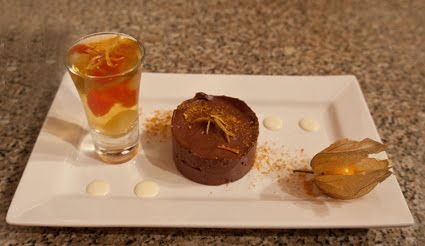
This was the starting point for the New Year's Day dessert. To go with it, I made another chocolate mousse - the same basic Roux recipe I'd used for Christmas Day.

Then it was simply a case of using more of the mandarin dust and the candied citrus peel, with a cape gooseberry to garnish and a few careful dots of double cream. Hey presto!

The jelly was very lightly set and had a sweet freshness, which contrasted well ith the bitter richness of the mousse.

But I also realised that learning from one great R was not enough – and decided that it was also time to start learning from another one: Joël Robuchon.

The Complete Robuchon has been on the shelf since last Christmas, but I haven’t invested the time needed to start really benefiting from it. It’s not, after all, a book with a single illustration in.

This holiday, I’ve spent a little time reading it. And the thing you start to realise quite early is that it’s not just haute cuisine. Indeed, far from it.

I tried a potato dish. Take your spuds, peel and then slice thinly – no thicker than 0.5cm. Rinse and dry them. For this one, you don’t want the starch.

Melt some lard in a pan – around 50g, so not just a tiny amount. Then you cook the potato in the lard, with lardons and a sprig of rosemary. Works very well.

But his recipies for vegetables intrigued me the most. After all, this is a man with a record 26 Michelin stars, so if he suggests an apparently complex way of poking sprouts, there's probably a reason.

The first thing I tried wasa rack of lamb for New Year's Day - but I should have either added a further 10 minutes to compensate for my oven or even switched it to grill or a final blast.

I don't like my meat overdone, but this was going to the other extreme, even though I'd followed the instructions of medium rare.

Mind, experience tells me it'll have been the oven - I just don't know how and what to factor in for any given dish: doing a créme caramel today, I had to give them an extra 15 minutes - but in that circumstance, you don't have other things waiting.

We saved half the lamb for today and I stuck it under a hot grill for five minutes, turning once, as the flesh cooked through properly and the fat crisped up from the rather jelly-like texture it had had. Indeed, it was utterly gorgeous - I don't know whether it had actually benefitted from being cooked in two stages over 24 hours or whether it was just a stunning good piece of meat. It was the first lamb I've bought from The Ginger Pig at Borough Market.

On the side, I sautéed some left-over potatoes - and then decided to concentrate some attention on Robuchon's sprouts.

After the usual prep, they spend about two minutes in a bowl of cold water with malt vinegar - two tablespoons to a litre of water. Then they go into boiling salted water for one minute.

Decant into cold water resting in a bowl of ice. Bring a fresh pan of salted water to the boil. Give them 20 minutes at a very gentle simmer.

Stop the cooking again by popping them carefully into icy water, then rinsing, draining and patting dry very gently in kitchen paper, before finishing off for five minutes in melted butter, with a couple of pinches of salt and one pinch of pepper - yes, the seasoning is that specific too.

Amazingly, given the cooking time, the sprouts were cooked but still with bite, as well as being very tasty.

Robuchon's says that some vegetables benefit from the blanching because it aids digestion. Well, I can only say that there has been no evidence of the notorious side effect of sprouts since dinner. So perhaps this approach has a serious point.

One thing's for certain - I'll be cooking with both the Rs again. And it won't be long before I do so either.