Showing posts with label German culture. Show all posts

Friday, 16 February 2024

Prussianism meets lesbianism in 1931 school drama

In Mädchen in Uniform, the apparently difficult Manuela von Meinhardis (‘you’re big for 14’ – ‘I’m 14 and a half’), whose mother died when she was young and whose father serves in the Prussian military, is enrolled by her aunt at an all-girls boarding school headed by strict disciplinarian Fräulein von Nordeck zur Nidden.

An emotional child, she is drawn to teacher Fräulein von Bernburg, who has a considerably kinder attitude toward the girls than the head and the rest of the teaching staff.


But while most of the girls have a crush on the teacher, for Manuela it becomes more serious, with hints too of the same from Fräulein von Bernburg.


While this is a film from Germany’s extraordinary Weimar era, you probably won’t guess at how it works itself out.


Written by Christa Winsloe (with FD Andam and based on Winsloe’s own play, Gestern und heute – Yesterday and Today), it’s set firmly at the start of the 20th century.


The themes are clear – from the head’s austere version of “Prussianism”, insisting that even if the school is struggling financially and the girls go hungry as a result, “poverty is not a sin; poverty enobles”; that the girls come from military and aristocratic stock and will, ‘God willing’, become mothers to more Prussian soldiers.


“Discipline and order” are paramount here.


None of this is far-fetched. I went to the state Lancaster Girls’ Grammar School in the late 1970s and into the 1980s – and the head in this film reminds me absolutely of our head then, Miss Owen (albeit the film version is infinitely thinner) with her deputy, Mrs Rigby, reminiscent of Fräulein von Kesten, a smarmy adjutant.


It is a remarkable film that I ‘discovered’ via a BFI list of 30 best LGBT+ films.


Directed by Leontine Sagan – her first film – and with an all-female cast, it’s astonishingly filmed, remarkably naturalistic – yet with nods to the visual look of German Expressionism – and wonderfully acted. The stand-out performances are from Hertha Thiele as Manuela, Dorothea Wieck as Fräulein von Bernburg and Emilia Unda as the headmistress.


A really powerful lesbian film for LGBT+ History Month.

Monday, 15 May 2017

Comics: making and maintaining mythologies

Cometh the hour, cometh the latest comics review, with examples of graphic pleasure that illustrate – since this is sometimes still needed – just how versatile the medium is.

First up, a two-part retelling of the iconic German Expressionist film, The Cabinet of Dr Caligari. with script and art from Diego Olmos, published by Amigo Comics.

Robert Wiene’s original film was intended as a devastating damnation of the imperial German establishment that had led the country into the catastrophe of war in 1914, but against a context of new global sabre rattling and populist nationalism, it has an uncomfortable prescience.

A faithful adaptation of the film, it’s told in black and white throughout, presumably with the aim of capturing the disorienting and highly experimental nature of the film.

Hopefully, it will introduce more viewers to the cinematic masterpiece that gave rise to it, but otherwise one wonders if rethinking the visual look might not have allowed it to have a greater impact.

Also with a sense of echoing our troubled times is Royal City from Jeff Lemire, who is both penning and drawing this new story about a dysfunctional family in a dysfunctional North America.

A panel from Royal City
Against a background of changing industrial times, one family finds itself forced to look at an uncomfortable past full of ghosts. 

An excellent double-sized issue launched the work, giving time to establish the central background and then leave the reader with plenty of questions. and a sense of unease.

Depending on where Lemire takes everything, this new series from Image has the potential to be very big indeed.

From the pen of Kim Newman comes Anno Dracula – 1895: Seven Days in Mayhem, an original Titan comic instalment in his ongoing series of novels.

At the back of the first issue of this steampunk vampiric romp, there’s a handy timeline of titles so that we can see this comes after the first Anno Dracula novel and before Anno Dracula 1899 and Other Stories, which was published three months ago, which itself comes before Anno Dracula: the Bloody Red Baron.

As an aside, this also shows that a new novel, Anno Dracula 1999: Daikaiju is slated for later this year.

Anyway, this is the expected fun, with words from Newman himself and artwork by Paul McCaffrey.

It’s easy on the eye and has all the fun – including the alternate history references that help to make the novels such a thoroughly entertaining and satisfying read.

The second issue arrived at the same time as the first and ensured that the start was no fluke.

American Gods is Neil Gaiman’s award-winning novel from 2001, which takes as its central idea a battle for supremacy between the old American gods and those brought to the United States by immigrants to those shores from their original homes, and the ‘new gods’ of technology and consumerism.

A fabulous read, it now has a new life as a comic from Dark Horse, with art by Scott Hampton accompanying Gaiman’s own text. Unlike Anno Dracula, this doesn’t constitute a new entry in a particular universe – although it does diverge from the novel in some ways – but it’s good and welcome anyway.

And of course, this is at the same time as a new TV version of the same novel has debuted on Amazon Prime in the UK.

Ricky Whittle makes an impressive start as the strong, silent Shadow Moon, with Ian McShane as Mr Wednesday – otherwise known as Odin – doing a spot of inevitable scene stealing as we got under way.

But such contrasts are part of why the pair spark so well from their first scene together. 

As has become the norm for the box set generation, it takes time to establish mood and context – and thank goodness for that. Broodingly atmospheric with some stunning visuals, this promises to be a stunningly good watch.

But back to paper.

Bill Willingham’s The Greatest Adventure sees the creator and writer of Fables bring together a group of Edgar Rice Burroughs’s heroes in a brand new adventure that involves saving the Earth.

With artwork by Cezar Razek, the first issue gave us a pacy and entertaining introduction to the premise.

Published by Dynamite comics, it’s going to be interesting to see how Willingham develops this and whether it will be a straightforward romp or have some of the heft of Fables.

Given the success of that previous work, will simply entertaining be enough for an entry on the Willingham CV?

We can but wait and see.

So, an entertaining selection. With the exception of Royal City, all take their inspiration from elsewhere – either from earlier works by the same writers or from even earlier works by other creatives.

What that means in terms of these projects ultimately remains to be seen, but while there might always be a fear that some of this is simply reinventing the wheel, they also give us an insight into how mythology works and grows in our modern, digital era.


Thursday, 16 March 2017

A Meistersinger with plenty to feast on

Ending of Act II
One of the things that makes good art great is its endurance and its openness to reinterpretation down the years: that whatever the apparent subject, it is never just about that.

Die Meistersinger von Nürnberg is such a beast. Weighing in at four and a half hours of music –divided here by two intervals of 35 minutes apiece, allowing audience members the time to unpack the Tupperware and enjoy a leisurely picnic – it might be Wagner’s one mature comedy, but that should not be read as suggesting it lacks intellectual meat.

Indeed, one of the pleasures in watching is in noting the themes – and also how the production works with (or against) them.

The downside with such works is that they can also be open to people attempting to foist interpretations on them.

In the case of Meistersinger, there has been a determined effort by some to suggest that Beckmesser is an anti-Semitic character (who has to be defeated by an Aryan).

Nobody has ever been able to concretely prove that any character in one of Wagner’s operas is Jewish. Wagner’s anti-Semitism is a well-known fact, but that doesn’t mean that his dramas are filled with anti-Jewish tropes. 

Here, the name of Sixtus Beckmesser is thoroughly German and what he quite clearly is is Wagner’s Malvolio, right down to the thin-soled shoes he has badgered Hans Sachs to finish being his yellow stockings, cross gartered.

Why does he have to suffer defeat and humiliation? Because he’s a jealous snob; a petty guard of the petty rules that govern the Meistersingers’ guild – the sorts of rules and attitudes toward art that Wagner himself railed and reacted against.

Further, he has the temerity to imagine that he would be a suitable match for the much younger Eva, who has been promised to the winning Meistersinger at the city’s midsummer festival. The widower Sachs has the decency, self-awareness and basic humanity to know he’s too old for her, even though the idea is not unattractive.

But Wagner is not quite so simplistic: while Sachs comes to see the limits of the rules, he doesn’t represent artistic anarchy, but wants to find an equilibrium between tradition and moving forward.

The idea of wahn – one of those German words that contains a whole philosophical concept; in this case, meaning far more than simple ‘madness’ as it is literally translated – permeates Sachs’s (and Wagners) fears, yet it can be a positive force in creativity. The conflict between strict rules/convention and artistic evolution reflects similar tensions in the wider world between the status quo and change. We all face this and most of us probably take comfort in what of the former suits us and believe only in limited change. Thus understanding Sachs’s fears and dilemma is not difficult.

However, when he pays homage to tradition in the final act, it is often considered a difficult piece of nationalistic fervour. 

But historical context means a lot. When it was penned in the 1860s, Germany was on the cusp of becoming a reality, offering its peoples an increased security in the face of competing and established nationalisms from east and west in particular. It is easy now to forget that nationalism was not considered inherently negative in the 19th century: specifically, we don’t consider Italy’s move toward nationhood at the same time as anywhere near so problematic. German nationalism of the same period, though, has come to be viewed through the prism of what happened decades later and is thus treated as unique.

And it’s hardly as if we in the UK don’t like more than a spot of wildly bombastic pomp and circumstance – and not just at the Last Night of the Proms.
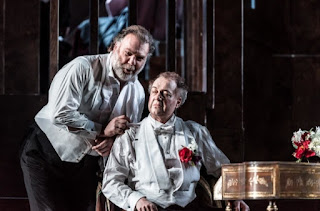
Hans Sachs and Sixtus Beckermesser
It’s also worth remembering that while Wagner himself might have been a nationalist in ways we think of today, he was also anti-militaristic and anti-imperialistic: today’s definition of nationalism usually includes militarism and, at a time when the UK government is planning ‘empire 2’, some on these islands at least hanker for imperialism.

On a cultural level, German-language opera existed, but German composers such as Handel and Gluck had preferred Italian, just as the court of Frederick the Great spoke French – a point referenced in Sach’s hymn to German art. That’s the context for artists striving for a German voice in art.

Royal Opera House director of opera Kasper Holten leaves the job with this new production. And it has left some to grumble – not least about how he’s changed the ending. But then, isn’t breaking the rules what this is all about?

Here, after Walther is accepted into the meistersingers’ guild and, in turn, accepts that, rather than fall into his arms, Eva storms off – presumably angered by his apparent rejection of rebelling against the rules and/or his acquiescence with the nationalism most usually perceived.

It does no damage to the whole, however you look at it.

Mia Stensgaard’s set has come in for criticism too – particularly in the second act, where something more pastoral might be welcome. This is certainly a point.

We start with something like a vaguely Deco series of boxes; angles everywhere, with staircases that go nowhere and a door like the aperture of a camera. It could remind one of Escher’s nightmarishly impossible architecture and indeed, at the climax of the second act, it becomes a nightmare. In a clever move, it only really resolves to full symmetrical neatness in the final act.

In between, during probably the slowest revolve in theatrical history, we see the back of the main set, rigged out as though it were backstage. But as Sachs plots to turn the madness to sanity, it also sees him ‘outside’ the world of which he has been such a part; a clique; an elite with its endless rules that help to preserve that elite.

Resolving the issues is what allows him to return inside, but only as he also helps to at least partially break the strangulating hold on artistic freedom. This is like Wagner’s personal manifesto – as is Sachs’s belief in democratising art by calling for the meistersinger to be chosen by popular vote and even his own determination to match words and music completely, which Sachs mentions in the libretto.

Dress is modern and includes nods to modern elites such as masons – the production poster adds business/City types as another elite.

It’s been noted that Walther is dressed scruffily, with a rock ‘n’ roll t-shirt – unfitting for a noble. But actually, it fits perfectly: the artisans in the guild are the ones for whom such things as appearance are central to their cultivation of their own sense of being an elite. An aristocrat has no need of such symbols because he’s already a member of a ‘real’ elite – though there is irony to his being the one trying to break into a very different sort of establishment.

Sachs, Eva and Walther
If Meistersinger, lacking the sturm und drang impact of Wagner’s great Romantic works, never quite hits the emotionally devastating notes of, say, the last minutes of Tristan und Isolde, it is perhaps his most consistently beautiful and melodic score.

The orchestra was in fine form under Antonio Pappano, if a tad too loud during some of the conversational moments.

Bryn Terfel might not be quite the baritone he was a few years ago, but his is an easy charisma and he brings a straightforward honesty to Sachs that is perfect for the role.

Johannes Martin Kränzle as Beckmesser deals with the comic elements delightfully, while Gwyn Hughes Jones as Walther and Rachel Willis-Sørensen as Eva, and Allan Clayton and Hanna Hipp and Sachs’s apprentice David and Eva’s maid Magdalene, all give fine performances.

The ending, with two choruses cramming the stage, is a theatrical barnstormer. The music resolves as it does at the end of the overture – and a glorious resolution it is too.


Meistersinger is a comedy in the same way that the likes of Twelfth Night is: there are laughs and chuckles, but there is much more to take away when the final chord has sounded.

Thursday, 29 December 2016

Reinventing Christmas folklore

Christmas Present
A few days ago, chatting over morning coffee and social media, The Other Half and I happened upon a mention of Père Fouettard, a Christmas character.

Thanks to the wonders of the internet and search engines, it didn’t take long to discover that Père Fouettard is a sort of counterpoint to Father Christmas in northern and eastern France, and in Flanders, and that he carries a whip with him to punish the naughty children.

This is not too far removed from Krampus, the half goat, half demon figure who can be found from Bavaria to northern Italy to Hungary and more, and who, through comics and more recently a film, has found his way into American and British minds.

It struck me how sanitised our own gift-bringing mythology is: at one time, a bad child in the UK might have been led to expect a lump of coal as a present, but we don’t seem to have the same child-snatching villain as Krampus or, indeed, Père Fouettard, who is sometimes equipped with a sack to take away naughty children, never mind whip them.

But then again, Victorian society was a weirdly mixed bag when it came to frightening children with morality tales, yet sanitising the likes of fairy tales.

The late 19th century was also the time when British personifications of Father Christmas morphed from the sort of Green Man version that owed a great deal to ancient myth and folklore – and is famously presented as the Ghost of Christmas Present in John Leechs illustration for Charles Dickenss Christmas Carol – to the red-cloaked old man we are so familiar with today.

Our discussion ranged across various other elements of Christmas folklore, including the vexed question of when Santa first needed elves.

Godey's Lady's Book
Elves were an established part of Germanic and Scandinavian folkloric traditions, but it was only in the US, where they’d made their way via migration, that they were incorporated into Christmas, with a first festive appearance in literature coming in 1850 in an unpublished book by Louisa May Alcott, called Christmas Elves.

Harper’s Weekly published a poem mentioning elves in 1857, but for the idea of the elves in the workshop, we can thank a 1873 edition of women’s magazine Godey’s Lady’s Book, with its cover illustration showing Santa surrounded by toys and elves and with the caption: "Here we have an idea of the preparations that are made to supply the young folks with toys at Christmas time”.

I’ve always rather thought of folklore as a process that has stopped, and that we preserve, as in amber, but it continues to grow, even if modern communication and entertainment methods have largely overtaken the oral tradition.

Star Wars has a sense of the mythological about it. And Christmas myth and folklore have not stood still in recent years either. Some reworkings and new versions are more successful than others.

In 1996, Terry Pratchett’s 20th Discworld novel introduced us to the Hogfather – with a two-part TV version following a decade later.

Josh Kirby's original cover artwork for Hogfather
Pratchett, of course, famously said that he’d occasionally been accused of penning ‘literature’ – and Hogfather is a good example of how his novels are so much more than simple ‘entertainments’.

Here, beyond the satire – and I’d suggest that Pratchett is one of the finest satirists the UK has ever produced – are questions and reflexions on the relationship between storytelling, myth and folklore and the human condition; on the fine balance between somehow believing (à la the willing suspension of disbelief we engage in at the cinema or theatre) and yet not allowing such beliefs to usurp science and reality.

The God Delusion didn’t hit bookshelves until three years after Hogfather, but re-reading it again this December, it was difficult not to see The Auditors as being akin to Richard Dawkins and others.

However, Hogfather is far from the only evocation of Christmas to add to the mythos and, indeed, to offer a sense of Christmas not being ‘just about the children’.

A Dan Mora cover for one issue of Klaus 
Klaus, written by top comic creator Grant Morrison and illustrated by Dan Mora (who has won an award already for his work on this), first appeared in seven parts, beginning at the end of 2015.

Now available as a trade – although when it’s a large-format, limited-edition hardback with gilded page edging, it’s hard to think of it as a ‘trade’ – this presents us with a far darker Santa origin story that draws on Norse myth and Siberian shamanism.

There are no elves here and nothing sanitised, but a brutal and beautiful tale that draws us back to Christmas as a festival marking the depths of winter.

It’s a really top work (the architectural aesthetic attracted me first, since it owes more than a little to the kind of Germany that we’ve experienced in the last couple of years), and left me with a meditative sense of something that was not new, but as old as the hills.

If youre unfamiliar with Morrisons work, just this work should illustrate why hes so highly regarded.

Klaus is available now from BOOM! Studios, both in the limited edition mentioned above (it seems that Forbidden Planet still has copies) and in a non-limited edition. A one-off, single story comic has also just been released to follow up the first series/book.

I’ve also read Krampus! from writer Brian Joines and artist Dean Kotz (published by Image) and, while it’s an entertaining romp, it also serves to reiterate how good Klaus is.


So, folklore/mythology does not stand still, even in technological, cynical times such as ours. And thank goodness for that.

Wednesday, 8 June 2016

The Threepenny Opera – get ready for Brecht on 'roids

It says something when critics are confused. And looking at some of the reviews of the National Theatre’s new production of The Threepenny Opera, a number of the critics out there are very confused.

For instance, it had been cleansed of all politics, suggested one review – which, were it true, would make it the most bowdlerised piece of Brecht ever produced.

It is also patently untrue and begs the question of what any such reviewer thinks is politics – let alone whether they actually know anything at all about one of theatre’s most iconic writers.

Brecht himself voiced the opinion that the British did his work no favours, treating it too reverentially and making it po-faced rather than fun.

The Other Half – a serious Brechtophile and a half – and I have been fortunate enough to see a number of productions that suggest Brits have learned how to do Brecht.

These included the 2009 National Theatre production of Mother Courage, with Fiona Shaw in the lead and songs reworked and played live by Duke Special, so we were expecting great things on our return to the Olivier for his most famous work.

A new adaptation by Simon Stephens has made textural changes – for instance, to more strongly reference bankers, which illustrates just how much this production is very conscious of its political heart.

Rufus Norris has enjoyed a mixed reception to the start of his tenure as artistic director at the National.

In a online comment after the Guardian review, one wit noted dryly that, in the style of its famous reviewer, Michael Billington, Norris’s latest outing had been given a three-star rating, meaning that it could be anything from crap to life changing.

So it was with the merest hint of trepidation that I entered the theatre last Friday evening. I don’t want to see Brecht treated like a religious text, and I’m far from being against adaptation and so on in principle, but would it really work?

Over the following three hours, there were moments when it felt as though I was closer to the soul of the Weimar cabaret scene than I have ever been before – even when listening to the songs of that era.

Brecht’s tale of London’s underworld, where the poor cannot afford ethics, is as resonant today as ever. Hypocrisy, the bread and circuses of pageantry, sex and violence and sexual violence, now with added gender play – it’s all here.

Roslie Craig as Polly and Rory Kinnear as Macheath
As too are beggars, disabled military veterans, crooked coppers and men whose minds have been damaged by war – appropriately, in Afghanistan.

While some changes have also been made to the song lyrics, Kurt Weill’s score is treated with due reverence and performed superbly by an eight-piece band, as it was originally. And this, of course, includes the iconic Mack the Knife.

It’s difficult to reconcile the doubts of some critics as to the quality of the singing – it was excellent throughout and Weill’s music has rarely sounded so downright, deep down sexy.

Indeed, many of the songs offer a very different feel to the general cynicism and decadence of the whole, giving characters the chance to reveal that they do dream and imagine something better, in sharp contrast to their physical, everyday lives.

But here’s the nub. In enjoying the dysfunctionality that is portrayed in front of us, we become complicit in the cruelty. It’s like Jeremy Kyle on speed.

Brecht has tied us in philosophical knots – with a piece of theatre that claims to eschew any moral.

Norris’s direction is spot on, giving us a performance of unrelenting energy and pace.

Vicki Mortimer’s design is wonderful – making the artifice and theatricality absolutely clear. Having characters enter and leave by tearing (or cutting) their way though paper flats is really effective – and the ruined mass of flats that creates Macheath’s den is so evocative of the decay all around (and also reminiscent of the set in GW Pabst’s 1931 film version).

The costumes evoke the Weimar period, with added Keystone cops and robbers.

The cast is uniformally excellent.

As Macheath, Rory Kinnear seems to be a physically calm presence in the midst of a whirlwind of action around him. But there’s always something sinister in that calm; a sense of latent violence – he brings to mind the brooding menace of the Mitchell brothers in EastEnders, but with knobs on; a thug with a soft underbelly.

But as Peachum, Nick Holder outdoes him in the nastiness stakes – perhaps most particularly when turned into a rotund Louise Brooks-alike in the second act; pinstripe suited and on black heels, threats and brutality his daily currency.

Nick Holder as Peachum and Peter de Jersey as 'Tiger' Brown 
Haydn Gwynne as Mrs Peachum is in wonderful form, while Rosalie Craig makes a marvelous Polly – apparently vulnerable and naïve, yet hard as nails when she needs to be.

Sharon Small is a super Jenny – her Surabaya Johnny is simply excellent, ranging from the poignant cry of a dreamer to the incandescent rage of the abused.

A special mention too, to Jamie Beddard as Matthais, one of Macheath’s four core gang members: casting a disabled actor in the role brings an extra dimension to the work’s sense of being about the disenfranchised and discarded of society, and Beddard’s performance adds a really ballsy note to proceedings.

It is great to see Elisabeth Hauptmann’s contribution as collaborator recognised – her German translation of John Gay’s Beggar’s Opera formed the basis for The Threepenny Opera.

This production might not be ‘life changing’ theatre – but it is an excellent, provocative, in-your-face, fuck-you evening’s entertainment that will live for a very, very long time in the memory.

I rather think Bert would have approved. The Other Half certainly hasn’t stopped singing since.

It’s in repertory until October. Find out more at www.nationaltheatre.org.uk.

Thursday, 24 March 2016

Wooden it be nice?

Nature's own sculpture
Not only do I not fly very often (thankfully), but it seems to have been a very long time since I sat next to an airplane window, in daylight, on a clear day.

But that happened when we flew back to the UK from Germany last week. And as we headed north west, the world below offered further evidence of something I’ve been aware of for a few years now: German towns and villages are never far from woods and forests.

Not only are forests at the heart of the German psyche, but it’s also reflected in the country’s love of wood as a material – and in particular, as a vehicle for art.

My maternal grandparents visited the Alpine region in the years after WWII and brought back a few small pieces, which my mother still has. So I’ve been familiar for years with the angular planes of wood on a carved mountain goat.

In 2000, my own parents went to Germany – the trip was my father’s retirement gift from his parishioners, and included tickets for the Oberammergau Passion Play.

They brought me back a pair of carved edelweiss flowers and a man with lantern and donkey, which owes something to the sentimental style of porcelain Hummel figures (if memory serves, my mother has a couple of those stashed somewhere too).

The central part of the Holy Blood altarpiece
When we headed into Bavaria for the first time last year, I expected to see plenty of wood carving, but in the event, the only obvious thing to be seen was cuckoo clocks.

This was not a trip where we were able to spend any time wandering in woods, but one of the specific things that we had penned in to do was to visit the Jakobskirche for some rather more polished wood.

The city’s main church, it’s Lutheran, although part of the many official pilgrimage routes to Santiago de Compostela.

Built between 1311 and 1484, in 1525, the church saw the peasant leader Florian Geyer (a Franconian noble) read aloud the articles of the revolting peasants during the German Peasant’s War.

But if you climb up the stairs to a gallery behind the vast organ, you’ll find a Holy Blood altarpiece, carved by Tilman Riemenschneider between 1500-1505.

The raw material
Riemenschneider has been dubbed ‘Germany’s Michelangelo’ and his work is always worth seeing. This is one of his seminal pieces – Andrew Graham-Dixon goes into some detail about in in his TV series, The Art of Germany. The artist’s ability to create highly realistic faces that seemed to have an inner life puts him head and shoulders above many others.

The church is also home to a high altar created in 1466 by Friedrich Herlin, a pupil of Rogier van der Weyden, but the Riemenschneider is the undoubted star here.

Flanked by two relief panels showing scenes from the Easter story, the central section of the altarpiece is a vast, 3D representation of the Last Supper. But what lends this version so much power is the figure of a disciple looking away from Christ and down toward us. As Graham-Dixon explained, it is a direct challenge to anyone looking at it.

Art historian Kenneth Clark considered that Riemenschneider’s works showed an idea of German piety in the 15th century and were harbingers of the coming Reformation.

Wooden woodsman and mushroom
The challenge created by the disciple breaking through the fourth wall (in effect) is a personal one that can be seen as indicative of the ideas of a personal relationship with God that would develop.

Away from religion, we did spot one or two wood carvings – although one small shop was still closed for the winter.

But I did find a small woodsman, which has now safely made the journey back to London, where he’s joined by a small wooden mushroom, which I was charged just €1 for, after the woman in the shop we were in was so delighted by The Other Half making a substantial Christmas decoration purchase.

However, aside from wooden Christmas decorations that were purchased away from Käthe Wohlfahrt, Germany’s biggest Christmas decoration manufacturer, which has its headquarters in Rothenburg, together with a number of shops and a Christmas museum.

One visit convinced us that it is grossly overpriced and nowhere near the best quality around. Indeed, the owner of one independent shop told us that the company, via marriage, was effectively in Japanese hands and that Japanese tourists expect things to be expensive as a guarantee of quality.

Nature and time, wrought in wood
What we did come away with – well, what I insisted on coming away with – was a cuckoo clock: a genuine, hand-made one from the Black Forest (which isn’t that far away).

I picked the smallest one I could find; not one made to look like a chalet; with no painting on it. Not only is it made from wood – the traditional design reflects the woods and forests.

Back in London, I took my time getting it out of the box and mounting it on the wall. There is something ridiculously fascinating, in these technological times, in having something that requires no batteries or plugs – it’s almost a revelation that leaves you wondering how anything can work without that confounded electrickery.

It delights me that it’s properly hand made; that when you open the back, the inside reveals once more how it not mass produced. It is, then, thus evidence that real craftsmanship has not been lost.

It’s hardly a Riemenschneider, but it is an authentic piece of Germany in its own way, and in an era of  smart this and smart that, it’s a real pleasure to have.