Showing posts with label beer. Show all posts

Tuesday, 7 April 2015

We love to go a wandering

The way ahead
After a day’s rest for the feet, further studious study of the weather forecast revealed that Thursday and Friday were set to see precipitation of one sort or another.

That meant one thing: if we were to undertake another proper walk, it would have to be on Wednesday.

Helpfully, The Other Half – who had spent weeks studying online maps for precisely such ends – had just such a walk planned. So off we went, having this time remembered to take bottles of water with us but, unfortunately, no Kendal Mint Cake. I should have taken a slab to Bavaria on principle.

Our destination was another small Alpine lake, the Alatsee, and the start of the walk took us through the park at the back of summer palace of the bishops of Augsburg before we crossed a small, wooden bridge and climbed gently upwards onto a wooded ridge.

Germans, as I’ve mentioned before, care passionately about forests – it’s an essential part of the national psyche. Woods are so central a part of German life that, when it was discovered, in the 1980s, that the woods were dying from pollution, there was a united commitment to doing something.

Woodland delicacy
That the country is now a major producer of renewable energy is, in part, a result of that – and also an indicator that green politics is not seen as overtly as ‘left’ in the way it is elsewhere, not least in the UK.

For British townies in particular, we have, in general, long lost that sense of connection with nature.

But in Germany, no town or city is far removed from a wood or forest in which to spend time.

And these are maintained and looked after with great dedication, as are the footpaths that wend through them.

My mental musical theme for the week – with the exception of a burst of Wagner when at Neuschwanstein – was The Happy Wanderer.

Mein Vater war ein Wandersmann, to give it its original German title, was originally penned by Florenz Friedrich Sigismund (1788-1857), while the tune we’re familiar with was composed after WWII by Friederich-Wilhelm Möller.

Wood – smelling beautiful
A 1953 performance of the piece by the Obernkirchen children’s choir at the Llangollen International Musical Eisteddfod, broadcast on BBC radio, saw the song become an instant hit and staying in the singles chart (a top 12 at the time) for 26 non-consecutive weeks.

As we wandered through woodland, for a long while, with the sounds of the traffic of Füssen intermittently drifting upward to us, yet already in a different world, it drifted into my head again and even, quietly, from my lips: a song from childhood memory, suddenly taking on a new life.

Away from it all
We stopped to inspect tiny flowers alongside the path; to listen to the birds around us; to watch as a small deer sprung away through the trees, glancing back over its shoulder to check us out.

It wasn't a busy road
The process of maintaining the woods means that some trees are felled. Clearly there had been recent work done in this department, as we saw logs stacked neatly between pairs of standing trees.

Walking past one such stack – clearly very recently cut – the smell was astonishing. Forget those ghastly ‘air fresheners’ in cars and elsewhere: this is what trees smell of and it’s intoxicating.
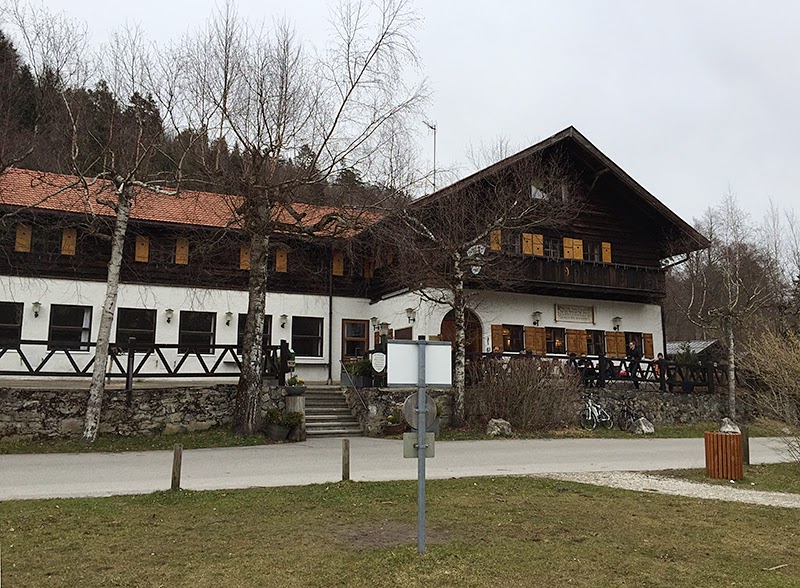
Perfect for lunch
As we made our way, the road sounds drifted away entirely: the tranquillity was wonderful and eventually the tinkling of a beck made it’s way up to our ears.

Having discovered (the hard way) the result of the lack of contour lines on Google maps, we made a decision after some time to take a path down the side of the ridge to meet a road that then went on to the lake, rather than take what looked to be a harder path that would take us back up before coming down near the lake.

I say ‘road’, but I don’t recall a single vehicle passing us as we strolled along it, the metal points of our walking sticks now striking the tarmac surface.

Brilliant beer ....
The trees to our left eventually fell away, leaving us with views of Alpine pasture filling the space between the ridge we come along and the rather higher hill side opposite.

We made it to the lake for around 1pm – perfect, since the hotel there also has a restaurant and The Other Half had fully factored this into his plans.

With the temperature ludicrously mild, we sat outside the chalet-style building and ordered drinks while scanning the menu.

The beer was a caramel-coloured dunkel from the Aktienbrauerei – the oldest existing brewery in Kaufbeuren, first mentioned in 1308, a whopping 208 years before the Reinsheitsgebot – and was the best beer of the week, with an absolutely wonderful taste.

As we sipped, we could hear the sound of The Other Half’s schnitzel being beaten out in the nearby kitchen. Oh, this was going to be freshly cooked.

... and fabulous fodder
For myself, I had leapt at the opportunity to try spätzle for the first time. A sort of soft egg noodle from the south of Germany (and areas to the east), I knew it by legend alone.

It came as the bed on my (large) plate, dressed in melted butter and with a vast mound of gloriously crisp and wafer-thin fried onion rings atop a piece of absolutely superb beef that had been cooked to perfection: beautifully seared on the outside and melting to very pink the further in I got.

It was the perfect illustration of how good food doesn’t have to be haute cuisine. This was perfection.

Sated, we sat awhile, quietly taking in the view.

The Alatsee spread put in front of us, with a snow-capped
Austrian berg soaring beyond the wooded ridge that marked the border, and the wooded hills around the lake split in one place by a wedge of pasture.

The Alatsee
It was still largely iced over, although where the thaw had set in, the water was that rich malachite green again, and crystal clear at the edge, creating a perfect mirror to reflect its surroundings.

It’s apparently a meromictic lake – meaning that it has layers of water that do not mix, which in turn means that it can include within it radically different environments for organisms.

Snow ahead
Such bodies of water were only really named in the early 20th century. They may occur where the basin sides are unusually deep and steep compared to the lake’s surface, and where the lower layer of the water is highly saline and denser than the upper layers.

The Alatsee is 868m above sea level, with a surface area of 12 hectares and a maximum depth of 32.1m. There are such toxic organisms living in the lake that they’ve been blamed for a number of divers have died or disappeared in its waters.

And as if this were not enough, it’s one of the (many) spots that’s alleged to be hiding ‘Hitler’s gold’ – although Lake Toplitz in Austria beats it for plausibility, given that forged British banknotes were found by divers in chests, together with a printing press, in 1959.

You see – travel broadens the mind: or at least the knowledge base.
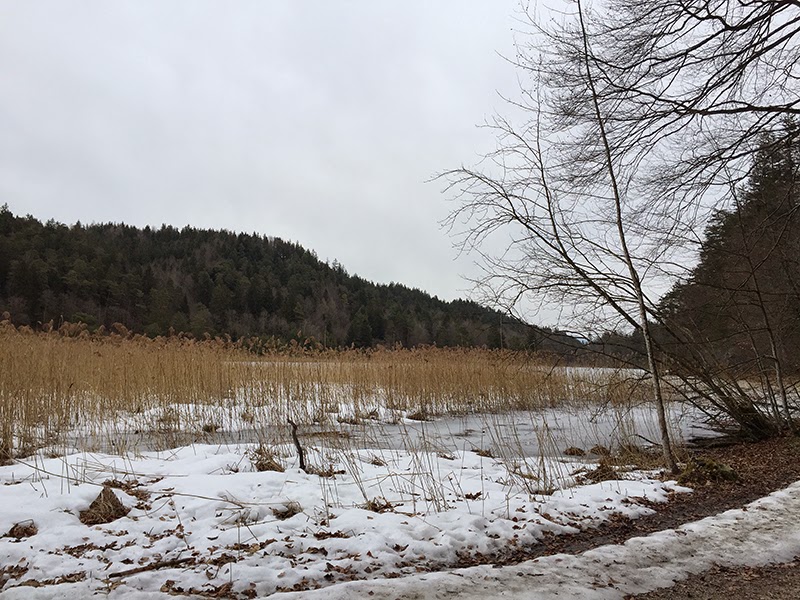
The Obersee
Eventually, we set off again. This time, the intention was to walk back along the valley floor on the opposite side, along the Faulenbach and passing the smaller Obersee and the positively diminutive Mittersee before reaching Füssen.

This route had been less exposed to the sun, meaning that snow several inches deep still lay in patches over the path. Those walking sticks were proving very handy.

There was evidence of winter tree fall from the steep, rocky ridge now to our right, and also where the local forestry management teams had come in and removed the section of a tree that had fallen across the path, leaving the rest where it lay.

Looking back from the Obsersee
Again, the sounds of trickling water and bird song were the dominant ones, leaving city natives to feel almost out of kilter at the absence of urban drone. It’s a long time since I spent so long away from the sounds of traffic.

The Obersee was almost completely iced over, with reeds rearing up to tell you that there was marshy land beneath the frozen white.

And so we continued toward the town; another satisfying walk under our belts – another day gazing at this extraordinary landscape and feeling awed by it. Happy wanderers indeed.


Tuesday, 31 March 2015

Bearing east for Bavaria and beer

Frauenkirche and Neues Rathaus, Munich
Commeth the hour, commeth the beer. But first came the chaos. Our long-awaited trip to Bavaria was thrown into chaos at the 11th hour when our flight to Munich was cancelled by virtue of a strike by Lufthansa pilots.

With only a little over 24 hours to go before we were scheduled to fly, The Other Half fortunately managed to get us new tickets on board EasyJet, from Gatwick.

One point to remember here: we were booking late, obviously, but those EasyJet tickets cost more for a one-way journey than the original Lufthansa return flights had cost.

So much for all the guff about ‘budget’ airlines. And unless you are travelling with only enough luggage for a couple of days, and can therefore cram it all into a cabin bag, you can expect to pay around £30 per case for the privilege of taking more.

Mind, judging by the sight of fellow passengers struggling to cram a bag into the overhead lockers, some people stretch the definition of cabin baggage to its limit and probably beyond.

That said, I’ll give EasyJet credit for being considerably less unpleasant than RyanAir.

Erdinger
At Gatwick, we discovered that the plane was a little late arriving. But, with the wind now in the ‘right’ direction, we made up time on the journey to Germany.

Our initial plans would have meant that we arrived at Munich airport at around 11pm German time, so with that in mind, we’d booked a room for that night at the Hilton hotel that sits squarely between the two terminals.

In the event, we had slightly longer at the hotel, since the EasyJet flight was two hours earlier. But having checked in, neither us of felt much like sitting down to a meal – travel days do disrupt eating patterns – and opted instead to sit outside (yes, outside) in the clear evening air (albeit under a small heater) to enjoy a couple of glasses of beer.

In this case, it was Erdinger: a clean weißbier with a good taste. And jolly welcome it was too. After the previous day’s panic, merely being in Munich felt like a victory.

The next morning, with sun in the sky, we grabbed a coffee (€25 for breakfast was not on the menu) and caught a train into central Munich.

Bavaria may, in many ways, be a conservative part of the world, but that it not a neo-liberal conservatism that believes in taking every opportunity to rip people off.

At the main railway station, which we were due to depart from in the afternoon, there were whole rooms of lockers where we could leave our bags for the day at a mere €3.

Weißwurst, pretzel and mustard
That’s right: no airport-style ‘security’ to allow some jobsworthy tosspot to spend 10 minutes running a finger around your laptop as though it’s the most mysterious container he’s ever encountered (all the while, giving you an unpleasantly challenging stare), and then charging you a rip-off £6 to hold your bag for three hours, with the company claiming that’s a “competitive” price.

Take note Britain and, in particular, the Excess Baggage Company at Manchester Piccadilly. 

Free to wander, we headed straight toward the Marienplatz and, claiming that coffee as our ‘first breakfast’, sat down on Neuhauser Straße outside an eatery called Schnitzelwirt to engage in a great Bavarian tradition.

Second breakfast traditionally occurs at around 11am, but always before noon. The reason for that is that it includes weißwurst, a local delicacy that, in the past, would have gone off if left any later.

It’s served in in the water in which it has been gently simmered and comes with a pretzel, sweet, grainy mustard and beer. The beer in this case was a Franziskaner – a gorgeous weißbier brewed in Munich, which I have experienced from bottles in the UK.

Altes Rathaus, Munich
It’s the sort of drink that makes you stop anything else, sit up and pay attention to the taste.

The most traditional way to eat the weißwurst is to cut off one end and suck the light veal and bacon mix out of its skin. Or you can slice it from end to end and then roll the meat out with a fork. I opted for the latter approach.

But all in all, this Bavarian ritual was observed properly and very much enjoyed.

We ambled on, seeing the extraordinary Rathaus-Glockenspiel strike noon. Made in 1908, its 32 life-size figures re-enact scenes from the city’s history, accompanied by 43 bells.

This is the new town hall – a vast piece of Gothic Revival (it has 400 rooms) built between 1867 and 1908 by Georg von Hauberrisser.

Its predecessor, the Altes Rathaus, stands at the east side of the Marienplatz, and was first documented in 1310.

The site of a 1938 speech by Goebbels that was the prelude to Kristallnacht, it now, rather more pleasingly, serves as a toy and teddy bear museum.

Heilig-Geist-Kirche, Munich
Here too, we could see the iconic twin onion domes of the Frauenkirche, the city’s cathedral. A Romanesque church was first built on the site in the 12th century. What stands there today crosses architectural styles, with the main building – completed in 1494 – being Gothic, while the Renaissance-style domes were added in 1524.

I bought a hat – of which more another time – and between exploring churches (a first taste of Bavarian baroque), markets and shops, we took coffee in thetypically large German cups that are almost bowls.

The original plan for our time in Munich had involved visiting one of the three major art galleries, but we soon realised that, to do so, we’d be rushing ridiculously. Thus we’d settled on a rather less frenzied approach.

But heading back to the railway station, we found ourselves facing another less-than-relaxing snafu: The Other Half’s locker wouldn’t open.

Welcoming coffee
Thankfully, we’d allowed ourselves plenty of time, and I raced off to deploy my pidgin German in finding someone to sort it out.

That was not entirely straightforward, but for the first time in my life, I actually understood directions in another language and did, after what seemed like an age but probably wasn’t, find a young man who understood, picked up a fistful of keys and followed me back.

Checking first that we could describe what was in the locker, he then opened it and liberated the case, leaving us to head to the train that would take us to Füssen.

The journey south east into the Alps takes two hours: fairly fast for the first half, it slows as you start the real climb into the mountains.

Not that we could see anything more than Alpine pasture that was close by, with heavy cloud draping its gloom over anything higher. My frustration was almost tangible.

We emerged at Füssen into a dark early evening, a fine drizzle in the air.

A fine plate of zander
Our hotel, fortunately, was only a very short walk away and, as a large tour party was decanted from a coach into the lobby, hauling industrial amounts of suitcases up in the lift for a single night, we were handed flutes of sparkling wine by the lady at reception.

Settling in a short while later, we found that we could look out and see the summer palace of the bishops of Augsburg close by.

After a dinner in Chili, one of the hotel’s two restaurants – a very enjoyable first taste for me of zander, a fresh water fish – we decided that it had been a long couple of days and an early night was in order.

But, with one or two hitches, we’d made it. Now Füssen awaited.


Thursday, 15 May 2014

The wurst a foodie can get?

Bratwurst in Lübeck – on a proper plate
Germany remains low on the list of travel destinations for Brits - and to be honest and from a rather selfish perspective, I rather like that.

Back in 2000, my parents visited the country for the first time as part of an organised trip to see the Oberammergau Passion Play.

Performed by the village people every 10 years or so since 1634, the millennium staging coincided with my father’s retirement, so his parishioners had thought it a fitting present.

The thing that worried him most was the very fact of going to Germany – for some, The War has never really ended.


That all-important first beer of the trip
Indeed, as I have been reminded more than once, “we didn’t win the war just so the Jerries could rule us through the EU!” and as I remember clearly when coming home from my first day in the second year at Fairfield High School for Girls: “We didn’t win the war so that you should have to learn German!”

In the event, both parents were charmed. And this seems to be the case for anyone visiting.

But while scenery and beer might be attractions, one thing that is not standardly viewed as a selling point for Germany is cuisine.

After all, it’s really just sausages and pickled cabbage, isn’t it?

As only a slight aside, it should be noted here that sauerkraut is not pickled, but is fermented, with the finely-shredded vegetable layered between salt in barrels.

But back to sausages.

Matjes herring with a jacket potato
One of the tedious little rules that those who complain about ‘red tape’ love to hate came I to force in 2003, when it became law that sausages be labeled so that you know how much actual meat is in them – and not just a figure that could include all sorts of parts of the animal, plus the ‘pink slime’ that has been blasted off otherwise stripped carcasses.

But while the foodie-based revival of the humble British banger has improved things greatly, millions of the smooth, pink slimy ones are still sold, leaving one with a sense of culinary despair. And I must admit, at this point, that it not so long ago that I preferred these – although now I find them fairly repulsive.

But back to Germany and wurst.

Breakfast, with fish and small frikadellen
Our trip to Schleswig-Holstein was always going to produce some wurst opportunities, and it was in Lübeck where I enjoyed a very nice bratwurst with chips and the obligatory mustard.

Germans make some very nice mustards indeed, from the mild, yellow senf that’s just perfect with a bratwurst, to the grainy, sweet type from Bavaria.

But that really was my sole taste of wurst on this trip, although and I was delighted to find a gift box of three tins of Bavarian weißwurst and a small jar of the latter in Hamburg Airport on the way home.

Instead, I made the most of the opportunity to enjoy the fish – whether fresh, smoked or soused, and starting every day with matjes herrings at breakfast.

"A great British tradition"
Indeed, a first meal selection on German soil involved matjes herring, fish that has been ‘ripened’ by soaking in a mild preserving liquid for a few days.

The flesh is firm, boneless, easy to digest and has a delightful, delicate taste. It can be served with a variety of sauces, including a very traditional one of sour cream or yogurt, and dill.

On this occasion it was served in full fillets alongside a jacket potato with sour cream and chives.

Among the other non-fresh delicacies tried came smoked mackerel and sprat, proper gravadlax – or as the Germans call it, gravad lachs – and eel.

Passing a small shop in Travemünde itself gave an opportunityfor a glance into northern German fish culture – an absolute Aladdin’s cave of piscene wonderfulness.

The Swinging Mods set the beat
Eel featured again on the trip – but as a combination of literature and jewellery: I bought a small one in the form of a pendant, based on a Günter Grass sculpture. Readers of The Tin Drum will know the role that eels played in those pages.

Other pleasures included a piece of fried turkey with a lemon hollandaise on Sunday after our long coastal walk, and, of all things, fish and chips on the Saturday.

The latter was served from a van at a May festival that we joined, where a husband and wife team advertised this as a “great British tradition” and were really chuffed when we told them that it was very good, which it was.

Black beer
Washed down with serious black beers, as the Swinging Mods rocked the air with the sort of ’60s sounds that encouraged an amount of unabashed dad dancing on a small wooden dance floor.

On the Sunday night, we hit a restaurant on the water front, where we enjoyed a vast spread of cod, with fresh cucumber salad, buttered potatoes and pickled cucumber and a mustard, cream sauce on the size.

The Other Half, gazing at this as it was laid before us, murmered, of Germans as a whole: “when it comes to portion size, they don’t fuck about!”

We had one below-par meal – but that was more a question of the restaurant being in chaos, only one man being in the kitchen and clearly refusing to try to speed up to keep up with the influx of customers.

Portion size!
We tried cake too – and oh, German cake is a thing of very great pleasure. Forget the cliché of Black Forest Gateaux (although a real one is a real delight) – I enjoyed a local speciality topped with marzipan, because Lübeck is, after all, the marzipan capital of the world, and a deep, dense chocolate torte.

There were other points of note on the culinary agenda too: honey – the hotel restaurant had at least 12 varieties available at breakfast and lovely were the six that I managed to try during our stay.

And breads too – again, the breakfast buffet included several varieties of traditional German breads, most of them organic. I’m not quite a pumpernickel girl, but I do love a good volkornbrot, a traditional whole wheat bread.

Beer everywhere was, of course, clean and a pleasure to enjoy – slowly!

Serious, serious chocolate cake
And one evening, after that poorest meal, we relaxed in the hotel bar, The Other Half with a cocktail and me with a glass of a very light beer and a Fürst Bismarck ‘doppelkorn’ schnapps on the side. It has to be done at least once.

The only disconcerting point was that these drinks were ordered by me in such immaculate manner that the woman serving declared that I spoke German “so sweetly”! I am not sweet!

We had two evening meals in the hotel restaurant – of which much more another time. But all this – the much more ‘humble’ fodder – had more than enough to recommend it and more than enough to make it memorable.

But oh, oh, oh – the herrings!

Monday, 22 April 2013

Of marzipan and vampires


Holstentor, Lübeck.
Saturday didn’t so much dawn as emerge, slowly and reluctantly, as the train headed north. We had crossed into Germany at Metz, some hours earlier.

But it was still very much dark by the time my fellow passenger quietly and carefully readied herself and left.

I tried to sleep a little longer, but it was no good. Having the cabin to myself, I lifted the blind and sat next to the window, as we passed a mixture of wide open and wooded terrain, through Hannover, and then beyond.

There was so much space; so many trees; so much sky. Give it a week or so of improved weather and Beethoven's Pastoral will make the perfect soundtrack.

The train had been comfortable – a proper duvet and pillow for sleeping, and a shower just a door along. Then we were served a boxed Frühstück for breaking the overnight fast.

A carton of sweetened fruit juice, a small packet of volkornbrot, some spreadable cheese and a muffin, plus coffee – hardly the best example of German cuisine, but welcome nonetheless, as I watched the countryside roll past.

Hamburg was waiting. I worked out the tickets and the platform and waited, but not for long.

The final leg of the journey took around 40 minutes. I was out of my seat and bending to see through the windows as we approached Lübeck. There on the horizon were the seven spires – I knew already to which vast Gothic churches some of them belonged.

Otto von Bismarck.
Out of the station and into a gloomy day. A taxi would have done the job quicker, but I was determined to make my entry to the Altstadt on foot, past a statue of Otto von Bismarck, over the Puppenbrüke bridge and on through the 15th century Holstentor – such a German icon that it used to feature on the 50 mark note.

It was always going to be this way, but dragging a case through puddles, up steps and over cobbles wasn’t easy.

I wonder whether the group of elderly tourists looking at this leaning, imposing building, who cast a glance, mused to themselves: ‘ah, such eccentric behaviour can only be a sign of someone from perfidious Albion’?

Lübeck was The Queen of the Hanseatic League, the medieval trading and defence organisation of guilds and towns, which operated thoughout northern Europe and beyond from the 13th century. Although often considered primarily as a German creation, it had significant links in many non-German towns and cities, including Bruges.

The one remaining Hanseatic building in the UK is in King's Lynn, where it is now the registry office. Unfortunately – and yet one more reason why I want to improve my German – this fascinating subject finds little information in English.

The city was independent for 711 years – until Hitler gave it to Hamburg in 1937, in revenge for its having refused to let him campaign there in '32.

Once into the old city, it was an easy passage to my hotel. Check-in was 3pm – hours away – but they happily let me store my case, so I could set off straight away on my exploration.

Buddenbrookhaus.
First stop – Buddenbrookhaus. Over the years, we have managed to forget, so often, to check opening times, and then found ourselves missing something, so on this trip I was prioritising madly.

The home of Heinrich and Thomas Mann’s grandparents, it was immortalised in Buddenbrooks, Thomas’s precocious 1901 debut novel. Deceptively straightforward and light, the book is far more than a story of one Hanseatic family’s gradual decline.

Apart from anything else, it is about the onset of modernity; the hardening of business attitudes and the development of individual sensibilities are just two aspects of the changing times that Mann marked. Like so much of his work, it is partially autobiographical.

And here I was – treading ground that Mann himself had trod and seeing, despite damage in WWII, plenty of buildings that he would have been familiar with.

The original building was bombed in the Easter 1942 RAF raid: the cellar and the impressive frontage alone remain.

Inside are extensive displays about the Mann family. There was also a temporary exhibition about other Lübeckers who were exiled during the Nazi years.

Marienkirche. The lower Death Dance Chapel window.
However much I would love to avoid that subject when I come to Germany, it is not entirely possible. But the key (for me at least) is not seeing all German history and culture through the prism of 12 years.

The British obsession with the years of National Socialism – and the WWII years in particular – to the exception of so much else is, I think, both increasingly negative and self-indulgent.

That in doing so we ignore the massive achievements and influence of German culture, and that it contributes to a widespread, isolationist belief that ‘we’ are somehow not European, are two, inter-linked aspects of a sort of wilful blindness brought on by a surfeit of anti-intellectual masturbation.

Anyway, back to the Manns.

It was an odd visit: I possibly expected too much. But the recreation of two rooms as two of those described in the novel seem to distance it from fact.

I bought a lovely, facsimile hardback edition of the novel – given the issues over translations into English of all Thomas’s novels, and the dearth of translations of most of Heinrich’s work (including the Lübeck-set story, Professor Unrat, which became the film, Der blaue Engel), it was another must-do-better language reminder.

Marienkirche, vault.
Next, the Marienkirche. Oh my. I do not, generally, rhapsodise about much to do with religion, but this really does take the breath away.

Begun in 1250, it's right next to the Rathaus (city hall) and was intended as a bit of a snub to the similarly double-spired cathedral a short way away. Its vast vaulting reaches 38.5 metres and it has become known as the ‘mother of Gothic brick churches’.

Here’s a touch of heresy: for it’s lightness alone, it is better than Notre Dame. I gazed upward in awe.

And then there are the bells. Two of them, shattered at the base of the south tower, lying where they fell in those bombing raids.

It’s all well and good being able to say that one’s country was in the right – explanations in the church itself compare the damage to that which the Luftwaffe exacted on Coventry Cathedral; in effect suggesting that it was like for like – but it is a striking reminder of the divisive insanity of politics by war, certainly in the modern era.

The bombing raids had a rather more positive effect on the church, though, as the fires licked away the plaster that had covered the paintwork from the Middle Ages.

Marienkirche, bells.
On a lighter note, the famous organist and composer Dieterich Buxtenhude (c1637-1707) held post at the church in his late career – and it was to the Marienkirche that JS Bach walked some 400km to hear the master play, while Handel also visited.

Buxtenhude's organ, the Totentanzorgel (Dance Macabre organ), probably played by Bach, was destroyed, along with the 1701 reproduction of an accompanying artwork by Bernt Notke.

But time doesn't have to stand still even in a building such as this, and the stained glass windows where it was housed were created in 1955-56 Alfred Mahlau.

By this time, I was starving. And having wandered out of the Marienkirche and around the corner into the marketplace that is bordered on two sides by the church and the medieval Rathaus (begun in 1226 and with add-ons over the centuries), I spotted that the Ratskeller was open for business.

A ratskeller is a remarkable German institution – a restaurant in the basement of a town hall. And in this case, as in so many, serving traditional German food.

Rathaus. Ratskeller entrance under Baroque arches to left.
I ordered a pork schnitzel with roast potatoes. It was huge! In local style, it came with a sauce/dressing of local shrimps, onions and button mushrooms, in a tangy, creamy sauce.

Now German cuisine may not be regarded as highly as some others, but food like this would very much please the likes of Odin and Thor. It is hearty and simple – and relies on good ingredients, used well.

I had a beer on the side. There is no such thing as a Lübeck beer – the city has the oldest wine merchant in Germany but no brewery of its own – so I had a Holsten. It was a very different taste and I’m not sure it entirely suited me, but it is always worth trying the most local brew – or food. The schnitzel was superb.

A very large pork schnitzel.
My waiter gave me an extra bowl of the onion, shrimp and mushroom mix. Perhaps it actually looked as though I was starving. Or perhaps Germans are feeders ...

And of course, there was the sheer pleasure of sitting in somewhere that, were it not still still in normal use, would be a museum.

Here, just a stone's throw from Buddenbrookhaus, in this very small part of this small city, was another key to “the house on Mengstraße”, as Mann often describes it in the novel.

The Marienkirche and the Rathaus were built close together, where they were, for reasons of local politics. It's no coincidence that Mengstraße is where the best merchant’s houses were.

Marzipan 'last supper'.
And Buddenbrookhaus, with its incredible Baroque frontage, is almost as near to both as it’s possible to be on that street.

It was from such a height that Mann charted the family’s fall – almost as high as possible.

After lunch, I headed to the Niederegger marzipan shop, café and museum, which is opposite the Rathaus.

There are various stories about how marzipan was created – from one of those fortunate kitchen accidents to the ingredients being all that was left during a siege, but the truth is that the only things that we really know is that merchants brought back almonds to the city and somehow marzipan was created there, making Lübeck became the world’s marzipan capital.

Marzipan 'apple'.
So even if, at Christmas, you eat a Dresden stollen, it’s entirely possible that the marzipan will have come from Lübeck.

It’s stretching things rather to call the exhibition area a ‘museum’ – there are a series of boards that tell the story of marzipan, placing particular emphasis on the role of the Niederegger clan.

And then there’s a huge exhibit – a sort of marzipan last supper – with one of the old Niedereggers at the heart of it.

The opportunity to watch a young woman working on various marzipan creations is more interesting, as are the small number of examples of superbly-crafted marzipan ‘fruit’.

The memorial to Thomas Mann.
Later, rather knackered, I headed back to my hotel, and discovered that, in effect, at the top of the road that I was staying on, there was a small memorial marking where the Mann brothers had been born on the street that crossed it.

As I walked down the street, it was past the theatre where both Heinrich and Thomas had first witnessed live performances and, in Thomas’s case, first seen anything by Wagner, which was a seminal moment for him.

I thought back to Buddenbrooks, and the Christmas scene where Hanno gets his toy theatre, all set for the final act of Mozart’s Idomeneo, and like some sort of clearing mist, I started seeing, as never before, the links between this city state, the Manns and the literature that those remarkable sons of Lübeck produced.

After a rest, more walking. This time, starting with the Salzspeicher – six brick salt warehouses next to the Holstentor alongside the river Trave, which were built in the 16th to 18th centuries.

The Salzspeicher. Orlok appears in the one on the left.
Not ony are they fascinating to see in their own right, but they were used by Expressionist director FW Murnau as one of the residences of Count Orlok (Dracula) in Nosferatu, his 1922 film version of Bram Stoker’s novel.

The names and title were changed because it was unauthorised, but Stoker’s widow still won a copyright infringement case and the court ordered all copies of the film burned.

Fortunately for posterity – and us – at least one copy had already been sent abroad for distribution and thus the film survives to this day.

Heiligen-Geist-Hospital.
The wandering continued, with a brief look at the outside of Schiffergesellschaft, the city’s 1535 eatery (of which much more tomorrow), the 1335 Jacobikirche opposite and the nearby Heiligen-Geist-Hospital (Hospital of the Holy Spirit) from 1260.

And yet for all this, the place does not feel like a lifeless monument to the past. It is a university town and areas of the Altstadt play host to student housing and bars.

But for Saturday at least, I was done in – and a stationary bed called, in a blissfully quiet room, where the only sounds I could hear were the birds and the Marienkirche bells, its spires just visible over the rooftops on the opposite side of the tiny quadrangle that my window looked out on.


* A note for clarity: all photographs were taken on this trip, by me, but not necessarily on the day described – I've used the best shots I ended up with, where such a thing exists.