Showing posts with label eating. Show all posts

Monday, 29 August 2011

Food for in-between days

It may still be August, but it's summer in name only. The early promise of sun and heat has not so much tapered out, but generally proved to be a damp squib.

And with the nights seeming to lurch rather than draw in, it's increasingly difficult to play the menu game.

Sat inside, watching rain and cloud dominate the shortening days, instinct seems to demand comfort.

But if simple salads are hardly the order of the day, it's not yet time for chunky soups and hearty stews.

I had Friday off and wandered up to Broadway Market while it was still quiet, sitting down for a latte under cover and debating the food question.

In the end, I tried a Provençal recipe for lunch – red mullet, cleaned but with the liver intact and the scales still on, dampened and then sprinkled with course salt that is patted into the fish.

It's fried (according to my book) in a hot pan for one and a half minutes on one side and then turned carefully and fried for a further two minutes on the other side.

After that, you can sit with it on a plate and use your fingers to pull off the skin, which comes away easy with the salt-encrusted scales. The point is also to eat the liver.

Served with a simple persillade on the side, it smells divine. Unfortunately, the timings were not enough and it wasn't cooked properly below the flesh nearest the surface, so I didn't get to the liver either. But you really can pull the skin right off, easily and cleanly with your fingers.

Remember that I said I'm far from an expert when it comes to cooking with fish? Well, ya lives and ya learns. This is certainly worth trying again sometime, remembering the timings.

Given plenty of time, for the evening I tried something new. Making a bread dough with a little olive oil, it formed the base of a Catalan-style pissaladiere.

In essence, pissaladiere is a form of pizza from Provence, with a topping of onions that have been cooked long and slow, then a lattice pattern of anchovies and olives.

But when we'd had a version of it in Collioure at the end of our trip a year ago, the onion had been replaced with tomato. Which makes regional sense, in that the Catalans on both sides of the Pyrenees eat pan tomate – toasted bread rubbed with a cut garlic clove and then a ripe tomato, seasoned with a drizzle of olive oil and good salt.

Here then was a combination. And I'm pleased to say that, although no recipe seems to exist, it was a success.

The weekend proper left me with further questions. In the end, I bought a chicken and decided that, instead of my usual way of cooking such a bird, à la River Café Easy Two, I'd used another recipe from the same book that the mullet had come from, Flavours of Provence by Clare Ferguson – chicken with 40 cloves.

Now I've done this before, in the past. But not quite like this.

Previously, it had involved a fairly standard roasting, with unpeeled cloves scattered around. Well, that's how I remember it.


This recipe involves scattering a few anchovies in a roasting dish, together with some rinsed/drained capers. The bird goes on top, stuffed with masses of thyme (in my case, with some rosemary too, plus the remains of a left-over lemon and a few loose garlic cloves).

Rub it with a little olive oil (I used that from the tin of anchovies – waste not, want not and so on), season and add a bulb of garlic per person to the roasting dish.

Now Ferguson instructs that you cut the base off each bulb and then pop it into the dish with the rest of the bulb on top. This is a fiddle – not least when the stem of the garlic in the centre is so difficult to cut through that you risk all the individual cloves coming loose.

I made a cut in each to facilitate exchanges of flavour, but didn't try to cut them through fully.

Roast at 200˚C (ordinary oven) for 30 minutes – at which point, Ferguson says to remove the garlic, as it should be cooked. In other words, soft enough to squeeze out and spread on a piece of bread. No chance – well, not in my oven. So after turning the oven down (180˚C) I left it for longer.

The bird – and the author is calculating on one of around 1.5kg here – should then need around 35-40 minutes further. Which seemed to work fine – I even checked the internal temperature just to be sure.

Remove the chicken and garlic to a warm place and, on a hob, add a good glug of robust red wine to the juices and stir well. Add a couple of cloves of the garlic, squeezed from their papery skins and then pulped into the jus.

There's no need to add extra seasoning, as you already have the anchovies and capers. Just skim or drain the fat off and you're ready to go.

Serve – rather obviously – with good bread and the jus on the side.

And very nice it is too. In case you think that that amount of garlic sounds overwhelming, it becomes gloriously sweet and much milder when roasted like this.

For afters, I'd made creme Catalan earlier in the day – a set custard that's lighter than crème brûlée and flavoured with lemon, before being given a burnt sugar topping.

Not quite summer – not quite autumn.

The perfect sort of food for such in-between days.

Sunday, 14 August 2011

Fromage sur le pain grillé

It had been a cloudy morning; cool and with occasional rather half-hearted attempts at rain. So we had stayed put on our little terrace, coffee and tobacco at hand, reading.

Not that we were the only ones. A group of Young People in a nearby house also stayed in. They sounded female and, between fits of giggling, were attempting, somewhat flatly, to sing a range of classics, such as Let I Be accompanied by a guitar that was attempting to outdo them for flatness.

All of which may - or may not - have had something to do with the two plant pots that are living on a low roof at their abode.

They eventually went quiet, presumably having got the munchies and gone in search of Mars bars.

I was reading Jeffrey Steingarten's The Man Who Ate Everything, a collection of this lawyer-turned-food-writer's columns, which had been recommended to me over a business lunch a couple of months ago.

The initial thing to bear in mind with Steingarten is that he is American, that his readers are American and that the target of his dry and withering comments are primarily and frequently the faddiness and hysteria of the US food world in particular.

That morning, I had been particularly reading a section of pieces about dieting and the hysterical fear of all fats.

Steingarten appears to have been one of the first people to use the phrase, the 'French paradox', and is consistent in pointing out the appallingly bad and often entirely misinformed advice not just of quack nutritionists, but the US government's own health bodies.

One of his techniques is to write as though genuinely excited by, for instance, the news that a company has produced a new fat - Olestra - that will replace all real fats and leave no impact on the body, not being absorbed, but passing right through.

He describes one low-fat cookery book that, even by the general low standard of such things seemed utterly dismal. Butter Busters was a best seller, but seemed almost entirely constructed of recipes made of the most hideous-sounding artificial, processed foodstuffs that you could imagine.

One assumes that the individual who wrote such trash wasn't intelligent enough to comprehend the links between processed foods and ill health, plus obesity. But then she clearly didn't know - or care - that her ideas of cutting out all fats was downright unhealthy in itself.

Still, where there's money to be made - and the diet industry Is a huge money spinner ...

If one were really cynical, one could imagine that the bosses of the processed/junk/snack food industries and the diet industries sit down to a celebratory feast together every year (with proper food, of course) and toasting their mutual aid in boosting each others already massive profits, as the poor plebs continue on the treadmill of weight worry, diet, weight gain, weight worry, diet, weight gain etc.

Perhaps they're even joined by luminaries from the fitness industries, who presumably find a place like France to be a disaster, since it has never adopted the gym culture with the same frantic, fearful passion as have the US and UK.

Steingarten is very funny, in an extremely dry way and about important issues (the are also plenty of other pieces simply about the joys of food). I had been laughing out load and quoting at The Other Half, who had been very tolerant of this.

But by the time it was around 1.15pm, I was in need not simply of food myself, but specifically, of something that would have offended the so-called 'health' gurus.

Since we had not planned to spend such time at the house, there were limited foodstuffs around. and by now, it was French lunch time, so the local shop would not be open.

There was plenty of food around, but it wasn't what I craved.

The solution, when it presented itself, seemed obvious.

I took two slabs of the day before's leftover campagne gris and popped them on a foil-lined roasting tin under a hot grill. While they toasted, I cut slices from a huge hunk of fantastically mature Cantal that I'd bought the previous day from Caroline at the market.

Mustard ... mustard: there had to be mustard somewhere. A small pot of the grainy stuff was hiding in the fridge.

Underneath the cheese or on top?

I opted for neither, but put layers of the cheese on the toast and popped it back under the grill, deciding that I'd have mustard on the side, which was a good idea, since it turned out to be rather dry.

The Cantal bubbled beautifully and just caught a hint of golden brown before I slid the pieces onto a plate for rapid consumption.

Take that, you joyless, puritanical diet fundamentalists! And if this is anything like our previous sojourns in France, both The Other Half and I will have lost weight by the time we return home. A paradox indeed!

Wednesday, 10 August 2011

Fabulous fish and figs

We have never really thought of Collioure as a home of fine dining - well, not in the haute cuisine sense.

Though as I hope I've made as clear as the sea here is, the simplest food, when the ingredients are of the highest quality, seasonal and local, is the finest dining there is.

In our first stay, we ate at Les Templiers, which was good - although I can't actually remember what I had, which usually reveals something - and La Frigate, where detail is again absent.

But as we have gone for simpler and simpler food with each visit, we have not returned to either of the above, and have avoided what is rumoured to be the poshest eatery in town with studied determination.

In some ways, this is possibly a sort of inverted snobbery. But two things happened to change that approach last week - for one day at least.

To begin with, I've been buying whatever publications I can get my hands on about the regional cuisine. These happen to be in French, but it doubles as good language practice and I've managed to cook from French recipes at home in the past.

This trip, I had found a copy of a periodical called Terres Catalanes, which is clearly aimed at the French tourism market and which, in its summer 2011 edition was focusing on "cuisine aux vins", with an added bonus of 30 recipes.

It includes a number of two-page advertorials for top regional restaurants. Within the opening pages, this included L'Arago in Perpignan, where I have eaten (it was the site of my first steak tartare) and later, Chez Pujol in Port Vendres, where we lunched last year, when I enjoyed - very much! - skewers of seafood.

And then, toward the back of the book was a page advert for l'Amphitryon, a Collioure restaurant overlooking the bay and at one end of what we think of as our first-week beach.

It described the cooking as including "fruits de mer" and added that recipes were of the area. The chef, Jean-Pierre, had apparently worked with "Ducasse et Pourcel". Now I don't know the latter, but I've most certainly heard of the former. And that's serious stuff.

During our first week in Collioure, we usually lunch at Brasserie St Elme - primarily because it backs right onto the beach. It's a straightforward, tourist menu. In the first few days this year, I'd actually found it better than I remembered, as I had a steak haché and chips on beach day one, breaded cuttlefish with battered squid the next time, and decent gambas the third.

But then come a goat's cheese salad that had disappointed on a number of counts.

And so there we were the following day, approaching lunchtime and wondering what to do. I suggested ambling over to the side of the bay where we now realised l'Amphitryon lay, just a few metres along from the restaurant we'd heard was good and had been avoiding.

We'd not even looked at l'Amphitryon before; The Other Half dismissing it as attached to a hotel, and me never even giving it even that much thought.

The menu, once examined, looked enticing. While evening booking is advised, we were able to get a table for lunch.

And it was certainly worth it.

I opted for "pavé de morue à l'aïoli et ses petits légumes". Six years ago, the first time I ate in Paris (at the end of my first trip to France), I sat in a very nice brasserie and realised, with delight, that I could understand almost all of the menu. Except for 'pavé', which I had to look up in a phrase book. It's simply a 'slab'. There's been no danger of forgetting it since.

Waiting, I munched a piece of bread that was fabulously crisp on the outside and enjoyably chewy inside.

What then arrived was amazing. A fat pillow of very lightly salted cod, spread with the aïoli on top and finished under the grill, resting on a bed of mixed vegetables, with persilade and thick Balsamic as garnishes.

The fish was superb: big flakes of translucent white flesh simply fell off at the merest hint of a knife. It was fragrant, flavoursome and impossibly soft, and complimented so well by the mild aïoli.

The vegetables too - asparagus, tomato, carrot, mange tout, artichoke and aubergine - were delightful and not simply a garnish or cursory side offering.

Fabulously soothing and tasty.

The Other Half had sardines that had been grilled on a fire, with a mixed leaf salad that he said was excellent, and fries.

It was good thing we hadn't opted for an entrée, since we'd neither of us have had any space left for dessert, and the menu was so far from the formulaic that one was desperate to try something.

In the end, after some umming and ahhing, I ordered "tarte fine aux figues rôties et sa crème d'amande, sorbet cassis".

So that was an individual tart with a sort of millefeuille base, and then two layers of the roasted figs, held in place by something more dough-like. The crème d'amande came in a small glass, with a fruit purée (passion fruit, I think) atop the almond cream.

It had been a very long time since I had had blackcurrants in any form, and I had, to my shame, forgotten just what a wonder of the berry kingdom they are. The sorbet was a jolt of fantastically deep tartness that cleansed and freshened in an instant.

It was all exceptional, but of that sorbet, I could have eaten a bucketful.

We'd just been having soft drinks and water with lunch previously, but the demi of 2010 Chateau de Corneilla rosé went down very well indeed - full of strawberries.

It was an exceptionally good meal, but it was also far from expansive, by comparison with what we had been eating for lunch in the preceding days. Indeed, the bill was almost painfully close to what we'd paid at St Elme the day I'd had the gambas - even though we'd had only soft drinks then.

But it's certainly very pleasing that, even after coming somewhere small for four years, you can still make new discoveries - and top-notch ones at that.

Tuesday, 9 August 2011

Kitchen matters

The first thing to do when you arrive at a new holiday home is to check the kitchen. And I mean really check.

What utensils are there? Are the knives halfway decent? What is the oven like? Does the fridge have a freezer that'll hold more than a few ice cubes?

This year we were in a new house in more ways than one. After two years staying at the same place, that was no longer available. And this one, which we very much picked with the outside terrance in mind, had only been renovated in 2010.

So it wasn't too big a revelation to discover a modern kitchen, pretty well outfitted.

But this trip, another question had been preying on my mind ages before we arrived: would there be a whisk?

'Why,' you ask, 'would anyone be so concerned about a whisk?'

Well the answer is really quite simple. When in Pays catalan, do as the Catalans do - and I wanted to make aïoli while within sight (well, almost) of Canigou.

In the course of our journey to Collioure, that plan had crystallised from the sort of aïoli I've been making for a few years now, with yolk, to the traditional one without, that we'd first come across in Villefranche de Conflent.

So at least I didn't need to get eggs in. There was already a bottle of basic virgin oil here too, and a selection of salts - basic table salt (the stuff I now avoid after discovering that aluminium is added to help it run), a little course stuff in a mill and, in a drawer, three pots of Roussillon salt: one natural, one with herbs added and one with "muscat rubi".

And there was a whisk. Okay, it's a fairly feeble one that looks as though it has seen better days, but it was there, in the drawer, waiting for me.

All that was needed was garlic.

So I bought a stinking big bulb that was gloriously fresh - none of those green bits in the middle (Michel Roux Snr says to remove those as they're indigestible).

Come the hour, I was left with minor quandaries. The woman who owns the house has something like half a dozen chopping boards, but it's not clear what is for what. I didn't really feel I could take the flat of a knife to a load of garlic and salt on one of her boards, since it might leave something of an aroma.

And there was no mortar and pestle, so I couldn't work the garlic and salt that way either.

The solution was in the draw, keeping company with the whisk - or possibly trying to avoid being seen with it: a spankingly big, heavy duty metal garlic press with a brushed steel look.

It did a job, mincing four large cloves into a small bowl.

From there, I added a little of the natural Roussillon salt and used the back of a spoon to get the best emulsion I could. It wasn't bad. And then just a little oil to loosen it.

It was another of our simple suppers. This time, there was a bowl of aïoli to spread on the bread.

It was a little too salty - the Roussillon salt was far stronger than I realised - and it would be smoother if I'd had either board that I could be assured nobody would mind being used for blending garlic and salt, or a mortar and pestle.

But for a first attempt at the regally traditional form of this regional mayonnaise, it wasn't bad - and it did have a real garlicky kick.

Saturday, 6 August 2011

Holy simplicity

It was only a matter of weeks ago - though it might as well be light years and a few thousand miles - when I was sitting in a hotel in Manchester, chatting with an acquaintance one evening after work.

Discussing culinary matters - he's considerably more optimistic than me about the food movement's potential wide scale impact in the UK - he was musing on how, if you took just three such basic things as beer, bread and cheese, it was a perfect illustration of just what we have done to our food culture.

It was an observation that stuck. Take the idea of a traditional ploughman's lunch with a pint on the side: with good ingredients, it's a thing to be relished.

But think of how we've ditched our brewing heritage for the ease of cooking lager; think of Chorleywood bread and think of the rows and rows of plastic-suffocated cheese in supermarkets that are terrified to sell the real stuff because they fear the bacteria that is involved.

After a few nights of the very simplest suppers here in Collioure, I went complex: thinly sliced tomatoes and red onion, with salt, a drizzle of olive oil and some basil.

Clean and fresh and utterly satisfying.

To accompany, excellent bread, bought that morning and freshly baked as dawn turned the sky apricot over a mercury sea and the church called out to the most faithful.

There was charcuterie bought at the market on Sunday: a campagne with peppercorns, and a saussicon with figs; both with real depth of flavour, moistened by generous fat that creates a beautiful marbling, and the latter with the added pleasure of the nutty sweetness of the figs.

And of course, a bottle of seriously chilled rosé from the region.

There is a holy simplicity about such eating: you don't want to rush, it demands your time - and that investment is rewarded with something deeply satisfying.

But it is a simplicity that relies utterly on the quality of the ingredients. And here, the ingredients are good; very good indeed.

And when you have that, you don't need to spend hours in the kitchen or submerge inferior ingredients in heavily-spiced sauces to disguise their inadequacies on the flavour front, or sit in front of the telly to distract yourself from food that is merely fuel.

You sit. You eat. You make it the centrepiece of your evening. You are sociable. And you take part, with joy and relish - even if you are dining alone - in something that is timeless and one of the deepest and most profound rituals of human existence.

Monday, 11 July 2011

You say tomato, I say risotto

It might seem somewhat perverse, after my regaling you all with tales of The Great Train Croissant Scandal, to claim that, in reality, it was actually a bit of foodie weekend.

But such is the strangeness of life. It started on Friday night, with a very different version of that dish that regular readers will know I love – a risotto.

Having finally got around to ordering a copy of the shamefully out-of-print Risotto! Risotto! by Valentina Harris, I found myself fascinated to read of versions of this essentially simple dish, the like of which I’d never imagined.

One such example was a tomato and basil one.

Now as it happened, I’d found some decent-looking (and smelling) tomatoes the previous weekend – a beautifully varied selection, which instantly brought to mind Collioure.

The original recipe called for pine nuts to be toasted in a little oil at the base of the risotto, but The Other Half grimaced at this, so I adjusted for the sake of a quiet life.

First, take your tomatoes and skin, halve and deseed them. I always lie them on some kitchen paper for a while after that to drain properly. Chop roughly. Pop into a pan with a drop of olive oil, a crushed clove of garlic and some shredded basil, and gently cook down. Taste and season.

Since we’d done away with the pine nuts base, I chopped shallots and some garlic and sweated that in olive oil. Add the risotto rice and let that absorb the remaining oil.

Add a slug of white wine. Enjoy the aroma. Let the rice absorb that. Then, a ladle at a time, start adding vegetable stock (a chopped onion, carrot, some celery and some garlic, water, bay and thyme, simmered for 20-30 minutes).

About half way through – so after around 10 minutes – add the tomatoes. Carry on adding stock and stirring for around 10 minutes more.

Serve with more basil.

Not bad at all – really fresh and light. I was really chuffed with that.

The next day, as you already know, saw me traveling north to Leeds for business. But after a lengthy meeting, we adjourned to a restaurant in the city called Sous Le Nez.

There, gazing at the menu while the service created an almost painfully slow orbit around us, yet rarely coming close enough to have attention grabbed, the idea of a 'foie gras crème brûlée' attracted table-wide attention.

Never being one to fight shy of such challenges, I decided that that was going to inform anything else I ate that night.

It was exceptional. A very light foie gras mousse, with a lightly caramelised top, served with elderflowers & red wine jelly and melba toast.

It was a definite food orgasm moment.

Me being me, I opted for a second starter for my next course. In this case, ballottine of pigeon breast with apricots, wrapped in Bayonne ham and with an orange and beetroot salad.

Nice – albeit possibly a bit dry. Though the pigeon breast itself was beautifully cooked.

I served myself a few vegetables from our table’s selection, but these were a let down – another kitchen that doesn’t understand that al denté is not a synonym for ‘raw’.

The restaurant has an extensive wine list, and we had very light and pleasant Sancerre rosé, plus one of our group also suggested an Albarino, which is a white wine from Galicia that he’s familiar with. Very pleasant it was too, with a quite different flavour.

Dessert was simple for me – vanilla and white chocolate ice cream. Which was perfectly pleasant and nicely presented, but nothing to write home about.

So while not a perfect meal, one with some very enjoyable moments.

And the memory of that foie gras crème brûlée will stay with me for some time.

The next morning, I made sure I ate enough at the hotel for breakfast so that I could comfortably ignore the filled croissants on the train journey home, concentrating instead on filling myself with bitter coffee, while blubbing over The Sound of Music (not an easy film to watch on public transport, since I desperately want to join in).

Once back in town, with The Other Half not due to return until late evening, I nipped up to the tiny market in the nearby London Fields Primary School playground, and found a couple of bits including, joy of joys, some wonderful Bath Soft Cheese.

A small piece of cod fillet was sourced at Fin & Founder on Broadway Market and that was that.

I salted the cod for around half an hour, rinsed and poached it, ready to be served with a large dollop of homemade aioli.

Complicated food can be good. But food doesn’t have to be complicated in order to be good.

And then, after a week of seeing the sulphurous workings of News International revealed ever more clearly, I sat and watched The Sound of Music all over again, bathing in Julie dust to make the badness go away.

And that, as my boss said a day later, merely confirmed to her that I am actually a gay man in disguise.

Wednesday, 15 June 2011

Welcome to Manchester

Since quite a high percentage of the readers of this blog will be decamping to Manchester this coming week for work purposes, it seemed the ideal opportunity to offer up an entirely personal guide to that city.

Anyone coming will, when they get their conference guide, have details of more political outings and events in the city this coming week – so they're not getting repeated here.

First, let's clarify that Coronation Street is a fantasy. And you don’t have to go around saying ‘Ee by gum’ all the time – but if people – male or female – do call you 'love', don't worry: it's a regional term of endearment and not some sort of insult.

What must be stressed – and this is essential for first-time visitors – is that football is pretty much a religion in the city.

And there is only one football team that comes from Manchester: despite misleading names, the 'other' one comes from the Borough of Trafford in the city of Salford.

Now it's only a short time since the end of the season, so don’t be surprised if you find a few conference goers and staff getting together to party, in celebration of City’s FA Cup win. Indeed, after a bit of a drought on the football success front, please excuse us if we're still a bit giddy.

There are two sensible reasons to visit Salford: one is to go to the real Old Trafford, which is the home of Lancashire County Cricket Club, and the other is to visit the Lowry Centre, where you can enjoy its wonderful collection of works by LS Lowry.

If you get the chance, I heartily recommend the latter.

In terms of the former, it’ll probably be raining, so you won’t have the chance. There exists a general view that the reason that Lancs haven’t won cricket’s County Championship for many, many years is because of the rain levels in Salford. Which is also why a certain football ground in the vicinity is sometimes referred to as ‘The Swamp’.

In fact, the region doesn’t actually have the kind of high rainfall that it is notorious for. It has less precipitation, indeed, than Porto in Portugal (1,253.5mm per annum as opposed to Manchester’s 806.6mm), but of course you never hear things like that.

The rainfall was also one of the reasons for the thriving cotton industry, which was the source of the area's industrial wealth. And in spite of the regeneration – some of which is brilliant and some of which is less so – you can still find the architectural signs of that industrial heritage.

Stadium tours at the City of Manchester Stadium will be restarting this weekend after the Take That concerts. More details here.

If you have any spare time, then the Manchester Gallery is just a short stroll from the conference centre on Mosley Street. Entry is free and the works by Adolphe Valette, a French Impressionist who painted Manchester – and also tutored Lowry – are well worth a look, even if the Pre-Raphelites are worth dodging by anyone who dislikes the idea of utterly passive (and even dead) women being some artists' idea of beauty.

The wonderful Central Library is unfortunately closed for refurbishment until 2013. But behind it is Albert Square and Manchester’s town hall – a Victorian mock Gothic affair.

But don't let the picture of Mr Gladstone deceive you – it's not all 'grim up North'!

Manchester is also a party town that has a big reputation for producing bands. These have included the likes of the Fall, the Smiths, the Stone Roses, Joy Division, the Buzzcocks, the Verve, The Chemical Brothers, Oasis and Take That.

Brian and Michael do not count.

If, after a few days, you find yourself automatically adopting a Gallagher brothers swagger, do not worry. There is nothing wrong with this. Although it’s not recommended in high heels.

If you want big time party/clubbing information, then I’m afraid I'm not your woman. You’d be better to rely on the After Dark guide.

Although I will point out that Canal Street – the heart of the city's gay village – can be great fun. Churchills is gloriously loud and brash, pumping out retro disco sounds and staging such quality events as drag karaoke.

Just off Canal Street itself, on Richmond Street, Vanilla is run by the delightful Mary.

There’s music of course, but also absinthe – which may be welcome by the end of a week of political debate and grandstanding.

And I’m delighted to report that, even though the pool table is dinky, this is not a lesbian bar that believes in ‘non-competitive pool’. I was irrevocably scarred by finding such a thing in Amsterdam. How do you try to not pot the bleedin’ balls?

Just off Canal Street is Sackville Gardens, where there's the memorial to Alan Turing, the brilliant mathematician who, after contributing massively to the WWII effort, with his work on the Enigma code, was hounded to his death for his sexuality.

There are no shortage of shopping opportunities in Manchester, from the Arndale Centre – resurrected as a modern cathedral to consumerism after the IRA bombed the previous incarnation – to the likes of Harvey Nicks (they do a nice ploughman's, I'll say that).

Manchester has plenty of cinemas and theatres, with a varied fare.

The Royal Exchange is a great spot, not just for good theatre, but also because it’s an architecturally stunning old building, with a theatre in the round built inside. Currently on is Arthur Miller’s wonderful A View from the Bridge.

And now – because it would hardly be The Voluptuous Manifesto if we didn’t do this – there’s the small matter of food.

Tragically, the fish ‘n’ chippy that used to stand next to the bus station at Piccadilly is no more. And I don’t know of a good chippy in the central area. Which just seems so wrong to me.

But here are the few recommendations that I can make:

The Pizza Express in Piccadilly Gardens is a good one. I have a certain fondness for the ‘American Hot’, with pepperoni and jalapeno peppers, and a much-needed Peroni on the side.

China Buffet on Nicholas Street in Chinatown is a bargain, offering a cracking selection of dishes with an eat-as-much-as-you-can approach.

From Monday to Thursday, it’s £5.50 from 12am-5pm £5.50 and £8.95 from 5pm-11pm.

On Friday and Saturday, it’s £6.95 from 12am-5pm and £8.95 from 5pm-11pm. Sunday is £7.95 from 12am-11pm.

Booking isn't needed.

At the other end of the eating spectrum is Michael Caines @ Abode, which is just a few metres stroll down from Piccadilly Station.

It ain’t cheap, but it’s excellent and inventive food, as you’d expect of something linked to a Michelin-starred chef who’s worked with Raymond Blanc. The grazing menu is super.

Booking is pretty much essential. The number is 0161 247 7744.

Just as cheap doesn’t always mean poor, so expensive doesn’t always recommend something.

Personally, I’m not intending to eat at the Midland Hotel’s main restaurant, The French. It may have two rosettes, but the menu looks clichéd, while the prices – judging on the basis of a Chateaubriand for two being a whopping £69.95 – are OTT, in my opinion. I’ve paid considerably less than £35 for excellent Chateaubriand in Paris (and sitting in the shadow of Napoleon's tomb), so I hope you’ll understand my scepticism.

On the other hand, the hotel’s Wyvern restaurant and bar, which is much more of a brasserie style, looks like it has a decent, modern menu and is far better priced. I'm likely to give it a whirl myself this trip.

For more details on both restaurants at the hotel, click here.

Now I haven't been yet, but the Manchester link in the Gaucho Argentinian steakhouse chain has been recommended. It’s apparently an excellent place to go with a few friends.

The staff are really knowledgeable about the meat and the restaurant does a special platter where a group can have a selection of different cuts cooked in the way that’s appropriate to the cut. Now that sounds like the very best sort of education.

It’s at 2a St Mary Street. Telephone 0161 833 4333 and booking is recommended.

Welcome to our city. Have a great conference and safe journeys to and from Manchester.

Tuesday, 14 June 2011

Aggression, tempered by a bit of food

It was a day that started in a quite surreal manner.

My first bus of the morning – a little vehicle, which plods through estates until meeting a main road, then plods though more estates before finally the big road to Islington – was, as it usually does, attempting to edge out of the first lot of estates and onto New North Road.

Usually, whatever traffic is around will allow it to do that. This morning, a vast lorry decided not to. The bus edged around the back of the lorry – obviously somebody else allowed way – and then managed to spin around to sit alongside the lorry in the next lane as we now waited together at the lights.

Now I have no idea whether the bus driver made any gesture at the lorry driver. I was sitting directly behind the driver, side on, so once we'd swung around, I was the one person on the bus with a full-on view of lorry and driver.

And the aforementioned driver had direct eye contact with me.

He was at least in his late 40s if not in his 50s. Bull headed and with a mouth that was flapping a tad like one of those stroppy bull terrier-type dogs, he was leaning out of his nice, clean, white lorry (with black, tattoo-like markings) and giving a bi-digital salte to our bus.

I mouthed back: 'Nice'.

He didn't like that, and leant further out of his cab to gesture at the lorry itself.

What? You've got a big vehicle? Is that a substitute for having a dinky dick?

Not, of course, that I was asking anything like this. I merely maintained eye contact and shook my head in a somewhat sorrowful manner.

He started to open the door of his cab and get out. Fortunately, at this point, the lights changed. He shuffled quickly back into his seat, slammed the door shot, and drove off, giving a constant version of the same bi-digital salute as he did so.

For goodness sake – what is it with some people? I imagine he'll have a heart attack shortly and either kick the bucket in almost Darwinesque fashion or sit around for years like more of a vegetable than he clearly already is, expecting to be waited on, hand and foot.

I hate to imagine what any possible partner goes through.

And honestly – would such a person be a loss to the world as a whole?

But let's move on.

My phone issue (or non-phone issue, to be accurate) continued – although I want to say here that Orange were (as always, to be fair) great. There's a reason I stay with them. Transport for London – which runs the general lost property service – were also helpful, but told me to expect no news before Friday at least.

The thing is, I go to Manchester on Saturday for a week-long conference (I'm working), so I need a phone. Amazingly, the company's IT contractor managed to find me a spare Blackberry before the end of the day. Thanks guys! Although an online manual for the model in question runs to over 200 pages, which leaves me feeling a tad queasy.

But I should also thank my immediate colleagues, who were quite wonderful when I got in this morning and relayed the story about the phone and the lorry driver. Indeed, they were, to a man and woman, more horrified than I was. I was simply still shaking my head in bafflement more than anything. Which is where I still am.

However, let's move on. What do you do after that sort of a day?

Okay, well the best thing to do, I think, is to cook.

It was a bit of an invention day. Or put another way – what's in the cupboard/frdge?

I took two big shallots and sliced them. Then four fat bulbs of garlic and half a red jalepeno chili and sliced them all too.

Everything went into an oiled paella pan (a gift from George from a visit to Madrid, so the real deal) and softened over a moderate heat for some time.

Next, add some ordinary rice. Stir. Allow the rice to pick up the rest of the oil.

Add some stock. Then some thickly sliced chestnut mushrooms and some fresh peas.

And then just let everything simmer until it's all cooked. Test to make sure it's all cooked.

It wasn't fancy. It wasn't expensive.

It was tasty. And as it happens, it was probably healthy too.

And frankly, it makes white man van seem even more of a surreal irrelevance than ever!

Thursday, 9 June 2011

Coping with the insanity of London life

I don’t know whether it’s the time of year, the time of the month or the time of life, but there seems to be a great deal of medium-grade irritation around at present.

Much of it involves my morning journey to work. This, when everything is running properly, involves walking around 100 metres to a bus stop, getting a bus, getting off at the penultimate stop on that route, getting any one of a number of other buses that also stop there and getting off just another 100 metres or so from the office.

Some weeks ago, the final stop in that journey was closed for roadworks. Roadworks, of course, take weeks.

Now that the stop is one more open, the stop I leave my first bus at has closed because of roadworks. And this morning, my first bus stop was closed because of … yes, you guessed it.

Add to that a person on each of today’s buses gabbing into their mobile phones. One is a regular: I’ve hardly ever seen her when she doesn’t have a conversation on the go; the device might well be glued to her head.

Today it involved a few ‘well I’d tell him to fuck offs’ before I could leave the bus – only to have her replaced by a far younger woman having another conversation that seemed to revolve around someone’s else’s troubled relationship.

Really, I do not need to and do not want to know. And a mobile phone is not a megaphone.

Off the bus eventually, I hit a shop and bought custard creams and jaffa cakes as therapy for myself and the whole department.

As a slight aside, the main difference I can see with an office that has a large number of women in it is the cake and biscuit frequency. And in the run up to annual conference, this increases.

But that was today. Yesterday was not helped by a trip to try to find some new clothes for conference later this month. As a hackette reporting such an event, I am expected to look smart. As a woman who has been very slowly losing weight in the last couple of years, some of my more formal clothing is being to look rather baggy – or simply fall off me.

Not wanting to spend a great deal, I went to M&S, which has served me admirably on the clothes front for many years. And I know my dress size according to that shop’s sizes

Or I thought I did. I picked out two pairs of trousers and a jacket and took them to the fitting rooms to try. They were all apparently of the same size – a size that, on the basis of what’s in the wardrobe at present could be expected to be on the generous side.

Nothing fitted. Not only that, but while one pair of the trousers could be fastened, the others didn’t come close. So the sizing isn’t remotely consistent. And the jacket was ridiculously small.

I gave up and, since it was either Marks or Tesco, nipped downstairs to get a couple of food bits.

But that was depressing too. Wall-to-wall, ceiling-to-floor plastic. Everything covered in it, bagged by it. My mother thinks this is a food heaven. Some of the packets even have the sort of security strips on them that you get on CDs, with the addition of a warning to ‘remove before putting in the microwave’.

For want of anything else, I picked up a pack of dab and then left. Fortunately, there was a rather nice chocolate shop nearby and a selection of truffles improved my mood straight away.

The dab was hardly the freshest fish I’d had. It was well within date, but smelled strongly when I opened it later. That’s not a sign of fresh, fresh fish.

It got done à la sole meuniere: so, dredged in seasoned flour and then cooked carefully in butter. When it’s nice and golden, remove to a warm plate.

Turn up the heat and let the butter start to brown if it hasn't already; then add a really good big squeeze of lemon juice and stir. Serve on top of the fish.

Now I'm not a dab hand at fish, really. I wish I was, but it takes more skill than I have to be a really good fish cook, I think. However, this is a great and easy sauce. I served a very small amount of new potatoes with it, together with asparagus tips and fresh peas and voila!

Simples. And enough to improve my mood. Until this morning’s commute, that was!

Saturday, 4 June 2011

Easy peasy

It’s easy to think, when hearing the words ‘processed food’, of the sort of additive-laden ready meals that you can buy and pop into the microwave, to be ready in a matter of moments.

But processed food also has saving graces, from tinned pulses – a magnificent timesaver – to tinned tomatoes. For the latter, we have one August Escoffier to thank.

Frozen vegetables have a role to play too. Is there a freezer anywhere that doesn’t contain at least a packet of frozen peas?

But as good as frozen veg are and as good as frozen peas are in particular, they’re not the same as the fresh version.

Podding peas goes along with scraping new potatoes as two of summer's kitchen jobs that I find thoroughly pleasant. And the aroma that follows that first pop, before you even start flicking the perfect, emerald spheres into the pan, is wonderfully redolent of growth and plant life.

The taste and texture are different too. And as with so much other spring and summer produce, you don’t need to do much with them. Frankly, you won’t want to most of the time.

It’s simply a question of three to four minutes (depending on size) in boiling water and they’re ready. They’re undemanding in other ways too, only needing a bit of seasoning and some good butter.

As such, they demand equally simple ingredients to make a perfect meal: simple, but the best quality possible.

Since there’s nothing wrong, in culinary terms, with the obvious – there’s usually a reason it is – then today’s pan of peas was served with ivory smooth Jersey Royals and lamb chops, with the meat cooked under a hot grill for around six minutes a side, until the skin was crisp and golden.

The potatoes benefit from a slick of butter too, while whatever the French may say, mint is a wonderful accompaniment to lamb cooked this way.

It was a day for such simplicity.

I was late out for the shopping and, by the time I got home, it was hot and sweaty. The realisation that I’d forgotten a vital ingredient for tomorrow saw me spit a hair or two before heading back up the road.

With the street now utterly rammed, it was hopeless to try to rush. Musing that some good water biscuits would also be nice, I revisited La Bouche, leaving not just with biscuits, but also one of a batch of Saint-Marcellin cheeses that had melted so much that Max had had to put them each in a plastic container and, in entrepreneurial fashion, was offering at a cut price. Although even that wasn't enough for many people, who looked with suspicion on them, as though that state of ripeness was indicative of something bad.

A ciabatta was then sourced before I headed back home and began tearing the bread and scooping up the creamy liquid with it. Utterly gorgeous.

It was an afternoon when the flimsiest of clouds rippled across the sky like the sand on a damp beach. My first melon of the season was perfect refreshment. Just plain slices cut from the globe – another wonderful scent – and consumed greedily, as the juice trickles down the chin.

Food really doesn’t have to be complex to be as voluptuous as this.

Wednesday, 1 June 2011

Let's hear it for the 'shrooms

Last week’s trip to Lina Stores in Soho produced, amongst other things, a bag of dried porcini, the like of which I have never previously known.

Dried mushrooms have become a store cupboard staple in recent years, but none that I have ever purchased in a supermarket have come close to the aroma of these.

I have an idea in my mind of mushrooms as autumnal food, but with the knowledge of having such superior ingredients around in mind, I decided that Tuesday should be a risotto night.

But the aim was to make this mushroom risotto just a little bit special.

So, stock was defrosted as usual and then warmed up with a handful of the new porcini.

Finely chopped shallot, celery and garlic were softened in olive oil, to be joined by Arborio rice.

A glug of white wine followed. Once that was absorbed, the process of adding the now-hot stock, ladle by ladle, began.

In the meantime, organic chestnut mushrooms were sweated down in a tiny amount of olive oil. White wine and lemon juice were added – just a little.

Everything was tasted and seasoned where necessary.

When the rice had absorbed the maximum stock (along with the rehydrated porcini by this time), the chestnut mushrooms were strained and added.

And then the denouement: I’d found a small roll of white truffle butter in the fridge that I’d bought before Easter and then forgotten. So instead of either the classic butter and Parmesan or my own usual crème fraïche, I took the pan off the heat and stirred some through.

And that was not bad at all.

I have, as it happens, just recently got a book on this glorious rice dish – Risotto! Risotto! by Valentina Harris. It’s not so much a question of needing the basics as being curious about all the differently flavoured risottos that she includes recipes for.

That was the result of a browse around Amazon leading me to this out-of-print books, which was available from a private seller.

In the meantime, on the basis of searches and purchases, Amazon seems to have decided that my core interests in terms of reading matter are currently politics/economics, Manchester City, food and Italy.

In terms of the latter, it seems that an interest in Italian food also translates into wanting to read umpteen books about the Cosa Nostra. I don’t.

Still, Amazon more than has its uses. It could be argued that this is a situation where ‘economies of scale’ works rather nicely – and certainly in a way that counters most chain booksellers these days.

Since Amazon can allow the reader to access hundreds of thousands of titles, rather than the more limited numbers in a bookshop – a number that is further limited by most chain bookshops (and other book retailers, such as supermarkets) only opting for the most obvious big sellers – you can end up finding things that you had no idea existed.

I don’t actually like the Amazon search engine much, because you seem to get so many results on an search, but the recommendation programme does produce some nice things.

The latest such discovery is a pair of books by Guardian food writer Matthew Fort, about his travels around Italy and Sicily (the latter a book on its own) on a Vespa. They apparently combine travel, food and history.

Now Fort is not some 20-something feeling all rebellious on his trendy wheels, so I expect something a bit different. I’m looking forward to them.

Monday, 30 May 2011

More lemons – and a bit of football

It was a blustery Sunday in London, somehow combining a cool wind with a sort of heavy and oppressive atmosphere.

It is also becoming a Sunday habit to pop back up Broadway Market for a few bits and pieces – not least from the London Farmers’ Market that sets up shop at London Fields Primary School.

It’s small, but there are some stalls that make it worth a visit – not least that of Bury Lane Farm, where I’ve been able to pick up asparagus that was only harvested the night before. And yesterday they also had what I was desperately looking for – fresh oregano.

These Sunday jaunts have also revealed that Percy Ingle the baker is open on a Sunday – although for some reason or other, it never has wholemeal loaves after Saturday.

Pottering back, I pick up my habitual can of V (fizz with caffeine etc – but no artificial sweeteners!) and, unless it’s raining, wander into the park behind our flats to sit on a bench, sip my drink and smoke a fag.

Which allows the opportunity to vicariously partake of a very English Sunday ritual: football in the park.

They’re a pretty organised bunch who play behind us each weekend – no jumpers for goalposts here, but ones that are extracted from bags and erected for a match, together with a marked-out pitch.

The skill level is better than you’d perhaps expect and it’s all good humoured.

Yesterday, unsurprisingly, as they set up and warmed up, the talk was of Saturday night’s match.

It’s an old saying that football is the working man’s ballet, but perhaps there has never been quite an exhibition of why as came at Wembley, from Barcelona in the Champions’ League Final.

I hadn’t really been planning to watch, but turned on just 10 minutes into the game. Thank goodness I did, because what followed was sublime: Messi and co are simply on a different planet.

Some months after the 1998 World Cup, the winners, France, came to play a friendly against England at Wembley. These were the days when I was a sports hackette and I readily grabbed the opportunity.

On a chilly February night, the French fielded a side with just two changes from the team that had won in Paris the previous summer.

It was, if memory serves, 0-0 at the break and concluded 2-0 – both goals scored by Nicolas Anelka, who hadn’t played in the final. What stands out in my mind, though, was not the score but the quality of football on display.

And I suspect that, like many others there, long before the final whistle, I had ceased to care that England were losing (the score flattered them), but had become absorbed by the quality of what I was seeing.

The Other Half – not notoriously a big football fan – joined me to watch part of Saturday’s match and marvel at what Barça were doing.

As a Manchester City fan, with the Citizens having qualified for this competition next season, it was a salutary reminder of the step up in class that any progress will require. Big gulp time. But that’s what moving forward means. And it’s a hang of a lot better than relegation.

But for the moment, let’s put that aside and concentrate again on the weekend’s food.

That oregano was wanted for a reason. With The Other Half traveling to Yorkshire and back for Rugby League yesterday, I had a choice: do I make myself something for dinner this evening and then either make him the same or something else later; do I wait until late so that we can eat together or do I find some other way around this.

The solution – entirely in keeping with my current culinary directions – involved lemons. And oregano.

In other words, a kleftiko.

So let me explain, according to a recipe from Rick Stein in his Mediterranean book.

Take a shoulder of lamb and have the butcher chop it into three pieces.

Pop these in a large casserole, with some peeled potatoes, a head of garlic (papery skin removed and then chopped in half on the horizontal), the juice of two lemons, a few bay leaves and generous amounts of dried and fresh oregano.

Pour around 200ml of water in.

Cover with foil and then pop in an oven that’s preheated to 190˚C.

Leave for three hours.

Well, that’s how I did it the first time, a year or so ago.

But it needs to be cooked longer if you really want the meat falling off the bone. That’s barely enough.

Looking online at recipes, it’s interesting the variety of times, from a staggeringly short 1 hour, 20 minutes on the Waitrose site, to around four on a UKTVfood.com recipe from the programme Galley Slaves.

This intrigues me. Mine ended up having around five hours – and another hour tonight to fully reheat the remainder. But I wonder if recipe writers are scared to give a dish that long for some reason?

Perhaps we’re so out of the habit of long, slow cooking, and so used to microwaves speeding everything up, that we’re shocked by really long times and think them impractical or even too costly in terms of the fuel bills?

Which is a shame, because this kleftiko has been considerably better than my first effort. And the big, simple but gutsy flavours are a real pleasure – be generous with the herbs!

The Other Half, who in the days before we met visited Greek restaurants with friends a few times, says that he’s sure that something like chickpeas were also included in the dish, but no recipe I’ve seen thus far has anything other than the ingredients above (well, apart from one that adds cinnamon).

For tonight, though, I did new potatoes and peas on the side, instead of adding more of the former to the main dish.

So, if you’re making kleftiko, try to give it a really long, slow cook. The rewards are obvious when you tuck in.

Saturday, 28 May 2011

A culinary pilgrimage to Soho

More culinary exploration and adventures beckoned on Friday, with another day to myself on the cards.

It was all a question of whether to head to Borough Market – or to try something completely new and make my way to Soho for a foodie outing.

After much musing on the subject – lasting until I actually had to decide which bus stop to go to – Soho came out as the winner.

This was a chance to descend a little deeper into Italian food. First, there was time to have a coffee at Bar Italia on Frith Street. An expensive coffee, to be sure, at £3, but it was the best latte I've tasted by a country mile.

Having been past the legendary cafe many times, but never having been in, the time was right to break that duck.

It really is like stepping into a different world. A long, narrow room, football news on two television screens, mirrors, a wonderful jumble of decorations and bar stools at the narrow table around two walls. And then the counter, with chilled cabinets crammed full of cakes and paninis, and a vast coffee maker on top.

It was more than just liquid refreshment; it was an experience.

And then on down Old Compton Street to Brewer Street.

A couple of weeks ago, I was browsing a new book about Tuscany – recipes combined with writing about the area's produce – when I came across an article about a regional delicacy, Lardo di Colonnata. It's fat from the back of a pig, cured in salt and herbs in baths made of the Carrara marble that is mined nearby – the marble that sculptors from Michelangelo to Henry Moore have chiseled away at.

Have you ever heard of lard being quite so classy?

But in 1996, lardo was nearly sunk, when EU inspectors took one look at the way it was made, threw up their collective hands in horror, proclaimed it unsafe for human consumption and impounded tons of it. To think of all the people it must have killed down the centuries: it's a wonder nobody had noticed ...

Fortunately, the Italian slow food movement stepped in to fight this stupidity, and thus we still have lardo today, made in the traditional – the proper – way.

Days after first reading about lardo, I came across more in Jennifer McLagan's Fat: An Appreciation of a Misunderstood Ingredient with Recipes, and it made me determined to try to find some.

You can cook with it, but it's mostly eaten thinly sliced on warm bread or toast, which melts it.

An online search soon gave me the name of several Italian delis in central London, but one stood out: Lina Stores. And so that was where I headed.

It's a step back into the past: a delightful shop with a soft green livery (which looked almost impossibly retro when the bag was seen later against a red and white gingham tablecloth). Inside isn't exactly big, but it's a floor-to-ceiling heaven for foodies.

I dipped to smell the dried porcini in a whicker basket and found a heady aroma, which prompted me to pile some gently into a bag.

And then there was the deli counter itself, with it's tantalising selection of cooked meats and cheeses. And there, right at the front, was a piece of Lardo di Colonnata. On hearing that I'd never had it but come in search of exactly that, one of the staff offered me a piece to taste.

Wafer thin, creamily white and wrapping itself around a finger, I tasted. Utter bliss. Fabulously sensual and satisfying.

I left the shop with a piece, together with some pancetta, some pork sausages, a chunk of Pecorino and a jar of bottarga – grated sun-dried roe of the red mullet, which can be used as a garnish on pasta, and something else that I'd be hankering to try.

A little of the precious lardo was used to cook the sausages in the evening, serving them with cannellini beans that I'd cooked together with a small tin of plum tomatoes, and some gnocchi from a packet that had been in the cupboard for some time, waiting to be tried.

Not a difficult meal by any stretch of the imagination, but a tasty one. The sausages were excellent and the vegetables and gnocchi worked well too.

But it's going to be a long time before I forget that amazing first taste of Lardo di Colonnata.

Wednesday, 25 May 2011

Lessons in taste

One of the most rewarding things about investing time in thinking and reading about food is that the learning process does bear fruit.

Alongside actual cooking, it really helps to change a recipe book-cook into one who can cook with passion, as Nigel Slater might put it.

Last night was a case in point.

Having bought pigeon breasts at the weekend with a view to serving a mid-week warm salad, I’d very lightly browsed the web for some specific ideas.

Nothing shot out of the blue, demanding to be made.

But ideas can be taken and used once you start to understand what they’re on about.

So later, it was no difficulty to rustle up something that was tasty, quick and not difficult.

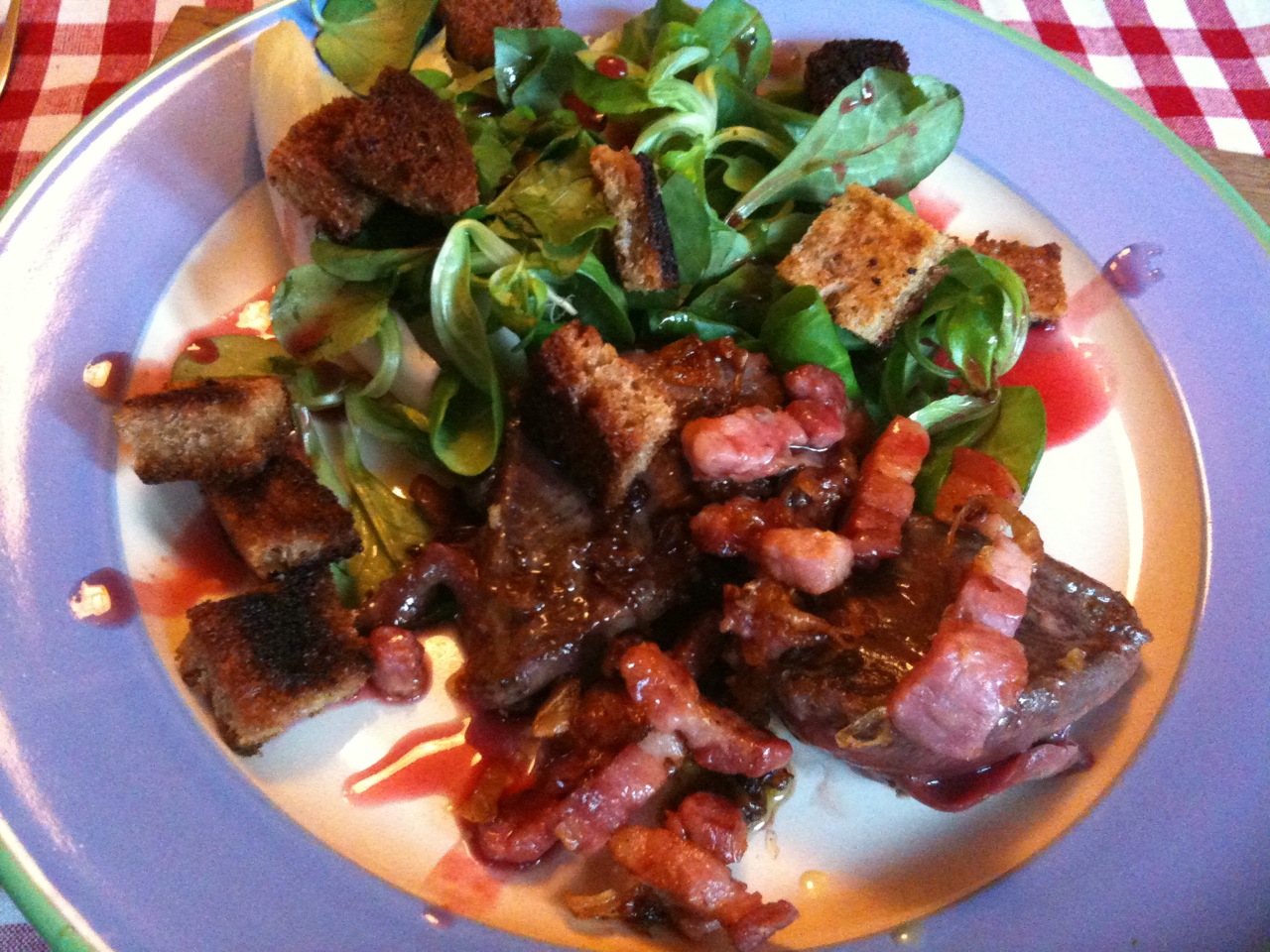
So for two, take a large shallot, chop finely and soften in some rapeseed oil. Add some lardons and leave them to start caramelising before moving around.

Make sure your pigeon breasts are nice and dry.

Share out some leaves on serving plates: I used endive, watercress and lamb’s lettuce.

Heat oil or lard and fry a slice of bread that you’ve diced into croutons.

Cook the pigeon breasts quickly in a hot pan. They need to be pink inside.

Decant your shallot and lardon mixture onto the plates. Then add the pigeon breasts and drizzle raspberry vinegar over.

Top with the croutons and serve with crusty bread. Voila!

The shallots and two meats here are sweet, so the raspberry vinegar is tart enough to cut through that and strong enough not to be overwhelmed by the pigeon.

The leaves add a bitter contrast and the croutons add texture.

We all use words to understand what we’re experiencing, and we have to do that by comparing things to something we already know. So when you’re trying to use words to describe a wine you’re tasting, for instance, you can end up with ‘like fresh-mown grass’ and ‘like petrol’ and things that can seem crazy.

I tried a big red wine from South Africa last year after it was suggested by a member of staff in the wine section of a shop. He pointed out that everyone tastes differently – and since everyone’s taste experiences will differ at least a bit, then their ways of describing tastes and smells will be subjective too.

But I admit to being chuffed to pieces when he almost applauded as I said that the first thing that struck me about the wine in my glass was burnt toast. Subjective possibly, but it felt like the ‘right’ answer.

When I ate ostrich for the first time, it was different from anything I’d tasted before. So how to describe that? I eventually came up with saying that it was like a gamey beef. But how would you understand that if you didn’t know what ‘gamey’ meant?

Raymond Blanc’s A Taste of My Life made me start trying to think more about flavours and, as I hope I’ve shown above, it really can help when it comes to putting together even a simple, midweek supper.

Tuesday, 24 May 2011

Lemon and lard: a match made in heaven?

Monday’s TOIL (time off in lieu) brought with it the opportunity for a spot of culinary endeavour.

And it started with a pleasantly lazy breakfast: fried bread and eggs – cooked experimentally for me – in lard.

Was ever there such a dirty word?

Back in February, Oliver Thring discussed that much maligned substance in his weekly Guardian column.

It was just at a time when I was starting to pick up some information surrounding the demonisation of animal fats in our diet and piece two and two together, and one of the things that hit me was just what very negative ideas I had about some fats.

Okay, not goose fat or duck fat perhaps, but that's because of the glow of Frenchness they have. But lard is so very northern; so very lumpen and unsophisticated, isn't it?

Look at the advert here and imagine that sort of an advertising campaign now.

We've been hoodwinked, you and I, into seeing lard – and other fats, including butter – as bad.

However, although I’ve barely used it since I read that article in February, there was some in the fridge.

Jennifer McLagen’s Fat: An Appreciation of a Misunderstood Ingredient with Recipes is a book that’s well worth thumbing through. Not just for the recipes – although the salted butter caramel tart that I’ve made thus far is utterly scrummy – but perhaps particularly for what else is included on the pages.

Part history, part science, McLagen looks at the forgotten health benefits of animal fats. Personally, I had no idea, for instance, just how many nutrients such fats included, having been convinced that saturated fats as a whole contained essentially ‘empty’ calories.

She even goes on to explain the molecular differences between different fats.

Now all this might seem a bit pointless for most of us, but it makes for valuable education when you’ve grown up pretty much alongside that process of demonisation.

Setting aside the health issue and diet myths though, McLagen also makes clear the role that fats play in taste – and also the suitability of certain fats for cooking.

Lard, as it happens, is very good to cook with because it’s so stable.

My fried bread was beautifully crisp, while the eggs were lusciously smooth, cooked beautifully and tasting wonderful. A breakfast that left me very happily sated.

But I’d also been wondering what else to do on the kitchen front and, given the egg whites remaining from Saturday’s culinary exploits (lemon gelato) had decided that this would be the perfect time to make my first attempt at meringue. And in keeping with the taste theme of recent days, I was contemplating a lemon meringue pie.

An internal debate then followed over which recipe to use: go for the simplicity of Delia or the greater complexity of Michel Roux?

I decided that it would be pastry from Roux’s book – but with lard substituted for some of the butter, as per Delia.

The filling and topping would be straight from Roux, which would mean making an Italian meringue – in other words, creating a syrup (including liquid gelatin) and adding this, at a specific temperature, to the whipped egg whites. But okay – I’m not a kitchen scaredy cat any more. I can do complicated things – and I have a jam thermometer.

The pastry veered close to disaster and was a nightmare to roll, as it was so sticky. That, I suspect, was partly because I’d let the fats get too warm before mixing. Fortunately, I had enough to make a second effort to roll and line the tin – and it just about worked.

Then, being a dipstick – and slightly frazzled by this juncture – I forgot to turn the temperature of the oven down from what was required to blind bake the pastry to what was required to cook the filled tart.

I realised about 40 minutes into a 1 hour 20 minute cook, when a glance in the oven showed something that had a rather unexpectedly brown hue on top. Since it was already set to the touch, I whacked the oven off completely and left it in to cool with the oven for a further 20 minutes or so, before bringing it out and, after another spell, removing it from the flan dish.

To compound matters, I then managed to stick a finger into the filling. Still, at least that proved that it was cooked – and still edible.

So meringue will have to wait for another day – it didn’t seem worth the effort after all that. I sprinkled caster sugar on top and simply caramelised that with my blow torch.

Remarkably for something that you think must be inherently fragile, it survived and proved edible. The filling is light as a feather and very fresh. The pastry was crisp and tasty.

There are questions about much modern lard, in that most of it is hydrogenated. But then again, McLagen makes the case – and gives the instructions – for rendering your own. It's not difficult, and it does mean a greater level of control over what you are cooking with and eating. I am seriously tempted to try.

But in the meantime, who knew that lemons and lard could make such a marriage – even given the hitches at the wedding?

Sunday, 22 May 2011

Let's hear it for the lemons

Has anyone else been watching Two Greedy Italians on BBC2 over the last few weeks?

Old friends Antonio Carluccio and Gennaro Contaldo went back to Italy to visit four areas and talk about the food. Okay, they don’t just talk about it – they cook and eat it.

But the trip is not one where gastronomy is a stand-alone motivation: they meet old friends and family, they share stories of their lives before leaving for the UK.

This is not about food in isolation, but about food as a part of life, of love, of family, of friendship. And what it achieves, starting with the title itself, is a sense of vibrancy and earthiness and sensual pleasure that is an absolute joy to behold. There is poignancy in places, but ultimately, this is a celebration.

And the food is simple and gutsy and full of bold flavours.

There was a scene in the second episode when the pair sat there eating lemons they’d plucked from a tree – peel and all.

Now that could leave a northern European quite shocked.

In the last few weeks, I’ve been drifting toward buying more organic fruit and veg than previously. I noticed with organic Jersey Royals that that the flavour was better.

And then there were the lemons I bought last weekend. A softer yellow, knobblier by far than any you’d find in a supermarket and obviously unwaxed. The aroma when you cut into them absolutely sang.

During the week, we squeezed some on pan-fried tuna and some on grilled lamb chops. Lovely stuff.

And when I opened a bottle of Sicilian-style lemonade (made in France) that I’d picked up as an impulse buy, it was a million miles away from most of what I’ve ever tasted that has been called lemonade.

I have a jar of preserved lemons in to try a couple of Morrocan-style salads from Rick Stein’s Mediterranean – that’ll be different. It might not be eating peel in the same way that Carluccio and Contaldo did in the series, but since I’ve never done it before, it’ll still be a whole new culinary experience.

Natives of Asia, lemons made their European debut near southern Italy, no later than the 1st century AD, during the time of ancient Rome, before being introduced to Persia and Egypt.

The first mentions of lemons in literature are in a 10th century Arabic treatise on farming, and trees were used as an ornamental plant in early Islamic gardens.

But it wasn’t until the middle of the 15th century that the first major cultivation of lemons in Europe began in Genoa.

In recent years, lemons have become something that I always have in the house. But I'm only just discovering that not all lemons are equal.

In a fit of lemony enthusiasm yesterday, I bought a load of the organic ones mentioned above.

First, the juice and zest of three went into a first attempt at gelato, the Italian ice cream that uses an egg custard as its base. It's not perfect: letting concentration slip for mere seconds, I barely saved the custard from boiling, and I need to work on the freezing process; it's a tad too icy. But the taste ...

The other thing I did, while The Other Half was biting his nails over a last-kick Challenge Cup victory for the Castleford Tigers at Wakefield, was to have another go at pasta.

Ravioli again, but this time with proper pasta flour – it's much finer. I used 125g of flour to one egg – and a few drops of chilled water. It was much more elastic – which is how you see it on TV – and seemed a little easier to roll.

The stuffing this time was a mixture of ricotta cheese, pine nuts, Parmesan, a little crème fraïche and lemon zest.

The pasta was thinner this time and I used an off cut to check when it was cooked, throwing that in the pan of boiling water with the ravioli themselves.

The sauce was simple – just some sage leaves fried in good butter and a squeeze of lemon to finish. That was not bad at all. Practice will improve my pasta skills, but it was good to try again so soon, while I still have ideas in my mind about what I did previously.

And if lemon had become an important ingredient for me in the last few years, it might just have moved into a higher pantheon of foods with the experimentation of the last week.

Sunday, 8 May 2011

The joy of a good spring roast

Is there anything much better suited to a Sunday dinner at this time of year than roast lamb?

There’s that wonderfully reassuring sense of a roast, while the season offers plenty of wonderful accompaniments on the vegetable front.

For the last few weeks, I’ve been wanting to do a big spring roast. But for various reasons, it’s not been possible.

At Easter, when it would have felt so apt, we were going away so shortly after the Sunday that there was no point in buying a big joint for the two of us.

Last week, neither of the butchers who I could have bought lamb from were at Broadway Market, since it was another bank holiday weekend. I had to settle – oh, woe is me! – for a piece of brisket, which was perfectly good.

But it wasn’t lamb.

This weekend finally presented the perfect opportunity.

I picked up a leg from Henry Tidiman, the local butcher and one of the very few traders to have survived the bad times until the revival of the market.

A hulking piece of meat, it weighed in at 2.438kg – thank goodness I’ve finally got scales that can deal with more then 900g.

For something like this, Delia always does the business with basic cooking instructions.

Adjusting for my fan oven, her ever-reliable instructions start with half an hour at 190˚ and then 30 minutes per 450g at 160˚.

And that was the end of the specific book use.

I took a load of fresh rosemary, mint and flat leaf parsley, plus three cloves of garlic, and blitzed it all, adding some salt and then some olive oil to bind it together.

Once that’s done, slap it on the meat – okay, not so much a ‘slapping’, as a rather more careful business, but you get the gist.

Into a big roasting tin went the meat, with a little cold water the logic of that being that it would help to create a nice jus. And then into the oven it went.

I have no head for maths, and a notebook page was needed to scrawl down the calculations for cooking times.

After half an hour, the temperature was reduced. Then it got two and a quarter hours. During that time, a few Jersey Royals were scraped and par-boiled (15 minutes).

When the time was up, four new carrots and four baby turnips (wiped) were added to the roasting tin, together with a slug of vermouth.

Half an hour after that, the meat came out for resting, and potatoes, a couple of artichoke hearts and a few asparagus tips were added and the tin placed back in the oven for a further 10 minutes.

After that, the only thing left (apart from carving, which was a doddle), was to pour all the juices and liquid into one of those fat separating jugs and drain off the fat.

The meat was lovely – people rave about pork crackling when done well, but crisped lamb skin, light as a feather and so, so sweet, is just gorgeous.

The crust worked well, the jus was right and the vegetables had roasted perfectly, cooked but still retaining enough bite.

Dessert was a Sarah Raven rhubarb syllabub – a perfect counterpoint to the sweetness of main course and now one of an increasing number of dishes that I can make without recourse to any book.

There is, obviously, a lot of meat left. But this accords absolutely with my plans – and my current aim of trying to avoid midweek supermarket shopping as much as possible.

With the mincing machine I now have, there are plenty of options for using this wonderful joint throughout the week in a variety of ways.

And making the most of it is something that will actually be rather exciting – and definitely enjoyable – in the coming days.

Saturday, 7 May 2011

Forget the weather - light the fire

It was hardly perfect braai weather. After a heavy rain shower this morning, I'd nipped up to Broadway Market as the skies cleared and the sun shucked off its grey cover, but as the afternoon wore on, the clouds returned, even as the temperature stayed high.

For various reasons, the last couple of weeks don't really seem to have produced much in the way of major cooking experiences. That's actually slightly deceptive, since I managed, a couple of weeks ago, to cure some pork chops to reasonable effect - a first such effort.

Yet today has had the feeling of being the first 'proper' shopping and cooking Saturday for some time.

Not that that has meant that I've actually done any cooking.

For some time, The Other Half and I have been contemplating the first barbecue - or braai - of the season. To be more specific, we'd been contemplating something that The Other Half has never done before - a fish feast cooked over the glowing coals.

The inspiration was last summer's trip to Collioure - and the boat trip on the Med down to the border with Spain, during which the captain had cooked us sardines on a little fire on board.

Until then, The Other Half has never been inspired to cook fish, but with Cornish sardines now available, it was a perfect opportunity. To three each of them, I added a small piece of line-caught tuna.

By the time the barbecue was hauled from beneath its cover for the first time this year, the weather had already changed direction, setting course for the forecast rain.

Nothing was going to alter our plans, though, and the simple solution was to cook outside and then eat inside, with green olives, slices of baguette and a bowl of the best virgin oil I have with a pool of dipping Balsamico in its midst, plus glasses of rosé on the side.

Captain Eric had cooked his sardines with just a little dried thyme and olive oil. In the absence of any of the former in the cupboard, these were done with oil, fresh thyme, oregano, some flat leaf parsley and some garlic. The tuna was done in oil, pimenton and a little piri piri (I'd forgotten there was even any in!).

And my goodness, weren't they good! Perhaps the simplest meal we've eaten for some time - a real reminder of the taste of the Roussillon.

Before we'd eaten those sardines while afloat, I'd always had problems with bony fish - a very English issue, as it happens. But then again, that was also the first time that I'd picked up a fish in my fingers and eaten it like that, not struggling ridiculously with knife and fork. It adds to the sensuality of the eating as well.

Today's weather might not have been as conducive as we would have wished, but nothing could dent the pleasure and the deep satisfaction of that meal.